WHIRLPOOL
Equity Metrics
September 24, 2026
Whirlpool of India Limited
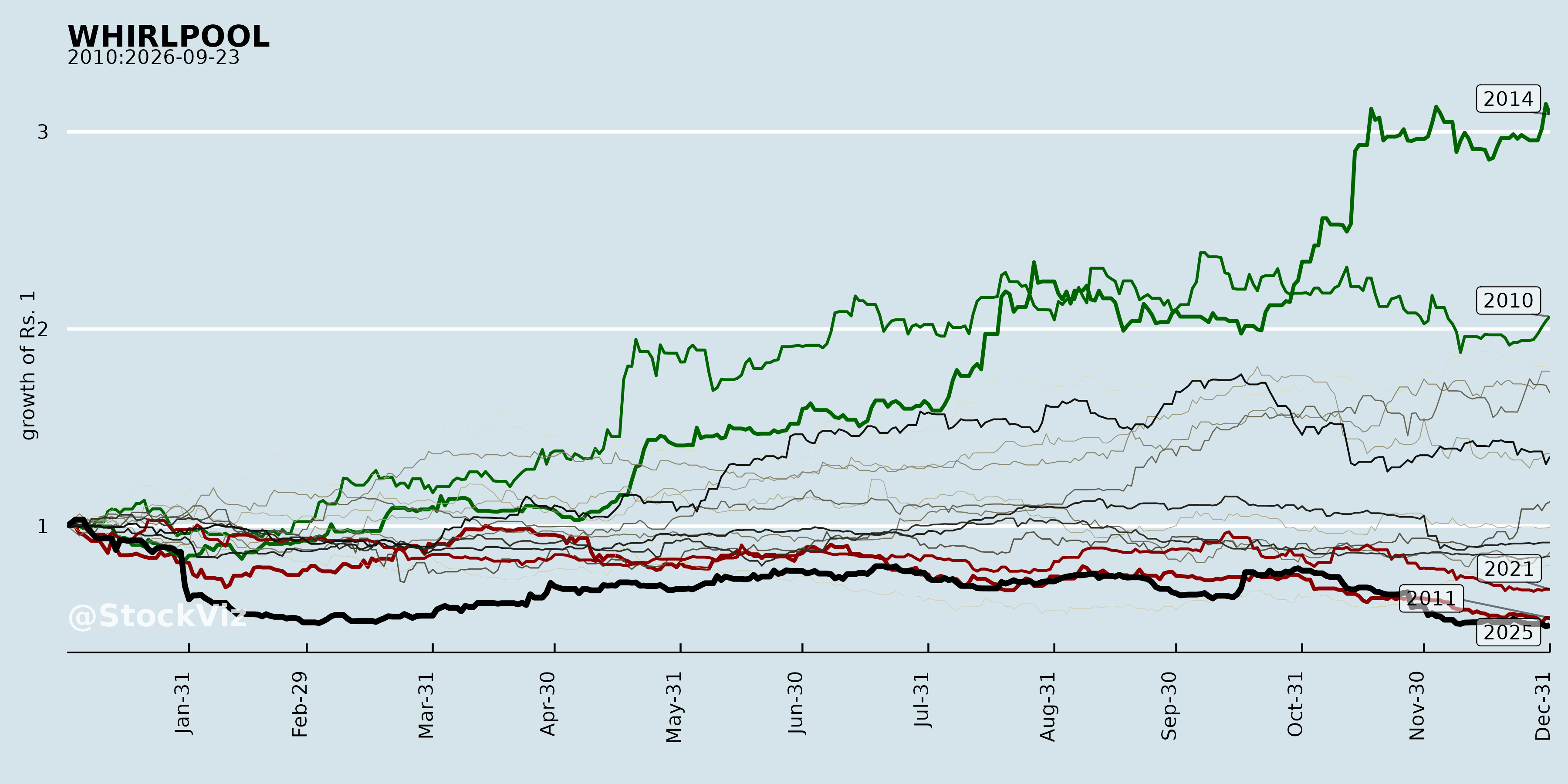
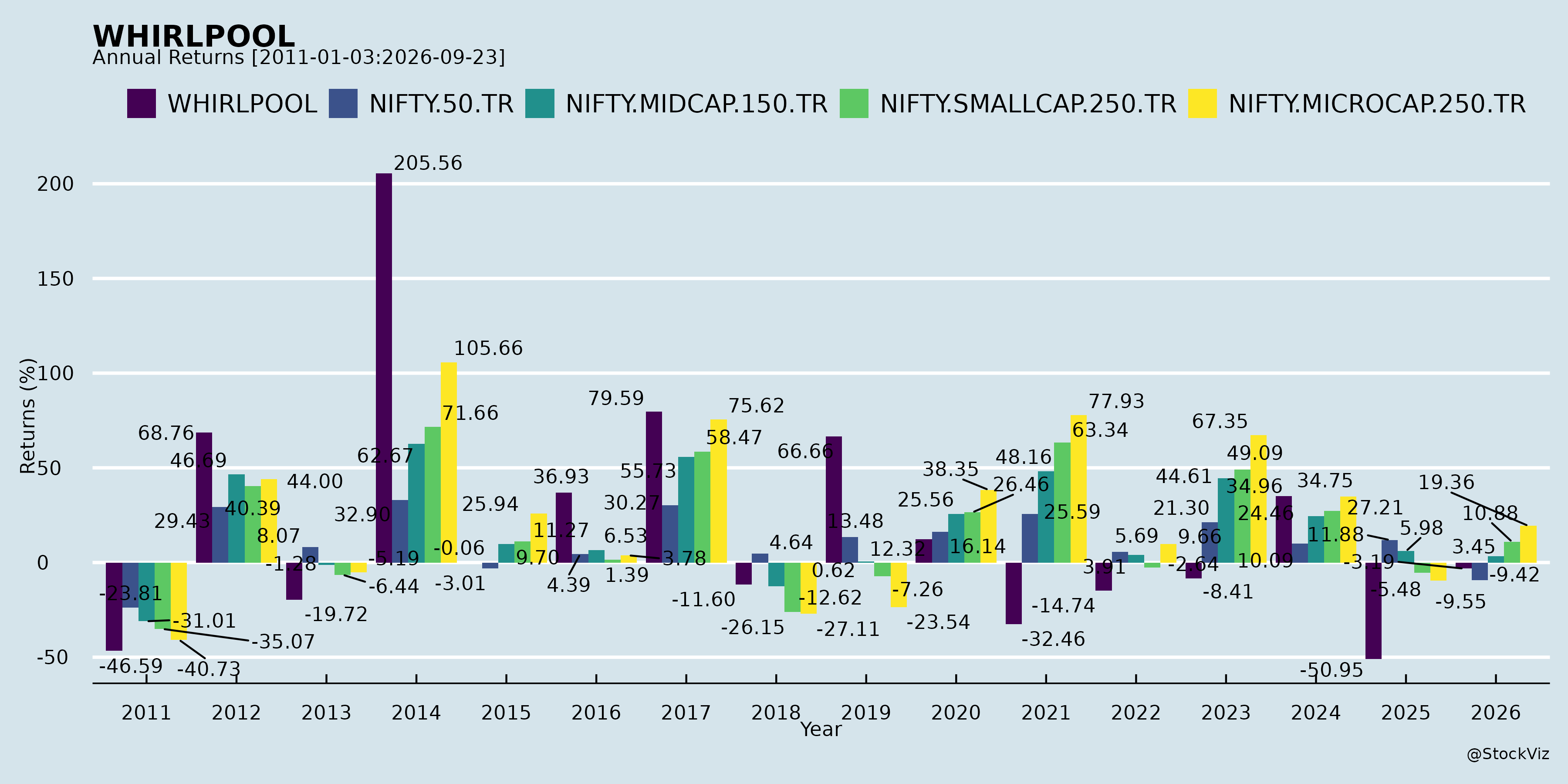
Annual Returns
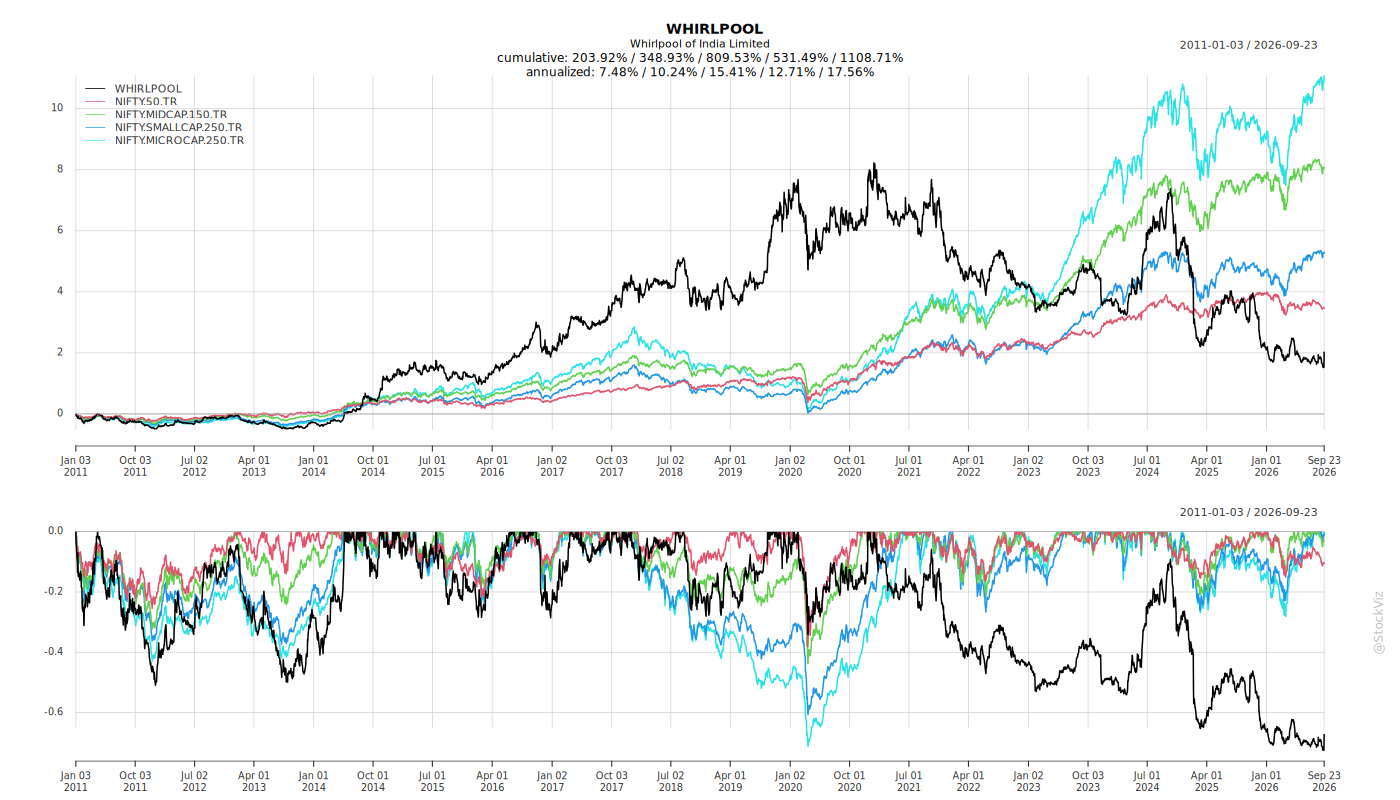
Cumulative Returns and Drawdowns
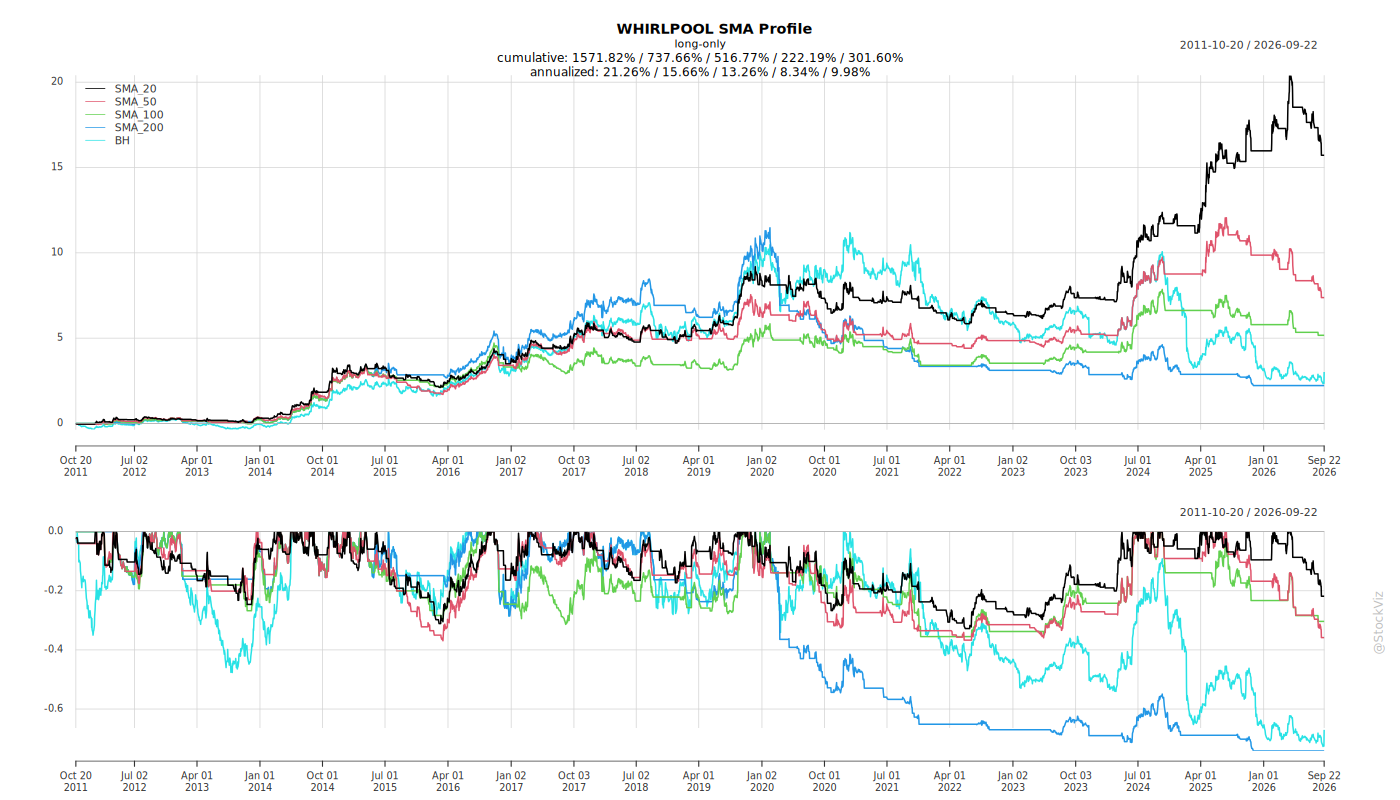
Fundamentals
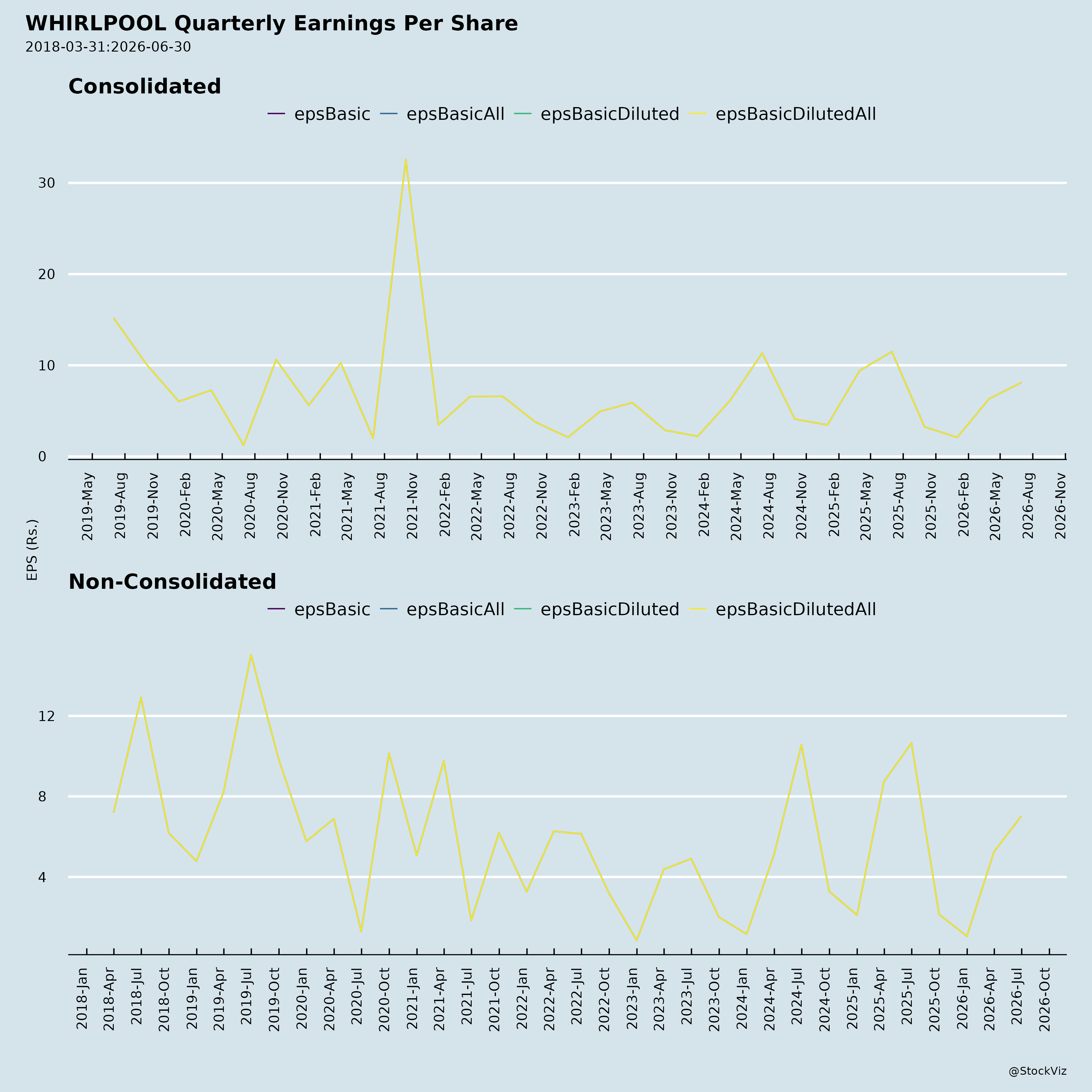
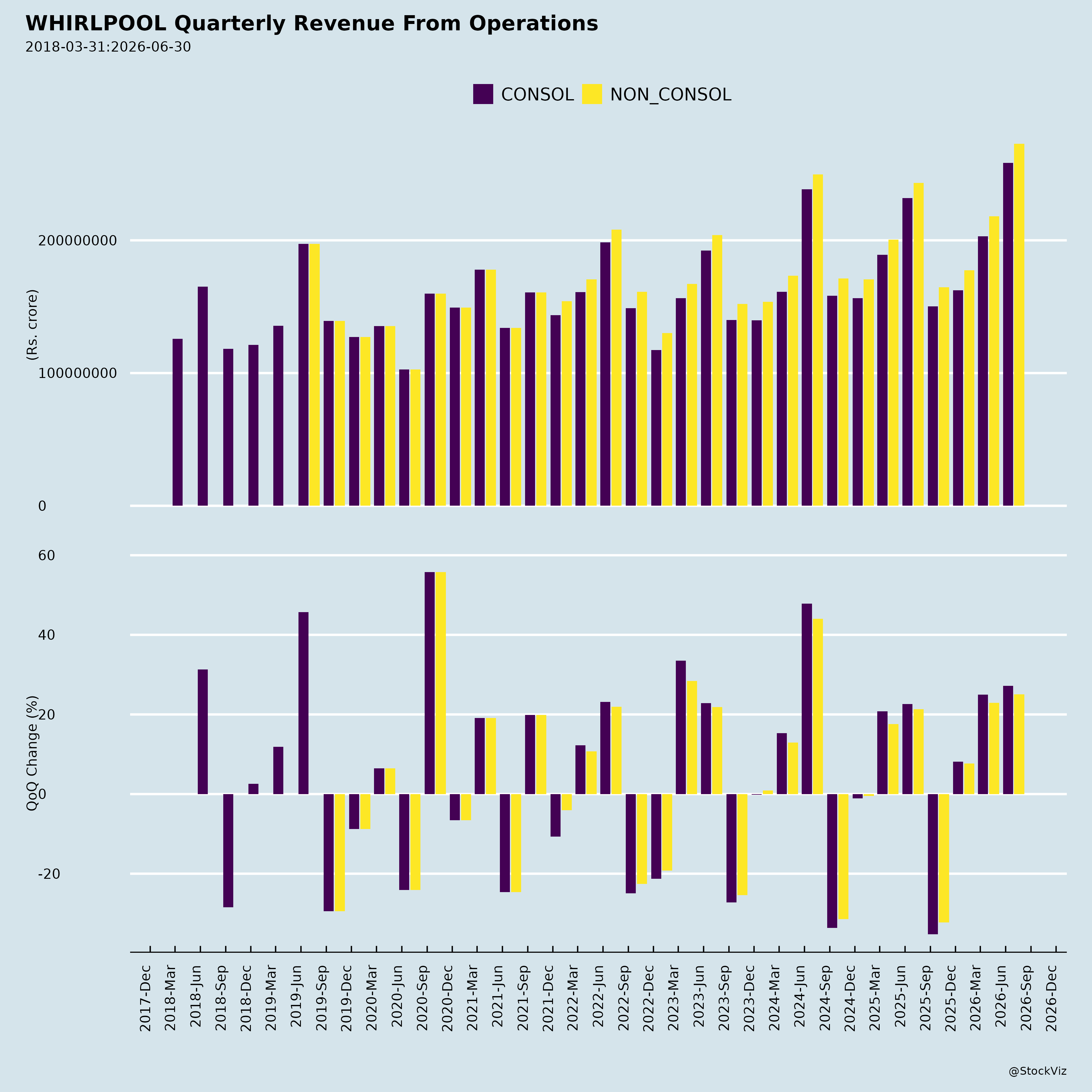
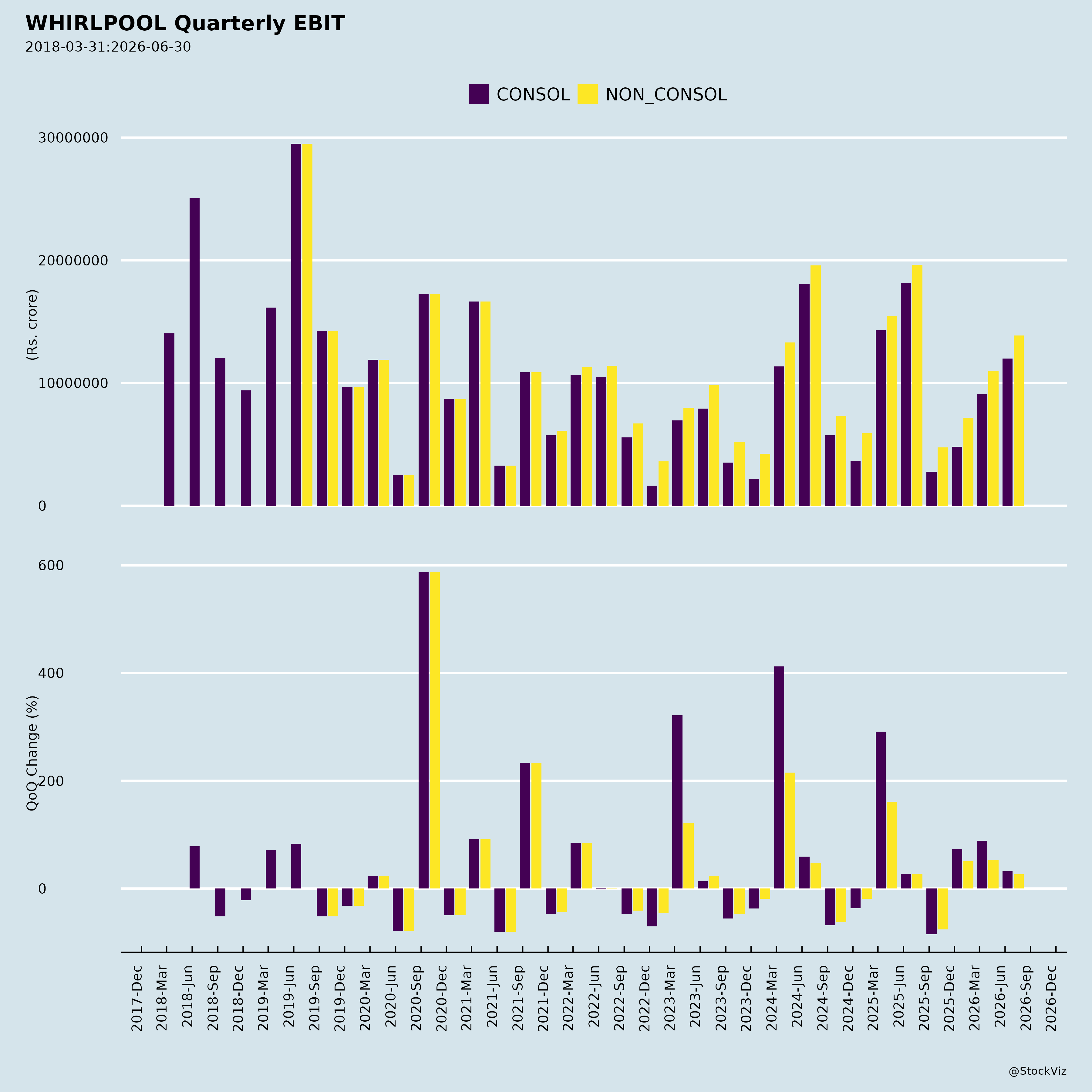
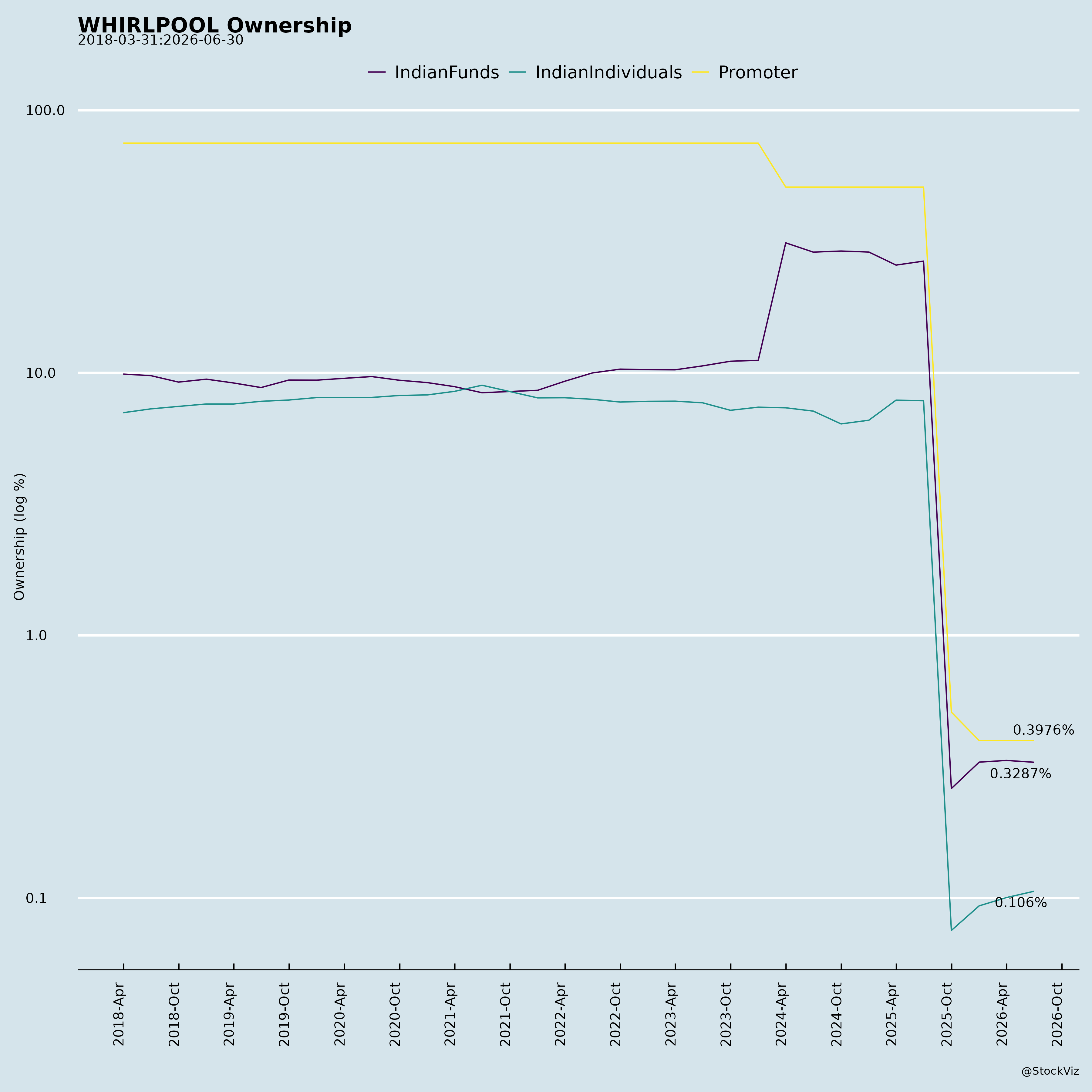
Ownership
Margined
AI Summary
asof: 2026-09-17
Whirlpool of India — Recent Corporate Announcements: Analysis
1. Headwinds and Challenges
Margin compression from a “black swan” cost environment. In Q1 FY 2026-27 (April–June 2026), management described an unprecedented combination of cost increases. Consolidated EBITDA fell to Rs 139 Cr (down ~34% YoY) and consolidated PBT to Rs 139 Cr (down ~29% YoY), even as revenue rose 12% to Rs 2,727 Cr. Standalone EBITDA was Rs 120 Cr (4.6% margin, down 377 bps YoY) and standalone PBT Rs 120 Cr (down ~34% YoY). Management characterized the quarter as a “perfect storm” and a “black swan event.”
Geopolitical / war-led inflation. Crude oil moved from ~USD 67 a year ago to ~USD 97 in the quarter, raising costs of oil-derived inputs (MDI, polyol, EPS packaging, plastics, foaming materials). The rupee depreciated more than 10% YoY (from ~88 to ~95–96/USD), affecting both direct imports (under 30% of inputs) and dollar-indexed components. War-led supply constraints in April–June created uncertainty over LPG, oil-based products, and components, and forced premium payments to secure supply.
Regulatory cost upcharges. New energy regulations effective January 2026 affected refrigerators and air conditioners — nearly two-thirds of the business — and management had flagged at the start of the calendar year that these would be a “debilitating impact” on FY27 financials. Incremental e-waste provisions continued at elevated levels, which management said exceed commercially procurable rates. Management noted the energy change cycle recurs roughly every three years (next expected around January 2029), while e-waste requires an industry-wide resolution.
Inability to fully recover costs through pricing. Price increases taken in April and May only partly covered war-led and regulatory inflation. Management cited industry competitive dynamics, noting that unilateral pricing in 2022 led to market-share loss and reduced customer and consumer confidence. It also stated that competitors acting independently makes coordinated pricing illegal and unlikely.
Other cost pressures. Minimum wage revisions in Haryana, labour cost inflation in Noida, diesel rate increases, and LPG price increases added to costs.
Category-specific softness. No-frost refrigerators were held back by supply issues and a gap above 500–600 litres (being addressed with the Luxuriem launch). Top-load washers saw a market-share decline this quarter amid aggressive new entrants at lower price points, after double-digit basis-point growth in the prior quarter.
Near-term outlook. Management expects July–September (JAS) to remain financially challenging, as it is the weakest quarter for refrigerators and air conditioners while commodity and forex costs stay high. It declined to give specific full-year revenue or margin guidance, citing unpredictability.
Other noted risks. Potential impact from implementation of new Labour Codes and rules; fire losses at the Delhi warehouse mentioned in previous periods.
2. Tailwinds and Growth Prospects
Record revenue and double-digit growth. Q1 FY27 standalone revenue of Rs 2,582 Cr was the highest ever quarterly revenue in company history, up 11.4% YoY; consolidated revenue rose 12.1% to Rs 2,727 Cr. Growth was driven by market-share gains in refrigerators and washers, mid-single-digit industry volume growth, price increases, and premiumisation. The revenue trajectory improved across recent quarters: Q3 FY25-26 +4%, Q4 FY25-26 +7%, Q1 FY26-27 +11%.
Market-share positions. Whirlpool maintained the #2 MBO volume market share in combined refrigerators and washers, and held the #1 MBO volume share in direct-cool refrigerators for seven consecutive months. Volume share rose by double-digit basis points YoY, with double-digit basis-point gains in both refrigerators and washers.
High-growth categories. Front-load washers delivered ~80% volume growth (1.8x YoY) with triple-digit basis-point market-share gains; air conditioners delivered ~50% revenue growth (~1.5x YoY). Both are high-value, premiumising categories where Whirlpool holds single-digit share, with management targeting double-digit (and eventually mid-double-digit) share. Management said it was the fastest-growing in AC off-take for two consecutive years.
Elica India. The wholly owned subsidiary grew revenue 26% and PBT 22% in Q1, benefiting from a responsive kitchen-appliance market, a dual strategy across value and premium ends, and pricing that nearly fully covered cost increases. Management expects strong double-digit growth and sees Elica as margin-accretive.
Premium innovation. Whirlpool launched the four-door Luxuriem refrigerator (654 litres) with triple-evaporator cooling, a sub-30-minute convertible freezer, 6th Sense AI ethylene-sensing freshness detection, glass-and-steel finishes, and Obsidian interiors — developed and made in India with INR 245 crore invested in the Pune lines. It also launched an 11 kg Bloomwash top-load with load-adaptive wash cycles and Soft Sense, expanded the Dynamix dispenser to 8 kg (now ~50% of semi-automatic washers), and introduced new Elica products. Two products (Jade Marble frost-free and 3D Protton NXT) won Silver A’ Design Awards.
Supply-chain and execution strength. The Faridabad plant achieved record quarterly volumes despite war-led constraints, with no production stoppages. Net working capital returned to negative after recovering air-conditioner investments, with five of the last eight quarters at negative net working capital.
Capital allocation optionality. Management said it will complete a blueprint within 12 months covering capacity expansion, new products, automation, and inorganic opportunities, and will consider other options for cash not deployed. The CFO noted capacity utilisation across products is ~70–75%, so no immediate large capacity capex is required, with base ongoing capex of about INR 100+ crore.
AGM outcomes (September 9, 2026). All five resolutions passed with requisite majority, including adoption of standalone and consolidated financial statements, a final dividend of INR 5.00 per equity share for FY ended March 31, 2026, re-appointment of Mr. Anil Berera as director, and remuneration of Cost Auditors.
3. Key Risks
- Commodity and currency volatility: Crude prices and the rupee are outside management control; further adverse moves would directly hit the P&L.
- Regulatory cost burden: Energy-efficiency upcharges recur roughly every three years; e-waste accrual at above-market rates persists pending an industry-wide solution.
- Competitive intensity: Pricing discipline is limited by competitors’ actions; volume loss from unilateral price hikes can worsen profitability more than margin recovery helps.
- Demand sensitivity: Cost inflation pressures the common consumer; GST reductions on some consumer goods provided partial offset, but demand growth remains uncertain.
- Seasonality: JAS is structurally the weakest quarter for refrigerators and air conditioners, amplifying the impact of high costs.
- Supply-chain fragility: Management stated the industry is “not out of the woods,” with any mishap potentially causing significant disruption.
- Parent relationship: Whirlpool Corporation holds 39.75% and operates at arm’s length; management said it has no insight into the parent’s refinancing or future stake plans. Services to Whirlpool Corporation (FY25: ~INR 250 crore, cost-plus, arm’s length) are contracted only until March 2029, with continuation beyond that at the parent’s discretion.
- Labour Codes: The Group continues to monitor finalisation of rules and related aspects to account for any resulting impact.
- AC business risk: Lower-margin than refrigerators or washers; poor summer seasons can leave excess stock requiring discounting or disposal.
4. Management Guidance Versus Observed Performance
Guidance on working capital — met. Management had promised net negative working capital; Q1 FY27 delivered negative net working capital, with air-conditioner investments fully recovered and receivables collected.
Guidance on large refrigerators — met. Management had promised to launch large-size refrigerators; the four-door Luxuriem (654 litres) launched in July 2026, shipping from the Pune plant, with more models expected during the year.
Guidance on energy regulation impact — materialised as flagged. Management had highlighted at the start of the calendar year that energy changes would be a “debilitating impact” on FY27 financials; Q1 margins were significantly affected by these upcharges alongside war-led inflation.
Guidance on margin recovery — not achieved. Price increases in April and May only partly covered cost inflation; management acknowledged a net under-recovery and stated it cannot comment on whether operating margins can be held flat YoY.
Guidance on front-load capacity — no immediate capex needed. Management stated significant unused front-load capacity remains (not operating three shifts), so no immediate capacity investment is required despite rapid growth.
Guidance on AC growth — delivered. Management’s stated strategy of “responsible growth” coincided with ~50% revenue growth in Q1, with management noting it was the fastest-growing in AC off-take for two consecutive years.
Guidance on Elica — delivered. Elica continued strong performance with 26% revenue growth and 22% PBT growth, consistent with management’s characterization of it as a high-growth, margin-accretive business.
Forward-looking statement caveat. Management noted the presentation may contain forward-looking statements based on expectations, assumptions, and anticipated developments, and the company does not undertake any obligation to update, modify, or revise them. Management explicitly declined to provide specific full-year revenue or margin guidance, citing unpredictability of war-related and forex factors.
Broker Narrative
The narrative evolved from a 2023 Buy thesis anchored on stable standalone gross margins, aggressive new product launches, and parental strength to regain share, to a 2026 Reduce call highlighting energy-transition costs, e-waste provisions up 247%, and declining RoE. Persistent themes were weak summer demand and competitive pressures, while the early confidence in margin stability and profitable growth via cost reduction reversed to acknowledgment of margin erosion and negative operating leverage. Expectations of strong revenue growth once the industry stabilizes were replaced by focus on P4G productivity offsetting inflationary and regulatory costs.
Fears that came true
- Weak summer muted demand in refrigerators and ACs materialized as DISAPPOINTMENT on Buy calls with actual returns from -38.5% to -51.8%.
- Prolonged demand slowdown in refrigerators materialized as sustained negative returns across multiple calls between 2023 and 2025.
- Calibrated price correction pressured margins materialized as later erosion from e-waste provisions and commodity costs alongside repeated DISAPPOINTMENT.
- Negative operating leverage from subdued conditions materialized as reduced EBITDA/PAT per 2026 headwinds and negative actual returns.
- Declining entry segment markets contributed to Buy call failures with actual returns repeatedly negative.
Optimism that failed
- Gross margin stable standalone failed as 2026 headwinds cite energy-transition costs and e-waste provisions impacting margins.
- Aggressive new product launches driving profitable growth failed because Buy calls still produced DISAPPOINTMENT with returns to -60.1%.
- Management cost reduction driving profitable growth failed as return ratios declined from RoE 9.3% to 8.0%.
- Elica India double-digit growth failed to prevent sustained negative stock performance across reports.
- Strong parentage and price correction to regain share failed as Buy calls returned -38.5% to -60.1%.
- Expectation of strong revenue growth once industry stabilizes failed as actual returns stayed negative for years.
Broker Timeline
22 broker calls · 2023-05-17 to 2026-09-04
Copyright © 2023 SAS Data Analytics Pvt. Ltd. All rights reserved.