TCS
Equity Metrics
September 24, 2026
Tata Consultancy Services Limited
Computers - Software & Consulting
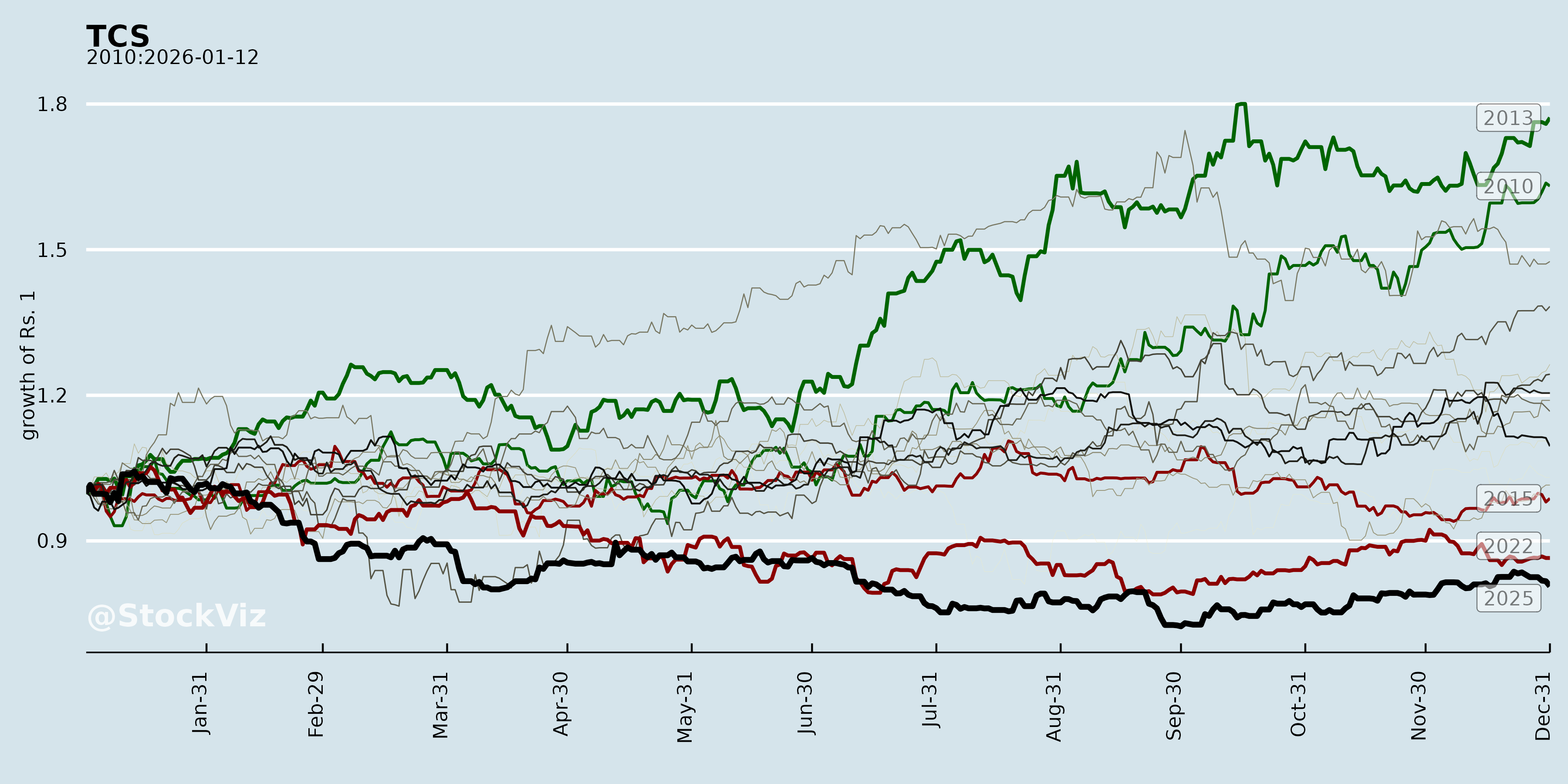
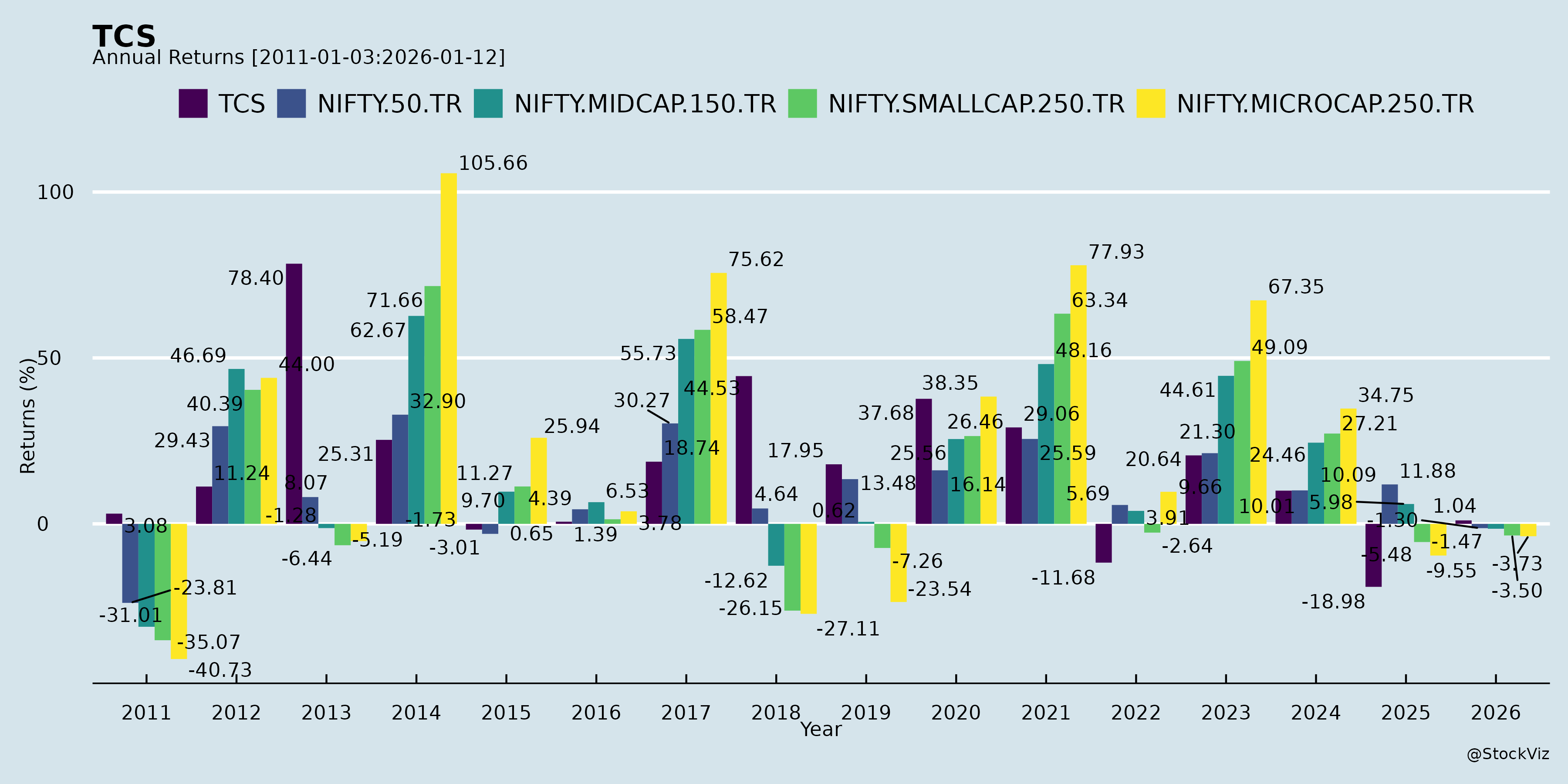
Annual Returns
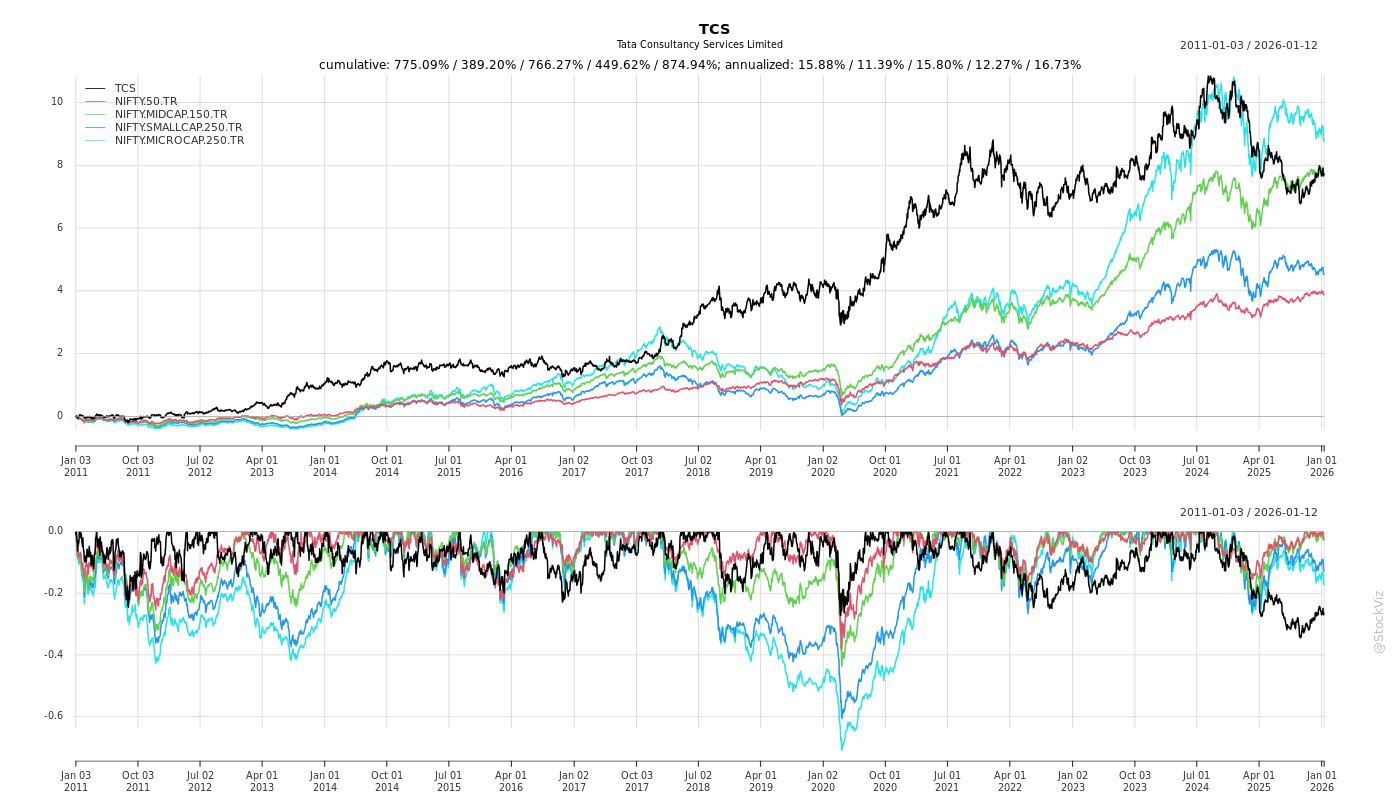
Cumulative Returns and Drawdowns
Fundamentals
Ownership
Margined
AI Summary
asof: 2026-09-14
Headwinds and Challenges
Legal claim settlement overhang: A long-running dispute with Computer Sciences Corporation (CSC) has moved through multiple stages. An advisory jury verdict on November 17, 2023 recommended US$70 million compensation and US$140 million punitive damages. On June 13, 2024, the trial court ordered US$56 million in compensatory damages, US$112 million in exemplary damages, and US$26 million in prejudgment interest. On November 21, 2025, the Fifth Circuit affirmed the District Court’s rulings on liability and awarded costs to CSC. A petition for a writ of certiorari was filed on March 19, 2026, and the US Supreme Court denied it on June 15, 2026. Consequently, TCS provided a further US$70 million (₹668 crore) towards exemplary damages and costs in the quarter ended June 30, 2026, disclosed as “Settlement of legal claim” under exceptional items, plus US$7 million (₹69 crore) towards interest under “Other interest costs.” This followed prior provisions of US$150 million (₹1,352 crore) in the year ended March 31, 2026, of which US$112 million (₹1,010 crore) was shown as “Provision towards legal claim” under exceptional items and US$38 million (₹342 crore) under “Other interest costs.”
Exceptional items weighing on profitability: In the year ended March 31, 2026, TCS also recorded restructuring expenses of ₹1,388 crore and a statutory impact of new Labour Codes of ₹2,128 crore. In the quarter ended June 30, 2026, the legal claim settlement of ₹668 crore was the exceptional item. These charges reduced profit before tax relative to profit before exceptional items and tax in the respective periods.
Rising cost base: Employee benefit expenses rose to ₹42,137 crore in the quarter ended June 30, 2026, from ₹40,143 crore in the quarter ended March 31, 2026, and ₹37,715 crore in the quarter ended June 30, 2025. Other expenses also increased to ₹10,228 crore from ₹9,835 crore and ₹8,121 crore respectively. Finance costs rose to ₹273 crore from ₹265 crore and ₹195 crore.
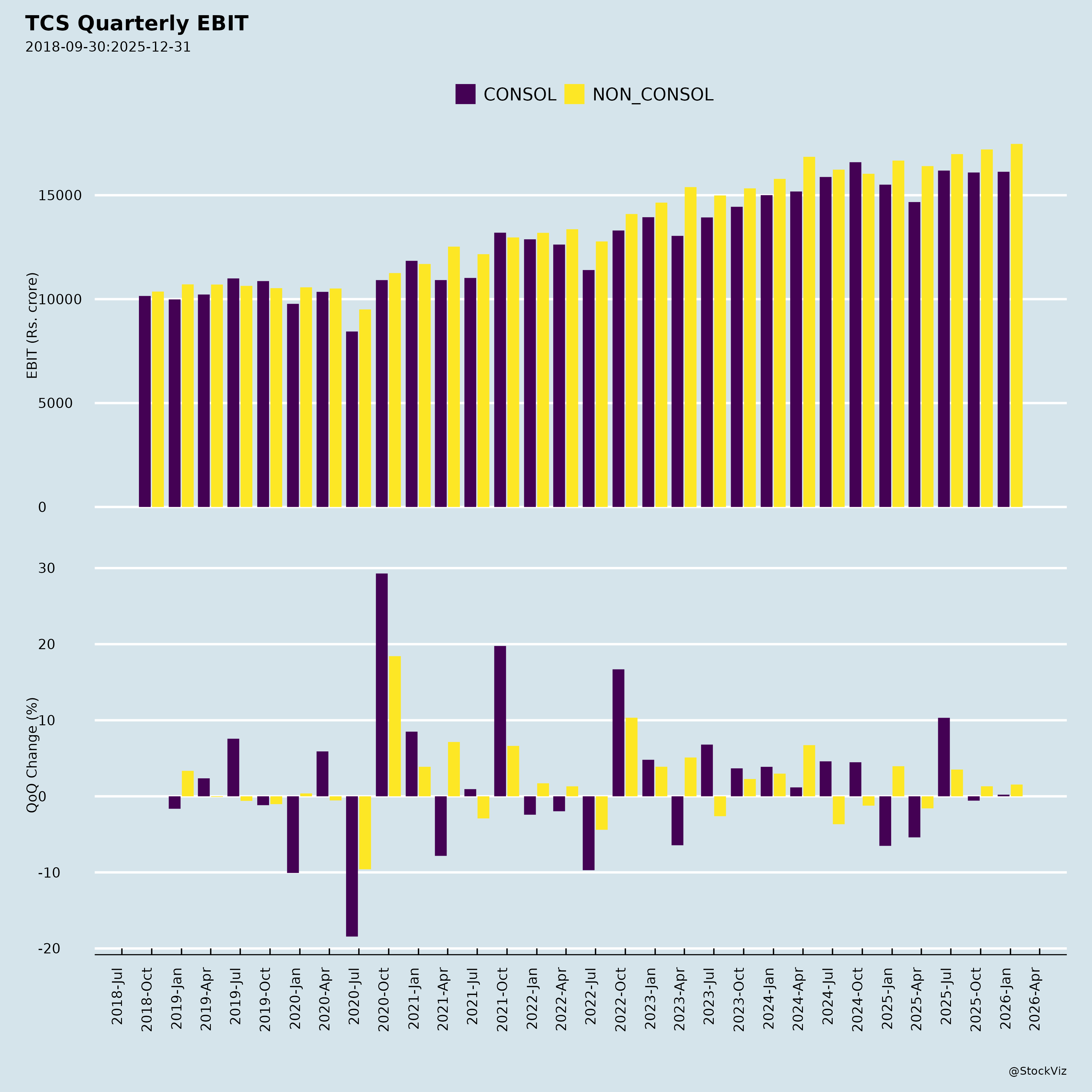
Sequential margin pressure: Operating income declined to ₹16,376 crore in the quarter ended June 30, 2026, from ₹17,605 crore in the quarter ended March 31, 2026, even as revenue rose. Unallocable expenses increased to ₹2,180 crore from ₹1,671 crore, partly reflecting the legal claim settlement. Segment results declined sequentially in Manufacturing (₹1,983 crore from ₹2,122 crore), Consumer Business (₹3,308 crore from ₹3,334 crore), Communication, Media and Technology (₹2,845 crore from ₹3,072 crore), Life Sciences and Healthcare (₹1,834 crore from ₹2,056 crore), and Others (₹1,409 crore from ₹1,575 crore), while Banking, Financial Services and Insurance improved to ₹7,177 crore from ₹7,117 crore.
Acquisition execution and regulatory risk: The MHP acquisition is subject to regulatory approvals, including the European Commission, EU Foreign Subsidies Regulation, Romanian foreign direct investment law, and German non-objection certification. Completion is expected within 3 to 4 months, subject to these approvals and fulfillment of conditions precedent.
Capital intensity of the AI data center project: The HyperVault AI data center campus in Hyderabad involves expected investments of up to ₹70,000 crore to build and manage the infrastructure, with development to be executed in phases in line with customer demand and technology requirements.
Tailwinds and Growth Prospects
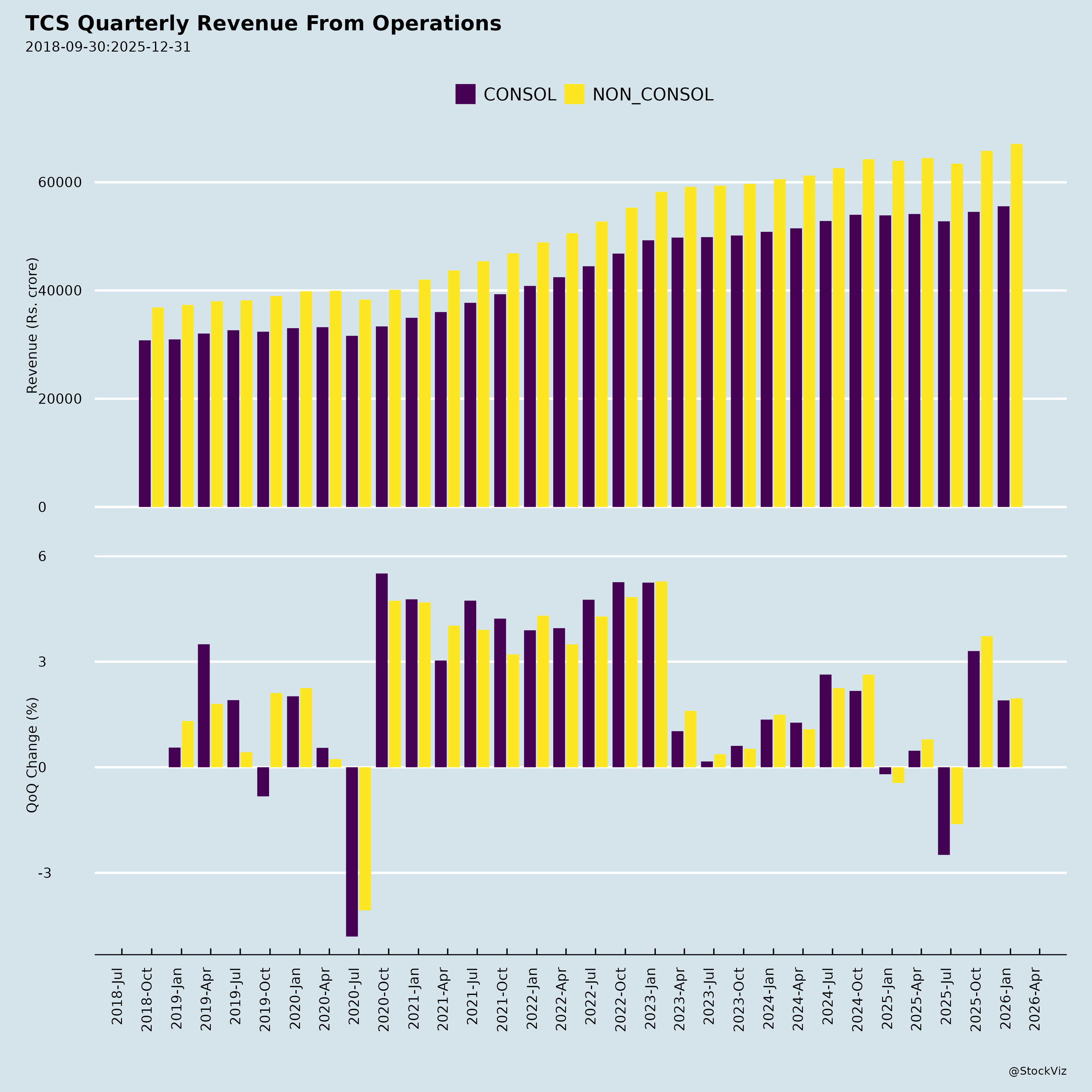
Revenue growth: Revenue from operations rose to ₹72,275 crore in the quarter ended June 30, 2026, from ₹70,698 crore in the quarter ended March 31, 2026, and ₹63,437 crore in the quarter ended June 30, 2025. For the year ended March 31, 2026, revenue was ₹2,67,021 crore.
Broad-based segment growth year-on-year: All reportable segments grew compared with the quarter ended June 30, 2025: Banking, Financial Services and Insurance (₹27,990 crore from ₹24,736 crore), Manufacturing (₹7,110 crore from ₹6,401 crore), Consumer Business (₹11,146 crore from ₹10,155 crore), Communication, Media and Technology (₹10,614 crore from ₹9,436 crore), Life Sciences and Healthcare (₹7,429 crore from ₹6,422 crore), and Others (₹7,986 crore from ₹6,287 crore).
Porsche and MHP strategic deal: Porsche AG executed a five-year strategic deal with MHP and TCS amounting to €1.25 billion, effective from the closing date of the MHP acquisition. The deal is intended to anchor a long-term partnership to industrialize AI across Porsche’s engineering, manufacturing, operations, customer experience, and enterprise transformation agenda, including delivery of next-generation automotive technology services and software-defined mobility platforms.
MHP acquisition as a strategic platform: TCS Netherlands B.V. is acquiring 100% of MHP Management- und IT-Beratung GmbH, a subsidiary of Porsche AG, for an enterprise value of €320 million. MHP had a turnover of €742 million as on CY2025 and approximately 4,500 employees. The acquisition positions TCS as a strategic consulting and technology partner for Porsche and broader European automotive and industrial customers, strengthens TCS’ presence in the German market, and supports its aspiration to become the world’s largest AI-led technology services company.
HyperVault AI data center campus: HyperVault, a subsidiary of TCS, has secured 264 acres of land in Hyderabad to develop a large-scale AI data center campus of up to 1GW capacity. The project is backed by the Tata ecosystem with TPG as a strategic partner, and HyperVault and its partners are expected to invest up to ₹70,000 crore. At full build-out, the campus is expected to rank amongst the most advanced and largest AI infrastructure campuses in India, leveraging green energy and water-neutral design principles, supporting frontier AI companies and hyperscalers with high-density, liquid-cooled compute infrastructure. The project is expected to generate several thousand direct and indirect jobs.
Expanding subsidiary footprint: The consolidated results include a growing list of entities, with several incorporations and acquisitions during the year ended March 31, 2026, including HyperVault AI Data Center Limited (incorporated October 29, 2025), Tata Consultancy Services BT Private Limited (incorporated December 16, 2025), TCS North America Corporation (incorporated December 15, 2025), ListEngage MidCo, LLC and ListEngage, LLC (acquired October 10, 2025), Coastal Cloud Holdings, LLC and related entities (acquired January 14, 2026), Tata Consultancy Services Maroc SARL AU (incorporated January 23, 2026), and Tata Consultancy Services Regional Headquarters (incorporated January 18, 2026).
Shareholder returns: The Board declared an interim dividend of ₹12 per equity share on July 9, 2026, payable on July 31, 2026, to shareholders on record as of July 15, 2026. For the year ended March 31, 2026, total dividend was ₹110 per share (interim ₹79 and final ₹31).
Investor engagement: TCS has scheduled an Analyst/Institutional Investor Meeting (BofA India IT call series) for September 1, 2026, at 5:30 pm IST, virtually over a call.
Key Risks
Legal and litigation risk: The CSC matter resulted in cumulative provisions, with the US Supreme Court denying the certiorari petition on June 15, 2026, leading to a further US$70 million (₹668 crore) provision in the quarter ended June 30, 2026, plus US$7 million (₹69 crore) interest. The matter has now progressed through trial court, appellate court, and Supreme Court denial.
Regulatory and approval risk: The MHP acquisition requires approvals from the European Commission, EU Foreign Subsidies Regulation, Romanian foreign direct investment law, and German non-objection certification. Completion is expected within 3 to 4 months, subject to these approvals and conditions precedent.
Execution and demand risk on large capital projects: The HyperVault AI data center campus is to be developed in phases in line with customer demand and technology requirements, with expected investments of up to ₹70,000 crore.
Cost inflation and margin risk: Employee benefit expenses, other expenses, and finance costs all increased year-on-year and sequentially, with operating income declining sequentially in the quarter ended June 30, 2026.
Concentration and segment mix risk: While all segments grew year-on-year, sequential segment results declined in five of six reportable segments in the quarter ended June 30, 2026.
Foreign exchange and translation risk: Exchange differences on translation of foreign operations were negative ₹108 crore in the quarter ended June 30, 2026, compared with positive ₹1,133 crore in the quarter ended March 31, 2026, and positive ₹1,105 crore in the quarter ended June 30, 2025.
Other comprehensive income volatility: Total other comprehensive income was ₹253 crore in the quarter ended June 30, 2026, compared with ₹661 crore in the quarter ended March 31, 2026, and ₹1,281 crore in the quarter ended June 30, 2025.
Management Guidance Versus Observed Business Performance
MHP acquisition timeline: Management stated the acquisition is expected to be completed within 3 to 4 months, subject to regulatory approvals and fulfillment of conditions precedent. The deal with Porsche is effective from the closing date of the acquisition. As of the documents, the acquisition had not yet closed.
HyperVault project guidance: At full build-out, the campus is expected to rank amongst the most advanced and largest AI infrastructure campuses in India, leveraging green energy and water-neutral design principles. The development will be executed in a phased manner in line with customer demand and technology requirements, and the project is expected to generate several thousand direct and indirect jobs while investing up to ₹70,000 crore. No completion date or capacity milestone beyond “up to 1GW” is provided.
Porsche deal guidance: The deal is intended to anchor a long-term partnership to industrialize AI across Porsche’s engineering, manufacturing, operations, customer experience, and enterprise transformation agenda, including delivery of next-generation automotive technology services and software-defined mobility platforms, effective from the closing date of the acquisition. No revenue recognition schedule or phasing is provided.
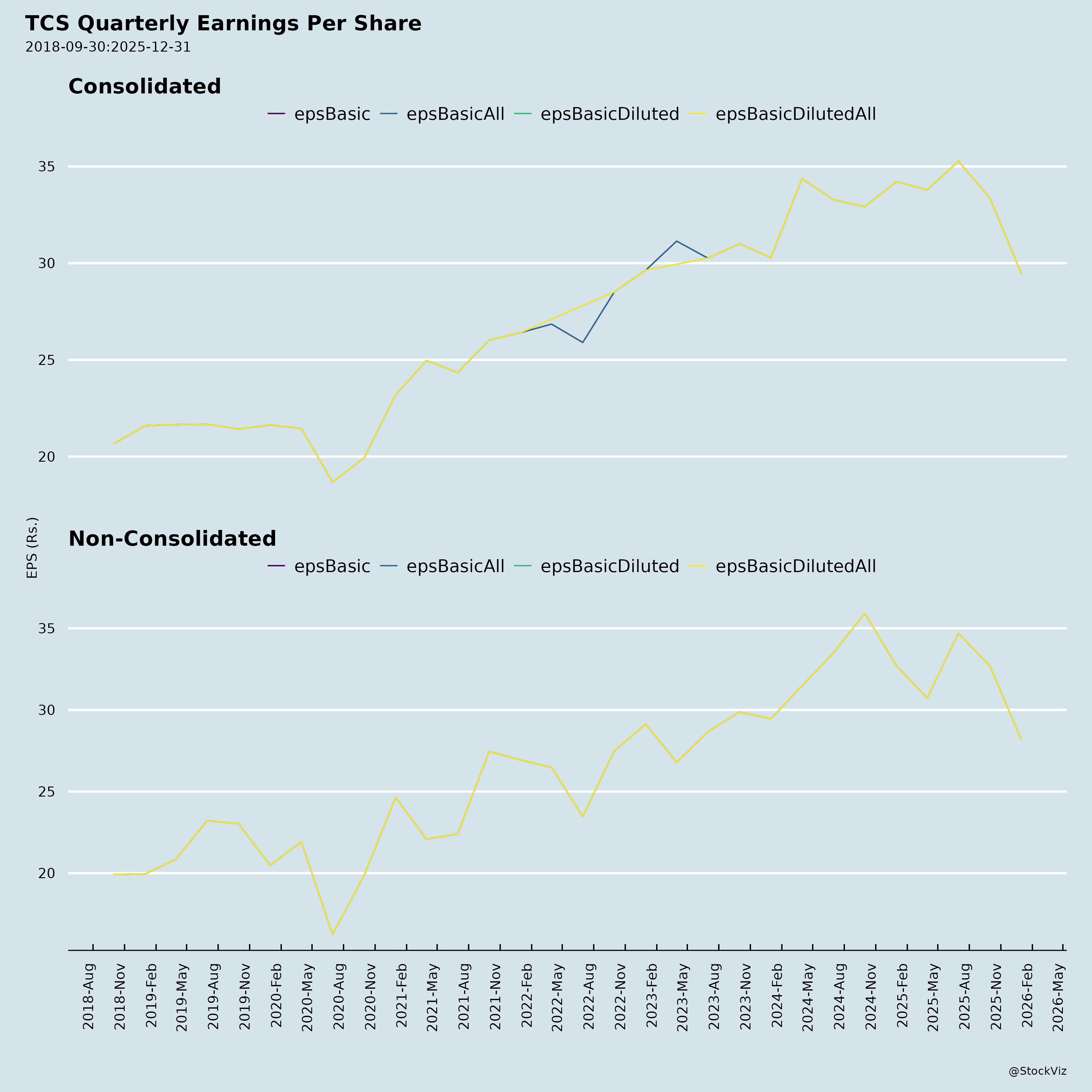
Observed performance versus prior periods: Revenue grew year-on-year and sequentially in the quarter ended June 30, 2026. Profit before exceptional items and tax was ₹18,612 crore, up from ₹18,362 crore sequentially and ₹16,979 crore year-on-year. However, profit before tax was ₹17,944 crore, lower than the sequential ₹18,362 crore, due to the ₹668 crore legal claim settlement. Profit for the period was ₹13,420 crore, compared with ₹13,784 crore sequentially and ₹12,819 crore year-on-year. Earnings per share (basic and diluted) was ₹37.70, compared with ₹40.15 sequentially and ₹34.69 year-on-year. Total comprehensive income was ₹13,673 crore, compared with ₹14,445 crore sequentially and ₹14,100 crore year-on-year.
Dividend guidance versus action: The Board declared an interim dividend of ₹12 per equity share on July 9, 2026, with a record date of July 15, 2026, and payment on July 31, 2026. This compares with an interim dividend of ₹11 per equity share in the quarter ended June 30, 2025, and a final dividend of ₹31 per equity share in the quarter ended March 31, 2026.
Auditor opinion: The statutory auditors expressed an unmodified audit opinion on both the consolidated and standalone results for the quarter ended June 30, 2026.
Broker Narrative
The broker narrative shifted from macro-driven market cycle concerns in 2021 to AI, cloud, and enterprise IT capex themes by 2026, while persistent structural fears around valuation and near-term correction risk recurred across cycles. Early headwinds centered on Nifty overextension and consolidation risk, later replaced by AI capacity constraints and slow pilot-to-production conversion, yet the stock’s chronic underperformance versus predictions endured throughout.
Fears that came true
- The 2021 warning of a possible Nifty intermediate top and short-term correction materialized as TCS fell -15.1% on the Hold call, and repeated intermediate correction fears resurfaced across 2023-2026 as the stock logged dozens of DISAPPOINTMENT outcomes with negative actual returns.
- Early fears of limited near-term upsides proved prescient as the stock delivered negative actual returns in 113 of 150 reports, validating the recurring caution that upside would be capped.
Optimism that failed
- Tailwinds citing accelerating cloud growth, AI buildout capex, and expanding monetization failed to lift the stock, with AI adoption and capex optimism repeatedly producing DISAPPOINTMENT outcomes as TCS underperformed predicted targets across 2024-2026.
- The bullish case for multi-year contracts and usage-based billing driving re-rating collapsed under persistent negative actual returns, with even the strongest AI-driven optimism in 2025-2026 yielding only FLAT or PENDING results rather than sustained gains.
Broker Timeline
150 broker calls · 2021-06-07 to 2026-08-02
Copyright © 2023 SAS Data Analytics Pvt. Ltd. All rights reserved.