SWIGGY
Equity Metrics
September 24, 2026
Swiggy Limited
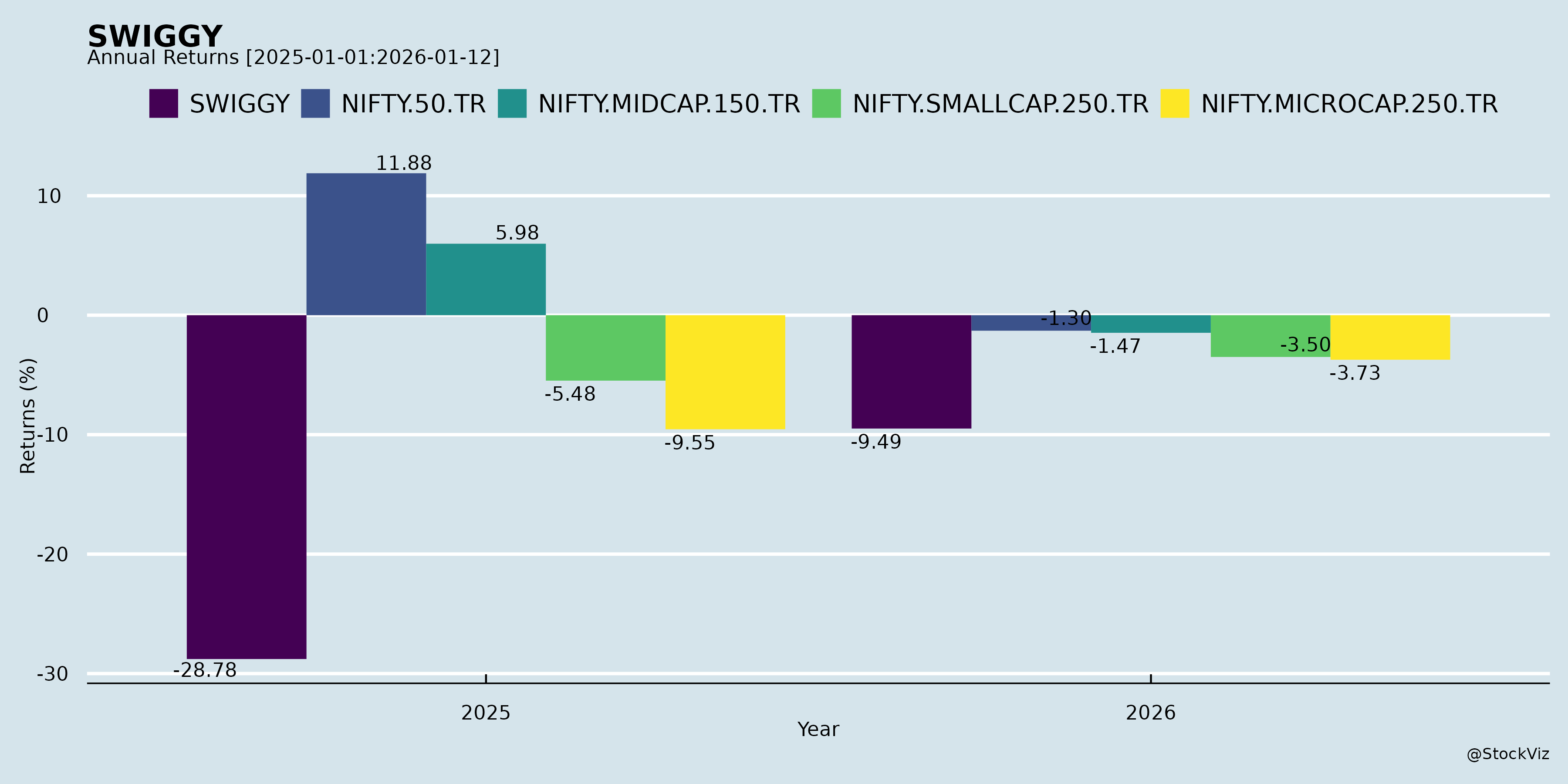
Annual Returns

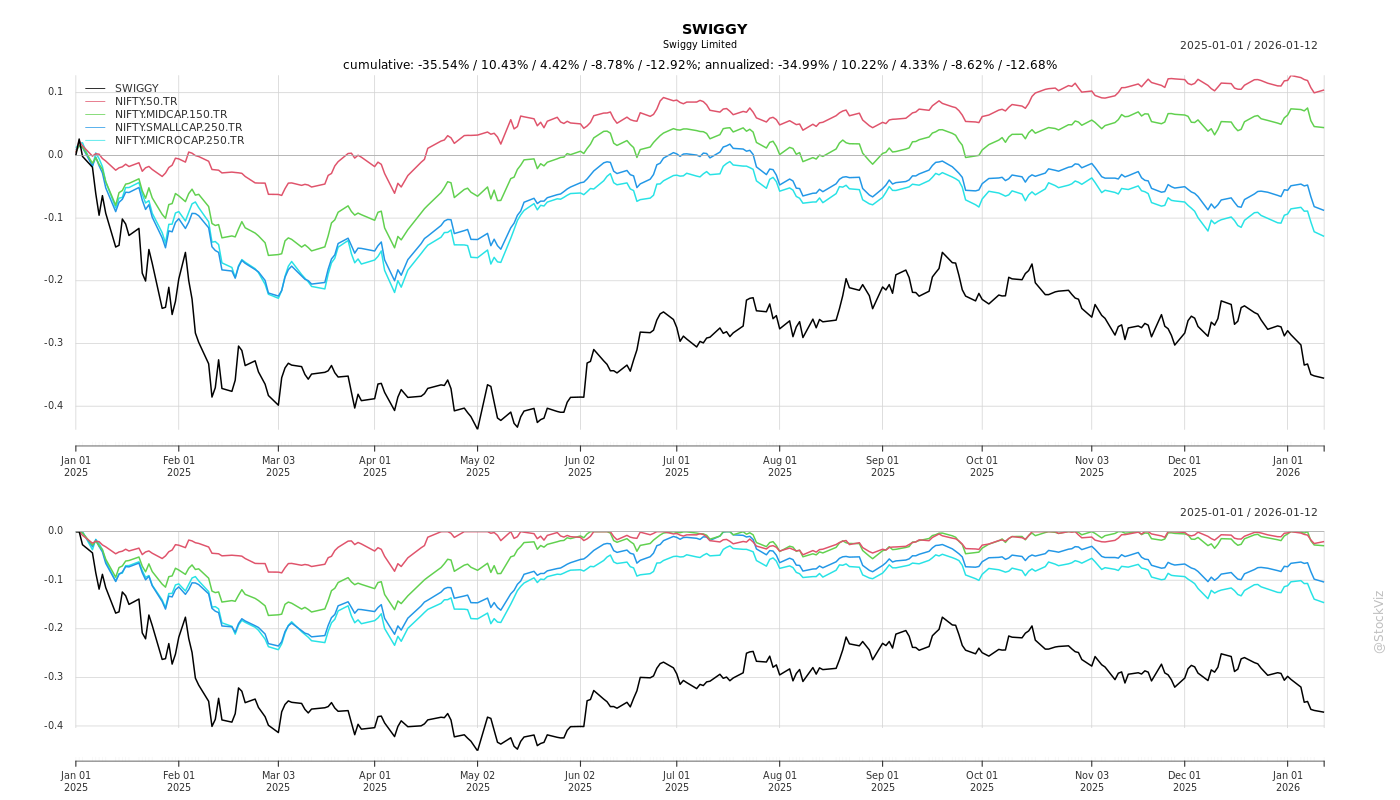
Cumulative Returns and Drawdowns
Fundamentals
Ownership
Margined
AI Summary
asof: 2026-09-16
Swiggy: Q1 FY27 Results and FY31 Capital Markets Day Vision
1. Headwinds and Challenges
Food delivery growth moderation. Food delivery GOV grew 17.4% YoY to ₹9,490 Cr in Q1 FY27, which management described as a slight slowdown. Two factors were cited: a marked increase in restaurant-driven cancellations during the initial part of the quarter due to LPG-led disruptions (normalised like-to-like growth would have been ~18%), and the continued expansion of value-led offerings. Management noted possible short-term interplay of demand levers between the main Swiggy platform and the separate Toing app, which it said is hard to predict.
Sequential margin dip in food delivery. Contribution margin and Adjusted EBITDA margin each declined 20 bps sequentially in Q1 FY27. Management attributed this largely to seasonality — higher investment in delivery partner availability and annual wage hikes — noting the like-to-like sequential drop in Q1 FY26 was larger (40 bps in CM, 50 bps in Adjusted EBITDA). Q1 is described as seasonally softer due to monsoon impact, with annual salary increments falling in the period.
Quick commerce growth deceleration. Instamart’s sequential NOV growth was 3% in Q1 FY27. Management said the path to contribution neutrality involved weaning away unprofitable users (~4M+ over the last three quarters) and negatively contributing orders. The quarter’s burn came in at -0.2% CM with a slight uptick in marketing spends below CM, alongside annual wage hikes.
Competitive intensity. Quick commerce competition “only intensified” during the period. Management also referenced recent headlines suggesting potential entry of new competition in food delivery, while stating its competitive position is durable with no near-term risks to the underlying growth trajectory.
Platform Innovations losses widened. Adjusted EBITDA losses in Platform Innovations increased to ₹131 Cr in Q1 FY27 from ₹58 Cr in Q4 FY26, with Adjusted Revenue of ₹69 Cr. Toing sits within this segment, and the company shut down Snacc, the micro-kitchen model serving functional meals, due to expected low category potential relative to incremental complexity.
Governance and personnel changes. Shareholder resolutions for alteration of the Articles of Association did not receive the requisite majority, so proposed appointments of Mr. Rahul Bothra and Mr. Phani Kishan Addepalli as Additional Directors, effective June 1, 2026, did not take effect. Mr. Lakshmi Nandan Reddy Obul and Mr. Roger Clark Rabalais resigned as directors effective April 10, 2026; Mr. Renan De Castro Alves Pinto was appointed as a Non-Executive, Non-Independent Nominee Director effective April 11, 2026. Subsequent to the quarter, Mr. Amitesh Kumar Jha resigned as CEO – Instamart effective July 28, 2026.
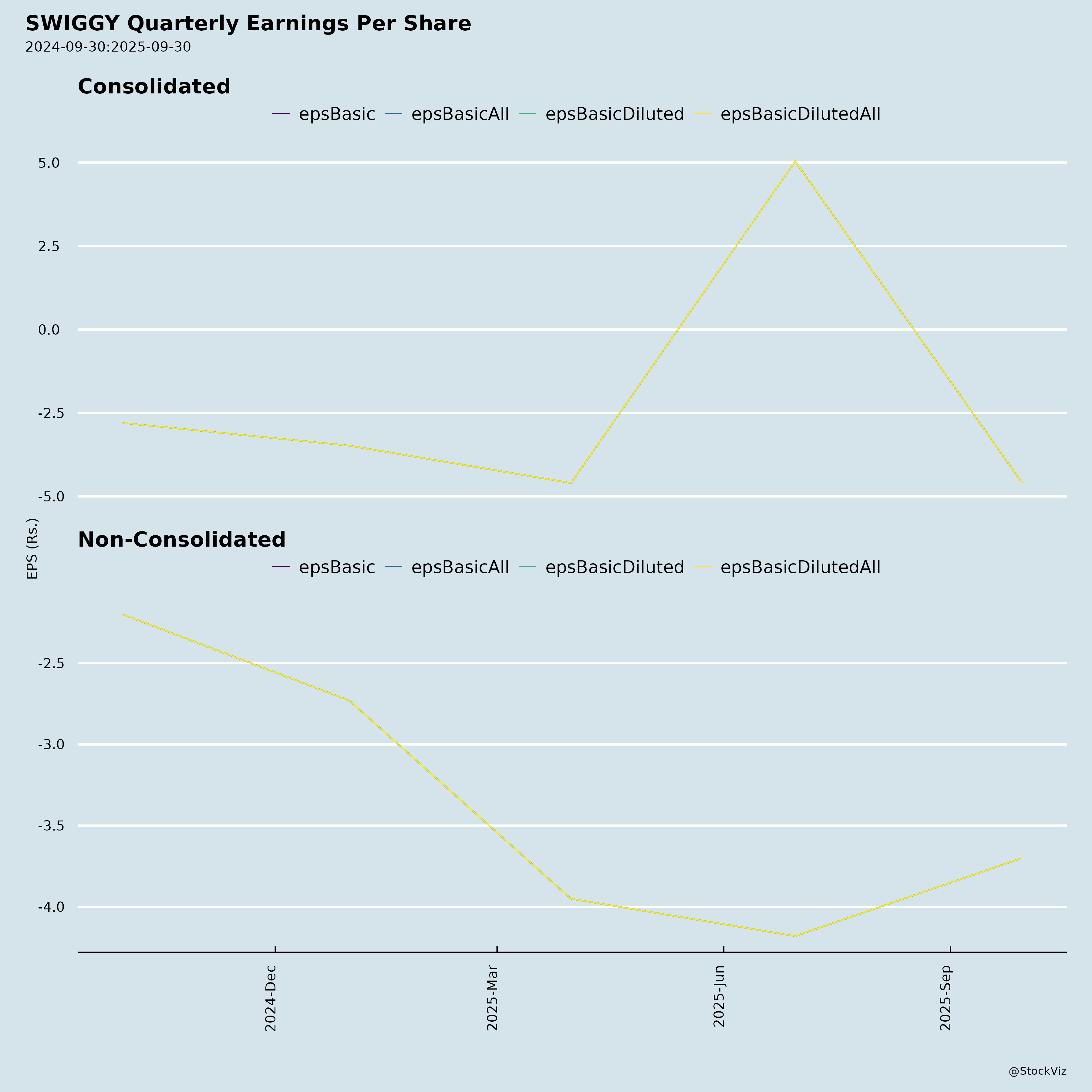
Consolidated losses persist. Loss for the period was ₹791 Cr in Q1 FY27, with consolidated Adjusted EBITDA of -₹651 Cr. EPS was -₹2.96 for the quarter and -₹16.87 for FY26.
2. Tailwinds and Growth Prospects
FY31 vision. At Capital Markets Day on August 6, 2026, Swiggy set a goal to build a ₹10,000 Cr Adjusted EBITDA business by FY31, more than tripling consolidated GOV to approximately ₹2.5 Lakh Cr from ₹67,734 Cr in FY26 — implying 30%+ GOV CAGR through 2031 alongside expanding profitability. Consolidated Adjusted EBITDA margin is targeted at approximately 4% of GOV, with EPS expected to improve from -₹16 in FY26 to ₹30-33 by FY31. The company reported a cash balance of ₹14,400 Cr and remains debt-free.
Food delivery. The India food services market is projected to grow from ~$90 Bn in 2026 to ~$150 Bn by 2031. Swiggy cited two structural levers: closing the frequency gap (~70% of users transact less than once a month) and cracking affordability, which it said can unlock 5-7 percentage points of higher category growth on its own. By FY31, Food Delivery GOV is expected to grow 2.5-3.5x with ~₹5,000 Cr in Adjusted EBITDA, driven by Toing and other affordability-led initiatives. Q1 FY27 food delivery Adjusted EBITDA was ₹292 Cr, up 5x from Q1 FY25 on a run-rate basis, with MTUs up 17.8% YoY to 19.2 Mn and margins at 3.1% of GOV.
Dineout / Out-of-Home Consumption. Dineout delivered its first full year of positive Adjusted EBITDA in FY26, with ₹4,600 Cr full-year GOV, up 51% YoY, serving over 52,000 monthly active restaurant partners across 75 cities. GOV is projected to scale five times to ₹20,000-25,000 Cr by FY31, with Adjusted EBITDA growing from ₹30 Cr in FY26 to ₹1,000 Cr, widening margins from 0.6% to 4%+. In Q1 FY27, GOV grew 44.8% YoY to ₹1,529 Cr with Adjusted EBITDA margin at 0.9% (highest ever) and 59k average monthly active restaurants. Management said it has hit an annualised GOV run rate of ₹6,000 Cr with 1% Adjusted EBITDA and expects to cross ₹10,000 Cr annualised GOV run-rate over the next two years with an annualised Adjusted EBITDA pool of ~₹500 Cr.
Instamart. Q1 FY27 GOV grew 40% YoY to ₹7,907 Cr, with Contribution Margin loss narrowed to -0.2% of GOV — a 5.4 percentage point improvement since Q4 FY25. Instamart became only the second player in quick commerce to demonstrate Contribution Margin breakeven while delivering 40% GOV growth. More than 45% of the store network is Contribution Margin-positive (vs 30% in the previous quarter), with 5 of 7 top cities, including Bangalore, operating profitably. Instamart targets a ₹1.5+ Lakh Cr GOV business by FY31, a 4-5x jump from ₹28,000 Cr in FY26, built on a monthly transacting user base of more than 40M. The differentiated “Switch” proposition spans roughly 400 brand partnerships and two owned brands — Noice (46+ categories, 380+ SKUs, over 9 million customers) and Nectr (fresh produce). Customers who purchased ‘Switch’ SKUs exhibited 30% higher retention versus benchmark cohorts.
Technology. Swiggy outlined a shift toward AI-native operations across five core engines — Demand, Fulfilment, Partners, Monetisation, and Building — including in-session personalisation, a self-correcting fulfilment network, and internal AI tooling such as SAGE.
IOCC status and 1P transition. Domestic ownership crossed 50% on July 1, 2026. On July 23, 2026, the Board approved raising the foreign shareholding cap to 49.5%, subject to a shareholder vote at the 13th AGM on August 18, 2026. IOCC status would allow Instamart to directly own and sell inventory, potentially adding ~80 bps to Contribution margin, with transition expected over 2-4 quarters post approval. An inventory-led operating model is expected to unlock an additional ₹4-5 per order.
Platform metrics. Platform MTUs grew 27.4% YoY to 27.5 Mn. Consolidated Adjusted Revenue grew 34.0% YoY to ₹7,112 Cr. B2C Adjusted EBITDA margin improved 223 bps YoY to -2.5%.
3. Key Risks
- Competitive pressure in quick commerce and food delivery, including potential new entrants in food delivery and heightened quick commerce competition; management’s growth expectations for Instamart explicitly assume no change in the existing competitive landscape.
- Execution risk on the FY31 ambition, which requires more than tripling consolidated GOV and reaching ~4% Adjusted EBITDA margin on GOV.
- Instamart EBITDA breakeven dependency: breakeven requires a further 2.5x scale-up and an additional 4 percentage point gain in Contribution Margin, from -0.2% to the ~4.0% level, at a scale of ~₹60,000 Cr run-rate annualised NOV (25-30 Cr orders per quarter versus the current 11.5 Cr).
- Margin sensitivity to investment choices: management expects Contribution margins to be range-bound in the zero to -100 bps territory for the next couple of quarters while accelerating sequential growth, with real-time decisions to accelerate growth while remaining fiscally disciplined.
- Regulatory and approval risk: the foreign shareholding cap increase and Articles amendments require shareholder approval; the earlier Articles alteration resolutions failed to receive requisite majority.
- Key personnel risk, evidenced by the Instamart CEO resignation effective July 28, 2026 and board changes during the quarter.
- Seasonality and external disruption, including monsoon impact, annual wage increments, and LPG-led disruptions that affected restaurant-driven cancellations and Dineout advertising spend.
- Metric definition concerns: management stated that NRV, as defined by others, can potentially inflate reported top-line metrics by ~20% by conflating brand spends with direct consumer transactions; Swiggy anchors on delivered NOV rather than placed orders.
4. Management Guidance Versus Observed Performance
Quick commerce Contribution Margin breakeven. Roughly a year before Q1 FY27, Swiggy committed to achieving Contribution margin break-even in Quick Commerce by Q1 FY27. Management stated this milestone was met — quick commerce hit break-even Contribution target in May ’26, with overall Contribution for the quarter at -0.2% of GOV, a 440 bps YoY improvement. CM losses had peaked at -5.6% of GOV in Q4 FY25. Contribution improved by ₹28 per order over the last five quarters, with Adjusted Revenue per order rising from ₹83 in Q4 FY25 to ₹108 in Q1 FY27.
Food delivery 18-20% GOV growth guidance. Management reiterated confidence in delivering the stated 18-20% guidance (outside of Toing). Q1 FY27 actual GOV growth was 17.4% YoY; normalised for LPG-led cancellations, like-to-like growth would have been ~18%.
Food delivery 5% medium-term Adjusted EBITDA guidance. Management reiterated the steady-state guidance of 5% Adjusted EBITDA on GOV over the medium term. Q1 FY27 actual was 3.1% of GOV, with a 20 bps sequential dip attributed to seasonality and a 70 bps YoY improvement.
Instamart medium-term ambition. Management reiterated its medium-term ambition of scaling to over ₹1 Lakh Cr NOV at a 4-5% Adjusted EBITDA margin. Q1 FY27 NOV was ₹5,817 Cr (38.9% growth), with Adjusted EBITDA margin at -9.8% and losses of ₹778 Cr.
Instamart growth trajectory. Management said it is starting to see green shoots, with the 4-week trending NOV growth rate at 10.0% (week ending July 26) versus 1.0% in the previous four weeks, and 1M retention of the transacting user base increasing to 61% from 55% in Q1 FY26. It expects Contribution margins range-bound in zero to -100 bps for the next couple of quarters while accelerating sequential quarterly growth rates.
Store additions. Management said it expects to add ~75 stores in Q2 FY27, with store utilization at ~40% and significant headroom to grow from the current network. Q1 FY27 saw a net addition of 28 darkstores to reach 1,171 stores across 131 cities.
Dineout trajectory. Management expects to cross ₹10,000 Cr annualised GOV run-rate over the next two years with an annualised Adjusted EBITDA pool of ~₹500 Cr. Q1 FY27 actual GOV was ₹1,529 Cr with 0.9% Adjusted EBITDA margin; the quarter saw a minor dip in Contribution margin due to scale-back of discretionary advertisement spending by restaurant partners in the early part of the quarter (LPG-led disruption), which has since normalised.
Toing expansion. Toing was expanded to ~50 cities during the quarter. Management reported that 2 out of 3 new users on Toing are new to platform or previously dormant on Swiggy, and a significant minority of restaurants on Toing have reached more than half of the volumes generated on the Swiggy platform. Initial investment is largely on new user acquisition, described as discretionary and scalable or cuttable depending on progress.
Broker Narrative
The broker narrative shifted from a cautious Neutral in Dec-2024 to a Buy in Aug-2026. Persistent themes were Swiggy’s competitive gap to Blinkit in quick commerce, the strength of food delivery, and concerns around profitability and execution. What changed was that early uncertainty over quick-commerce winners and near-term margin pressure was replaced by confidence in Instamart’s differentiation, advertising monetization, Dineout breakeven, and the ~INR100b FY31 adjusted EBITDA target.
Fears that came true
- Swiggy’s initial risk of trailing Blinkit in quick commerce materialized: Instamart MTUs stayed broadly flat and dark-store order frequency (~1,089 OPD) remained below Blinkit’s ~1,505 OPD, with repeated DISAPPOINTMENT outcomes on Buy calls.
- The early caution that quick-commerce winners were still undecided persisted: the last report still flagged unclear long-term profitability for Toing and the difficulty of delivering a 42% quick-commerce GOV CAGR while expanding margins.
Broker Timeline
26 broker calls · 2024-12-04 to 2026-08-06
Copyright © 2023 SAS Data Analytics Pvt. Ltd. All rights reserved.