STERTOOLS
Equity Metrics
October 23, 2026
Sterling Tools Limited
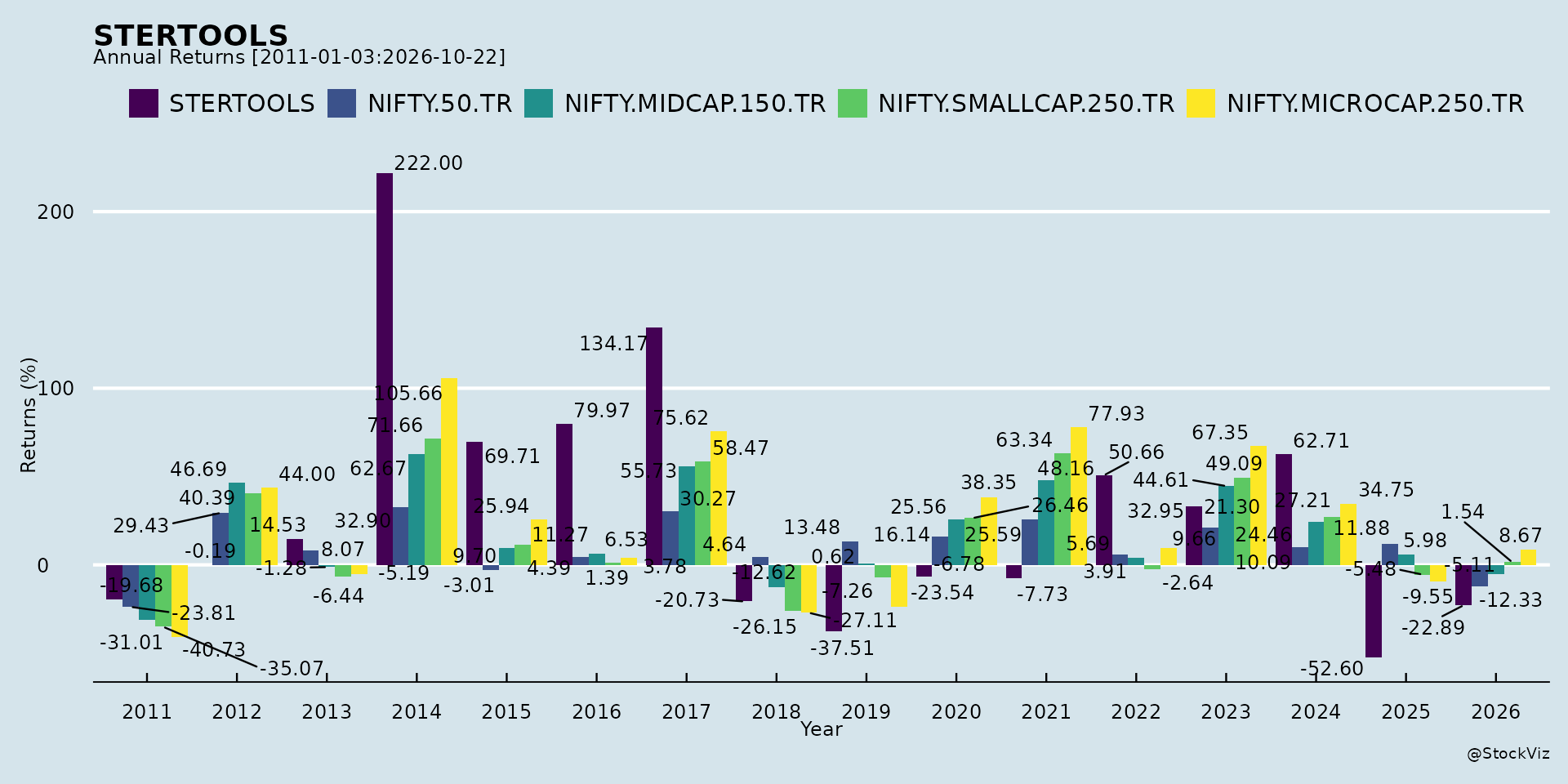
Annual Returns
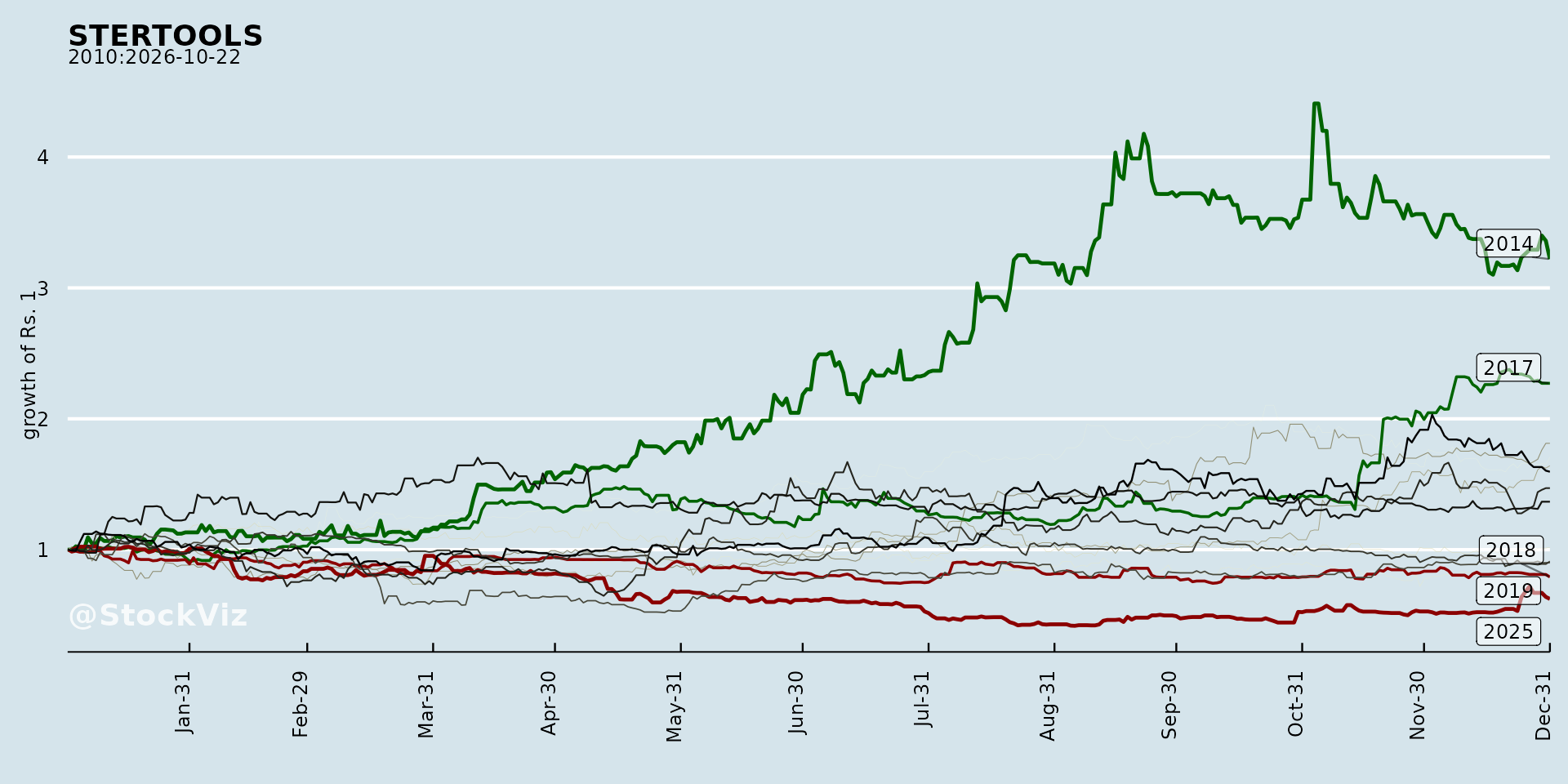
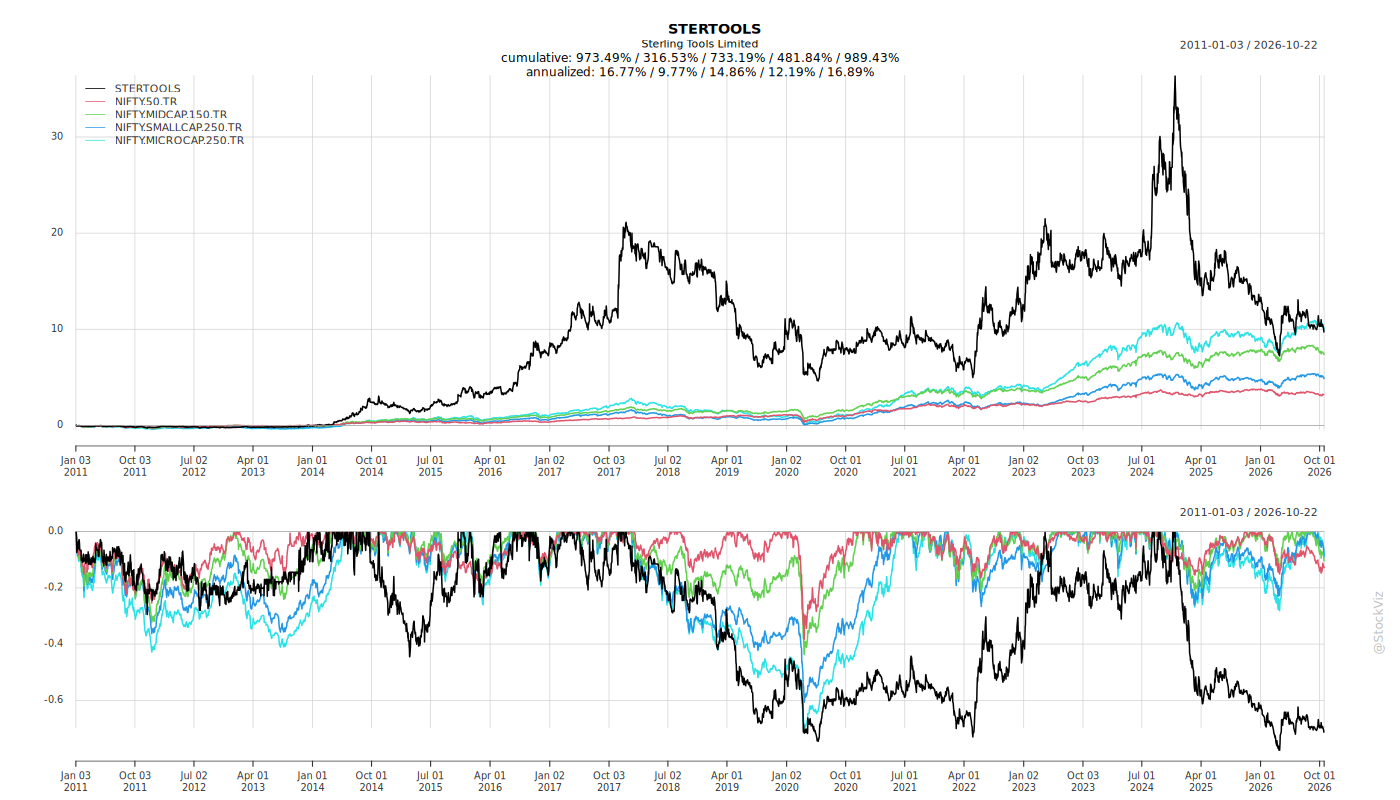
Cumulative Returns and Drawdowns
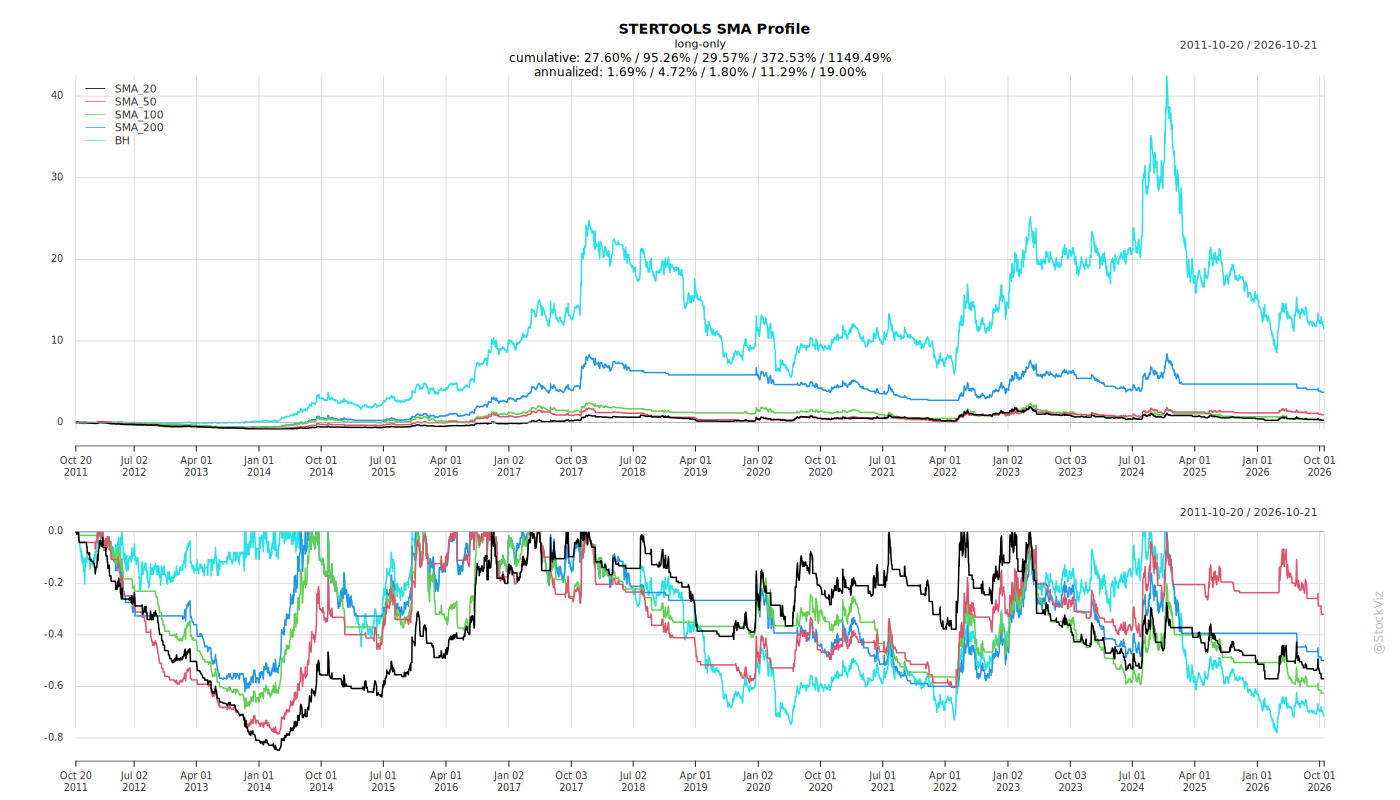
Fundamentals
Ownership
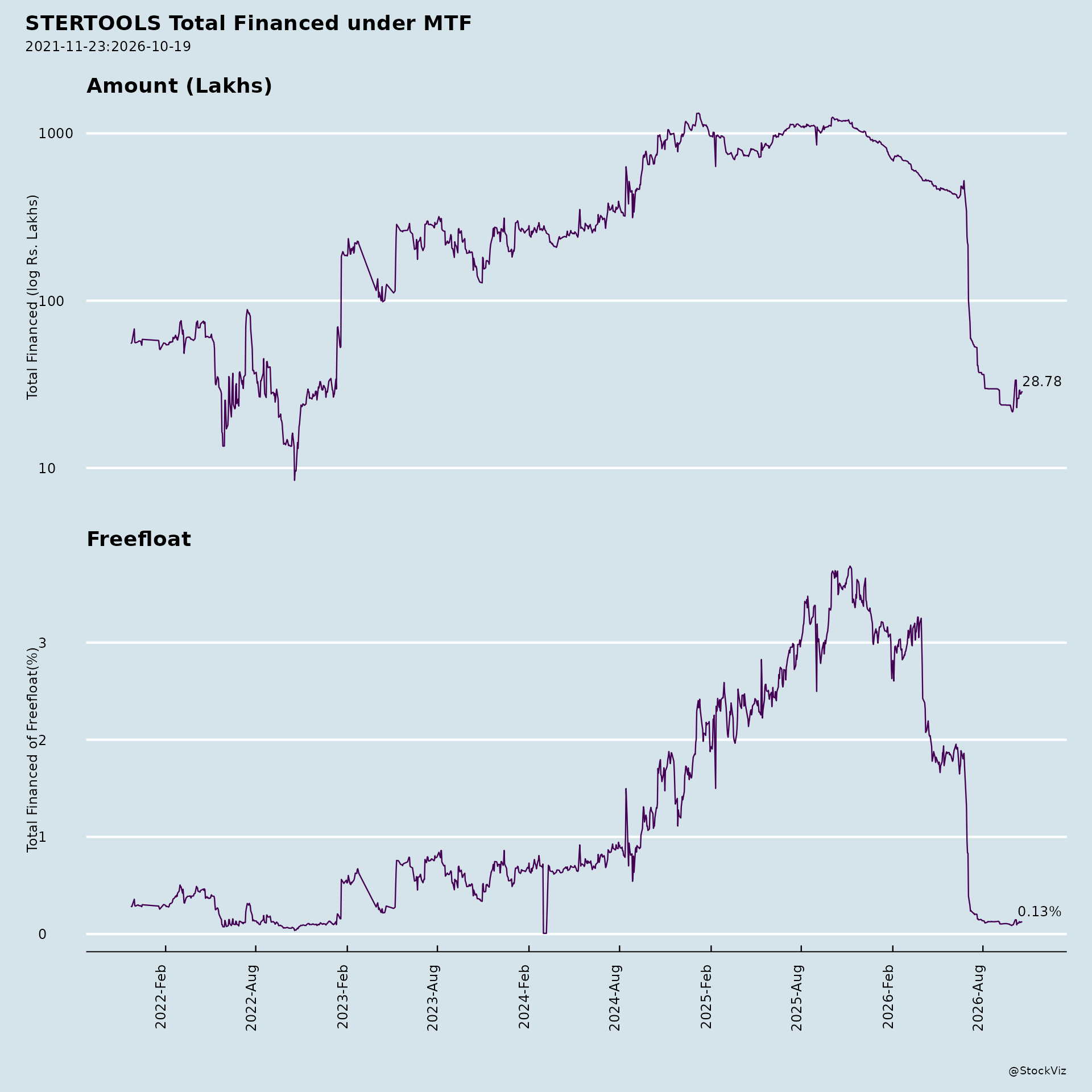
Margined
AI Summary
asof: 2026-09-18
Sterling Tools Limited — Recent Corporate Announcements
1. Headwinds and Challenges
Input cost inflation in the fasteners business. Management stated that steel prices increased during Q1FY27, creating cost pressure. This was compounded by broader inflation across commodities — chemicals, tungsten, steel — and a sharp rise in minimum wages, described as going up by as high as 35% in some areas. Lower-cost inventory has now been largely utilized, so the impact of higher steel prices is expected to be more visible in the coming quarter.
Pass-through lag. Steel is handled through a regular pass-through mechanism, but negotiations typically take two to four months to conclude and translate into the P&L. Management noted it has, for the first time in a long time, taken up the inflationary impact strongly with customers and is receiving positive feedback, though the timing lag remains.
Capacity constraints in fasteners. Standalone capacity utilization was described as 90%–95%, effectively fully utilized given product-mix considerations. The INR 80 crore capex for FY27 is largely back-ended, with a substantial portion kicking in during the second half, so full-year benefits will not be felt; benefits are expected starting perhaps the last quarter and into the following year.
Losses and cash burn in the EV subsidiaries. Both Sterling E-Mobility (SEM) and Sterling Tech-Mobility (STML) are expected to lose money this year. An analyst noted continued burn of approximately INR 10 crore a quarter. Management attributed SEM’s losses partly to a large anchor customer in-sourcing its product in FY25, which removed close to INR 280-odd crore of revenue in a single year against an infrastructure and cost base built for larger revenue, and partly to continued investment in product engineering, design, development and R&D.
Testing and validation timelines. STML’s products are safety-related, with testing and validation taking anywhere from 8 to 16 months depending on customer requirements. For SEM’s onboard charger and multifunction unit lines, after commissioning, customer on-road trials of roughly 50,000 kilometres could take about four months before sign-off.
Weak domestic EV ecosystem. Management observed that India’s EV ecosystem remains poor and the country is still largely dependent on overseas technologies and supply chains, making the ramp-up slow.
Limited penetration with large two-wheeler EV makers. Some large incumbent two-wheeler customers have in-house production or longstanding supplier relationships. Management is working on two programs with two different two-wheeler makers at advanced stages.
External factors to monitor. Geopolitical developments, commodity prices and global supply chain disruptions were flagged as key factors to monitor during the year.
Shareholder compliance matters. Under a SEBI Master Circular dated 6 February 2026, physical shareholders must furnish/update PAN, e-mail, mobile, signature and bank details. Physical shareholders who have not updated these details shall not be eligible to lodge grievances or avail service requests from the RTA, and dividend payments shall remain withheld until details are furnished. Dividend payments are to be processed only through electronic mode, with no physical dividend warrants issued.
2. Tailwinds and Growth Prospects
Record automotive industry quarter. The Indian automobile industry delivered its highest ever quarterly sales across passenger vehicles, commercial vehicles and three-wheelers. Passenger vehicle sales grew 25.9% Y-o-Y to 1.27 million units, two-wheeler sales rose 20.3% Y-o-Y to 5.63 million units, commercial vehicle sales rose 18.3% Y-o-Y, and three-wheeler sales grew 29.7% Y-o-Y. Exports recorded their strongest ever quarter across all major vehicle categories. Support came from lower GST rates, easier financing, new model launches and improving consumer demand.
Positive FY27 industry outlook. Supported by the upcoming festive season, lower vehicle ownership costs following GST 2.0, easier financing and steady consumer sentiment.
Fasteners business momentum. Growth was driven by increased wallet share with existing customers, deeper OEM relationships and traction in value-added products, enabling the company to outperform the underlying automotive industry. The business remains strongly cash generative and net debt free, providing a foundation to internally support long-term investments across EV and technology-led growth initiatives.
Customer diversification in fasteners. Progress in expanding presence across commercial vehicle programs, with significant inroads into both LCV and HCV segments, combined with a growing portfolio of critical and value-added fasteners.
SEM portfolio expansion. The business has evolved beyond motor control units to an integrated portfolio comprising motors, integrated motor and controller solutions, onboard chargers, off-board chargers, DC/DC converters and rare-earth magnet-free motors, enabling participation across multiple EV platforms and higher content per vehicle. SEM is engaged in 33 active customer programs, received business confirmations from 4 OEMs, and is seeing increasing traction in the commercial vehicle segment. Motor and off-board charger programs are progressing well.
New SEM production lines. Commissioning of onboard charger and multifunction unit production lines remains on track for Q2FY27, which will broaden the addressable market. Management indicated supplies could start around December or January following customer road trials.
STML import substitution opportunity. STML is establishing a domestic manufacturing ecosystem for high-voltage DC contactors and relays, focused on import substitution in a segment expected to see significant demand from electrification across electric vehicles, charging infrastructure and energy storage. Seven customer programs are already secured, with commercial supplies scheduled to commence from Q2FY27. The fully automated Bangalore facility and technology collaboration with GLVAC support this. Management sees exports as a potential game changer over the next two to three years, after stabilizing domestic processes, and also intends to focus on charging infrastructure and solar infrastructure.
ADAS opportunity. A regulation notified for medium and heavy commercial vehicles kicks in from October 2027, covering about 0.5 million units a year across five features including driver monitoring, front collision warning and blind spot. Implementation may be pushed to January 2028. A partnership has been signed with a company in China. A draft regulation for Level 2 ADAS in passenger vehicles from 2029 is also noted, along with a two-wheeler safety rider assistance standard under draft.
Content per vehicle. Integrated units for heavy bus and heavy truck platforms typically run about INR 3 lakh to INR 3.5 lakh per unit depending on configuration.
Capacity headroom. SEM can do over INR 300 crore without further investment; STML can do around INR 140 crore on a three-shift basis — over INR 400 crore combined installed capacity.
3. Key Risks
- Commodity and inflation risk: Steel price increases and broad inflation (chemicals, tungsten, wages) pressuring margins, with pass-through negotiations carrying a two-to-four-month lag.
- Customer concentration and in-sourcing risk: The FY25 loss of close to INR 280-odd crore of SEM revenue from a single anchor customer in-sourcing its product illustrates exposure to customer decisions.
- Execution and timing risk: Commissioning of OBC and multifunction unit lines, STML commercial supplies, and customer testing/validation timelines (8–16 months for STML; ~4 months of road trials for SEM products) could shift.
- Subsidiary profitability risk: Both SEM and STML are expected to lose money in FY27, with breakeven guided for FY28; continued cash burn of approximately INR 10 crore a quarter was noted by an analyst.
- Ecosystem and adoption risk: A weak domestic EV ecosystem and dependence on overseas technologies and supply chains could slow the ramp-up.
- Regulatory timing risk: ADAS implementation dates may shift (October 2027 possibly pushed to January 2028).
- External macro risk: Geopolitical developments, commodity prices and global supply chain disruptions.
- Shareholder servicing risk: Withholding of dividends and ineligibility for grievance redressal for physical shareholders who have not updated PAN/KYC/bank details.
4. Management Guidance Versus Observed Business Performance
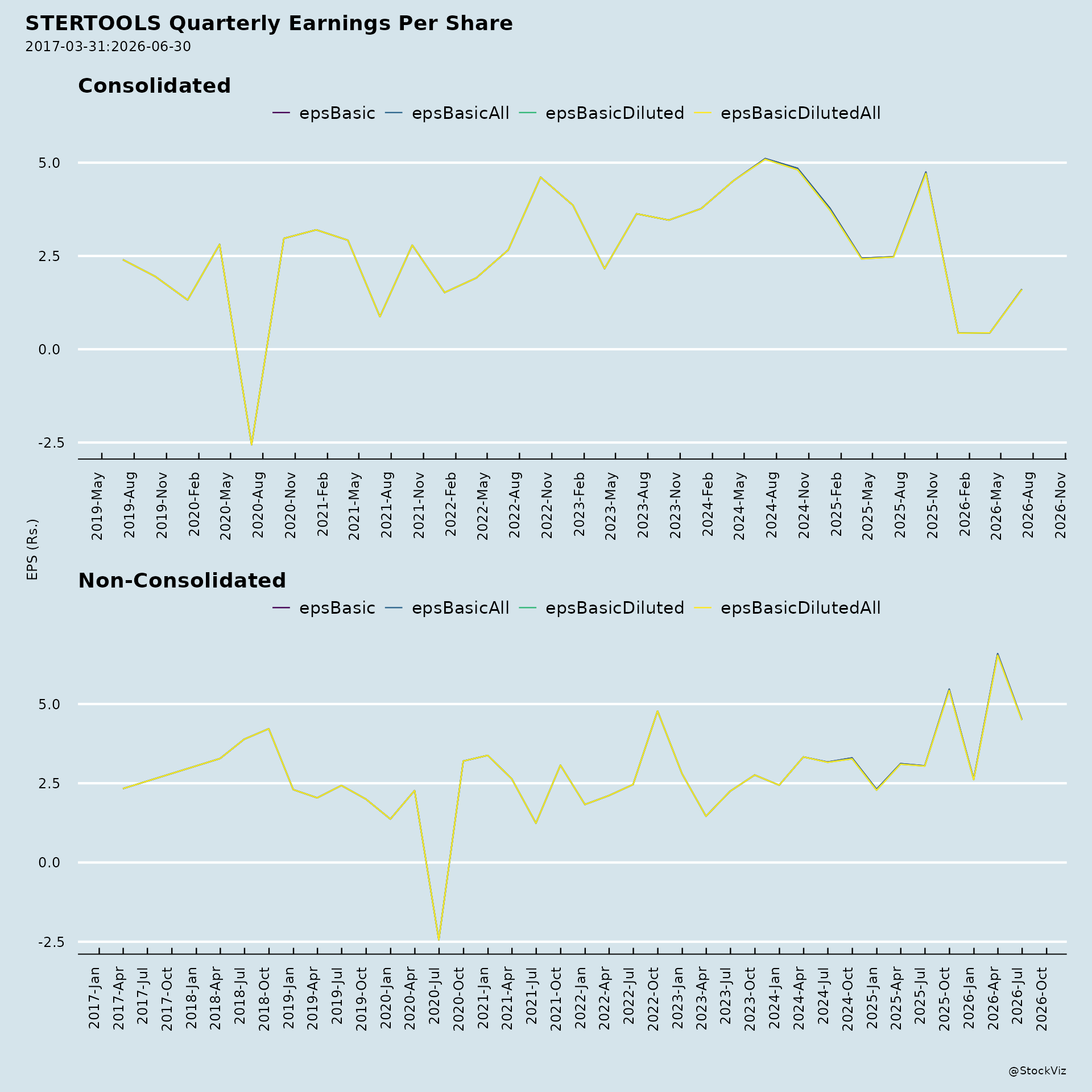
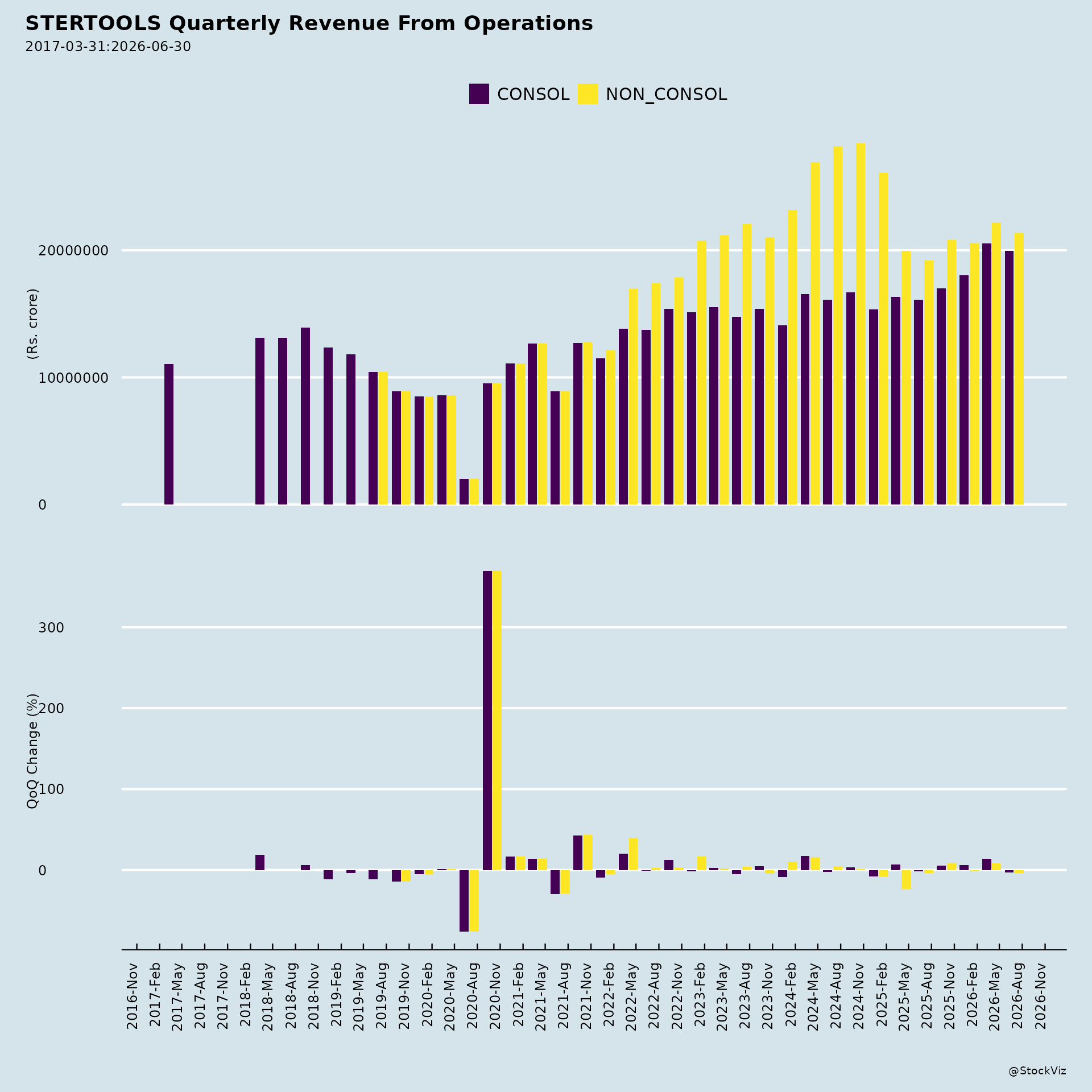
Fasteners growth. Management guided that the fastener business will grow 20% plus, similar to Q1, with the near term looking similar unless the automotive industry slows. Observed: standalone total income grew 23.7% Y-o-Y to INR 201.9 crore in Q1FY27, consistent with that trajectory.
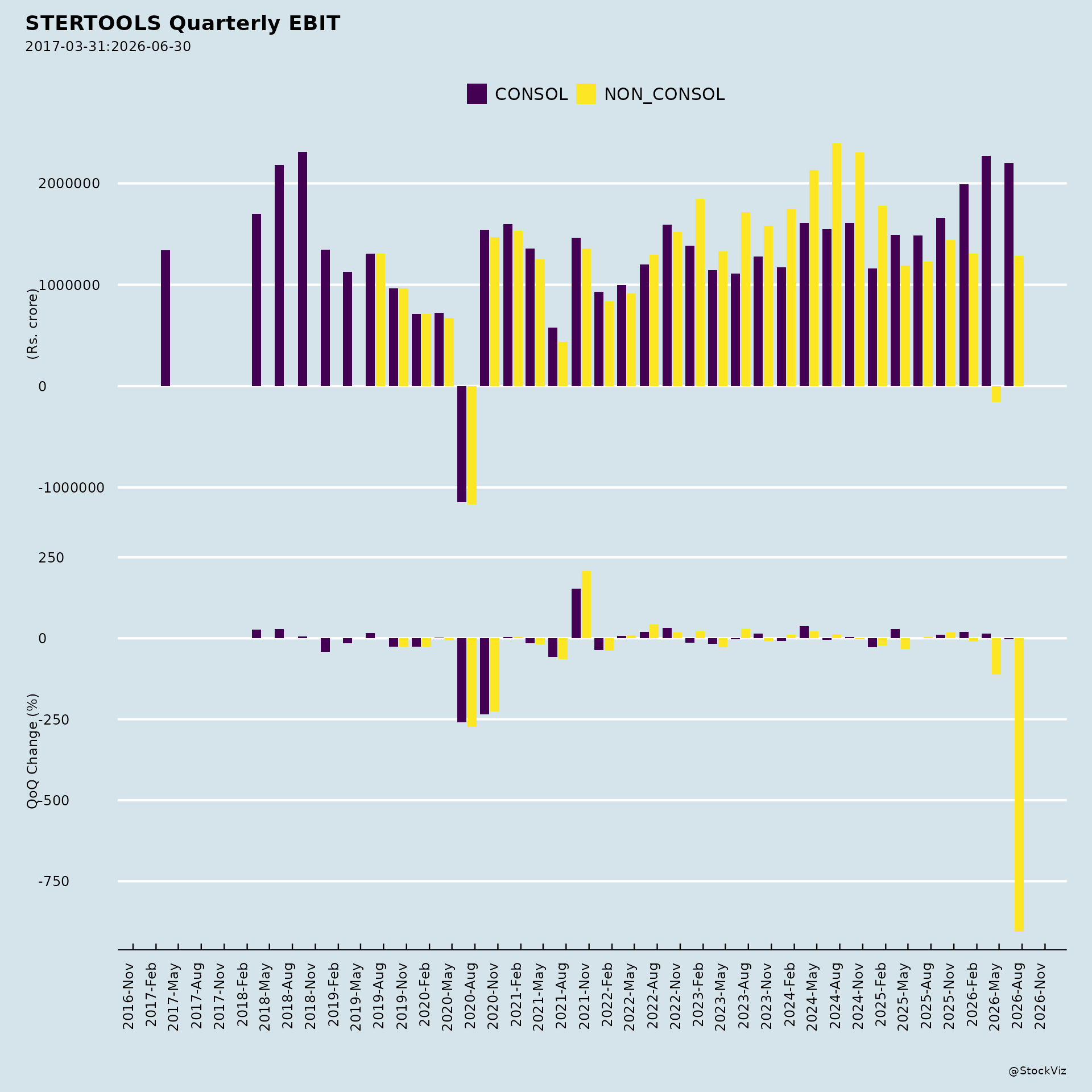
Fasteners margins. Management expressed confidence in holding margin structures for the full year despite steel and inflation, expecting customer price increases in advanced stages, and stated it does not see EBITDA getting weaker. Observed: Q1FY27 standalone EBITDA rose 26.9% Y-o-Y to INR 31.1 crore with margins at 15.4% versus 15% last year; PAT grew 48.4% Y-o-Y to INR 16.4 crore with margins at 8.1%. An analyst noted gross margin expanded sharply by about 270 bps while EBITDA margin expanded only about 40 bps, which management attributed to steel and broad inflationary pressures alongside shop-floor efficiencies.
EV business growth. Management guided 20%–30% growth for the EV businesses in FY27, and 30%–40% growth on top of that in FY28. No FY27 EV revenue figure was disclosed in the call.
Subsidiary breakeven. Management guided that both SEM and STML will break even in FY28, with SEM breaking even at around INR 175 crore revenue and STML at around INR 70-odd crore — roughly INR 225–250 crore combined. Both are expected to lose money this year. Observed: the consolidated results show two subsidiaries with total revenues of INR 1,466.96 lakh and a net loss after tax of INR 923.83 lakh for the quarter ended 30 June 2026, alongside three unreviewed subsidiaries with nil revenue and a net loss of INR 8.44 lakh.
Subsidiary operating margin at scale. Management indicated about 10%, plus/minus 2%, aiming to keep at double-digit 10% plus levels.
Capex and capacity. Management guided INR 80 crore capex for FY27 in fasteners (noted in the transcript as wrongly said as INR 88 crore), largely in existing facilities between Bangalore and two NCR plants, with a further INR 25–30 crore investment next year to balance out toward a potential revenue of INR 1,000 crore. Observed: Q1 saw only marginal capex kick-in, with the substantial portion expected in H2.
STML commercial supplies. Management stated commercial supplies are scheduled to commence from Q2FY27, with serial production of HVDC contactors and relays commencing in July/August 2026.
SEM new lines. Onboard charger and multifunction unit production lines remain on track for Q2FY27 commissioning, with supplies potentially starting December or January after customer road trials.
Investment in STML. The Board approved investment in STML by way of equity up to INR 15 crore in one tranche, through a rights issue, to facilitate working capital requirements. STML’s revenue from operations for FY2025-26 was INR 34.39 lakh, with nil turnover in FY2024-25 and FY2023-24. Management stated current cash investment in STML is INR 50-odd crore and in SEM about INR 48–49 crore, totaling roughly INR 100 crore across both.
Dividend. The Board recommended a final dividend of INR 2.75 per equity share of face value INR 2 each for FY2025-26 (previous year INR 2.5 per share), subject to shareholder approval at the 47th AGM held on 4 September 2026, where all five resolutions were approved with the requisite majority. The record date was fixed as 28 August 2026, with book closure from 29 August 2026 to 4 September 2026.
Other corporate items. The Board approved the appointment of M/s Jitender Navneet & Co as Cost Auditors for FY2026-27. Exceptional items for the year ended 31 March 2026 represent enhanced compensation of INR 949.64 lakh (including interest of INR 622.45 lakh) received from Delhi Metro Rail Corporation against land acquired in an earlier year.
Broker Narrative
The narrative moved from an aggressive Buy in May 2023 (fastener growth of 18%, doubling EV business, margin recovery) to an Accumulate in November 2023, with lowered targets and a more cautious tone. Persistent themes were EV subsidy/regulatory risk, margin pressure, and EV ramp-up costs; what changed was the scale of expected growth and margin, with EV doubling abandoned and fastener targets cut to gradual recovery.
Fears that came true
- The margin contraction/quarterly weakness persisted: by Q2FY24 consolidated revenue de-grew 4.7% QoQ and operating margin was hit by negative operating leverage, contributing to the -38% and -43% actual returns on the first two Buy calls.
- The EV subsidy uncertainty materialized: the FAME subsidy for 2W EVs was downwardly revised, and the last report said it would impact the MCU business in the coming quarter.
Optimism that failed
- The targeted 18% fastener revenue growth for FY24 failed to materialize—by Q2FY24 the fastener business grew only 4% YoY.
- The EV business doubling target failed: the last report explicitly said the MCU business was not expected to achieve its FY24 doubling revenue target due to slowing EV volumes.
- The expected margin recovery to 16-17% in fasteners and 9-10% in EV did not occur—the last report showed fastener margins at 14% and expected MCU margins at 7-9%.
Broker Timeline
3 broker calls · 2023-05-09 to 2023-11-01
Copyright © 2023 SAS Data Analytics Pvt. Ltd. All rights reserved.