STARHEALTH
Equity Metrics
September 24, 2026
Star Health and Allied Insurance Company Limited
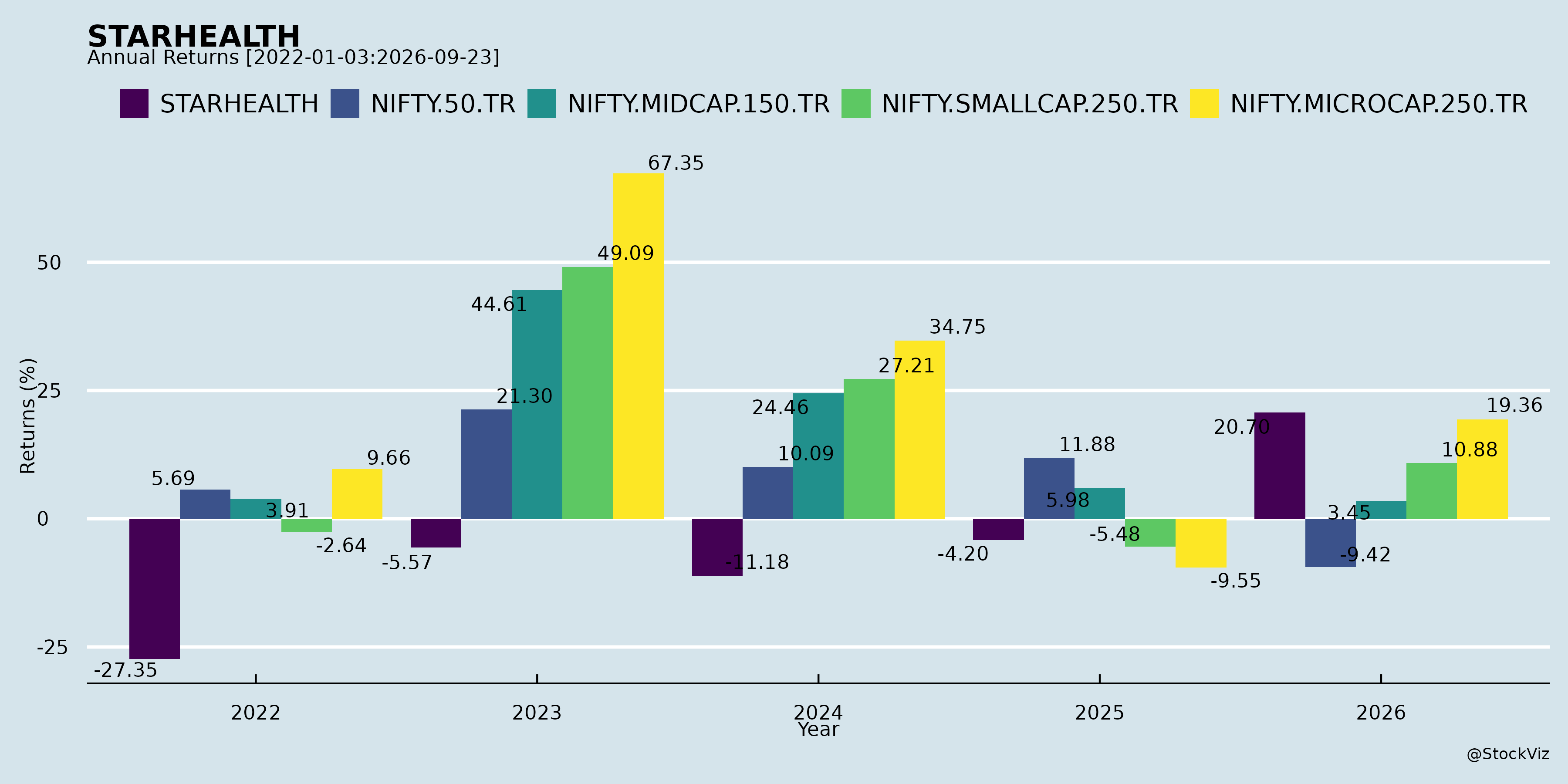
Annual Returns
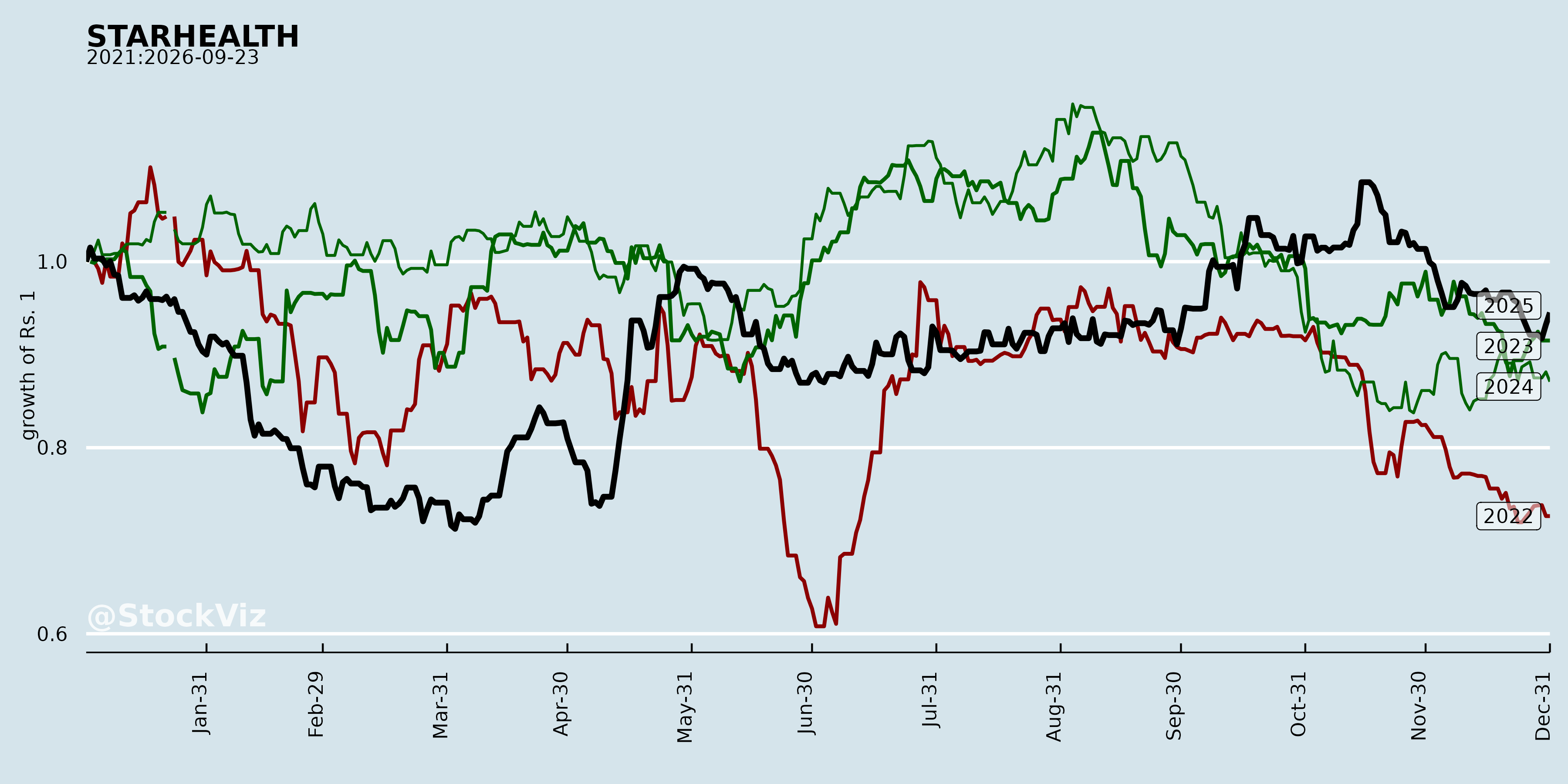
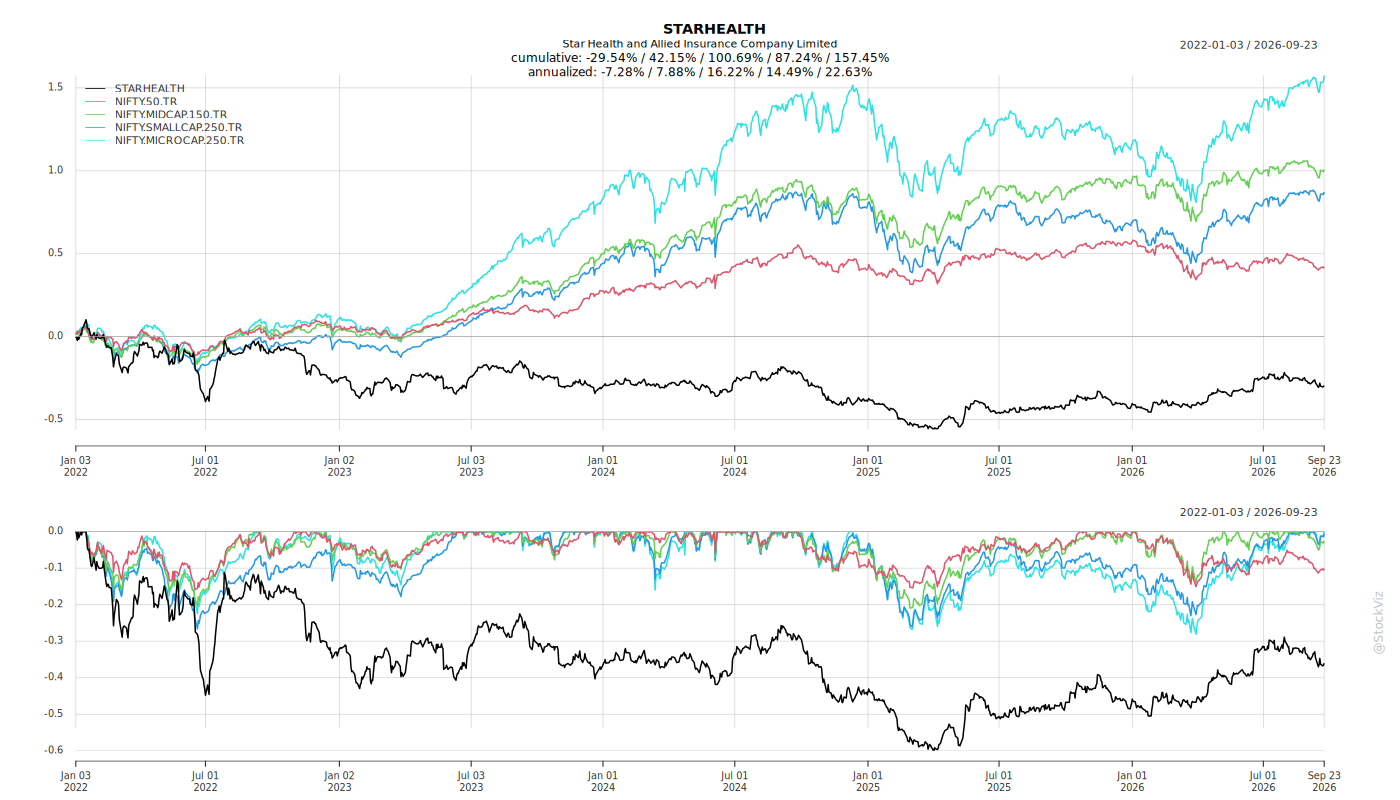
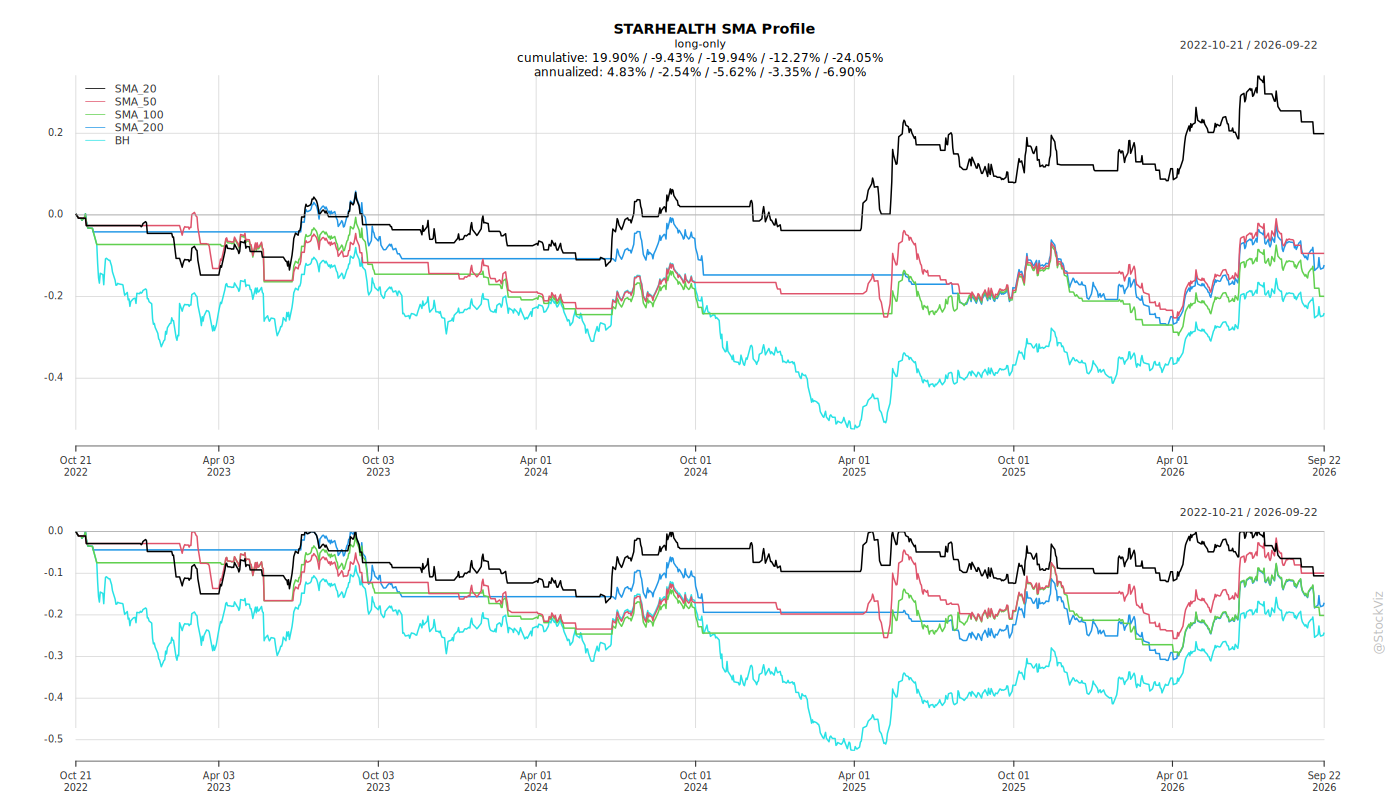
Cumulative Returns and Drawdowns
Fundamentals
Ownership
Margined
AI Summary
asof: 2026-09-16
Headwinds and Challenges
- Seasonality of the health insurance business. The company notes that the industry typically sees higher claims during the monsoon period due to rain-related diseases, while premium income is higher toward the end of the financial year because of tax benefits available to policyholders. As a result, quarterly results are not indicative of full-year performance.
- Transition to Ind AS. The company adopted Ind AS with effect from FY 2026-27, with a transition date of April 1, 2025, following an IRDAI notification dated March 30, 2026. Comparative periods have been restated, and the transition produced reconciliation adjustments across insurance contracts, fair valuation of financial instruments, and deferred tax.
- Investment income sensitivity. Investment income declined from ₹1,260 crore in FY25 to ₹1,091 crore in FY26, and annualised investment yield fell from 7.6% to 5.8% over the same period, reflecting mark-to-market movements. The company reports a “Normalised PAT” pegged at a normalised investment yield of 8% to insulate reported profitability from short-term mark-to-market volatility.
- Reinsurance result volatility. Net expenses from reinsurance contracts moved from ₹59 crore in Q1 FY26 to ₹21 crore in Q1 FY27, and from ₹159 crore in FY25 to ₹154 crore in FY26, indicating variability in this line.
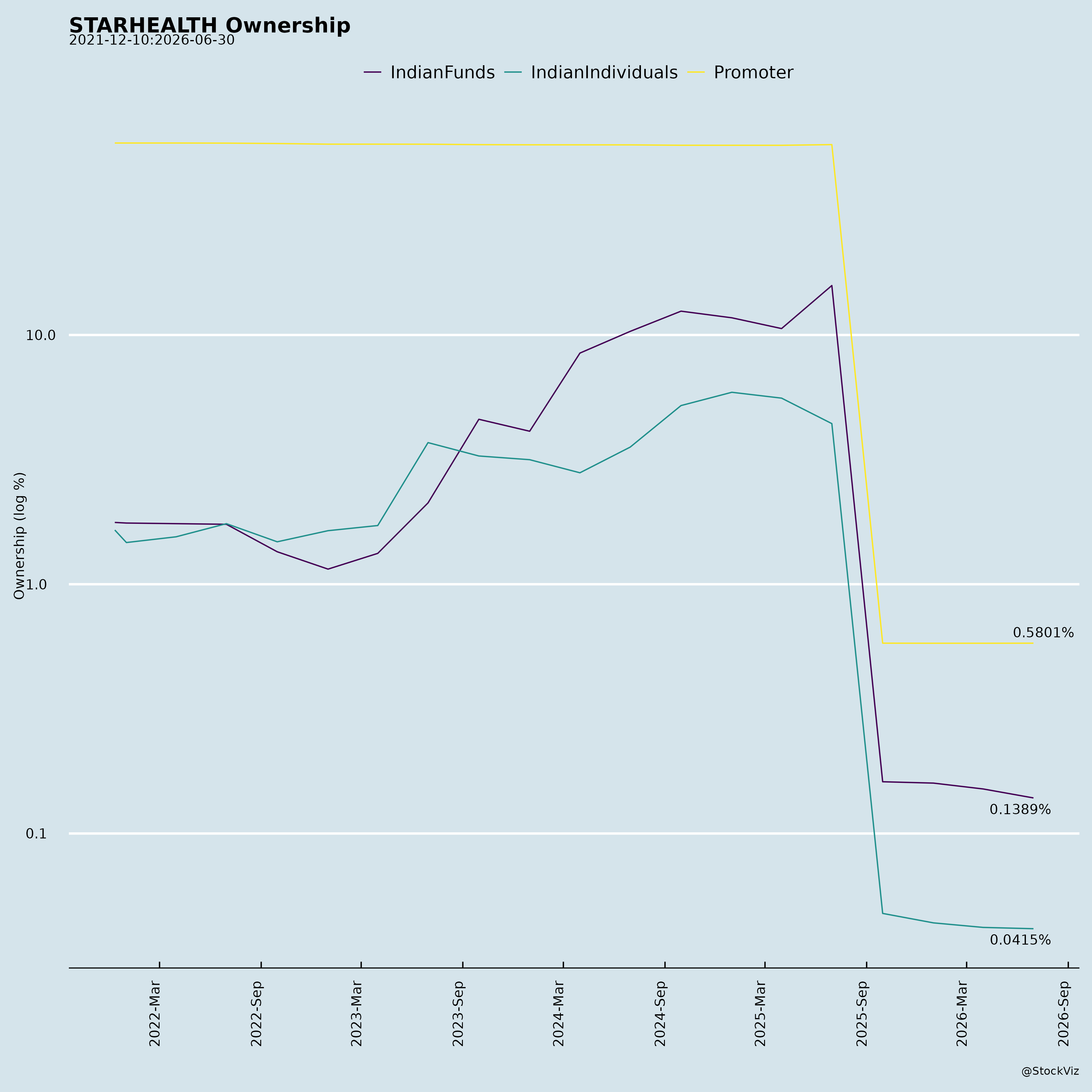
- Regulatory and structural changes. The reclassification of promoter group entities as public shareholders is subject to approval of the Stock Exchanges and Members. The company also approved exercise of call options and redemption of 4,000 NCDs (interest due September 30, 2026) and 700 NCDs (interest due October 29, 2026).
- Event scheduling risk. The Analyst/Investor meeting (JP Morgan India Conference) is subject to changes that may happen due to exigencies on the part of Analysts/Investors of the Company.
Tailwinds and Growth Prospects
- Premium growth. Gross Written Premium on a reported 1/N basis rose 19% YoY to ₹4,287 crore in Q1 FY27. Retail Health fresh GWP on the same basis rose 37% YoY to ₹730 crore.
- Underwriting profitability improvement. Underwriting Result rose to ₹111 crore in Q1 FY27 from ₹16 crore in Q1 FY26, and from a negative ₹151 crore in FY25 to positive ₹198 crore in FY26. CISR improved to 97.0% in Q1 FY27 from 98.7% in Q1 FY26, and from 100.7% in FY25 to 98.4% in FY26.
- Profitability and returns. PAT rose 25% YoY to ₹550 crore in Q1 FY27. Normalised PAT rose 44% YoY from ₹267 crore to ₹386 crore. Annualised ROE was 22.3% in Q1 FY27 versus 19.7% in Q1 FY26; normalised ROE was 15.6% versus 12.2%.
- Distribution moat. The company describes its agency network as the largest agency-led health distribution network built over two decades, with 900+ branch offices, 8.5 lakh+ agents, 16,000+ network hospitals, and 18,500+ employees as of June 30, 2026. More than 90% of overall GWP emerges from proprietary channels.
- Digital D2C scaling. The proprietary digital D2C channel contributed 16% of fresh retail sales in Q1 FY27, with 142% YoY growth. 97% of fresh policies were sourced digitally. D2C Fresh NOP is described as profitable and fast-growing, with 98% of D2C Fresh NOP being new-to-insurance.
- Customer engagement and retention. Persistency improved to 102% from 99% YoY. Company NPS improved 12 points to 65. Retail Claims Settlement Ratio improved 1% to 91%. The customer app has 14.7 million downloads and over 1.5 million monthly active users.
- Non-metro footprint. Non-metro geographies contribute 60%+ of fresh business with growth momentum.
- Technology and AI. ATOM Pro (AI-enabled distribution platform) was recognized by The Economic Times in the BFSI FinNext Awards 2026 under ‘InsurTech Product Excellence of the Year’. Generative AI is being layered into claims processing, and AI-ML architecture is used for mitigation of Fraud, Waste and Abuse. Pipeline initiatives include a sales co-pilot, conversational chat bot, voice bot, AI-led verification, and AI-assisted resolutions.
- Capital position. Shareholder net worth rose to ₹10,144 crore as of June 30, 2026, from ₹9,110 crore as of June 30, 2025.
Key Risks
- Claims seasonality risk. Higher claims during the monsoon period can pressure results in specific quarters.
- Mark-to-market volatility. Investment yield swings (13.1% annualised in Q1 FY26 versus 12.2% in Q1 FY27; 7.6% in FY25 versus 5.8% in FY26) affect reported profitability, which is why normalised PAT is disclosed.
- Regulatory approval dependency. The promoter group reclassification requires Stock Exchange and Member approvals. The withdrawal of the reclassification application for IDC Electronics Limited is subject to Board approval.
- Reinsurance cost variability. Net expenses from reinsurance contracts fluctuate period to period.
- Forward-looking statement risk. The presentation states that forward-looking statements are not guarantees of future performance and involve risks and uncertainties including price fluctuations, actual demand, exchange rate fluctuations, competition, environmental risks, changes in legal, financial and regulatory frameworks, political risks, and factors beyond the company’s control.
- Event scheduling risk. The Analyst/Investor meeting is subject to changes due to exigencies on the part of Analysts/Investors.
Management Guidance Versus Observed Business Performance
- Strategic priorities stated: sustainable growth through granular retail distribution built on proprietary channels (Agency and Digital D2C); core underwriting profitability through disciplined portfolio management across the risk lifecycle; customer centricity through a digital-first approach with technology-led engagement.
- Observed performance against these priorities: GWP grew 19% YoY and Retail Fresh GWP grew 37% YoY in Q1 FY27, consistent with the sustainable growth priority. Underwriting Result improved to ₹111 crore from ₹16 crore, and CISR improved to 97.0% from 98.7%, consistent with the core underwriting profitability priority. NPS improved to 65 from 53, persistency improved to 102% from 99%, and digital sourcing reached 97% of fresh policies, consistent with the customer centricity priority.
- CEO commentary: Mr. Anand Roy stated that the first quarter reflects the strength of fundamentals and consistency of execution, that sustainable growth, improvement in core underwriting profitability, and sustained operating discipline enabled a strong start to the year, and that the company remains focused on expanding health insurance access while maintaining prudent risk selection and delivering superior customer experience. He also stated that investments in digital capabilities, AI-led innovation, and distribution network continue to strengthen the ability to serve customers more efficiently and at scale, and that the company remains committed to building a resilient, digital-first organisation that creates long-term value for policyholders and shareholders.
- Normalisation approach: The company reports Normalised PAT pegged at a normalised investment yield (annualised) of 8% to report profitability insulated from short-term mark-to-market volatility. Normalised PAT rose 44% YoY to ₹386 crore in Q1 FY27.
- Withdrawal of reclassification application: The company shall make necessary steps for processing the withdrawal of the reclassification application filed with the stock exchanges with respect to IDC Electronics Limited, subject to the approval of the Board of Directors.
- AGM outcomes: The 21st Annual General Meeting was held on August 28, 2026, where shareholders voted on adoption of standalone financial statements, re-appointment of Director Mr. Deepak Ramineedi, and appointment of Mr. Utpal Hemendra Sheth as a Nominee Director.
Broker Narrative
The early ICICI Securities view was a defensive Buy: it acknowledged a small FY24E downgrade and slower retail growth but leaned on regulatory flexibility, partner expansion, renewals, and investment income. By the 2026 Motilal Oswal report, the narrative had shifted to defending the proprietary distribution model and technology/claims improvements, while the key concern became accounting-driven revenue lag rather than the original NEP downgrade. Distribution strength and claims management remained persistent tailwinds, but regulatory flexibility gave way to regulatory risk, and IFRS/accounting upside became an accounting drag.
Fears that came true
- The FY24E PAT/NEP downgrade was vindicated by the stock’s repeated DISAPPOINTMENT outcomes on later Buy calls (e.g., -4.8%, -18.0%, -26.4%), showing the revenue headwind was real and persistent.
Optimism that failed
- The early optimism that new EOM commission flexibility would create growth did not hold; by the last report, regulatory changes affecting distribution economics were still flagged as a risk.
- The expected IFRS/accounting upside did not materialize; instead, accounting treatment of long-term policies was still dragging insurance revenue growth in 2026.
Broker Timeline
29 broker calls · 2023-07-31 to 2026-07-30
Copyright © 2023 SAS Data Analytics Pvt. Ltd. All rights reserved.