STANLEY
Equity Metrics
September 24, 2026
Stanley Lifestyles Limited
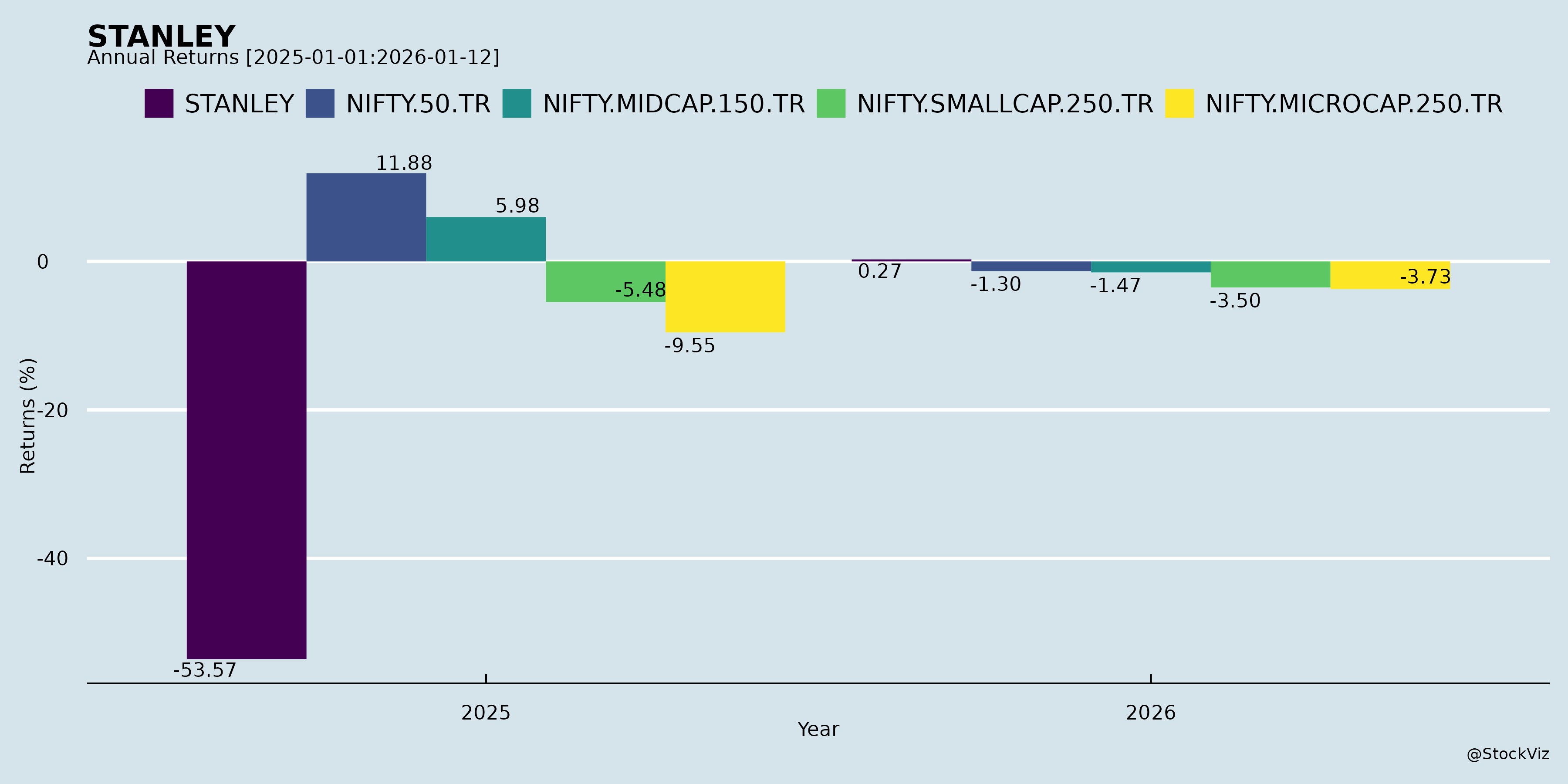
Annual Returns

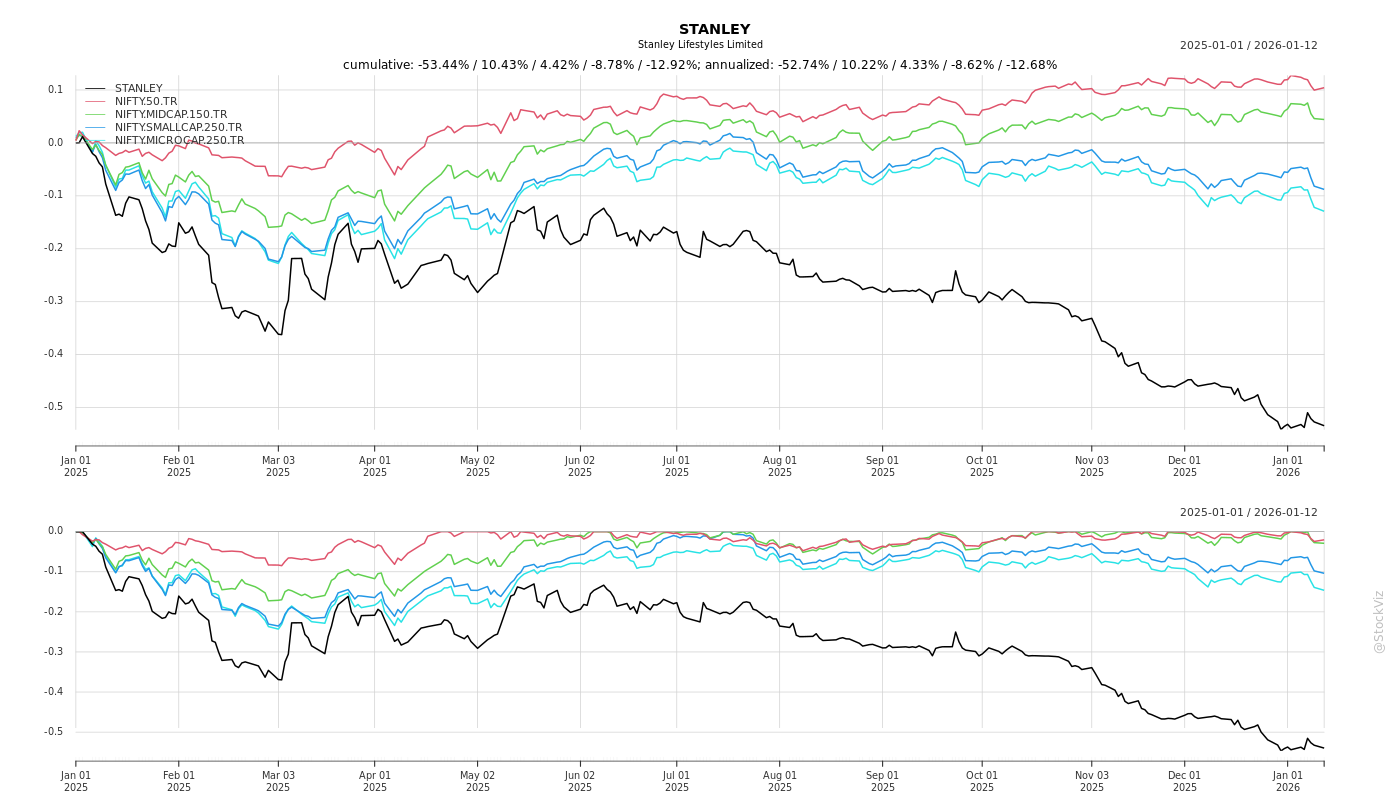
Cumulative Returns and Drawdowns

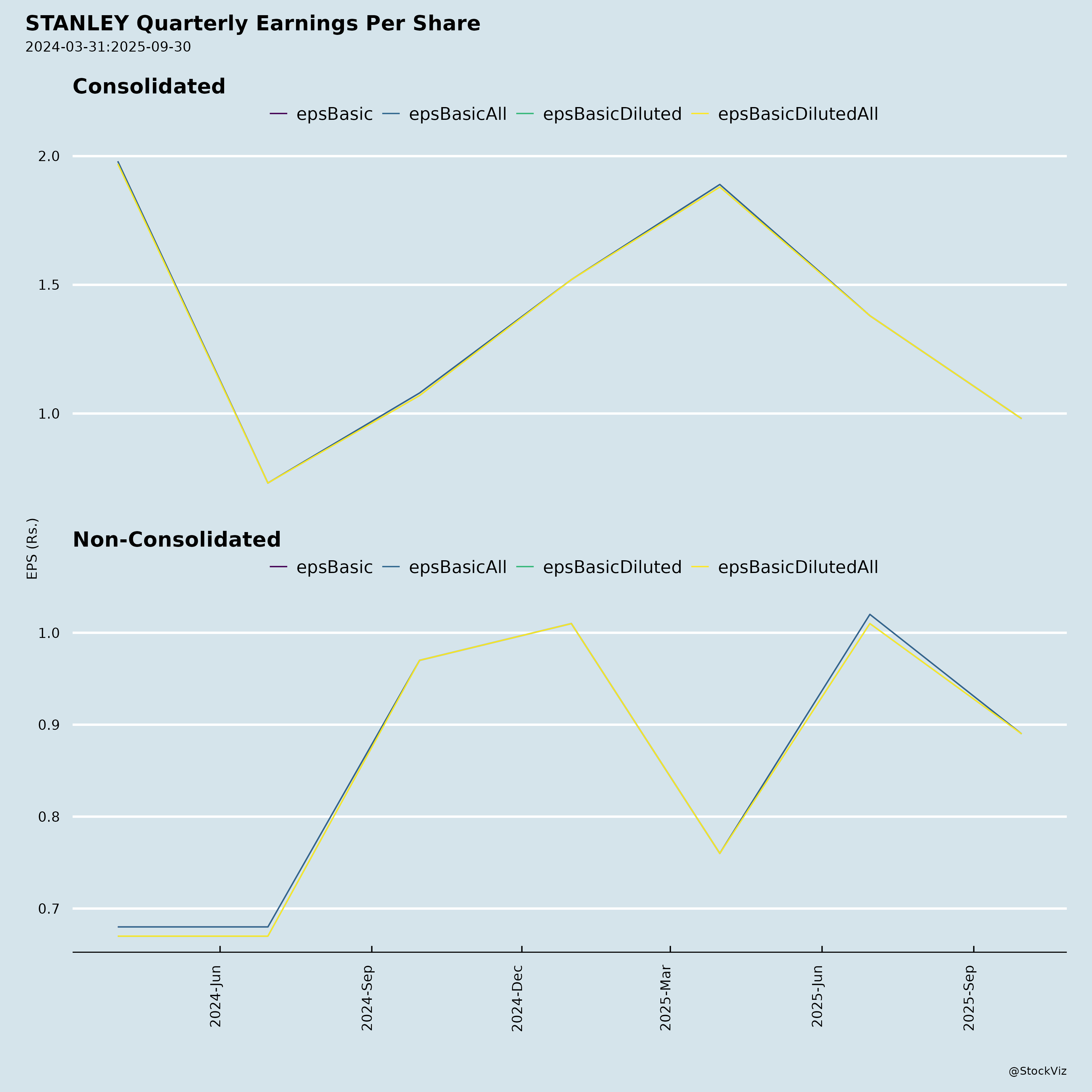
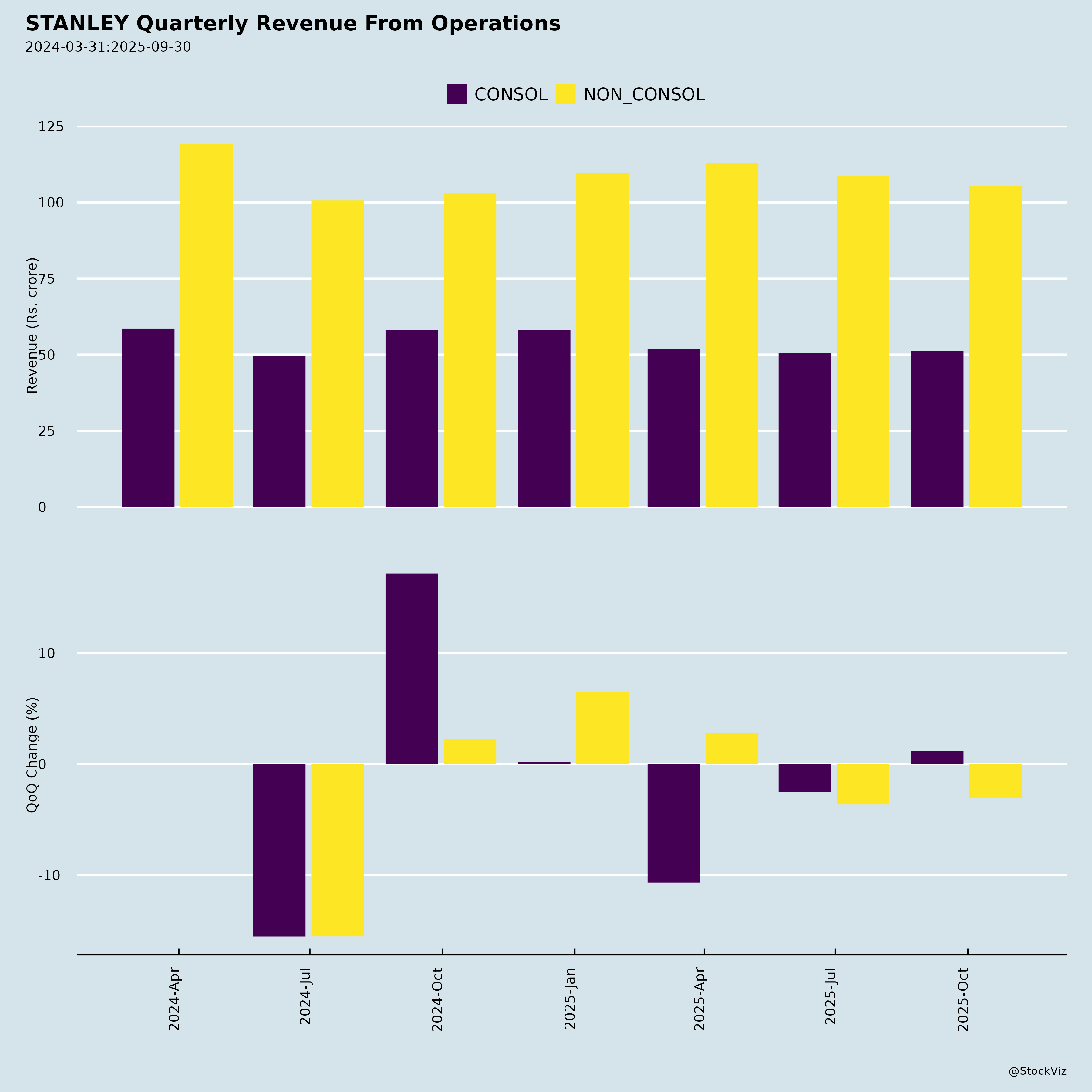
Fundamentals
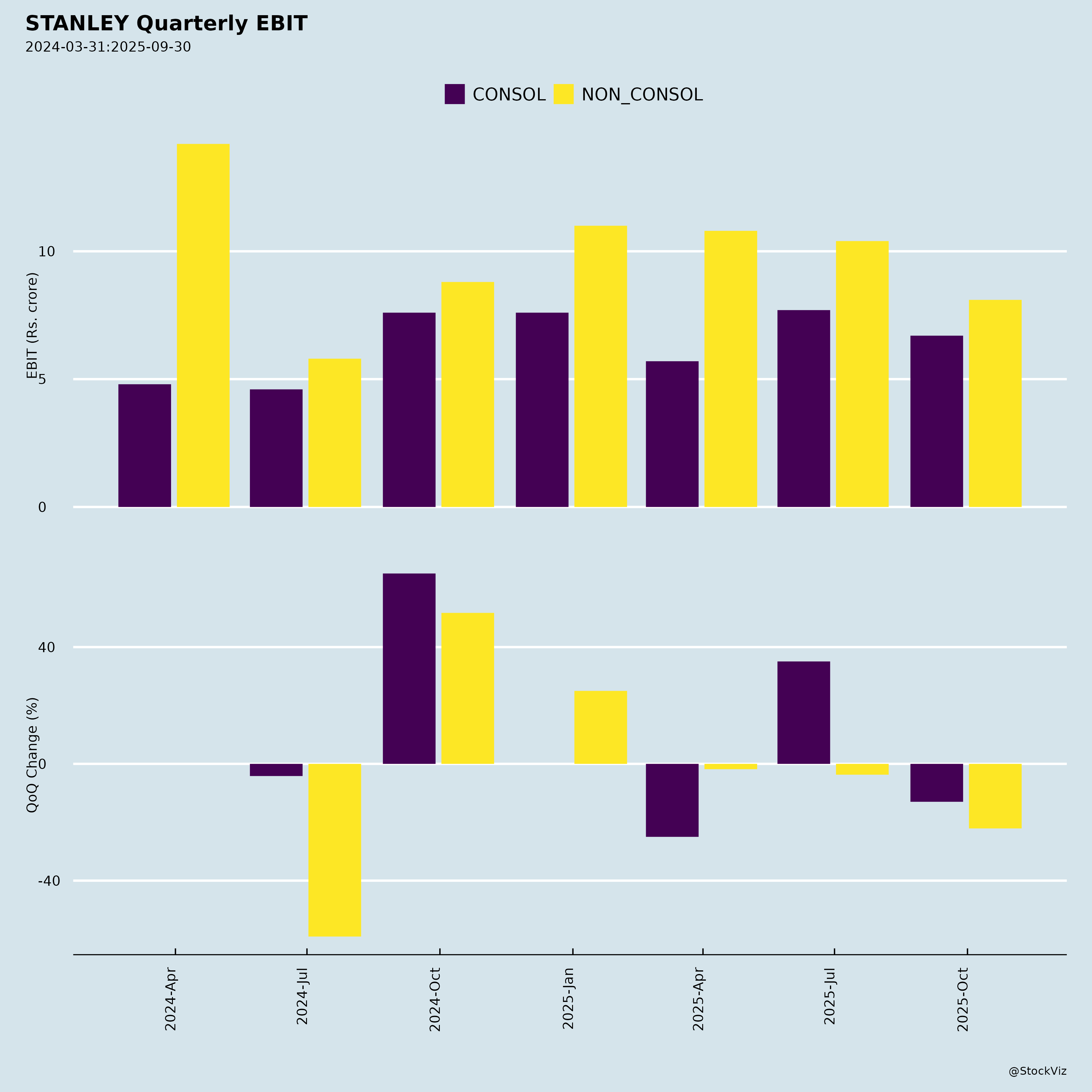
Ownership
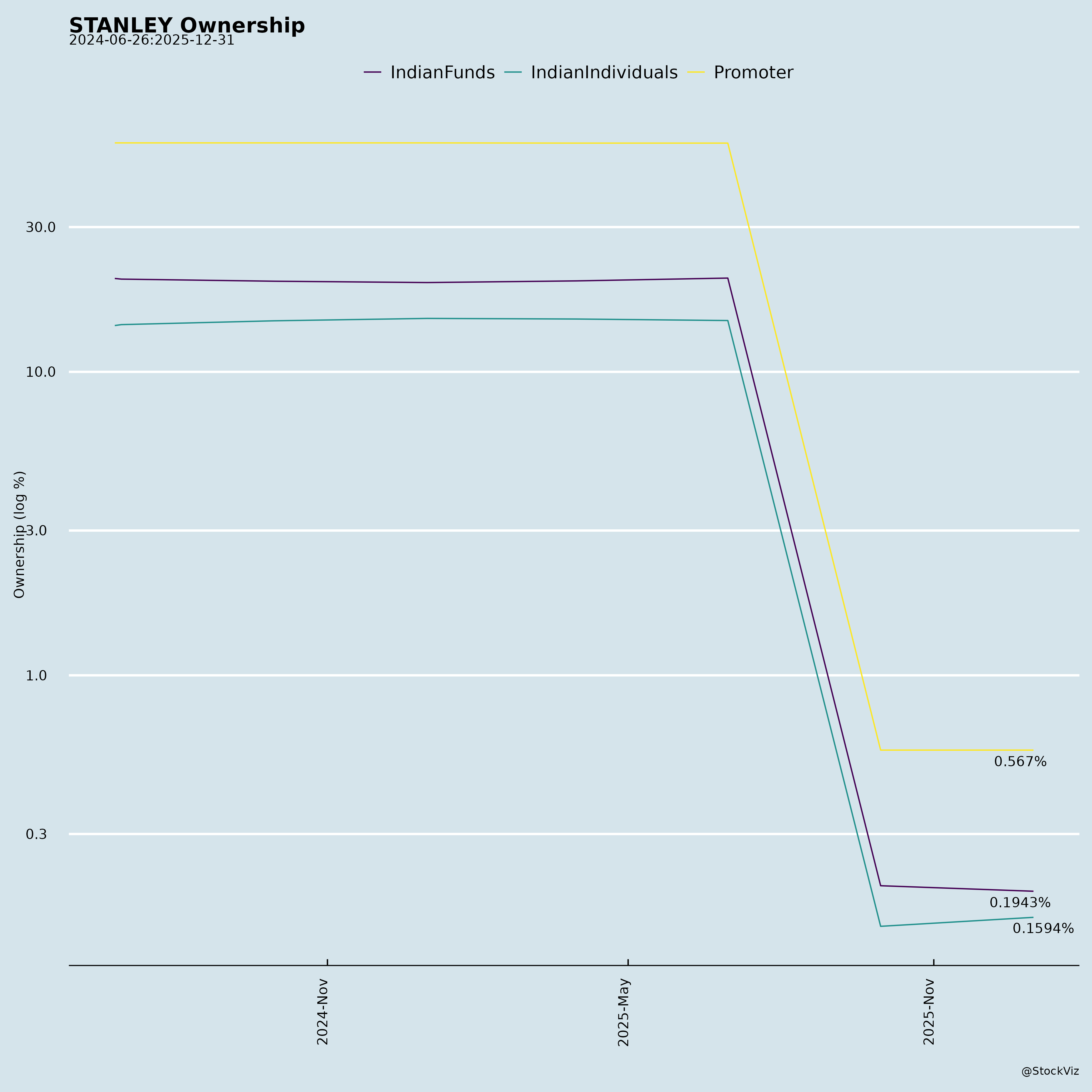
Margined
AI Summary
asof: 2026-09-18
Stanley Lifestyles — Recent Corporate Announcements: Summary
1. Headwinds and Challenges
Revenue decline in Q1 FY27. Revenue from operations was ₹9,935 lakhs in Q1 FY27, down from ₹10,861 lakhs in Q1 FY26 (a decline of 8.6% year-on-year, and 2.0% quarter-on-quarter from ₹10,141 lakhs in Q4 FY26). Management attributed the dip to two main factors.
B2B shipment disruption. The B2B business faced challenges from the Middle East war, which disrupted freight movement. Products were produced and are held with the company, and a healthy order book exists, but logistics constraints prevented invoicing in Q1. Management described this as the highest-ever visibility of opportunity in the B2B business, but billing could not take place.
Retail conversion slowdown. Stanley’s customers are primarily new home buyers in the premium and luxury residential segment, representing 80%–85% of the base. Residential project handovers have been delayed by 12–18 months in several cases. Supply chain disruptions in West Asia have also constrained the availability of construction materials. While customer inquiries and store footfall remain encouraging, conversions are slower as customers await possession of their homes.
Store closures and network rationalization. During the quarter, 3 new stores were opened in Bangalore (2 in Varthur, 1 on Mysore Road), while 4 stores were closed (3 in Bangalore, 1 in Mumbai). Certain catchments had matured, with residential development cycles largely completed. One store had to be closed because a local body changed road rules to one-way and removed parking, causing footfall to drop drastically. Management noted retail hazards such as metro construction or road expansion appearing after a store is taken.
Profitability pressure. EBITDA fell to ₹1,722 lakhs (17.3% margin) from ₹2,247 lakhs (20.7%) in Q1 FY26, a decline of 23.4% year-on-year, though up 14.2% quarter-on-quarter from ₹1,508 lakhs (14.9%). PAT was ₹65 lakhs (0.7% margin) versus ₹778 lakhs (7.2%) in Q1 FY26, a decline of 91.6%. PBT was ₹181 lakhs (1.8% margin) versus ₹1,035 lakhs (9.5%). Depreciation was ₹1,535 lakhs, finance cost ₹568 lakhs, and there was an exceptional item of ₹67 lakhs.
Depreciation load. Management explained that depreciation is elevated due to Ind AS impact, with the charge front-loaded; the IGAAP depreciation would be lower. The quarterly depreciation of ₹1,535 lakhs reflects this Ind AS treatment.
Fraud and misappropriation. In the Q1 audit of internal controls, fraudulent activity by the company secretary was identified. Subsequent to the quarter, on August 05, 2026, the company terminated the services of its Company Secretary and Compliance Officer following an investigation into misconduct and misappropriation of funds. An amount of ₹199 lakhs was identified as misappropriated; considering uncertainty regarding recoverability, ₹101 lakhs relating to the period April 2026 to June 2026 was charged off as an exceptional item in the standalone financial results for the quarter ended June 30, 2026. The company has initiated appropriate legal proceedings and is taking necessary steps to recover the amounts involved. The investigation is ongoing and the company will inform the public once investigations are complete.
Export headwinds. Tariffs from America have affected export plans. Management noted it was in deep discussions with large buyers from the United States, but tariffs are not helping right now. The United States is the biggest market, and management believes it will turn around given China plus 1 or China plus 2 strategies.
Same-store sales in transition. In Q1, mature store same-store sales growth was negative, partly because store models are being changed. Management projects 15%–20% growth for mature stores going forward.
Corporate cost. Corporate cost is roughly ₹90 lakhs per month, about 2.25% of total revenues annually. Management expects corporate expenses to hover around the same level as the company grows, with some additional corporate expenses expected as store formats change and early stores require the right set of people.
2. Tailwinds and Growth Prospects
Store expansion. 3 new stores were opened in Bangalore during the quarter. In July 2026, the first international market entry was achieved with the opening of Stanley Boutique Homes in Colombo, Sri Lanka, through a strategic joint venture with Singer (Sri Lanka) PLC. In August 2026, a new Sofas & More by Stanley store opened in Jaipur (Ajmer Road, 6,500 sq. ft.), marking entry into Rajasthan.
Stanley Superlative Living. A new format is being prepared for mature markets, positioned at the high end of the luxury segment and benchmarked with global luxury retail standards. It is intended to bring complete home solutions under one roof with focus on design, product presentation, and customer experience. The first flagship store opened in Hyderabad on September 4, 2026, spanning approximately 72,000 sq. ft. across six floors on Road No. 45, Jubilee Hills, with more than 60 curated room settings. Management plans to expand the format across leading luxury markets in India and, over time, internationally. The format targets customers with a budget of ₹3 crores to ₹5 crores and above, not homes below ₹2 crores. Average ticket size can go up almost tenfold from current levels. The company will design, build, and deliver, offering complete solutions with warranty on product and installation.
Brand architecture change. The company is folding three brands into one Sofas & More and one Stanley brand. Stanley is becoming a complete-home solution provider, moving from furniture to complete home solutions, while Sofas & More will play the role Stanley played in the past as a furniture retail concept. This architecture change is expected to be completed in about 3 to 4 quarters. In the 6 major metros (Hyderabad, Mumbai, Pune, Delhi, Chennai, Bangalore), the plan is one large Stanley store per city, with Stanley Boutique stores downshifted to Sofas & More. Hyderabad is the first proof of concept; Bangalore is planned next year, then Bombay and Delhi. The execution is expected to take at least 2 to 3 years. Management noted Delhi, Bombay, and Bangalore can each take 2 stores.
Complete home solutions. The company has delivered 200+ full home projects with an average project value of ₹30–35 lakhs. Expansion into full home solutions is expected to increase the average customer ticket size from ₹2.0 lakhs to ₹20–25 lakhs.
Manufacturing capacity. Manufacturing capacity is currently at about 68%–70%. Management stated it can easily go up to 2x revenues in the coming quarters by recalibrating the factory and adding machines if required, and is comfortable with the space for the next 2 to 3 years of growth. Artisans are fully utilized, with ongoing upskilling and recruitment of younger artisans.
Order book. Order book was ₹68 crores as of June 30, 2026, up from ₹62 crores as of March 2026.
BIS regulation. BIS came into effect on August 14, 2026, after a 6-month gazette extension. Management believes this will help going forward, as imports without BIS certification will not be permitted.
Amalgamation of subsidiaries. The proposed amalgamation of subsidiaries and step-down subsidiaries into Stanley Lifestyles Limited aims to create a simpler, more integrated corporate structure, reduce the number of legal entities, and make management, governance, and reporting more efficient. A unified structure is expected to allow more efficient deployment of cash, manpower, assets, and other resources, and provide greater flexibility for future expansion, fundraising, M&A, and business integration, while improving accountability and decision-making.
Leadership strengthening. Mr. Sudhir Iyer was appointed as Group Chief Financial Officer effective August 13, 2026. He is a qualified Chartered Accountant with over 20 years of experience in corporate finance, financial strategy, M&A, IPOs, treasury, financial planning and analysis, taxation, accounting, corporate governance, compliance, risk management, and business finance. He was previously Group CFO and Vice President at Revathi Equipment Limited (Dalmia Group), and has served as Head – Finance at Goenka International and in senior finance leadership positions at Arvind Lifestyle Brands Ltd.
ESOP pool. The company is seeking ratification for an increase of the ESOP pool to 3,793,580 stock options and a maximum vesting period of 5 years.
AGM. The 19th Annual General Meeting is scheduled for Monday, September 28, 2026, at 2:30 P.M. IST via video conferencing or other audio-visual means. Changes in designation and remuneration were approved for key executives: Mr. Sunil Suresh as Executive Chairman, Mrs. Shubha Sunil as Whole-time Director, and Mr. Venkataramana Seshagirirao Gorti as Managing Director.
Tata Realty order. On June 19, 2026, the company disclosed receipt of an order from Infopark Developers Private Limited (Tata Realty) for supply of armchairs for an office area, with an aggregate order value of ₹10,96,928 inclusive of GST and delivery charges, to be executed within 45–60 days.
Store-level economics. Of 47 COCO stores, 35 are EBITDA positive at store level after cash rent. Some are brand new and one or two are not EBITDA positive. FOFO stores operate on a cash-and-carry model with no credit given to franchisees. EBITDA positive is expected between 6 and 12 months, and ROI between 24 and 36 months (capital with interest). Mature store average revenues: Sofas & More around ₹4.5–5 crores per store per year; Stanley Boutique around ₹5–6 crores per year (₹40–50 lakhs per month); Stanley Level Next around ₹12–14 crores per year, with some stores up to ₹20 crores. Maturity kickstarts at about 18–22 months, sometimes extending to 38–40 months; average 36 months is considered a good period for ROI. Pre-Ind AS gross margin is around 56%–60% and EBITDA margin around 11%–13% across all three formats. Rent expense was 10% of revenue in Q1 FY27. Capex for Sofas & More is roughly ₹2 crores per store (average size 5,000–6,000 sq. ft.); for larger one-city-one-store formats, capex can go up to ₹20 crores.
Relocation success. In one case, a relocated store’s business is almost 2.5x more than the previous store.
International expansion. The Sri Lanka entry through the Singer joint venture provides access to local market knowledge and a platform to understand customer preferences. The partnership establishes a scalable business model and provides market insights to support future international expansion. The format targets Sri Lanka’s luxury home interiors market, supported by rising affluent consumers and increasing demand for premium lifestyle products.
Hyderabad luxury market. Hyderabad is described as one of India’s fastest-growing luxury residential markets, with increasing demand for premium residences, expansive villas, and thoughtfully designed living spaces.
3. Key Risks
Geopolitical and logistics risk. The Middle East war disrupted freight movement, preventing B2B invoicing despite finished products and a healthy order book. Management hopes logistics will clear and expects a better quarter ahead once movement resumes.
Residential handover delays. Delays of 12–18 months in residential project handovers in several cases have slowed customer conversions, as purchases are tied to home possession.
Construction material availability. Supply chain disruptions in West Asia have constrained availability and movement of construction materials.
Retail location risk. Catchments can mature and residential development cycles complete, reducing store relevance. External changes such as metro construction, road expansion, or parking removal can drastically reduce footfall after a store is taken. Management is putting checks in place, including consulting BBMP or BDA on road plans.
Fraud and internal control risk. Misappropriation of funds by the company secretary was identified in the Q1 audit of internal controls. ₹199 lakhs was identified as misappropriated, with ₹101 lakhs charged off as an exceptional item. Investigation is ongoing, and legal proceedings have been initiated. The company secretary’s services were terminated on August 05, 2026.
Export tariff risk. Tariffs from America have affected export plans to the United States, the biggest market. Management believes the situation may turn around given China plus 1 or China plus 2 strategies.
Transition execution risk. The brand architecture change, store format consolidation, and amalgamation of subsidiaries are multi-quarter to multi-year processes. Management noted the architecture change should complete in about 3 to 4 quarters, and the store consolidation execution could take at least 2 to 3 years. Same-store sales were negative in Q1 during the transition.
Profitability risk. PAT margin was 0.7% in Q1 FY27, with PBT margin at 1.8%. Depreciation and finance costs remain elevated. The company reported an exceptional item of ₹67 lakhs in Q1 FY27 and ₹266 lakhs in Q4 FY26.
Dependence on premium/luxury residential cycle. 80%–85% of customers are new home buyers in the premium and luxury residential segment, making performance sensitive to that cycle.
4. Management Guidance Versus Observed Business Performance
Revenue. Management attributed the Q1 FY27 revenue decline to B2B shipment delays and retail conversion slowdown. Observed performance: revenue fell 8.6% year-on-year to ₹9,935 lakhs. Management expressed hope that once logistics move, the company should have a much better quarter ahead.
Margins. Management stated gross margin was maintained during the quarter, supported by restructuring initiatives and localization efforts. Observed performance: EBITDA margin was 17.3% in Q1 FY27 versus 20.7% in Q1 FY26, though up from 14.9% in Q4 FY26. Pre-Ind AS gross margin was stated at 56%–60% and EBITDA margin at 11%–13% across all three formats.
Same-store sales. Management projects 15%–20% growth for mature stores. Observed performance: Q1 was negative, partly because store models are being changed. Management stated it would be happy with 15%–20% year-on-year growth for mature stores and is targeting that.
Store expansion. Management stated focus on expanding in the right markets while reviewing financial prospects of the existing network. Observed performance: 3 stores opened and 4 closed in the quarter; first international store opened in Colombo in July 2026; Jaipur store opened in August 2026; Hyderabad Superlative Living store opened September 4, 2026.
Manufacturing utilization. Management stated utilization is at about 68%–70% and that capacity can support 2x revenues with recalibration. Observed performance: no conflicting data provided.
Order book. Management stated healthy order book from B2B. Observed performance: order book was ₹68 crores as of June 30, 2026, up from ₹62 crores as of March 2026.
Amalgamation. Management stated commitment to completing the proposed amalgamation and appreciation of shareholder support. Observed performance: the process is ongoing; no completion date provided.
Corporate costs. Management stated corporate expenses will hover around the same level as the company grows, with some additional corporate expenses expected. Observed performance: corporate cost is roughly ₹90 lakhs per month, about 2.25% of total revenues annually.
Store-level returns. Management stated EBITDA positive between 6 and 12 months and ROI between 24 and 36 months. Observed performance: 35 of 47 COCO stores are EBITDA positive at store level after cash rent; some are brand new and one or two are not EBITDA positive.
Export outlook. Management stated it remains in deep discussions with large US buyers and believes the market will turn around. Observed performance: exports are not a big percentage of revenue as yet; the domestic market is the main focus. The Sri Lanka entry is the first international opportunity.
BIS impact. Management stated BIS came into effect on August 14, 2026, and believes it will help going forward. Observed performance: no quantified impact provided.
Closing outlook. Management stated it sees good market pull with respect to demand, with challenges from the West Asia crisis, and focus on improving customer conversions and cost management efficiencies, and believes it is getting ready for the growth path when the West Asia crisis comes down.
Copyright © 2023 SAS Data Analytics Pvt. Ltd. All rights reserved.