SKFINDIA
Equity Metrics
October 7, 2026
SKF India Limited
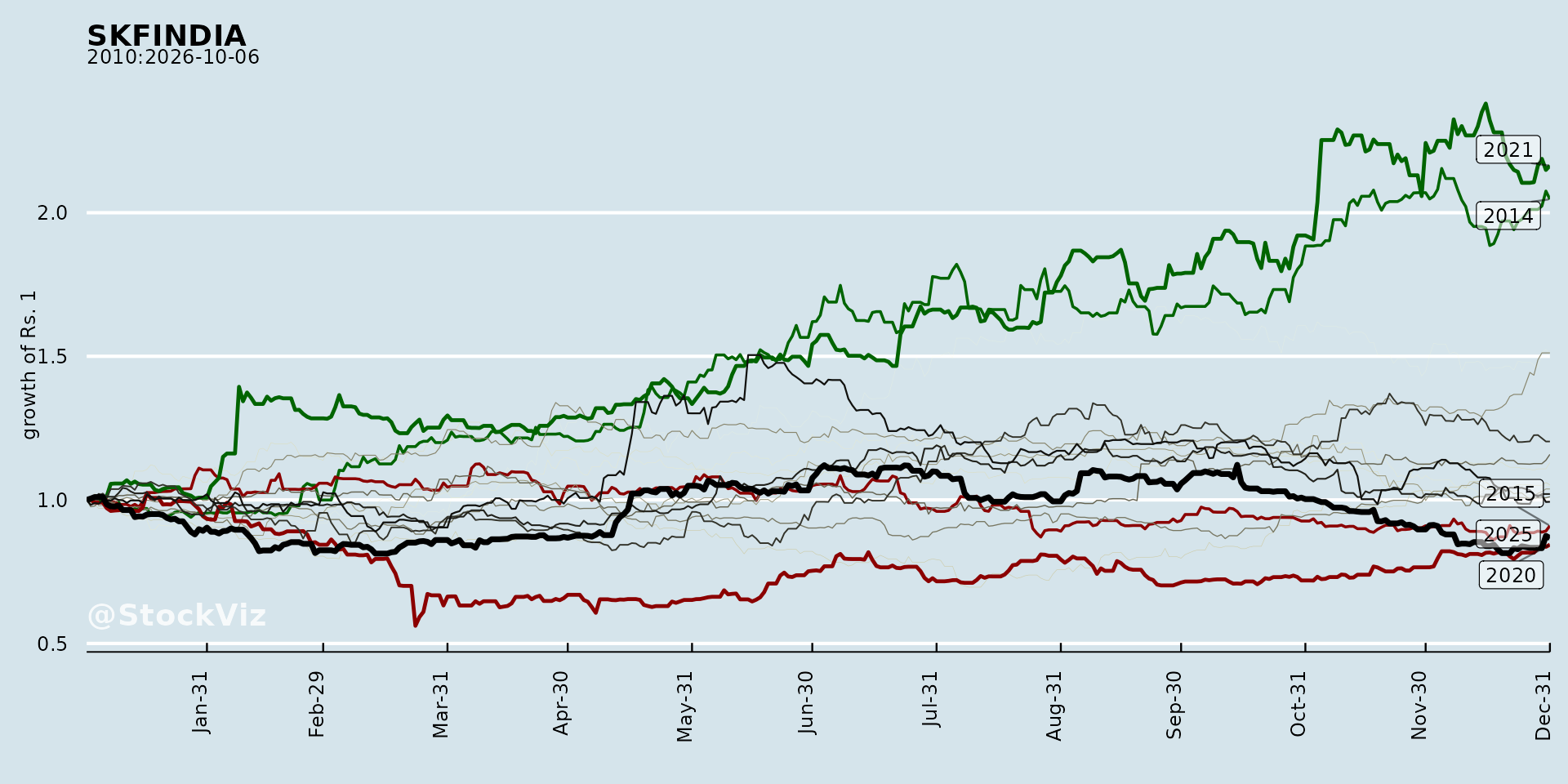
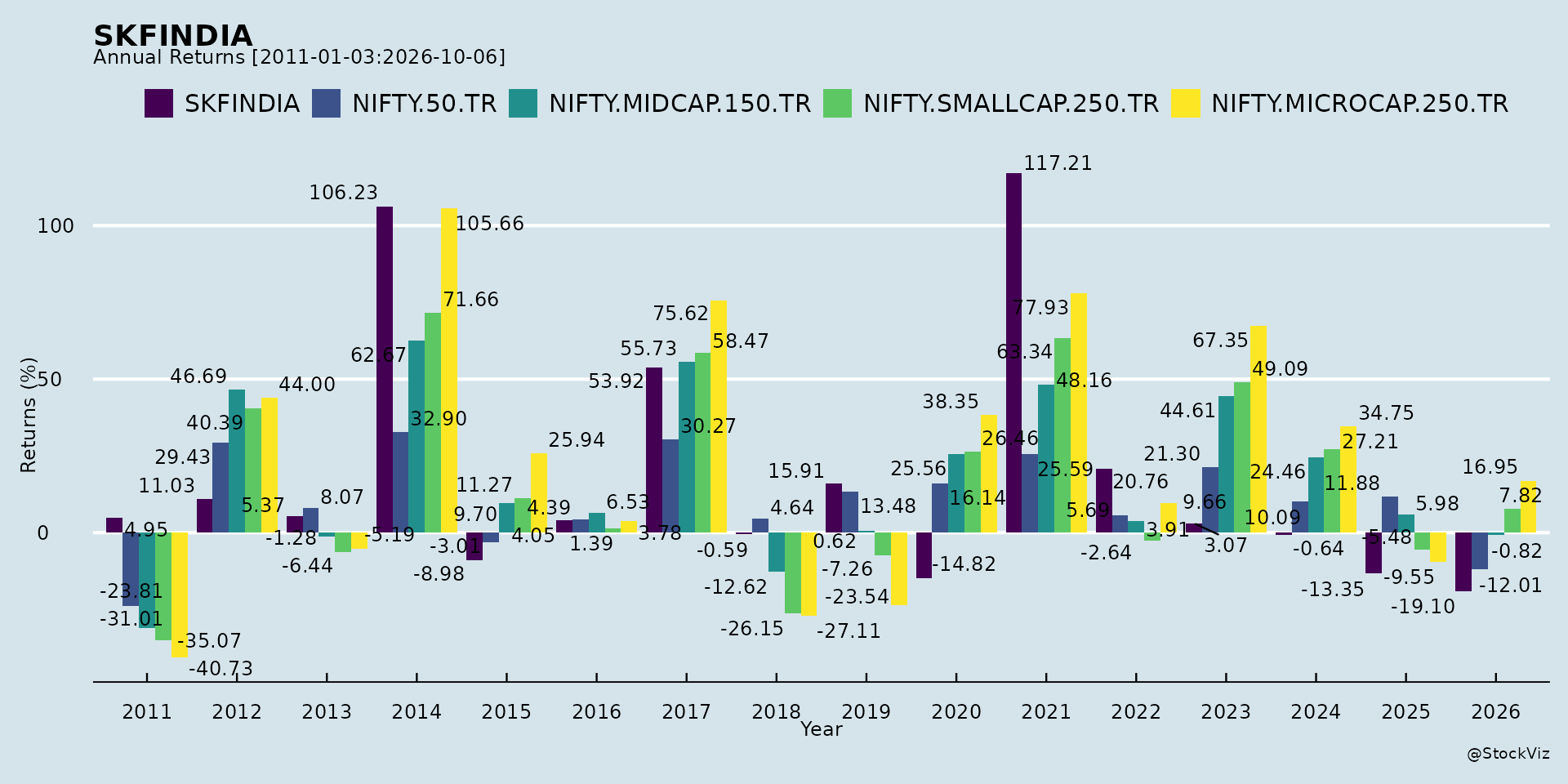
Annual Returns
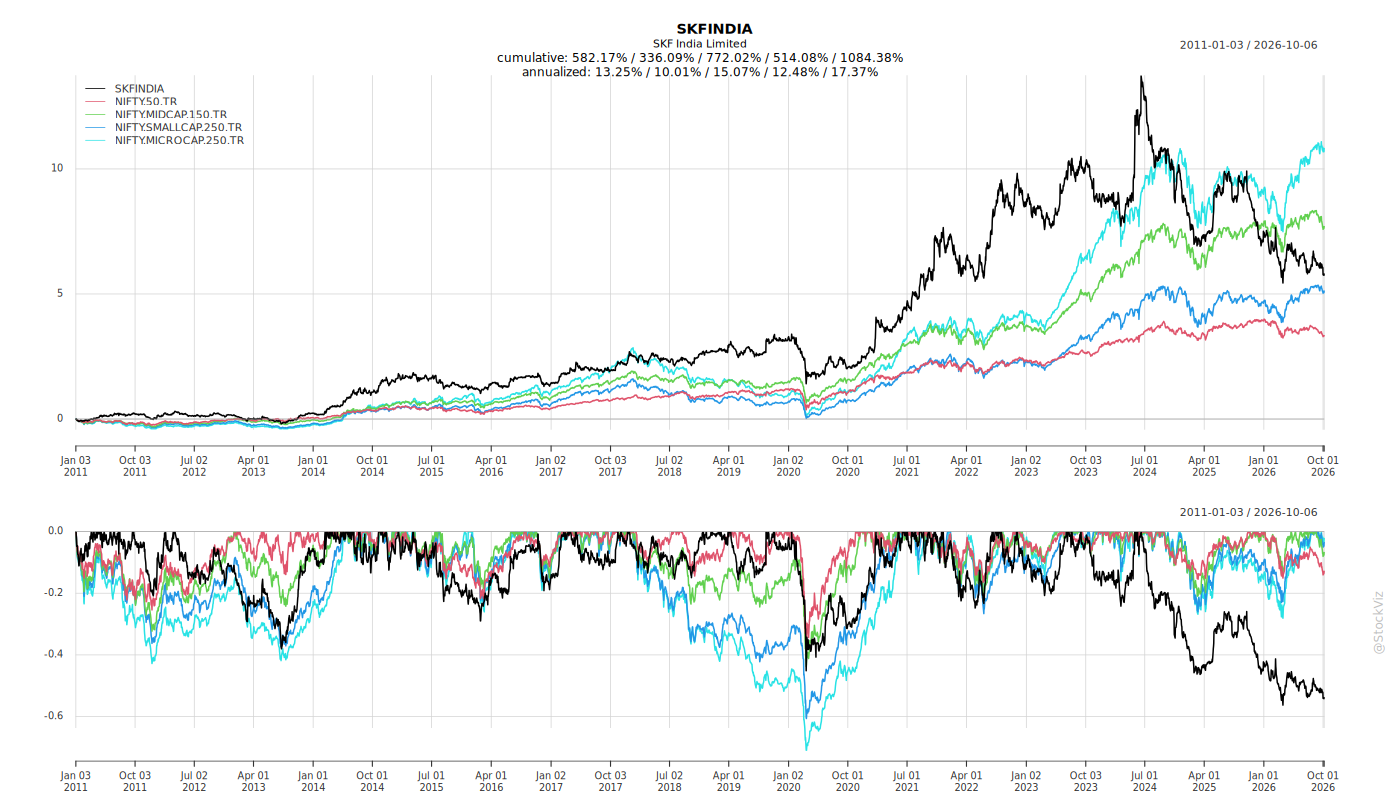
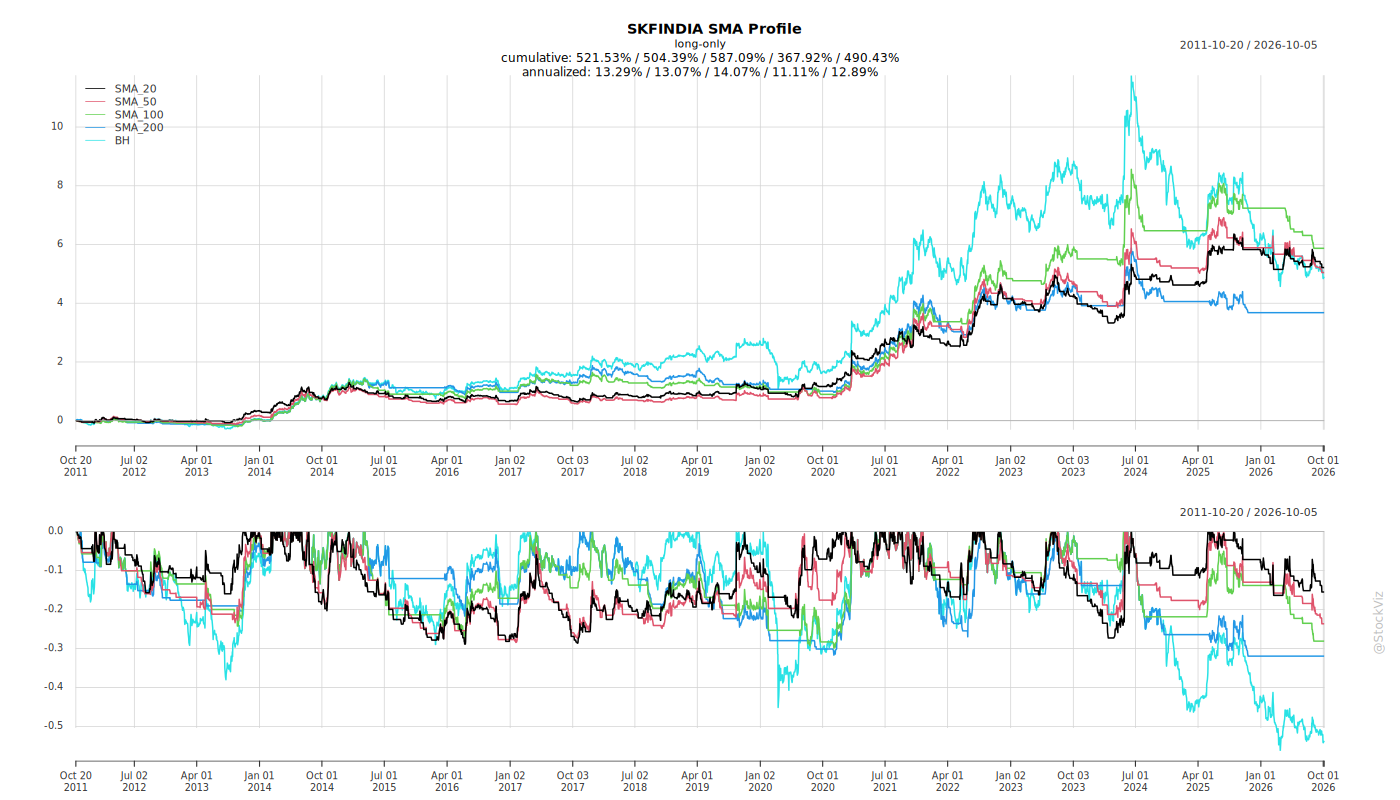
Cumulative Returns and Drawdowns
Fundamentals
Ownership
Margined
AI Summary
asof: 2026-09-17
SKF India Limited — Q1 FY27 Announcements: Headwinds, Tailwinds, Risks and Guidance
1. Headwinds and Challenges
Mixed macro and end-market signals. Management described IIP growth as stable at 4.8% for Q1 FY27 and manufacturing PMI at 54.4 for June 2026. Automotive production trended upward for two- and three-wheelers, but passenger and commercial vehicle production declined marginally, and iron and steel production declined during the quarter.
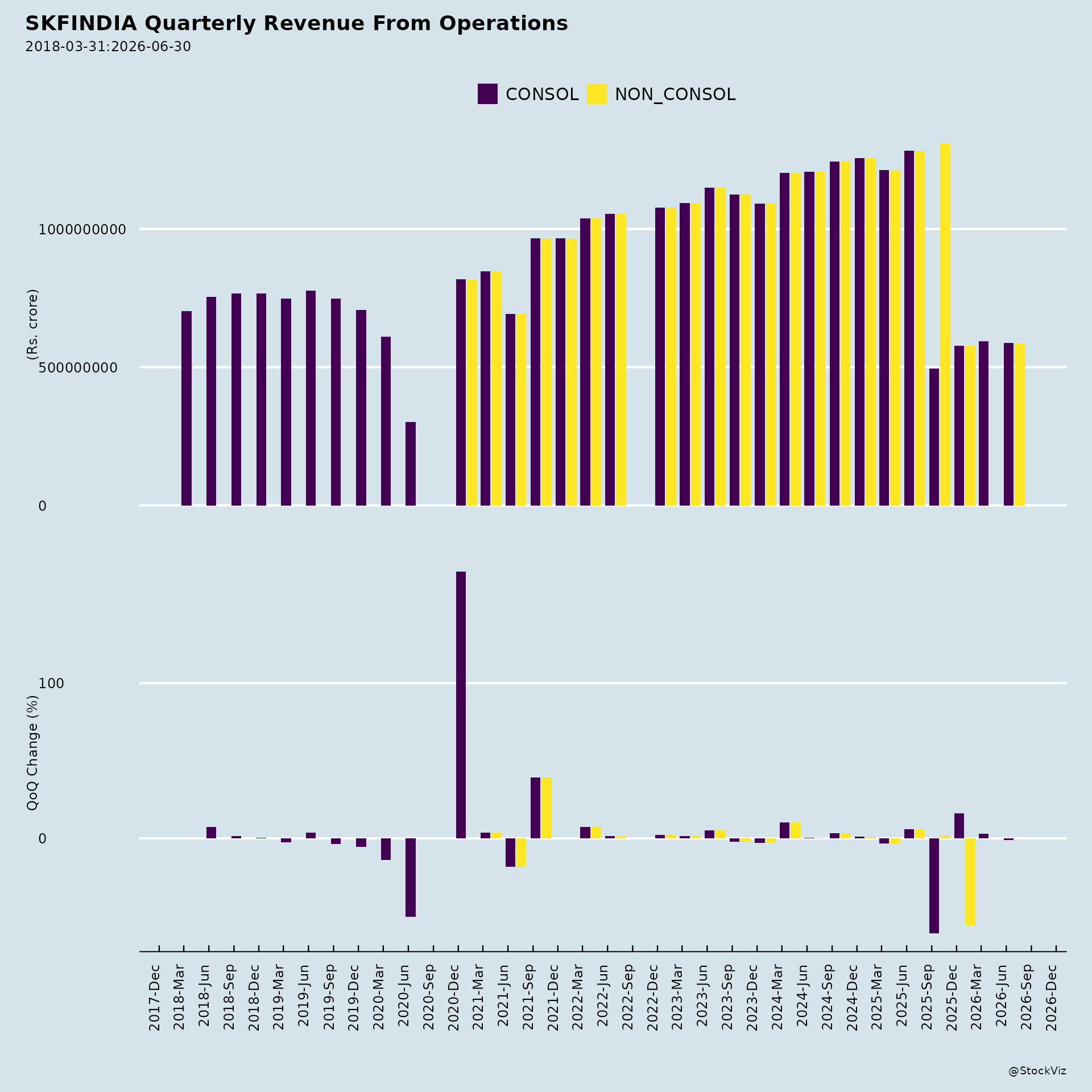
Sequential softness. Although revenue grew 27% year-on-year to INR 5.9 billion, it was roughly flat to marginally lower quarter-on-quarter (minus 1% at the revenue level; product sales down 0.7% QoQ). Volumes were 6.3% lower QoQ, offset by a positive 5.6% price-mix impact.
Gross margin pressure and lag effects. Gross margin was about 1% lower year-on-year, with the sequential move from 42.5% in Q4 to 51% in Q1 attributed to mix and inventory revaluation under FIFO. Management noted that commodity inflation realisation does not occur in the same quarter, with a lag of one to two quarters depending on individual customer contracts, so quarterly gross margin can fluctuate.
Vehicle aftermarket weakness. The vehicle aftermarket (about 20% of sales) has been “kind of plateau or a small decline,” with discounting required in the last two months. Management described this segment as facing a different set of challenges, including numerous competitors and fake products, and said the focus is on protecting profitability before improving volume.
Industrial segment not a growth priority. Sales to SKF Industrial are described as not a growth segment; this revenue is expected to come down over the next few years as capacity is redirected to automotive customers. Comparability is also affected because the industrial entity was carved out only in the December 2025 quarter.
Trading mix and related-party markups. Trading parts involve both sales to and purchases from SKF Industrial, with a markup applied on related-party transactions; margins are expected to improve only as in-house capacity builds up.
Demerger-related items. Exceptional items include non-recurring demerger expenses and new labour-code impacts. Q4 FY26 profitability was impacted by one-off factors including demerger-related items, and the company has recognised stamp duty costs including estimated transfer premium of INR 1,639.2 million related to land transfers between SKF India Limited and SKF India (Industrial) Limited. A BAPA with the CBDT covering FY2012-13 to FY2020-21 resulted in an incremental tax expense of INR 614.8 million (including interest of INR 72.8 million) in the prior quarter, with modified tax returns filed for those years in the current quarter.
2. Tailwinds and Growth Prospects
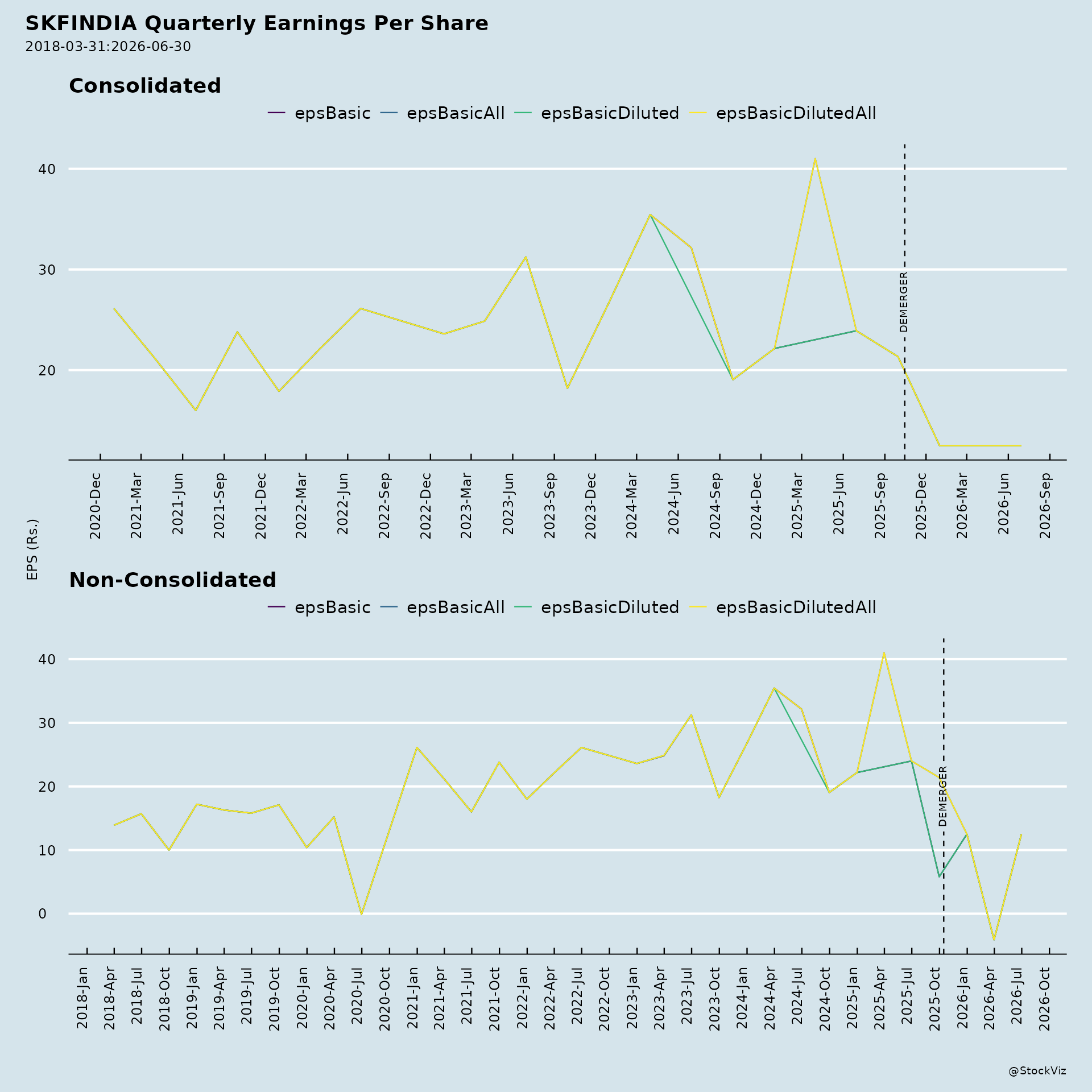
Strong top-line momentum. Q1 FY27 revenue from operations was INR 5,877.9 million, up 27.1% year-on-year, driven by 22% higher volumes and broad-based demand across two- and three-wheelers, passenger vehicles and commercial vehicles, in both domestic and export markets.
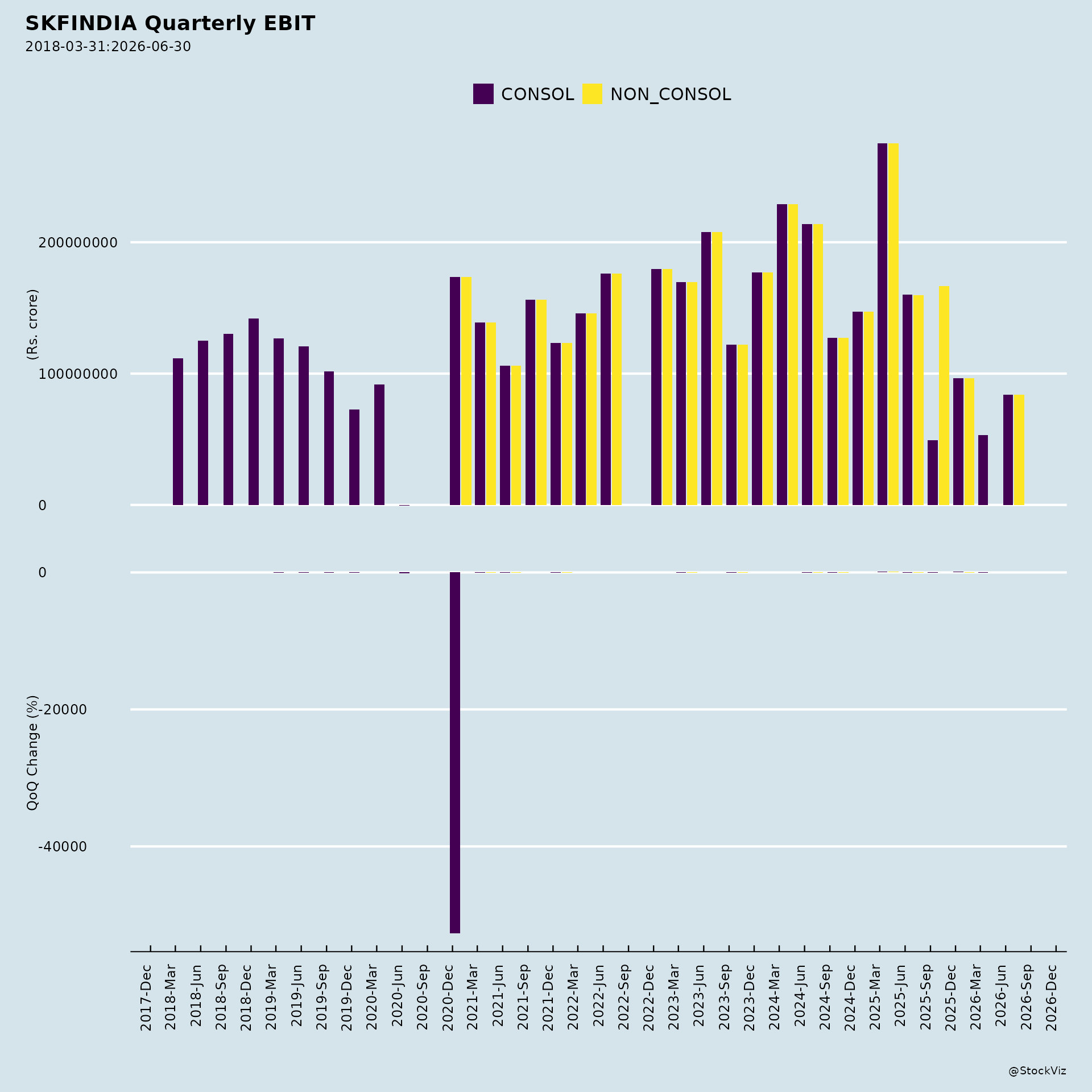
Profitability normalisation. EBITDA was INR 1,003.9 million at 17.1% margin versus 17.0% a year earlier; PBT was INR 837.8 million (14.3%) versus INR 631.5 million (13.7%). Sequentially, EBITDA margin improved about 540 bps and PBT about 527 bps excluding exceptional items, which management attributed to profitability returning to a normal level after Q4 FY26 one-offs.
New wheel-end business win. SKF won a wheel-end business from a large passenger vehicle manufacturer seeking localisation of bearings, following multi-year engagement and audits. Production starts Q4 CY2028; management called it SKF’s first wheel-end offering with this customer and a foundation for long-term engagement.
Electrification pipeline. Orders referenced in the prior quarter are developmental platforms expected to come on stream around Q4 CY2028, with full-stream production ramp-up across vehicle segments beginning mid-2027 and fuller visibility in 2028. Capex at Haridwar is primarily for two-wheeler traction motors and some driveline applications.
Customer engagement and recognition. A tech show at Maruti Suzuki drew 400-plus visitors, with interest in low-friction hub bearing units and e-drive conductive brush ring solutions for ICE and EV applications. SKF received a Best Delivery Award from Suzuki Motorcycle and a technical supplier partnership recognition from Degree Torque Transfer Solution.
Sustainability milestones. All three plants (Pune, Bangalore, Haridwar) achieved more than 98% renewable energy sourcing and received group certification as decarbonized plants. Bangalore achieved water positivity of 2x and Haridwar 2.57x, with Pune in progress.
Capacity expansion. About 5 million pieces of capacity were unlocked this year through technological upgradation of assets, with channels being added at Haridwar. Of the INR 500 crore capex programme, INR 170–180 crore is expected in the current financial year, with new capacity starting in Q4 and revenue impact from the next financial year; the programme is largely expected to be completed by FY28, with some possible spillover to FY29.
3. Key Risks
- Forward-looking statements are subject to risks and uncertainties, and actual results may differ materially.
- Commodity inflation pass-through carries a one-to-two-quarter lag depending on customer contracts, creating quarterly margin variability.
- Gross margin can move with mix, seasonality and FIFO inventory revaluation.
- The vehicle aftermarket faces competition from numerous players and fake products, with volume recovery dependent on strategy execution over the next five months.
- Export demand is not a major strategic pillar and is expected to remain range-bound, influenced by capacity shortages in other regions rather than SKF’s own demand planning.
- The industrial segment’s contribution is expected to decline, and related-party trading carries markup effects on margin.
- New capacity at Haridwar starts only in Q4 and requires ramp-up, so revenue contribution is deferred to the next financial year.
- Demerger-related land transfer obligations and stamp duty/transfer premium costs, plus tax proceedings and labour-code rule finalisation, remain open items.
- Portfolio rationalisation — relocating production across the three factories and addressing unprofitable or loss-making sales — carries execution considerations, though management indicated no major FY27 impact.
4. Management Guidance Versus Observed Performance
Revenue guidance raised. Management had previously guided to about 12% revenue growth. Following Q1 growth of 27%, management revised expectations to close to 20%, “much better than the 12% guidance we had given earlier.” Q1 actual growth of 27.1% year-on-year exceeded both the original and revised guidance.
Capacity adequacy. Management confirmed sufficient capacity to achieve the ~20% growth, supported by 5 million pieces unlocked through asset upgradation and Haridwar capacity additions, with Q4 capacity build also underway.
Margin guidance. Management stated the 17% margin level is largely normalised and is the range expected for the next two years. Q1 EBITDA margin of 17.1% is consistent with this guidance.
Capex guidance. Management guided to INR 170–180 crore capex in the current financial year out of the INR 500 crore programme, with completion largely by FY28 and possible spillover to FY29. No Q1 capex figure was disclosed.
Segment mix guidance. OEM is about 62% of sales (two-wheeler ~54%, passenger vehicle ~31%, commercial vehicle ~15%), distribution/aftermarket ~20%, exports ~8%, SKF Industrial ~10%. Management indicated OEM segment shares are range-bound historically (two-wheeler 48–52%, PV 28–30%, CV 11–12%) and that growth broadly mirrors underlying OEM production data.
EV revenue timing. Management indicated it is not yet relevant to quote EV non-wheel bearing revenue numbers, as these businesses remain in development and ramp-up phases with visibility expected in 2028.
Portfolio rationalisation. Management confirmed no major FY27 revenue or volume impact from portfolio rationalisation.
Net Zero commitment. SKF is committed to achieving Net Zero in operations by 2030 and throughout the value chain by 2050.
Broker Narrative
The broker maintained a Buy rating across both reports, but the tone shifted from confident optimism about healthy domestic demand, localisation, railways, and after-market margin gains to a more guarded view that acknowledged a domestic automotive/industrial slowdown, raw-material/steel volatility, and Industry 4.0 adoption challenges. Persistent themes were localisation, after-market/services mix, and exposure to railways/EV/renewables/mining; the earlier export-slowdown and commodity-inflation risk was reframed as domestic demand and high-grade steel availability/price risk.
Fears that came true
- The last report’s slowdown warning in domestic automotive and industrial segments materialised as a disappointment, with the stock returning only +3.9% versus the predicted +25.5%.
- Raw-material/steel volatility, which persisted from the first report’s commodity-inflation risk into the last report’s high-grade steel warning, weighed on profitability and contributed to the below-forecast +3.9% actual return.
Optimism that failed
- The expected 15% revenue, 20% EBITDA, and 22.8% PAT CAGR over FY23-25E did not translate into the broker’s predicted +25.5% return, as the actual return was just +3.9%.
- The first report’s optimism on healthy domestic industrial/automotive demand failed to sustain, with the last report itself flagging a slowdown and the subsequent stock performance disappointing.
Copyright © 2023 SAS Data Analytics Pvt. Ltd. All rights reserved.