SBILIFE
Equity Metrics
September 24, 2026
SBI Life Insurance Company Limited
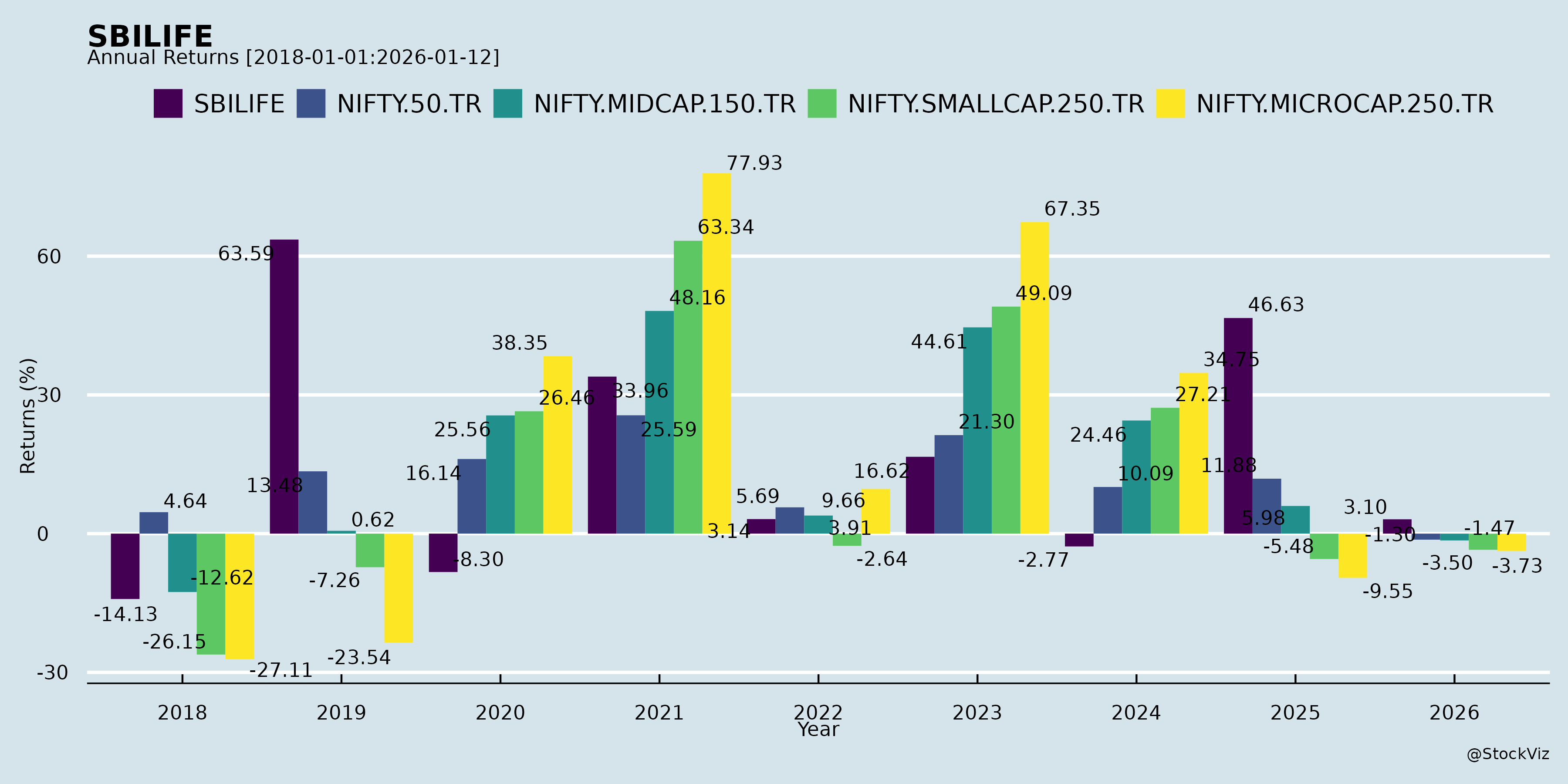
Annual Returns
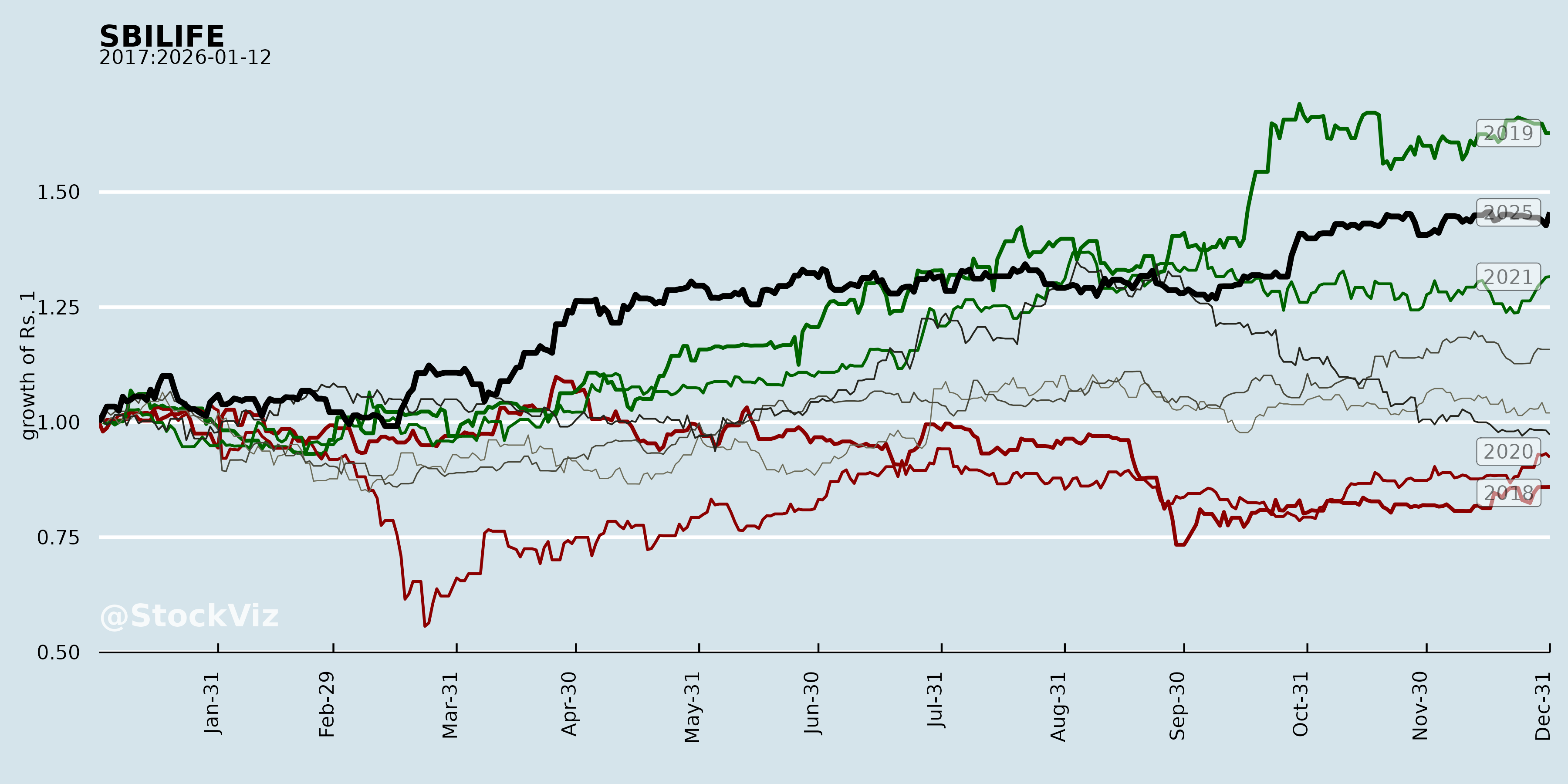
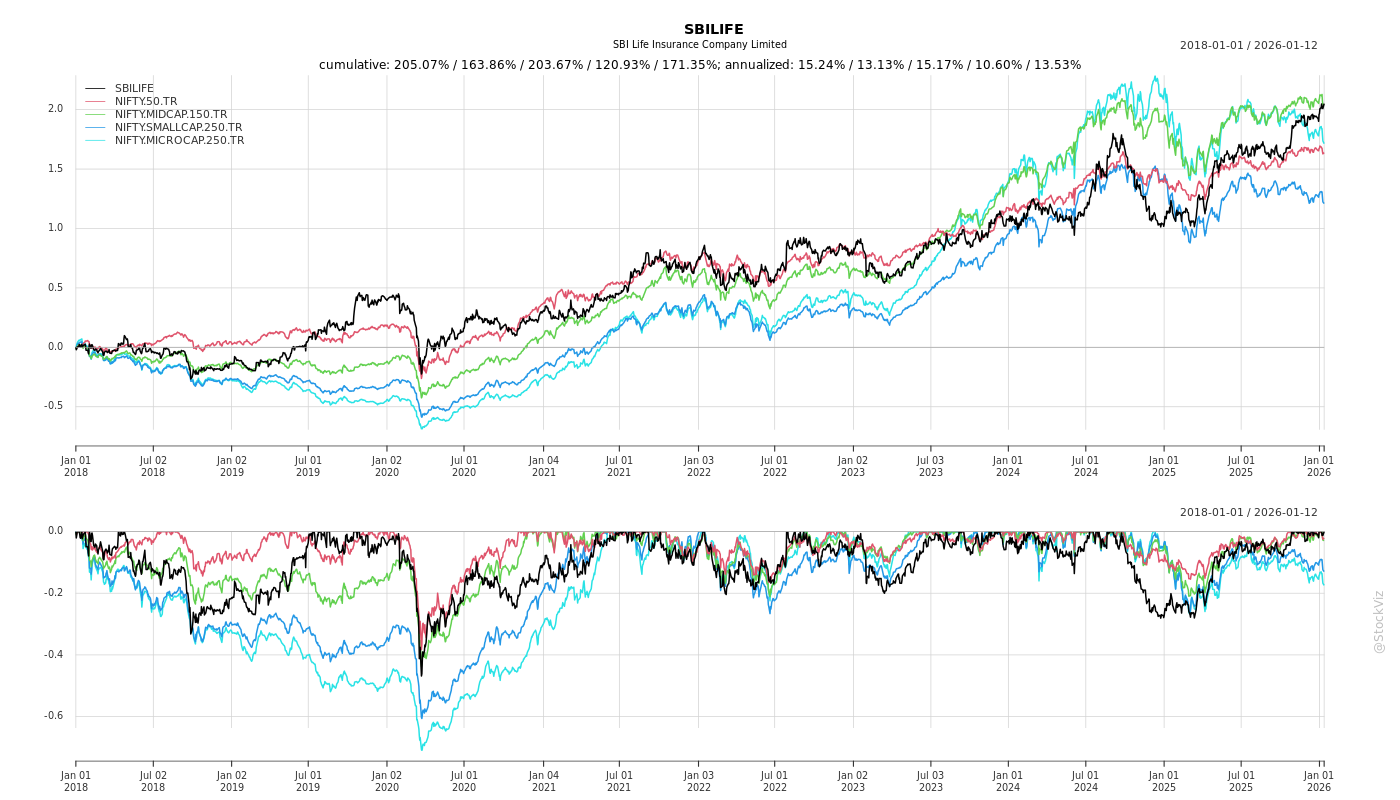
Cumulative Returns and Drawdowns
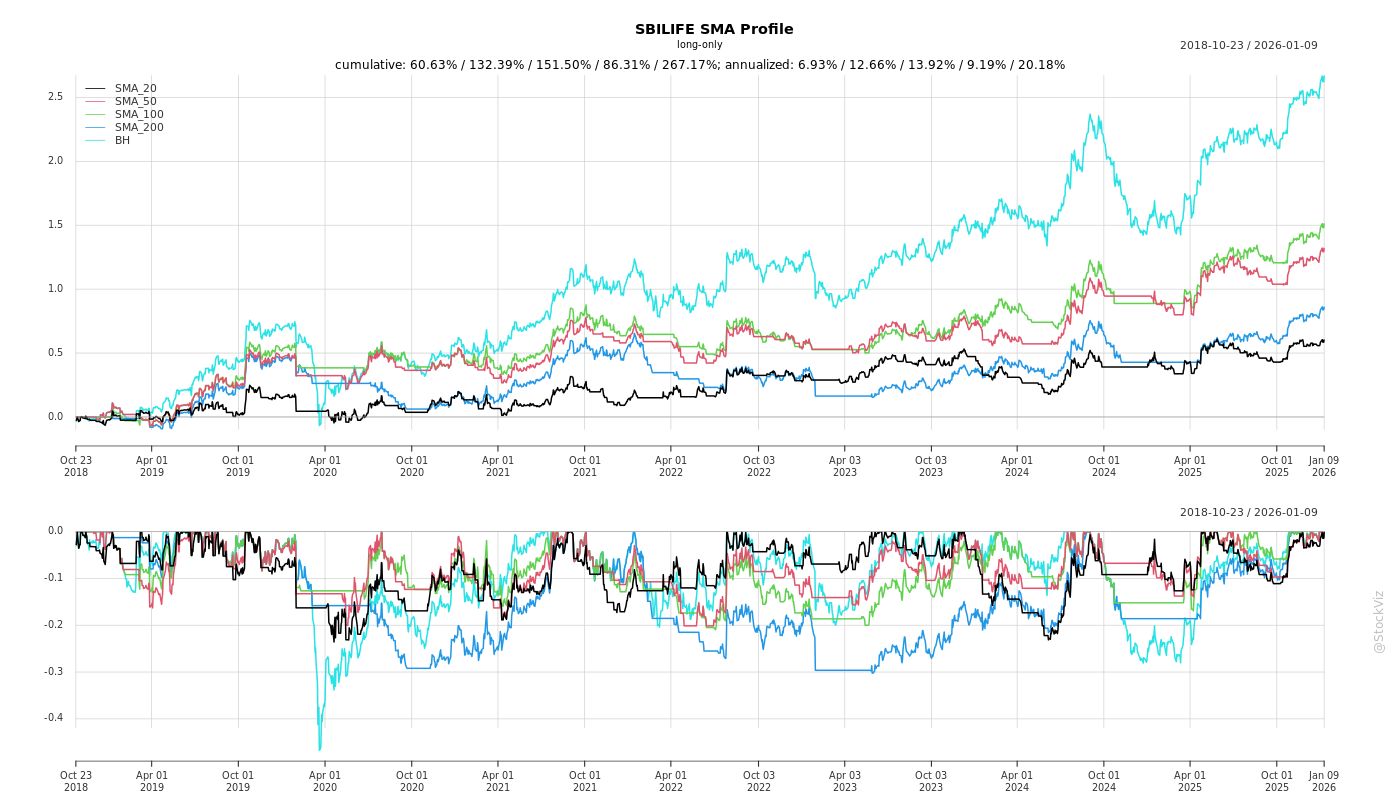
Fundamentals
Ownership
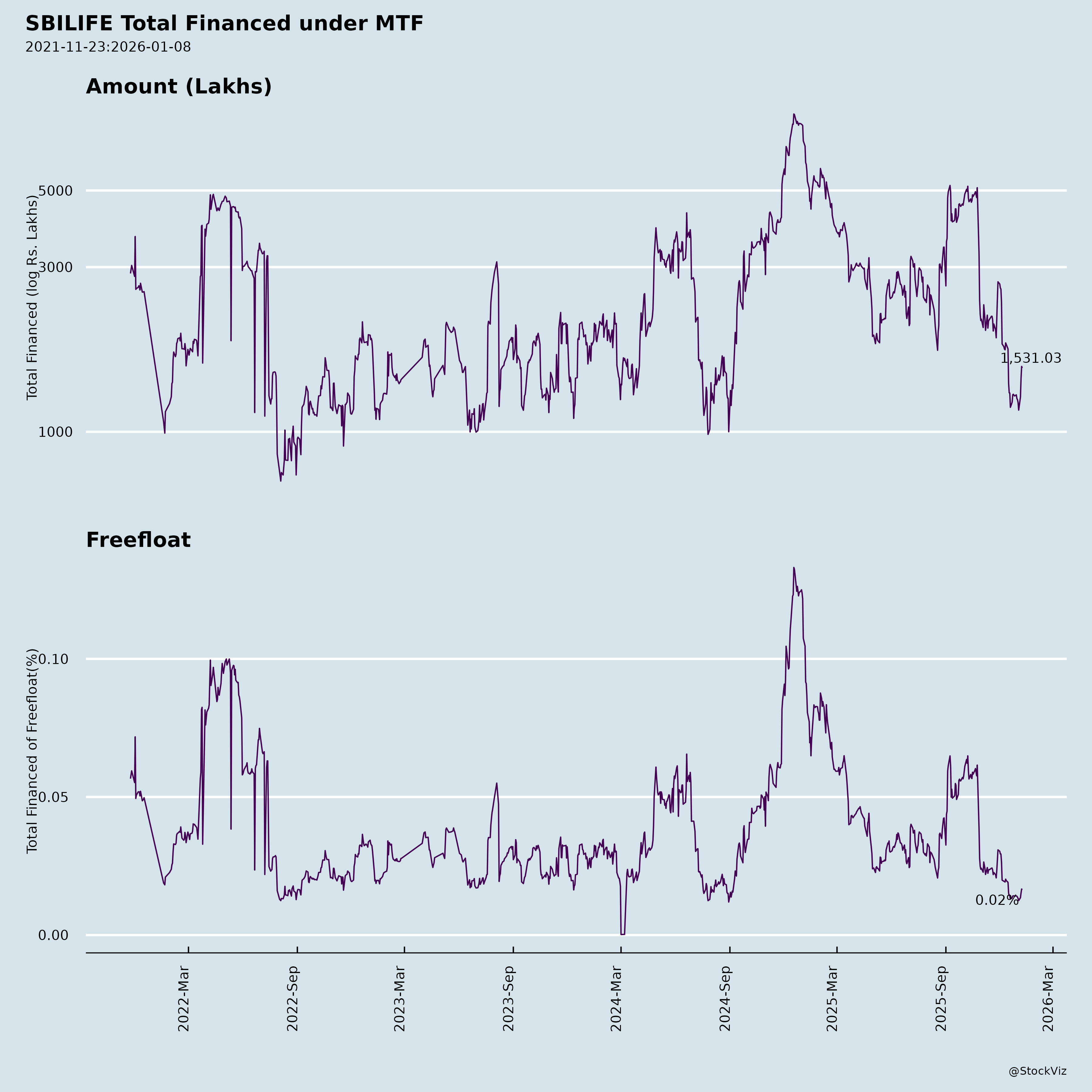
Margined
AI Summary
asof: 2026-09-14
SBI Life Insurance — Recent Corporate Announcements: Analysis
1. Headwinds and Challenges
Cost pressure. Total cost ratio rose to 12.0% in Q1 FY27 from 10.8% in Q1 FY26. The operating expense ratio increased to 7.7% from 6.3%, while the commission ratio was flat at 4.4%. The company attributes the operating expense movement to its growth investments, but the direction of travel is adverse relative to the prior-year quarter.
Declining long-tenure persistency. While 13th-month persistency improved by 61 bps (87.7% vs 87.1%) and 49th-month persistency improved by 68 bps (69.1% vs 68.4%), the 61st-month persistency ratio fell sharply to 58.4% from 63.6%. This indicates weaker retention of older cohorts even as near-term retention improves.
VoNB margin compression. VoNB margin declined to 26.2% in Q1 FY27 from 27.4% in Q1 FY26, even as absolute VoNB grew 29% to ₹14.1 billion. The margin dilution reflects the changing product mix, notably the sharp rise in group protection business.
Product and channel mix concentration shifts. The APE product mix moved to 5% Par / 49% Non-Par / 46% ULIP from 5% / 38% / 57%, and the channel mix moved to 47% Bancassurance / 25% Agency / 28% Others from 58% / 27% / 15%. The heavy swing toward “Others” (largely group protection) introduces mix volatility.
Sensitivity to lapse and mortality experience. The disclosed sensitivity analysis shows VoNB is highly sensitive to adverse experience: a 10% proportionate increase in lapse rates reduces VoNB by 4.4%, a 10% increase in mortality/morbidity reduces VoNB by 7.3%, and a mass lapse event for ULIPs after the surrender penalty period (25% / 50% scenarios) reduces VoNB by 7.3% / 15.8%. A tax rate change to 25% would reduce VoNB by 9.6%.
Regulatory and accounting transition. IRDAI granted a one-year forbearance to defer adoption of Ind AS for FY 2026-27. The company continues to maintain separate books of account for the SILIC portfolio. This defers, rather than removes, the accounting transition.
Seasonality. Management notes that, given industry seasonality, quarterly or interim results are not necessarily indicative of results for any other interim period or the full year.
2. Tailwinds and Growth Prospects
Strong top-line growth. Q1 FY27 APE stood at ₹53.8 billion, up 36% year-on-year. New Business Premium grew 23% to ₹89.1 billion, Renewal Premium grew 17% to ₹123.8 billion, and Gross Written Premium grew 20% to ₹212.9 billion. Total New Business Sum Assured stood at ₹8,500.3 billion, up 211%.
Market leadership. The company retained private-market leadership in Individual New Business Premium and Individual Rated Premium, with market shares of 24.9% and 22.2% respectively. Individual Rated Premium was ₹39.7 billion, up 14%.
Protection and non-par momentum. Protection New Business Premium stood at ₹19.6 billion in Q1 FY27, with group protection APE up 313% and individual protection APE up 18%. Non-par savings APE grew 27%. Management describes the shift toward protection and guaranteed non-par savings as reflecting evolving customer preferences and strategic focus.
Profitability and value accretion. PAT grew 22% to ₹7.2 billion. VoNB grew 29% to ₹14.1 billion. Indian Embedded Value rose 15% to ₹852.9 billion (IEV per share ₹850.2). Return on Equity improved to 14.8% from 13.7%.
Distribution expansion. All key channels achieved double-digit APE growth: Bancassurance +10%, Agency +24%, Others +160%. Individual NBP of the Agency channel rose 17% to ₹15.5 billion and of Other channels rose 25% to ₹10.3 billion. The company operates 1,241 offices with 371,935 trained insurance professionals.
Financial strength. Solvency ratio stood at 1.96 against the regulatory requirement of 1.50. Net worth rose 13% to ₹201.1 billion. AuM grew 10% to ₹5,248.5 billion, with a 60:40 debt-equity mix and approximately 94% of debt investments in AAA and Sovereign instruments.
Industry and macro opportunity. The presentation cites India as the second-largest life insurance market among emerging economies with an 11% share of premiums written in 2025 and 3% of global life premiums; life insurance penetration of 2.6% in 2025 versus an emerging-markets average of 1.9%; a median population age of 28 years; and expectations that India will be the fastest-growing major economy, with real GDP growth forecasts of 6.6% annually on average from 2024 to 2028 and 6.8% from 2026 to 2030. Annuity demand is expected to rise with increasing life expectancy and NPS growth.
Digital and customer metrics. 99.9% of individual applications were submitted digitally; 98.8% overall death claim settlement ratio; Net Promoter Score of 86; 76.7 million servicing inforce lives; 37% of policies sold in rural areas in Q1 FY27.
3. Key Risks
- Lapse risk: VoNB sensitivity of −4.4% for a 10% lapse increase and −15.8% under a 50% mass-lapse ULIP scenario.
- Mortality/morbidity risk: VoNB sensitivity of −7.3% for a 10% adverse movement.
- Expense risk: VoNB sensitivity of −1.9% for a 10% maintenance expense increase; the operating expense ratio has already risen year-on-year.
- Tax risk: A tax rate change to 25% would reduce VoNB by 9.6%.
- Market risk: A 10% decrease in equity value reduces VoNB by 0.6%; interest rate movements have a smaller measured effect (reference rate +100 bps: −0.5%; −100 bps: 0.0%).
- Regulatory/accounting risk: Deferred Ind AS adoption for FY 2026-27 and continued separate accounting for the SILIC portfolio.
- Forward-looking statement risk: The company’s own disclosures note risks and uncertainties including demand growth, strategy execution, technology changes, regulatory changes, tax and legal proceedings, and accounting standard impacts.
4. Management Guidance Versus Observed Performance
Management commentary (July 24, 2026). MD & CEO Amit Jhingran stated that SBI Life continued its FY26 growth trajectory into Q1 FY27, delivering 14% growth in Individual Rated Premium supported by a favourable product-mix shift; that all product segments and all key distribution channels grew on an IRP basis; that renewal premium growth and improved 13th- and 49th-month persistency underscore strengthening customer relationships and business quality; and that the company is well-positioned to meet demand across protection, savings, and retirement solutions, with profitable new business supporting sustainable shareholder value creation.
Observed performance against that commentary. The reported numbers are consistent with the stated growth trajectory: IRP grew 14%, all channels grew at double digits, renewal premium grew 17%, and 13th- and 49th-month persistency improved. However, the same quarter also shows VoNB margin compression (26.2% vs 27.4%), a higher total cost ratio (12.0% vs 10.8%), and a decline in 61st-month persistency (58.4% vs 63.6%) — dimensions not addressed in the management statement.
Explicit forward-looking caveat. Management states that, in view of industry seasonality, financial results for a quarter or interim period are not necessarily indicative of results expected for any other interim period or the full year.
Governance and disclosure events. The 26th AGM was held on August 14, 2026, and all resolutions were approved with requisite majority, including adoption of FY26 accounts, confirmation of the interim dividend declared February 25, 2026 as final dividend, fixation of statutory auditor remuneration for FY 2026-27, and revision in the remuneration of MD & CEO Amit Jhingran. M/s. K S Aiyar & Co. and M/s. J Singh & Associates were reappointed as Joint Statutory Auditors for FY 2026-27. The Q1 FY27 results received Limited Review Reports with unmodified opinions from the joint statutory auditors. The company disclosed upcoming investor meetings: UBS India Summit 2026 on September 11, 2026 in Mumbai; Jefferies India Forum 2026 on September 15–16, 2026 in Gurugram; and J.P. Morgan India Conference on September 22, 2026 in Mumbai.
Broker Narrative
The broker narrative evolved from early concerns about rising deposit costs, stagnating loan yields, and elevated operating expenses toward later focus on VNB margin compression from GST and GTI mix shifts, sharply higher expense ratios from labor-code and stamp-duty costs, and regulatory overhang on bancassurance. Persistent themes were margin pressure and expense escalation, while new headwinds around group business lumpiness and regulatory risk on bank-led distribution emerged. Tailwinds shifted from macro factors like INR2k discontinuance and treasury performance toward operational metrics like NBP growth, product diversification, persistency improvements, and solvency strength.
Fears that came true
- Rising cost of deposits and higher funding costs materialized as total cost ratio increased to 12.0% (vs 10.8% YoY) and Opex ratio rose to 7.7% (vs 6.3% YoY), coinciding with DISAPPOINTMENT outcomes from Aug 2024 through 2026.
- Margin moderation materialized as VNB margin compressed to 26.2% (down from 26.8% YoY) impacted by ~110 bps GST drag and higher GTI mix, correlating with DISAPPOINTMENT outcomes in late 2025 and 2026.
- Elevated operating expenses from wage/labor-code revisions materialized as Opex ratio surging to 7.7% (vs 6.3% YoY), coinciding with DISAPPOINTMENT outcomes in late 2024 and 2025.
- Regulatory uncertainties surrounding bank-led bancassurance distribution materialized as a persistent overhang correlating with the cluster of DISAPPOINTMENT outcomes from Oct 2025 onward.
Optimism that failed
- Robust Business Traction with NBP growing 23% YoY and pure protection premium up 41% YoY failed to prevent DISAPPOINTMENT outcomes from Oct 2025 through July 2026 despite strong growth numbers.
- Improving Operational & Persistency Metrics (13th-month persistency at 87.7%, 49th-month at 69.1%) failed to avert DISAPPOINTMENT results as margin compression and expense ratios overwhelmed persistency gains.
- Discontinuance of INR2k currency note aiding deposit accretion and improved real rate of return failed as rising cost of deposits and higher funding costs ultimately eroded those tailwinds, contributing to DISAPPOINTMENT outcomes.
Broker Timeline
67 broker calls · 2023-06-01 to 2026-07-28
Copyright © 2023 SAS Data Analytics Pvt. Ltd. All rights reserved.