RUBICON
Equity Metrics
September 24, 2026
Rubicon Research Limited
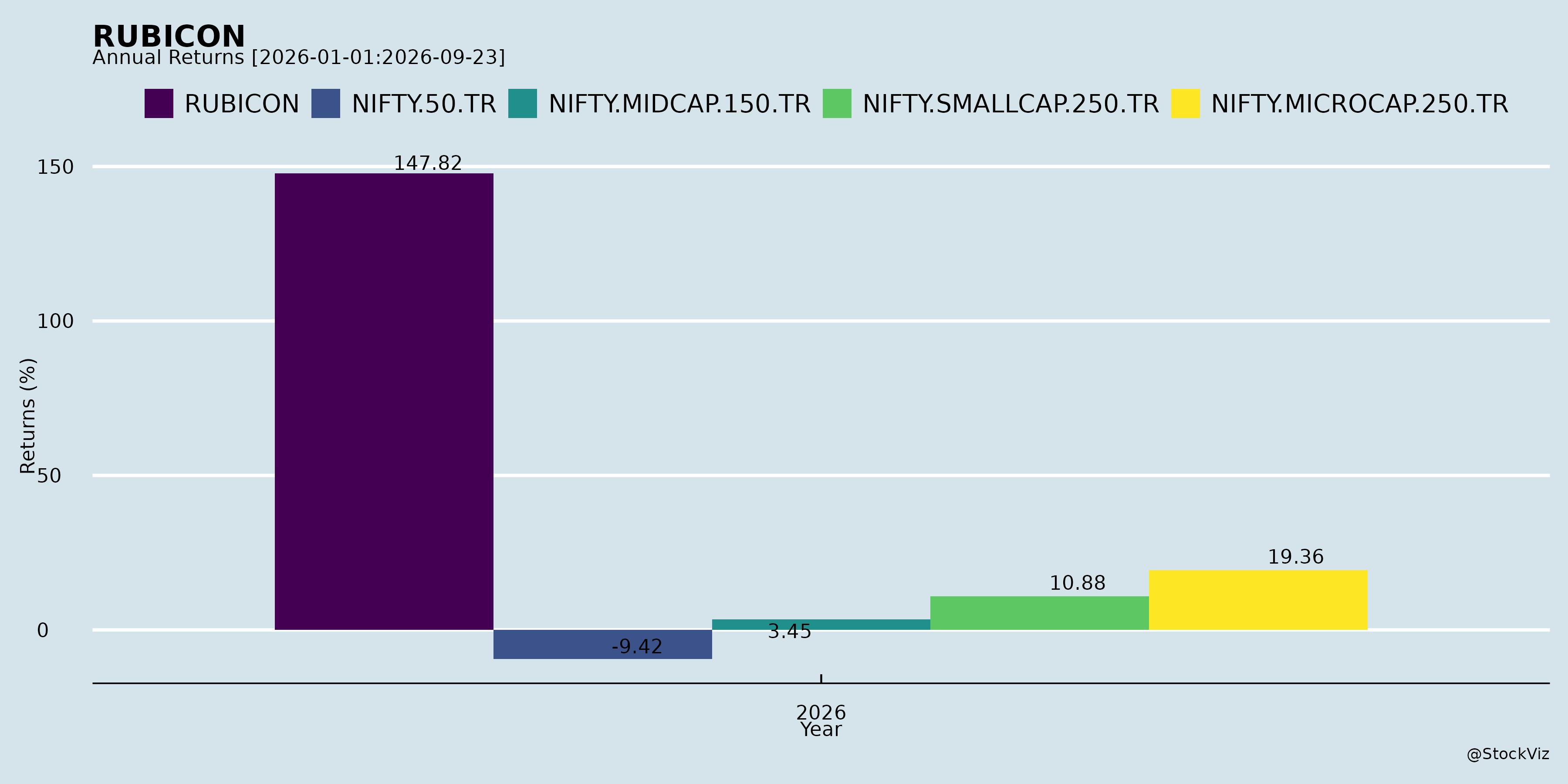
Annual Returns

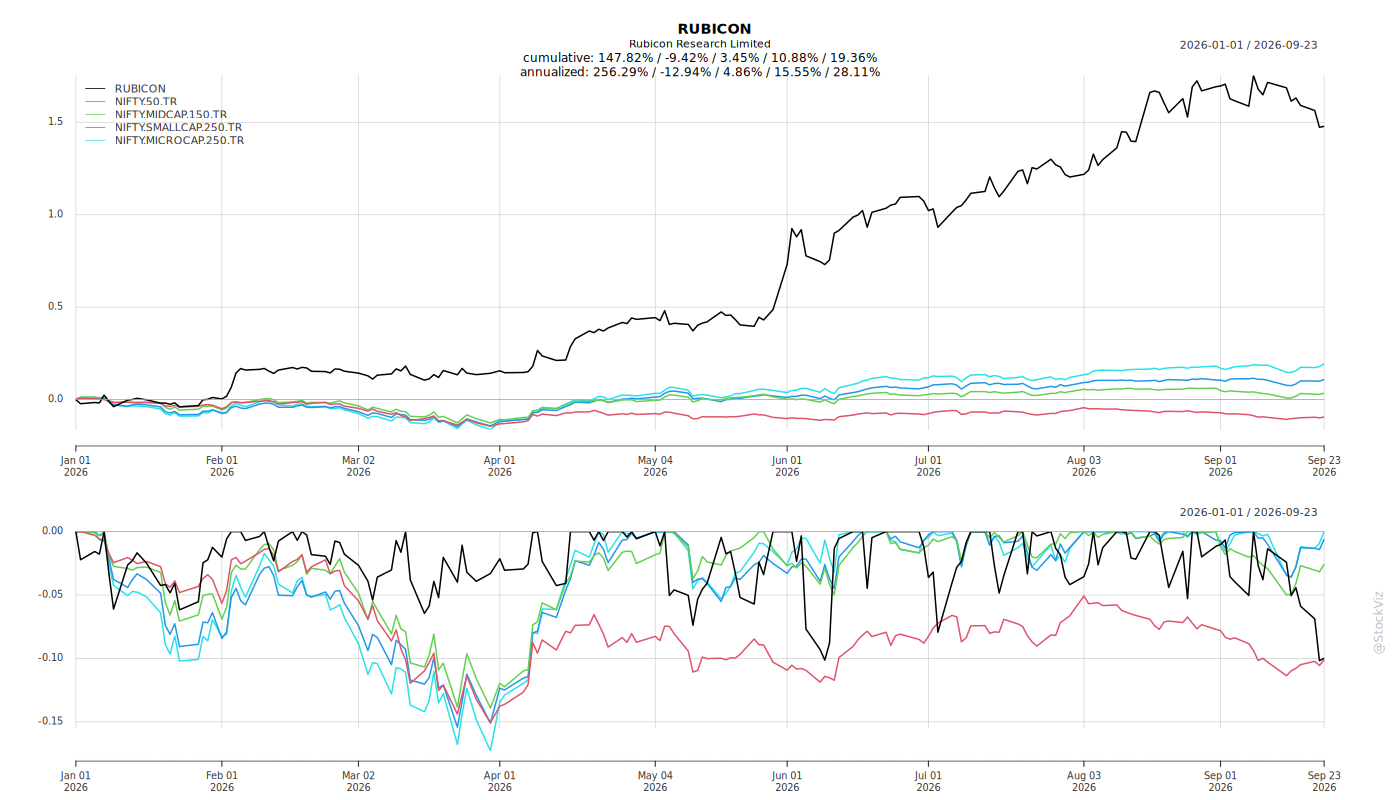
Cumulative Returns and Drawdowns
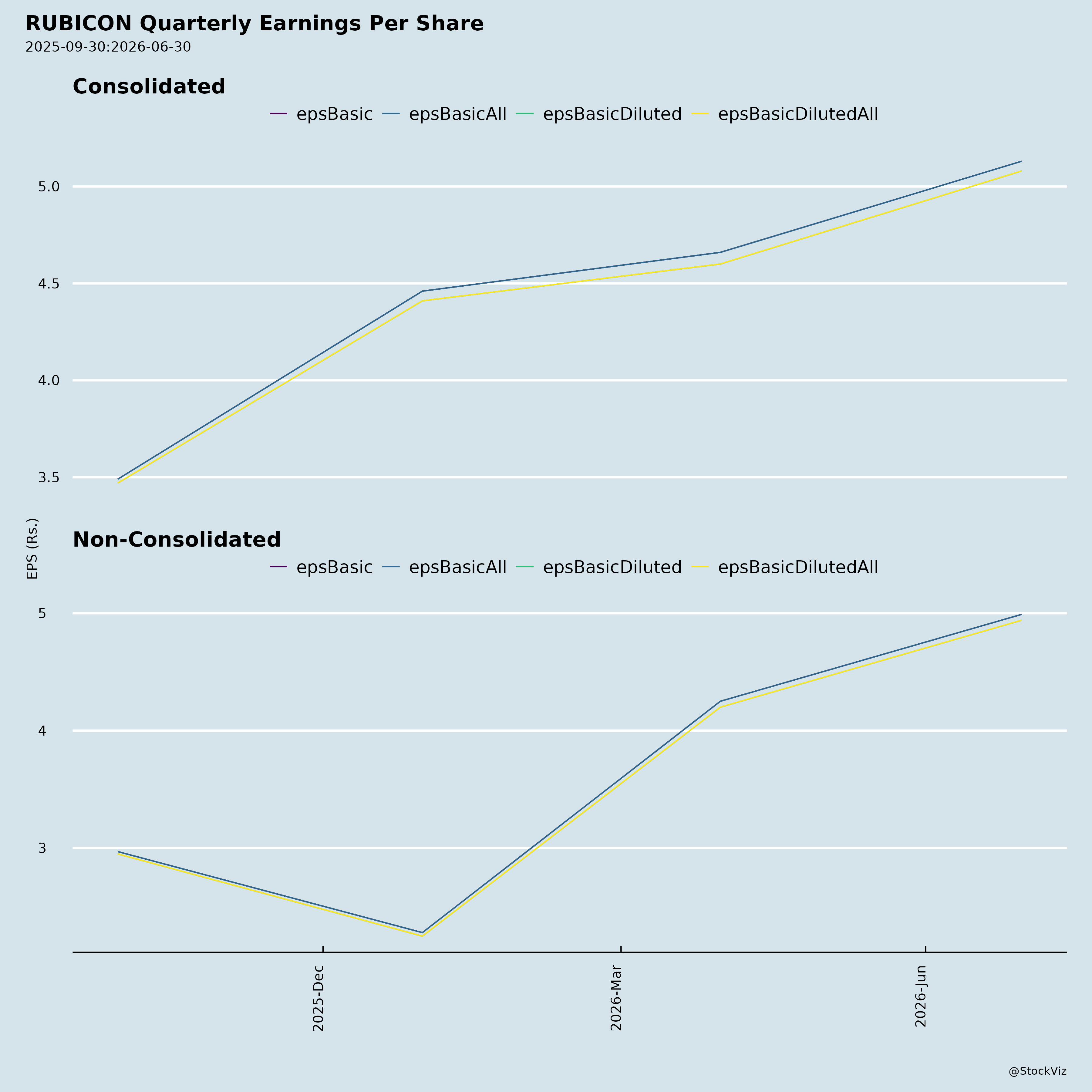
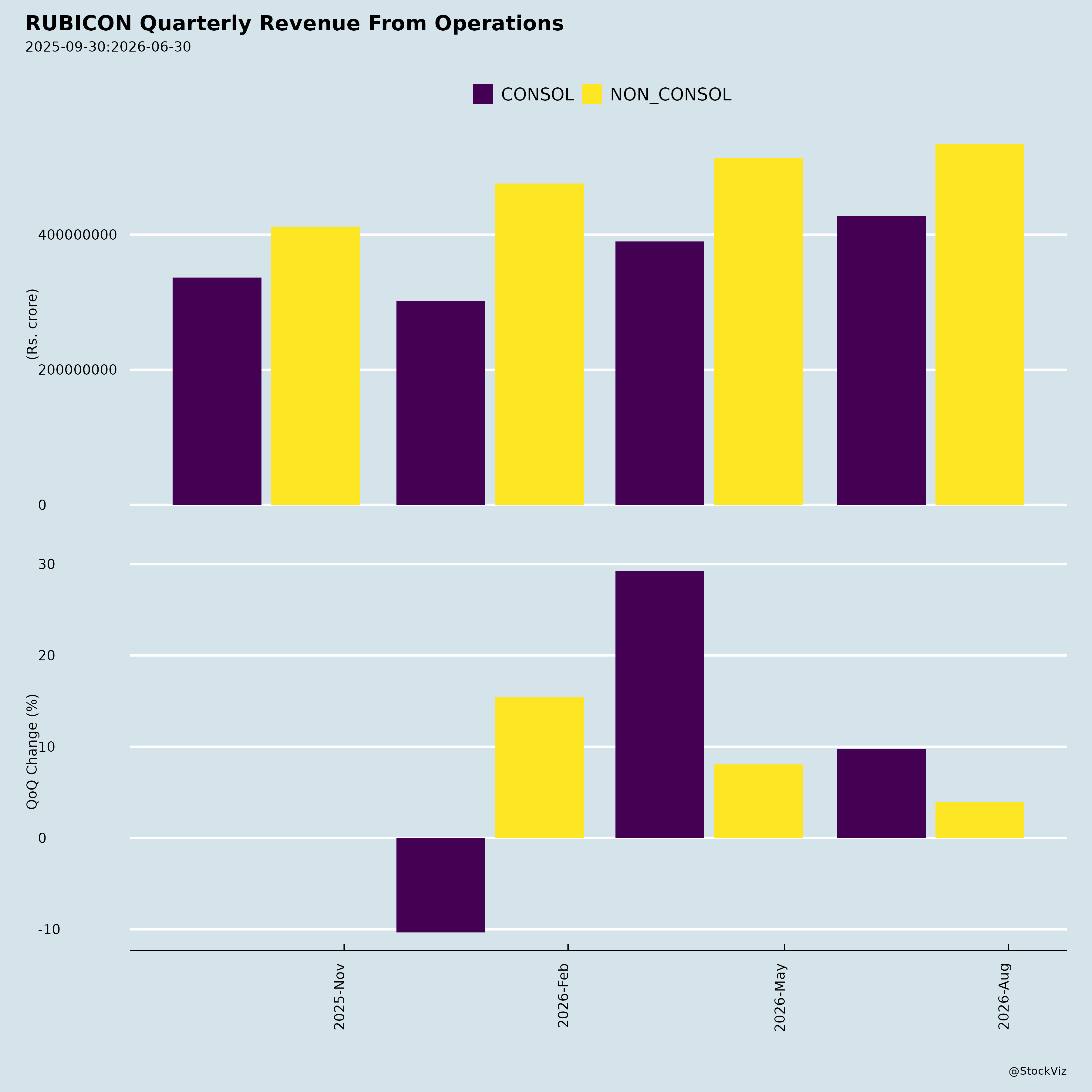
Fundamentals
Ownership
Margined
AI Summary
asof: 2026-09-16
Headwinds and Challenges
- Input cost inflation: Gross margin improved sequentially by 140bps to 67.7% in Q1 FY27 despite a sharp sequential increase in key input costs owing to the prevailing geopolitical situation.
- Manufacturing capacity constraints: Stronger-than-anticipated revenue traction combined with own manufacturing capacity constraints led to greater reliance on outsourced manufacturing, pressuring gross margins. In response, the company tactically gave up some relatively lower-margin business, which caused a marginal sequential drop in US revenues.
- Cost pressures on EBITDA: For the remaining three quarters of FY27, specific costs are expected to impact EBITDA margins, including ESOP costs of a new ESOP scheme, Arinna upfront growth-enabler costs, and pre-revenue costs at the New Jersey and Pithampur plants.
- Regulatory inspections: A US FDA unannounced inspection of the Pithampur facility (intimated to stock exchanges on 3 July 2026) resulted in a Form 483 with 2 procedural observations. The East Brunswick, New Jersey facility received a Form 483 with 6 largely procedural observations following a May 2026 unannounced inspection.
- Working capital and cash flow timing: Net cash generated from operating activities for Q1 FY27 was adversely affected by a delay in receiving certain significant GST refunds. Working capital changes consumed ₹937 million in the quarter, and net working capital stood at 114 days.
- Pre-revenue capital deployment: Capital employed includes pre-revenue/yet-to-materially-contribute areas: the Pithampur plant (₹1,496 million), the new CSN manufacturing facility (₹282 million), and Arinna (₹1,759 million), totaling ₹3,537 million.
- Arinna contribution: Q1 FY27 numbers include the impact of consolidation post the Arinna acquisition — revenue of ₹128 million, with contribution to EBITDA not material.
Tailwinds and Growth Prospects
- Revenue growth: Q1 FY27 revenue from operations grew 51.6% YoY to ₹5,343 million, with broad-based growth. Top 5 products contributed 39% of revenue. USD revenue of $55 million in Q1 FY27 was up 32% YoY ($42 million in Q1 FY26). Q2 FY27 is tracking well for sequential USD revenue growth.
- Pricing stability: Pricing continues to remain stable, driven by focus on specialty/differentiated products.
- Specialty portfolio: Specialty products contributed 36% of gross profit in Q1 FY27, underpinned by a robust pipeline.
- Approvals and commercialization: Two product approvals were received in Q1 FY27, and 88% of approved products are commercialized.
- Pithampur ramp-up: Following the Form 483 response, US FDA approved a regulatory filing post-inspection, keeping the company on track for ramp-up of commercial operations at Pithampur from Q1 CY27.
- US manufacturing footprint: Acquisition of the East Brunswick, New Jersey facility for $2.9 million gives a first US manufacturing footprint about the same size as the Satara facility. The site received VAI status on the USFDA website. It will focus on specialty and high-value products and US government demand, with commercialization targeted in CY 2027 after quality system implementation. The site shares a wall with the AimRx distribution center, enabling efficient expansion.
- Nasal spray franchise: The company commissioned one of the largest single-site nasal spray capacities in the world, with 5 products approved and others in pipeline. Recent nasal approvals include Fluticasone Propionate nasal spray (Rx and OTC). The nasal sprays Rx market has 3 players, >50 million units, and $400 million gross, with the first Rx approval in 15+ years.
- R&D pipeline visibility: R&D spend is described as a lead indicator of future revenue, with incremental revenue multiple on lagging R&D spend on an increasing trend. The company is on track for INR 5,000 million+ R&D spend over 9 quarters (FY26 + FY27 + Q1 FY28), with cumulative spend of INR 2,515 million over 5 of these quarters. This provides strong visibility for FY29/30 and beyond.
- India formulations platform: The Arinna Lifesciences acquisition (April 2026) added a CNS-focused India formulations company with 60 brands, ~160 sales reps, 3 sales divisions, 5,000+ pharmacies, 600+ stockists, and 4,000 active prescribers.
- Capital efficiency: ROACE (annualized, pre-tax) stood at 36% as of 30 June 2026, unchanged from 31 March 2026. Limited equity capital has been raised since inception, with most growth investments funded by internal accruals.
- Leadership strengthening: Nitin Jajodia will transition from CFO to Chief Commercial Officer, and Rohit Saraogi has joined as CFO (Designate).
Key Risks
- Regulatory and compliance risk: Ongoing US FDA inspections across facilities; the Pithampur and East Brunswick sites each received Form 483 observations, though both are described as procedural and unrelated to data integrity.
- Execution risk on new facilities: Commercial operations at Pithampur are targeted from Q1 CY27, and at East Brunswick from CY 2027, subject to quality management system implementation and significant planned capex over the next 3 years.
- Margin risk from cost inflation and ESOP/pre-revenue costs: Despite upward revision of FY27 margin guidance, specific costs are expected to weigh on EBITDA margins in the remaining three quarters.
- Working capital risk: Delays in GST refunds adversely affected Q1 FY27 operating cash flows; net working capital days stood at 114.
- Integration risk: The Arinna acquisition and the proposed Scheme of Amalgamation of Kia Health Tech Private Limited involve integration and consolidation.
- Dependence on outsourced manufacturing: Capacity constraints have increased reliance on outsourced manufacturing, which pressures gross margins.
- Forward-looking statement risk: The presentation notes that forward-looking statements are subject to risks, uncertainties, and assumptions that could cause actual results to differ materially.
Management Guidance vs. Observed Performance
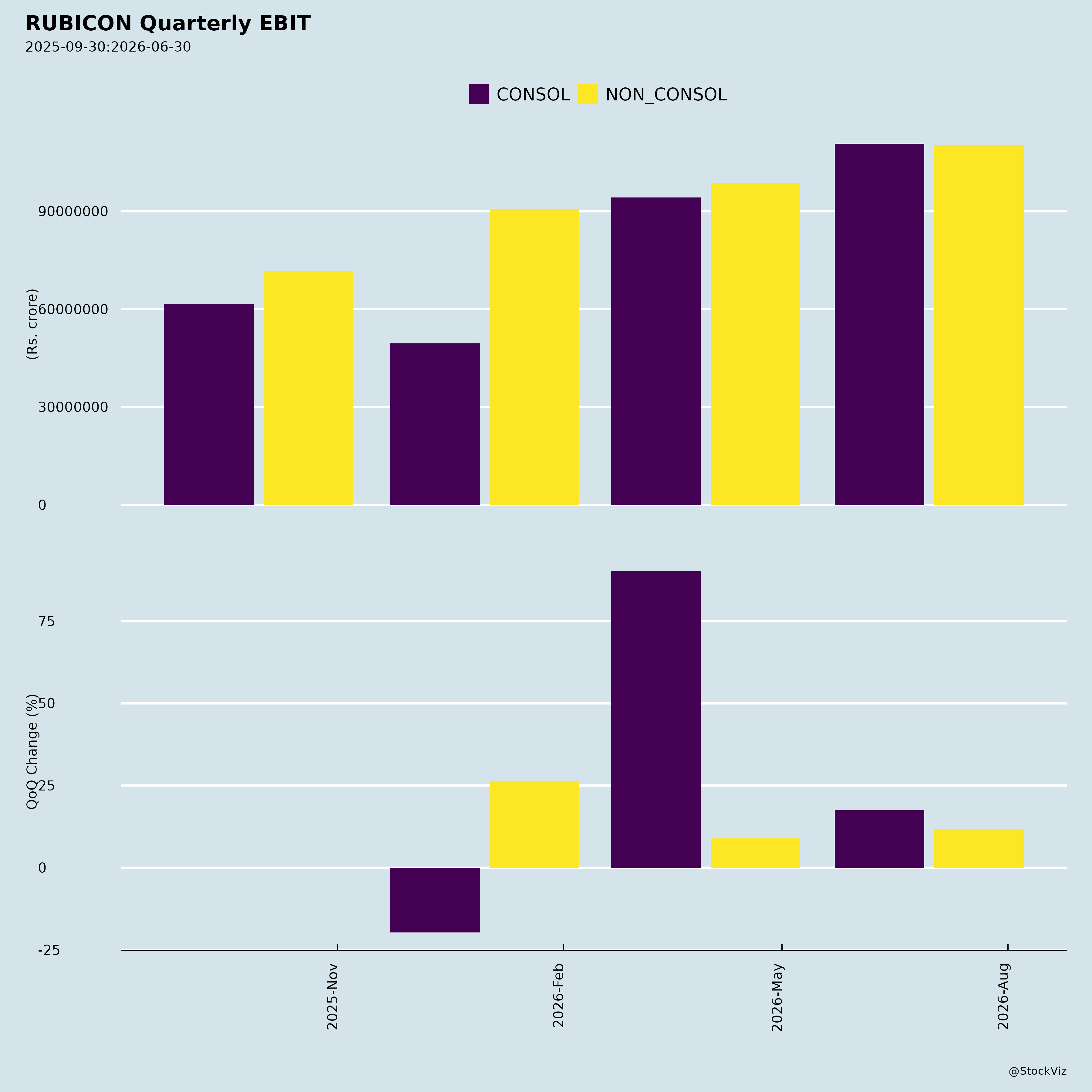
- EBITDA margin guidance: Management had earlier guided Operating EBITDA margins in the 22–23% range. In the Q1 FY27 update, management revised this upward, stating that for FY27 as a whole, Operating EBITDA margins would hold at least 23%. Observed: Q1 FY27 Operating EBITDA margin was 24.2%, compared to 23.1% in Q4 FY26 and 22.4% in Q1 FY26.
- R&D spend guidance: Management guided INR 5,000 million+ R&D spend over 9 quarters (FY26 + FY27 + Q1 FY28), fully expensed through P&L. Observed: Cumulative R&D spend over 5 of these 9 quarters till date is INR 2,515 million, and management states it is on track to achieve this guidance.
- Pithampur ramp-up guidance: Management had guided ramp-up of commercial operations at Pithampur from Q1 CY27. Observed: Following the Form 483 response and US FDA approval of a regulatory filing post-inspection, management states it is on track for this ramp-up.
- US revenue trajectory: Management states Q2 FY27 is tracking well for sequential USD revenue growth, after the tactical sequential drop in Q1 FY27 US revenues taken to improve the mix of own versus outsourced manufacturing.
- Nasal spray commercialization: Management expects to benefit from an early mover advantage coupled with captive supply chain, with 5 products approved and others in pipeline.
- East Brunswick commercialization: Management targets commercialization in CY 2027 after implementing quality systems, with significant capex planned over the next 3 years.
- AGM resolutions: All 9 resolutions presented at the 27th Annual General Meeting held on August 26, 2026, including adoption of financial statements, dividend declaration, stock options plans (ESOP 2026), and the scheme of merger with KIA Health Tech Private Limited, were passed with the requisite majority.
- Standalone vs consolidated Q1 FY27: Standalone revenue from operations was ₹4,277.30 million with net profit after tax of ₹824.49 million; consolidated revenue from operations was ₹5,343.38 million with consolidated net profit after tax of ₹847.81 million.
Broker Narrative
Motilal Oswal kept a Buy rating throughout, with the early thesis centered on R&D-led differentiation, USFDA compliance, specialty/commercialized portfolio, and resilience against US generics and pricing pressures. By the last report, the narrative had become more execution-driven: four earnings beats, raised FY27 margin guidance, successful Pithampur approval, NJ facility VAI, and market share gains replaced the earlier defensive framing. External US generics/regulatory fears faded from emphasis, while actual cost headwinds from geopolitical disruptions, outsourcing-related gross margin contraction, and pre-revenue facility investments were acknowledged but did not undermine the bullish view.
Broker Timeline
5 broker calls · 2025-10-01 to 2026-08-15
Copyright © 2023 SAS Data Analytics Pvt. Ltd. All rights reserved.