RISHABH
Equity Metrics
November 18, 2026
Rishabh Instruments Limited
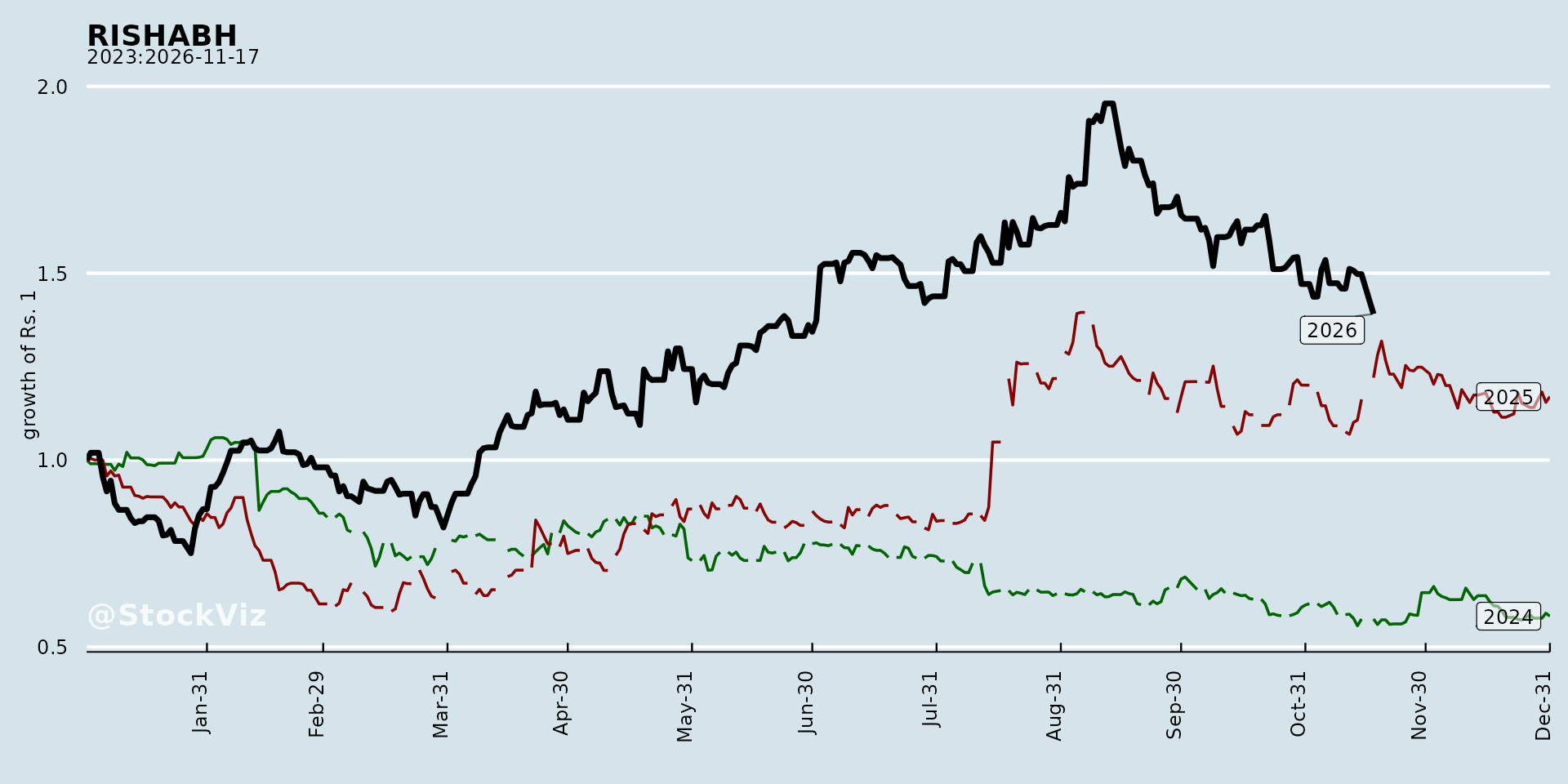
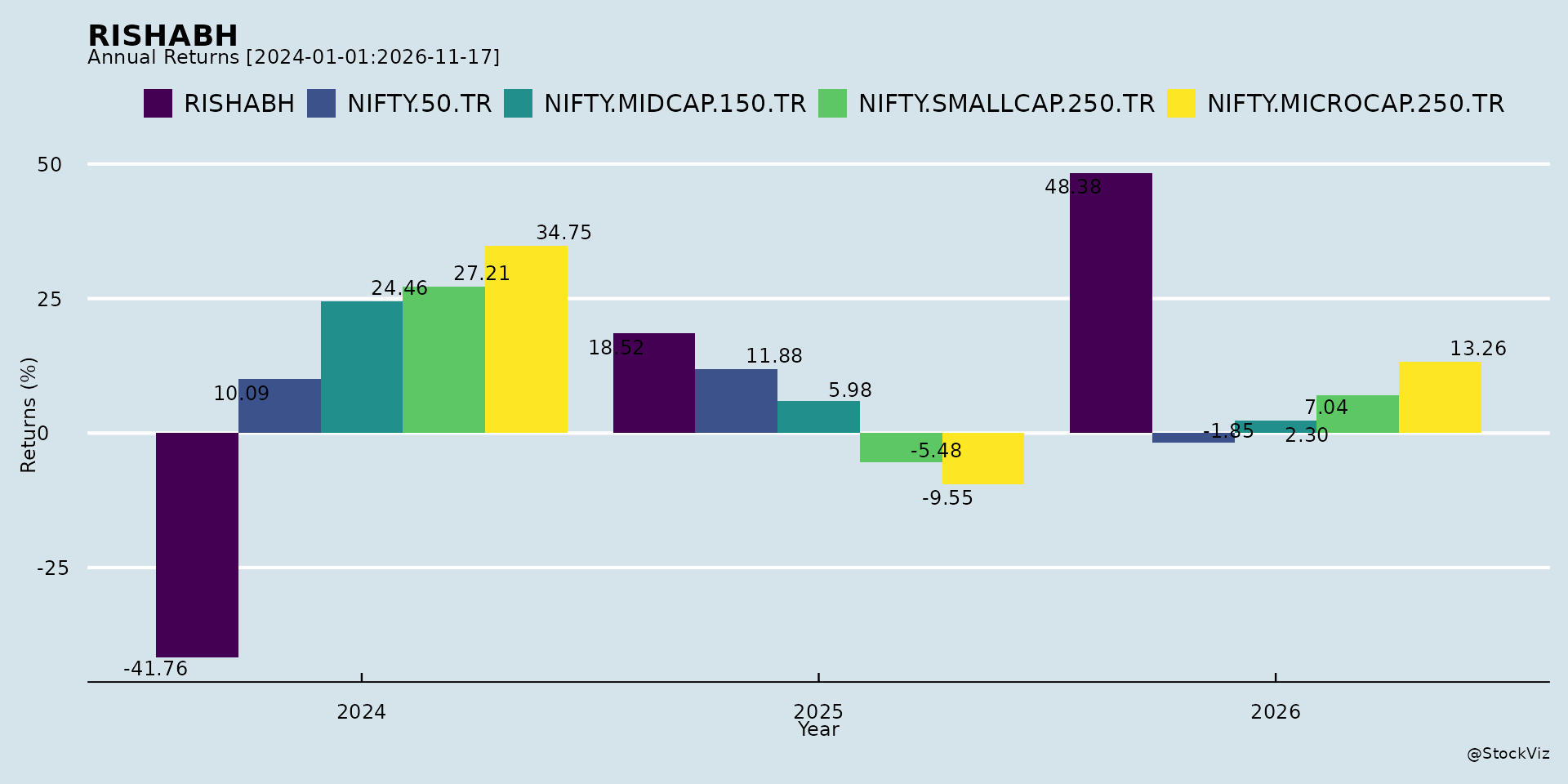
Annual Returns
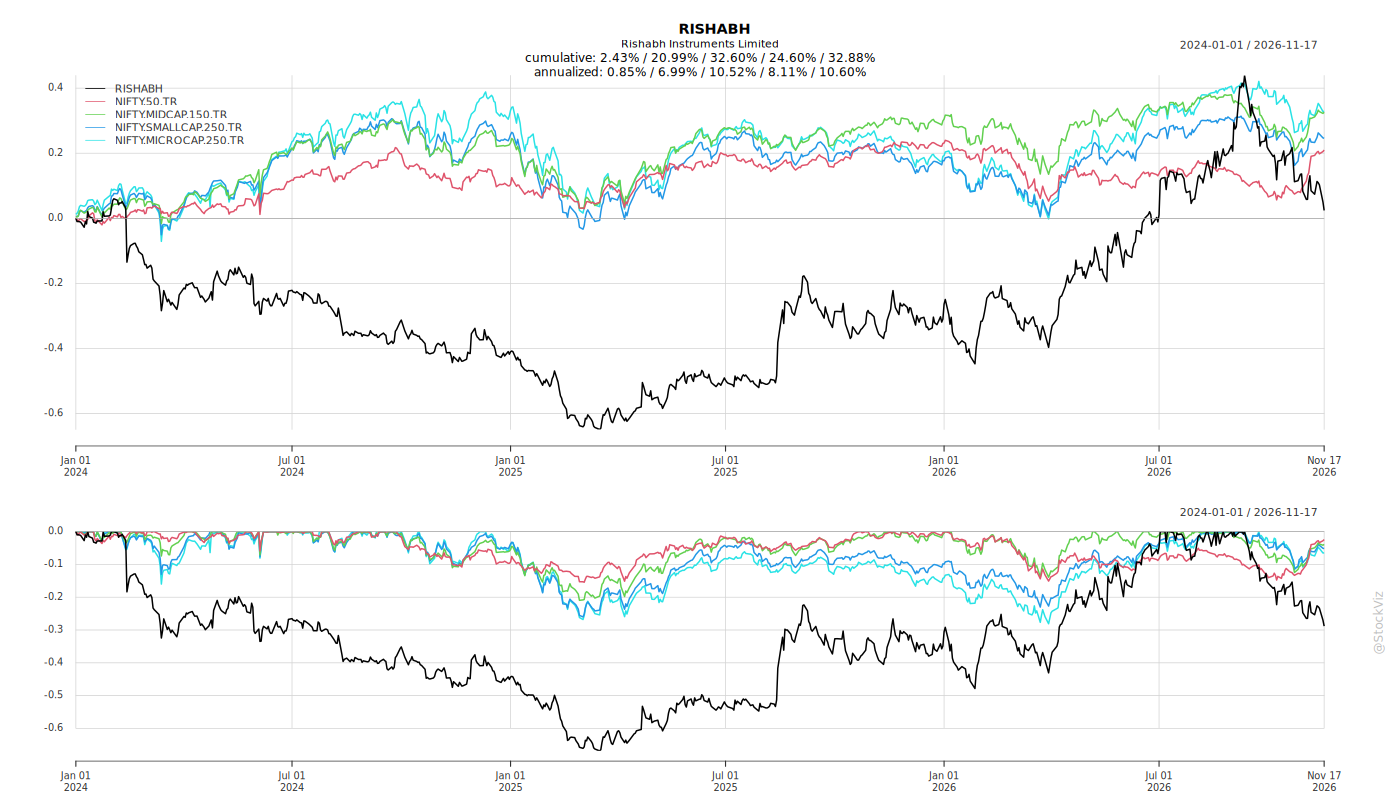
Cumulative Returns and Drawdowns
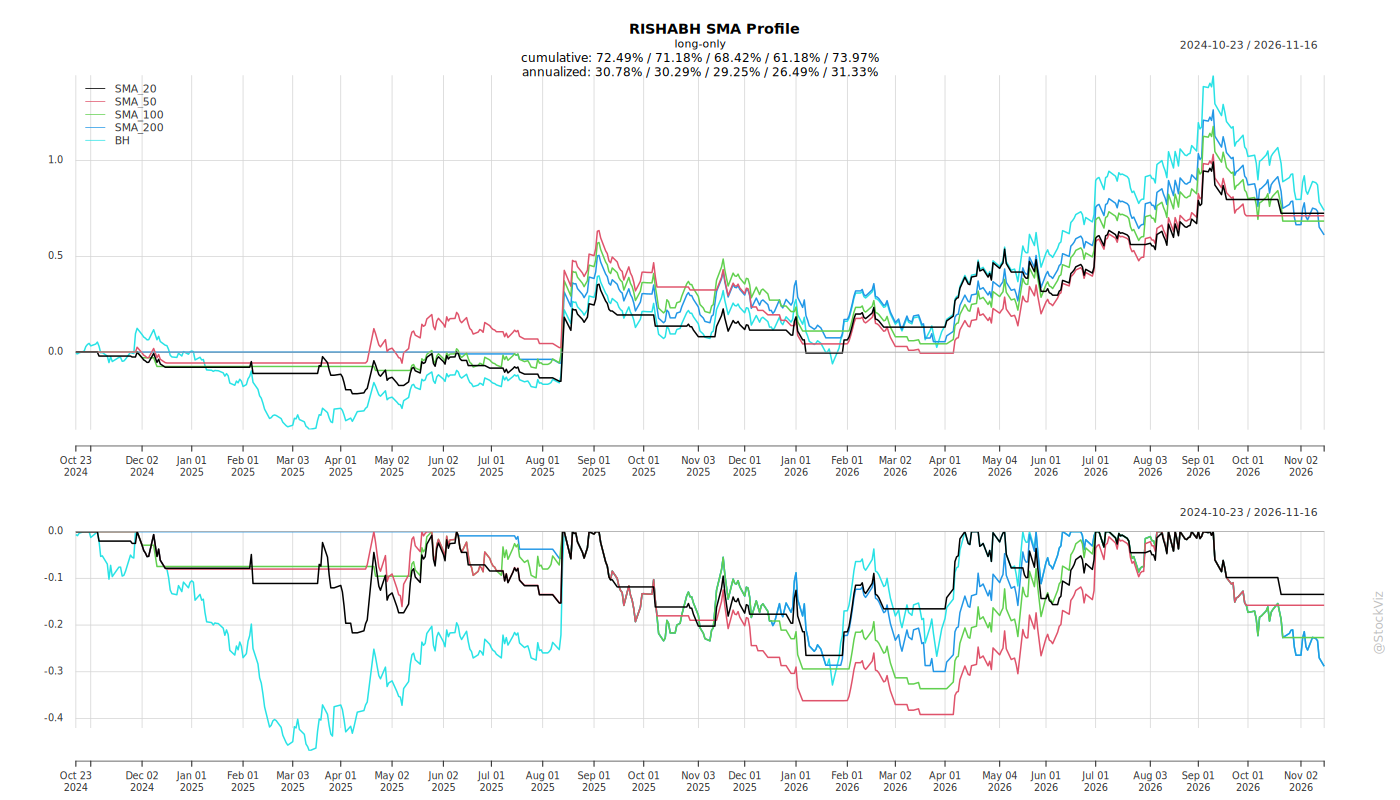
Fundamentals
Ownership
Margined
AI Summary
asof: 2026-09-17
Headwinds and Challenges
- The global operating environment continues to be shaped by geopolitical uncertainties, tariff developments and supply chain volatility, as noted in the Q1 FY27 earnings call on August 17, 2026.
- Industrial activity in Europe remained relatively moderate, and the European industrial environment was described as subdued, even though Lumel S.A. grew 39% year-on-year in Q1 FY27.
- Seasonality affects the business: July–August and December–January holiday periods in Europe and the Diwali period in India tend to soften activity, which management cited as a reason not to upgrade full-year guidance despite a strong Q1.
- Lumel Alucast (HPDC) continued to face a planned decline, with Q1 FY27 revenue of INR443 million, a degrowth of 41.2% year-on-year, and adjusted EBITDA of negative INR28 million (negative 6.4% margin). The business remained only at operating breakeven.
- The Alucast transformation is slow: RFQs are progressing through commercial negotiations, qualifications and customer approvals, and management noted that ramping up a product after award takes about six months. Consolidation in die-casting, partly linked to problems in the EV industry, has shifted some projects to China.
- Consolidated PAT declined 1.4% year-on-year in Q1 FY27, mainly due to a INR20 million increase in depreciation.
- ESOP and stock appreciation rights costs weighed on reported profitability: INR20 million at consolidated level and INR4 million at standalone level in Q1 FY27. Additional ESOPs granted last year will keep costs in the books for another three years, though at lower amounts than earlier.
- Solar inverters and part of the EMS business carry lower margins than the rest of the portfolio, with contribution levels of around 15%–20% versus 40%–45% for the broader basket.
Tailwinds and Growth Prospects
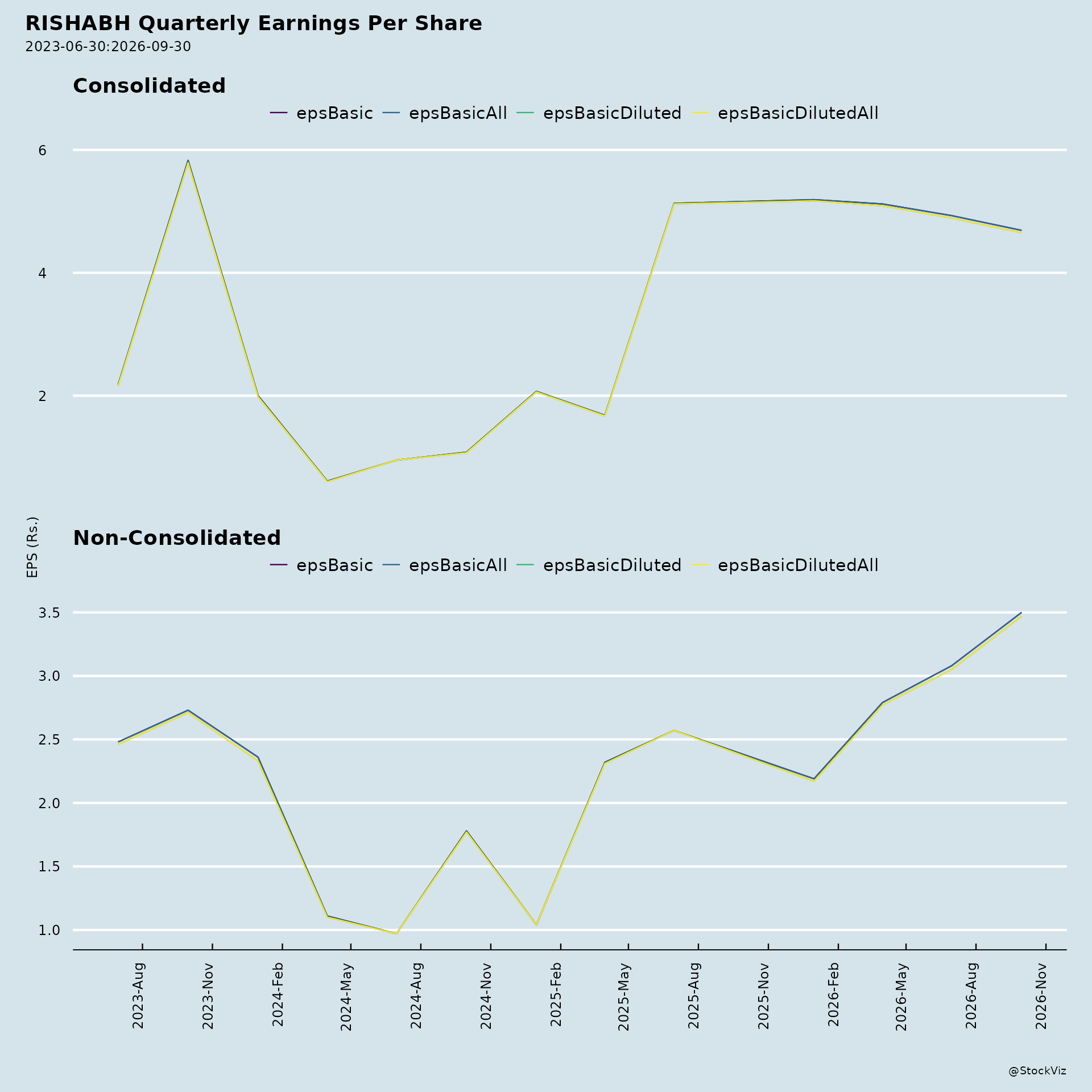
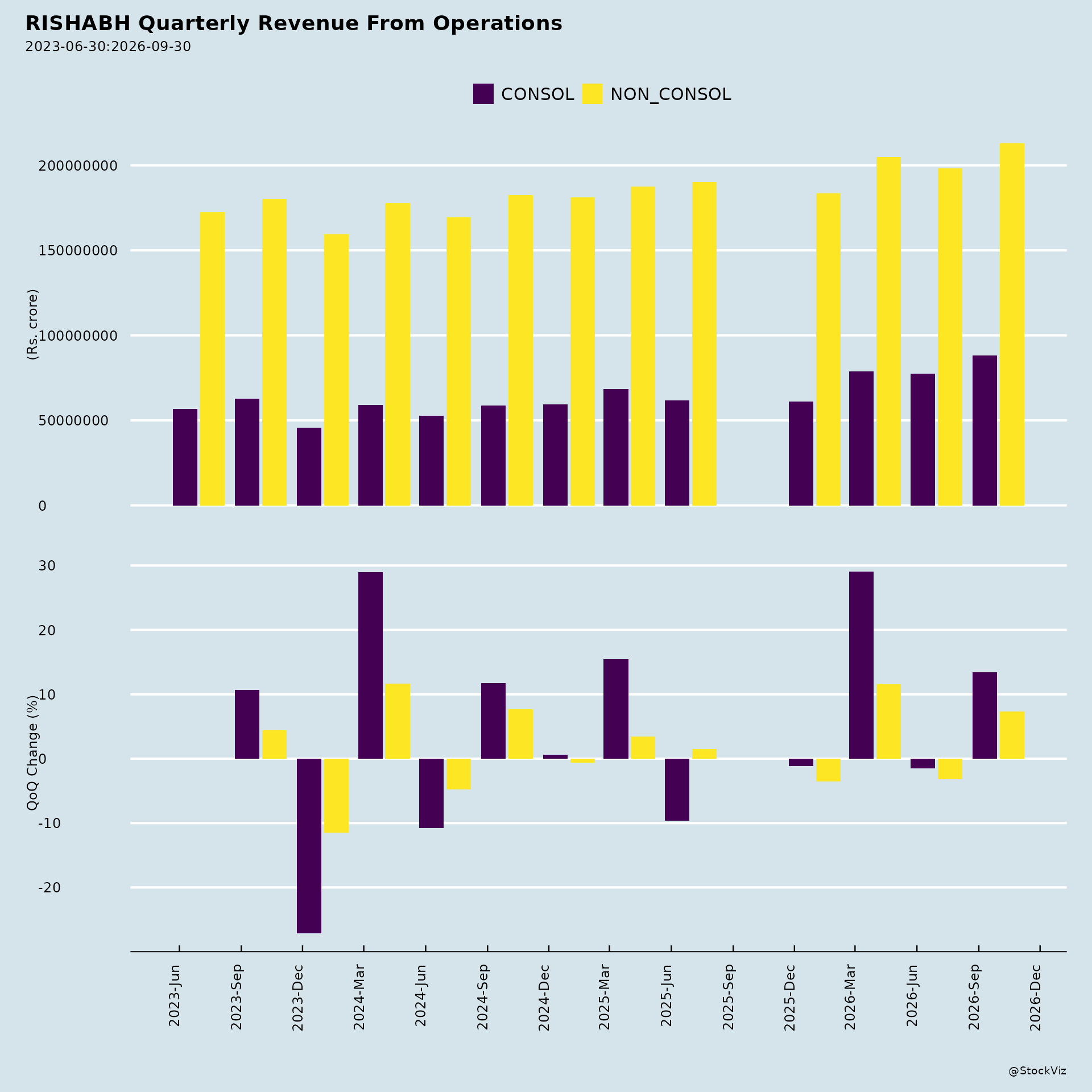
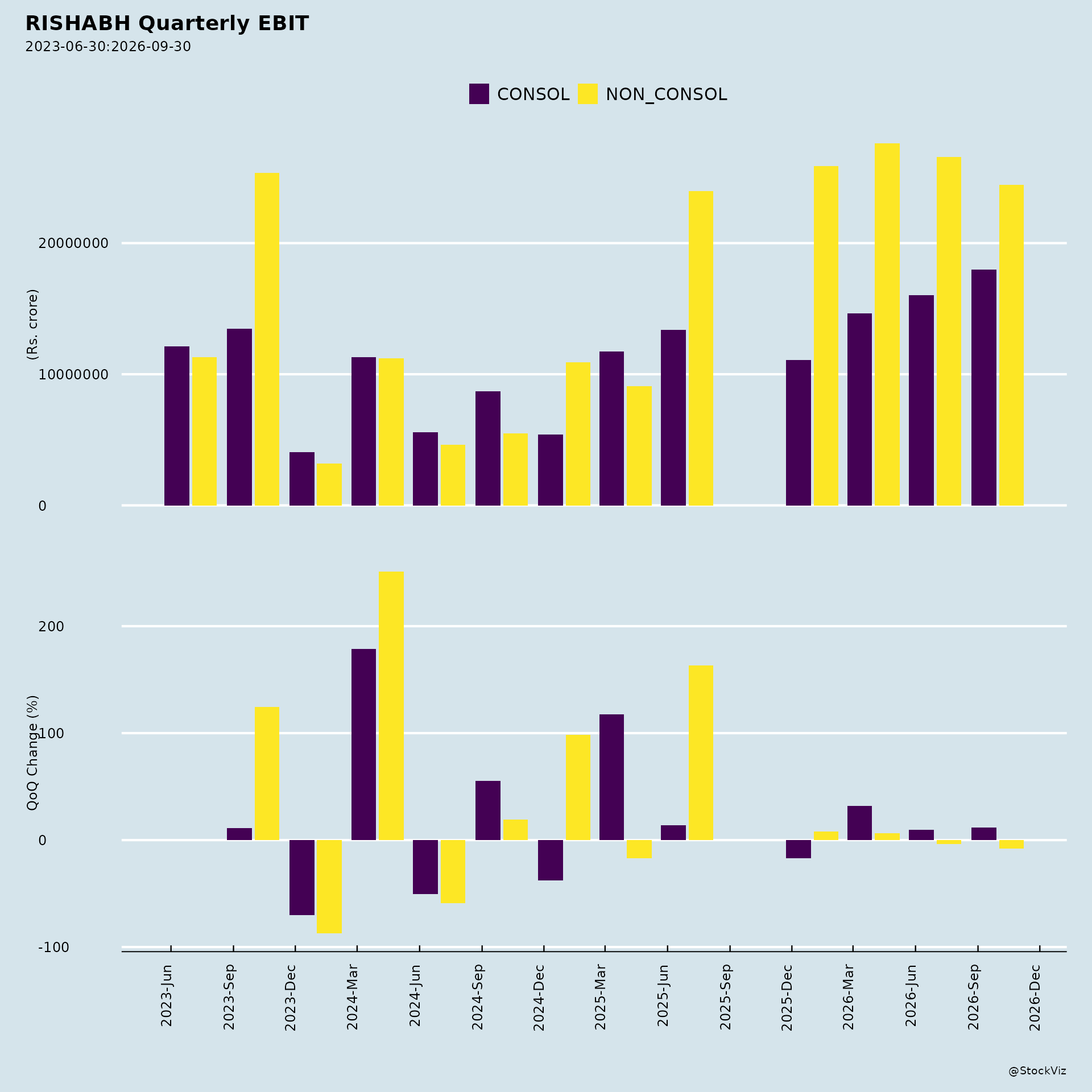
- Consolidated revenue in Q1 FY27 was INR1,983 million, up 4.2% year-on-year, with consolidated EBITDA of INR333 million, up 17.3%, and a 16.8% EBITDA margin.
- The EEI segment grew 34% year-on-year with approximately 24% EBITDA margin, exceeding initial guidance. Adjusted EBITDA rose 69.1% year-on-year to INR382 million, with margins expanding 520 basis points to 24.8% from 19.6%. PAT margins improved to 16.4% from 13.8%.
- Rishabh India standalone revenue grew 25.6% year-on-year to INR776 million, with EBITDA of INR178 million (22.9% margin) and PAT of INR119 million, up 20.2%.
- Lumel S.A. revenue was INR639 million, up 39% year-on-year; adjusted EBITDA was INR153 million (24% margin, up 1,190 basis points); PAT was INR115 million, up 321.1%. Lumel S.A. contributed 50% of consolidated bottom line in Q1 FY27.
- U.S. and U.K. businesses grew over 40% year-on-year; China grew 20.3%. Management targets the Americas business growing from INR30 crores to INR45 crores this year, with an organic target of INR100 crores in two to three years.
- Growth drivers cited include current transformers (global demand linked to data centers and solar), energy distribution upgradation in Germany, radiation gates in Europe, medium-voltage products, solar installations, and new product launches. Around 15 new products were launched over the past two years, with more than 15 planned for FY27.
- Data centers are a growing opportunity: after an initial win, the company won three to four more and is quoting about ten more. Domestic order bookings in Q1 were up about 20% year-on-year, with billing lagging bookings.
- Solar inverters: the single-phase iUNO series (up to 5 kW) achieved operational profitability and is selling in thousands rather than hundreds. The 3-phase iNEO range up to 12 kW was launched in Q1 FY27, with next-generation models up to 50 kW planned by end of FY27, plus hybrid inverter development. Solar revenue was INR8–9 crores last year, targeted at INR24–25 crores this year, with INR250–300 crores envisioned next year.
- Current transformer capacity is being expanded from 5,000–6,000 low-voltage units per day toward 8,000–10,000, with medium-voltage extension planned.
- PCB/EMS: three SMT lines are in place, including a high-end line making PCBA for motherboards including Intel chips; an older line is being upgraded, and a fourth line is planned once three-shift utilization is reached.
- The new Nashik facility has been partially commissioned, with both buildings completed and full shift expected within one to two months. It is designed for more than 2.5x production capacity over the next four to five years.
- The first Rishabh TMI Experience Center opened in the last quarter, with similar centers planned for Mumbai and Delhi by end of FY27.
- Structural tailwinds cited: electrification, grid modernization, energy efficiency, renewable energy integration, industrial automation, digital infrastructure, AI-enabled data centers, and Indian policy support for manufacturing, power infrastructure, renewable energy, transportation modernization and electronics localization. Encouraging opportunities were noted in the U.S., Middle East, Southeast Asia and Africa.
- The company remains net debt-free, with net cash and cash equivalents of INR1,606 million as of June 30, 2026.
- Inorganic growth is being explored in the U.S., Europe and India, with a typical ticket size of INR50 crores to INR150–200 crores, though nothing was described as being at a serious stage.
Key Risks
- Fluctuations in earnings and the ability to manage growth.
- Domestic and international competition.
- Economic growth in India and abroad.
- Ability to attract and retain highly skilled professionals.
- Time and cost overruns on contracts.
- Management of international operations.
- Government policies, regulations, and interest and other fiscal costs prevailing in the economy.
- Dependence on the pace of conversion of Alucast RFQs into production programs; delays in customer approvals and audits could slow the recovery.
- Geographic concentration effects: Europe remains the largest revenue region (INR1,239.93 million in Q1 FY27), so European industrial weakness matters despite diversification.
- Margin mix risk from lower-margin solar and EMS revenue as those businesses scale.
- Execution risk on the new Nashik facility ramp-up and on the solar inverter product roadmap (up to 50 kW and hybrid inverters) within FY27.
Management Guidance vs. Observed Performance
- EEI guidance: management had guided 20%–25% top-line growth and 20%–22% EBITDA margin. Q1 FY27 delivered 34% revenue growth and approximately 24% EBITDA margin, exceeding the initial guideline. Management declined to raise the full-year guidance, citing seasonality, but stated it would try to deliver more than guided.
- Alucast guidance: management expects to breakeven adjusted EBITDA for the full year by end of FY27. In Q1 FY27, Alucast was at operating breakeven but adjusted EBITDA remained negative at INR28 million (negative 6.4%). Management sees a pathway to double-digit EBITDA margin over the medium term, with a two-year horizon mentioned for double-digit margins.
- Americas guidance: management targets INR100 crores in two to three years on the organic side, up from INR30 crores last year and a INR45 crores target this year.
- Solar guidance: INR24–25 crores targeted this year versus INR8–9 crores last year, with INR250–300 crores envisioned next year.
- Capital allocation: management reiterated priorities of profitable growth, better product mix, new product development, deeper customer relationships, strategic geographic expansion, and disciplined capital allocation.
- Management noted that last year it overdelivered on guidance and aims to repeat that, while deliberately keeping guidance conservative rather than raising it after a strong Q1.
Broker Narrative
The broker maintained a Buy rating throughout, but the narrative evolved from broad structural-growth optimism to a Q1FY27 scorecard: EEI/data-centre demand was the confirmed winner, while Europe/Alucast became an acknowledged drag rather than a near-term headwind. Persistent themes were India electrification/automation, high-margin EEI growth, and Alucast restructuring, but the last report shifted to concrete evidence of European contraction and reliance on a FY27-end Alucast break-even.
Fears that came true
- European revenue declined 7.9% YoY in Q1FY27, confirming the flagged geographic-concentration and European automotive-supply-chain weakness.
- Lumel Alucast revenue fell 41.2% YoY and adjusted EBITDA was negative ₹2.8 crore, validating the early warning on loss of casting volumes and cost/contract pressures.
- Billing lagged bookings, leaving revenue backlog unconverted, consistent with the execution-risk flag and the last report’s disappointment of +0.0% actual versus +30.3% predicted.
Optimism that failed
- The Alucast/European turnaround had not materialized by the last report: despite the expected non-automotive shift and cost rationalization, Alucast revenue slumped 41.2% and remained EBITDA-negative.
- Solar inverters remained at an early stage, contributing <5% of business, so the anticipated scale-up had not yet materialized by the last report.
Broker Timeline
3 broker calls · 2026-04-08 to 2026-08-18
CNBC-TV18: ratings, targets and commentary
No recorded CNBC-TV18 statements for this ticker.
Management comments
No recorded management comments with an explicit designation and affiliation for this ticker.
Copyright © 2023 SAS Data Analytics Pvt. Ltd. All rights reserved.