RELIANCE
Equity Metrics
September 24, 2026
Reliance Industries Limited
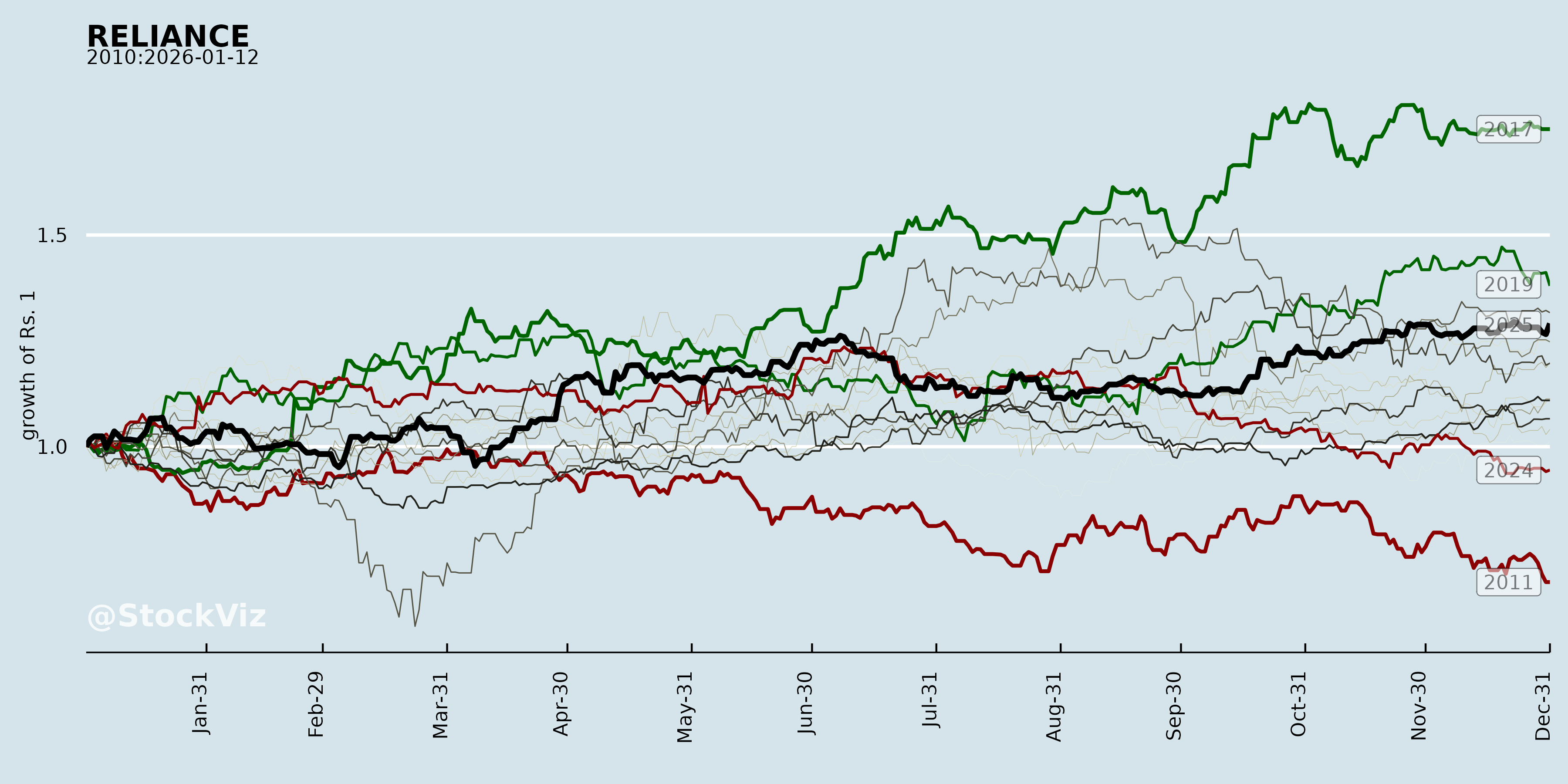
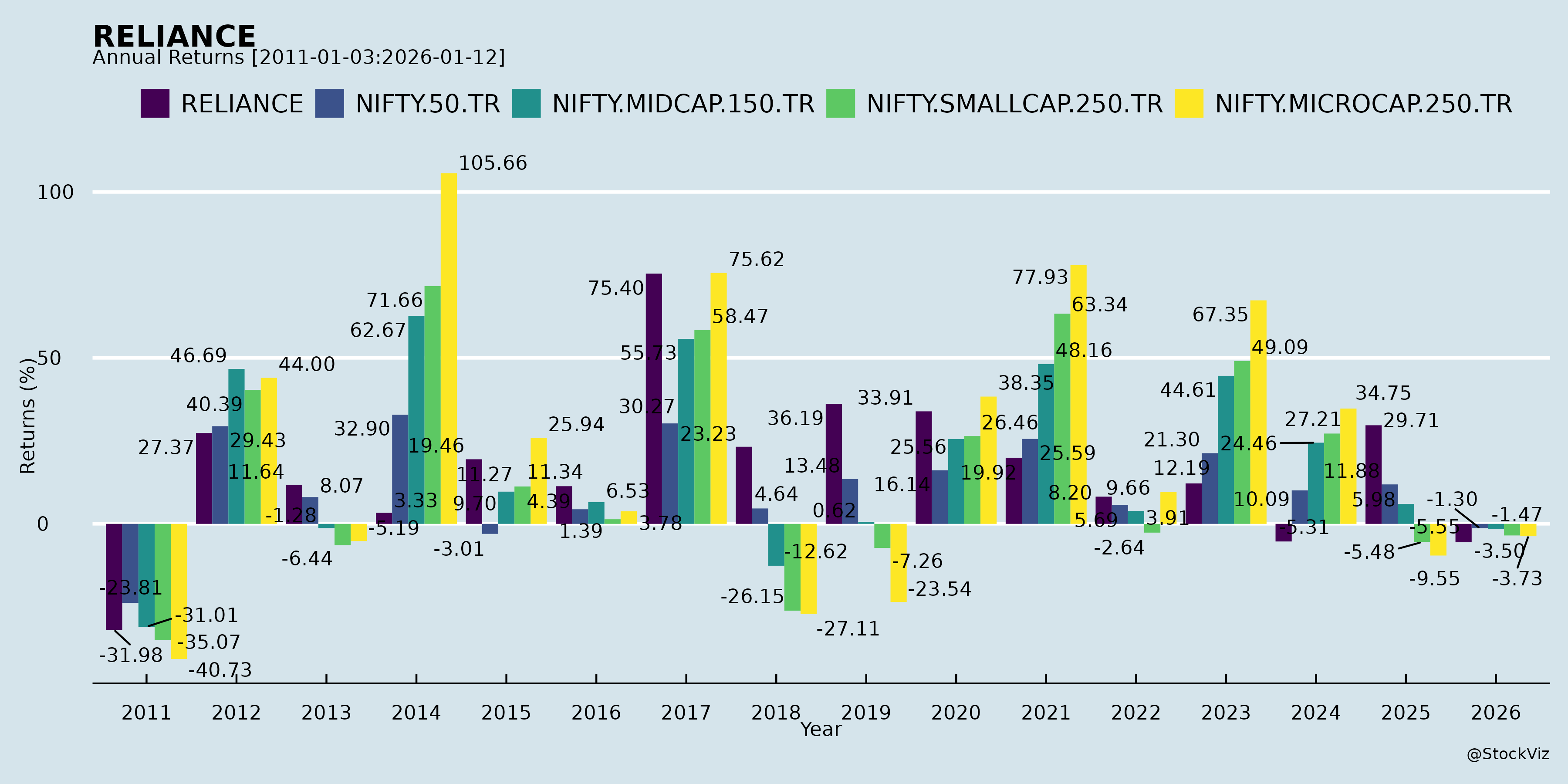
Annual Returns
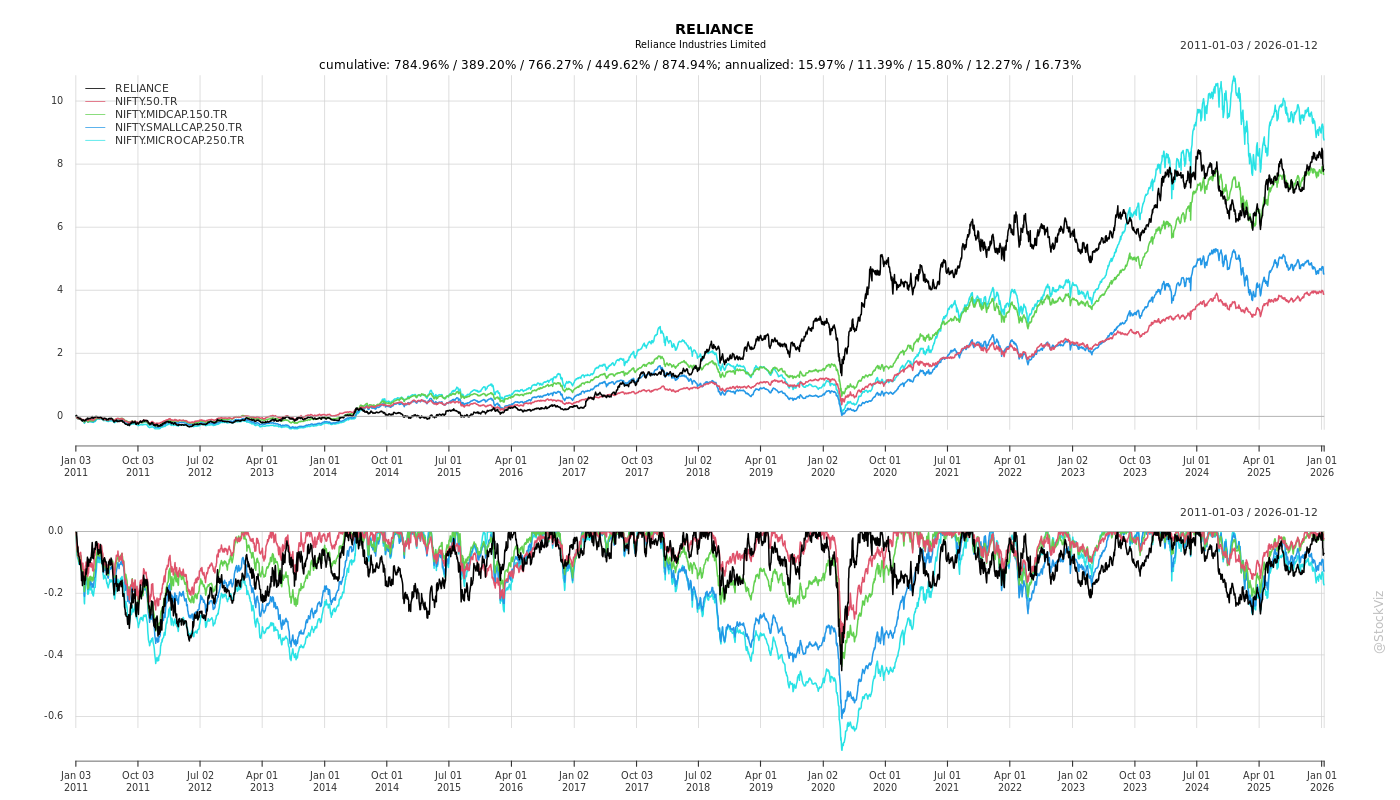
Cumulative Returns and Drawdowns
Fundamentals
Ownership
Margined
AI Summary
asof: 2026-09-14
Reliance Industries: Recent Corporate Developments
1. Headwinds and Challenges
Energy market dislocation and supply chain disruption The quarter witnessed what the company describes as the largest energy market shock, with the closure of the Strait of Hormuz disrupting an estimated 13 mb/d of crude supplies. Dated Brent averaged $104.5/bbl in Q1 FY27, up $36.7/bbl YoY. Global oil demand fell 4.8 mb/d YoY to 99.1 mb/d, with diesel down ~1 mb/d, gasoline down ~0.6 mb/d and jet/kero down 0.15 mb/d. Global refinery throughput was lower by 4.7 mb/d YoY at 77.6 mb/d.
O2C margin capture constrained Despite strong cracks, O2C earnings were weighed down by SAED-related costs, under-recovery in domestic fuel retail (as domestic fuel prices were held to protect consumers), higher crude oil premiums on physical barrels, higher freight and insurance costs, and 10% lower volumes on planned turnaround and LPG diversion. Throughput fell 5.2% YoY to 18.1 MMT and production meant for sale fell 9.8% YoY to 15.6 MMT. EBITDA margin declined 100 bps YoY to 8.4%.
Weak domestic chemical demand Domestic polymer demand degrew 21.7% YoY (PE -30.8%, PP -20.3%, PVC -8.1%) amid supply disruptions, lower domestic producer operating rates and need-based buying. Domestic polyester demand declined 18.1% YoY (PSF -25.8%, PFY -22.5%, PET -3.7%).
Retail profitability pressure Retail EBITDA fell 1.1% YoY to ₹6,309 crore with margin down 80 bps to 7.9%, reflecting the current investment phase in digital commerce and build-out of hyper-local delivery infrastructure. PAT declined 14.1% YoY to ₹2,805 crore. Depreciation rose 17.5% and finance costs rose 34.0%.
Oil and Gas softness KGD6 gas price realisation fell 10.8% YoY to $8.89/MMBtu and KGD6 production fell 7.4% YoY to 59.2 BCFe. Segment EBITDA was marginally down 0.5% YoY and margin fell 290 bps to 79.0%.
Media sentiment and macro JioStar noted that the impact of the Real Money Gaming Ban and the US-Iran war resulted in weak market sentiment, with Linear TV continuing to be under transition. Investment income fell 62% YoY.
Higher finance costs and depreciation at JPL JPL finance costs rose 41.6% YoY and depreciation rose 15.1% YoY due to 5G asset capitalisation, offsetting EBITDA growth at the PAT level (PAT up 9.2% versus EBITDA up 15.1%).
2. Tailwinds and Growth Prospects
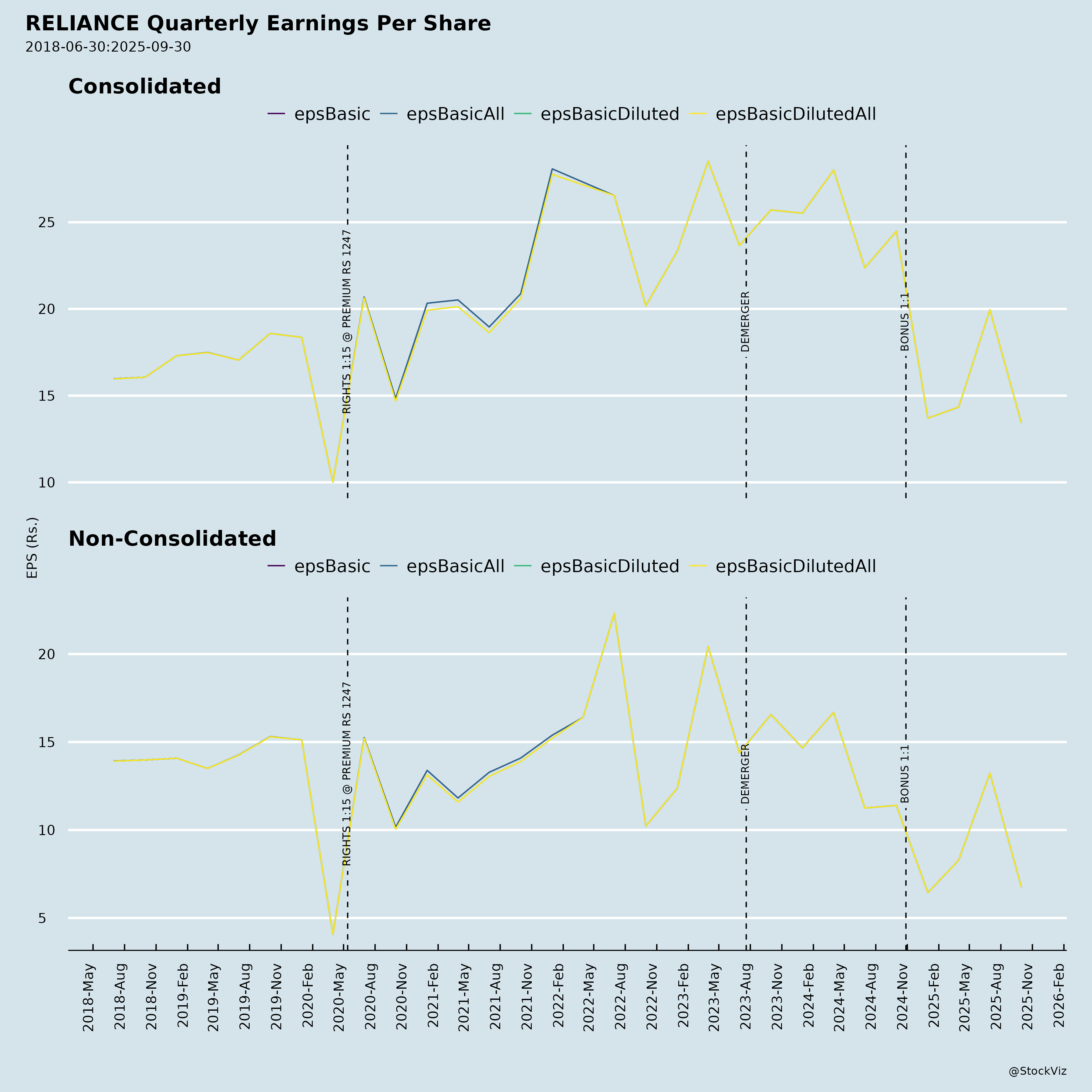
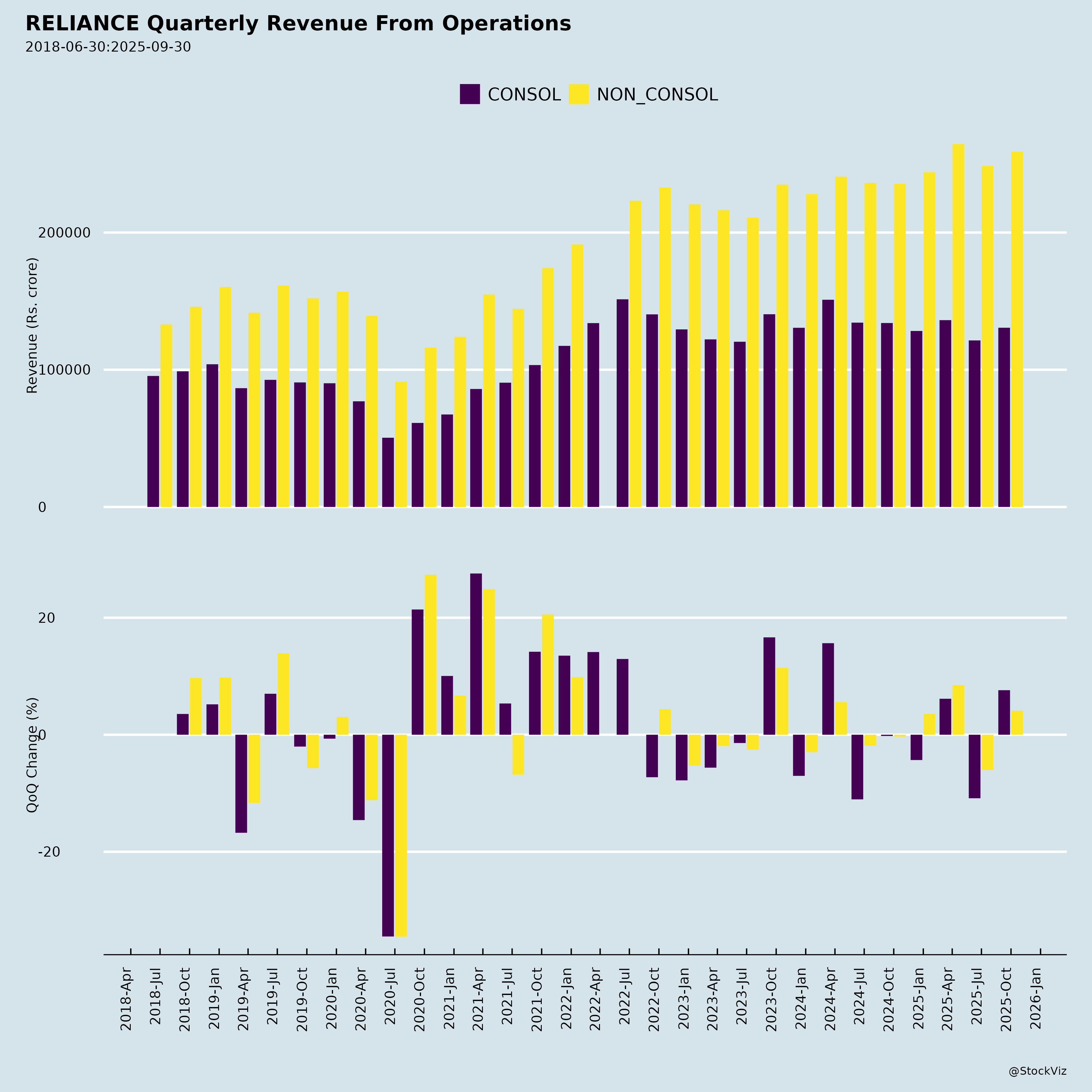
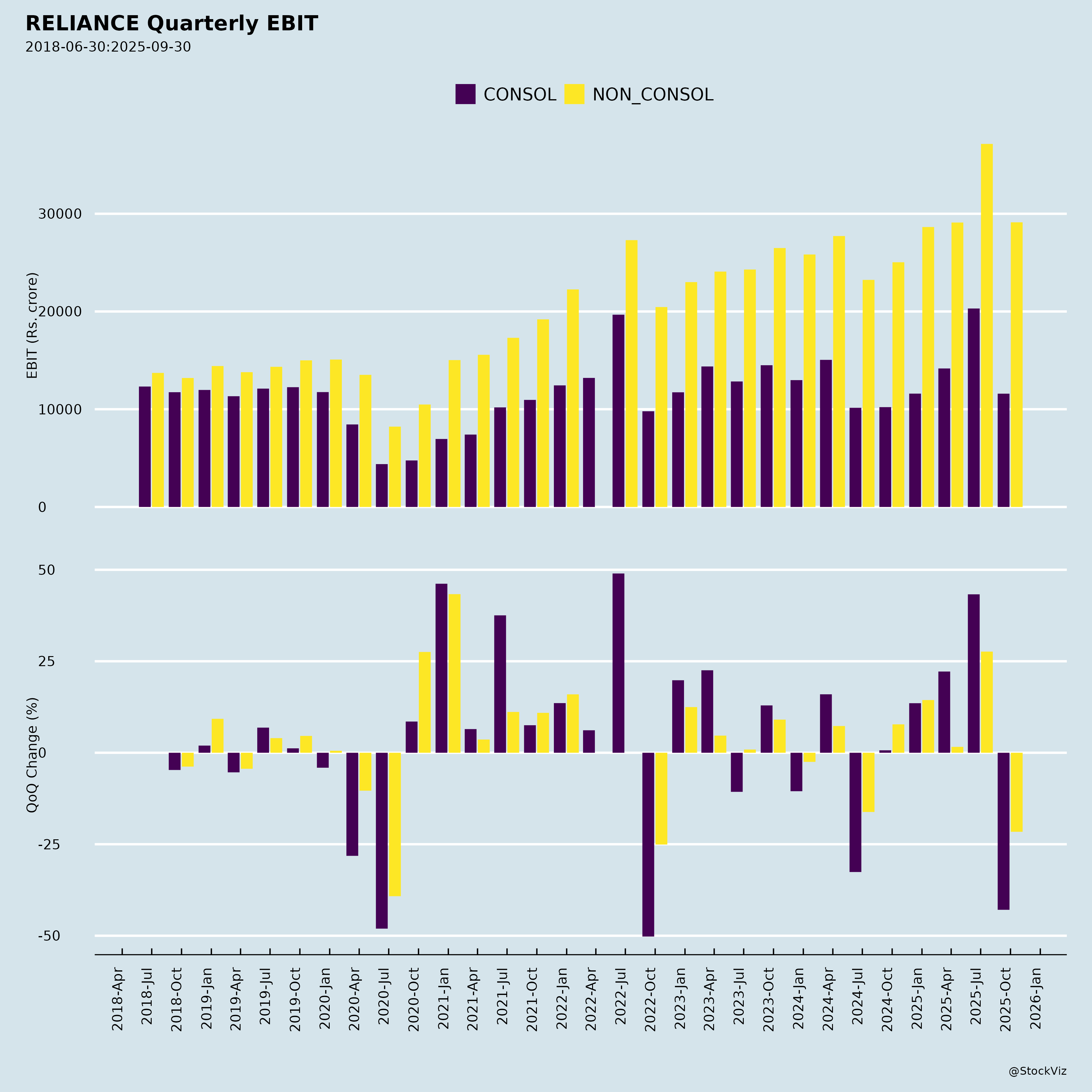
Record consolidated performance Consolidated revenue rose 24.5% YoY to ₹340,257 crore. Recurring EBITDA rose 10.1% YoY to a record ₹54,067 crore and recurring PAT rose 6.1% YoY to ₹23,196 crore. Consumer businesses continued to deliver over 50% of consolidated EBITDA. RIL standalone PAT rose 48% to ₹13,272 crore.
O2C strength O2C revenue rose 30.4% YoY to ₹201,803 crore and EBITDA rose 17.2% YoY to ₹17,010 crore, a four-year high, led by all-time high middle distillate cracks (Gasoil +299%, Jet/Kerosene +343%, Gasoline +159%), downstream chemical deltas at 3-4 year highs, sustained ethane cracking economics over naphtha, crude basket diversification (higher Russia/LatAm sourcing) and netback optimisation via redirection to deficit markets (Singapore, Australia, East/South Africa). US ethane prices fell 11% YoY to 21.3 cpg.
Digital Services momentum JPL revenue rose 12.0% YoY to ₹45,961 crore and EBITDA rose 15.1% YoY to a record ₹20,865 crore with record 53.3% margin (+150 bps). Subscriber base exceeded 533 million with 285 million 5G users (73 million net additions in 12 months). Fixed broadband reached 28.6 million with ~50% on Jio AirFiber and over 78% FWA market share. Digital Services revenue grew 20% YoY, outpacing connectivity growth of 11%. ARPU rose to ₹215.6 and monthly churn improved to 1.6%. JPL filed its DRHP with SEBI, a step towards public listing.
Retail scale and digital commerce Retail revenue rose 7.4% YoY (11.6% adjusted for the RCPL demerger) to ₹90,408 crore. Registered customers reached 396 million (+10.6%) and transactions rose 46% YoY to 568 million. Grocery digital daily orders rose 116% YoY; digital share of Grocery B2C revenue was 13.4% (+610 bps). JioMart services ~5,500 pin codes with 2,500+ stores connected to two-hour delivery. Management outlined a three-year objective to double operating EBITDA.
FMCG scale-up RCPL revenue reached ₹8,600 crore, up 2.1x YoY. Daily Essentials (Independence) delivered ~₹3,200 crore and Beverages (Campa) ~₹2,900 crore in Q1, with Campa achieving double-digit market share in key markets and >50% of FY26 sales in Q1. Distribution spans 5,000+ distributors and 3M+ retail outlets, with external channels contributing >80% of sales and presence in 40+ markets. RCPL was the #1 advertiser on IPL 2026 linear TV.
Media engagement JioStar revenue rose 14.1% YoY to ₹12,799 crore and EBITDA from operations rose 30.7% YoY to ₹933 crore. JioHotstar averaged 530 million MAUs (up 15% YoY), IPL 2026 reached 1.2 billion viewers, and the Tadka micro-content hub crossed 100 million users within two months.
New Energy execution A US$3 billion green ammonia contract was announced with Samsung C&T. The company aims to scale to 55 MWp solar and 150 MWh batteries daily by next year, with ~1 GWp of HJT modules produced and ALMM certified, scaling to 20 GWp annual module capacity and 120 GWh battery capacity (40 GWh to be commissioned this year).
Balance sheet and ratings Net debt stood at ₹122,914 crore with net debt to LTM EBITDA at 0.60x. Capex was ₹38,682 crore. Moody’s upgraded foreign currency debt issuances to “Baa1”; the company references premium ratings of A-/Baa1.
3. Key Risks
- Renewed conflict in the Middle East could increase volatility and prices; gradual increase in Strait of Hormuz flows would keep crude prices lower.
- Oil demand is expected to decline by 1 mb/d in CY2026 before rebounding by 2 mb/d in CY2027.
- New Asian cracker capacities are expected to pressure margins.
- Tariff threats, macro headwinds and geopolitical uncertainty continue to weigh on product deltas.
- LNG prices are expected to remain volatile due to uncertainty over Strait of Hormuz flows; Qatar’s damaged ~13 MMTPA LNG capacity may take 3-5 years to restart.
- Retail margin pressure is expected to persist in the near term as hyper-local delivery infrastructure build-out continues.
- JPL profitability is exposed to higher finance costs and depreciation from 5G asset capitalisation.
- The Objects Clause alteration (new sub-clause 14 covering ammonia, ammonium nitrate, ANFO, explosives, fertilisers and agro-chemicals) remains subject to approval from the Registrar of Companies.
4. Management Guidance Versus Observed Performance
Retail three-year ambition Management set a three-year objective to double operating EBITDA through growth and better economics, with FY27 framed as a foundation year for scaling online, proving unit economics market by market, and expanding dark stores, followed by FY28-FY29 value conversion. Observed performance shows revenue growth of 7.4% YoY (11.6% adjusted) but EBITDA down 1.1% YoY and margin down 80 bps to 7.9%, with the company attributing this to planned investments in scaling digital commerce. Digital metrics are tracking the stated focus: grocery digital daily orders +116% YoY, active seller base +26% YoY, and digital share of Grocery B2C revenue at 13.4% (+610 bps).
New Energy execution timeline Management stated an aim to start installation post-monsoon with transmission capacity ready in time for electricity export this year, and to scale to 55 MWp solar and 150 MWh batteries daily by next year. Observed progress includes ~1 GWp of HJT modules produced and ALMM certified, with scaling to 20 GWp annual module capacity and 40 GWh of the 120 GWh battery capacity to be commissioned this year.
Jio public listing The Chairman described the JPL DRHP filing with SEBI as a significant step towards public listing and an important milestone. The DRHP filing is confirmed in the quarter’s strategic progress.
O2C near-term outlook Management stated refinery margins are likely to stay robust in the near term amid strong summer demand and tight balances, and that depleted global product inventory levels should provide continued support to product cracks. Observed Q1 FY27 O2C EBITDA of ₹17,010 crore (+17.2% YoY) at a four-year high is consistent with this, though margin was 100 bps lower YoY at 8.4% due to SAED costs, fuel retail under-recovery and higher feedstock costs.
CBM production ramp The CBM second-phase multi-lateral well campaign targets 40 wells; 31 were completed and 29 put to production, with current production at 1.0 MMSCMD and CBM volumes up 10.7% YoY to 3.1 BCFe.
Jio-bp network expansion Jio-bp operated 2,221 outlets versus 1,991 in Q1 FY26, with MS volumes up 16.8% YoY and HSD volumes down 1.9% YoY. Jio-bp Pulse crossed 50,000 monthly B2C customers with 5,820 live charging points, targeting ~2x sales growth. CBG volumes rose 161% YoY across 131 operating outlets.
Broker Narrative
The broker narrative evolved from broad optimism in mid-2023 — citing strong retail growth, Jio subscriber momentum, and upstream expansion — to a picture by 2026 where retail performance had turned subdued and O2C faced severe macro headwinds like elevated crude premiums and freight spikes. While the last report noted a standalone EBITDA surge on improved fuel cracks and downstream margins, the three-year trajectory was dominated by DISAPPOINTMENT outcomes and negative actual returns, indicating early tailwinds largely failed to translate into sustained value creation. Persistent themes of high debt, financing costs, and macroeconomic pressure on refining margins evolved from flagged risks into realized headwinds.
Fears that came true
- O2C segment weakness persisted: the first report flagged a 17% YoY O2C revenue decline, and the last report confirmed retail EBITDA fell 1.8% YoY and 11.3% QoQ, correlating with prolonged DISAPPOINTMENT outcomes across 2024-2026.
- Macroeconomic headwinds materialized as elevated Middle East crude premiums (~USD20/bbl), a nearly 10x spike in freight rates, and sharply higher marine insurance costs, directly driving negative actual returns.
- High debt and escalating financing costs persisted: interest expense was flagged rising 46% YoY in the first report, and the sustained period of DISAPPOINTMENT and deeply negative stock performance through 2024-2026 reflects ongoing financial strain from elevated borrowings and depreciation.
Optimism that failed
- Strong retail growth failed to sustain: the first report’s 20.5% YoY retail revenue growth with record footfalls gave way to the last report’s ‘subdued’ retail performance with EBITDA from ops declining 1.8% YoY.
- Long-term catalysts including petrochemical expansion (Rs 750bn investment) and New Energy/Carbon Fiber initiatives failed to deliver near-term value, as the stock recorded predominantly DISAPPOINTMENT outcomes from 2024 through 2026 despite these being highlighted as key growth drivers.
- Jio’s subscriber and 5G momentum optimism did not translate into sustained returns: while RJIL grew 10.8% YoY in the last report, the first report’s projected 16%/21% Revenue/EBITDA CAGR and ARPU tailwinds were repeatedly invalidated by DISAPPOINTMENT outcomes across multiple broker calls.
Broker Timeline
92 broker calls · 2023-07-22 to 2026-07-19
Copyright © 2023 SAS Data Analytics Pvt. Ltd. All rights reserved.