PNBHOUSING
Equity Metrics
September 24, 2026
PNB Housing Finance Limited
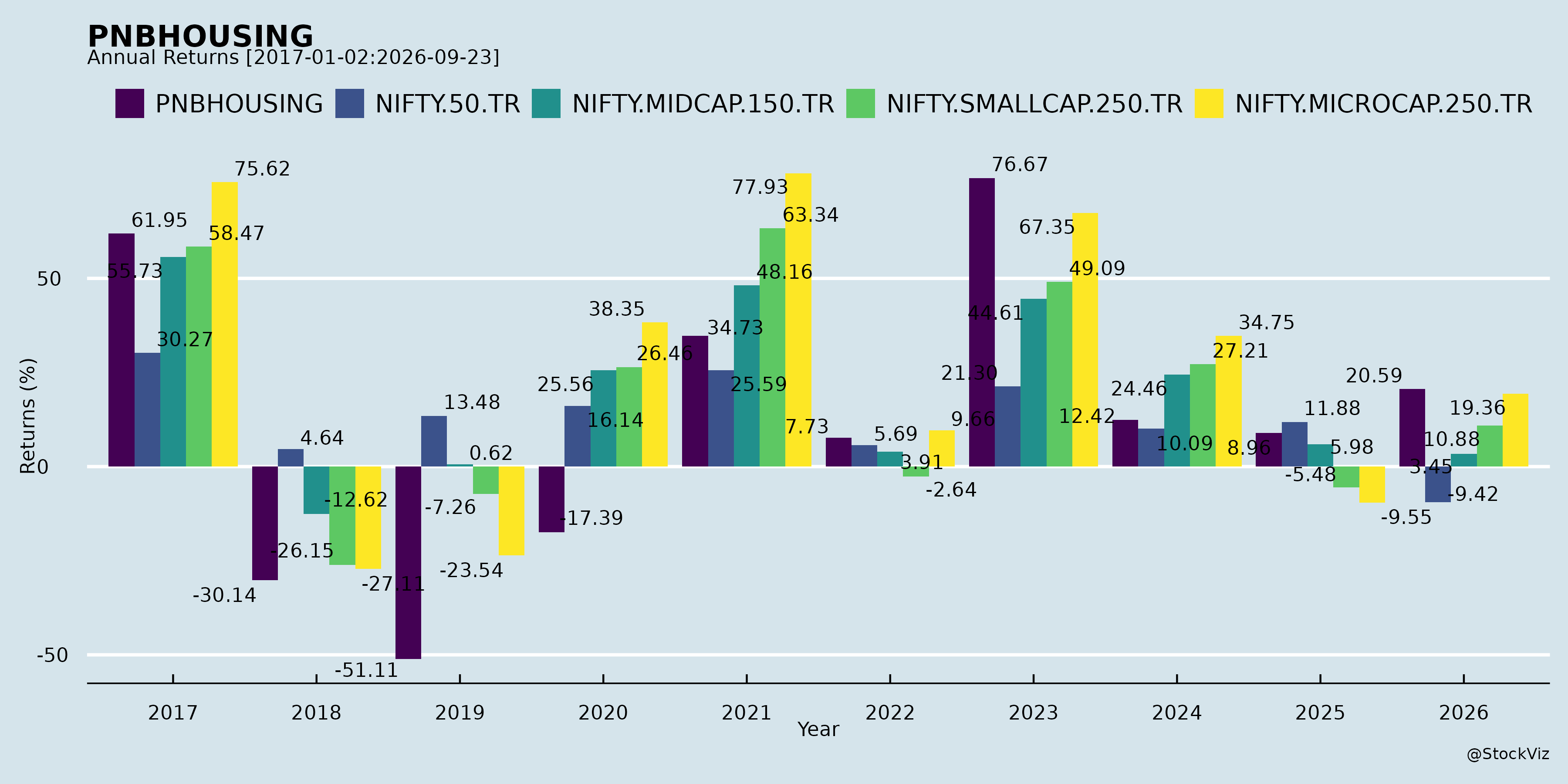
Annual Returns
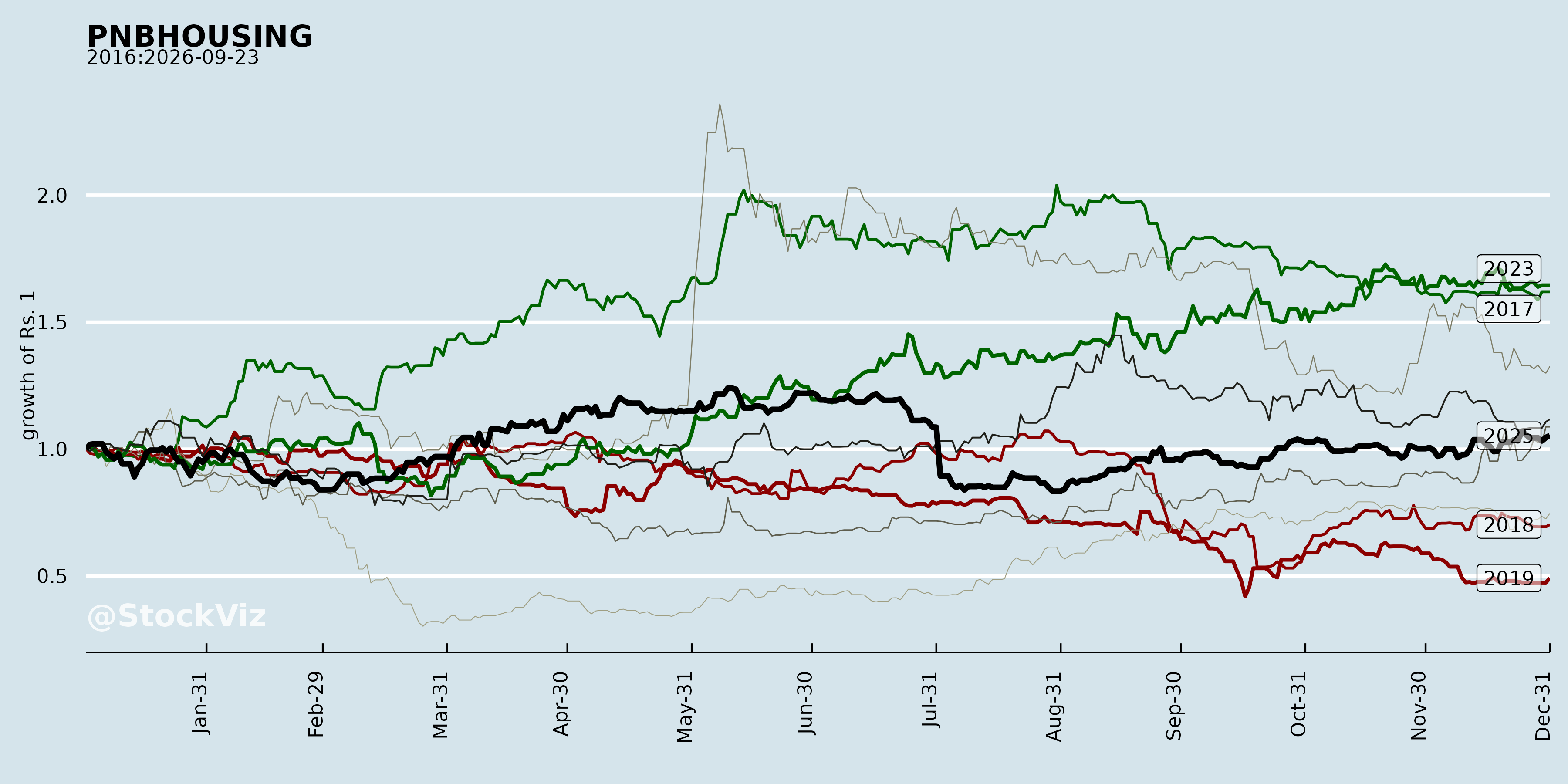
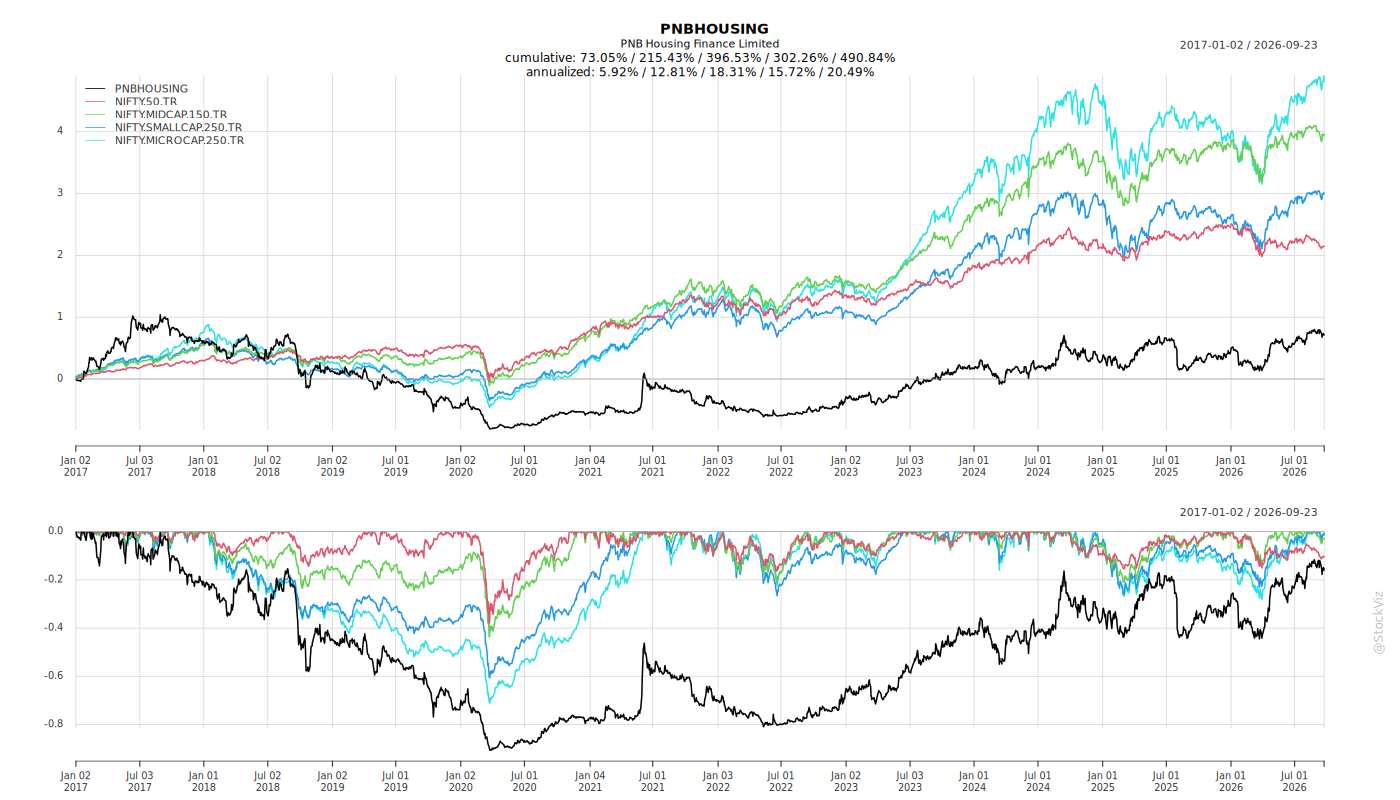
Cumulative Returns and Drawdowns
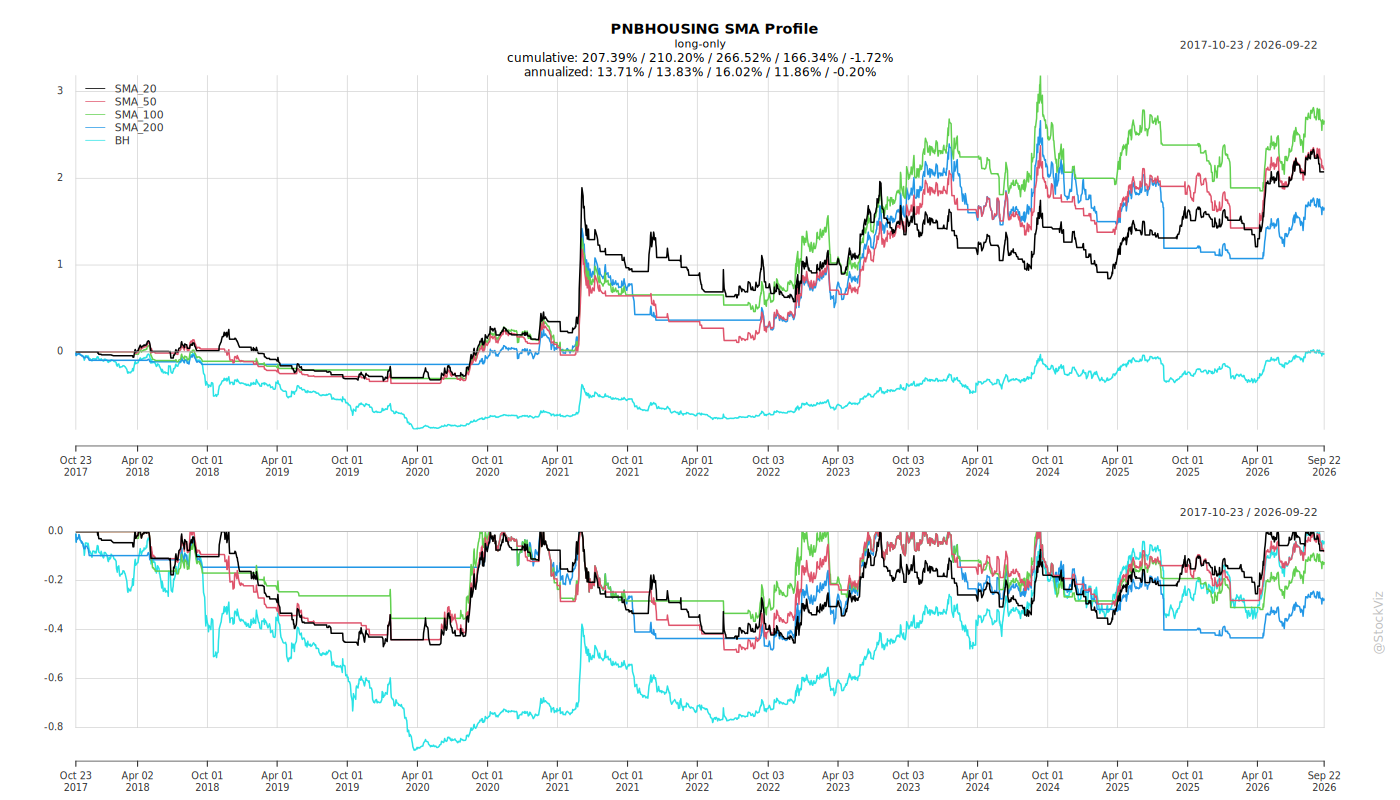
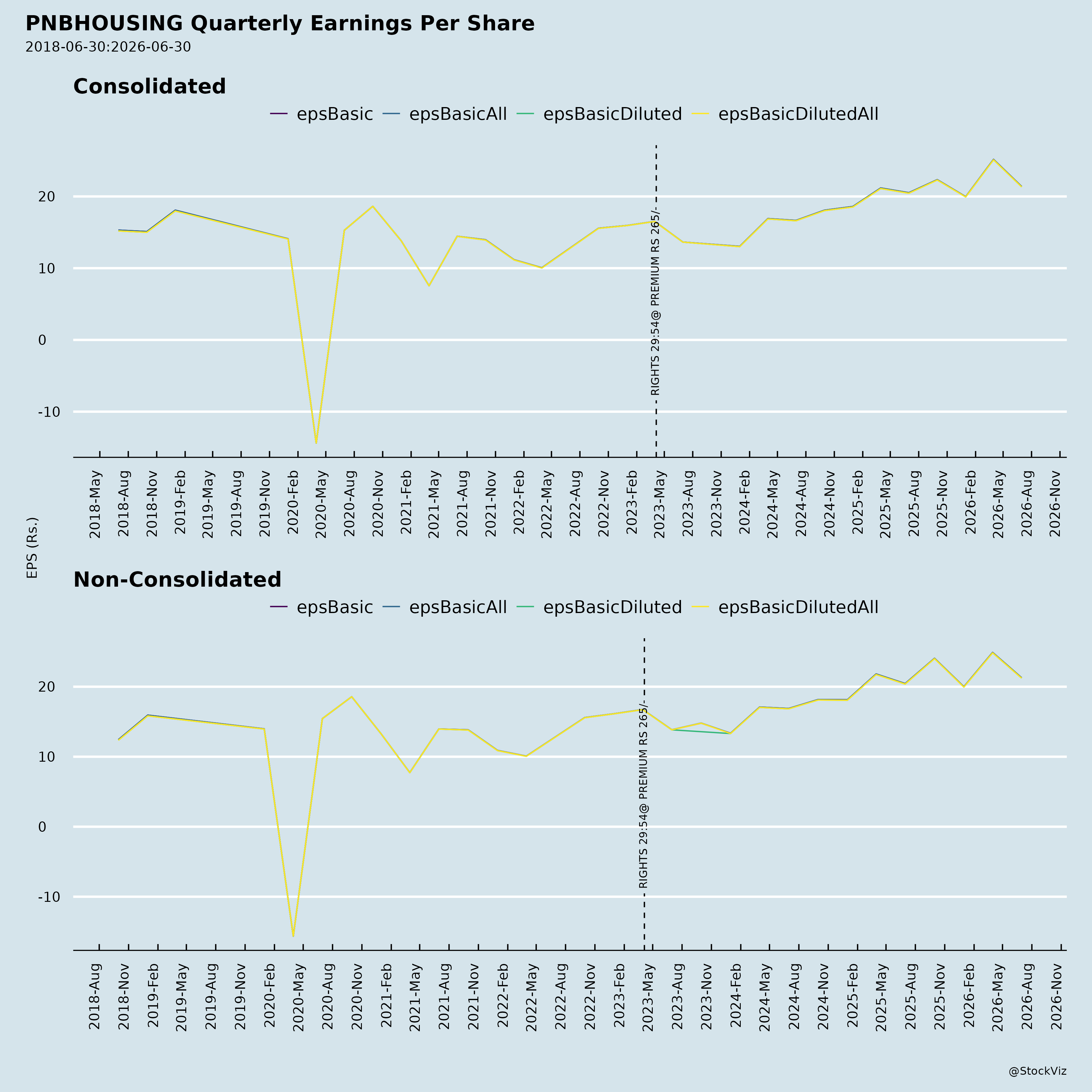
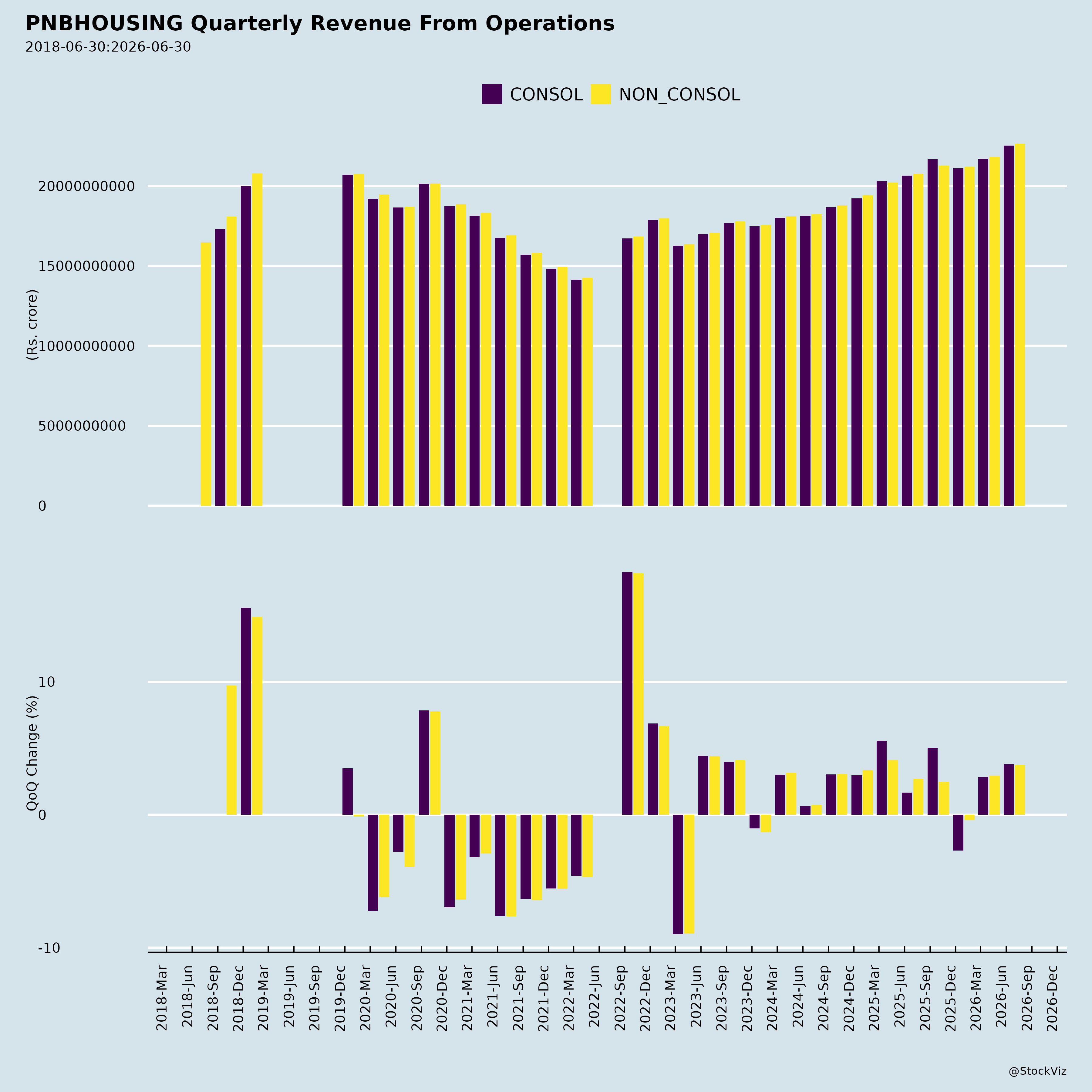
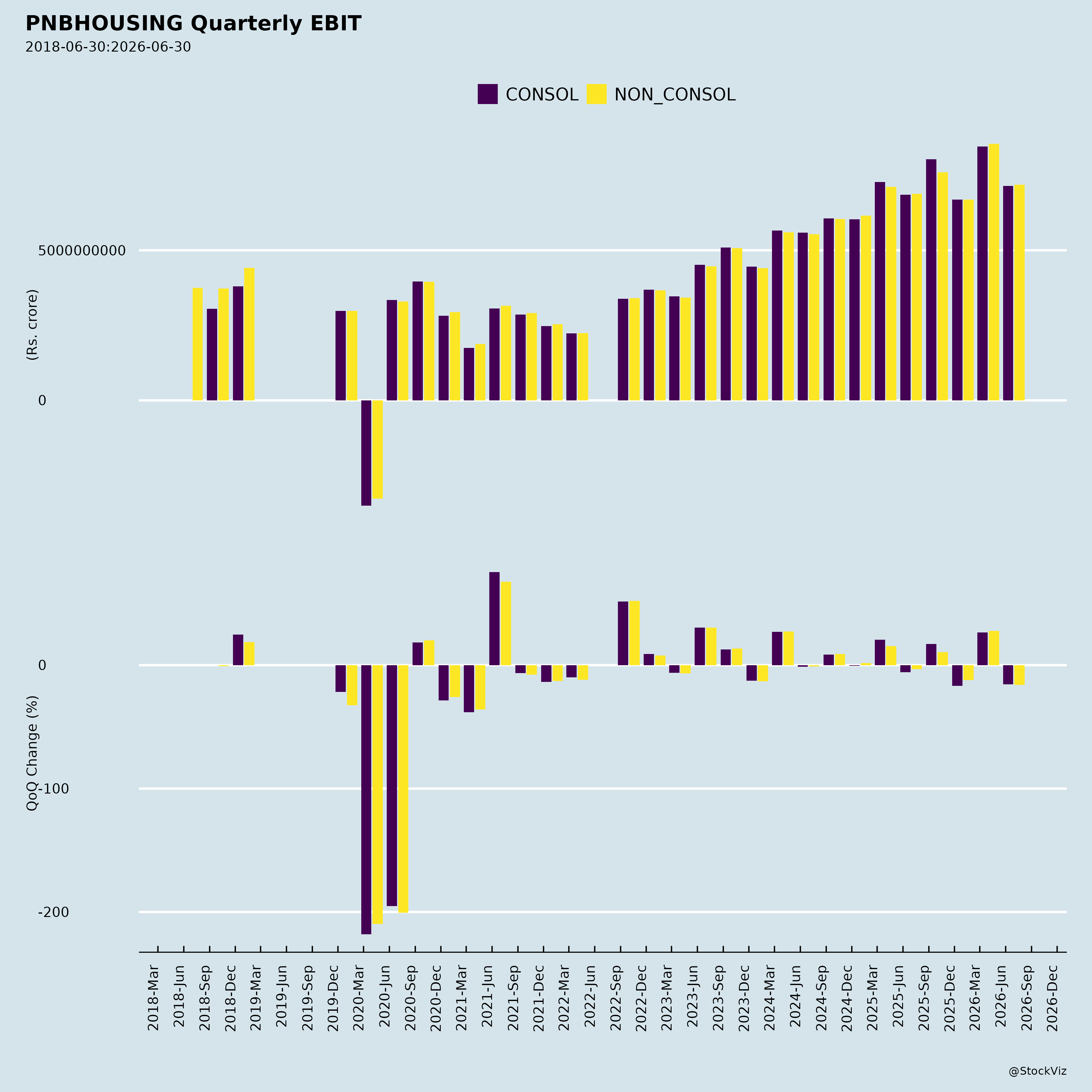
Fundamentals
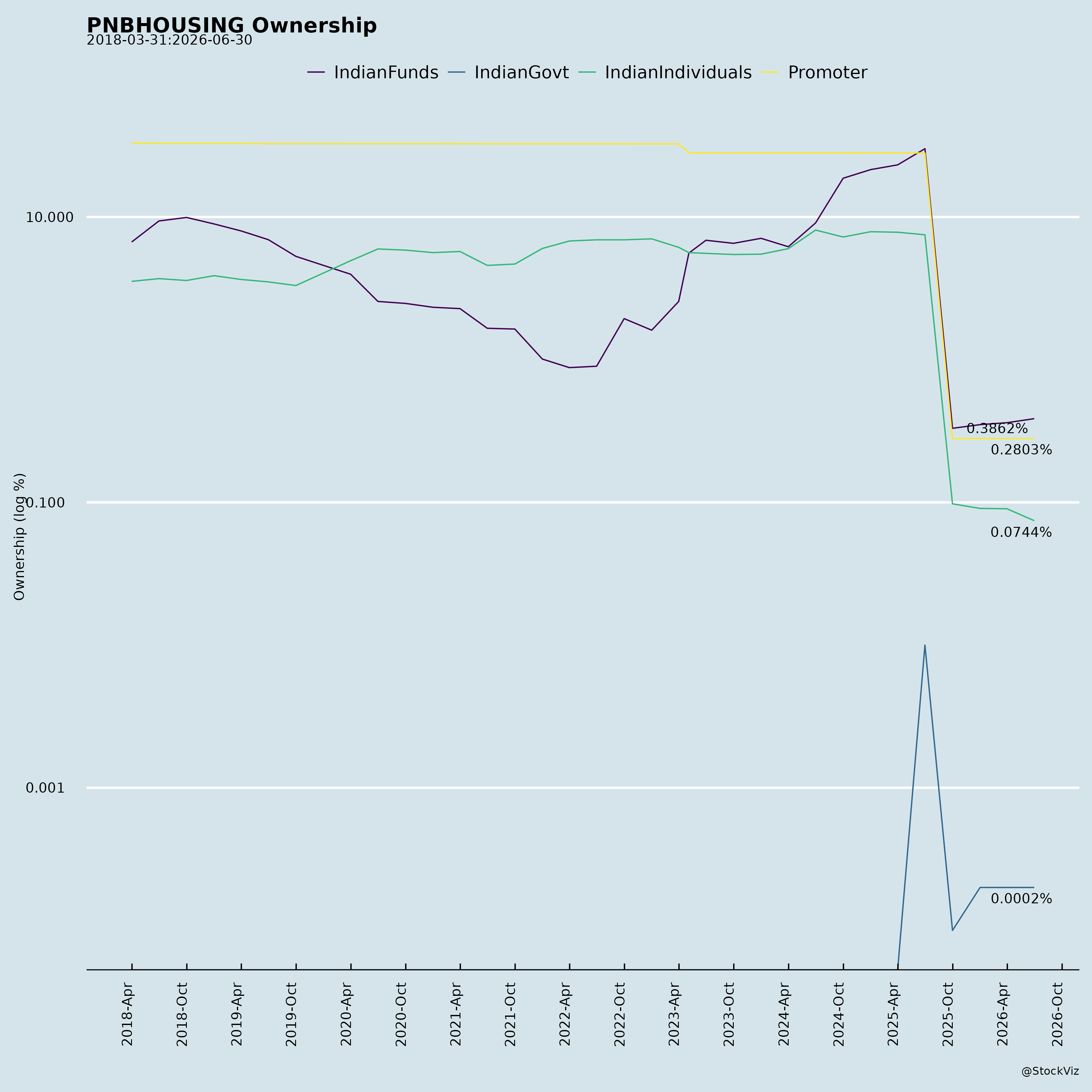
Ownership
Margined
AI Summary
asof: 2026-09-16
PNB Housing Finance — Recent Developments
1. Headwinds and Challenges
Margin pressure. NIM moderated 19 bps QoQ to 3.50% in Q1 FY27, attributed to higher leverage in the quarter and the true-up impact of Q4 FY26 reported NIM. On a YoY basis NIM fell 24 bps. Spread was flat QoQ at 2.12% but down 11 bps YoY. Yield improved only marginally to 9.48% from 9.47% QoQ, while cost of borrowing edged up to 7.36% from 7.35%, with the company noting tight liquidity on account of macro-economic conditions.
Disbursement optics and accounting change. Effective Q1 FY27, disbursement recognition shifted from cheque handover to cheque realization. Reported disbursements of INR 5,882 crore were down 37% QoQ and up 18% YoY; on a cheque handover basis disbursements were INR 7,752 crore, up 56% YoY. Management stated retail disbursements were up 14% post the accounting change and would “normalize from next quarter.” Affordable disbursements fell 27% YoY (up 11% YoY on cheque handover basis) and 56% QoQ.
Profitability moderation. PAT grew 4% YoY to INR 557 crore but declined 15% QoQ. ROA fell to 2.37% (down 52 bps QoQ, 20 bps YoY) and ROE to 11.44% (down 250 bps QoQ, 96 bps YoY). Credit cost was negative (-0.12%), aided by recoveries, so the QoQ profit decline was not driven by credit losses.
Asset quality drift at the margin. GNPA rose to 0.95% from 0.93% QoQ (though down 11 bps YoY); NNPA rose to 0.58% from 0.57%. Stage 3 ECL provision rose to INR 335 crore from INR 310 crore. In the Affordable segment, DPD 30+ rose to 1.60% from 1.32% QoQ and bounce rate to 12.0% from 11.0%, which the company attributed to seasonality in Q1 FY27. Emerging Markets 30+ rose to 0.81% from 0.72% and 90+ to 0.82% from 0.70%; Prime 30+ rose to 1.28% from 1.09%.
Fraud reporting. A fraud reported in July 2026 pertained to a legacy account fully written off in FY2022-23, with no financial impact.
Key personnel and regulatory transition. The Chief Information Officer’s relieving date was extended to on or before September 30, 2026. Separately, the company is monitoring finalization of Central and State Rules under the four Labour Codes notified on November 21, 2025, and has restructured employee compensation effective April 1, 2026, with accounting effects to follow as clarifications emerge.
2. Tailwinds and Growth Prospects
Loan book growth. AUM rose 13% YoY to INR 93,021 crore; the retail loan book grew 16% YoY to INR 89,178 crore and constitutes 99.5% of total loan assets. Overall loan book grew 15% YoY to INR 89,670 crore.
High-yielding segment expansion. Affordable and Emerging Markets grew 27% YoY, contributing 41% of the retail loan book and 46% of retail disbursements. Affordable loan assets grew 49% YoY to INR 8,556 crore; Emerging Markets grew 22% to INR 27,676 crore. Incremental yields improved QoQ across all segments (Affordable 11.85%, Emerging Markets 9.31%, Prime 9.00%). The company is expanding high-yielding branches, launching Micro Housing Finance (rollout expected from Q2 FY27), and launching Developer Finance, with a stated FY27 plan mix of 45% Emerging Markets + Affordable versus 55% Prime.
Distribution and digital build-out. Branches rose to 404 as on June 30, 2026, with 12 additions in Q1 FY27. Live loan accounts crossed 3,87,000. The in-house “Infinity” sales platform, e-Sign/e-Stamp (live since January 21, 2026 in Affordable, with 2,610 eSign executions in Q1 FY27), and voice AI initiatives (SUD AI calling, top-up AI calling, Re-KYC AI calling) are cited as efficiency and conversion drivers. The FY26-27 roadmap moves from Gen AI pilots toward an “agentic enterprise.”
Corporate lending re-entry. The company plans to reinitiate corporate lending with disciplined risk management, capping exposure at under ~10% of the total loan portfolio. Corporate NPA has been nil since June 2024.
Funding capacity and capital. Shareholders approved NCD issuance up to INR 10,000 crore on private placement basis and an increase in borrowing limits from INR 1,05,000 crore to INR 1,50,000 crore. The Board subsequently approved NCD issuance up to INR 6,000 crore with or without green shoe option. CRAR was 28.26% (Tier 1 at 27.87%) as on June 30, 2026, with AAA (Stable) and AA+ (Stable) ratings.
Asset quality and recoveries. GNPA remains below 1%. Recoveries from the written-off pool were INR 67 crore in Q1 FY27 (INR 22 crore retail, INR 45 crore corporate), driving negative credit cost. Controlled delinquency in recent vintages: 30+ at 0.08% for 12-month and 0.24% for 24-month books. 87% of Q1 FY27 bookings had bureau scores above 700.
ESG recognition. Resurgent ESG Services assigned an ESG score of 82.10, corresponding to an ‘A+’ rating for FY2025-26, placing the company in the ‘Leader’ category for the second consecutive year. The company also featured in the top quintile of the Diversified Financial Services and Capital Markets industry in the S&P Global Corporate Sustainability Assessment.
Governance refresh. The 38th AGM on August 17, 2026 approved a dividend of INR 8 per equity share (payable August 26, 2026), re-appointment of Mr. D. Surendran as non-executive nominee director, and appointment of Mr. Shreekant and Mr. Rajiv Kumar Singh as Independent Directors (both effective July 10, 2026).
3. Key Risks
- Margin and funding risk: NIM compression from leverage and funding cost sensitivity to tight liquidity conditions; CoB rose YoY (7.36% vs 7.19% in Q1 FY26).
- Asset quality risk: QoQ upticks in GNPA, NNPA, Stage 3 provisions, and segment-level 30+/90+ delinquencies; Affordable DPD 30+ and bounce rate increases, even if characterized as seasonal.
- Execution risk on new initiatives: Micro Housing Finance, Developer Finance, corporate lending re-entry, and AI/digital rollouts are at early stages (Micro Housing rollout expected from Q2 FY27; Re-KYC AI calling under UAT).
- Accounting/recognition risk: The disbursement recognition change creates comparability distortions; management expects normalization from next quarter.
- Regulatory risk: Pending finalization of Central and State Rules under the Labour Codes, with potential accounting effects.
- Key personnel risk: CIO transition with relieving extended to on or before September 30, 2026.
- Concentration: Top 5 states account for 70.1% of Affordable loan assets (down from 74.4% a year ago), indicating ongoing but reduced geographic concentration.
4. Management Guidance vs. Observed Performance
Guidance/forward-looking statements: - Retail disbursements “will normalize from next quarter” after the accounting change. - Micro Housing Finance rollout expected from Q2 FY27. - FY27 plan mix: 45% Emerging Markets + Affordable vs 55% Prime; corporate lending capped under ~10% of total loan portfolio. - Mr. Anubhav Rajput to be relieved on or before September 30, 2026. - Management expects the pre-delinquency AI calling improvement (75% vs 35%) to “improve over the next 2–3 months.” - Management commentary: focused on strengthening distribution and digital capabilities, and “well positioned to drive sustainable growth.”
Observed performance against prior positioning: - The high-yielding segment strategy is visible in results: Affordable + Emerging Markets now 41% of retail loan book and 46% of retail disbursements, with QoQ incremental yield gains in all three segments. - Asset quality guidance of “best-in-class” is broadly supported by GNPA below 1% and negative credit cost, though QoQ deterioration in GNPA, NNPA, and segment 30+/90+ metrics bears watching. - The disbursement normalization guidance is not yet verifiable within the supplied material, as Q1 FY27 is the first quarter under the new recognition basis. - Digital/AI initiatives show early traction (2,610 eSign executions; SUD AI calling with 86% connected, 56% interested, 41% disbursement date captured), but most are pilots or under UAT rather than scaled. - Capital position guidance is supported: CRAR 28.26%, Tier 1 27.87%, with enhanced borrowing and NCD authorizations in place.
Broker Narrative
The broker narrative evolved from early concerns over MCLR-driven NIM compression, high corporate real estate GNPA, and leadership execution risk, to recent headwinds centered on prime-segment competitive intensity, NIM contraction from leverage, and asset quality seasoning in affordable books. Optimism initially focused on near-term 4QFY earnings but shifted to structural tailwinds around affordable housing growth, declining repayments, and negative credit costs. Themes of margin pressure and asset quality persisted but migrated from corporate real estate to affordable segment seasoning.
Fears that came true
- The flagged rise in MCLR rates compressing NIM by ~95bp QoQ materialized as persistent NIM contraction and higher leverage, correlating with periods of negative actual returns and DISAPPOINTMENT outcomes.
- The high corporate GNPA and delayed real estate resolution persisted as asset quality risks, correlating with DISAPPOINTMENT outcomes and negative returns in early and late 2024.
- The attrition in the super-prime segment and shift to prime led to high competitive intensity in the prime mortgage segment, correlating with multiple DISAPPOINTMENT outcomes and negative actual returns.
Optimism that failed
- The early optimism around 4QFY earnings momentum failed to sustain, leading to DISAPPOINTMENT outcomes and negative returns in early 2024.
Broker Timeline
41 broker calls · 2023-05-19 to 2026-08-05
Copyright © 2023 SAS Data Analytics Pvt. Ltd. All rights reserved.