PAYTM
Equity Metrics
November 16, 2026
One 97 Communications Limited
Financial Technology (Fintech)
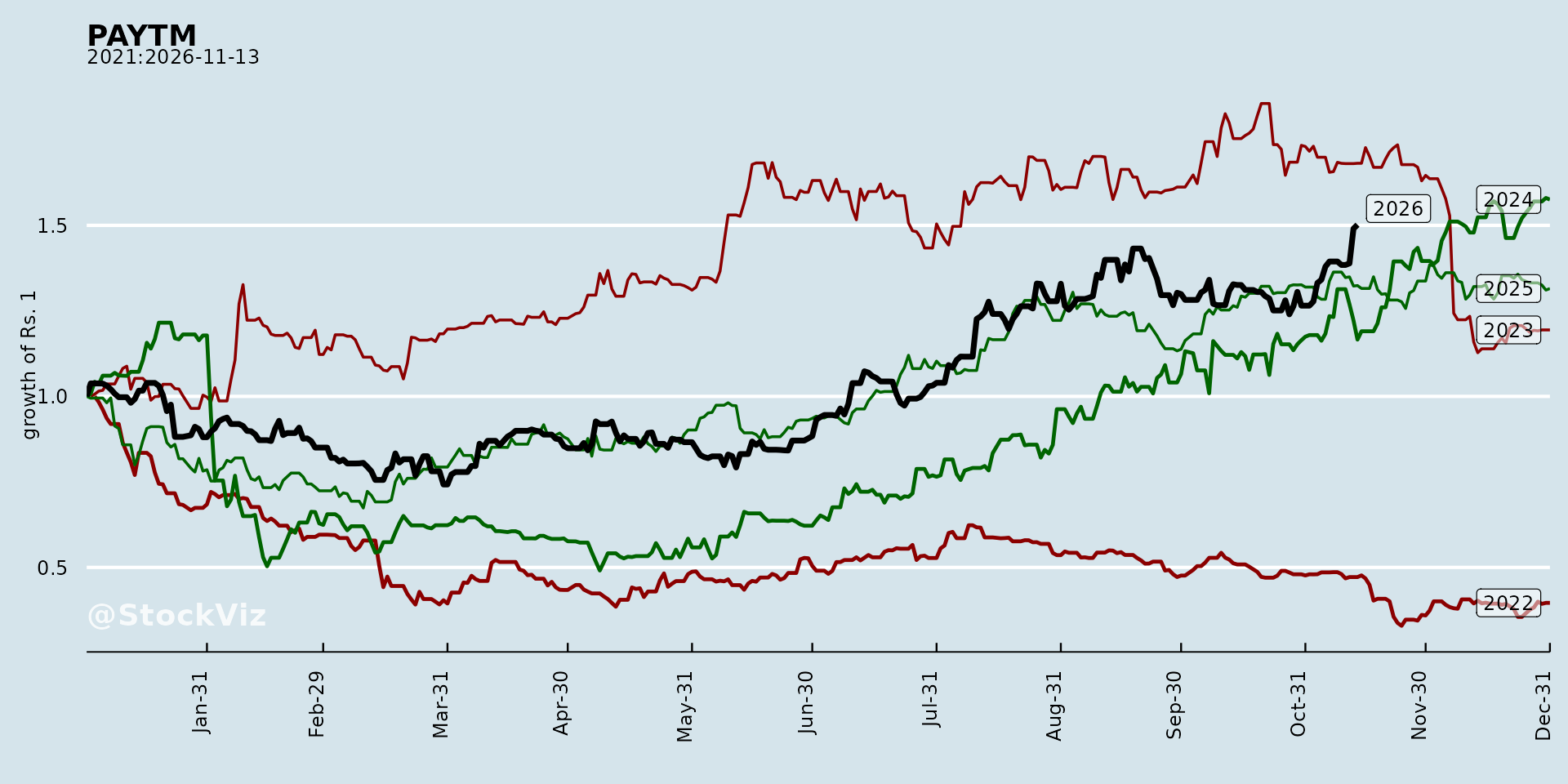
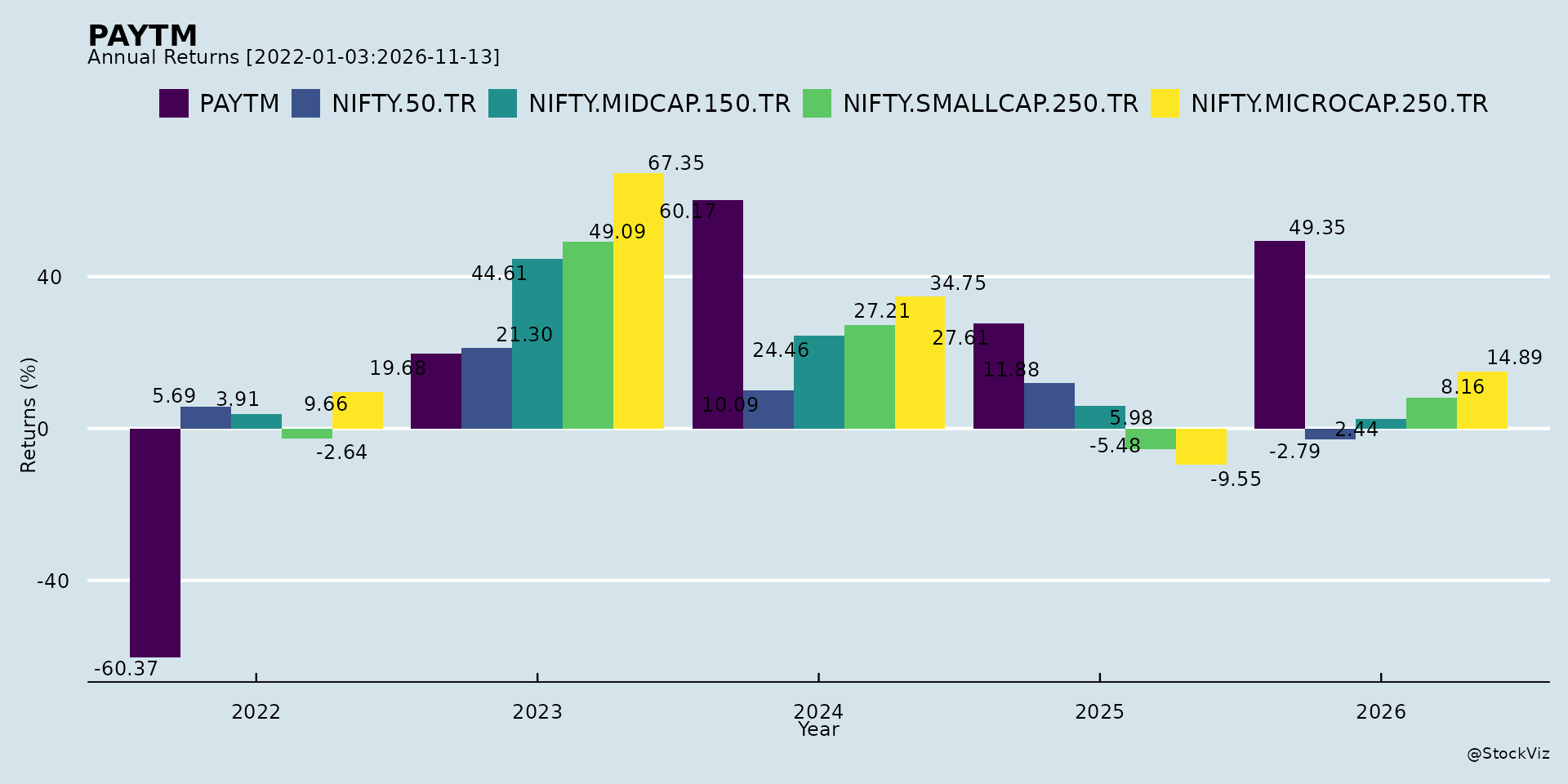
Annual Returns
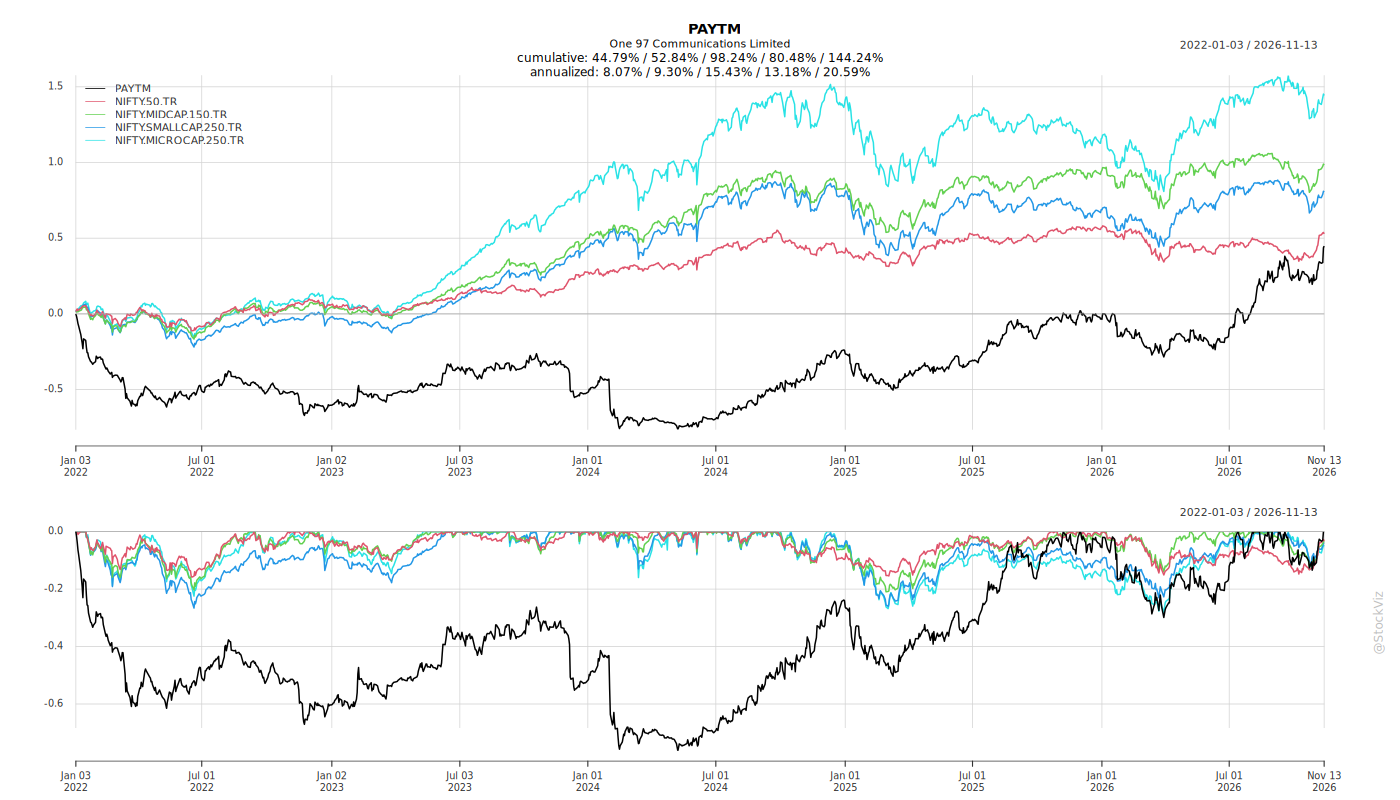
Cumulative Returns and Drawdowns
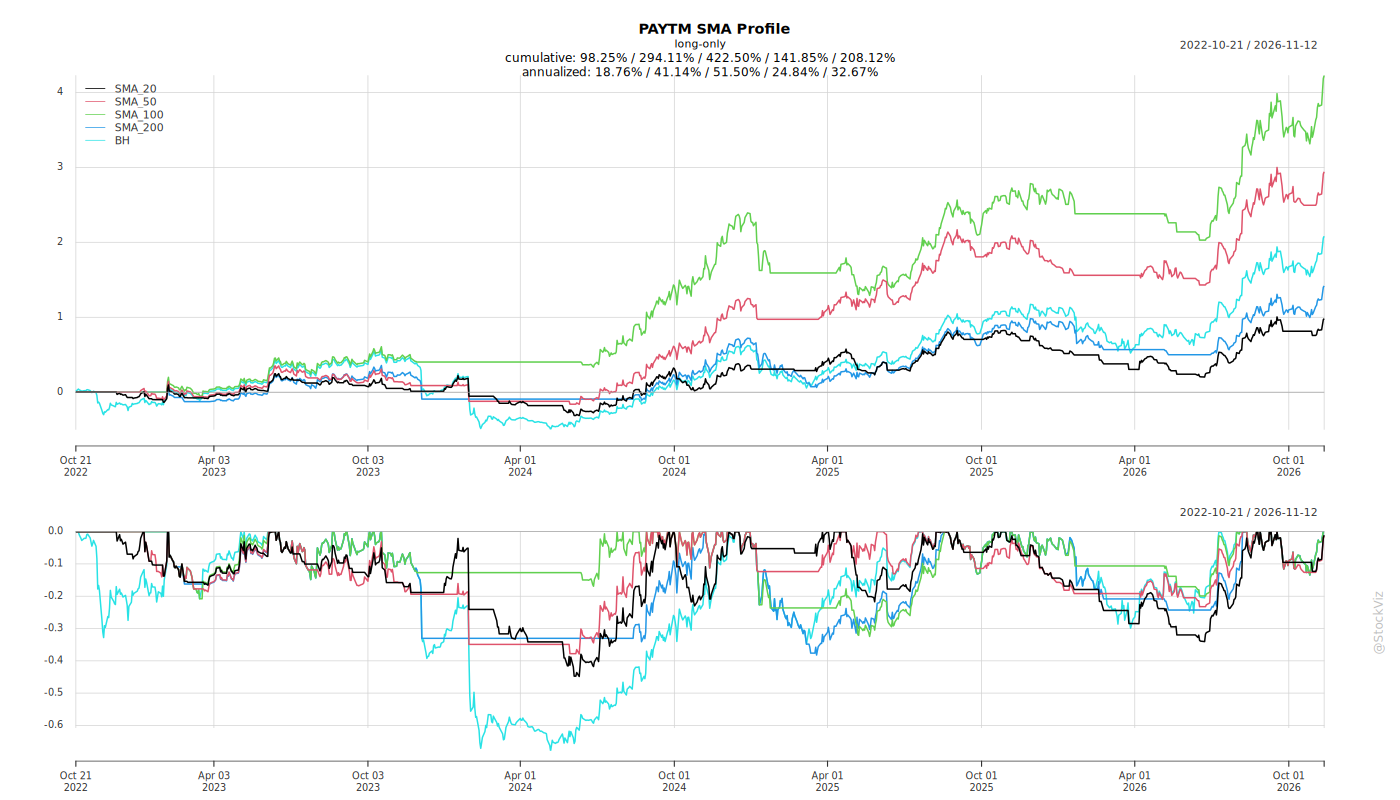
Fundamentals
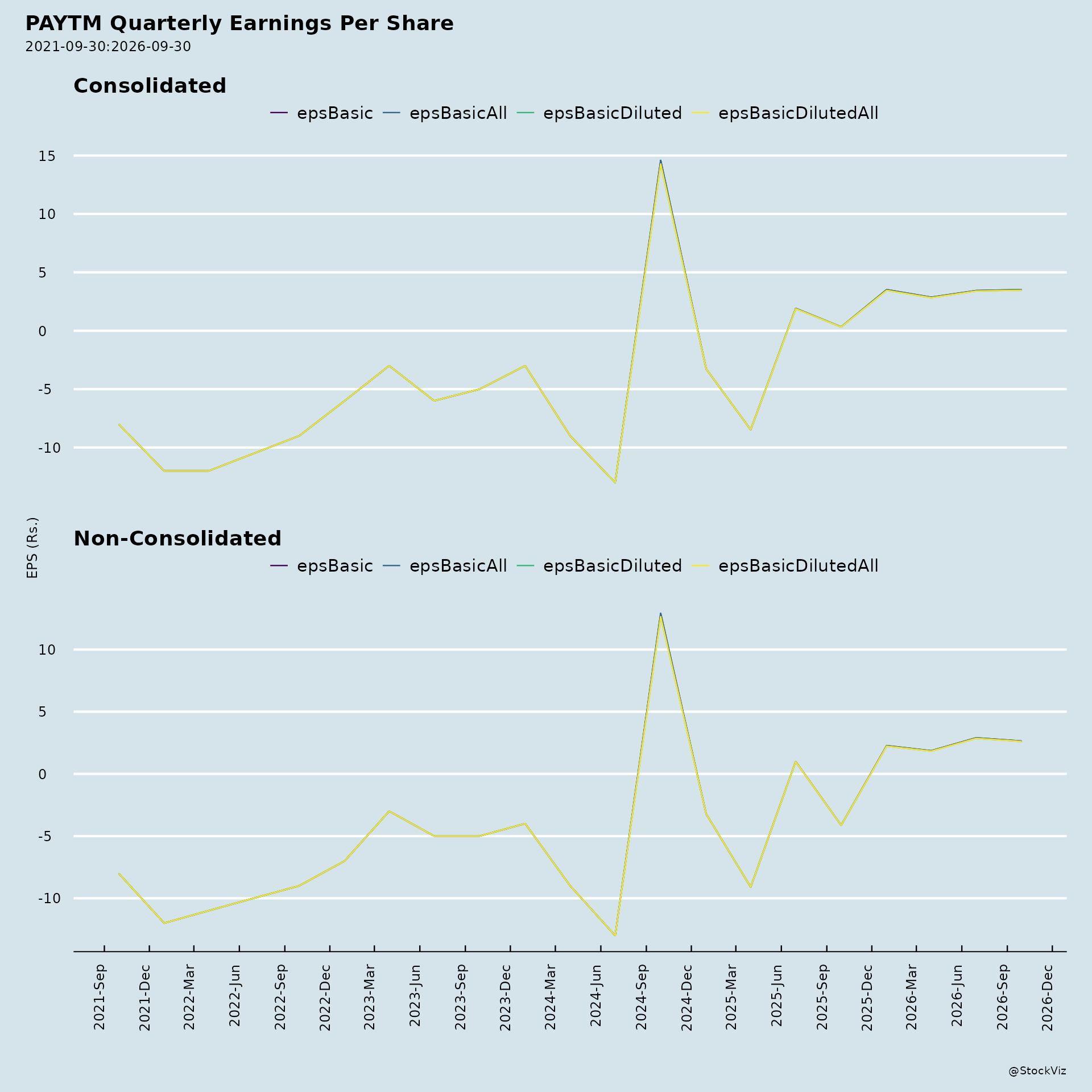
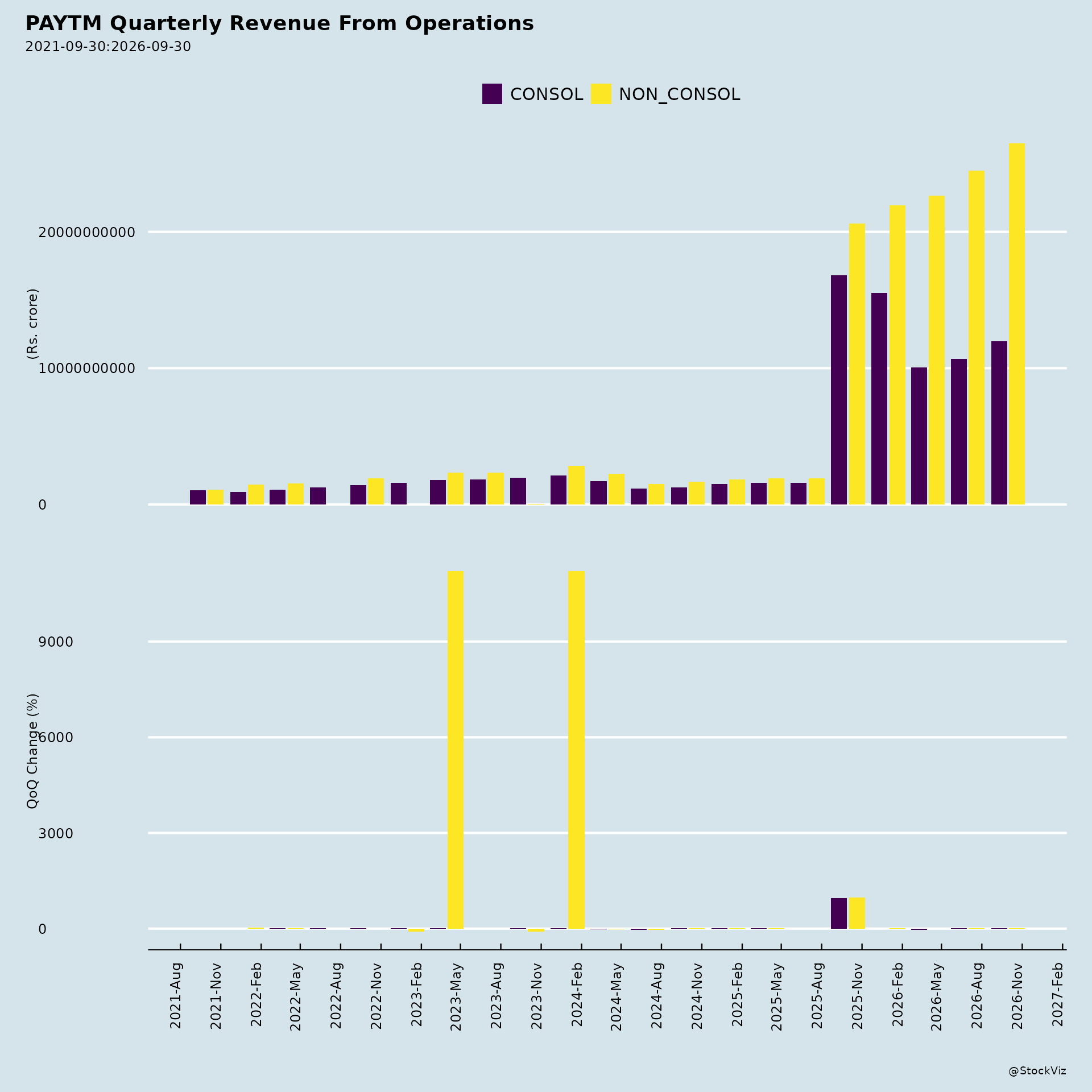
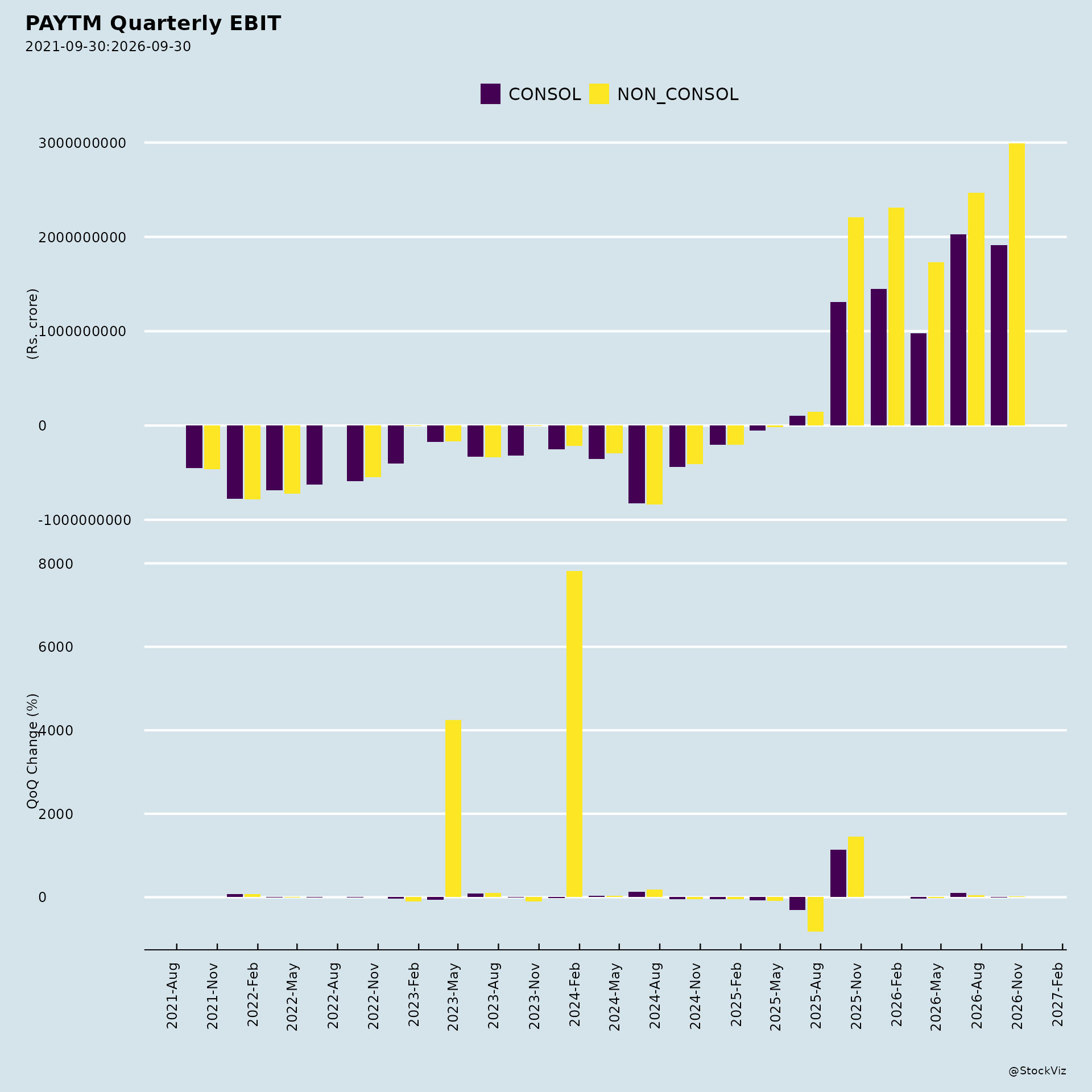
Ownership
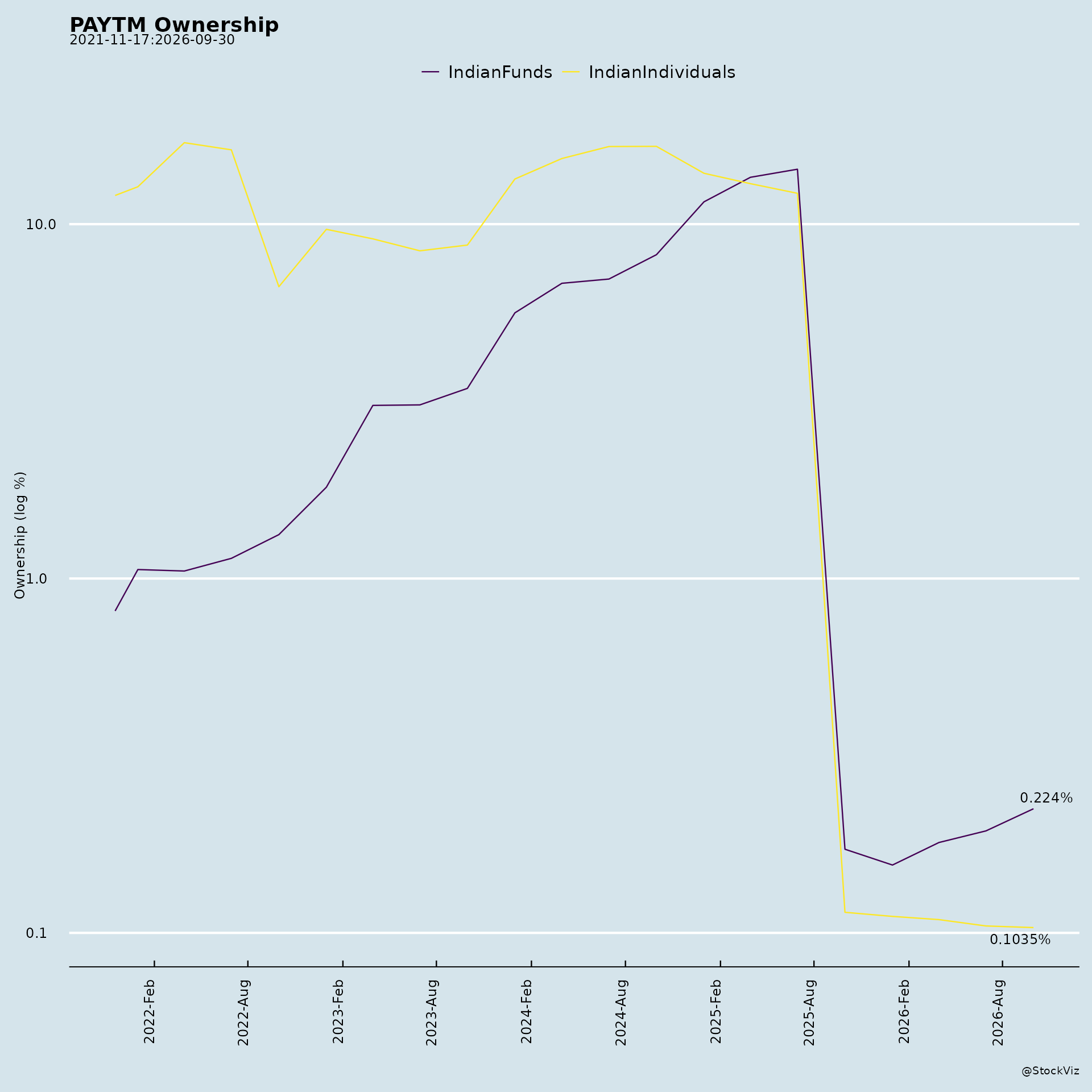
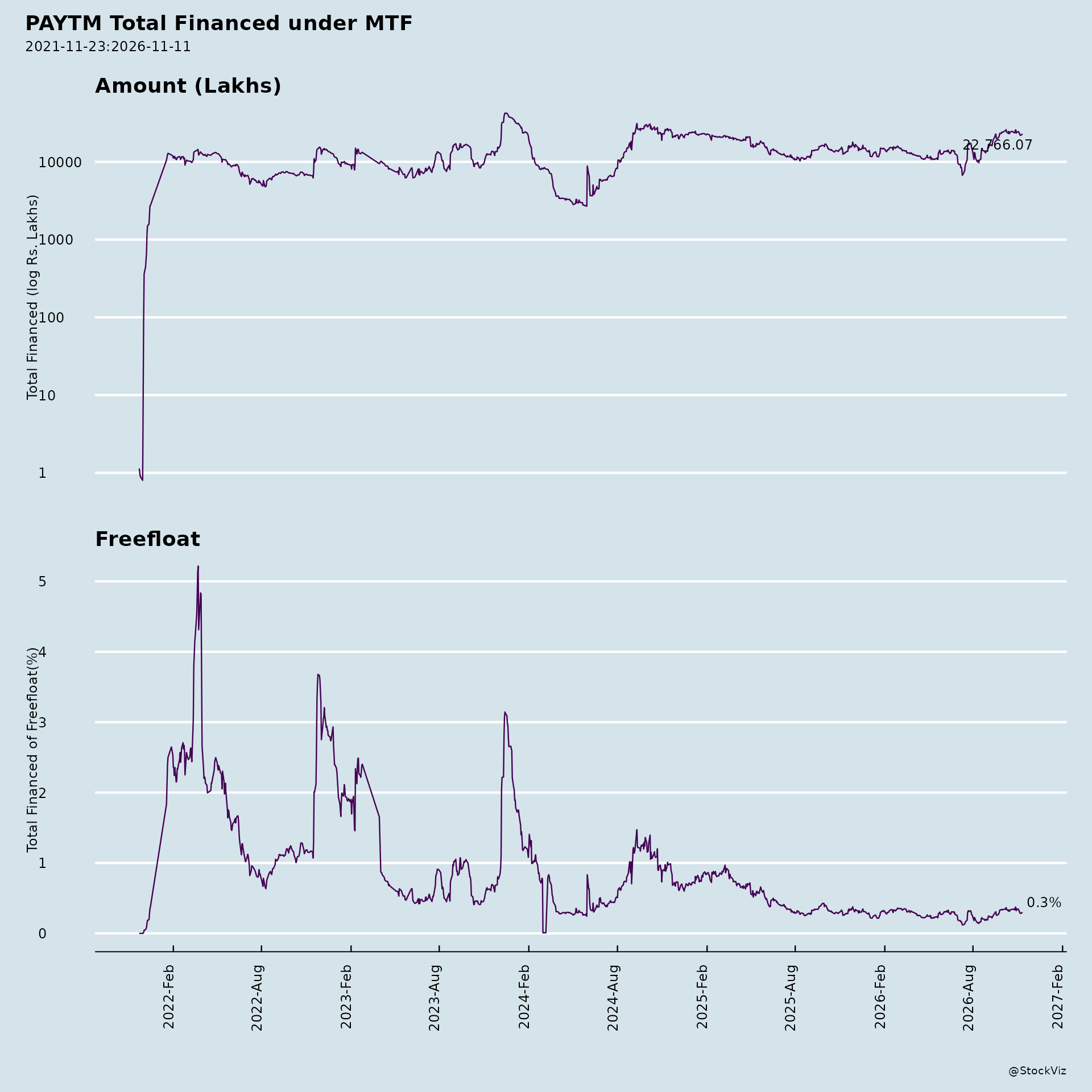
Margined
AI Summary
asof: 2026-09-14
Paytm: Recent Corporate Announcements — Summary
1. Headwinds and Challenges
- Under-utilisation of IPO proceeds earmarked for new businesses. Of the ₹2,000 Crores originally earmarked under Object 2 (new business initiatives, acquisitions and strategic partnerships), only ₹314 Crores had been deployed as of July 20, 2026 — 15.7% of the earmarked amount — leaving ₹1,686 Crores unutilised. The company attributes this to being selective in entering new businesses and pursuing acquisitions/partnerships, and to prioritising its core business instead.
- Remuneration gaps versus peers. An independent benchmarking exercise conducted in June 2026 found the MD & CEO’s existing remuneration materially below median across all three comparator groups, and the existing Independent Director cap of ₹48 lakh per annum materially below the median paid by the peer group. This prompted proposals to revise both frameworks.
- ESOP vesting standards being tightened. The existing ESOP Scheme 2019 allowed 100% vesting on a “Meets expectation” rating; the proposed amendment makes full vesting contingent on higher performance levels and introduces graded vesting (10%–100%) based on an ESOP rating approved by the CEO. This signals a more demanding internal performance bar for future grants.
- Governance and compliance workload. The notice reflects a substantial governance agenda — multiple new director appointments, revised remuneration frameworks, IPO object variation, and ESOP amendments — alongside the transition of the offline merchant payments business to Paytm Payment Services Limited (PPSL) effective midnight of November 30, 2025.
2. Tailwinds and Growth Prospects
- First full year of profitability. FY 2026 was Paytm’s first full year of profitability. Revenue grew 22% YoY to ₹8,437 Crores, EBITDA improved by ₹2,008 Crores YoY to ₹502 Crores, and PAT improved by ₹1,215 Crores YoY to ₹552 Crores.
- Continued momentum into FY 2027. In Q1 FY2027, the company reported its highest ever EBITDA and PAT at ₹203 Crores (up 182% YoY) and ₹220 Crores (up 79% YoY) respectively.
- Merchant business as the profit engine. The letter to shareholders states that most profits are generated through the merchant business, that Paytm has built India’s largest merchant payment business, and that the model is “now fully proven.”
- Consumer momentum. The company states it continues to grow at more than 2x the pace of the UPI market and has gained market share for five consecutive quarters, with consumer monetisation accelerating.
- New growth vectors. Wealth (equity broking, margin trade facility, mutual fund distribution) is expected to become a contributor to revenue and profitability. International expansion is described as beginning to take shape, taking merchant payments technology and financial services capabilities to select markets.
- AI-led operating leverage. AI is being applied across processes, products and merchant/consumer journeys, with the stated aim of improving efficiency, lowering costs and opening new revenue opportunities. India’s AI infrastructure build-out (IndiaAI Mission, 38,000+ GPUs, 5G across 99.9% of districts) is cited as enabling context.
- Favourable market backdrop. India’s fintech market revenue is cited at $51 billion in 2026, projected to reach $109 billion by 2031 at a 16% CAGR; digital payments are projected to expand roughly threefold by FY30 to $10.2 trillion, with UPI expected to approach one billion transactions per day by FY28.
- Capital reallocation flexibility. The proposed variation in IPO objects would allow the remaining ₹1,686 Crores to be deployed interchangeably across Object 1 (growing and strengthening the Paytm ecosystem) and Object 2, with the utilisation timeline extended by two years to March 31, 2029. No new object is being introduced and the total amount remains unchanged.
- Board strengthening. Proposed appointments bring sector depth: Mr. Narasinganallore Venkatesh Srinivasan (four decades in financial services, ex-CEO of AMFI, former CFO/Executive Director of IDBI and Lakshmi Vilas Bank), Ms. Sachee Trivedi (Founder & Managing Partner of Trident Capital Investments, ex-Columbia Threadneedle), and Mr. Amitabh Kumar Singhal (former Senior Vice President of Search at Google and Google Fellow, nearly three decades in search and technology).
3. Key Risks
- Execution risk on capital deployment. The company has been selective in deploying Object 2 proceeds; the proposed flexibility to channel funds into Object 1 is intended to put capital to “productive, value-accretive use,” but the outcome depends on the timing and manner of deployment. The company states it does not anticipate any material adverse impact on earnings or cash flows arising solely from the variation, and that any financial impact will depend on deployment timing and manner.
- No additional risk factors disclosed for the IPO variation. The company states the proposed variation introduces no new object and therefore no additional risk factors beyond those already disclosed in the Prospectus and otherwise applicable to the business.
- Remuneration approval dependency. The revised MD & CEO remuneration (fixed pay of ₹7 Crores per annum for FY 2027 with up to 15% annual increment, variable pay up to 200% of prevailing fixed pay linked to target PAT growth, perquisites up to ₹1 Crore per annum, statutory benefits and reimbursements) and the Non-Executive Director framework (up to ₹98 Lakhs per annum per director, capped at 1% of net profits in aggregate) are subject to member approval. The MD & CEO resolution also provides for payment in years of no or inadequate profits, subject to Section 197 read with Schedule V compliance.
- ESOP amendment scope. The amendments apply to future grants only, do not affect options already granted, and do not result in incremental dilution or an increase in the maximum number of options grantable. Options already granted continue under existing terms.
- Dependence on continued profitability. The remuneration frameworks and the IPO reallocation rationale are explicitly tied to the company’s profitability trajectory; the MD & CEO variable pay for FY 2027 is tied to percentage achievement of target PAT growth.
- Regulatory and approval conditions. The resolutions are subject to applicable provisions of the Companies Act, 2013, SEBI Listing Regulations, SEBI ICDR Regulations, SEBI SBEB & SE Regulations, FEMA and other approvals. The IPO variation requires a special resolution; the independent director appointments require special resolutions under Regulation 25(2A) of the SEBI Listing Regulations.
4. Management Guidance Versus Observed Business Performance
- Profitability trajectory. The notice and letter to shareholders state that FY 2026 was Paytm’s first full year of profitability, with revenue of ₹8,437 Crores (up 22% YoY), EBITDA of ₹502 Crores (up ₹2,008 Crores YoY) and PAT of ₹552 Crores (up ₹1,215 Crores YoY). Q1 FY2027 EBITDA and PAT were the highest ever at ₹203 Crores and ₹220 Crores respectively. The company describes itself as “well positioned for long-term sustainable profit growth,” citing a large market, accelerating revenue growth and AI-led operating leverage leading to EBITDA margin expansion.
- Prior remuneration decisions versus subsequent revision. At the 25th AGM (August 29, 2025), members approved remuneration for Mr. Sharma for April 1, 2025 to December 18, 2027 on the same terms approved on August 19, 2022. The NRC and Board, in meetings on July 21, 2025 and July 22, 2025, had recommended that an additional variable pay component be considered for FY 2026-27 and the balance tenure, noting a revision “may be appropriate at that point of time.” Following FY 2026 profitability and Q1 FY2027 performance, the NRC and Board on July 3, 2026 approved and recommended the revised remuneration now placed before members — consistent with the earlier stated intent to revisit compensation.
- ESOPs. Mr. Sharma was granted 2,10,00,000 stock options under ESOP Scheme 2019 (approved at the EGM on October 4, 2021). By letter dated April 16, 2025, he voluntarily forwent all 2,10,00,000 unvested ESOPs. As on the date of the notice, he holds no ESOPs, and no ESOPs are proposed to be granted to him for the remainder of his current tenure.
- IPO proceeds utilisation versus original plan. Object 1 (₹4,300 Crores) and Object 3 (General Corporate Purposes, ₹1,819.4 Crores) are fully utilised (100%). Object 2 is 15.7% utilised (₹314 Crores of ₹2,000 Crores). Total IPO proceeds of ₹8,119.4 Crores are 79.2% utilised (₹6,433.4 Crores), with ₹1,686 Crores unutilised. The company states its core-business investments were funded in part by Object 1 proceeds and that this approach “has proven successful demonstrated by the full year profitability that we posted in FY26.”
- Business transition. The offline merchant payments business was transferred to PPSL, a material wholly owned subsidiary, effective midnight of November 30, 2025. Mr. Sharma was appointed MD & CEO of PPSL for five years effective January 29, 2026, without remuneration or fee from PPSL, to provide continuity of leadership for merchant payments.
- Director remuneration practice. Mr. Ravi Chandra Adusumalli, a Non-Executive Director since February 16, 2012 and nominee of SAIF III Mauritius Company Limited, SAIF Partners India IV Limited, Elevation Capital V Limited and Elevation Capital V FII Holdings Limited, does not receive remuneration or sitting fees. Non-Executive Nominee Directors are excluded from the proposed remuneration framework except for expense reimbursement.
- Board and committee engagement. During FY 2025-26, three Board meetings were held; Mr. Sharma attended all three, plus two of two Risk Management Committee meetings, two of two Corporate Social Responsibility Committee meetings, and one of one Investment Committee meeting. Mr. Adusumalli attended two of three Board meetings, nil of one NRC meeting during his tenure (appointed NRC member effective July 5, 2026), and one of one Investment Committee meeting.
Broker Narrative
The narrative shifted from cyclical headwinds—high repo rates, absent UPI incentives, and partner-led lending pauses—to structural execution themes: payments market share, financial services revenue growth, and operating leverage. Persistent themes include the underpenetrated borrower and merchant base, contribution margin expansion, and regulatory oversight of lending. What changed is the cost dynamic: early depreciation concerns from devices were later joined by materially higher DLG and fixed costs pressuring margins, while new growth levers expanded from UPI Lite and co-branded cards to AI services, wallet, and international payments.
Fears that came true
- The warning that elevated interest rates would force calibrated, quality-focused loan growth and limit near-term gains matched the string of 2023 Buy calls with sharply negative actual returns, such as -49.0%, -51.5%, and -46.4%.
- The risk of lagged deterioration in unsecured credit after the ~250 bps repo increase materialized in multiple 2023 disappointments where predicted upside was not realized and actual prices fell.
- The expectation of sequential revenue decline from lack of UPI incentive and lending moderation aligned with Q1FY24-era reports that ended as DISAPPOINTMENT despite optimistic price targets.
Optimism that failed
- The thesis of sustained contribution margin expansion above 50% ex-UPI incentive failed to hold, as the final report flags a Q3FY27 margin decline from materially higher DLG costs and 13.4% YoY fixed-cost growth.
- Optimism around steady financial-services adoption via new lender partners and Credit-on-UPI was curtailed by persistent regulatory challenges that continue to cap loan growth.
- The device-subscription annuity run-rate promise was partly offset by higher depreciation charges that prevented operating leverage from translating into consistent share-price gains.
Broker Timeline
49 broker calls · 2023-05-06 to 2026-10-30
CNBC-TV18: ratings, targets and commentary
Extracted from CNBC-TV18 posts; ratings and targets are as published, not current consensus. OCR may contain errors. Speaker attribution is retained; not all speakers are brokers. These statements are separate from the Broker Narrative and Broker Timeline and have no calculated performance or outcomes.
Ratings and targets
| Published / source (IST) | Speaker / affiliation | Rating / target | Commentary |
|---|---|---|---|
| 2026-11-16 |
Jefferies
|
—
Target: INR 2,300
Target action: raised
|
Jefferies raised Paytm share price target to a joint highest ₹2,300 |
Management comments
No recorded management comments with an explicit designation and affiliation for this ticker.
Copyright © 2023 SAS Data Analytics Pvt. Ltd. All rights reserved.