PARKHOSPS
Equity Metrics
September 24, 2026
Park Medi World Limited
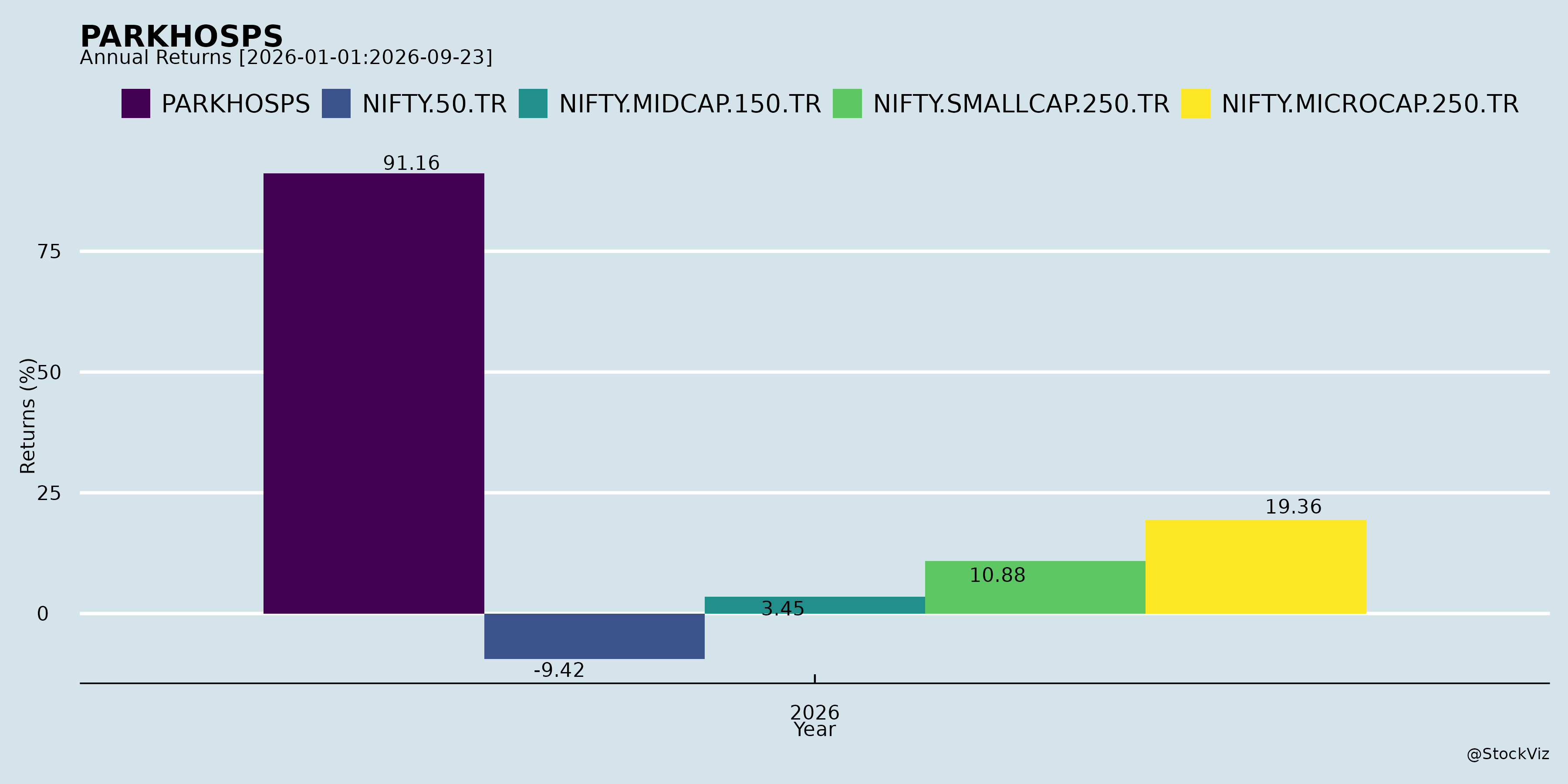
Annual Returns

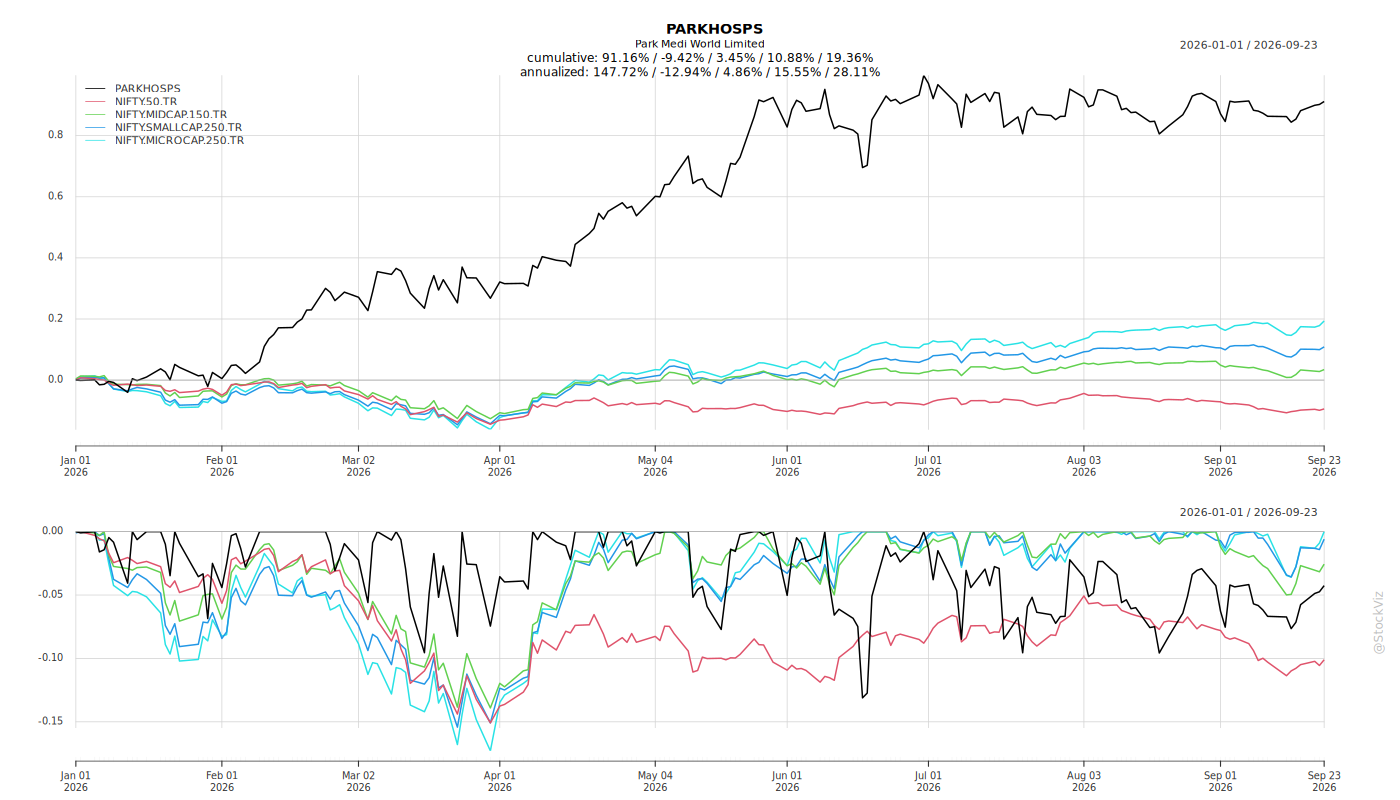
Cumulative Returns and Drawdowns
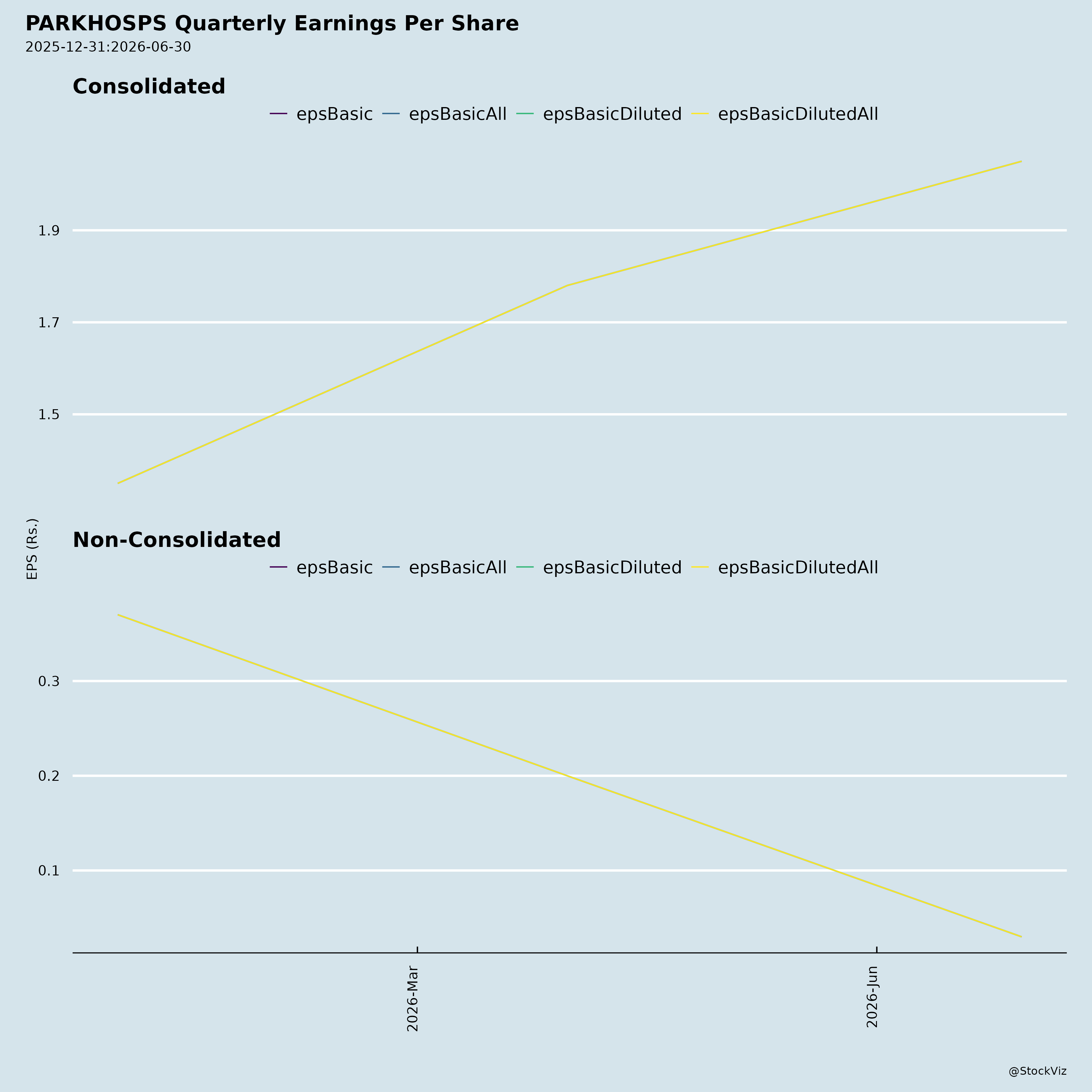
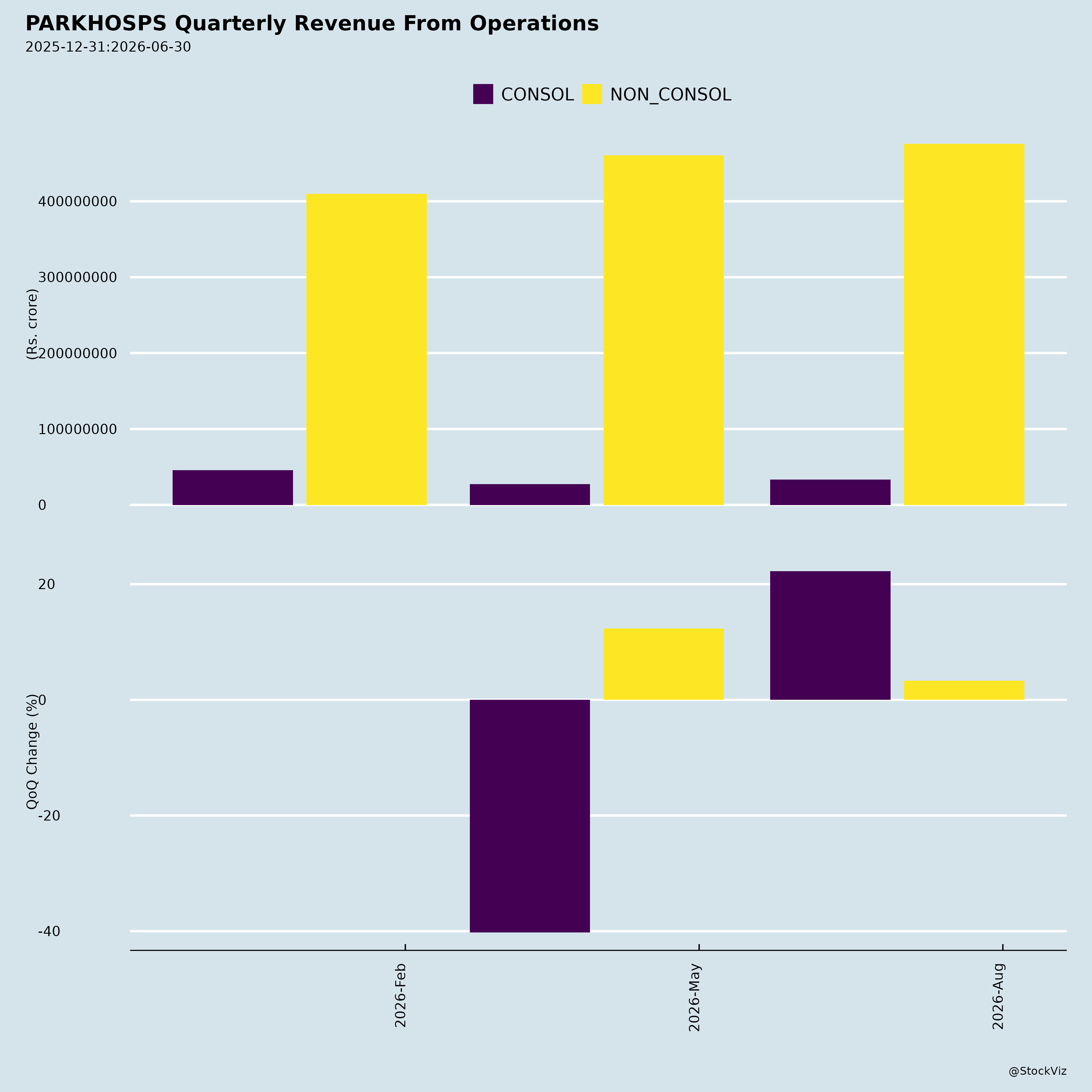
Fundamentals
Ownership
Margined
AI Summary
asof: 2026-09-17
Park Medi World Limited — Recent Corporate Developments
1. Headwinds and Challenges
- Occupancy dilution from capacity addition. Occupancy moderated to 55.6% in Q1 FY’27 from 67.8% in Q1 FY’26 (a decline of 1,224 bps) and from 62.5% in Q4 FY’26 (a decline of 692 bps). The company attributes this moderation to the addition of significant capacity, with newly commissioned beds still ramping up.
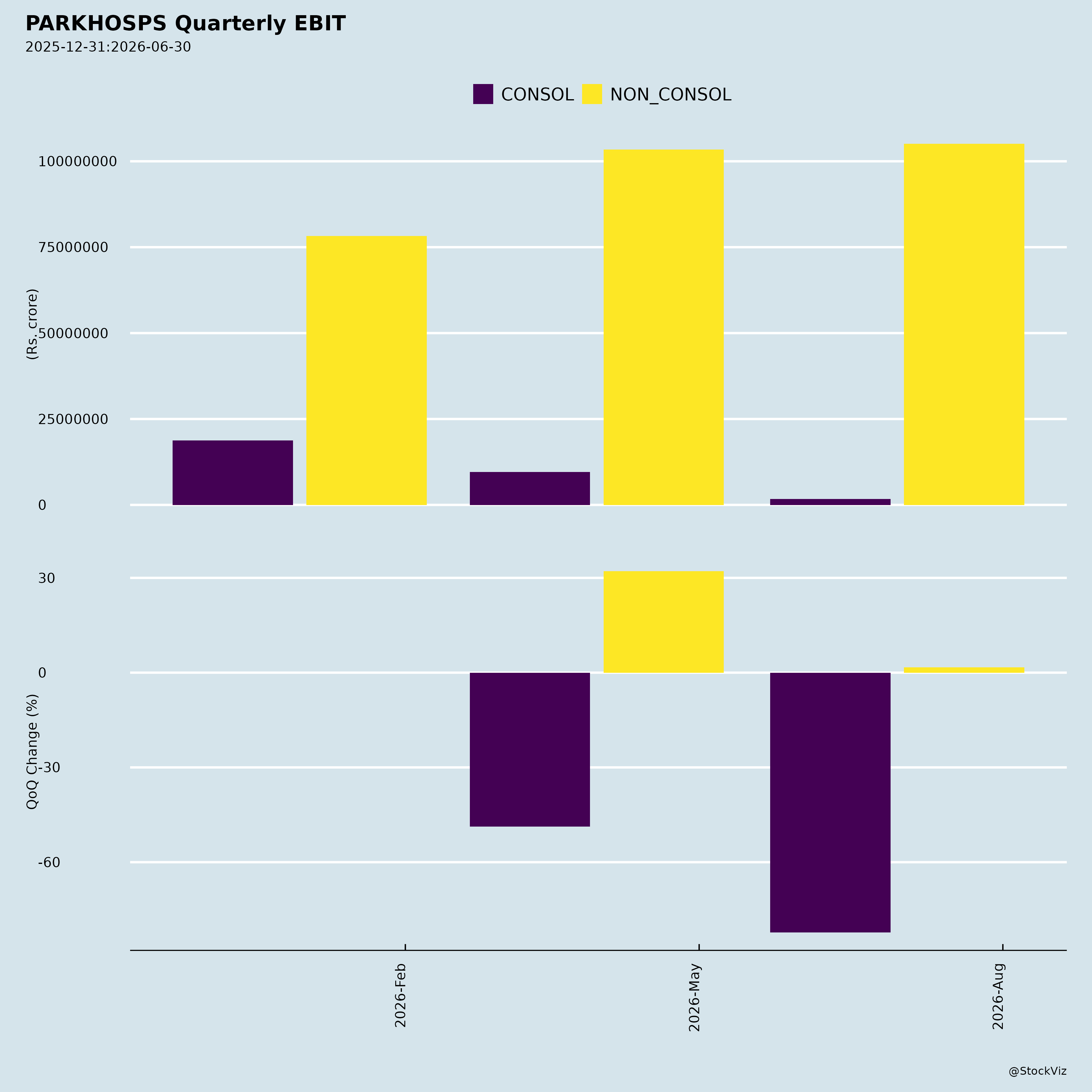
- Sequential margin pressure. While EBITDA margin expanded 20 bps year-on-year to 26.5%, it contracted 116 bps quarter-on-quarter from 27.7% in Q4 FY’26. EBITDA declined 1% quarter-on-quarter (INR 1,261 mn vs INR 1,274 mn).
- Integration workload. Management’s stated near-term focus includes integration of acquired assets and improving utilisation at newer facilities, indicating execution demands from the ongoing expansion programme.
- Business exigencies affecting investor engagement. Due to certain business exigencies, management did not participate in the Anand Rathi Annual Flagship Conference G-200 Summit 2026 scheduled for September 21, 2026. No change was made to other scheduled conferences mentioned in the intimation dated September 05, 2026.
2. Tailwinds and Growth Prospects
- Strong Q1 FY’27 performance. Revenue of INR 4,757 mn (up 19% YoY), EBITDA of INR 1,261 mn (up 20% YoY), and Net Profit of INR 886 mn (up 35% YoY), with Net Profit margin expanding 220 bps to 18.6%.
- Largest-ever capacity expansion programme. The company expects to commission 1,490 beds in calendar year 2026, a c.46% increase over the closing 2025 capacity of 3,250 beds — described as the single largest addition of beds in any 12-month period.
- Specific capacity milestones:
- Panchkula greenfield hospital (350 beds) commissioned April 10, 2026.
- Agra facility (360 beds) commissioned February 2026.
- Acquisition of The Medicity Hospital, Rudrapur (Kumaon region’s largest NABH-accredited hospital) at a valuation of INR 177 crs, agreement signed May 25, 2026; commissioned August 2, 2026.
- Palam Vihar, Gurugram expansion: 100 new beds under the name ‘Park Platinum’ approved June 30, 2026, expected commissioning November 2026; takes consolidated Gurugram capacity to 750 beds. The existing 225-bed facility had ~86% occupancy and ~INR 245 crs revenue in FY’26.
- Acquisition of Mehar Hospital, Zirakpur (150+ beds) at a valuation of INR 107 crs, agreement signed August 3, 2026; expected commissioning November 2026.
- Febris multi-super-speciality hospital, Narela, Delhi (200 beds) upcoming.
- PPP opportunity in Prayagraj. Development and operation of a 550-bed multi-super-speciality hospital at Prayagraj, Uttar Pradesh under the Public-Private Partnership model awarded by the Prayagraj Municipal Corporation. A wholly-owned SPV, “Park Medicity Prayagraj Limited” or “Park Hospital Prayagraj Limited,” was incorporated with a subscription cost of INR 0.15 crore (1,50,000 equity shares of face value Rs. 10 each, 100% shareholding).
- Projected network growth. Bed capacity is projected to grow by approximately 59% between FY’26 and FY’28, reaching 5,740 beds by March 2028. The company cites expanding multi-super-speciality capabilities, rising health insurance penetration, increasing healthcare demand in North India, and multi-lever growth from greenfield, brownfield, and inorganic acquisitions.
- Geographic expansion. Presence across 15 cities and 6 states, with expansion into Zirakpur (Punjab), Gorakhpur (Uttar Pradesh), and Rohtak (Haryana).
- Balance sheet strength. Negligible term bank debt of INR 256 mn as of June 30, 2026; strong liquidity with INR 2,998 mn in fixed deposits; negative net debt position; promoter holding at approximately 82.9%.
3. Key Risks
- Execution and ramp-up risk. The scale of the expansion (1,490 beds in calendar year 2026; 1,450 beds across 5 hospitals being integrated and 2 existing units being expanded) creates dependence on timely commissioning and successful integration of acquired assets.
- Occupancy and utilisation risk. Newly added capacity has already diluted occupancy; failure to ramp up utilisation at newer facilities could weigh on margins.
- Regulatory and external factors. The company’s cautionary statement notes that forward-looking statements are subject to risks and uncertainties including regulatory changes, local political or economic developments, and other factors that could cause actual results to differ materially.
- Forward-looking statement reliance. Past performance is not necessarily indicative of future results, and the company undertakes no obligation to publicly update forward-looking statements.
4. Management Guidance vs. Observed Business Performance
- Guidance: Management expects to exit FY’27 at 4,740 beds and reach 5,740 beds by March 2028, funded largely through internal accruals and IPO proceeds without material fresh debt. The company also expects to commission 1,490 beds in calendar year 2026.
- Observed performance: As of June 30, 2026, the company operated 17 hospitals with 3,960 beds across 15 cities and 6 states, up 32% YoY from 3,000 beds and up 10% QoQ from 3,610 beds. Total patients grew 17% YoY to 249.8 thousand; IPD patients grew 16% YoY to 26.3 thousand; OPD patients grew 17% YoY to 223.4 thousand.
- Margin and profitability trend: EBITDA margin of 26.5% in Q1 FY’27 versus 26.3% in Q1 FY’26 (expansion of 20 bps) but below the 27.7% recorded in Q4 FY’26. Net Profit margin of 18.6% versus 16.4% in Q1 FY’26 and 16.7% in Q4 FY’26. EPS of INR 2.05 versus INR 1.70 YoY and INR 1.78 QoQ.
- Funding position: The negligible term debt (INR 256 mn) and strong liquidity (INR 2,998 mn in fixed deposits) are consistent with the stated intent to fund expansion largely through internal accruals and IPO proceeds without material fresh debt.
- Shareholder approvals: Members approved a special resolution via postal ballot to amend certain objects of the IPO proceeds, with 99.999% of total valid votes cast in favour. The 15th AGM is scheduled for September 22, 2026, at 11:00 a.m. IST through video conferencing, with remote e-voting from September 18, 2026, to September 21, 2026 (cut-off date September 15, 2026).
Broker Narrative
The broker stayed Buy throughout and repeatedly leaned on the same core growth story: capital-efficient self-funded capacity expansion, high-acuity case-mix gains, ARPOB expansion, ALOS compression, and a gradual shift away from government payor dependence. The narrative shifted from broad structural optimism in April, including the CGHS rate-hike uplift, to a more operational assessment in August, explicitly acknowledging that Q1FY27 occupancy fell to 56% and EBITDA margin contracted 116 bps QoQ after 960 beds were added. Despite this, the final report retained the Buy stance, lifted the FY28 bed target to 6,000+, and framed payor-mix improvement as an ongoing 12-18 month expectation.
Fears that came true
- The risk of slower-than-anticipated ramp-up of new hospitals materialized: Q1FY27 occupancy dropped to 56% because the 960 recently added beds were still ramping, coinciding with the -2.5% DISAPPOINTMENT.
Broker Timeline
4 broker calls · 2026-04-30 to 2026-08-04
Copyright © 2023 SAS Data Analytics Pvt. Ltd. All rights reserved.