NTPC
Equity Metrics
September 24, 2026
NTPC Limited
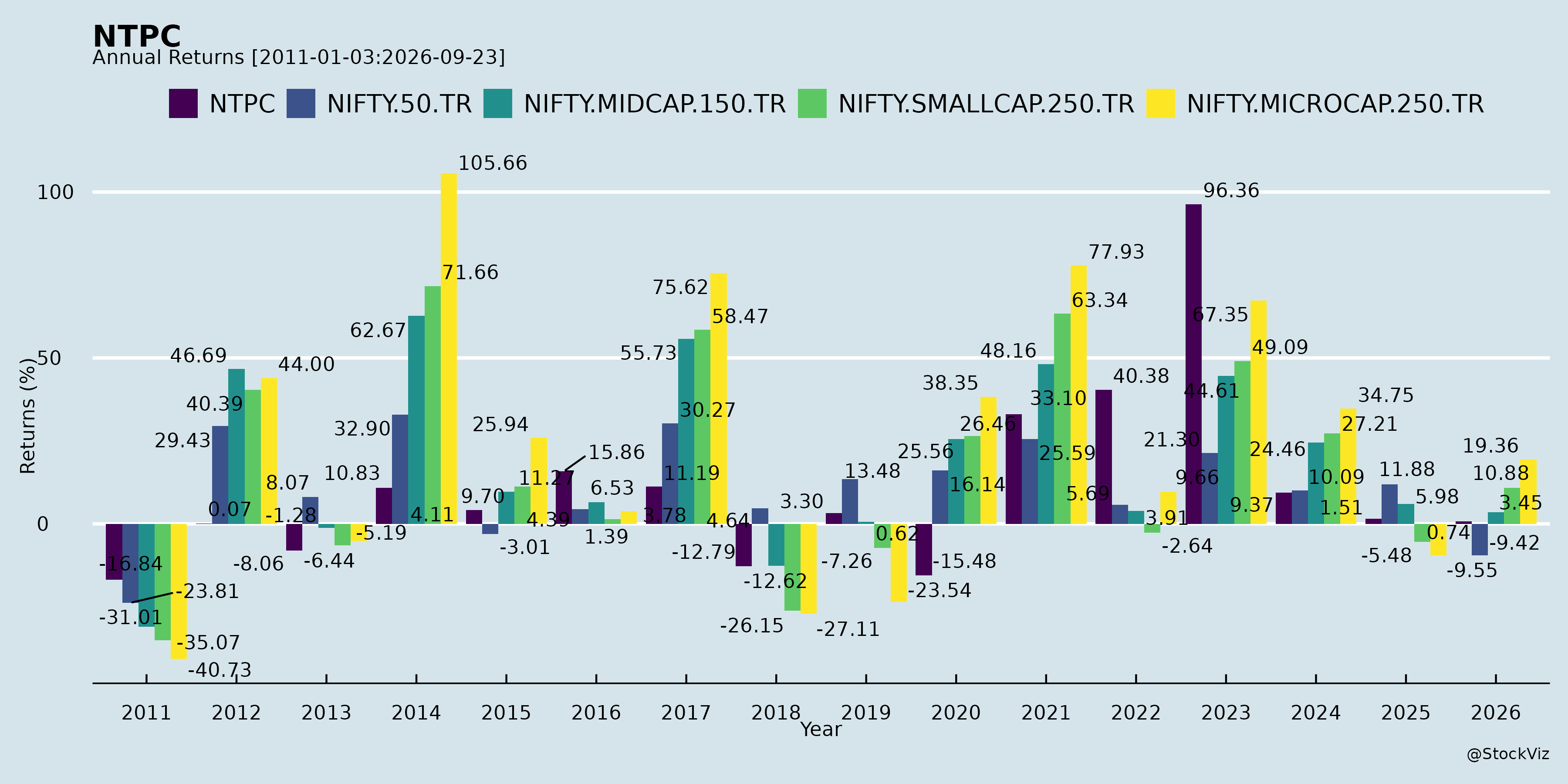
Annual Returns
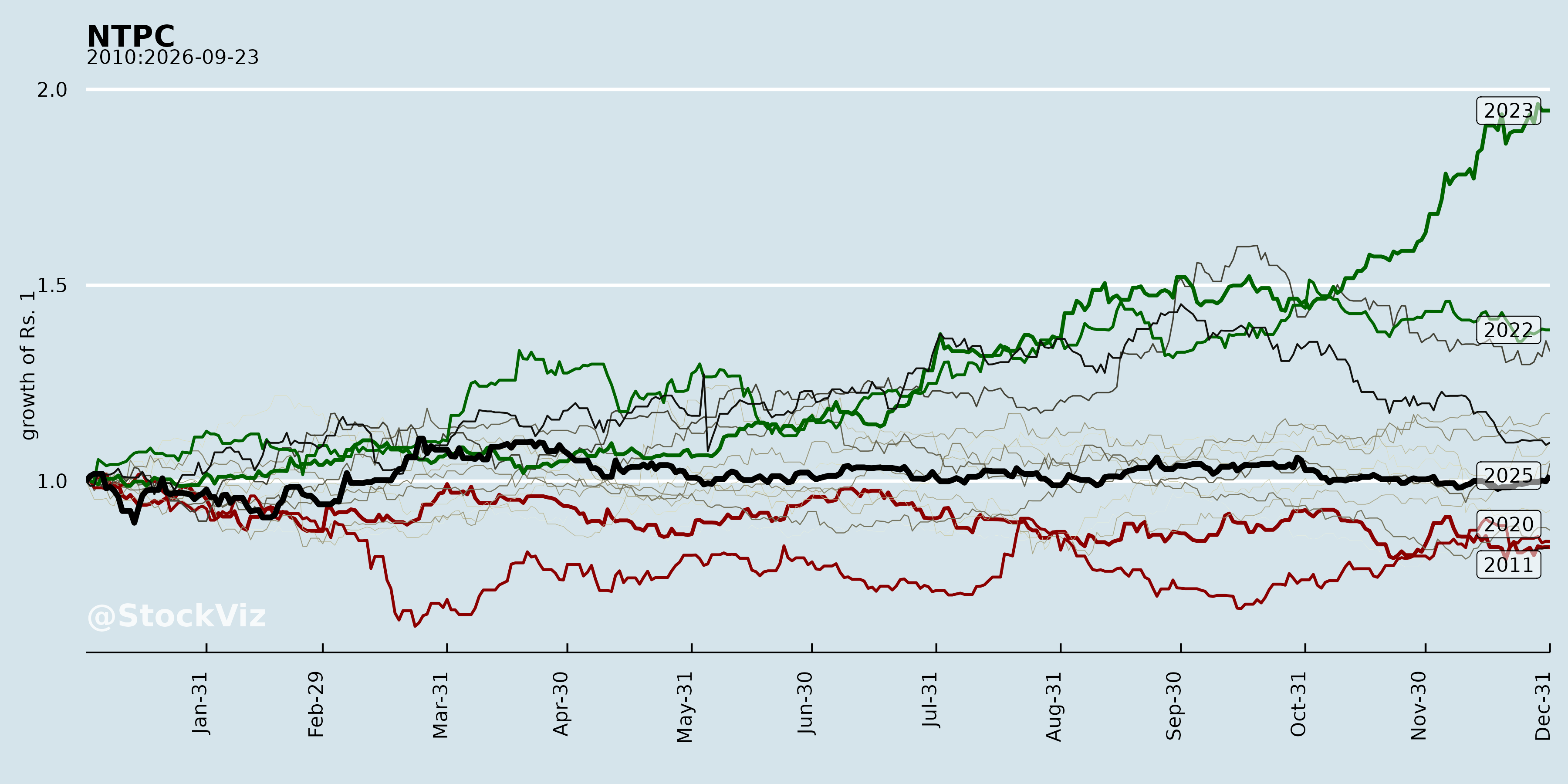
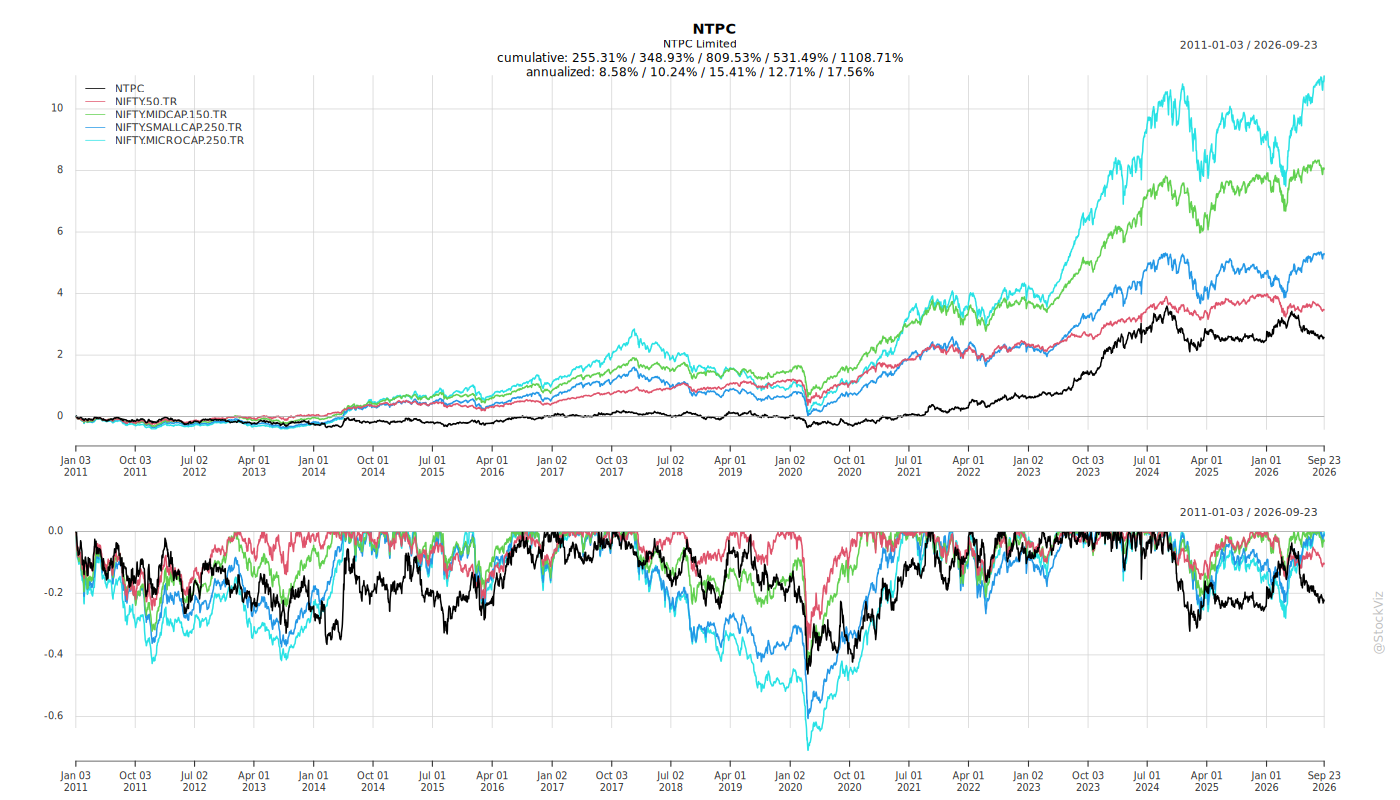
Cumulative Returns and Drawdowns
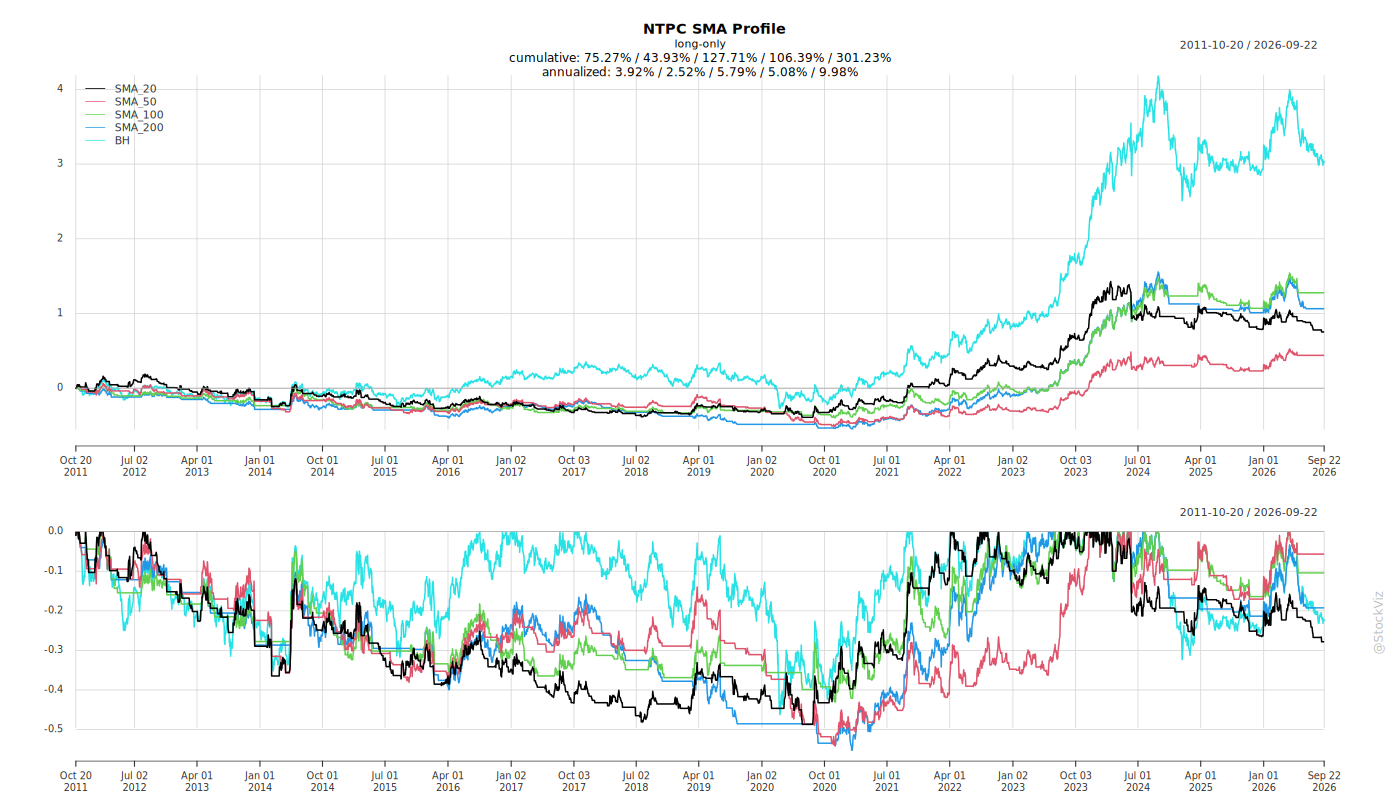
Fundamentals
Ownership
Margined
AI Summary
asof: 2026-09-14
NTPC: Recent Developments, Challenges and Growth Outlook
1. Headwinds and Challenges
Renewable capacity addition is running behind plan. Management acknowledged that the FY27 renewable target of 7–8 GW faces execution constraints, with only about 0.6 GW added in the year to date. The CMD attributed this primarily to transmission availability, stating that projects cannot be commissioned without transmission facilities. He also argued that renewable capacity should not be judged on megawatts alone, since storage investment (measured in megawatt-hours) is increasingly bundled with solar and wind, and that a 7 GW solar-plus-storage programme represents more value than a plain 8 GW renewable addition.
Curtailment and backing down of thermal plants. High renewable penetration during solar hours is forcing coal units below their 55% technical minimum. Management noted that units below this threshold are now permitted to be shut down and restarted, and that for short curtailment windows of one to two hours it is preferable to curtail renewable generation rather than shut a thermal unit, since the thermal plant is needed in the evening. The CMD described these pressures as transitory but acknowledged they are placing strain on the sector, particularly on smaller balance sheets.
Efficiency penalty from cycling supercritical units. An analyst pointed out that running an 800 MW supercritical unit at low PLF defeats the purpose of its higher efficiency. Management accepted that efficiency is affected and said the endeavour is to limit backing down so that units remain within supercritical operation, with storage and flexible plant designs intended to reduce the need for cycling.
Regulatory and compliance issues. BSE and NSE imposed fines of Rs.5,36,900 each (inclusive of GST) for the quarter ended 30 June 2026 for non-compliance with Regulation 17(1) of the Listing Regulations concerning the requisite number of Independent Directors. NTPC replied that as a Government Company, the power to appoint or remove Directors vests with the President of India through the Ministry of Power, requested that the fines not be levied, and said it is pursuing the matter with the Ministry.
Project slippage. On the Pipalkoti hydro project, management indicated commissioning is targeted for the next financial year end but that it may slip by a few months due to additional precautionary guidelines.
Dividend versus capex tension. An investor questioned whether the dividend is the most tax-efficient use of capital given the large capex programme. Management maintained that the payout ratio will remain around 36–40% and that the dividend should continue to increase slightly, balancing retained earnings for expansion with shareholder returns.
2. Tailwinds and Growth Prospects
Strong demand growth. All-India energy met has risen 9.28% year to date, with coal generation up 9.00%. NTPC’s own generation is up about 8% year to date, with a 24% increase for the day cited and a 40% increase for the day at rail-fed stations, which are the first to be backed down. PLF remains around 77% despite backing down and must-run renewables. Peak demand has crossed 270 GW, with projections of 450+ GW by FY36.
Capacity and capex pipeline. NTPC group operates over 90 GW of commercial capacity with about 35.7 GW under construction and roughly 12 GW under tendering. The corporate plan targets 150 GW by FY32 and 250 GW by FY37, with fossil fuel’s share of capacity declining from 82% today to 56% by FY32 and 39% by FY37. Total capex envisaged is about INR 17 lakh crore over 11 years to FY37, phased as INR 1,08,000 crore in FY26–27 (of which INR 56,000 crore already incurred in FY26), INR 5,97,000 crore in FY28–32, and INR 9,63,000 crore in FY33–37.
Renewables and storage. The renewable portfolio is targeted at 60 GW by FY32 and 136 GW by FY37, from 12 GW operational today. NTPC added about 4.2 GW in FY26 and targets 7–8 GW in FY27, subject to transmission. The BESS portfolio stands at 38.9 GWh, including 6.62 GWh under execution (of which 5 GWh is co-located at thermal stations under a regulated returns framework) and a 30.4 GWh non-solar-hour pipeline, of which 18.6 GWh has been tendered. Pump storage plans exceed 18 GW, with 1 GW Tehri PSP already in commercial operation and 13.2 GW allocated across Tamil Nadu, Maharashtra, Chhattisgarh, Madhya Pradesh and Odisha.
Nuclear entry. NTPC targets 30 GW of nuclear capacity by FY47. ASHVINI, the JV with NPCIL, is developing a 2,800 MW project at Mahi Banswara, with all government approvals in place and an NIT floated on 15 July 2026 for the nuclear island mega EPC package. NPUNL, a wholly owned subsidiary, is dedicated to advanced nuclear technologies. Site studies are underway across about 34 sites in around 10 states, with both PHWR and PWR technologies under consideration.
Coal mining and fuel security. NTPC Mining Limited now holds all mines, with nine coal blocks totalling 92 MMTPA peak capacity and FY26 production of 48.66 million tonnes, up about 8.5%. Captive mines meet 18% of coal requirement, targeted to reach 25% by FY30. No coal was imported in FY26.
New businesses. Coal gasification is being pursued, with the Government of India earmarking INR 37,000 crore; NTPC sees itself as a serious contender and is working on converting coal to synthetic natural gas and chemicals, with tenders expected. The Pudimadaka green hydrogen hub in Andhra Pradesh spans 1,200 acres with an envisaged investment of about INR 1 lakh crore, targeting 5 GW RE-RTC and about 1,400 TPD hydrogen for green methanol, ammonia, ethanol, sustainable aviation fuel and green urea. Other hydrogen initiatives include fuel cell buses in Leh and Delhi, India’s first green hydrogen PNG blending project at Kawas, and a hydrogen microgrid in Ladakh. International projects include the operational 1,320 MW BIFPCL plant in Bangladesh, a 50 MW plus 70 MW solar project in Sri Lanka expected to commission in FY28, and a 15 MW floating solar with BESS in Mauritius.
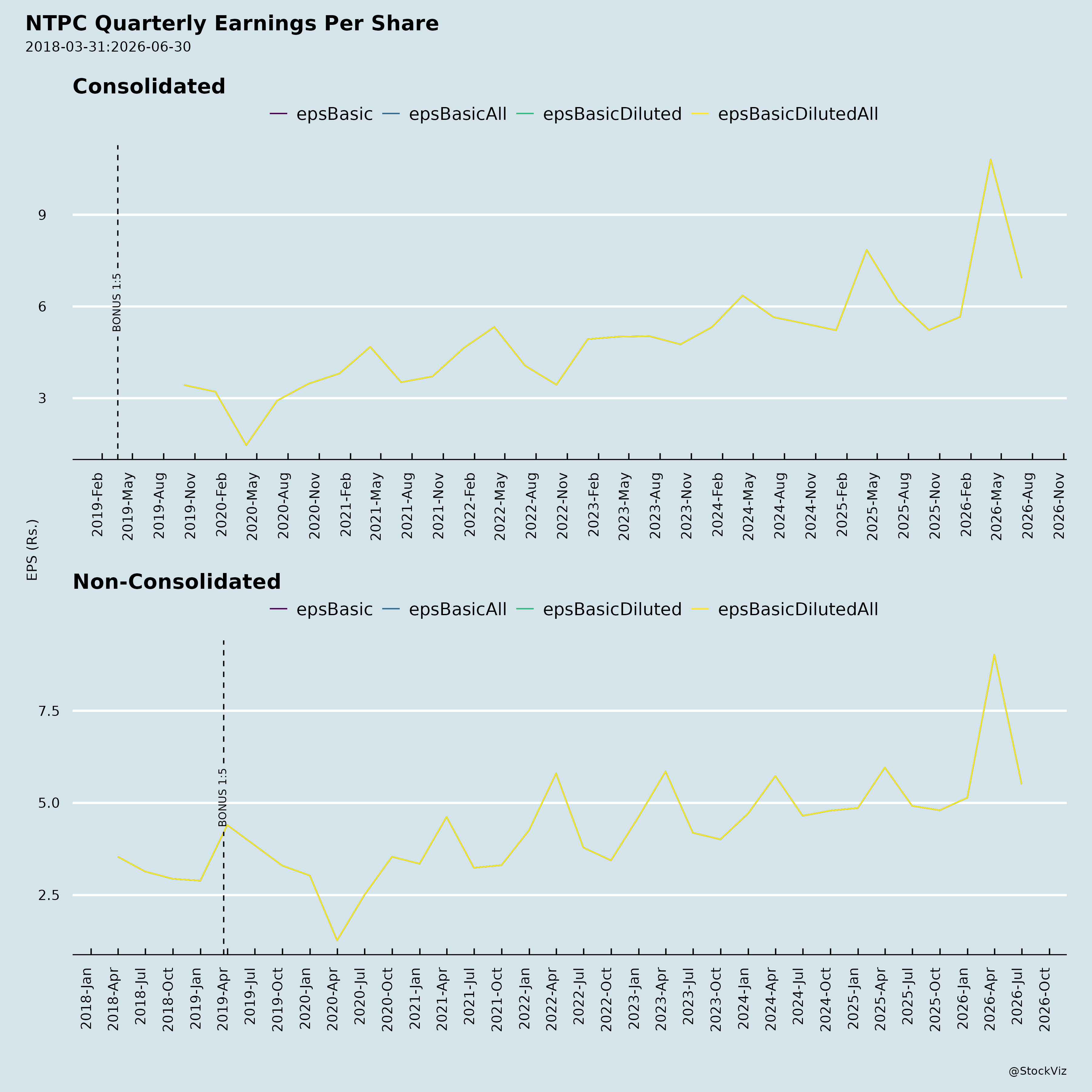
Financial strength and cost of funds. Group PAT grew from INR 16,960 crore in FY22 to INR 27,546 crore in FY26 (12.89% CAGR); standalone PAT rose from INR 16,282 crore to INR 23,162 crore (9.21% CAGR). Group net worth crossed INR 2 lakh crore. The debt-equity ratio improved to 1.32. The weighted average interest rate on borrowing fell to 5.98% in FY26 from 6.61% in FY25. Receivable days improved to 15 from 31. The Board approved raising up to INR 12,000 crore through non-convertible debentures, and shareholders approved this at the 50th AGM on 27 August 2026.
ESG recognition. Sustainalytics upgraded NTPC to a medium-risk ESG rating; S&P Global’s February 2026 score rose to 50 out of 100 against an industry norm of 41; MSCI upgraded from CCC to B and then to BB. Biomass co-firing rose from 20 kilotons in FY23 to 1,544 kilotons in FY26.
Recent capacity milestone. NGEL declared commercial operation of the second part capacity of 6.3 MW of the Vanki Wind Energy Project in Nakhatrana, Kutch, Gujarat, effective 00:00 hrs on 13 September 2026. This takes NTPC group total installed capacity to 91,086 MW and commercial capacity to 90,006 MW, and NGEL group total installed capacity to 10,842.86 MW.
3. Key Risks
- Transmission availability constraining renewable commissioning and creating curtailment risk.
- Technical minimum and cycling stress on thermal assets, with potential efficiency losses and, if technical minimums are redrawn further, a need to secure asset returns through regulatory means.
- Regulatory dependence, including policy advocacy on technical minimums, uniform technical minimums across states, and approval of co-located BESS under a regulated framework.
- Execution risk on large nuclear, pump storage and hydrogen programmes, with management noting nuclear technology choices and land acquisition still being worked through.
- Competitive bidding pressure: states increasingly prefer tendering over regulated cost-plus routes, with tariffs discovered around INR 4 per unit. NTPC has chosen not to participate, preferring brownfield cost-plus projects with assured regulated returns of about 15.5% (roughly 12–13% in practice), which management framed as a deliberate trade-off between scalability, returns and fairness to customers.
- Compliance risk arising from the Independent Director shortfall and the exchange fines.
- Dividend versus capex trade-off as the investment programme scales up.
4. Management Guidance Versus Observed Performance
| Area | Guidance / Target | Observed Performance |
|---|---|---|
| Renewable addition FY27 | 7–8 GW, subject to transmission | About 0.6 GW added in FY27 to date; FY26 addition was about 4.2 GW |
| Capacity portfolio | 150 GW by FY32, 250 GW by FY37 | About 127 GW group portfolio; 90.9 GW operational, 35.7 GW under construction |
| Coal capacity | 66 GW in March 2026 to 77 GW planned, with 17 GW pipeline reaching 91 GW | 54.75 GW standalone coal operational, 12.52 GW under construction |
| Captive coal share | 25% of coal requirement by FY30 | 18% currently; FY26 production 48.66 million tonnes, up 8.5% |
| Nuclear | 30 GW by FY47; 6 GW by FY32–37 period | ASHVINI 2,800 MW project approved; NIT floated 15 July 2026; about 34 sites under study |
| Pump storage | 3–5 GW commissioned by FY33, nearly 6 GW by FY37 | 1 GW Tehri PSP in commercial operation |
| Dividend payout | 36–40% payout ratio maintained | INR 5.50 interim plus INR 3.50 recommended final for FY26, totalling about INR 9; 33rd consecutive year of dividend |
| Cost of funds | Keep cost of funds at minimum | Weighted average borrowing rate 5.98% in FY26 versus 6.61% in FY25 |
| Receivables | Maintain strong payment discipline | Debtor days improved to 15 from 31, against an industry benchmark of 45 days |
| Q1 FY27 profit | — | Standalone PAT of INR 5,343 crore, up 11.9% over Q1 FY26 |
| Pipalkoti hydro | Next financial year end | Management indicated possible slippage of a few months due to additional guidelines |
Management also indicated that the 5 GWh of co-located BESS at thermal stations will be under a regulated returns framework, that any additional capex such as batteries will be included in ROE calculations, and that beyond the current 17 GW thermal pipeline, further coal capacity decisions will be reviewed as renewable growth, storage solutions and overall demand evolve.
Broker Narrative
The broker narrative evolved from aggressive growth optimism in 2023—emphasizing renewable capacity additions, diversification into green hydrogen and nuclear, and rising ROE—to a cautious Neutral stance by 2026, citing sluggish near-term earnings growth and execution headwinds. Renewable execution challenges and regulatory concerns persisted throughout, while enthusiasm for diversification and ROE improvement gave way to realization of practical constraints. Power demand, initially flagged as a headwind, defied fears with stronger-than-expected ~6% growth, becoming a key tailwind instead.
Fears that came true
- Delay in execution of renewable capacity addition materialized, as land availability constraints for solar replacement in northern states and nuclear regulatory delays hindered growth plans, correlating with multiple DISAPPOINTMENT outcomes.
- Adverse impact on regulated ROE concerns persisted, with the last report confirming sluggish near-term earnings growth and a proposed reduction in minimum PLF norms from 55% to 40% facing strong industry opposition.
- Limitations on gas-based generation due to economics and availability/cost of gas, along with lack of immediate commercialization timeline for coal gasification, constrained diversification plans flagged as risks.
- Limitations on gas-based generation due to economics and availability/cost of gas, along with lack of immediate commercialization timeline for coal gasification, constrained diversification plans flagged as risks.
Optimism that failed
- Aggressive renewable capacity addition of 16,000 MW over FY24-FY26 was hindered by land availability constraints for solar replacement in northern states, undermining the targeted renewable capacity growth.
- Diversification into nuclear power via JV with NPCIL failed to gain near-term traction, with nuclear regulatory clarity taking another 6-9 months.
- Improving return ratios with ROE expected to rise from 12.9% in FY23 to 14.3% in FY25E did not sustain, as sluggish near-term earnings growth was confirmed in the last report.
- Strong thermal base business with 9,300 MW coal-based capacity under construction supporting ~11% generation growth did not translate into sustained profitability, as multiple Buy calls resulted in DISAPPOINTMENT with negative actual returns.
Broker Timeline
27 broker calls · 2023-09-27 to 2026-09-06
Copyright © 2023 SAS Data Analytics Pvt. Ltd. All rights reserved.