MIDHANI
Equity Metrics
September 24, 2026
Mishra Dhatu Nigam Limited
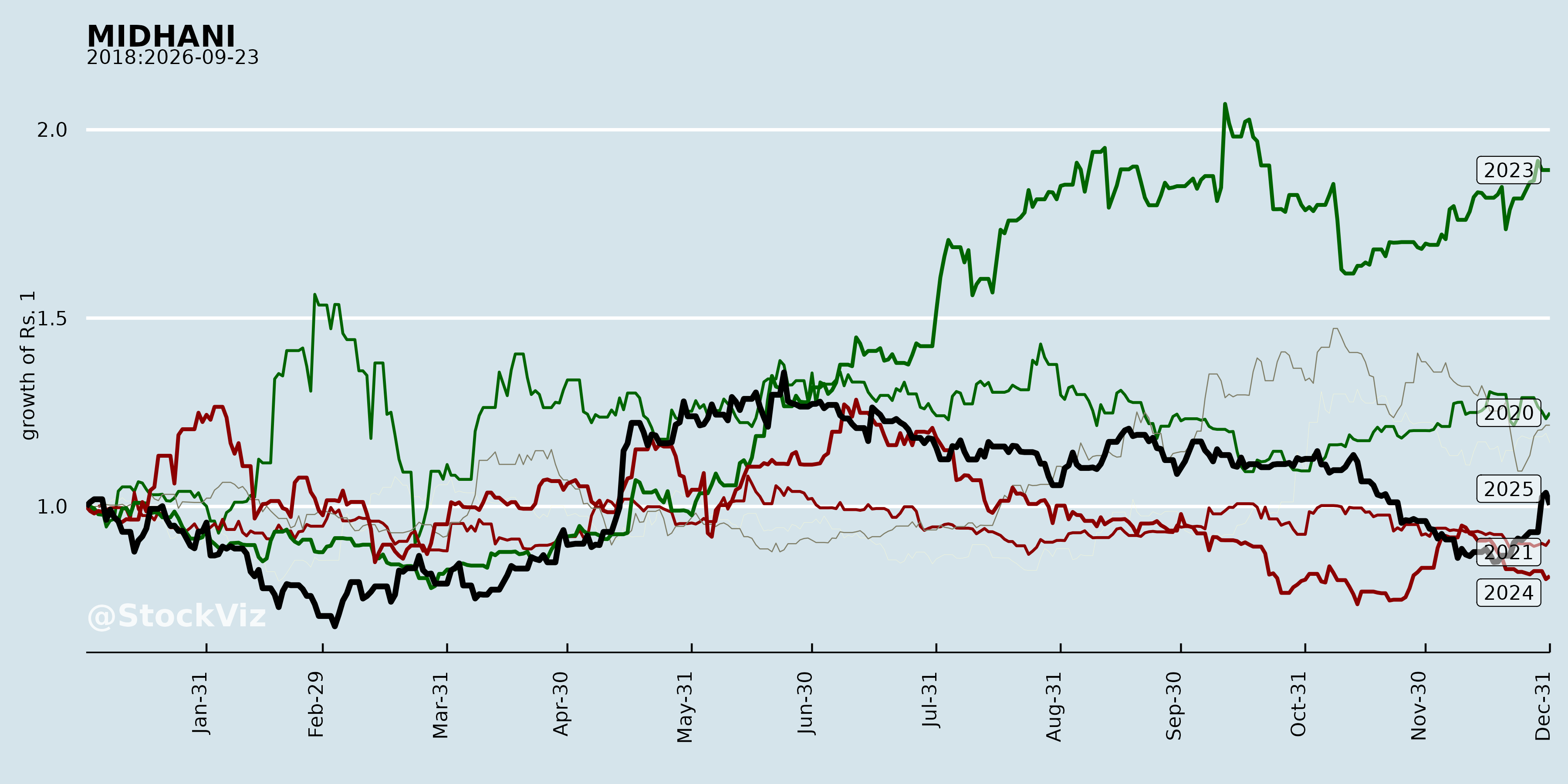
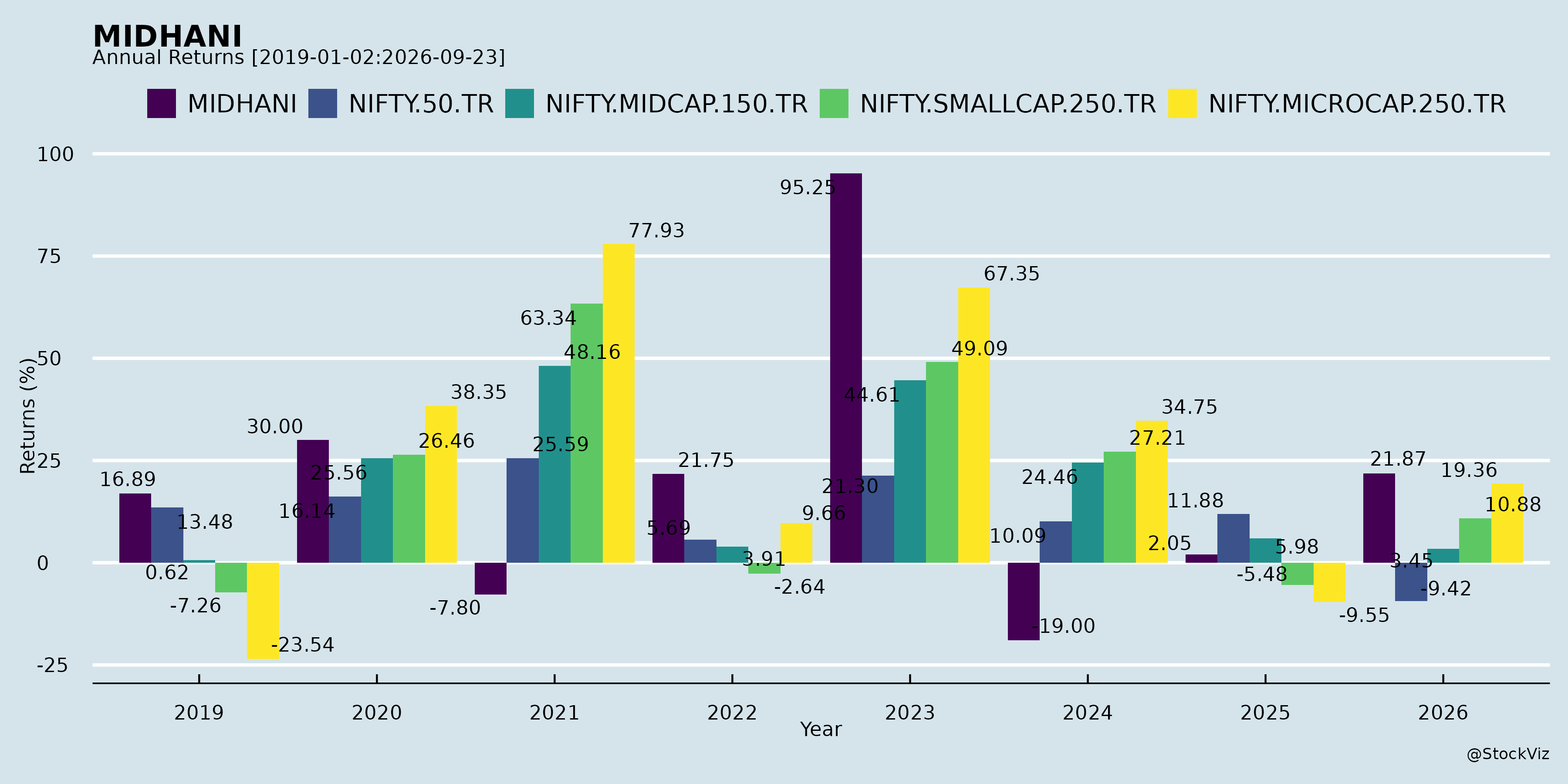
Annual Returns
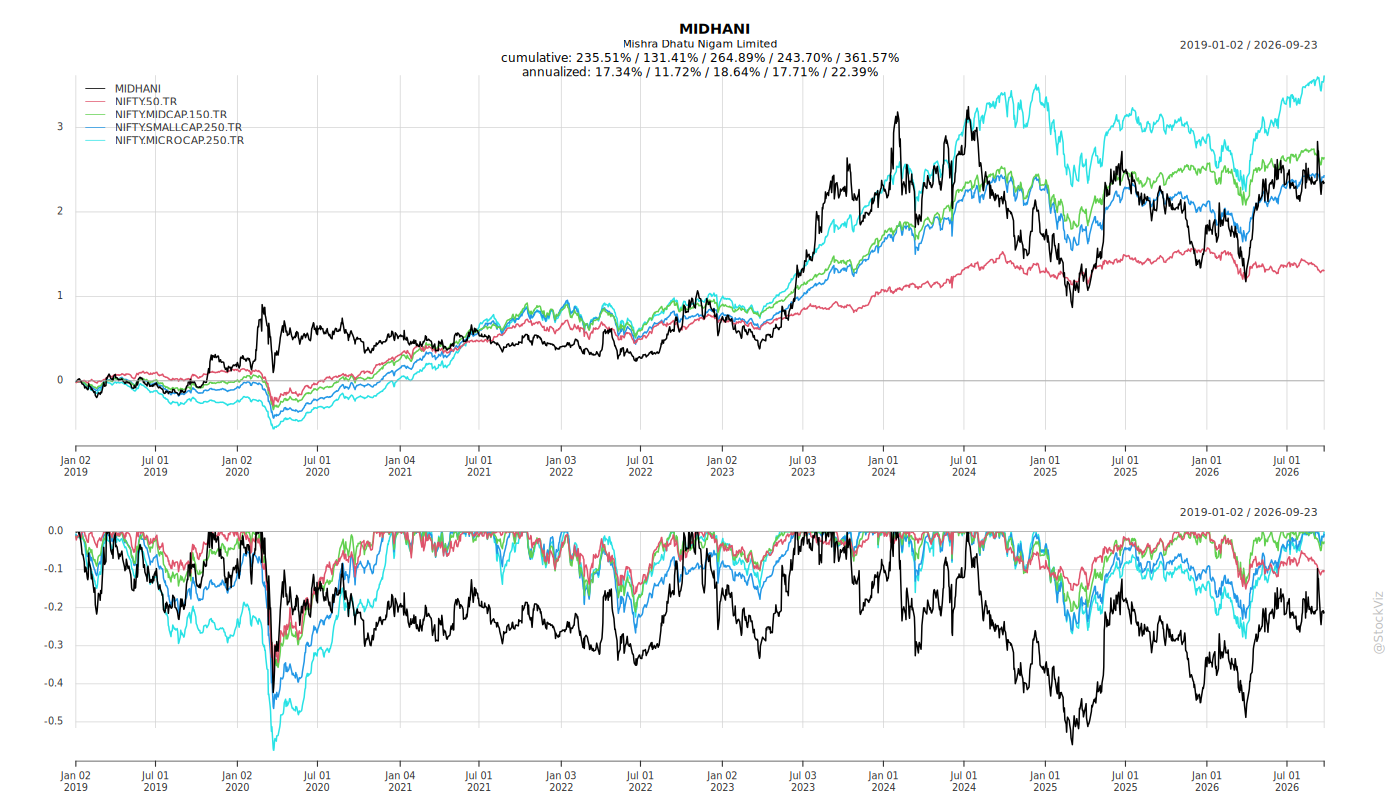
Cumulative Returns and Drawdowns
Fundamentals
Ownership
Margined
AI Summary
asof: 2026-09-17
MIDHANI: Recent Developments and Outlook
1. Headwinds and Challenges
Input cost pressure. The June 2026 quarter was affected by two distinct cost shocks. LPG prices nearly doubled due to a war-related crisis, and since MIDHANI’s reheating and heat-treatment furnaces are LPG-fired, this directly compressed margins. Separately, prices of nickel, molybdenum and tungsten rose abnormally, with the company quantifying an adverse raw material price variance of roughly ₹13 crore in the quarter and an LPG impact of around ₹5 crore. Management indicated the LPG effect may spill into Q2, with normalisation expected from Q3.
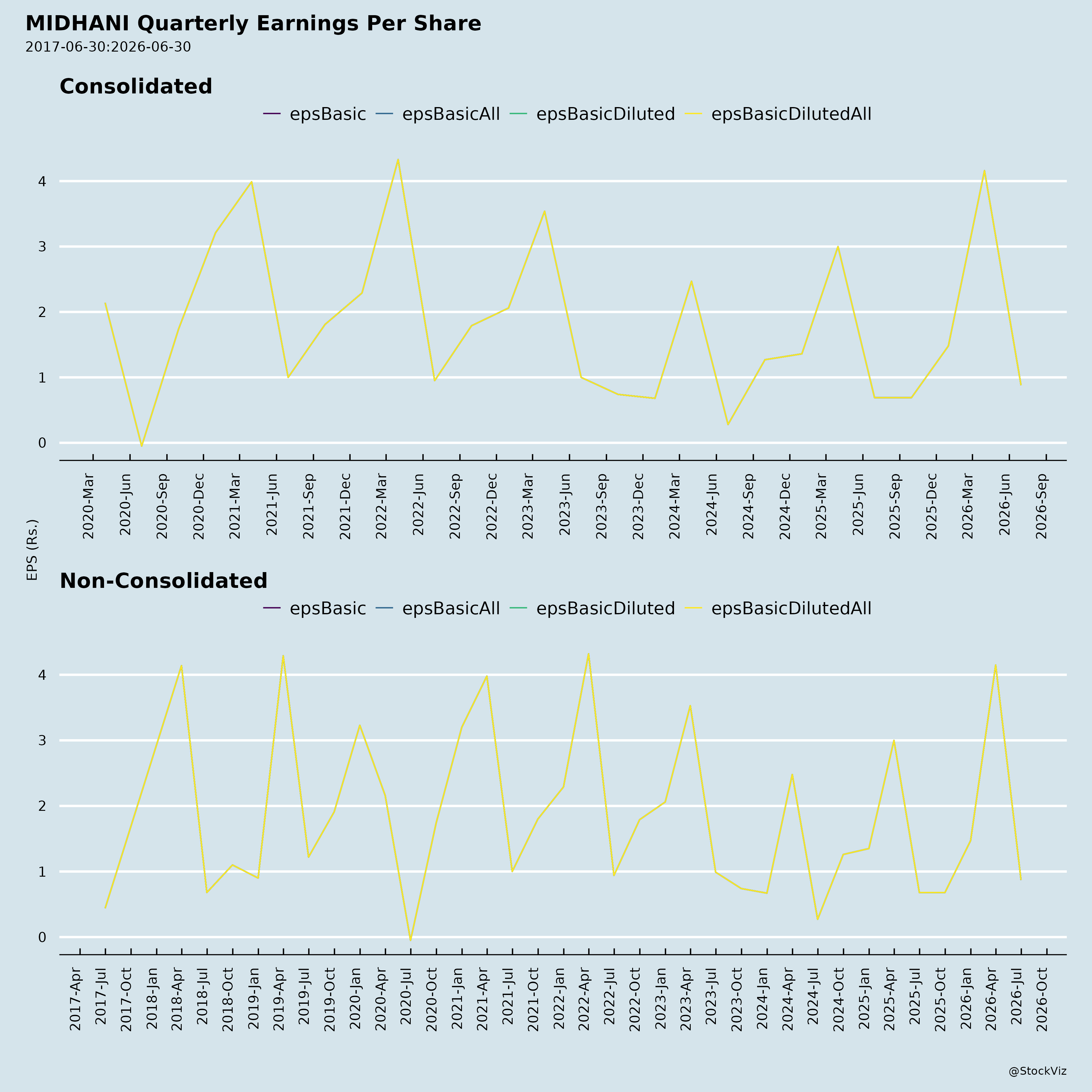
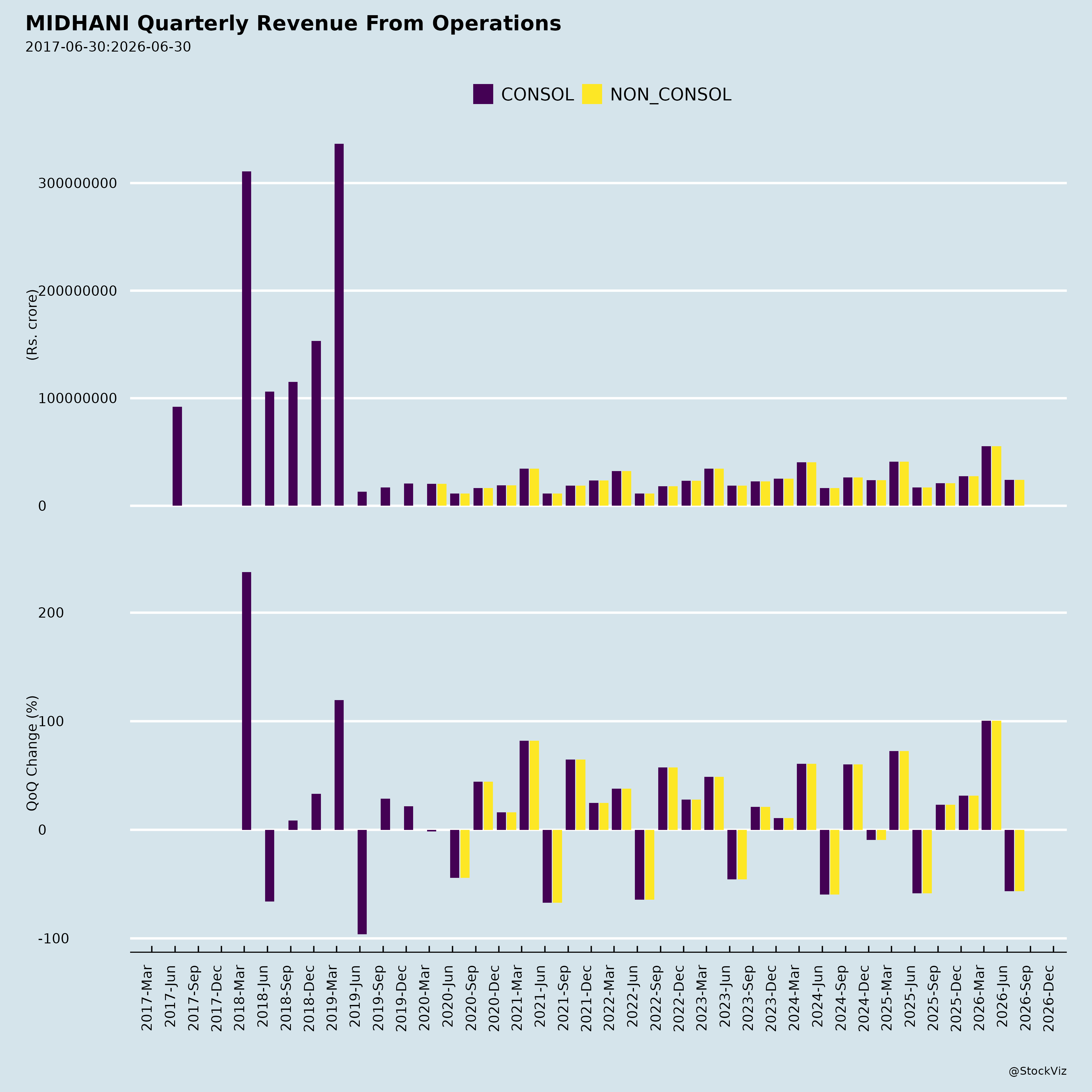
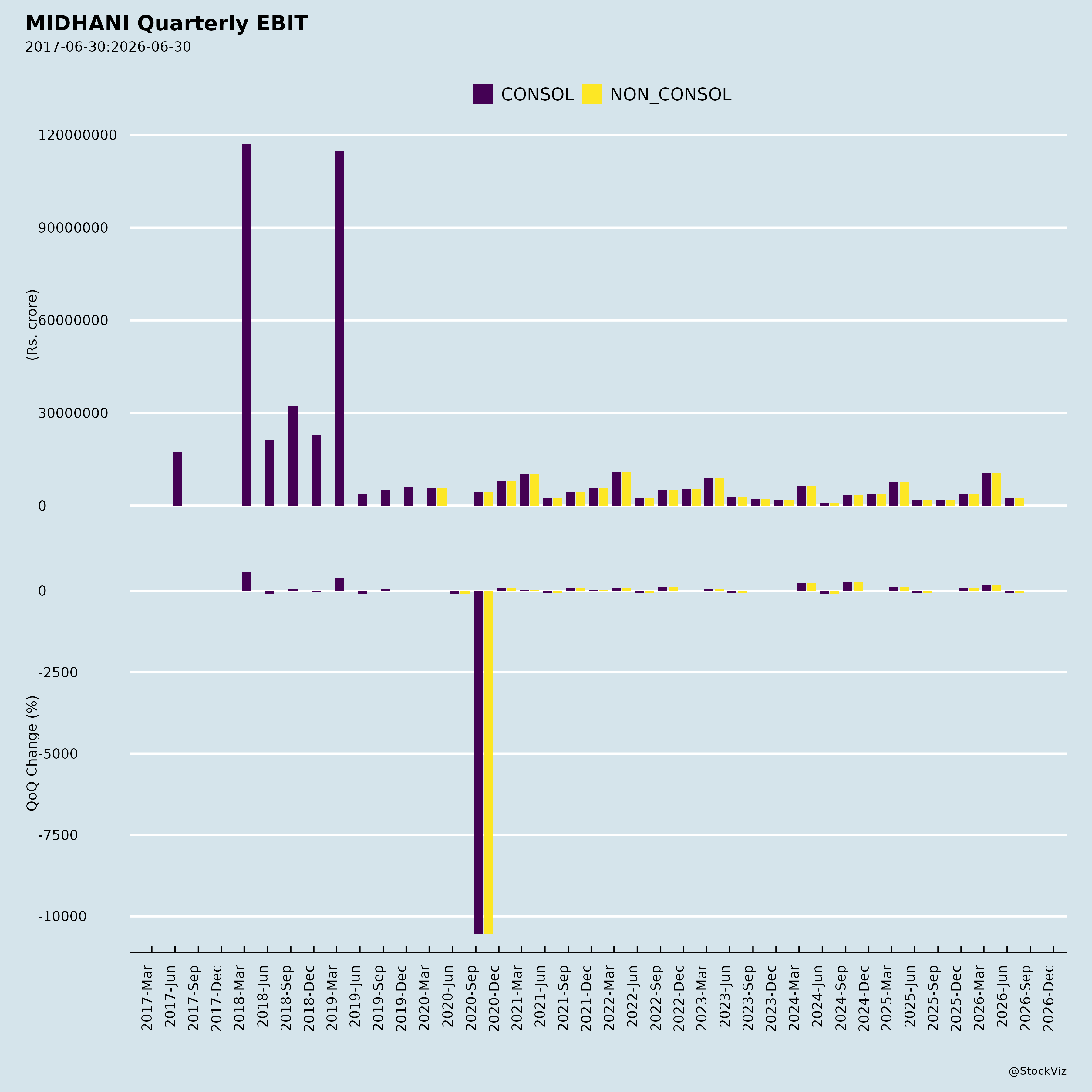
Margin compression despite strong top line. Turnover grew 40.46% year-on-year to ₹239.49 crore, but EBITDA growth lagged at 12.89% (₹46.6 crore), with EBITDA margin around 20% against an expected ~23%. Management attributed this to the input cost factors above rather than to any demand weakness.
Shift away from nomination-based ordering. Management stated that orders are no longer received on a nomination basis and are now won through competition. This was cited as a structural reason why margins may settle closer to 20% rather than the 25%-plus levels seen in earlier periods.
Import dependence and supply chain exposure. Titanium sponge and master alloy are imported from East European countries and the former Russian Federation, chosen for quality and process alignment. Management stated there is currently no supply constraint or issue with these imports, though the concentration of sourcing is a structural feature of the business.
Regulatory/compliance matter. BSE and NSE imposed a fine of ₹12,59,060 each (inclusive of GST) for the quarter ended June 30, 2026 for non-compliance under various SEBI LODR regulations. MIDHANI has not paid the fine, noting that the authority to appoint Directors vests with the President of India acting through the Ministry of Defence and the Board has no role in it. The company intends to submit a waiver request and states the levy has no impact on financial or operational activities.
Project closure. The proposed aluminium plant at Nellore under Utkarsha Aluminium Dhatu Nigam Limited has been recommended for closure by both the MIDHANI and NALCO boards and is in the process of being formally closed, subject to Ministry approvals.
2. Tailwinds and Growth Prospects
Strong order book and revenue trajectory. Order book as on July 1, 2026 stood at ₹2,329 crore, split approximately 66% defence, 21% space (ISRO), 9% energy and 4% others. Q1 FY27 turnover was ₹239.49 crore (up 40.46%), value of production ₹260.36 crore (up 7.9%), PBT ₹23.92 crore (up 25.89%) and PAT ₹16.31 crore (up 27.42%).
GE Aerospace S400 laboratory approval. On August 13, 2026, MIDHANI received S400 certification from GE USA for mechanical, chemical and metallography testing of specimens. This makes MIDHANI an authorised lab covering room-temperature and high-temperature mechanical testing, chemical analysis and metallography. Management noted customers previously sent specimens abroad for such testing, and that MIDHANI can now issue certificates itself without requiring further external approval, opening a domestic and potentially export testing revenue stream. No revenue sharing with GE is required.
Certification pipeline. Non-destructive testing personnel have been qualified for NAS410, a prerequisite for obtaining Nadcap certification in NDT, targeted within the current financial year. MIDHANI is also pursuing ISO 27001 (Information Security Management) and ISO 50001 (Energy Management System) certifications during the year. Management linked these approvals to unlocking domestic substitution of imported aerospace materials.
Titanium and superalloy expansion. A new titanium melting facility was inaugurated last year, with around 750 tonnes melted last year and growth expected. Titanium orders currently stand at roughly ₹600 crore. Management indicated titanium and superalloy margins are higher than special steel, and the product mix is gradually shifting toward these categories.
Isothermal forging and new alloy grades. MIDHANI successfully isothermally forged a nickel-based superalloy for a fighter aircraft engine on its 6,000-tonne press. Orders have been received for four grades of superalloys and three grades of titanium alloys to be taken up during the year. The company has also melted and supplied novel single-crystal feedstock grades containing elements such as rhenium and ruthenium for fighter aircraft programmes.
Aluminium plate rolling. MIDHANI successfully rolled 7000-series aluminium alloy for a PSU — its first commercial rolling order for aluminium. Using customer-supplied cast ingots on its wide plate mill, the company produced rolled plate meeting requirements. This is positioned as an indigenisation route for 2000- and 7000-series plates currently imported for aircraft and ISRO launch vehicle programmes, distinct from the now-closed Nellore aluminium plant.
ABHED bulletproof jackets. Technology for the ABHED jacket was taken from DRDO and IIT Delhi; jackets have been fabricated and are under testing, with test certificates expected by the next quarter. Management expects periodic orders from services, CRPF, BSF and state police through competitive tenders once qualified.
Spring plant and metal powder. The spring plant on campus has commenced operations and received a sample order from BEML, with more orders hoped for during the year. A preliminary BAFA (German export licence clearing agency) licence for metal powder has been obtained, with equipment expected on campus possibly next year.
Metal bank. MIDHANI is in advanced stages of procuring raw materials for a metal bank arrangement with a customer. Management clarified this is a MIDHANI-operated, customer-owned stock held on campus for melting, and therefore does not appear on MIDHANI’s books and does not release working capital. It is intended to address delayed supplies and abnormally high costs.
Nuclear and strategic programmes. MIDHANI supplies materials for nuclear power plants, including for the prototype fast breeder reactor which has attained criticality, and expects more orders. It is executing steam generator tube orders and expects to supply ingots/mother hollows for nuclear-grade tubing. Management also referenced the government’s 100 GW energy target by 2047, AMCA development orders from ADA (with bulk orders anticipated once the programme is approved), and potential opportunities from the RIL-Rolls-Royce joint venture and aero-engine indigenisation.
Exports. Export sales of ₹33 crore so far this year with an open export order book of about ₹25 crore. Management targets exports at about 10% of turnover, growing 10%-15% annually over three to four years toward ₹100-120 crore. Approvals from global OEMs such as Rolls-Royce, Boeing and Airbus are described as a time-consuming process, with some approvals hoped within about a year.
Scrap as a resource. Management characterised scrap as a “gold mine” rather than waste, given its use as melting input. Scrap inventory was reduced by about ₹17 crore in Q1 and by ₹75 crore last year. Scrap usage of 50-60% is typical where customer specifications permit; human spaceflight and critical engine parts require virgin material. MIDHANI has an MOU with NFTDC to explore extraction of pure elements from scrap, though not yet at commercial scale.
3. Key Risks
- Customer and sector concentration: Order book is heavily weighted to defence (66%) and space (21%), with government-linked customers dominating.
- Raw material price and supply volatility: Import dependence for titanium sponge, nickel, cobalt and other inputs, with fixed-price defence contracts limiting the ability to pass through cost increases. Freight cost increases are sometimes absorbed.
- Margin mix sensitivity: Margins vary by product category (special steel lower; superalloys and titanium higher), so quarterly profitability depends on execution mix.
- Competitive tendering: The shift from nomination-based to competitive ordering is cited as a factor in lower margin levels.
- Certification and qualification timelines: Approvals from global OEMs and Nadcap-type certifications are time-consuming and outside the company’s control.
- Programme dependence: Opportunities such as AMCA and new engine programmes depend on end-user programme approval and timelines.
- Regulatory compliance: The SEBI LODR non-compliance fine, with a waiver request pending, and the observation that Director appointment authority rests outside the Board.
- CapEx execution risk: The proposed ~₹1,000 crore modernisation CapEx has long lead times for supply and installation, with benefits expected only from around year four.
4. Management Guidance Versus Observed Performance
Revenue growth. Management guided that FY27 growth would be maintained at FY25-26 levels or higher, while the Director (Production & Marketing) explicitly stated that sustaining the Q1 run rate of 40% for the full year is not practicable. Observed Q1 FY27 turnover growth was 40.46% year-on-year, with value of production growth of only 7.9%, indicating the turnover growth outpaced production growth in the quarter.
Margins. Management guided that Q2 may remain somewhat affected, with normalisation from Q3, and that the ~20%-21% EBITDA margin level could be restored. Observed Q1 EBITDA margin was around 20% versus an expected ~23%, with the shortfall attributed to ~₹13 crore raw material price variance and ~₹5 crore LPG impact. Management also acknowledged that with competitive (non-nomination) ordering, margins could settle around 20% going forward.
Order book. Order book was reported at ₹2,329 crore as on July 1, 2026, and described as around ₹2,300 crore during the call, with a 66/21/9/4 split across defence, space, energy and others. This compares with the ₹2,290 crore order book as of April 1, 2026 cited in the annual disclosure, with defence at approximately 69% at that time.
Metal bank timing. Management guided that clarity and further procurement of metal bank stocks would emerge by the end of Q2, with implementation in the next quarter. This remains a forward-looking item at the time of the call.
S400 revenue. Management was unable to quantify revenue from the S400 approval, stating a couple of quarters would be needed to gauge demand, while conservatively referencing a 10% figure in response to a question about incremental revenue. No revenue from this approval had been realised as of the call.
CapEx. Management guided FY27 CapEx at approximately ₹50-60 crore, largely maintenance in nature, with the larger ~₹1,000 crore modernisation proposal over two to three years still awaiting evaluation and approval, and benefits expected from year four. No asset-turn or EBITDA-expansion quantification was provided, with management stating it was difficult to give a number at present.
ABHED jackets. Management guided that testing would be completed in the current quarter and that orders would follow periodically through competitive tenders. No revenue guidance for FY27 was provided, as outcomes depend on tender participation and competitive bidding.
Exports. Management guided exports toward 10% of turnover, growing 10%-15% annually over three to four years. Observed year-to-date export sales were ₹33 crore with an open order book of about ₹25 crore.
Scrap reduction. Management indicated intent to bring scrap inventory to an optimal level, selling only where not useful for production. Observed reduction was about ₹17 crore in Q1 FY27, following about ₹75 crore last year.
Broker Narrative
The broker narrative shifted from a defensive Hold in May-2023, dominated by raw-material inflation, margin pressure, low book-to-bill and JV uncertainty, to a confident Buy by Aug-2026 built on GE Aerospace certification, titanium/superalloy margins and a diversified order book. Raw-material/input cost inflation, inventory build-up and execution/ramp-up delays persisted throughout, while the earlier book-to-bill and JV concerns faded. The first report’s bearish tilt was a major miss (+101.1% actual vs -1.8% predicted), and the final Buy call also disappointed (-2.1% actual vs +18.9% predicted).
Fears that came true
- Raw-material/input cost inflation and related margin pressure persisted, from alloying-element costs in Q4FY23 to abnormal nickel/moly/tungsten and LPG cost inflation in 2026, coinciding with negative actual returns during ICICI’s 2024 Sell calls.
- Inventory/working-capital build-up materialised: the first report’s elevated inventory/WIP was echoed by the last report’s inventory build-up caused by higher-than-expected development time.
- Execution, ramp-up and government-programme delays materialised: slower-than-expected VAR ramp-up and key programme delays were still being flagged in 2026, and the final Buy call’s -2.1% actual return was a DISAPPOINTMENT.
Optimism that failed
- The steady-state revenue ramp-up expected from new facilities (wide plate mill, Rohtak, VAR) did not happen on time, as the last report cited slower-than-expected VAR ramp-up.
- The short execution cycles expected to accelerate revenue realisation were undermined by higher-than-expected development time and consequent inventory build-up.
- The VIM furnace’s import-substitution benefit remained a ‘long-term’ opportunity by the last report rather than the Rs2.5-3.0bn near-term driver initially projected.
- Strategic domestic defence programme optimism was delayed, with the last report listing delays in key government programmes.
Broker Timeline
13 broker calls · 2023-05-31 to 2026-08-18
Copyright © 2023 SAS Data Analytics Pvt. Ltd. All rights reserved.