MAXHEALTH
Equity Metrics
October 23, 2026
Max Healthcare Institute Limited
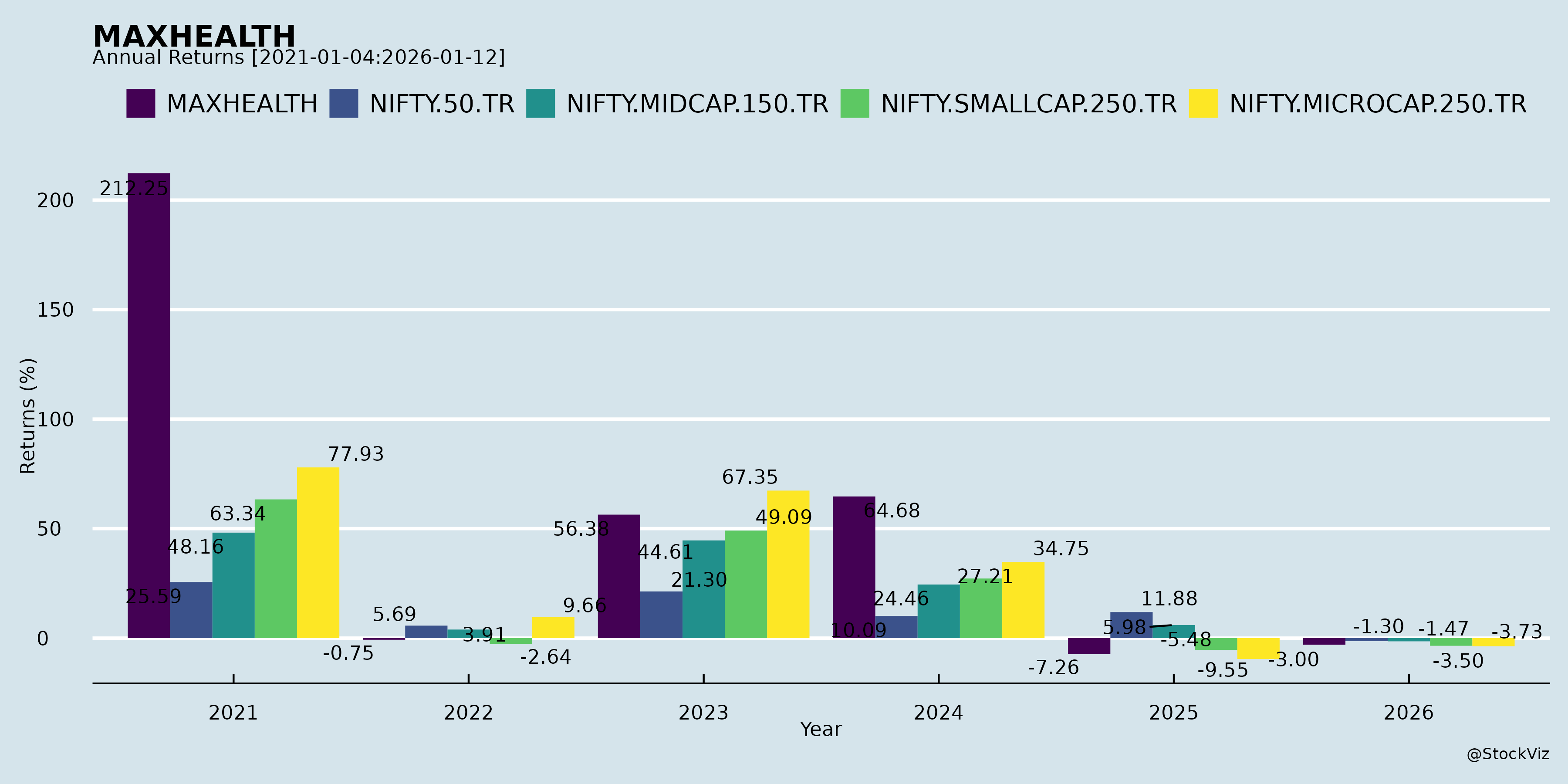
Annual Returns
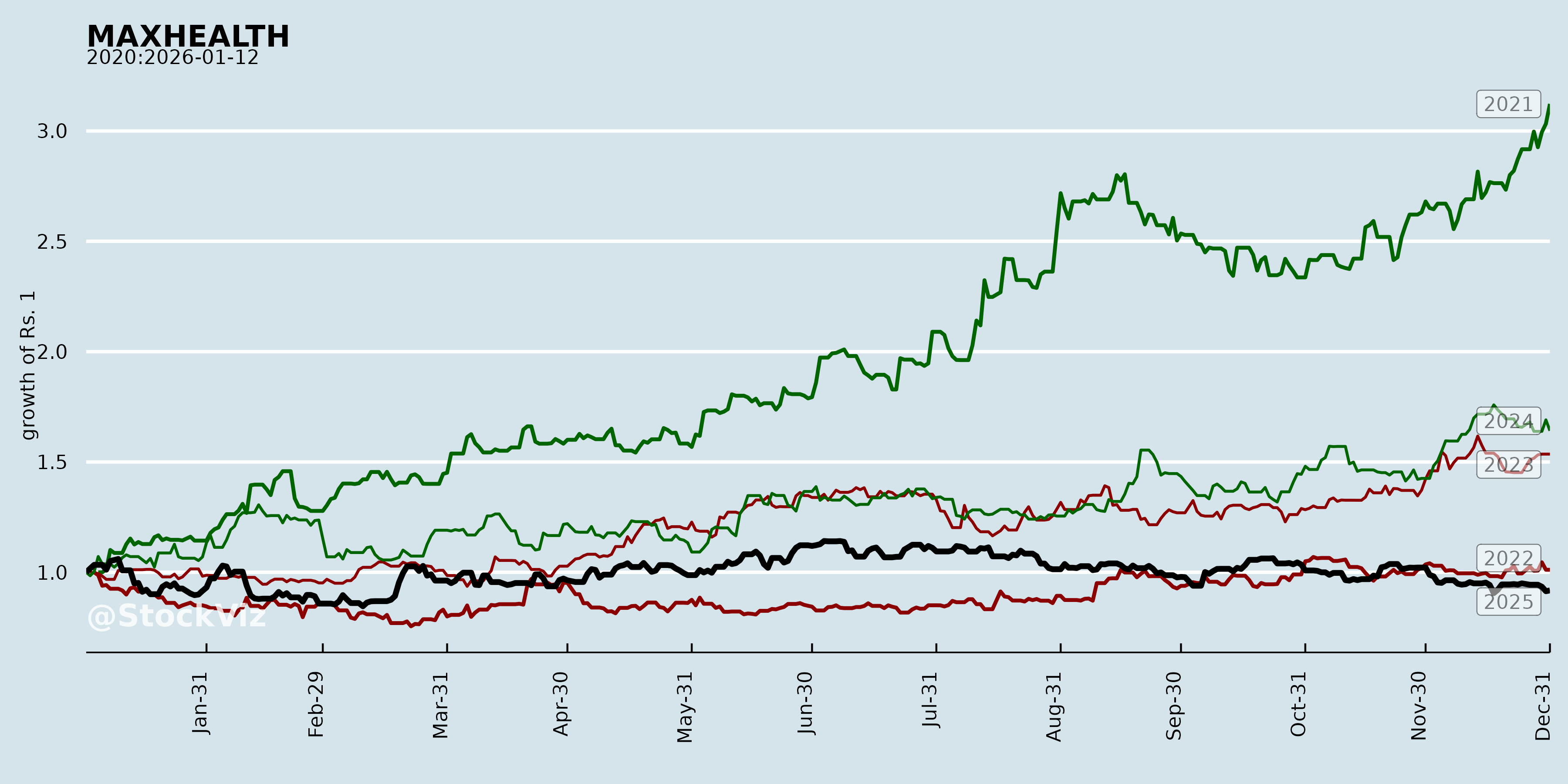
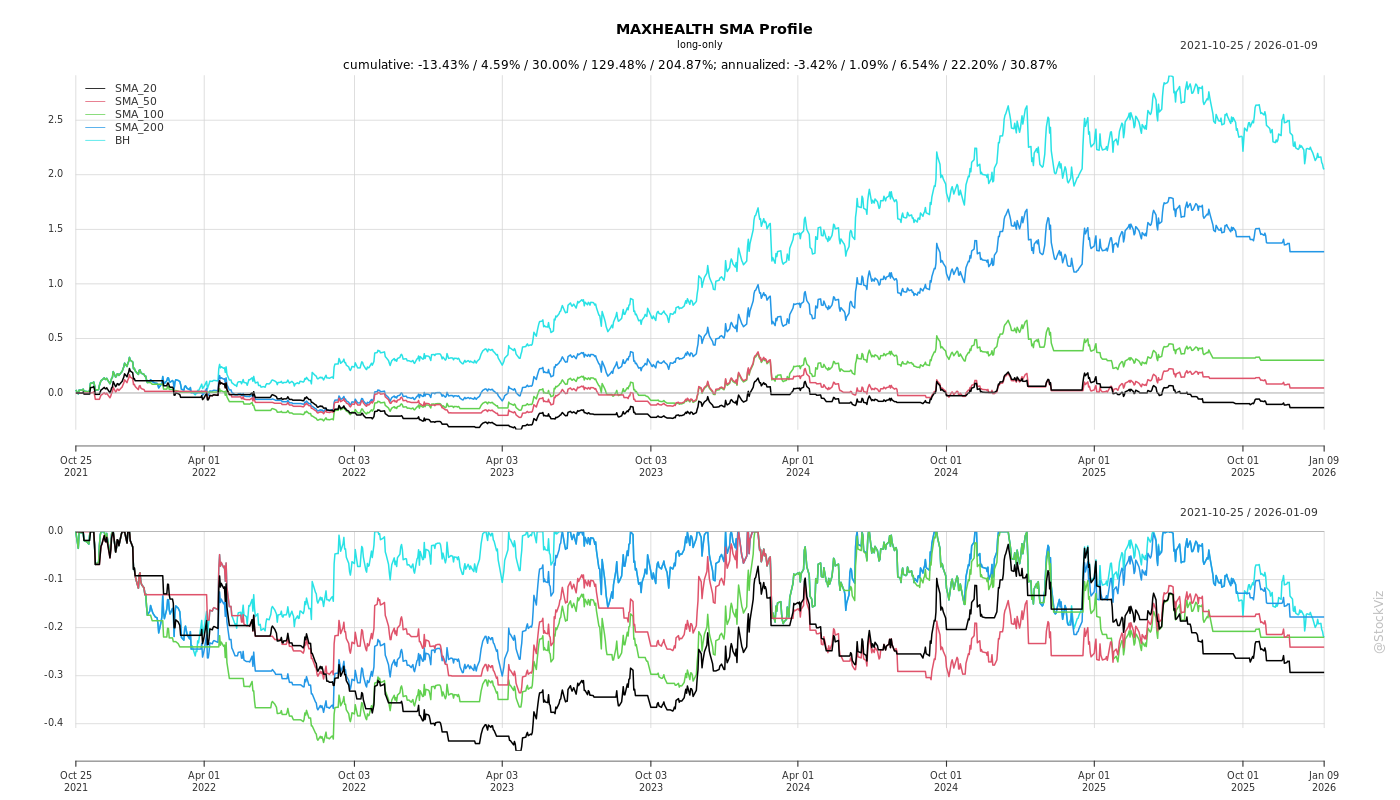
Cumulative Returns and Drawdowns

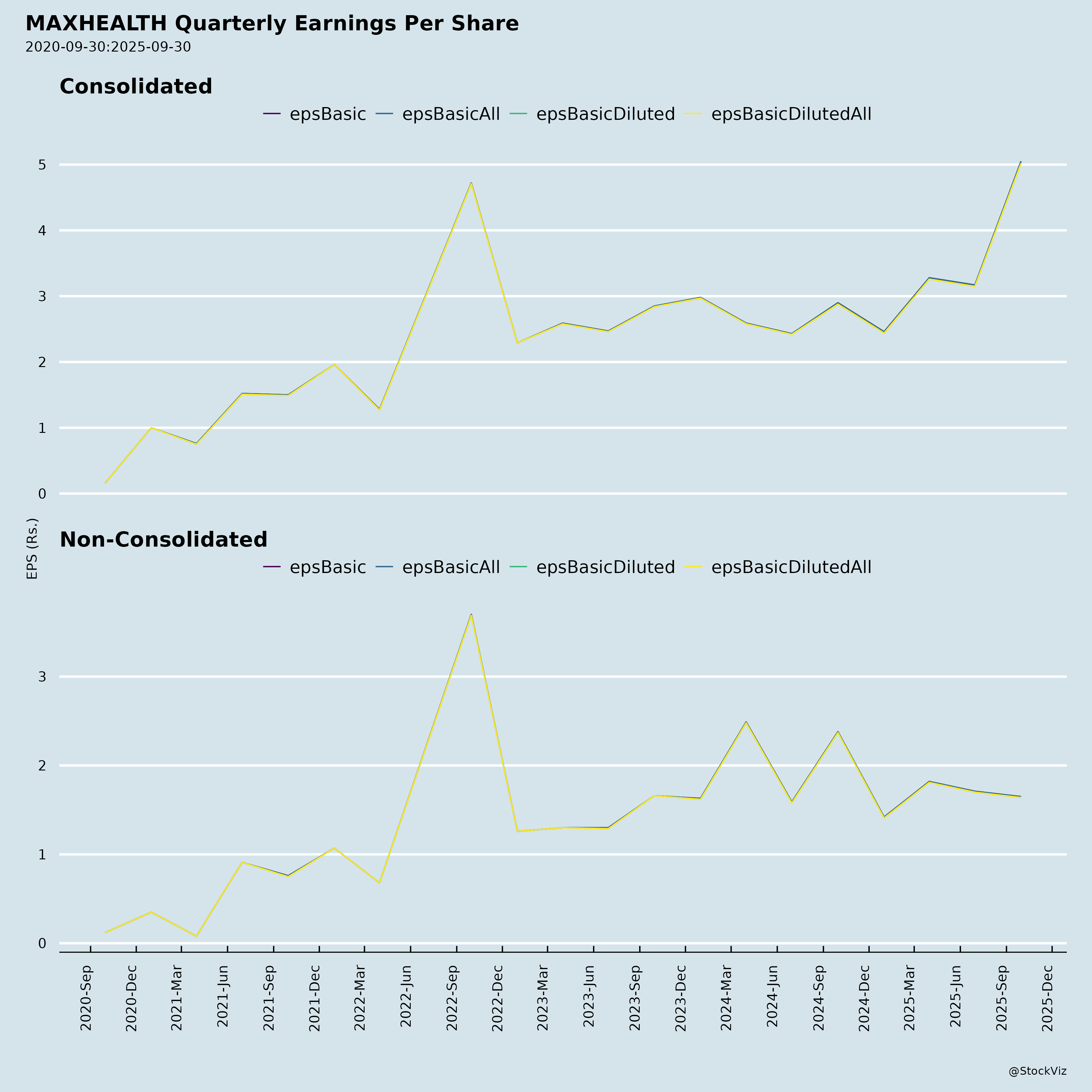
Fundamentals
Ownership
Margined
AI Summary
asof: 2026-09-14
MAXHEALTH: Recent Corporate Developments
1. Headwinds and Challenges
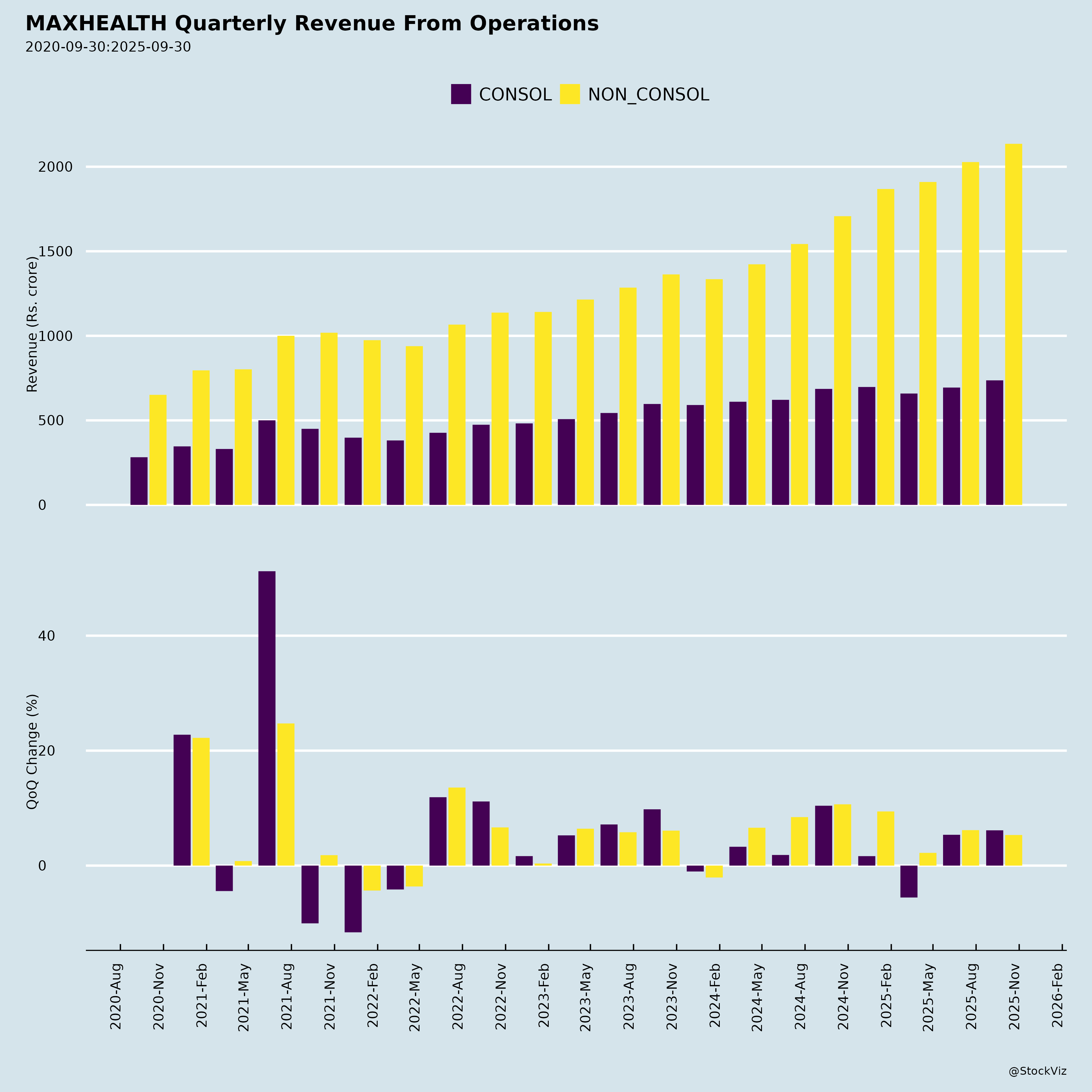
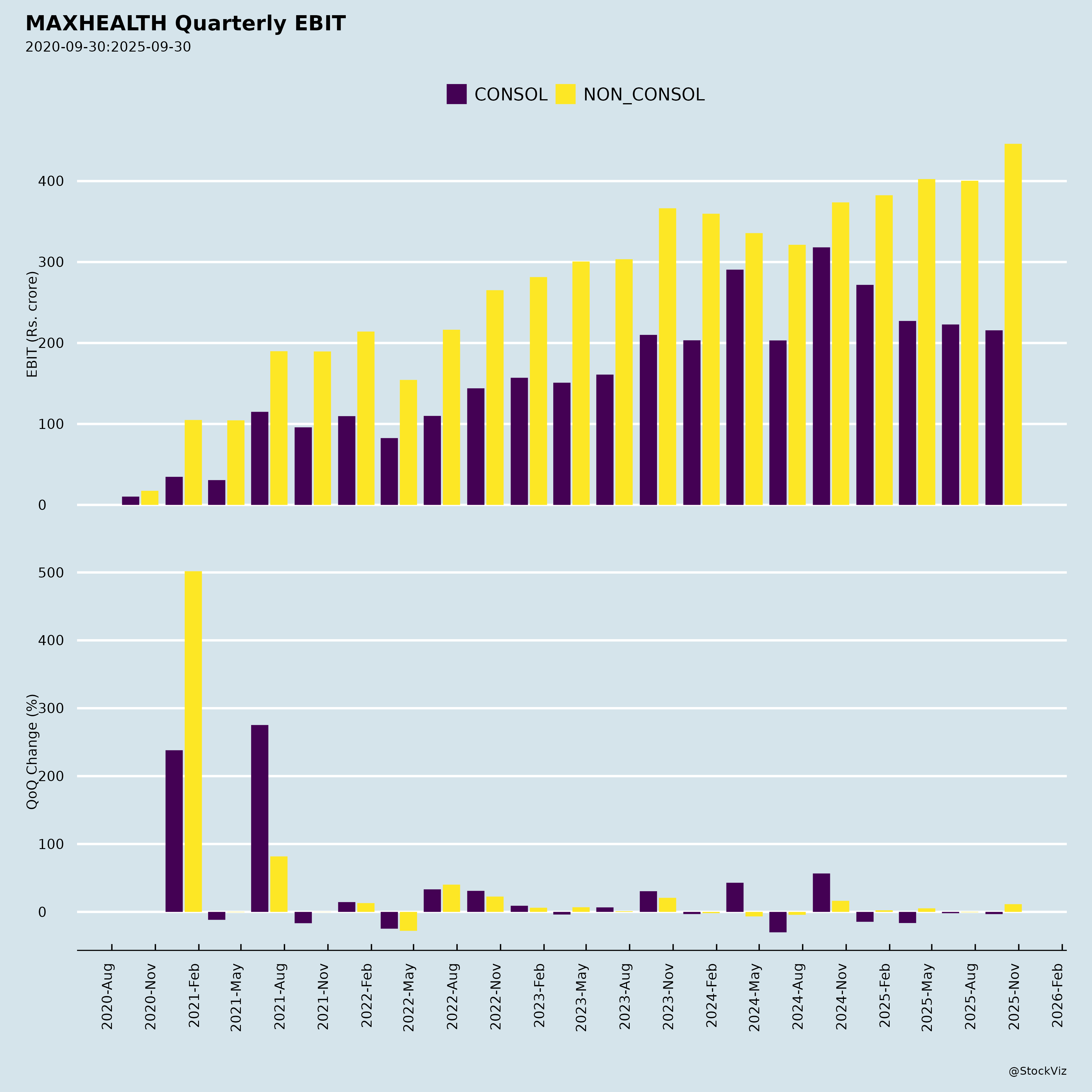
Margin pressure amid expansion. Operating EBITDA margin was 24.8% in Q1 FY27, down from 24.9% in Q1 FY26 and 26.8% in Q4 FY26. Reported EBITDA margin fell to 24.1% from 24.0% a year earlier and 27.5% in the prior quarter. The annual trend shows a steady slide: 27.7% (FY23), 27.8% (FY24), 26.8% (FY25), 26.2% (FY26).
Cost escalation from new units. Indirect overheads in Q1 FY27 included ₹195 Cr relating to new units, including KHL. On a like-for-like basis, indirect overheads rose 12% year-on-year, driven by annual merit increases, additional manpower for brownfield expansions, higher sales and marketing spend, and increased provisions for doubtful debts on overdue receivables.
Rising finance and depreciation costs. Net finance cost rose to ₹61 Cr in Q1 FY27 from ₹34 Cr in Q1 FY26 and ₹47 Cr in Q4 FY26. Depreciation and amortisation increased to ₹150 Cr from ₹117 Cr a year earlier, attributed to capitalisation of brownfield projects at Max Mohali, Nanavati-Max and Max Lucknow.
Profit growth lagging revenue growth. While net revenue grew 15% year-on-year in Q1 FY27, profit before tax grew 7% and profit after tax grew 3%. PAT margin declined to 12.6% from 14.0% in Q1 FY26.
Underperformance at newly acquired Kalinga Hospital (Bhubaneswar). In FY26, Kalinga reported revenue of ~₹154 Cr and EBITDA of ~₹7 Cr before an ₹8 Cr impact from a stricter policy for provision for doubtful debts. For the post-acquisition period in Q1 FY27, it contributed ₹19 Cr revenue and ~₹2 Cr EBITDA, with occupancy at 50% and ARPOB at ₹35K. FY26 occupancy was ~60% with ARPOB of ₹29K.
Doubtful debt provisions. The company flagged increased provisions for doubtful debts on overdue receivables as a contributor to higher indirect overheads. Trade receivables rose to ₹1,155 Cr at March 2026 from ₹857 Cr at March 2025, with DSO at 87 days.
Regulatory and policy uncertainty. The board’s in-principle approval to explore medical colleges is contingent on proposed NMC regulatory amendments allowing companies incorporated under the Companies Act, 2013 to pursue such activity. The MoA amendment requires member approval.
Senior management turnover. Dr. N. Venkatesan, Senior Director & Chief Procurement Officer, resigned effective August 31, 2026, citing future career opportunities. Two new senior appointments were made: Mr. Ajay Vij as Director – Chief Supply Chain & Procurement Officer (effective August 14, 2026) and Mr. Pawan Kumar Marella as Senior Director – Chief Experience & Brand Officer (effective August 17, 2026).
Execution risk on large expansion pipeline. The company plans to add ~8,300 beds, with ~4,000 in the next 3–4 years and total potential reaching ~14,500 beds by FY30 and beyond. Estimated outflow is ₹1,711 Cr (FY27), ₹2,340 Cr (FY28), ₹2,025 Cr (FY29) and ₹6,961 Cr (FY30 onwards). The Vaishali Tower 3 project alone requires ~₹425 Cr and is not expected to be commissioned until November 2029.
Discontinued operations. Max Medcentre, Lajpat Nagar (Cancer Care) and Max Medcentre, Pitampura were discontinued, and MSSH, Gr. Noida was discontinued in 2019.
Partner Healthcare Facility accounting. Financial information includes PHFs that MHIL does not own or control under IND AS 110, and PHF financials have not been verified by the Company. The presentation states no reliance should be placed on PHF financial information.
2. Tailwinds and Growth Prospects
Capacity expansion pipeline. The company operates 6,100+ beds across 21 facilities and plans to roughly double bed capacity in 4–5 years. Brownfield additions of ~2,000 beds are described as ROCE accretive. Greenfield land parcels have been acquired with potential for ~1,000 beds in Gurgaon and ~550 beds in Lucknow. The new 400-bed tower at Max Smart, Saket was inaugurated on September 3, 2026, bringing Max Hospital, Saket to ~1,200 beds — described as the largest private hospital in Delhi by bed capacity, expanding advanced care across 22+ specialties.
Asset-light expansion. Executed agreements to lease for hospitals in Mohali (400 beds), Thane (500 beds) and Dehradun (130 beds), plus O&M for a hospital in Pitampura (200 beds). Additional asset-light projects include a ~400-bed built-to-suit hospital in Dwarka, a ~500-bed built-to-suit hospital (Crosslay), a ~300-bed built-to-suit hospital (MSSH Dwarka), a ~400-bed asset-light built-to-suit hospital (Mohali), a ~500-bed asset-light built-to-suit hospital (Thane), a 200-bed long-term service agreement (Pitampura), and a 200-bed Alexis Hospital, Nagpur.
Vaishali Tower 3. Board approved ~₹425 Cr capex for an additional hospital block adding ~202 census beds and ~48 non-census beds to the existing ~387 beds, to be commissioned by November 2029, catering to Ghaziabad and Uttar Pradesh.
Kalinga Hospital integration. New HIS rolled out August 1, 2026. Integration into the MHIL operating model is progressing through standardisation of clinical protocols, quality systems, procurement, finance, HR and digital processes. Medium-term focus is on expanding the consultant base, improving occupancy, and enhancing case and payor mix. The company infused ~₹87.87 Cr into KHL via rights issue, raising shareholding from ~58.28% to ~66.15%.
Medical value travel. India’s foreign medical tourism industry is projected to reach ~3.0 million medical tourists by 2030e. Max Healthcare has 12 company- and partner-owned Patient Assistance Centres across Uzbekistan, UAE, Myanmar, Oman, Nigeria, Ethiopia, Bangladesh, Kenya, Nepal, Tanzania, Fiji and Vanuatu. India offers significant cost advantages versus Thailand, Singapore, Malaysia and the US across procedures including hip replacement, knee replacement, heart bypass, angioplasty, heart valve replacement and dental implants.
Favourable market structure. Low bed density relative to WHO recommendations, higher per capita income, higher ARPOB and rising insurance penetration make Delhi and Mumbai attractive. Health insurance gross premiums grew at 18% CAGR from FY18 to FY25. Max Healthcare has 4,400+ beds in metros, with ~73% of facilities and ~73% of beds in metros.
Max Lab growth. Non-captive pathology revenue grew from ₹32 Cr (FY20) to ₹175 Cr (FY26), a 30%+ six-year CAGR. Q1 FY27 revenue was ₹78 Cr with 17% EBITDA margin. Operational footprint includes 620+ collection centres, 890+ pick-up points, 50+ test processing labs, 60+ cities, 1,590+ active partners and 6.2 lakh+ patients served in Q1 FY27. Digital revenue grew 34% year-on-year.
Max@Home growth. Revenue grew from ₹77 Cr (FY19) to ₹263 Cr (FY25), a 23% CAGR, with 20%+ six-year CAGR. The business has 4,800+ daily billed transactions through 1,900+ team members and is QAI accredited.
Digital platform. Max MyHealth has 18.0 lakh+ patient registrations, 1,20,000+ monthly active users (8x growth), 10,000+ patients completing OPD assessments, and published MAX-EVAL-11 as the first large-scale benchmark for full-spectrum ICD-11 coding. Digital revenue accounted for ~32% of overall revenue in Q1 FY27.
Medical colleges opportunity. Board granted in-principle approval to explore setting up medical colleges/institutions under the Company or through subsidiary, contingent on proposed NMC regulatory amendments.
Strong cash generation and low leverage. Free cash from operations was ₹397 Cr in Q1 FY27. Net debt was ₹2,384 Cr as on June 30, 2026. The company describes headroom to raise debt given current leverage.
Track record of acquisitions. Management has completed multiple acquisitions and integrations including BLK, Nanavati and Max Healthcare. In the last 18 months, ~1,300 beds were acquired across Lucknow, Nagpur and Noida, all integrated into the network. ROCE threshold is 20% within 4 years post acquisition.
Clinical and academic credentials. 4 JCI and 1 AACI accredited facilities. 3,400+ research publications over 11 years. 750+ clinical research projects completed, ~145 ongoing. 30,000+ research participants and US$2.2 Mn in research grants. Partnerships with Columbia & Boston Universities, Imperial College, Aston University, Deakin University, Monash University, Pfizer, Mazumdar Shaw Medical Foundation, Ashoka University, IIT Bombay & Delhi, BITS Pilani, and Tata Institute for Genetics & Society.
3. Key Risks
Execution and timeline risk. The expansion pipeline is large and multi-year, with significant outflows extending beyond FY30. The Vaishali Tower 3 commissioning is targeted for November 2029. Bed additions may vary subject to ward configuration.
Margin sustainability. The company states ability to sustain >25% EBITDA margins on expanded footprint, but Q1 FY27 operating EBITDA margin was 24.8%, below that threshold. Annual margins have declined from 27.8% (FY24) to 26.2% (FY26).
Integration risk. Kalinga Hospital is being integrated, with new HIS rolled out August 1, 2026. Its Q1 FY27 occupancy was 50% and ARPOB ₹35K, below network averages.
Receivables and credit risk. Trade receivables increased to ₹1,155 Cr at March 2026 from ₹857 Cr at March 2025. DSO was 87 days at March 2026 versus 92 days at September 2025. Increased provisions for doubtful debts on overdue receivables were flagged.
Regulatory risk. Medical college plans depend on proposed NMC amendments. The MoA amendment requires member approval. The presentation notes risks including general market conditions, macro-economic, governmental and regulatory trends, currency and interest rate movements, competitive pressures, technological developments, changes in financial conditions of third parties, and legislative developments.
PHF accounting and disclosure risk. The presentation states PHF financial information has not been verified by the Company and no reliance should be placed on it. The combined financial information does not meet statutory, regulatory or other audit or similar stipulated requirements of MHIL.
Forward-looking statement risk. The presentation states a number of risks, uncertainties and other unknown factors could cause actual developments and results to differ materially from expectations. The Company does not guarantee that assumptions underlying forward-looking statements or management estimates are free from errors.
Competitive intensity. The presentation notes limited competitive intensity in the context of M&A, but the broader market includes peers such as Medanta, Fortis, Narayana Health, Apollo Hospitals and KIMS.
Cyber and data privacy risk. The presentation identifies cybersecurity and data privacy as key priorities, with a multi-layered framework including EDR, SOC, WAF, API and e-mail security, DLP, ISO 27001 certification received in October 2025, and Digital Personal Data Protection Act implementation underway.
Climate risk. Climate risk assessment was done with risks integrated into ERP.
4. Management Guidance Versus Observed Business Performance
EBITDA margin guidance. Management states ability to sustain >25% EBITDA margins on expanded footprint. Observed: Q1 FY27 operating EBITDA margin was 24.8%; FY26 was 26.2%; FY25 was 26.8%; FY24 was 27.8%. The Q1 FY27 margin is below the stated >25% threshold.
Bed capacity guidance. Management targets ~2x bed capacity in next 4–5 years, with ~2,000 beds via brownfield, ~4,000 beds in next 3–4 years, and total potential of ~14,500 beds by FY30 and beyond. Observed: 6,100+ beds as of August 17, 2026. The new 400-bed tower at Max Smart, Saket was inaugurated September 3, 2026. Vaishali Tower 3 (~250 beds) approved for commissioning by November 2029.
ROCE guidance. Management targets ROCE threshold of 20% within 4 years post acquisition. Observed: No specific ROCE figure is disclosed for recent acquisitions in the supplied material.
Kalinga integration guidance. Management states integration activities are progressing as planned, with new HIS rolled out August 1, 2026, and medium-term focus on expanding consultant base, improving occupancy, and enhancing case and payor mix. Observed: Q1 FY27 occupancy was 50% and ARPOB ₹35K; FY26 occupancy was ~60% and ARPOB ₹29K. Kalinga contributed ₹19 Cr revenue and ~₹2 Cr EBITDA in Q1 FY27 post-acquisition.
Max Lab growth guidance. Management describes investing for growth with 30%+ six-year CAGR. Observed: Revenue grew from ₹32 Cr (FY20) to ₹175 Cr (FY26), consistent with 30%+ CAGR. Q1 FY27 revenue was ₹78 Cr with 17% EBITDA margin.
Max@Home growth guidance. Management describes investing for growth with 20%+ six-year CAGR. Observed: Revenue grew from ₹77 Cr (FY19) to ₹263 Cr (FY25), consistent with 23% CAGR.
Digital revenue guidance. Management states digital revenue accounted for ~32% of overall revenue in Q1 FY27. Observed: Max MyHealth has 18.0 lakh+ patient registrations and 1,20,000+ monthly active users.
Free cash flow guidance. Management states strong free cash flow generation. Observed: Free cash from operations was ₹397 Cr in Q1 FY27. Net debt was ₹2,384 Cr as on June 30, 2026.
Acquisition integration guidance. Management states strong track record of successful M&A and swift turnaround, with ROCE threshold of 20% within 4 years post acquisition. Observed: In the last 18 months, ~1,300 beds were acquired across Lucknow, Nagpur and Noida, all integrated into the network. The Dwarka asset-light hospital achieved EBITDA breakeven in 6 months.
Medical college guidance. Management granted in-principle approval to explore setting up medical colleges/institutions, contingent on proposed NMC regulatory amendments. Observed: No operational medical college exists as of the supplied material.
Vaishali expansion guidance. Management approved ~₹425 Cr capex for Tower 3 adding ~250 beds, to be commissioned by November 2029. Observed: Existing Vaishali capacity is ~387 beds.
Broker Narrative
The broker narrative shifted from early optimism about MaxHealth’s expansion, pricing power, ancillary businesses, international patients, and net cash to a later phase dominated by repeated Buy calls despite mounting negative returns and no explicit headwinds or tailwinds in the final report. The initial warning of occupancy dilution from rapid bed additions persisted as a risk, while the promised ARPOB, capacity, non-hospital, international, and balance-sheet drivers failed to translate into realized gains.
Fears that came true
- The flagged occupancy dilution from adding 1,169 beds in FY25 and pushing utilization toward ~72% coincided with repeated DISAPPOINTMENT outcomes and negative actual returns from late 2024 through 2026.
Optimism that failed
- ARPOB and pricing realization from PSU tariff hikes, annual price increases, and insurance mix optimization did not prevent negative actual returns or repeated DISAPPOINTMENT ratings.
- Aggressive bed capacity expansion at Dwarka, Nanavati, and Delhi-NCR brownfield sites backed by the land bank failed to deliver positive price performance despite the build-out.
- Scaling of MaxLab diagnostics and Max@Home at projected CAGRs did not offset the deterioration in actual returns toward negative territory.
- International patient recovery contributing ~9% of FY23 revenue did not sustain returns as later calls produced negative outcomes and DISAPPOINTMENTS.
- The strong balance sheet with INR 7.3 billion surplus net cash did not avert negative actual returns or disappointing broker calls in 2025-2026.
Broker Timeline
30 broker calls · 2023-05-17 to 2026-07-24
Copyright © 2023 SAS Data Analytics Pvt. Ltd. All rights reserved.