MARUTI
Equity Metrics
September 24, 2026
Maruti Suzuki India Limited
Passenger Cars & Utility Vehicles
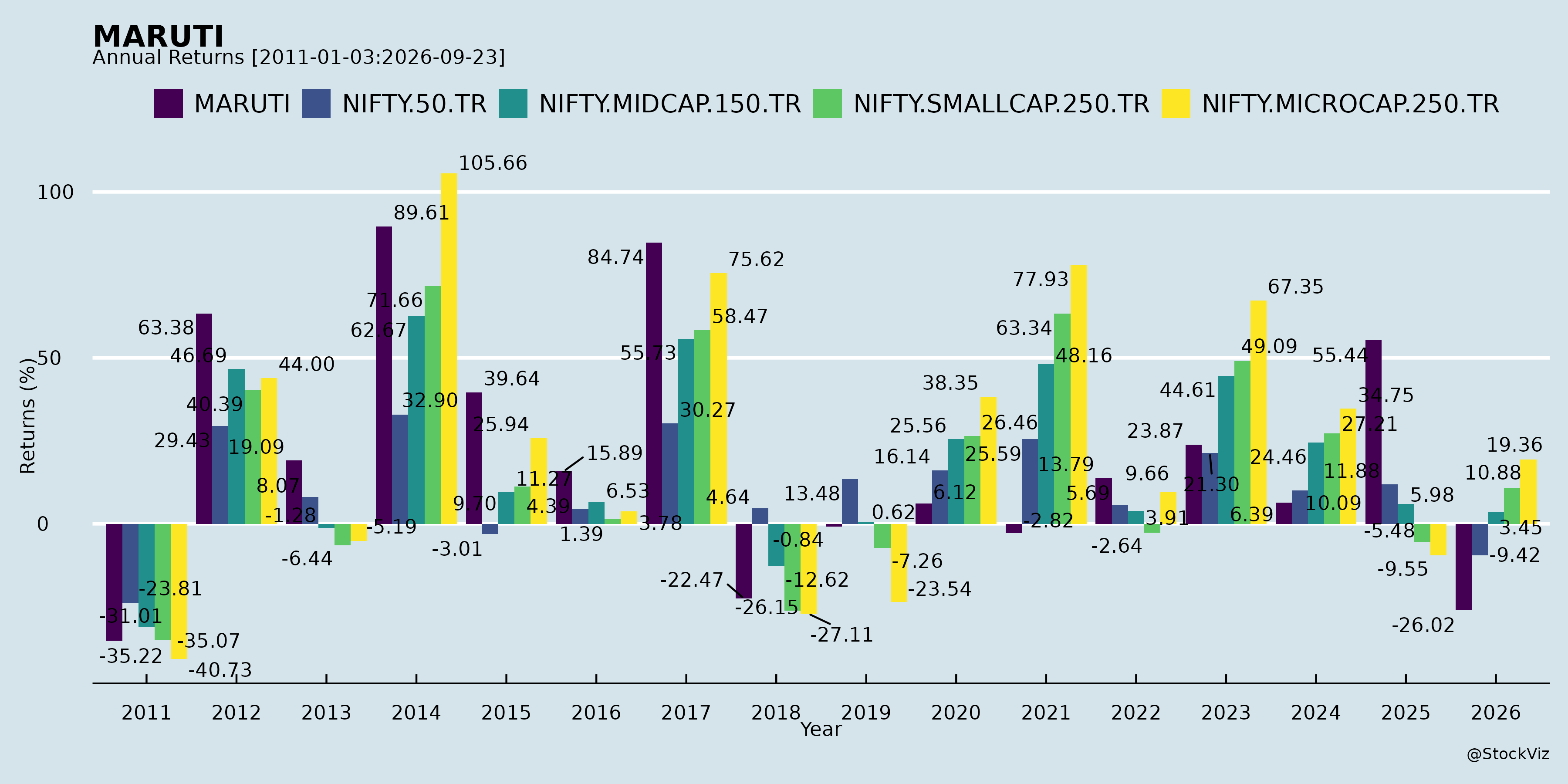
Annual Returns
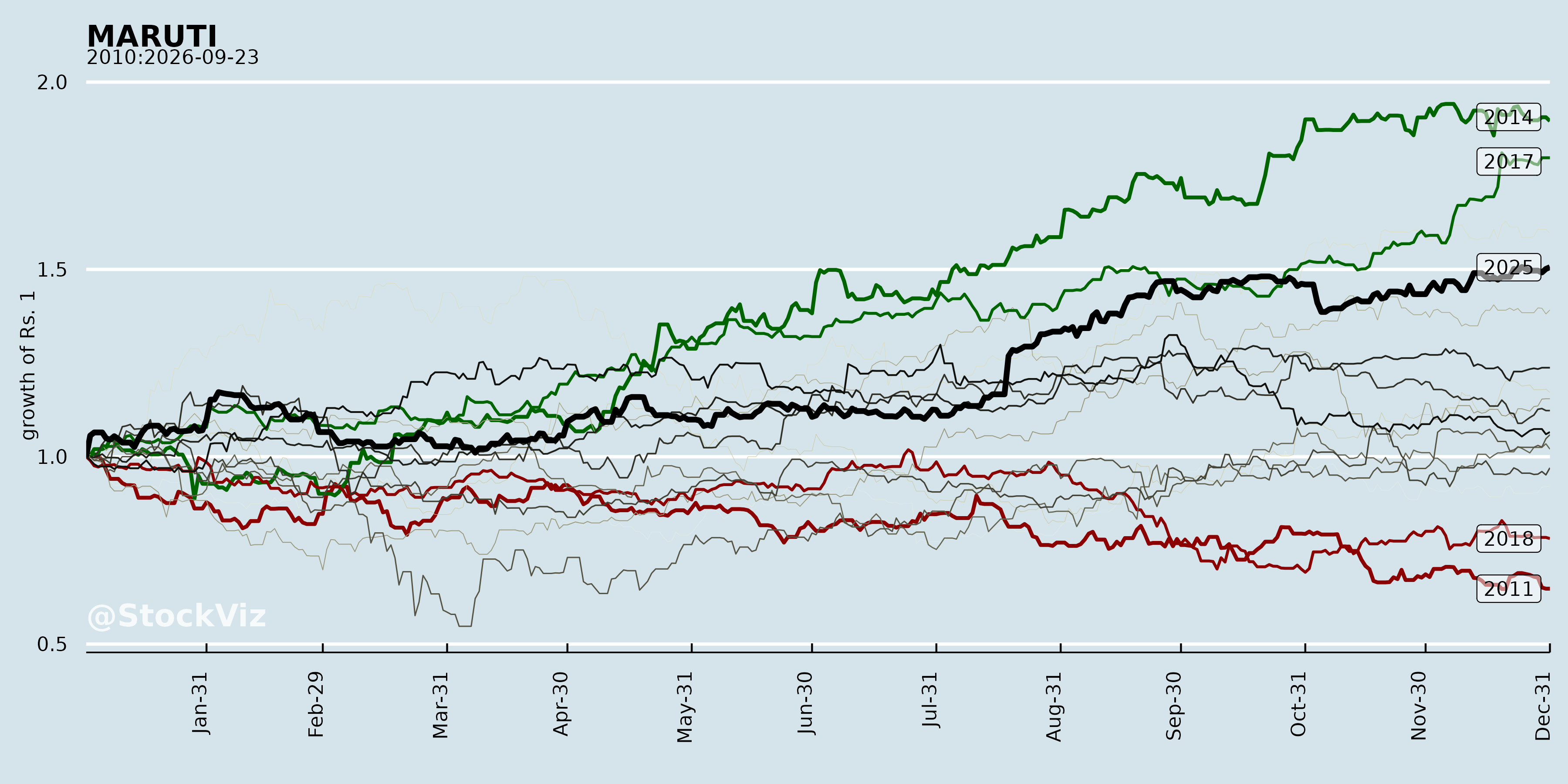
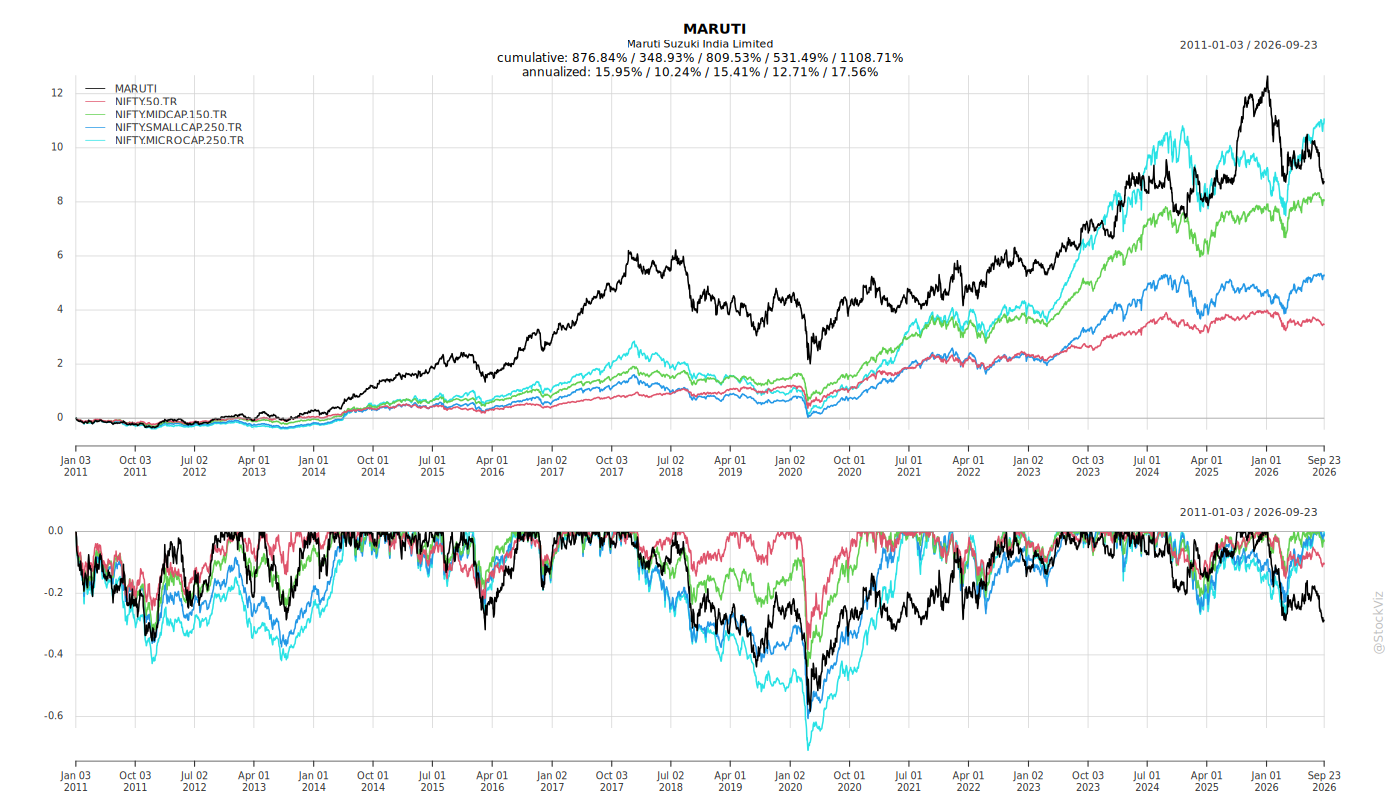
Cumulative Returns and Drawdowns
Fundamentals
Ownership
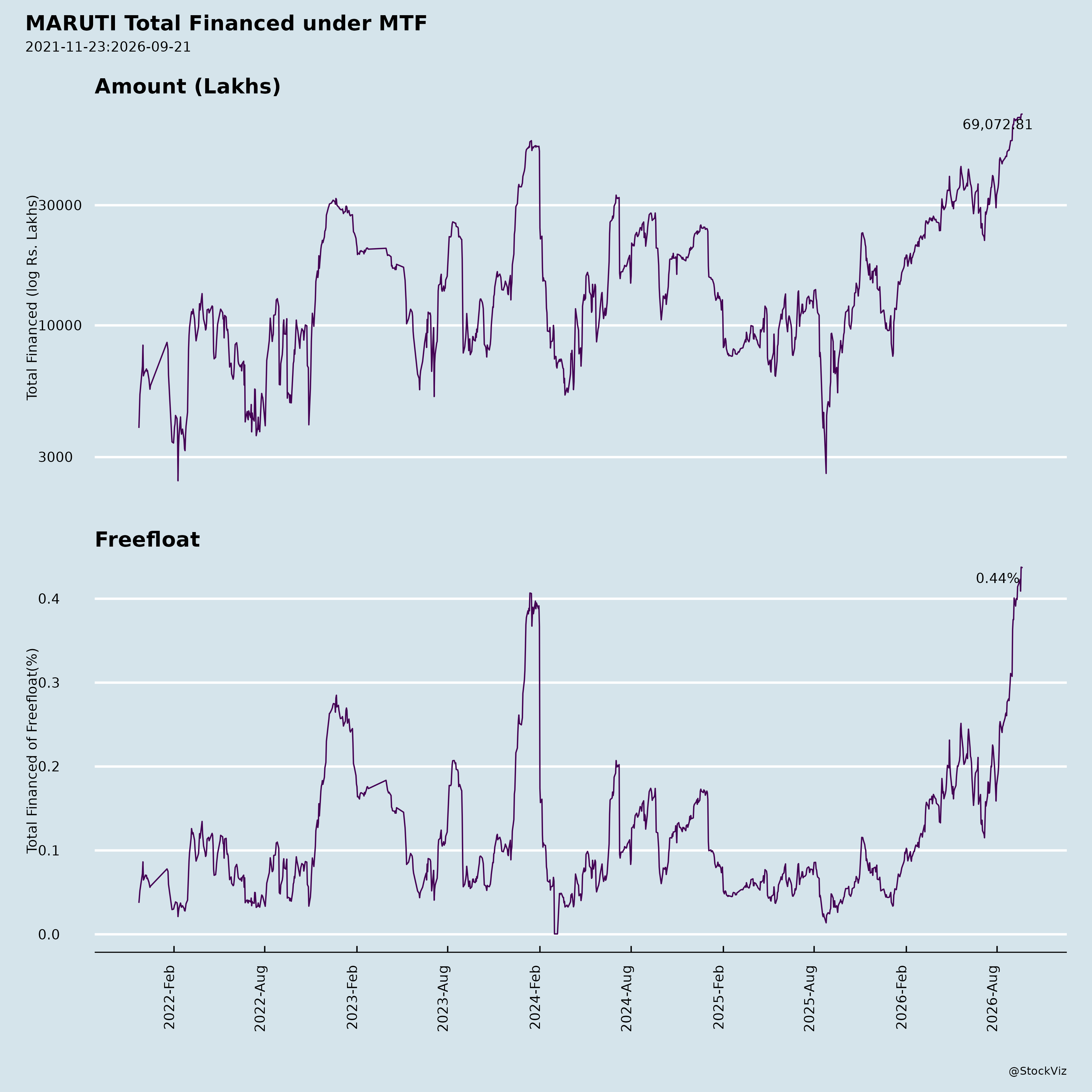
Margined
AI Summary
asof: 2026-09-14
Maruti Suzuki India Limited — Recent Corporate Announcements
1. Headwinds and Challenges
Margin pressure from commodity and currency movements. In the Q1 FY’27 investor presentation (quarter ended 30 June 2026), the company attributes margin movement to adverse commodity prices in the context of the West Asia conflict and adverse foreign exchange movement. These are cited as negative factors both against Q1 FY’26 and against Q4 FY’26.
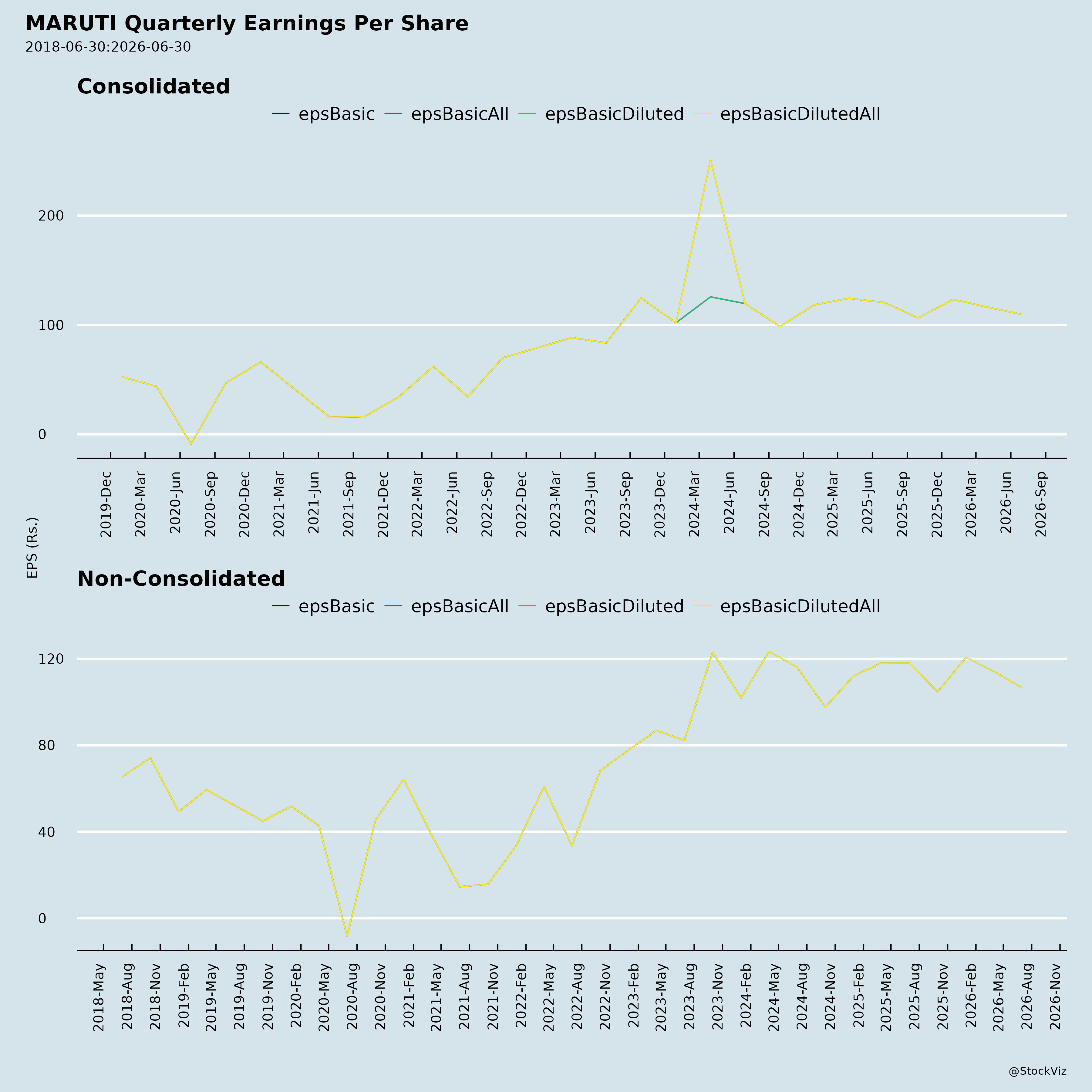
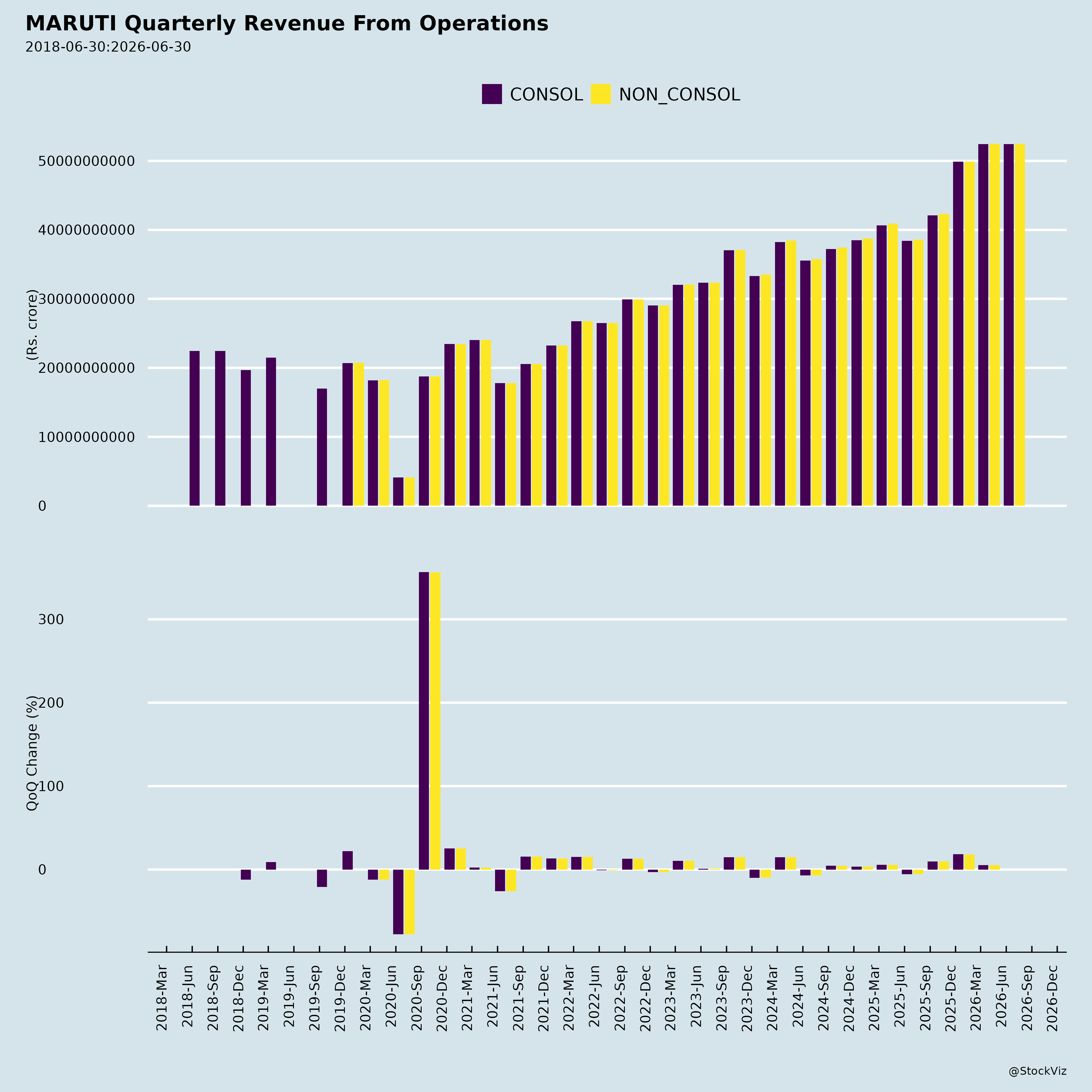
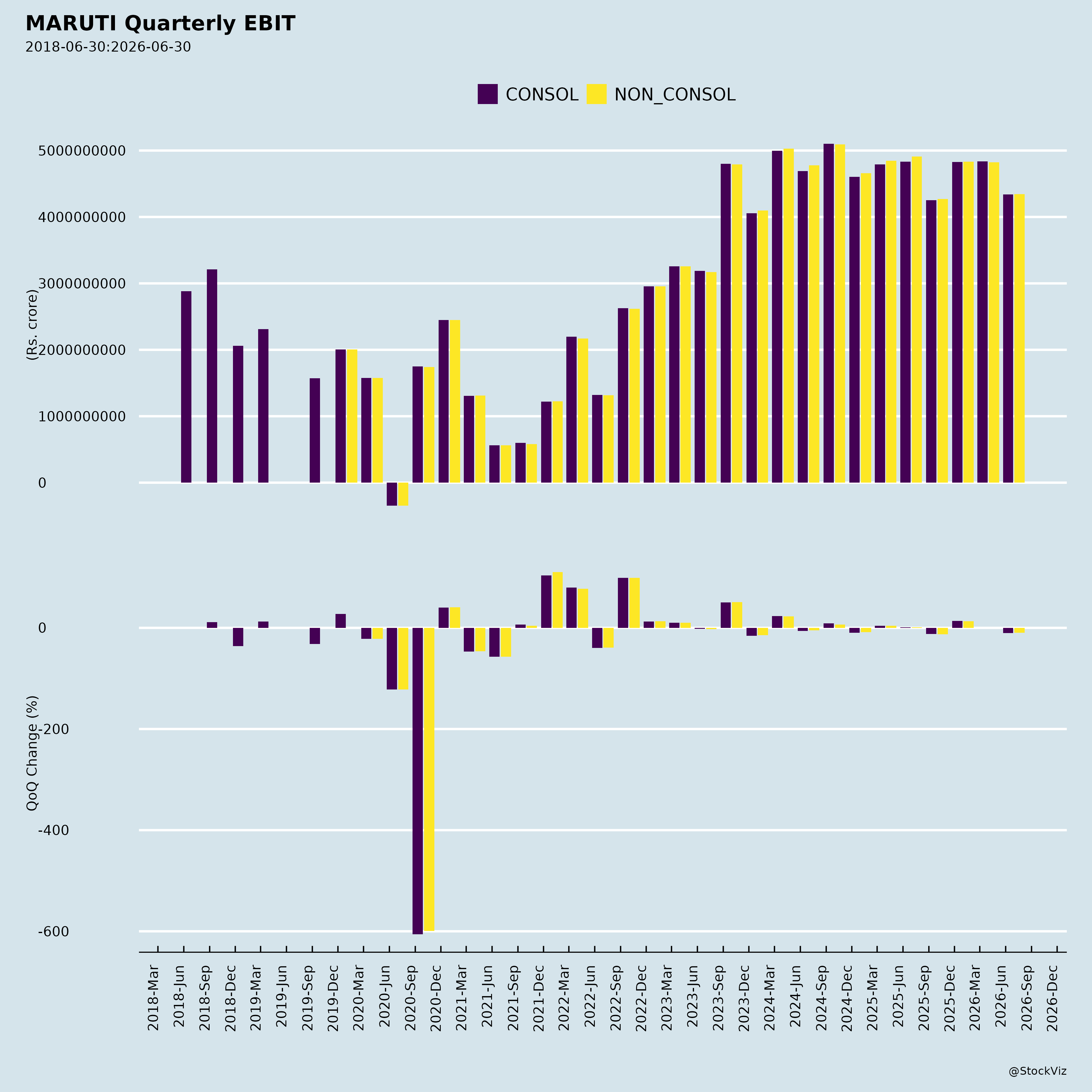
Sharp year-on-year profitability decline despite volume growth. For Q1 FY’27 versus Q1 FY’26, sales volume rose 29.3% to 682,724 units and net sales rose 36.4% to INR 499,591 million, yet Op. EBITDA fell 6.7% to INR 43,111 million, Op. EBIT fell 17.4% to INR 25,311 million, PBT fell 11.5% to INR 43,413 million and PAT fell 10.8% to INR 33,521 million. Material cost as a percentage of net sales rose 600 bps to 80.5% from 74.5%, and Op. EBITDA margin fell 400 bps to 8.6% from 12.6%.
Sequential deterioration. Against Q4 FY’26, Q1 FY’27 volume grew only 1.0% while net sales were marginally lower at -0.2%. Op. EBITDA fell 30.0% and Op. EBIT fell 42.6%. Material cost rose 380 bps to 80.5% from 76.7%. Additional negative factors cited sequentially include unfavourable fixed cost incidence on account of inventory depletion, higher employee expense due to Q1 seasonality, and higher depreciation expense from capacity expansion at the Kharkhoda facility.
Weakness in sales to other OEMs. Within domestic sales, sales to other OEM declined 19.5% year-on-year to 23,181 units, the only domestic category to contract.
Regulatory uncertainty on Extended Producer Responsibility. The Environment Protection (End-of-Life Vehicles) Rules, 2025, notified on 6 January 2025 and effective from 1 April 2025, impose EPR obligations on vehicle manufacturers for scrapping of End-of-Life Vehicles. The company states that the pricing mechanism for EPR certificates and the measurement framework for determining financial obligations are not yet available, and that it is currently unable to reliably estimate a range of possible outcomes; the impact will be evaluated once the implementation framework is established. The statutory auditors drew attention to this note in both the standalone and consolidated review reports.
Customs order. On 6 July 2026 the company received an Order-In-Original from the Office of the Commissioner of Customs (NS-V, JNCH), Maharashtra, regarding payment of duties on imported goods at a different rate. The company has been asked to pay differential duty of INR 4,73,94,938 along with an equal penalty of INR 4,73,94,938 and applicable interest. The company states it will challenge the order before the appropriate authority and that there is no major impact on financial, operational or other activities.
2. Tailwinds and Growth Prospects
Strong volume growth. Q1 FY’27 total sales volume was 682,724 units, up 29.3% year-on-year. Domestic sales were 557,988 units, up 29.5%, and exports were 124,736 units, up 28.6%, with exports at 18.3% of total sales.
Broad-based domestic segment performance. Mini segment volumes rose 124.1% to 43,757 units. Passenger cars rose 35.8% to 269,786 units. UVs rose 35.2% to 218,885 units. Vans rose 10.4% to 36,557 units and LCV rose 12.6% to 9,579 units.
Positive margin factors. Against Q1 FY’26, the company cites favourable operating leverage and cost reduction efforts as positive factors. Sequentially, higher operating and non-operating income is cited as a positive factor; non-operating income rose to 3.7% of net sales from 1.0% in Q4 FY’26.
New product launch. Maruti Suzuki introduced the Stunning New Baleno with segment-first features including Level 2 ADAS, ventilated front seats, and an Advanced Z12E powertrain offering improved fuel efficiency of 6.4% to 9.8% over predecessors. Bookings are open at INR 11,000 and prices start at INR 6,09,900. The launch was on 5 September 2026, with 7 colour options including Enigmatic Teal and a SmartPlay Pro+ Infotainment system.
ESG score improvement. Crisil ESG Ratings & Analytics Limited upgraded the company’s ESG score to 68 (Strong) for FY 2025-26 from 63 (Strong) in FY 2024-25, and the core ESG score increased to 64 from 57. The company notes it did not engage Crisil for this rating and the report was prepared independently based on public domain data.
Capacity expansion. Depreciation expense increased partly due to capacity expansion at the Kharkhoda facility, indicating ongoing investment in manufacturing capacity.
3. Key Risks
- Commodity price volatility linked to the West Asia conflict.
- Adverse foreign exchange movement.
- Inability to reliably estimate EPR obligations under the End-of-Life Vehicles Rules, 2025, pending the pricing and measurement framework.
- Customs duty dispute with potential liability of INR 4,73,94,938 in differential duty plus an equal penalty and applicable interest, which the company intends to challenge.
- Margin sensitivity to fixed cost incidence, as illustrated by the unfavourable impact from inventory depletion in Q1 FY’27 relative to Q4 FY’26.
- Seasonality in employee expenses, noted as higher in Q1.
- Rising depreciation from capacity expansion.
4. Management Guidance Versus Observed Business Performance
The supplied material does not contain explicit quantitative management guidance or forward-looking financial targets. The investor presentation includes a safe harbour statement noting that it may contain forward-looking statements involving risks and uncertainties, and that the company undertakes no obligation to update them.
Where evidence of management commentary exists, it is explanatory rather than predictive. Management attributes the Q1 FY’27 margin decline to adverse commodity prices, adverse foreign exchange movement, unfavourable fixed cost incidence from inventory depletion, higher employee expense due to Q1 seasonality, and higher depreciation from Kharkhoda capacity expansion, partly offset by favourable operating leverage, cost reduction efforts, and higher operating and non-operating income. Observed performance is consistent with these explanations: volumes and net sales grew strongly year-on-year, but material cost rose to 80.5% of net sales and Op. EBITDA margin fell to 8.6% from 12.6% in Q1 FY’26 and 12.3% in Q4 FY’26.
On the customs order, management states there is no major impact on financial, operational or other activities, and that the company will challenge the order. On EPR, management states it cannot currently reliably estimate the impact and will evaluate it once the implementation framework is established.
The company held an investors’ call on 31 July 2026 on the Q1 FY’27 financial results, the transcript of which has been uploaded to the company’s website. The 45th Annual General Meeting was held on 31 August 2026 through video conferencing, and all six ordinary resolutions set out in the AGM notice were passed with the requisite majority based on consolidated voting results of remote e-voting and e-voting during the AGM.
Broker Narrative
The broker narrative evolved from pure technical bearishness in 2020 (bearish engulfing, trend-line breaks, sectoral divergence, metal sector weakness) to fundamental optimism by 2026 (record volumes, capacity expansion, export strength, GST-driven demand), yet the commodity risk first implicitly flagged in the metal sector concerns resurged as the dominant margin-destroying force in Q1FY27, ultimately undermining the bullish operational story. Despite the directional shift from Sell to Buy, nobroker could override the margin compression that drove sustained negative actual returns from late 2025 onward.
Fears that came true
- Commodity inflation crushed EBITDA margins to a record-low 8.2% (−350 bps QoQ) exactly as the commodity/metal sector weakness concerns flagged since 2020 resurfaced, with raw material expenses up 47.5% YoY — this correlated with the string of DISAPPOINTMENT outcomes from late 2025 through mid-2026.
- The risk that adverse commodity price movements would limit margin gains materialized as commodity inflation alone eroded EBIT margins by ~300 bps, plus an additional ~110 bps from the shift to monthly commodity settlement cycles.
- Supply-chain disruptions flagged as ‘extraordinary supply-chain actions during the West Asia conflict’ coincided with the period of sustained negative actual returns and DISAPPOINTMENT calls throughout 2025–2026.
- The first report’s warning about metal sector weakness breaking bullish trend lines proved prescient years later when aluminium, plastics, and rubber commodity inflation drove the very margin compression that sank the bull case.
- The explicit risk of lower-than-anticipated volume growth over FY26–28E was overshadowed by margin erosion that negated any benefit from volume beats.
- Expectations that healthy macro triggers (income tax rationalisation, 8th Pay Commission, GST cuts) would sustain positive returns failed as the stock declined -13.6% at the last report despite record Q1FY27 volumes.
- The optimism that low dealer inventory (13 days) and a ~130,000-vehicle order book would catalyze positive returns failed as margin compression dominated the narrative and the stock registered sustained DISAPPOINTMENT outcomes.
Optimism that failed
- Despite record Q1FY27 domestic PV volumes of 12.7 lakh units (+26% YoY) and broad-based demand across urban and rural markets, the optimism that strong top-line growth would translate into positive stock returns failed — the last report showed a -13.6% actual return with PENDING status.
- Export outperformance (volumes +28.6% YoY, MSIL accounting for >55% of India’s PV exports) failed to shield the stock from significant underperformance, with actual returns deeply negative through 2025–2026.
- Small car volumes growing 34% YoY and SUV volumes growing 44.6% YoY were cited as bullish demand signals but did not prevent DISAPPOINTMENT outcomes as commodity-driven margin compression overwhelmed the volume tailwind.
- The new Brezza launch with strong bookings and 5-star Bharat NCAP rating was expected to reinforce the growth narrative but failed to offset the margin destruction from rising raw material costs.
- The capacity expansion (second Kharkhoda plant, fourth Gujarat line adding 500,000 units) was presented as a growth driver but the EBITDA margin at 8.2% — the lowest ever — suggested new capacity was not translating into profitability gains.
Broker Timeline
88 broker calls · 2020-02-15 to 2026-08-03
Copyright © 2023 SAS Data Analytics Pvt. Ltd. All rights reserved.