KOTAKBANK
Equity Metrics
September 24, 2026
Kotak Mahindra Bank Limited
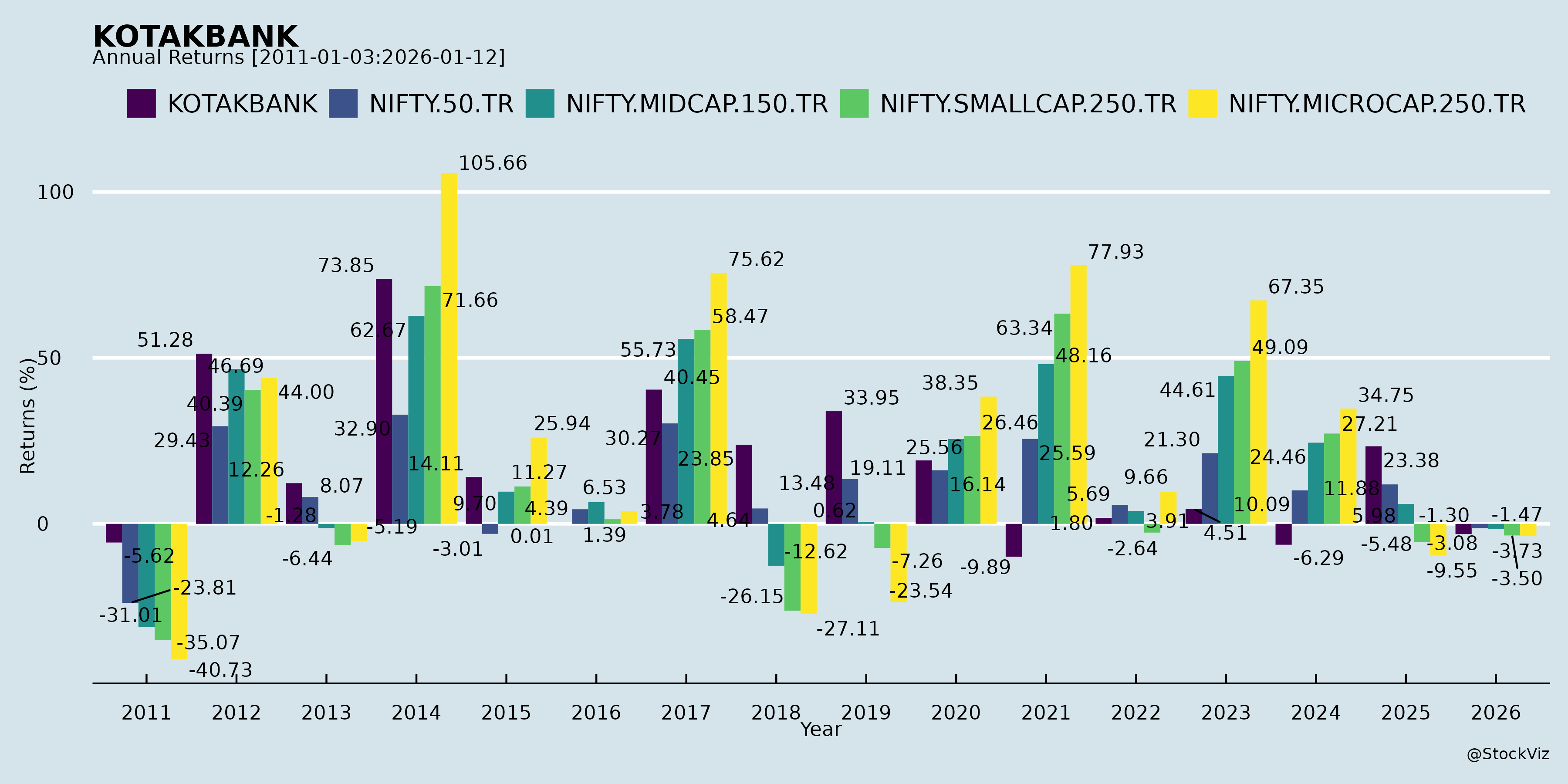
Annual Returns
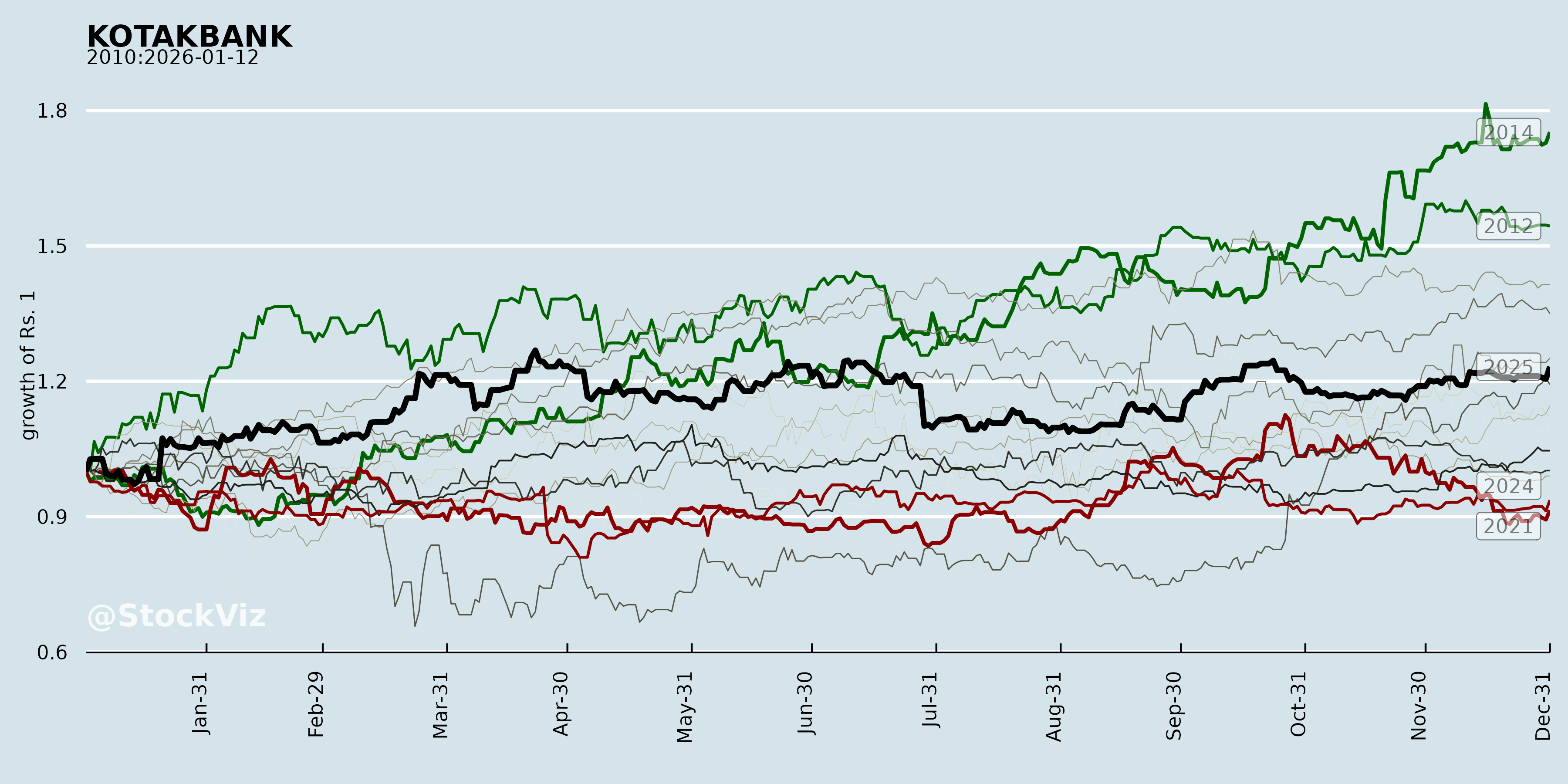
Cumulative Returns and Drawdowns


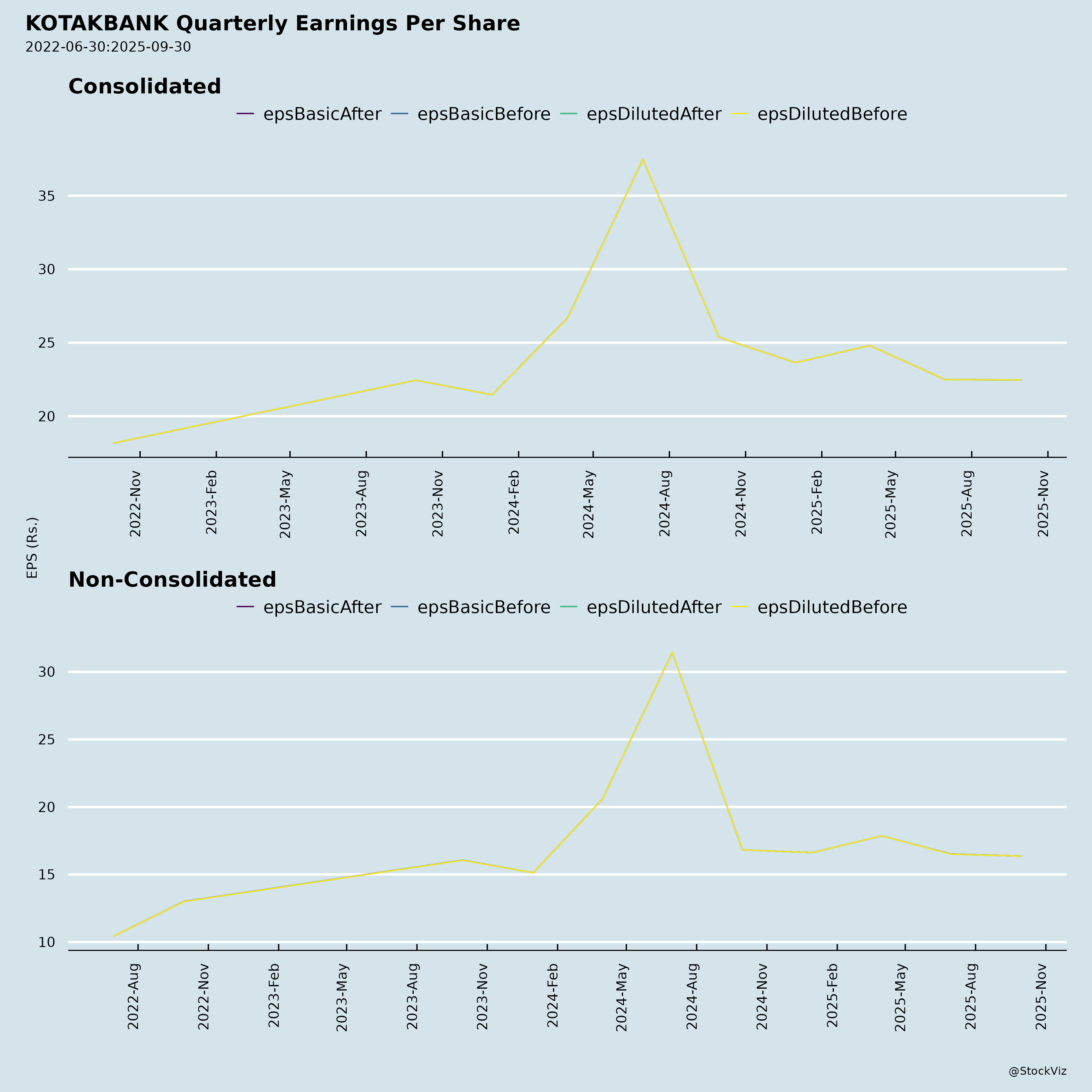
Fundamentals
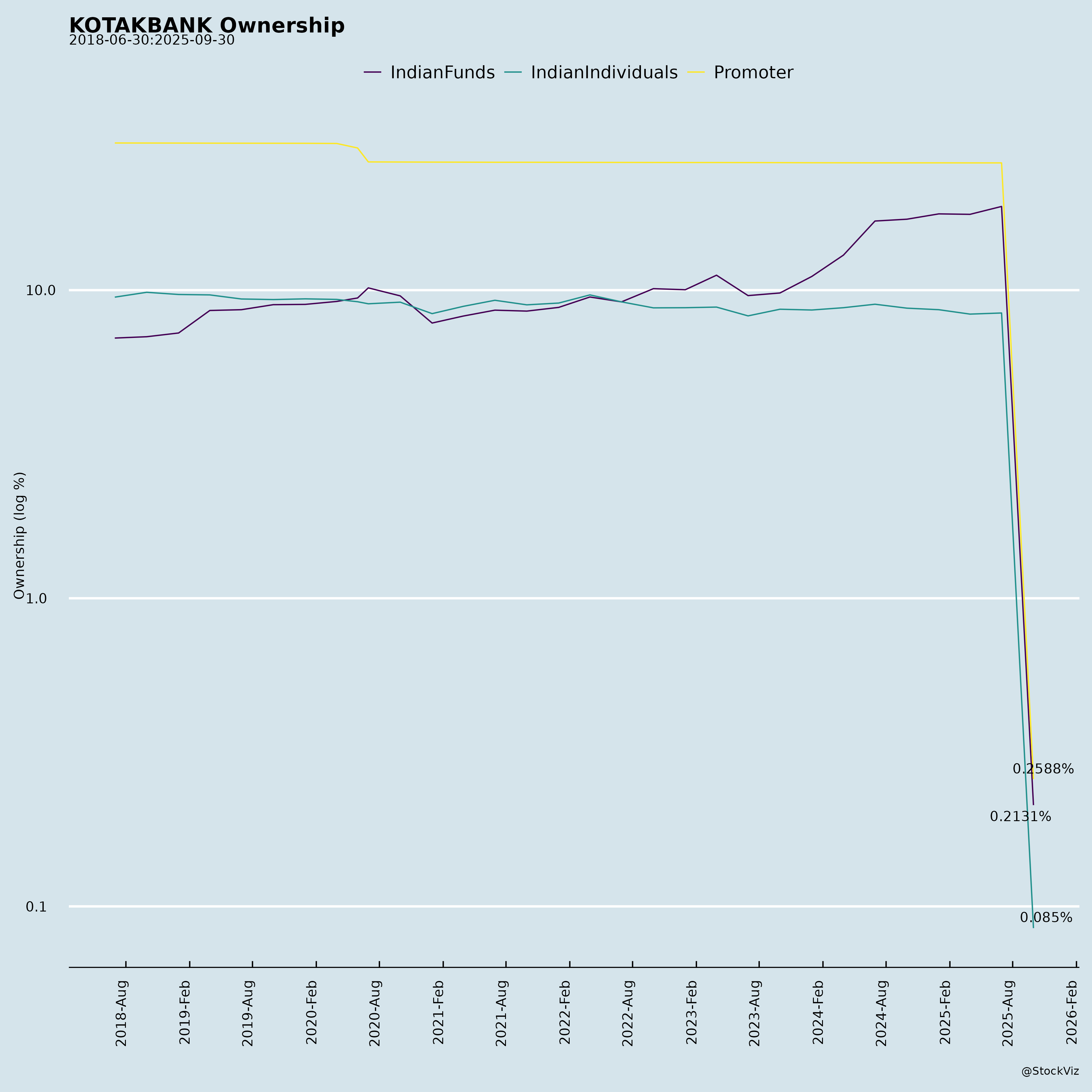
Ownership
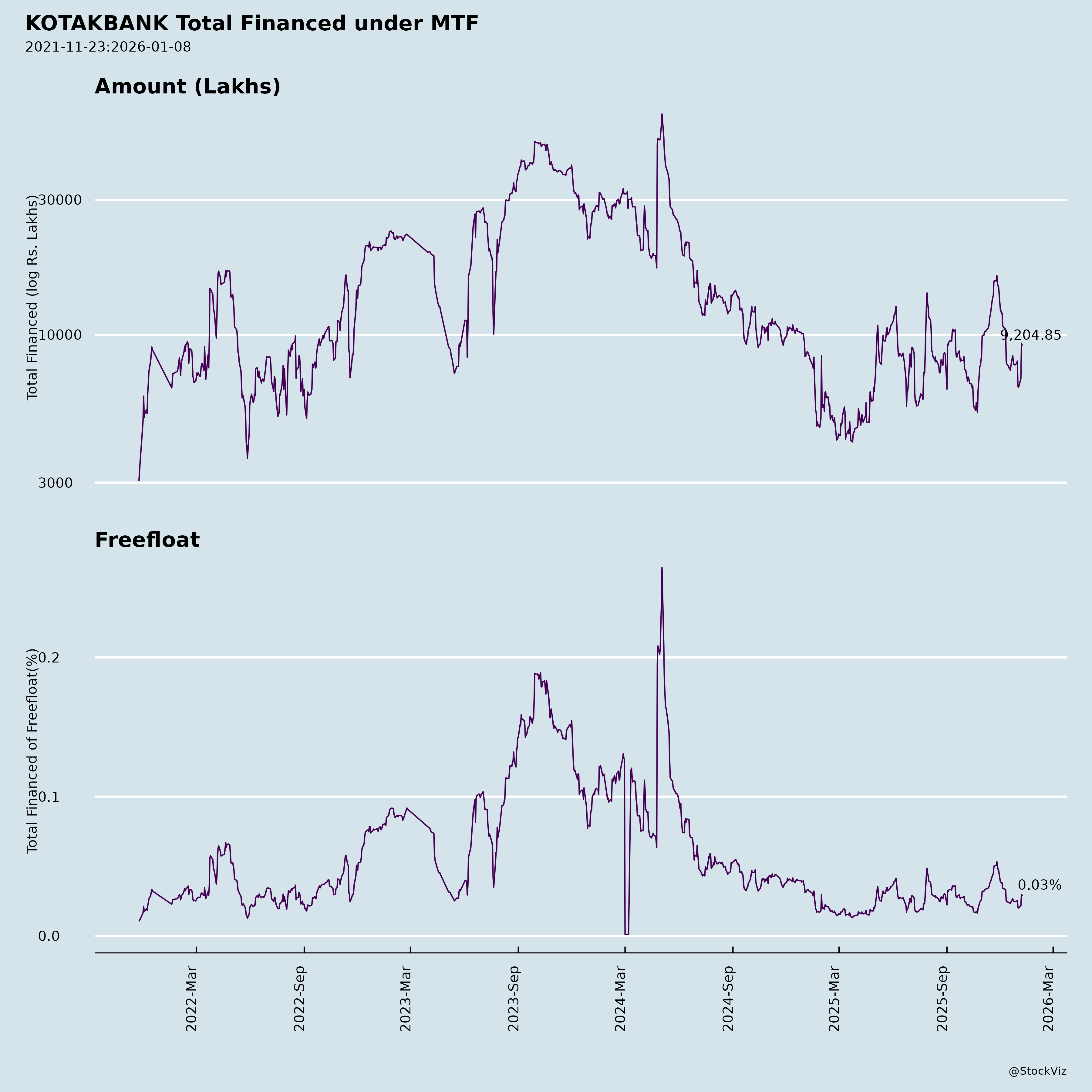
Margined
AI Summary
asof: 2026-09-14
Kotak Mahindra Bank — Recent Corporate Announcements
1. Headwinds and Challenges
The disclosed material does not contain any financial performance commentary, earnings guidance, or discussion of business headwinds. The announcements are limited to governance and shareholder-meeting matters. The only observable friction points are in shareholder voting outcomes:
- Director re-appointment dissent: The re-appointment of Mr. Amit Desai as a director (Resolution 4) attracted the highest level of opposition among all resolutions. While 97.12% of votes polled were in favour, 2.88% were against, with 290 members voting against. Within the non-institutional public category, 9.83% of votes polled were against the resolution.
- Second director re-appointment: The re-appointment of Mr. Jaideep Hansraj (Resolution 5) saw 1.56% of votes polled against, with 217 members opposing. Among non-institutional public shareholders, 5.33% voted against.
- Dividend resolution: Resolution 3 (declaration of dividend for FY 2025-26) passed with 99.9999% in favour; only 5,313 votes were cast against by 22 members.
- Auditor remuneration: Resolution 6 (fixing remuneration of Joint Statutory Auditors for FY 2026-27) passed with 99.9998% in favour; 19,278 votes were cast against by 45 members.
- Non-executive director remuneration: Resolution 7 (special resolution for payment of fixed remuneration to non-executive directors, excluding the non-executive independent part-time chairperson) passed with 99.9999% in favour; 1,03,242 votes were cast against by 90 members.
2. Tailwinds and Growth Prospects
The supplied material does not contain any business or financial growth commentary. The only forward-looking items are procedural:
- Investor engagement: The Bank will meet investors at the Morgan Stanley India Financials Investor Group Trip virtually on August 27, 2026, as intimated on August 21, 2026.
- Governance continuity: All seven resolutions proposed at the 41st AGM were approved with the requisite majority, including adoption of standalone and consolidated audited financial statements for FY 2025-26, declaration of dividend for FY 2025-26, re-appointment of two rotating directors, fixing of Joint Statutory Auditors’ remuneration for FY 2026-27, and payment of fixed remuneration to non-executive directors.
- Shareholder participation: Total votes polled represented 84.9780% of outstanding shares across all resolutions, indicating broad shareholder engagement.
3. Key Risks
The material does not identify business, credit, market, or regulatory risks. The only risk-relevant observations that can be drawn from the disclosures are:
- Concentration of promoter voting: Promoter and Promoter Group holdings of 2,57,32,01,985 shares (approximately 25.87% of total shares of 9,94,73,70,773) voted overwhelmingly in favour of all resolutions, with 99.9915% of their shares polled. This means outcomes on contested resolutions are materially influenced by promoter votes.
- Dissent on director re-appointments: The relatively higher against-votes on Resolutions 4 and 5, particularly from non-institutional public shareholders (9.83% and 5.33% against, respectively), indicate some shareholder opposition to these appointments.
- No invalid votes: No votes were declared invalid across any resolution, and no poll or postal ballot was used; all voting was via e-voting.
4. Management Guidance Versus Observed Business Performance
The supplied material contains no management guidance on financial or business performance, and no financial results or performance metrics. Accordingly, no comparison between guidance and observed performance can be made from these documents.
What can be observed is that the AGM, held on August 1, 2026 at 10:00 a.m. IST through video conferencing, transacted all proposed business:
- The standalone and consolidated audited financial statements for FY 2025-26 were adopted with 99.95% of votes in favour.
- A dividend on equity shares for FY 2025-26 was declared with 99.9999% approval.
- Mr. Amit Desai and Mr. Jaideep Hansraj were re-appointed as directors retiring by rotation.
- Joint Statutory Auditors’ remuneration for FY 2026-27 was fixed.
- Fixed remuneration for non-executive directors (excluding the non-executive independent part-time chairperson) was approved as a special resolution.
The scrutinizer’s report, dated August 1, 2026, confirms that all resolutions were deemed passed on that date with the requisite majority. The Bank has also scheduled an investor meeting on August 27, 2026, which may provide further business updates not covered in the supplied material.
Broker Narrative
Early narratives focused on deposit cost pressure, margin moderation, and elevated opex, while later reports shifted toward celebrating loan/NII growth, NIM stability, and subsidiary strength. The theme of asset quality persisted throughout, evolving from controlled slippages to concerns over CV/Tractor delinquencies and ECL provisions. Optimism around unsecured retail growth gave way to caution on segmental drags and weather risks, even as corporate/SME credit growth remained a consistent positive thread.
Fears that came true
- Rising cost of deposits and CASA mix deterioration materialized, with the CASA mix declining QoQ to 40.3% due to a 13% drop in CA balances.
- Elevated operating expenses from wage revisions resurfaced, with employee expenses rising 7.3% QoQ to INR 22.1bn on annual increments.
- Margin moderation risk reappeared as sustainable credit costs are expected to increase by 12–15 bps and a one-time ECL impact of 1.5–2.0% of equity is estimated.
- Segmental growth drag in CV/CE (contracting 1.8% QoQ) and unsecured retail (-0.3% QoQ) from the Standard Chartered rundown confirmed earlier fears of weak loan yields and portfolio rundown.
Optimism that failed
- Healthy credit growth optimism was partially undermined as CV/CE contracted 1.8% QoQ and unsecured retail saw sequential drag, even though overall credit growth of 15.2% YoY was strong.
- Controlled slippages and asset quality optimism failed as slippages rose from INR 10.2bn to INR 13.2bn QoQ, driven by CV and Tractor Finance delinquencies.
- The tailwind of improved real rate of return and deposit accretion from the INR2k note discontinuance did not prevent the CASA mix from deteriorating and fee income from missing estimates.
- Optimism on healthy treasury performance and subsidiary dividend payouts was offset by the fee income miss of 6.9% and reliance on non-recurring FX gains and subsidiary dividends for other income beat.
Broker Timeline
75 broker calls · 2023-06-01 to 2026-07-19
Copyright © 2023 SAS Data Analytics Pvt. Ltd. All rights reserved.