IIFLCAPS
Equity Metrics
September 24, 2026
IIFL Capital Services Limited
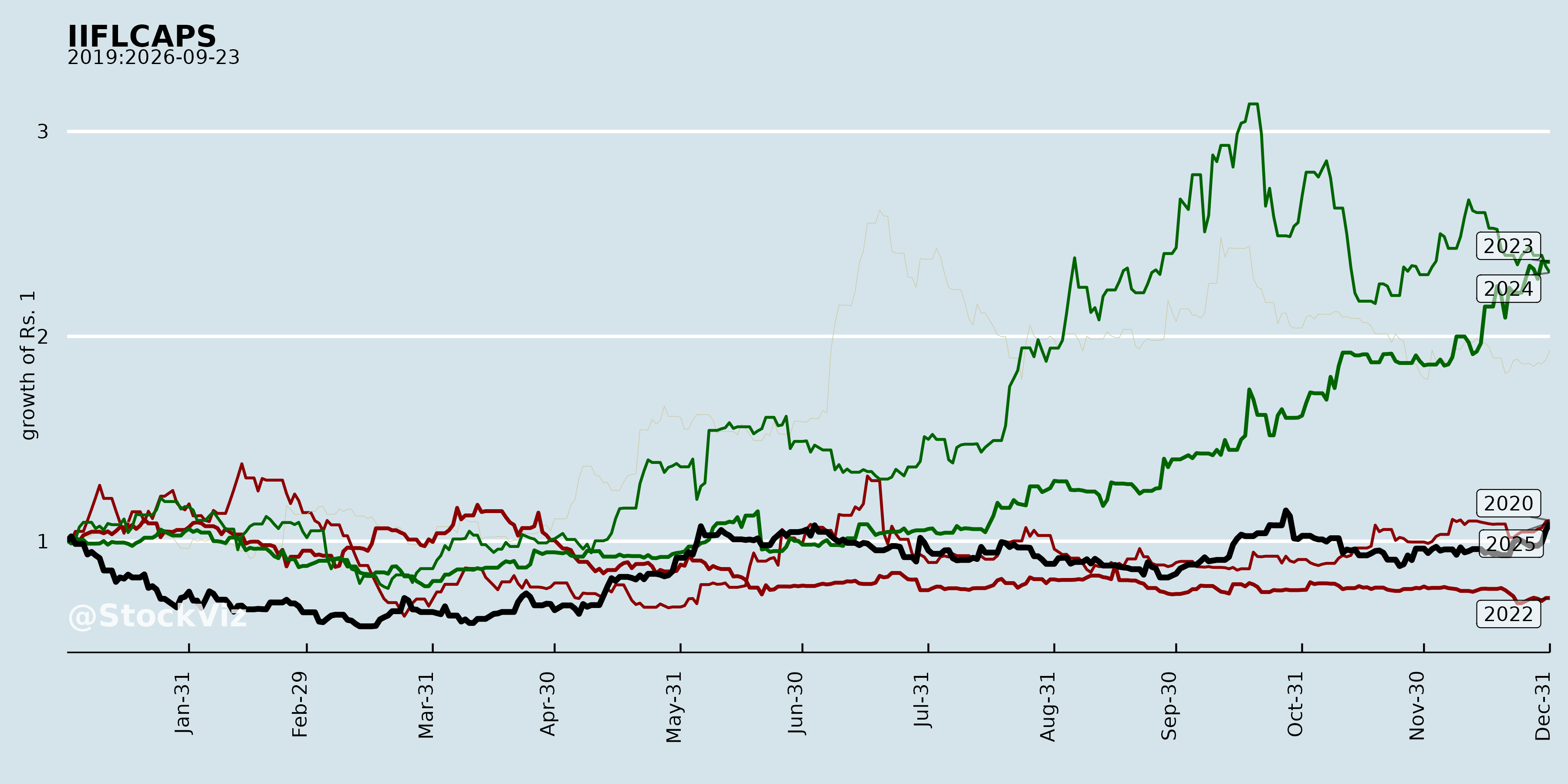
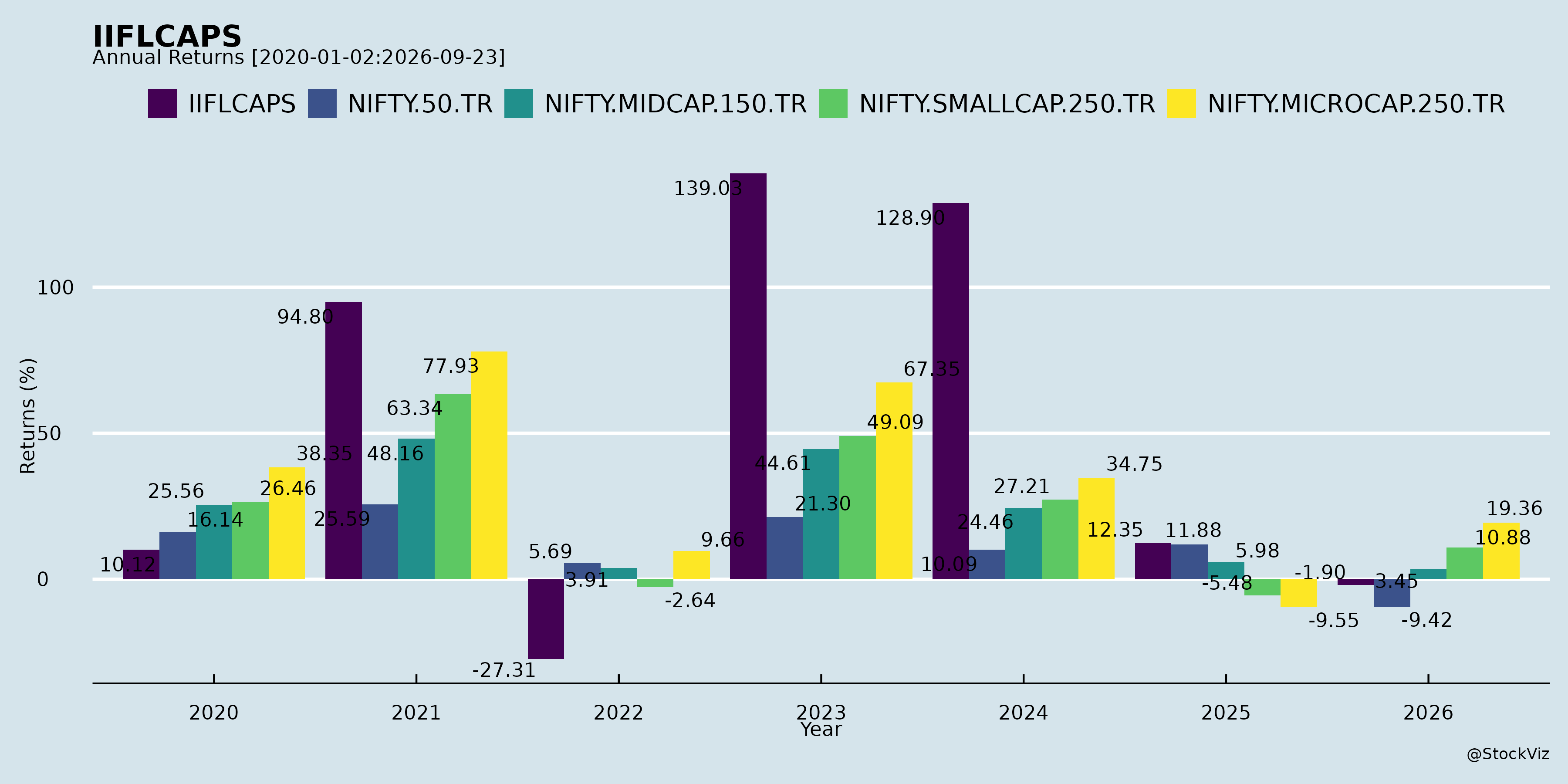
Annual Returns
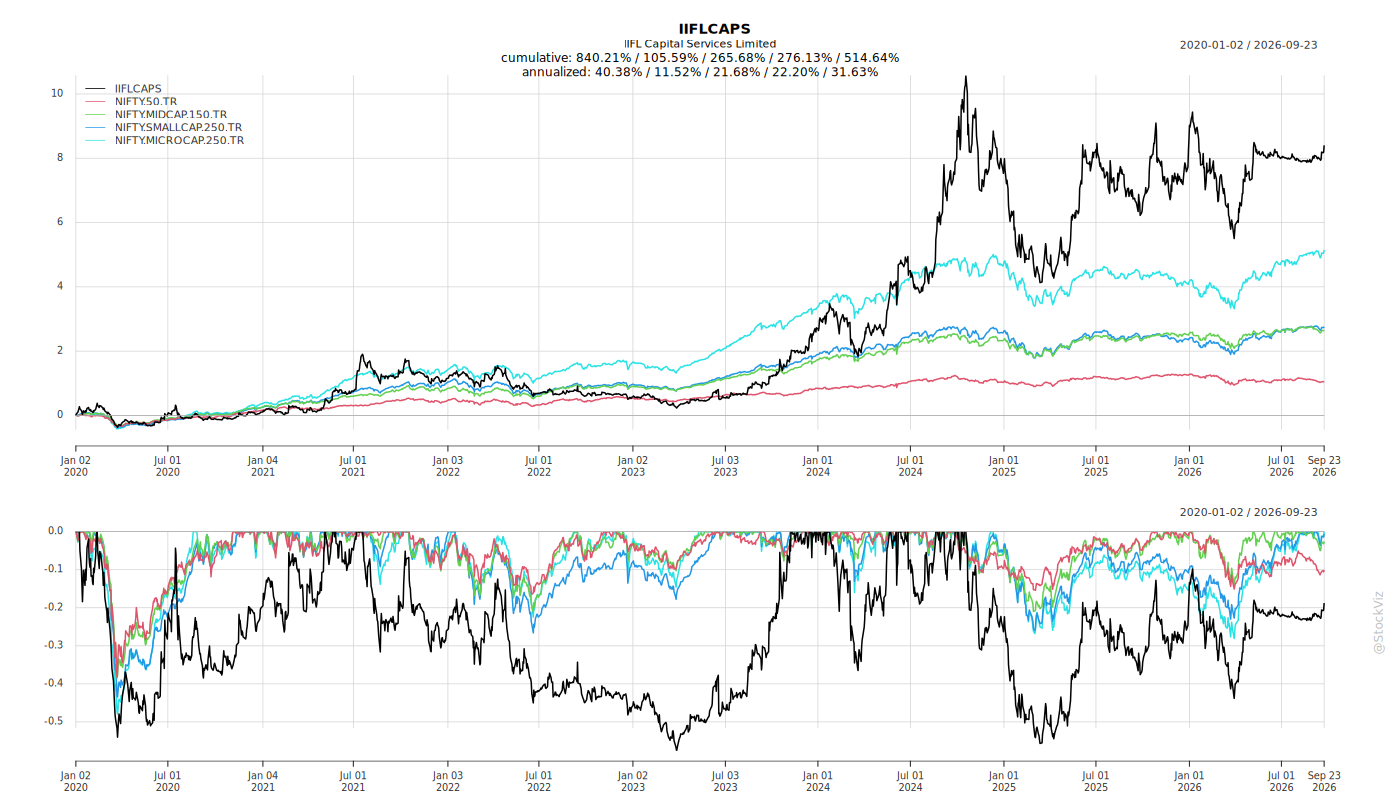
Cumulative Returns and Drawdowns
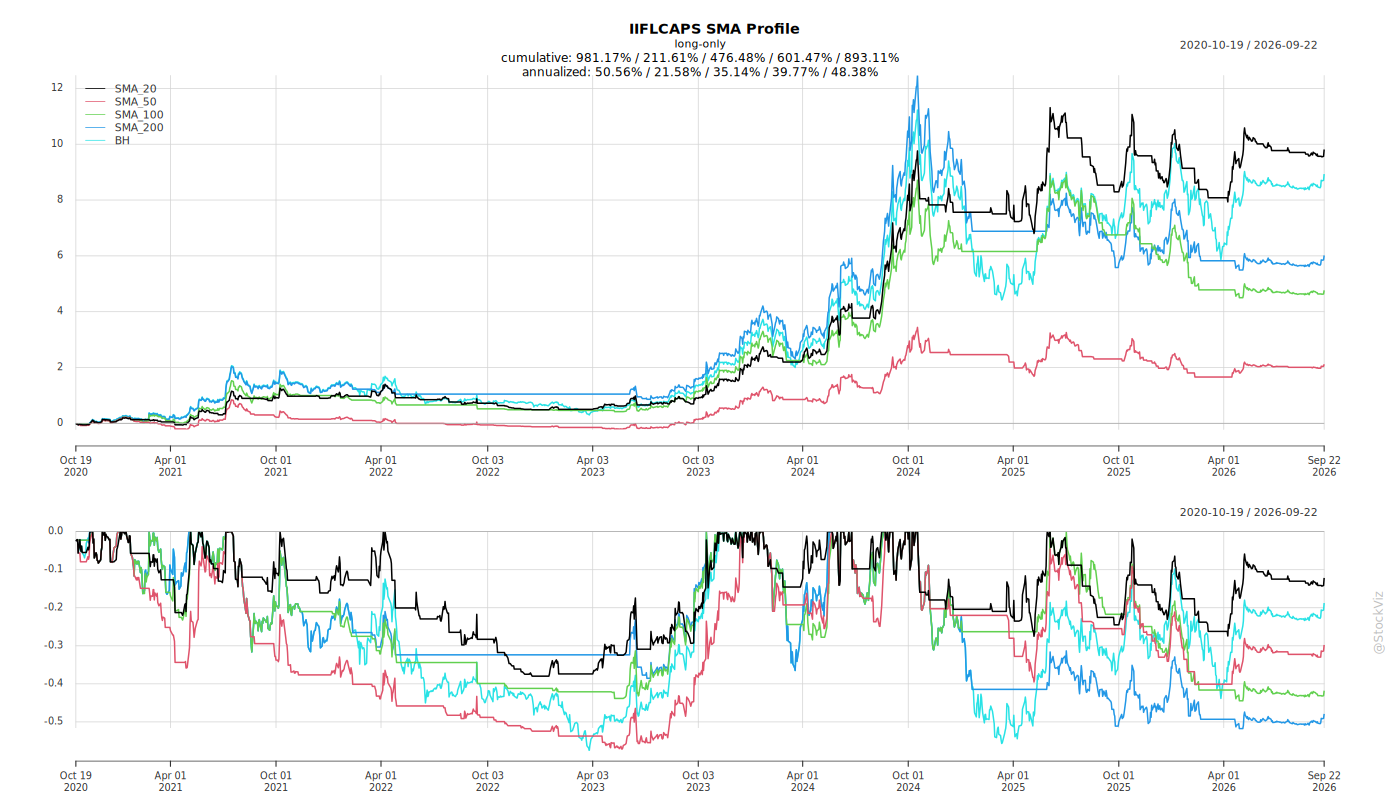
Fundamentals
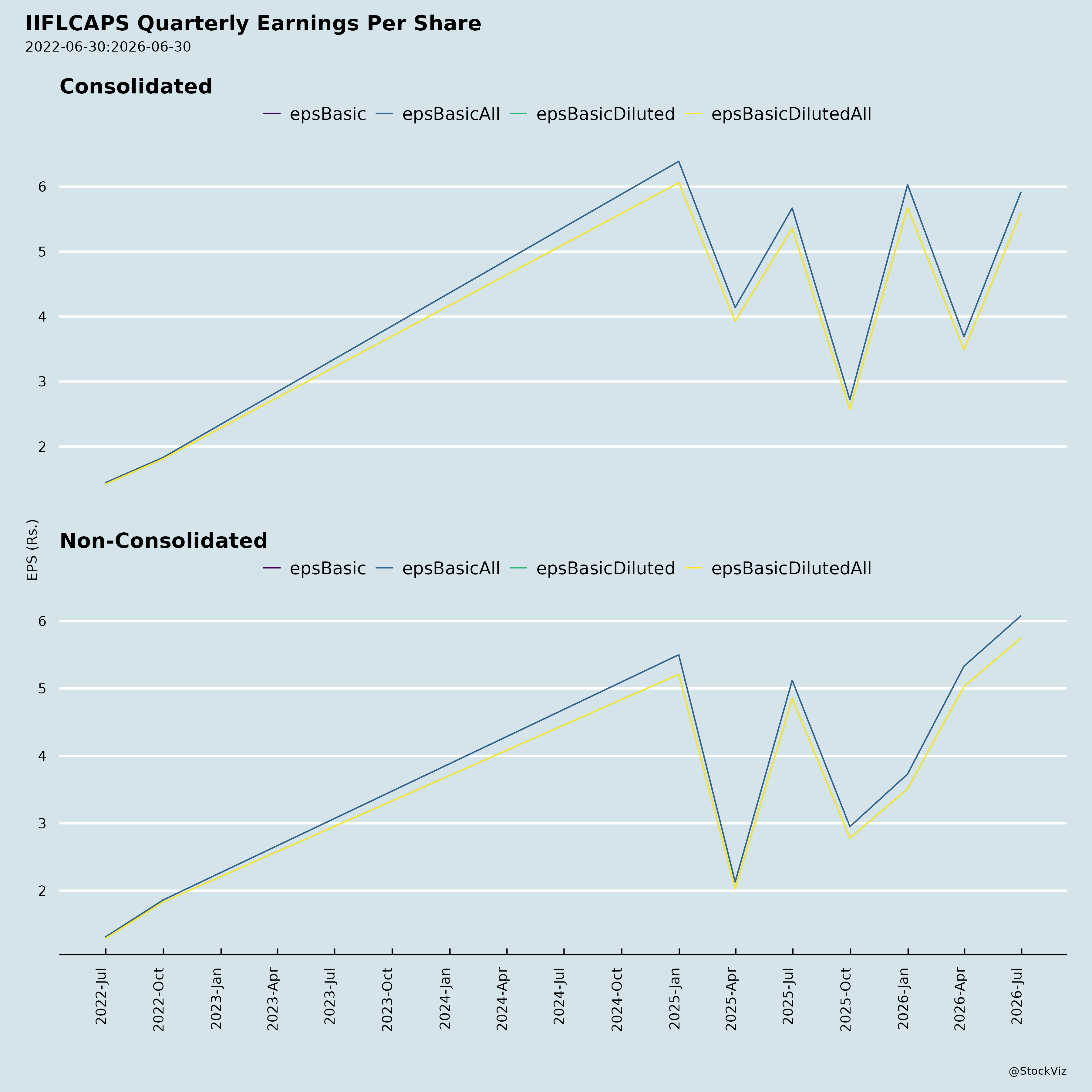
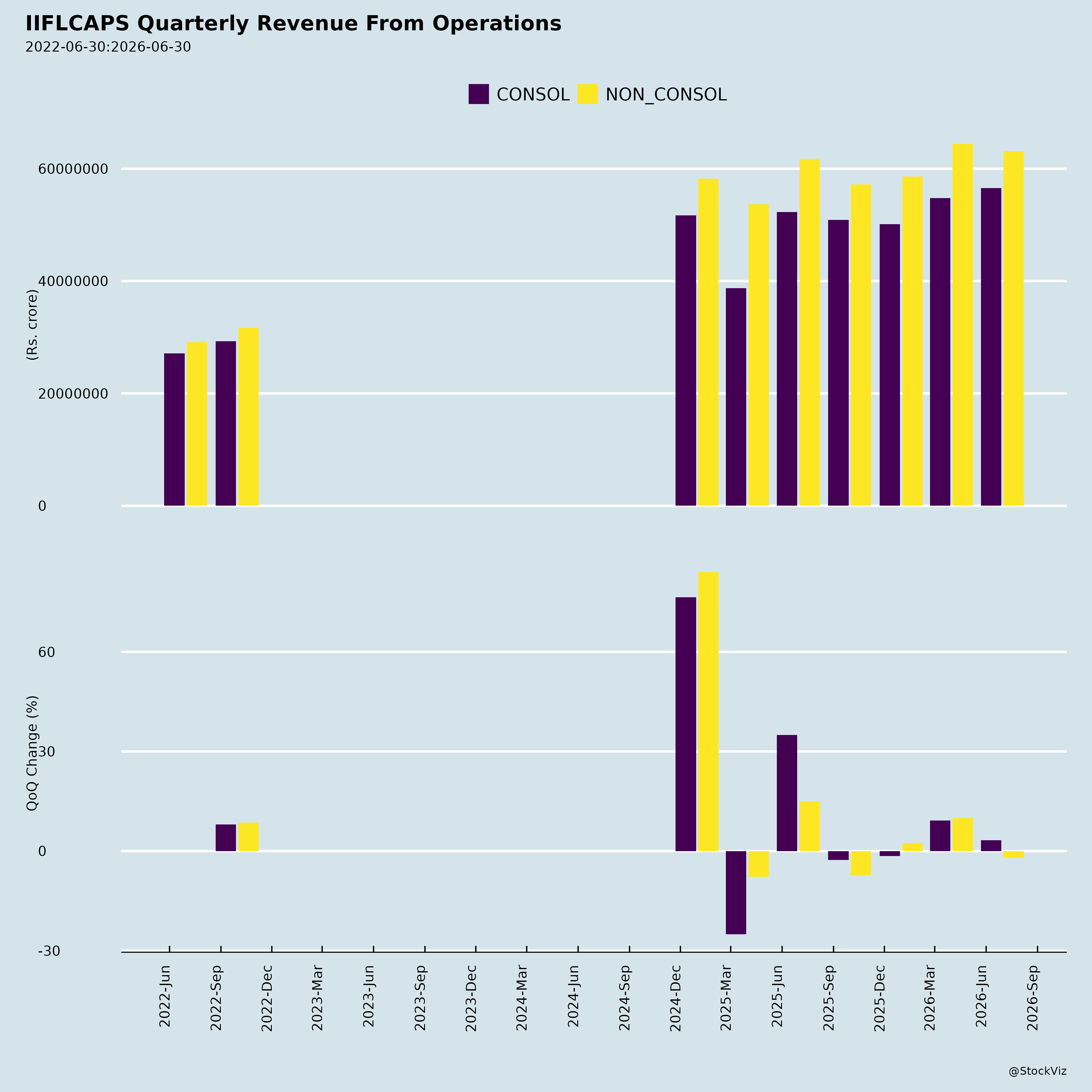
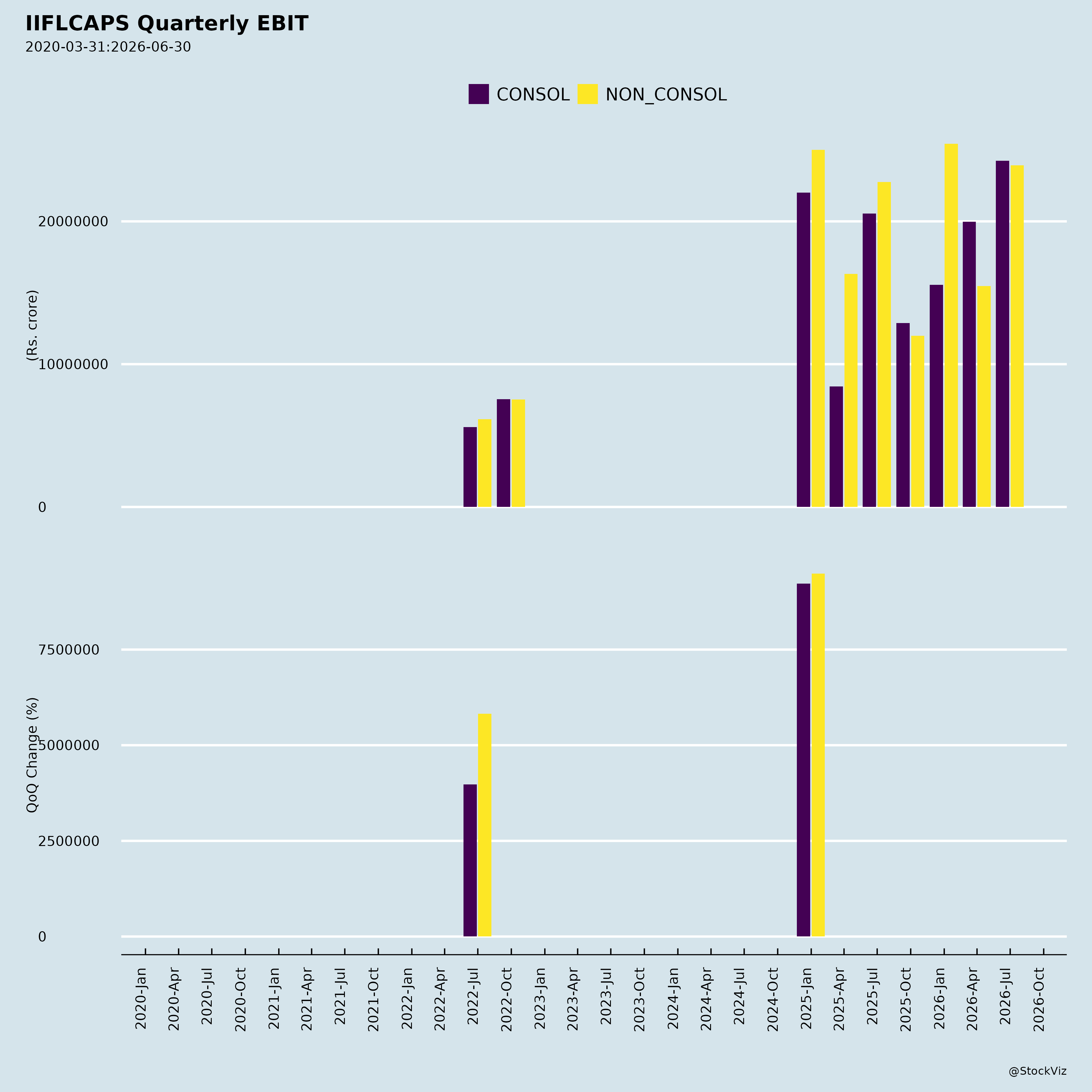
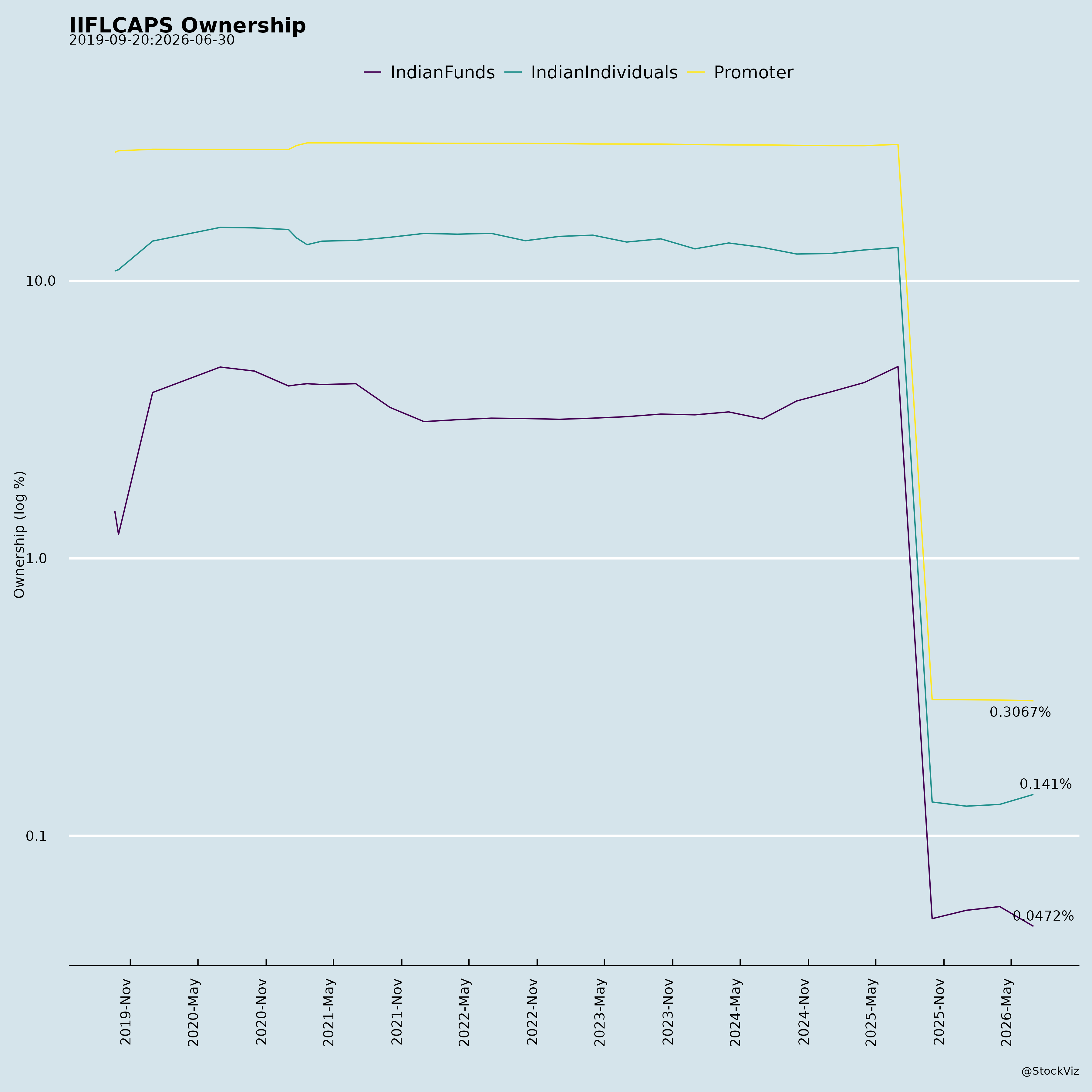
Ownership
Margined
AI Summary
asof: 2026-09-17
IIFL Capital Services — Q1 FY27 Announcements Review
1. Headwinds and Challenges
- Uncertain global environment. Management described the backdrop as “interesting times,” citing geopolitical developments, commodity price volatility, and crude touching $100 a barrel, with the effect on India still to be seen.
- Flat to declining revenue. Consolidated operating revenue was ₹631 crores, down 2% Q-o-Q and up 2% Y-o-Y. Retail broking revenue was virtually flat Q-o-Q at ₹297 crores. Financial product distribution income fell 31% Q-o-Q to ₹125 crores and 14% Y-o-Y, attributed to the typical fourth-quarter peak in insurance income and lumpy transactional income booked in the prior quarter.
- Distribution yields compressed. The implied yield on distribution declined to about 87 basis points, which management linked to the fall in non-ARR income (insurance and transactional brokerage) rather than any change in product-wise yields; the mix in the prior quarter had more non-ARR and insurance.
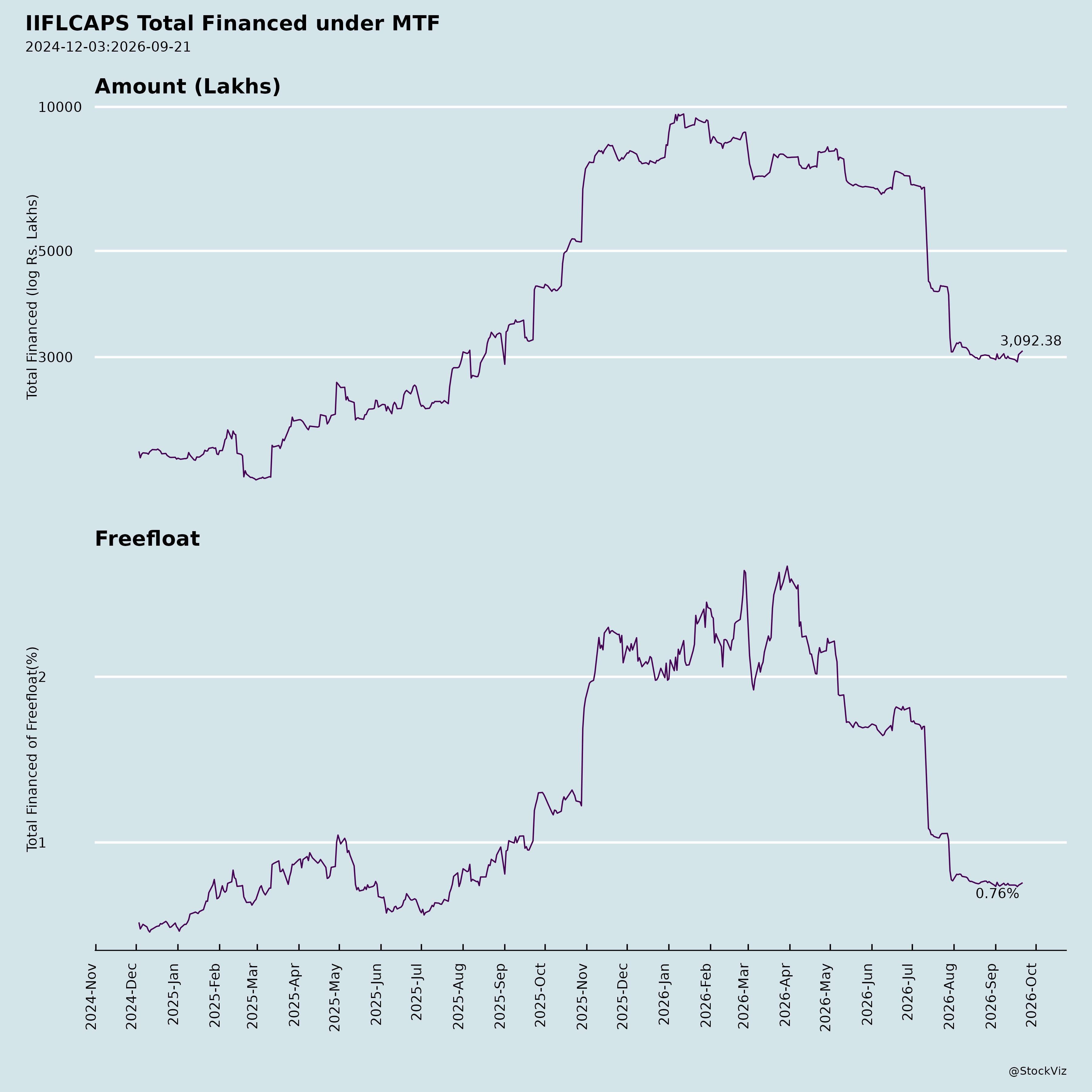
- Operating PBT declined Y-o-Y. Operating PBT of ₹149 crores was up 4% Q-o-Q but down about 9% Y-o-Y. Finance cost rose 48% Y-o-Y to ₹60 crores on the back of an increased MTF book.
- Slower AUM growth. AUM growth was relatively slower this quarter versus peers; net collections were about ₹3,675 crores. Management characterized this as possibly a one-off.
- Minimal RM additions. Only a single-digit number of relationship managers were added during the quarter.
- Regulatory margin changes. SEBI margin regulations effective 1 July were noted; management said impact so far is marginal because the company is not a prop trader and did not have a large number of such customers, but called it too early to comment and expects some impact over time.
- Tax demand. Following an income tax search under Section 132 in January 2025, the holding company and subsidiaries received a demand of ₹124 crores; appeals have been filed.
- Regulatory penalties and orders. RBI passed a compounding order dated June 30, 2026 imposing ₹2,14,858 for FEMA contraventions (repatriating disinvestment proceeds through a non-designated AD Bank and delayed submission of seven APRs for overseas direct investment). Separately, NSE imposed a monetary penalty of ₹2,24,100 on August 30, 2026 for discrepancies in reporting of margin collection from clients identified in a Limited Purpose Inspection (Offsite) covering CM, F&O and CD segments for January–March 2026. Management stated no material impact beyond the penalty amounts and that internal controls are being strengthened.
- Turnover softness. Average daily turnover was ₹3,15,780 crores (F&O ₹3,12,480 crores; cash ₹3,300 crores), down about 2% Q-o-Q.
2. Tailwinds and Growth Prospects
- Fairfax investment. Fairfax India Holdings Corporation, through FIH Mauritius Investments Ltd. and its affiliate, proposed to increase its shareholding to at least 51% via a preferential issue of equity aggregating ~₹2,000 crores at ₹350 per share, an open offer, and arrangements with existing promoters, subject to regulatory approvals. Shareholders approved the preferential issue at the EGM held June 1, 2026. Approvals from SEBI, NSE, BSE and IRDAI are in process; management indicated approvals may come in the next 2–3 months, after which the preferential allotment can take place. Funds had not been received as of the call. On completion, Fairfax will join the Promoter Group alongside existing promoters and will have the right to nominate two directors. The investment is expected to strengthen the capital base and support growth across capital markets, wealth management, asset management, institutional equities and investment banking, and enhance credibility through Fairfax’s global reach and financial strength.
- Institutional and investment banking momentum. Institutional and investment banking revenue rose 27% Q-o-Q to ₹207 crores (₹163 crores in Q4 FY26) and was flat Y-o-Y. The division completed 11 deals across capital markets and private placement/advisory in Q1 FY27, including the Bagmane Prime Office REIT IPO, QIPs for Acme Solar Holdings, Krishna Institute of Medical Sciences and KRN Heat Exchanger, private placements for Yes Madam Technologies and SSF Plastics India, and an open offer by Zenrock Chemicals on Indo Borax and Chemicals. Five DRHPs were filed during the quarter. The deal pipeline remains robust with multiple transactions at various stages, expected to be executed over the next 4–6 quarters, subject to market conditions. IIFL held the #1 position in FY2026 IPO league tables with a 25.9% market share of total mainboard IPOs.
- Wealth and asset management traction. Financial Product Distribution AUM stood at ₹57,364 crores, up 10% Q-o-Q; total AUM and custody stood at ₹2,57,095 crores (distribution ₹57,364 crores; custody ₹1,99,731 crores). The in-house investment engine (PMS and AIF) had total AUM of ₹4,402 crores (PMS ₹2,521 crores; AIF ₹1,881 crores), with income booked under financial product distribution. Management reiterated plans to strengthen manufacturing — AIF, PMS, a credit fund and a late-stage fund — while retaining open architecture.
- Distribution network and platform. 2,600+ partners and 100+ branches; institutional sales presence in Mumbai, Singapore, London and New York; 1,100+ empanelled institutional clients; research coverage of 317+ stocks (~68% of India’s market capitalisation) by 48 analysts.
- Other income boost. Other income rose steeply by ₹90 crores, primarily mark-to-market gains on BSE shares, lifting PBT to ₹239 crores (up 55% Q-o-Q, 5% Y-o-Y) and PAT to ₹184 crores (up 60% Q-o-Q, 5% Y-o-Y).
3. Key Risks
- Regulatory approval risk on the Fairfax transaction. The preferential issue and open offer are subject to customary regulatory and other approvals from SEBI, NSE, BSE and IRDAI; funds have not been received and completion is not assured.
- Market and macro risk. Geopolitical developments, commodity price volatility and crude at $100 a barrel could influence investor sentiment and capital flows.
- Earnings dependence on lumpy and seasonal income. Distribution income is exposed to the fourth-quarter insurance peak and lumpy transactional income, which affected both Q-o-Q and Y-o-Y comparisons and yields.
- Tax demand. A ₹124 crores demand on the holding company and subsidiaries following the January 2025 search; appeals are pending.
- Regulatory compliance exposure. The RBI FEMA compounding order (₹2,14,858) and the NSE penalty (₹2,24,100) for margin collection reporting discrepancies; the company states no material impact beyond these amounts.
- Margin regulation impact. SEBI margin regulations effective 1 July could affect volumes over time, though management sees no likely impact in the current quarter.
- Corporate actions. The Board approved the strike-off or voluntary winding up of IIFL Securities Services IFSC Limited and the transfer of India Infoline Foundation to IIFL Finance Limited for a consideration of ₹10,000.
4. Management Guidance Versus Observed Performance
- AUM growth. Management said the slower AUM growth may be a one-off and that the company would “catch up” from the next quarter; net collections for the quarter were about ₹3,675 crores.
- Margin regulations. Management stated no likely impact on volumes in the current quarter, while acknowledging it is too early to comment and that some impact may appear over time.
- Fairfax transaction timing. Management indicated all approvals may be received in the next 2–3 months, after which the preferential allotment can take place; as of the call, funds had not been received and approvals were in process.
- Deal pipeline. Management described the investment banking pipeline as robust, with execution expected over the next 4–6 quarters, subject to market conditions; Q1 FY27 saw 11 completed transactions and 5 DRHP filings.
- Asset manufacturing. Management reiterated continued investment in AIF and PMS manufacturing without losing the open-architecture character; the in-house engine stood at ₹4,402 crores.
- Distribution yields. Management stated product-wise yields have not changed and the decline reflects non-ARR income mix; observed distribution income fell 31% Q-o-Q and 14% Y-o-Y.
- Operating performance. Management characterized Q1 FY27 as a steady performance driven by resilient investment banking and institutional equities and continued traction in wealth and asset management; observed operating PBT was up 4% Q-o-Q but down 9% Y-o-Y, with revenue down 2% Q-o-Q and up 2% Y-o-Y.
Copyright © 2023 SAS Data Analytics Pvt. Ltd. All rights reserved.