IDEAFORGE
Equity Metrics
November 18, 2026
Ideaforge Technology Limited
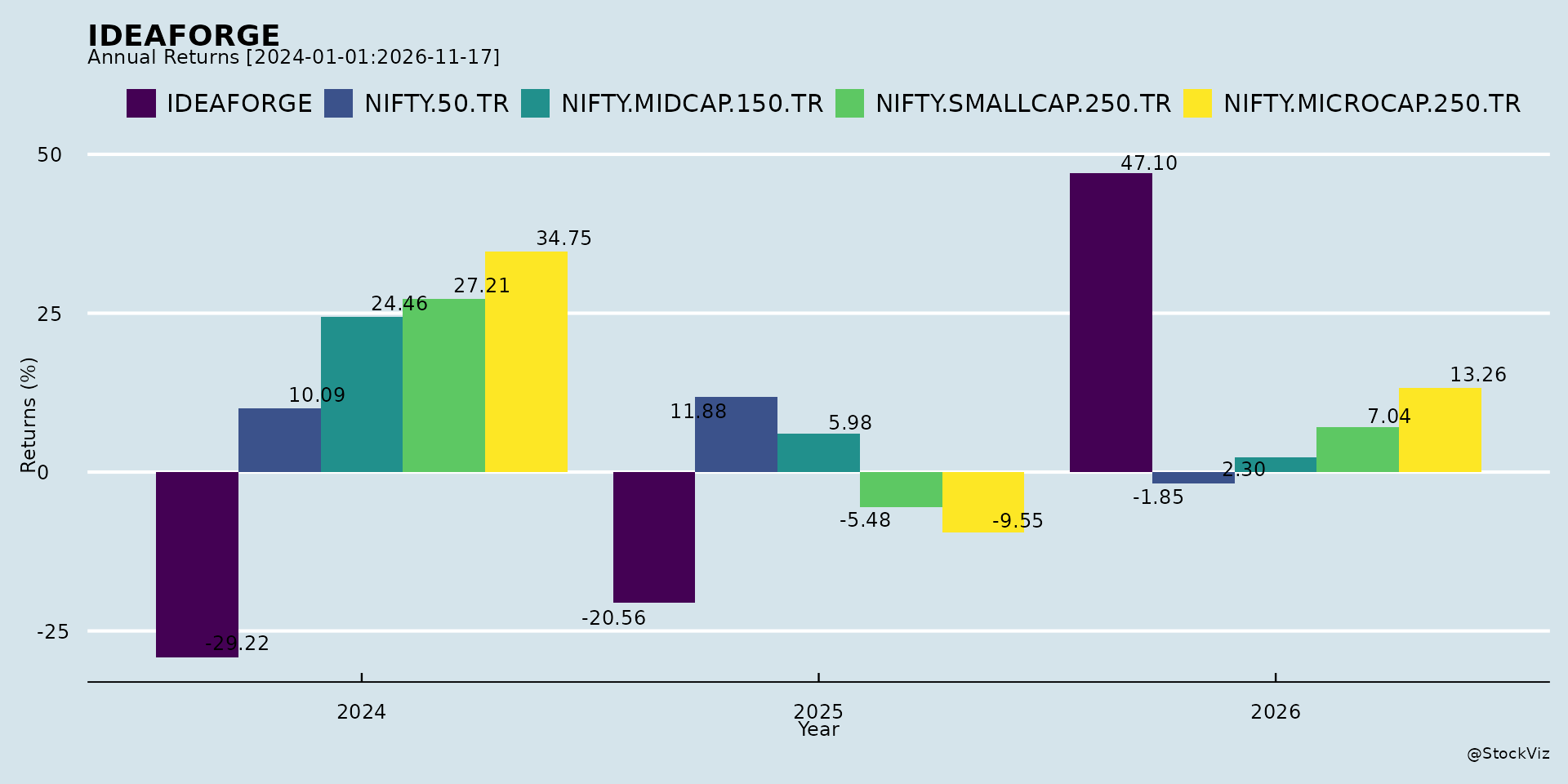
Annual Returns
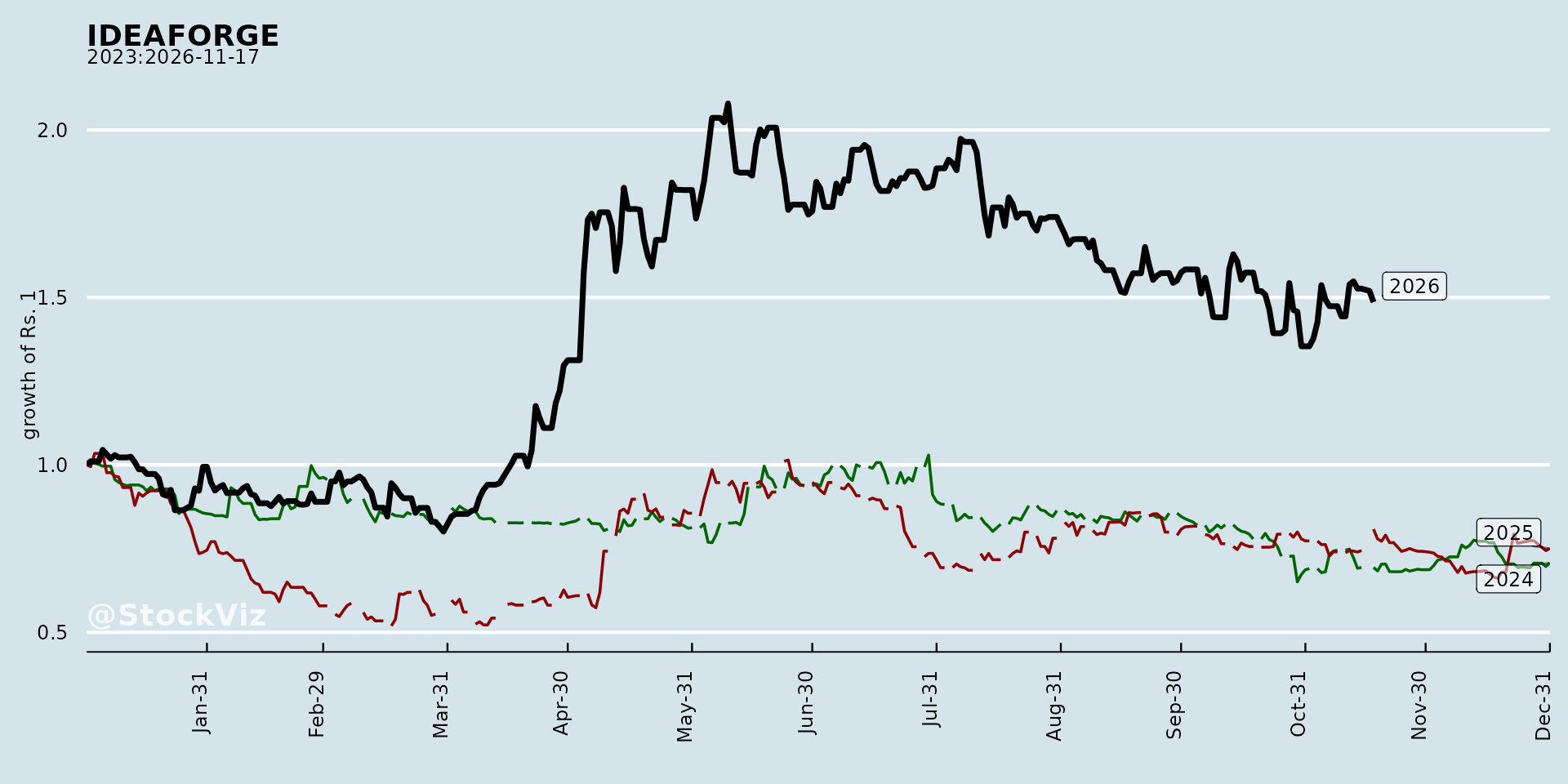
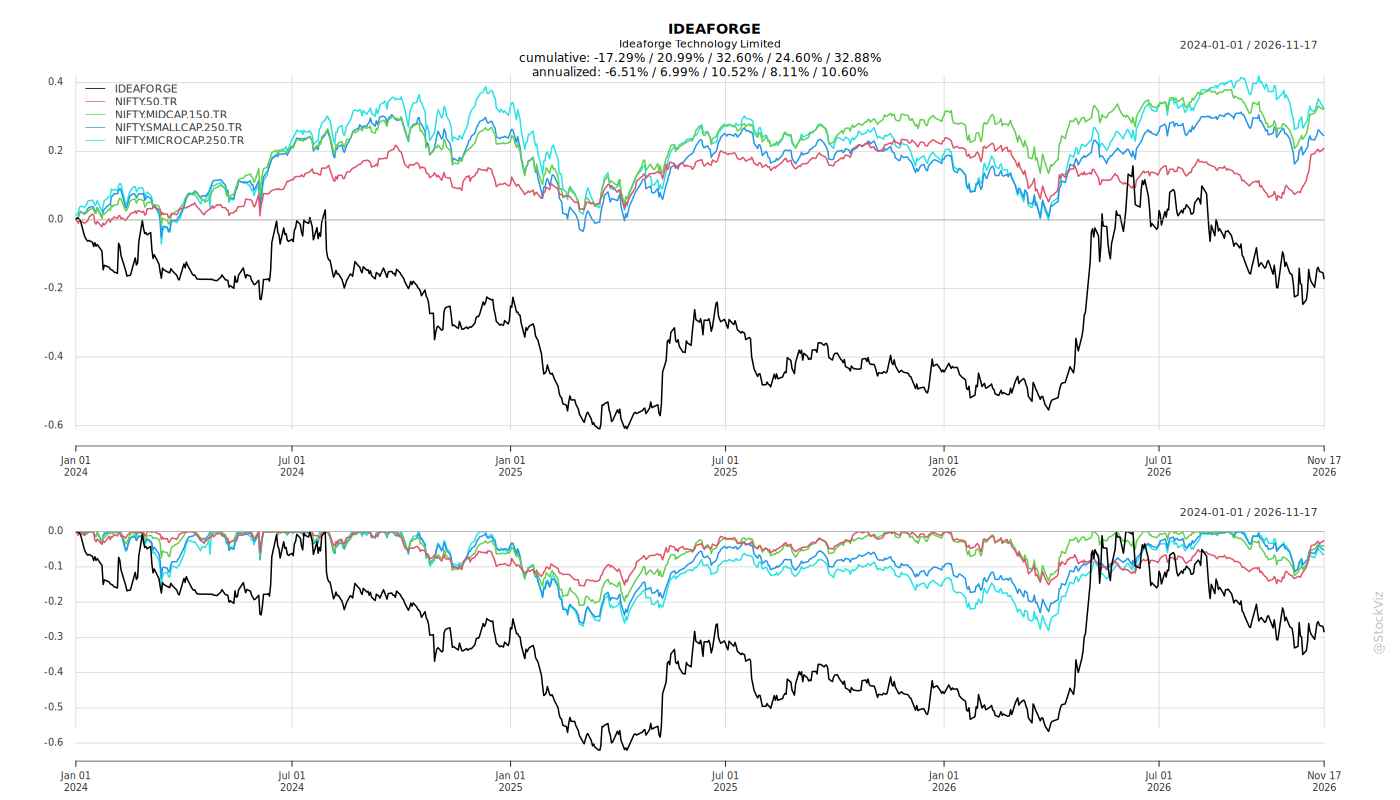
Cumulative Returns and Drawdowns
Fundamentals
Ownership
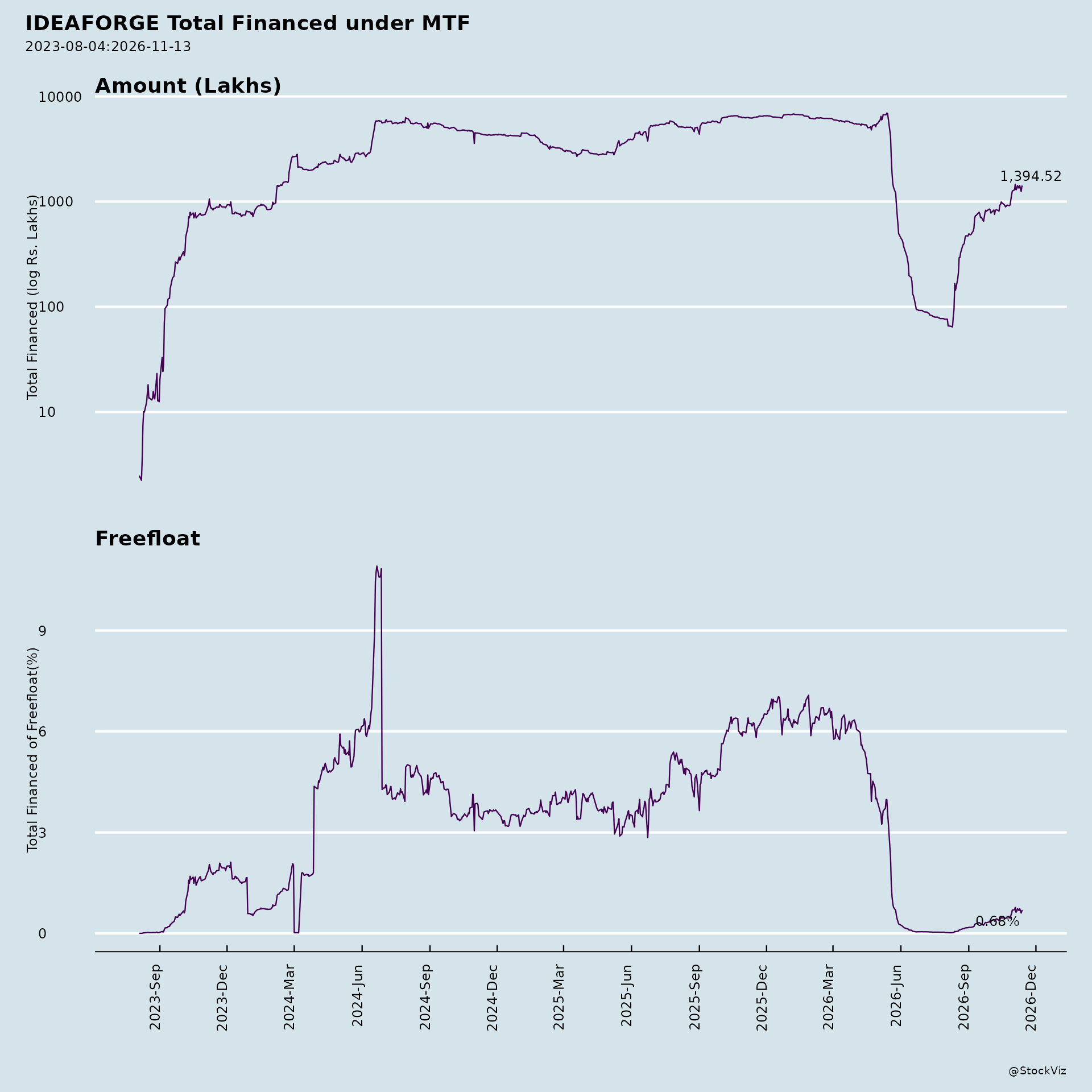
Margined
AI Summary
asof: 2026-09-17
ideaForge: Recent Corporate Developments
1. Headwinds and Challenges
- Supply chain disruption: Global supply chain disruptions and component availability issues have persisted since Q4 of FY26 and continue to pose challenges into Q1 FY27. Management attributes these disruptions to geopolitical situations.
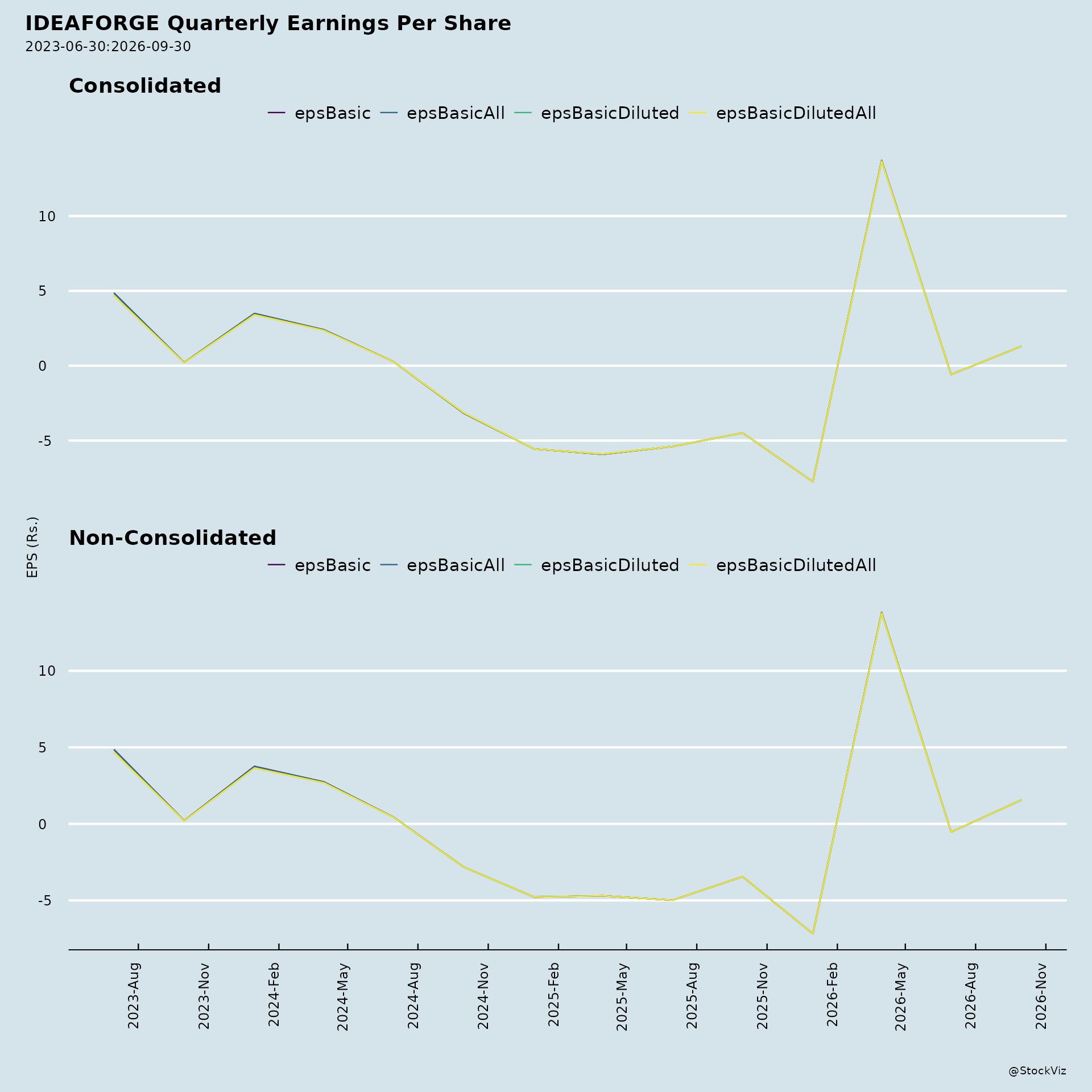
- Margin compression: Gross profit margin fell to 49.0% in Q1 FY27, compared with 61.7% in Q1 FY26 and 67.6% in Q4 FY26. EBITDA margin was 6.2% in Q1 FY27 versus 52.6% in Q4 FY26, and PAT margin was negative at -3.8%.
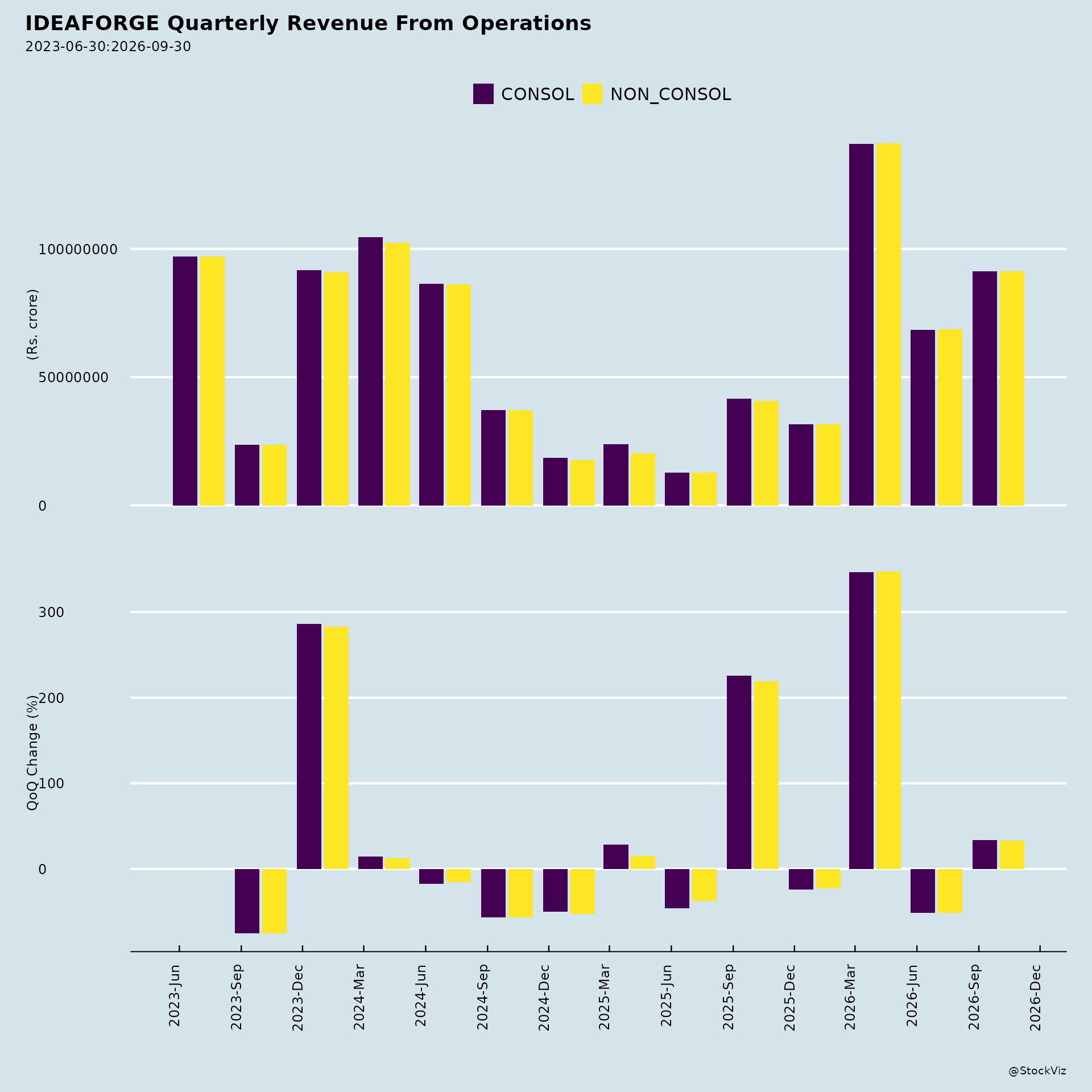
- Sequential decline: Revenue of ₹68.6 crore in Q1 FY27 was well below the ₹141.0 crore recorded in Q4 FY26, alongside lower gross profit (₹33.6 crore vs ₹95.4 crore) and a swing from PAT of ₹60.0 crore in Q4 FY26 to a loss of ₹2.6 crore in Q1 FY27.
- Lumpy order execution: The company executed over 20% of its FY27 opening order book in Q1, with the remainder targeted for completion by Q3, leaving execution concentrated in a narrow window and dependent on customer timelines.
2. Tailwinds and Growth Prospects
- Order book visibility: The company entered FY27 with an order book of ₹300-plus crore, described by the CEO as a stronger starting point than a year earlier. Order book position as of 30 June 2026 stood at ₹2,568 million.
- Capital raise: A ₹500 crore Qualified Institutional Placement was completed with participation from domestic and global institutional investors, strengthening financial capability for the order pipeline and new product development.
- Government RDI support: A Letter of Intent dated 27 July 2026 from the Technology Development Board conveys in-principle approval for financial assistance up to ₹151 crore as a loan under the RDI Scheme for the YETI heavy-lift long-range autonomous aerial logistics vehicle, against a total estimated project cost of ₹302 crore. Terms include 4% simple interest, a three-year project completion period from first disbursement, and tranched disbursement subject to equivalent non-Government funding and milestone execution.
- Defence procurement pipeline: Public reports cite large defence procurement of about ₹20,000 crore through the Fast Track Procurement approach, with one opportunity already in the RFP stage and several others in various stages of the approval pipeline. The Defence Acquisition Council’s approval of ₹520 billion for capital acquisitions includes jet-based Kamikaze and Naval drones (NSUAS).
- Procurement policy tailwind: Higher operational procurement limits for field commanders of Indian Defence Forces under DFPDS 2026 are expected to accelerate procurement activity in Q3 and Q4, with civil business cycles also leaning toward Q3 and Q4.
- Technology and certification milestones: DGCA Type Certification for the Q6 V2 GEO UAV expands addressable opportunities in advanced GIS and enterprise mapping domestically. Development progress continues on combat drone capabilities including air-launched effects and fuel-hybrid long-endurance capability for ZOLT, plus long-range strike platforms and loitering munitions through in-house and collaborative efforts.
- Operational scale: The indigenous UAV fleet crossed one million customer flights, with an ideaForge drone taking off every two minutes on average.
3. Key Risks
- Conditional nature of RDI assistance: The TDB LOI is an in-principle approval and does not constitute a final binding commitment or sanction letter until definitive agreements are executed following due diligence and fulfilment of prescribed conditions. The final amount is subject to TDB’s sole discretion, and disbursement requires the company to arrange equivalent non-Government funding and meet milestones.
- Execution timing risk: Delivery of the FY27 opening order book is targeted for completion by Q3, contingent on customer timelines and resolution of component availability constraints.
- Procurement dependency: Growth prospects rest substantially on defence procurement decisions, RFP conversions, and policy-driven procurement cycles that are outside the company’s control.
- Margin trajectory: The sharp year-on-year and sequential decline in gross margin and the return to a quarterly net loss indicate sensitivity of profitability to revenue mix and volume.
4. Management Guidance Versus Observed Performance
- Order book execution: Management stated the company executed over 20% of its FY27 opening order book in Q1 FY27 and targets completing delivery of the opening order book by Q3, in line with customer timelines. The stated order book of ₹300-plus crore at FY27 entry and ₹2,568 million as of 30 June 2026 provides the base for this guidance.
- Procurement acceleration: Management expects higher operational procurement limits under DFPDS 2026 to accelerate procurement activities in Q3 and Q4, with civil business cycles also leaning toward Q3 and Q4. Management also cites positive field signals indicating higher procurement activity from FY27 onwards. These expectations are forward-looking; the observed Q1 FY27 revenue of ₹68.6 crore reflects a slow start relative to the prior quarter.
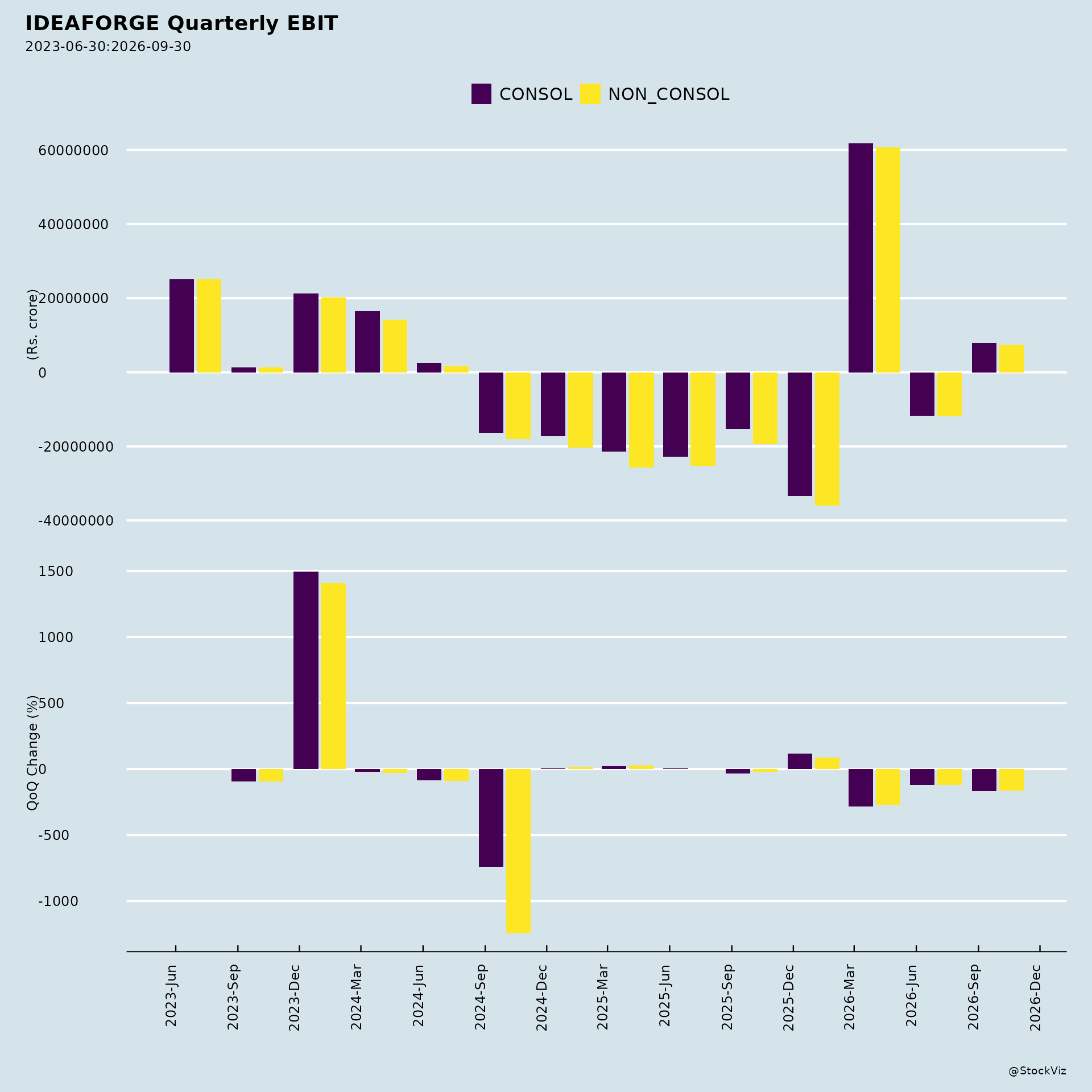
- Financial performance: Management characterised Q1 FY27 as a steady start with positive EBITDA of ₹4.3 crore and “another quarter of improving financial performance.” Observed results show positive EBITDA but a net loss of ₹2.6 crore and margins below recent quarters, indicating improvement on a year-on-year basis (Q1 FY26 EBITDA was -₹15.1 crore) while declining sequentially.
- Development programmes: Management reports progress on combat drone capabilities (air-launched effects, fuel-hybrid long-endurance for ZOLT), long-range strike platforms, loitering munitions, and communication infrastructure for collaborative autonomy, with the intent to participate in upcoming large Indian defence opportunities. No revenue contribution from these programmes is quantified in the supplied material.
- Investor communication: Company officials are scheduled to meet investors and analysts in a group meeting in Mumbai on 22 September 2026, with discussions based strictly on publicly available information and no unpublished price sensitive information intended to be discussed.
- Governance: The 19th Annual General Meeting was held on 5 August 2026, where resolutions adopting the financial statements and appointing Mr. Ashish Bhat as a director were passed with the requisite majority.
CNBC-TV18: ratings, targets and commentary
No recorded CNBC-TV18 statements for this ticker.
Management comments
No recorded management comments with an explicit designation and affiliation for this ticker.
Copyright © 2023 SAS Data Analytics Pvt. Ltd. All rights reserved.