ICICIGI
Equity Metrics
September 24, 2026
ICICI Lombard General Insurance Company Limited
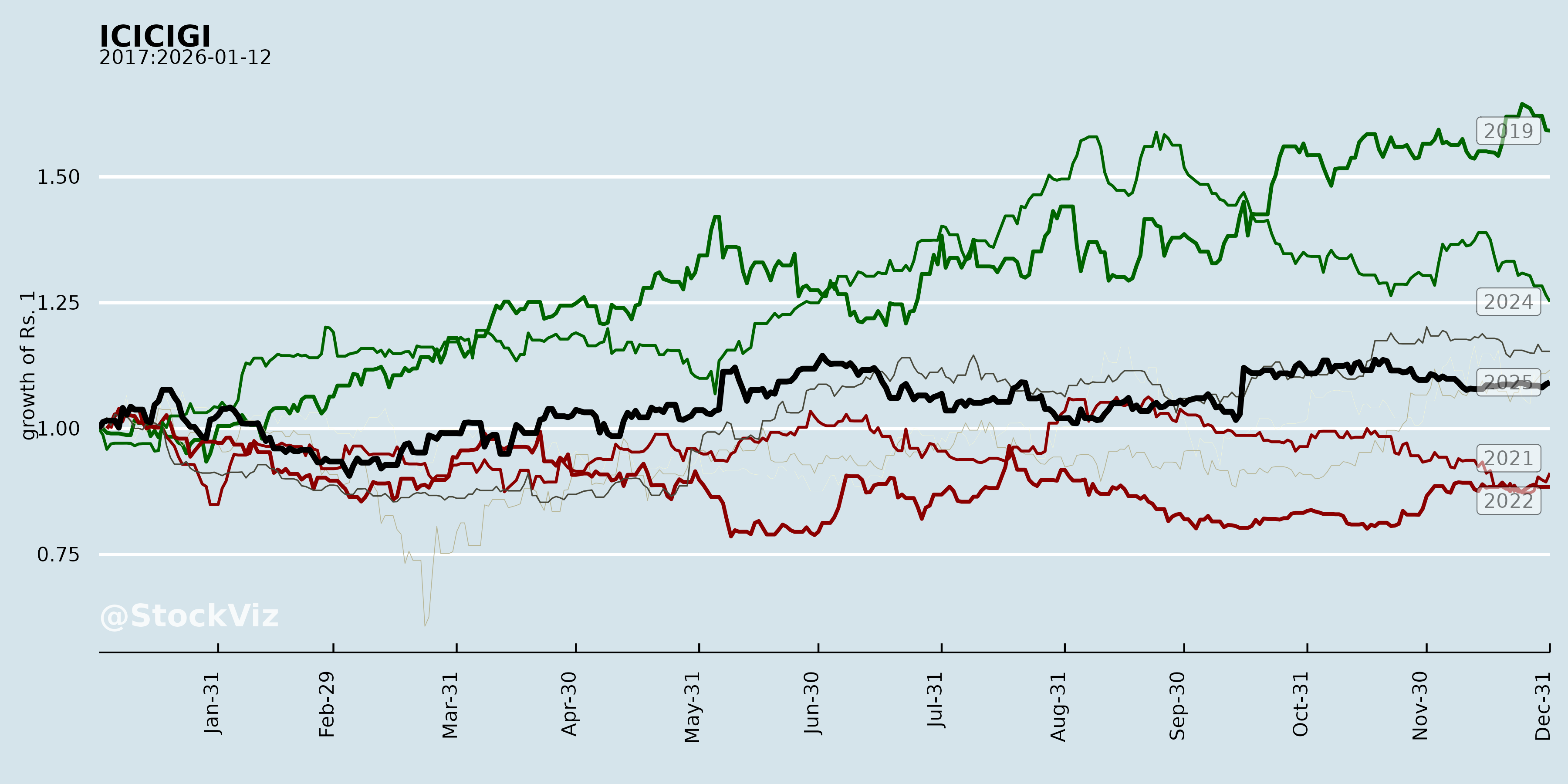
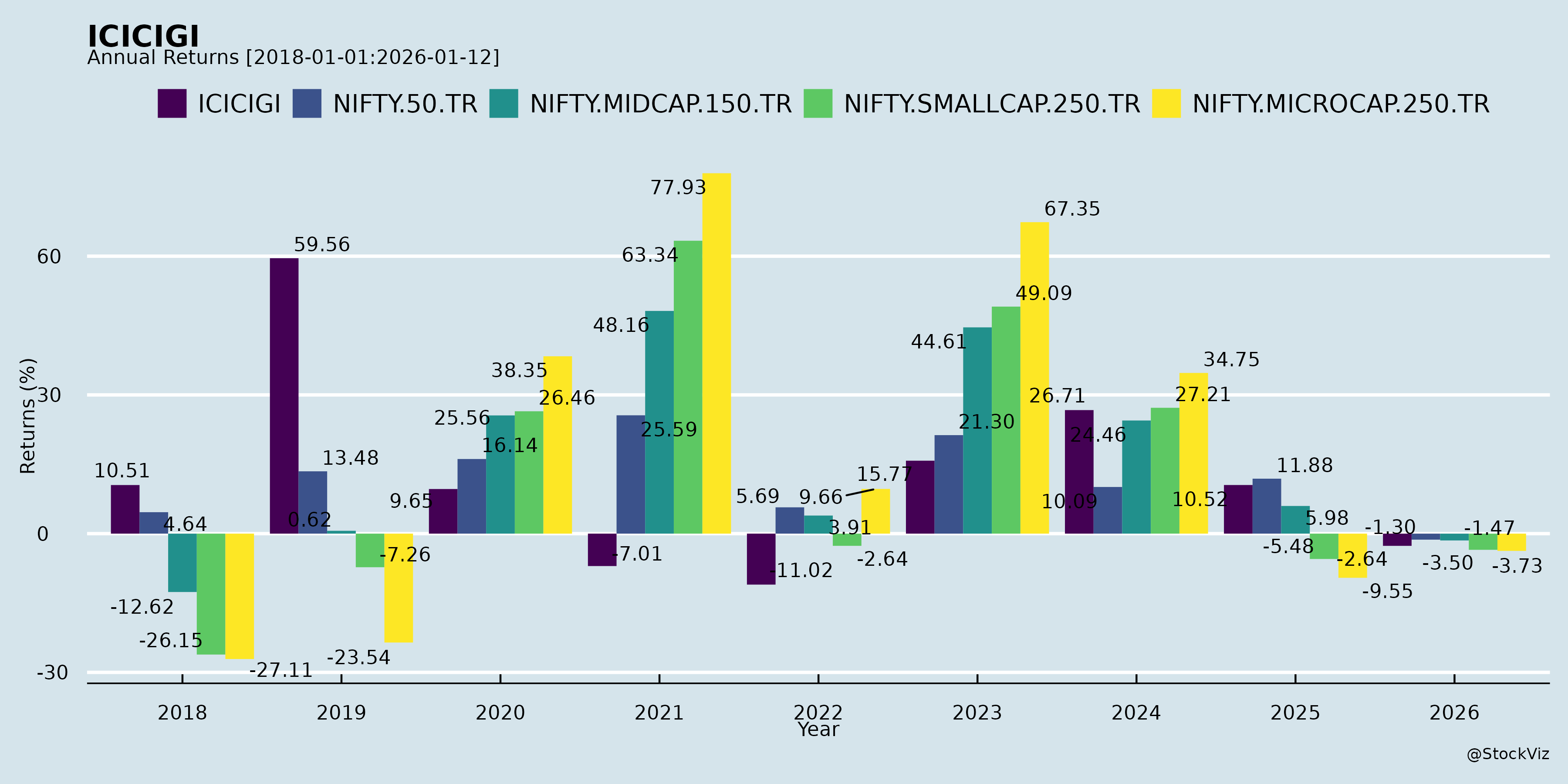
Annual Returns
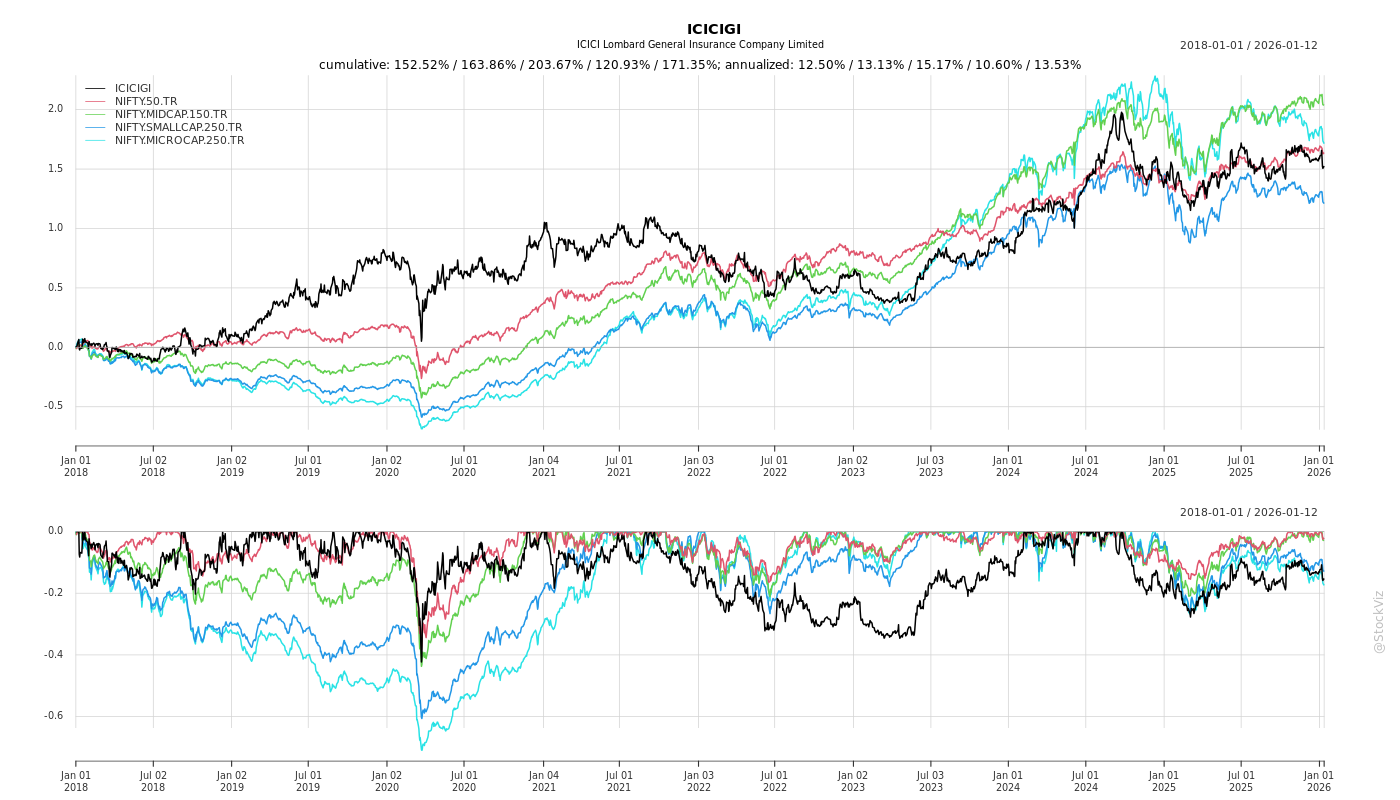
Cumulative Returns and Drawdowns

Fundamentals
Ownership
Margined
AI Summary
asof: 2026-09-16
ICICI Lombard General Insurance — Q1 FY2027 Developments
1. Headwinds and Challenges
Motor third-party reserving shock from the Supreme Court judgement (June 11, 2026). The Supreme Court recognised the economic value of unpaid domestic work by homemakers when determining compensation under the Motor Vehicles Act, creating a distinct head of compensation (“Loss of Domestic Care”) based on a monthly income of ₹30,000 with periodic inflation-linked increases. Management’s preliminary assessment is that the industry Motor TP loss ratio will rise by 12% to 15%. ICICI Lombard made a claim reserve impact of ₹1.65 billion in Q1 FY2027, which added 2.8% to the combined ratio. The General Insurance Council has filed a revision petition seeking review of the order, which remains sub judice.
Fire segment pricing pressure and large losses. The commercial segment de-grew 8.6% industry-wide in Q1 FY2027, with the Fire line down 27.8%, driven by exceptional competitive pricing at the April renewal cycle. ICICI Lombard’s Fire book de-grew 32.1% (versus industry 27.8%), and its commercial lines segment de-grew 13.8%. Two large Fire losses of ₹0.63 billion impacted the combined ratio by 1.0%. The Fire loss ratio for Q1 FY2027 was 118.3%, against a historical range of 65%–70%.
Health loss ratio elevation. The Health, Travel & PA loss ratio rose to 83.5% in Q1 FY2027 from 80.8% in Q1 FY2026, attributed to elevated claim incidences across the industry, with management noting that monsoon-related elevation is typically seen in Q2.
Profitability and return metrics. PBT de-grew 46.1% to ₹5.36 billion and PAT de-grew 46.0% to ₹4.03 billion. ROAE fell to 9.6% from 20.5%. Excluding the two large Fire losses and the Supreme Court judgement impact, PAT de-grew 23.0% to ₹5.75 billion and ROAE was 13.6%. Investment income fell to ₹11.74 billion from ₹12.88 billion, with capital gains (net of impairment) at ₹1.83 billion versus ₹3.80 billion.
Growth below industry. GDPI growth of 7.5% (8.5% on an ‘n’ basis) trailed industry growth of 10.9% (10.7% on an ‘n’ basis), primarily due to the calibrated pullback in commercial lines.
Arbitral award. An arbitral award of approximately ₹78 crore plus interest relating to a policy dating back seven to eight years was disclosed. Management stated the award is not final, legal remedies will be explored, existing reserves and reinsurance protection are in place, and the net P&L impact is not expected to be material.
Macro risks. El Nino conditions affecting the monsoon and continuing geopolitical tensions were flagged as risks that may influence growth momentum.
2. Tailwinds and Growth Prospects
Motor segment momentum. India recorded its highest-ever first-quarter retail vehicle sales of 7.8 million. VAHAN data showed passenger vehicle registrations up 21.3%, two-wheelers up 13.8%, commercial vehicles up 14.1%, and tractors up 21.8%. Industry motor growth was 13.9% in Q1 FY2027 versus 8.7% in Q1 FY2026 and 10.0% in Q4 FY2026. ICICI Lombard grew 14.0% in Motor, maintaining market leadership with a 10.5% share; new vehicle sales grew 33.6% on a unit basis versus industry 14.9%. Advance premium at June 30, 2026 was ₹45.12 billion versus ₹43.07 billion at March 31, 2026.
Health segment as the fastest-growing line. Health contributed 47.3% of overall industry premium in Q1 FY2027, with industry growth of 20.1%. ICICI Lombard grew 24.9% in Health. Retail Health grew 69.5% against industry 31.6%, raising market share to 4.5% from 3.5%. The long-term book share of new retail health business rose to 53.4% from 31.8%. Group Health grew 16.3% with market share of 10.3%. The high sum assured (≥₹10L) mix in fresh health business rose to 96.4% from 84.5%.
SME focus in commercial lines. The SME proportion of commercial lines rose to 33.6% from 28.4%. The company retained leadership in Engineering and Marine Cargo.
Digital and service metrics. IL TakeCare app downloads reached 22.1 million; gross written premium from the app was ₹1,545.3 million versus ₹932.0 million. Digital interactions reached 624K versus 214K, with digital contribution rising to 69.0% (71.0% in June 2026) from 36.0%. Call Centre NPS rose to 76 from 60. Health claims paid within 30 days were 99.0%; Motor claims NPS was 69 and Health claims NPS was 73 for FY2026. Renewal retention improved approximately 4.3%.
Industry rationality argument. Management noted industry solvency fell to 1.56x at March 2026 from 1.75x at March 2025, and industry combined ratio deteriorated roughly 500 bps from about 112% to 117%, arguing that aggressive pricing is not sustainable. June 2026 Fire de-growth narrowed to 18.8% for the company versus 22.5% for the industry.
Investment portfolio. Debt portfolio yield rose to 7.58% (FY2026: 7.46%) and duration increased to 5.53 years (FY2026: 5.13 years). Solvency stood at 2.71x versus the 1.50x regulatory minimum. Unrealised gain of ₹6.21 billion as at June 30, 2026.
3. Key Risks
- Motor TP reserve adequacy and recurrence. Management declined to confirm whether the ₹1.65 billion quarterly charge is a recurring base, citing variability from the pending review petition, potential TP price revision, and ground-level adoption of the order. The charge was described as a holistic assessment of exposures as at June 30, including past periods, with closed cases generally not expected to reopen.
- Pricing adequacy in Motor TP. No third-party price change has occurred for several years; management stated an upward revision is “necessary and urgent” and that the 12%–15% loss ratio impact plus prior inadequacy represents the minimum expected price change.
- Fire competitive intensity. Management does not expect the same level of price aggression to persist but does not expect a full recovery of the de-growth for the rest of the year.
- Health claim incidence. Management will wait to see how monsoon-related incidence plays out, with clarity expected at the October results.
- Reserve release sustainability. Management stated the reserving philosophy is unchanged and the reserving triangle should continue to exhibit favourable loss development over cycles, while confirming the Q1 charge was taken despite existing margins.
- Regulatory uncertainty. On potential commission regulation changes in Motor TP, management said it will wait for the regulator to spell out its position.
4. Management Guidance Versus Observed Performance
Combined ratio. FY2026 combined ratio was 103.4% versus industry 117.8%, a gap of over 14 percentage points. Motor combined ratio was 106.6% versus industry 128.0%, with the differential widening to 21.4% from 18.4% in FY2025 and 10.3% in FY2020. In Q1 FY2027, the combined ratio was 107.2% (106.1% on an ‘n’ basis) versus 102.9% (102.2% on an ‘n’ basis) in Q1 FY2026; excluding the two Fire losses and the judgement, it was 102.3% versus 102.2%.
Commercial lines stance. Management had indicated in the prior investor call that the April renewal cycle saw exceptional competitive pricing. Observed outcome: commercial lines de-grew 13.8% and Fire de-grew 32.1%, consistent with the stated disciplined and calibrated approach.
Motor positioning. Management highlighted resilience and market leadership without compromising underwriting quality. Observed: 14.0% growth in line with industry, 10.5% market share maintained, and new vehicle unit growth of 33.6% versus industry 14.9%.
Health growth. Management described Health as the fastest-growing segment with continued product innovation and distribution expansion. Observed: 24.9% company growth versus 20.1% industry, with Retail Health at 69.5% versus 31.6%.
Reserving philosophy. Management repeatedly emphasised prudence and conservatism, referencing prior Supreme Court judgements (2008–2009, 2021) where impacts were recognised in the period the judgements came through. Observed: the ₹1.65 billion Q1 FY2027 charge was taken in the quarter the judgement was delivered, with management stating past book is covered by margins for adverse deviation.
Fire loss ratio range. Management stated Fire loss ratios have historically operated in a 65%–70% range and that excluding the two large losses, Q1 would be within that historical range. Observed: reported Fire loss ratio of 118.3% in Q1 FY2027 including the large losses.
Capital position. Solvency was guided as comfortably above regulatory minimum. Observed: 2.71x at June 30, 2026 versus 2.67x at March 31, 2026 and the 1.50x requirement.
Broker Narrative
The broker narrative shifted from strongly bullish in 2023—emphasizing regulatory reforms, health growth, digitalization, and a path to ~102% combined ratio and high-teens RoE—to a Neutral call by mid-2026 as persistent motor OD and commercial lines pricing competition, deteriorating underwriting, and severe earnings misses dominated. Regulatory optimism and distribution expansion themes persisted in name but lost conviction, while the last report’s tailwinds (revenue growth, retail health outperformance) were overshadowed by a 46% YoY PAT decline and 107.2% combined ratio.
Fears that came true
- Motor OD pricing & competition: The flagged high competitive intensity materialized into prolonged pricing aggression, especially in commercial lines during the April 2026 renewal cycle, correlating with sustained DISAPPOINTMENT outcomes from 2024 onward.
- Elevated loss ratios: Claims ratios worsened significantly, surging 340 bps YoY to 76.4% in 1QFY27 and pushing the combined ratio to 107.2%, directly driving the 46% YoY PAT decline.
- Investment costs/yield erosion: The concern about investment costs offsetting underwriting benefits materialized as investment yield fell to 7.6% in 1QFY27 from 9.2% in 1QFY26, compounding the earnings miss.
- Motor TP reserve strengthening from Supreme Court judgment: The last report flagged an INR 1.65b reserve increase impacting CoR by 2.8%, a risk not anticipated in earlier bullish narratives.
Optimism that failed
- Regulatory reforms driving margin expansion: Despite IRDAI’s Use and File norm, relaxed EoM regulations, and other reforms, the combined ratio deteriorated to 107.2% instead of improving toward the ~102% target by FY25.
- Digitalization & efficiency driving RoE recovery: High-teens RoE recovery failed as PAT fell 46% YoY and PAT estimates were cut by 14% for FY27 and 11% for FY28.
- Commercial lines leadership via innovation: Market share gains through IoT monitoring and AI/NLG tools were overwhelmed by aggressive pricing competition, turning a stated tailwind into a current headwind.
- Health business growth driving overall margin expansion: Retail health grew 31% YoY with share expanding to 4.5%, but this could not offset systemic underwriting deterioration, and overall earnings collapsed.
- Distribution & bancassurance expansion: Despite robust channel growth (AU Small Finance Bank covering 980+ branches, ~113,000 agents), it failed to prevent sustained earnings decline across nearly three years of broker calls.
Broker Timeline
42 broker calls · 2023-06-28 to 2026-07-15
Copyright © 2023 SAS Data Analytics Pvt. Ltd. All rights reserved.