HDFCLIFE
Equity Metrics
September 24, 2026
HDFC Life Insurance Company Limited
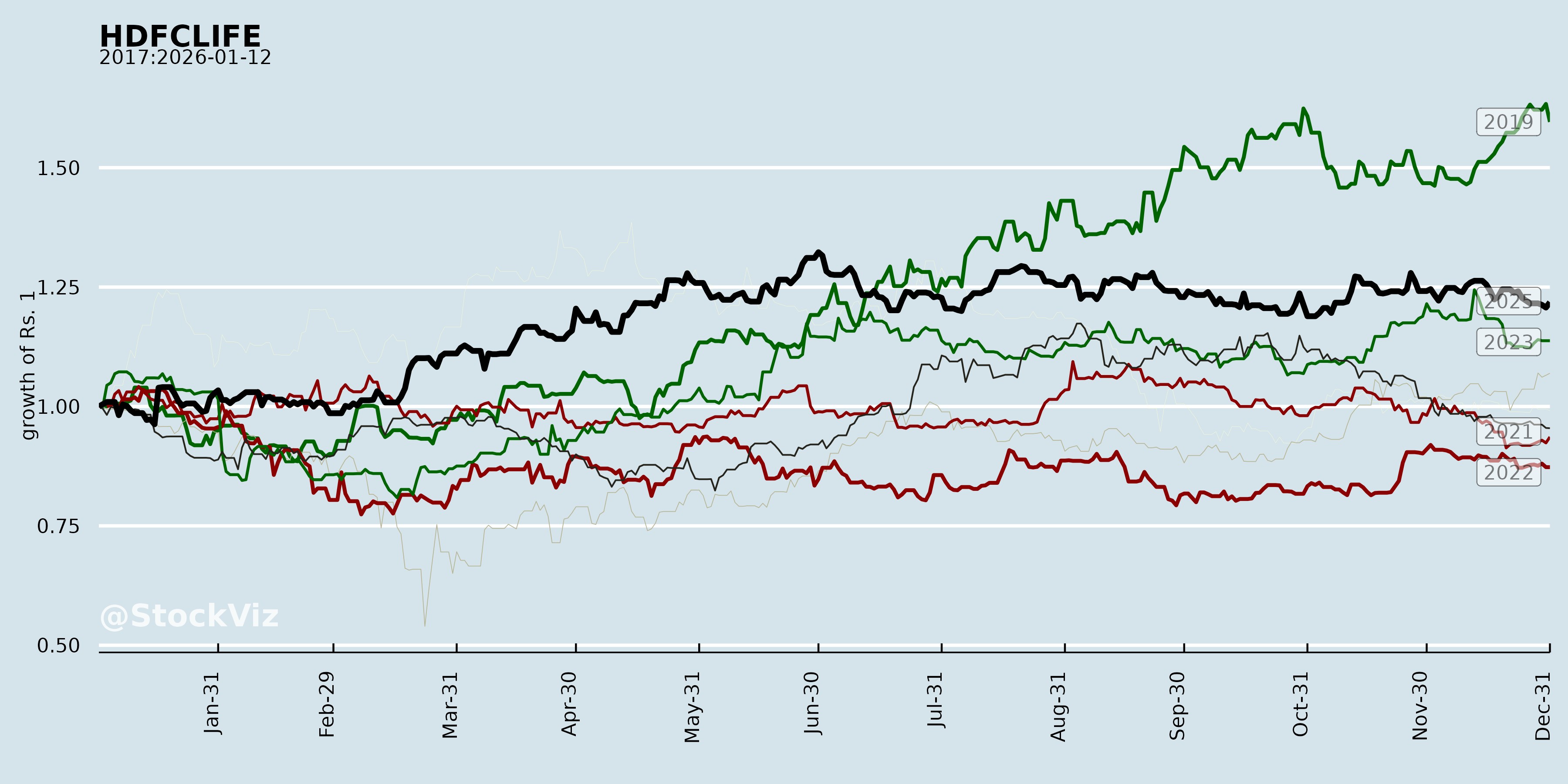
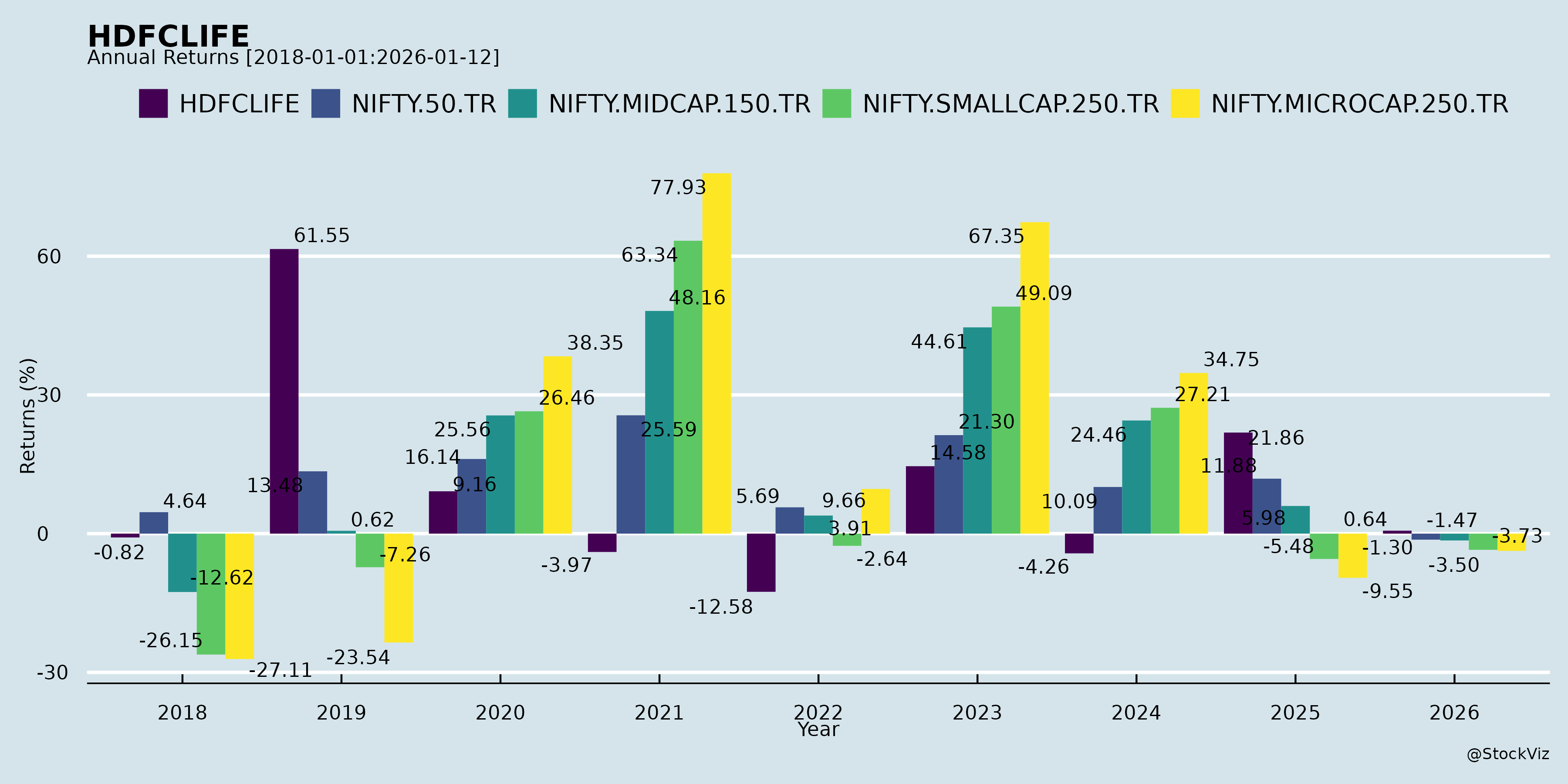
Annual Returns
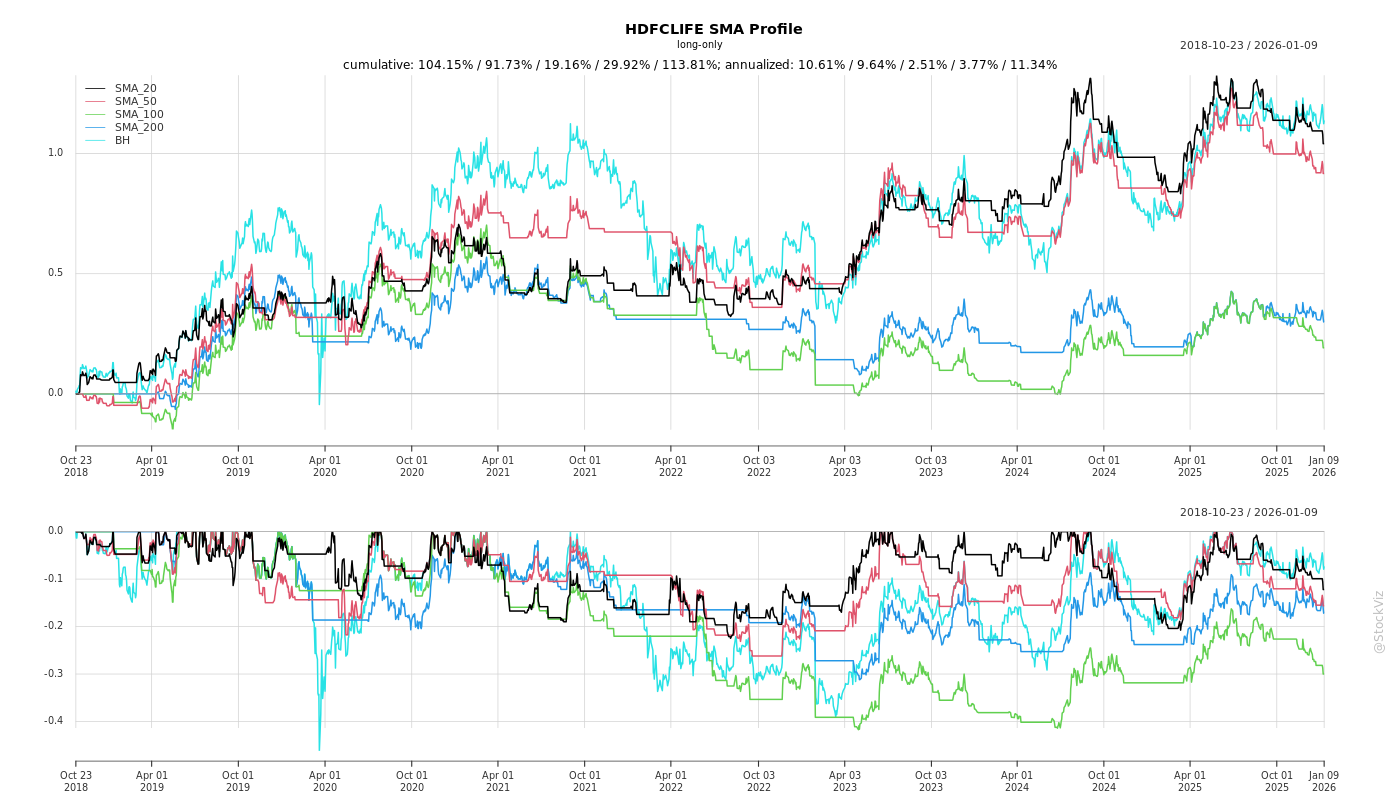
Cumulative Returns and Drawdowns

Fundamentals



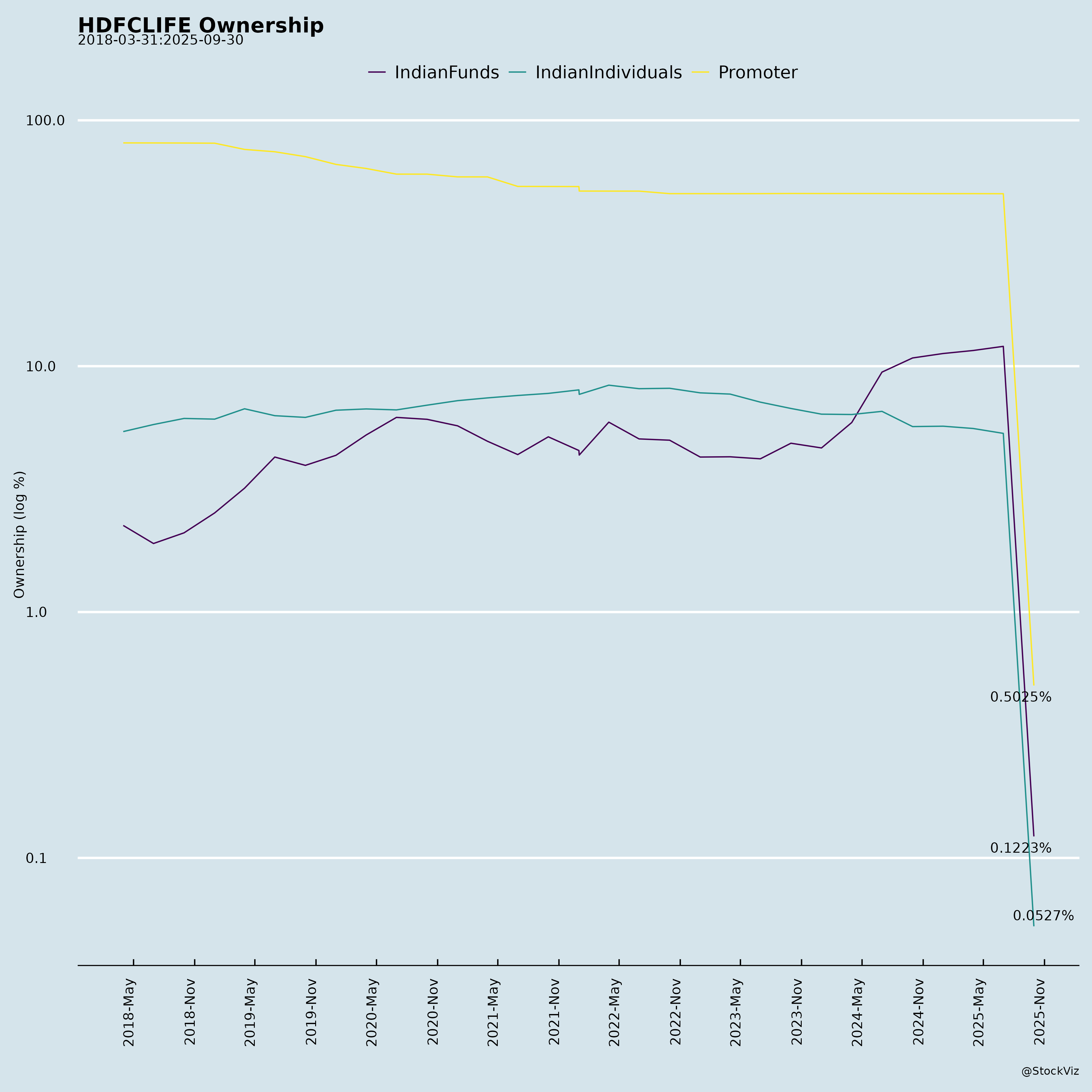
Ownership
Margined
AI Summary
asof: 2026-09-14
HDFC Life — Recent Corporate Announcements: Summary
1. Headwinds and Challenges
- Moderating macro growth: India’s FY27 growth is expected to moderate, largely due to the ongoing West Asia conflict and its bearing on energy prices. The company remains watchful for material shifts through the year.
- Regulatory transition: The sector is adapting to a meaningful pace of regulatory change. Management describes the industry as working through a period of regulatory transition.
- Bancassurance slowdown: Business through the bancassurance channel saw only moderate growth in Q1FY27, resulting in Individual APE growth of 7%. Bancassurance Individual APE was flat year-on-year (₹16.8 bn in both Q1FY26 and Q1FY27), with a 2-year CAGR of 6%.
- GST impact on margins and profit: New Business Margin for Q1FY27 was 25.0%; excluding GST it would have been 25.6% (vs 25.1% in Q1FY26). PAT growth was 12% year-on-year; excluding GST impact, underlying PAT growth was 17%.
- Rising expense ratio: Total Expenses / Total Premium rose to 22.6% in Q1FY27 from 21.9% in Q1FY26. The standalone Expenses of Management Ratio was 22.5% for Q1FY27 versus 21.9% a year earlier.
- Declining solvency and RoEV: Solvency Ratio stood at 185% (vs 192% in Q1FY26 and 177% in Q4FY26). Operating Return on EV on a rolling 12-month basis was 14.7% versus 16.3% in Q1FY26.
- Persistency pressure at the short end: 13-month persistency declined to 84% from 86% year-on-year (61-month persistency improved to 65% from 64%). The company attributes this to underlying product and tier mix and changes in customer cohorts.
- Market share dip: Individual WRP market share (overall) was 11.2% in Q1FY27 versus 12.1% in Q1FY26.
- GST order upheld: On June 29, 2026, the Commissioner (Appeals Thane) confirmed the total tax demand including interest and penalty from the June 27, 2024 GST Order (period July 1, 2017 to March 31, 2022; tax demand ₹132.7 crore; penalty ₹132.7 crore). The company states this will have no adverse material impact and will be contested before the GST Appellate Tribunal.
- Ind AS deferral: Pursuant to IRDAI notification dated March 30, 2026, insurers must adopt Ind AS from April 1, 2026; HDFC Life has been granted a one-year forbearance and will adopt Ind AS from April 1, 2027.
- Attrition: Permanent employee turnover was 43.7% in FY2025-26 (male 42.7%, female 46.3%), with prior years restated to include front-line sales employees.
2. Tailwinds and Growth Prospects
- Underpenetration and protection gap: India’s life insurance opportunity remains significantly underpenetrated relative to its economic size, with a widening protection gap as household incomes rise. India has the highest protection gap in the region and the lowest sum assured as a % of GDP among peers.
- Proprietary channel growth: Proprietary channels led by agency and non-bank alliances grew 17%, faster than the industry. Agency Individual APE grew 21% year-on-year; non-bank alliances grew 12%; direct grew 19%.
- Protection franchise strength: Retail protection grew 42% in Q1FY27; retail sum assured grew 31%; credit protect grew close to 20%. Retail protection mix (including riders) rose to 8% of Individual APE (nearly 11% including riders), up ~200 bps year-on-year.
- Product mix improvement: Non-participating savings crossed 25% of Individual APE on a run-rate basis. Annuity APE mix rose to 11% of Individual APE from 5% a year earlier.
- Customer acquisition: Number of policies grew 13% (282k vs 249k), ahead of industry, with double-digit growth.
- Scale milestones: AUM including the wholly owned subsidiary HDFC Pension Fund Management crossed ₹5.7 lakh crore; HDFC Life AUM surpassed the ₹4 lakh crore mark (₹4,00,870 crore, up 13% year-on-year).
- Financial growth: Total APE grew 9% (₹3,515 crore); New Business Premium grew 12%; Renewal Premium grew 19%; Total Premium grew 15%. VNB grew 9% to ₹879 crore (11% excluding GST). PAT grew 12% to ₹611 crore. Embedded Value stood at ₹65,860 crore, up 13%.
- Distribution expansion: Over 500 distribution partnerships with more than 46,000 partner branches; total agent base of 284k, ranked #2 by agent count; active agent count up 12%; new branches contributed 72% year-on-year APE growth, with 80% of branches opened in Tier 2/3 markets since FY24.
- Structural macro drivers: India’s middle-income households expected to nearly double to 181 mn between FY22 and FY30, largely from semi-urban and rural areas; insurable population estimated at ~1 bn by 2035; life insurance premiums projected to grow 9% annually in real terms over the next decade; retirement savings gap to grow ~10% annually to ~$96 tn by 2050; Bima Trinity initiative (Bima Sugam, Bima Vistaar, Bima Vahak) to catalyse growth.
- Technology and AI: AI deployment across the value chain, including an in-house Agentic AI platform, with 16% higher front-line productivity reported and 60L+ conversations managed annually.
- Capital return: Dividend of ₹2.10 per equity share for FY2025-26 approved at the AGM on July 16, 2026.
3. Key Risks
- Interest rate sensitivity: A 1% increase in reference rate reduces EV by 2.3% and VNB margin by 1.2%; a 1% decrease increases EV by 2.2% and VNB margin by 0.8% (FY26 sensitivity analysis).
- Equity market movement: A 10% equity market decrease reduces EV by 1.4% and VNB margin by 0.2%.
- Persistency/lapse risk: A 10% increase in lapse rates reduces VNB margin by 1.8% and EV by 0.4%.
- Expense risk: A 10% increase in acquisition expenses reduces VNB margin by 2.8%; a 10% increase in maintenance expenses reduces VNB margin by 0.7% and EV by 0.8%.
- Mortality/morbidity risk: A 5% increase reduces VNB margin by 1.4% and EV by 1.1%.
- Tax rate risk: An increase in tax rate to 25% reduces VNB margin by 4.7% and EV by 9.5%.
- Credit risk: Gross NPAs in the policyholders’ fund include non-linked par (₹922 lakh), non-par (₹800 lakh) and linked non-par (₹5,990 lakh); shareholders’ fund gross NPAs at ₹1,344 lakh (0.06% of gross NPAs). Net NPAs are nil.
- Regulatory and legal risk: The GST demand confirmation and the broader pace of regulatory change; Ind AS transition deferred to April 1, 2027.
- Macro/geopolitical risk: West Asia conflict and energy price impact on FY27 growth.
- Mitigants cited: Natural hedges between protection and longevity businesses and between unit-linked and non-par savings products; target cash flow matching for non-par savings plus group protection; immunisation of the overall portfolio for parallel yield curve shifts; external hedging instruments (FRAs, IRFs, swaps) and reinsurance; ~98% of debt investments in Government bonds and AAA rated securities as on June 30, 2026; average entry age for annuity ~58 years with over 50% deferred annuity and average deferment under 5 years.
4. Management Guidance Versus Observed Performance
- Guidance (FY27 aspiration, stated by MD & CEO and ED & CFO): To grow in line with or faster than the industry, and to deliver VNB growth broadly in line with APE growth.
- Observed Q1FY27 performance: Total APE grew 9% and VNB grew 9% (11% excluding GST), consistent with the stated aspiration of VNB growth broadly in line with APE growth. Individual APE grew 7%, with management noting bancassurance growth was moderate while proprietary channels grew 17%, faster than industry.
- Guidance on bancassurance: Management stated it saw encouraging improvement in counter share at partner banks as the quarter progressed and expects this to normalise further over the coming months.
- Guidance on margins: Management reported Q1FY27 NBM of 25.0% (25.6% excluding GST) against 25.1% in Q1FY26, and stated confidence in the underlying strength of the franchise.
- Prior-year context: The investor presentation notes FY23 VNB was elevated due to budget changes, with FY24 2-year CAGR at 13%; FY22 operating variance included excess mortality impact due to Covid-19. Over FY21–FY26, VNB CAGR was 13% and EV CAGR 18%; over FY16–FY26, VNB CAGR 18% and EV CAGR 20%.
- Governance confirmation: The Chairman informed the AGM that the Joint Statutory Auditors’ Report on standalone and consolidated financial statements and the Secretarial Audit Report for FY ended March 31, 2026 contained no qualifications, reservations, adverse remarks, or disclaimers. All resolutions at the 26th AGM (July 16, 2026) were passed with requisite majority, including adoption of accounts, dividend declaration, re-appointments of Mr Kaizad Bharucha, Mr Niraj Shah and Ms Vibha Padalkar, revision in remuneration of Mr Vineet Arora, appointment of KKC & Associates LLP as Joint Statutory Auditor, and approval of related party transactions with HDFC Bank Limited.
Broker Narrative
The broker narrative evolved from concerns about rising deposit costs, funding pressures, and stagnating yields in 2023 to more specific channel-driven fears—subdued banca growth, GST margin drag, and persistency deterioration—by 2026, while growth themes in retail/SME segments and protection persisted across both reports but increasingly qualified by caveats. Early systemic cost and yield fears gave way to company-specific operational challenges like Project Inspire expenses and PAR segment decline, yet the overall sentiment stayed cautious, reflected in a heavy tally of DISAPPOINTMENT outcomes across the full call history. The upgrade to Buy in the last report rested on segment-level growth and capital strength, but persistent margin and expense headwinds were still explicitly acknowledged.
Fears that came true
- Rising cost of deposits and higher funding costs flagged in the first report persisted through the entire period, materializing as ongoing margin and growth pressure correlating with repeated DISAPPOINTMENT outcomes across the call history.
- Elevated operating expenses due to wage revisions materialized as the EoM ratio increasing to 22.6% from 21.9% in Q1FY27 due to strategic investments under Project Inspire, consistent with persistent DISAPPOINTMENT calls.
- Margin moderation for several banks materialized as a ~60 bps VNB margin drag from GST ITC loss in the last report, capping near-term margin expansion and aligning with repeated DISAPPOINTMENT outcomes.
- Stagnating loan yields correlated with the subdued banca growth flagged in the last report, where HDFC Bank channel sales volumes produced flattish +2% YoY growth.
Optimism that failed
- The discontinuance of the INR2k currency note aiding deposit accretion proved to be a temporary tailwind that did not sustain, as evidenced by the PAR segment APE declining 52% YoY due to a high base effect in the last report.
- Healthy treasury performance due to bond yield moderation failed to persist, as the last report explicitly cites global macro uncertainties including West Asia tensions and fluctuating oil prices as ongoing headwinds.
- Controlled slippages and credit costs supported by recoveries did not fully hold, as the 13th-month persistency ratio deteriorated to 84% in Q1FY27 from 86% in 1QFY26, indicating sustained operational quality pressure.
Broker Timeline
63 broker calls · 2023-06-01 to 2026-07-16
Copyright © 2023 SAS Data Analytics Pvt. Ltd. All rights reserved.