HDFCBANK
Equity Metrics
September 24, 2026
HDFC Bank Limited
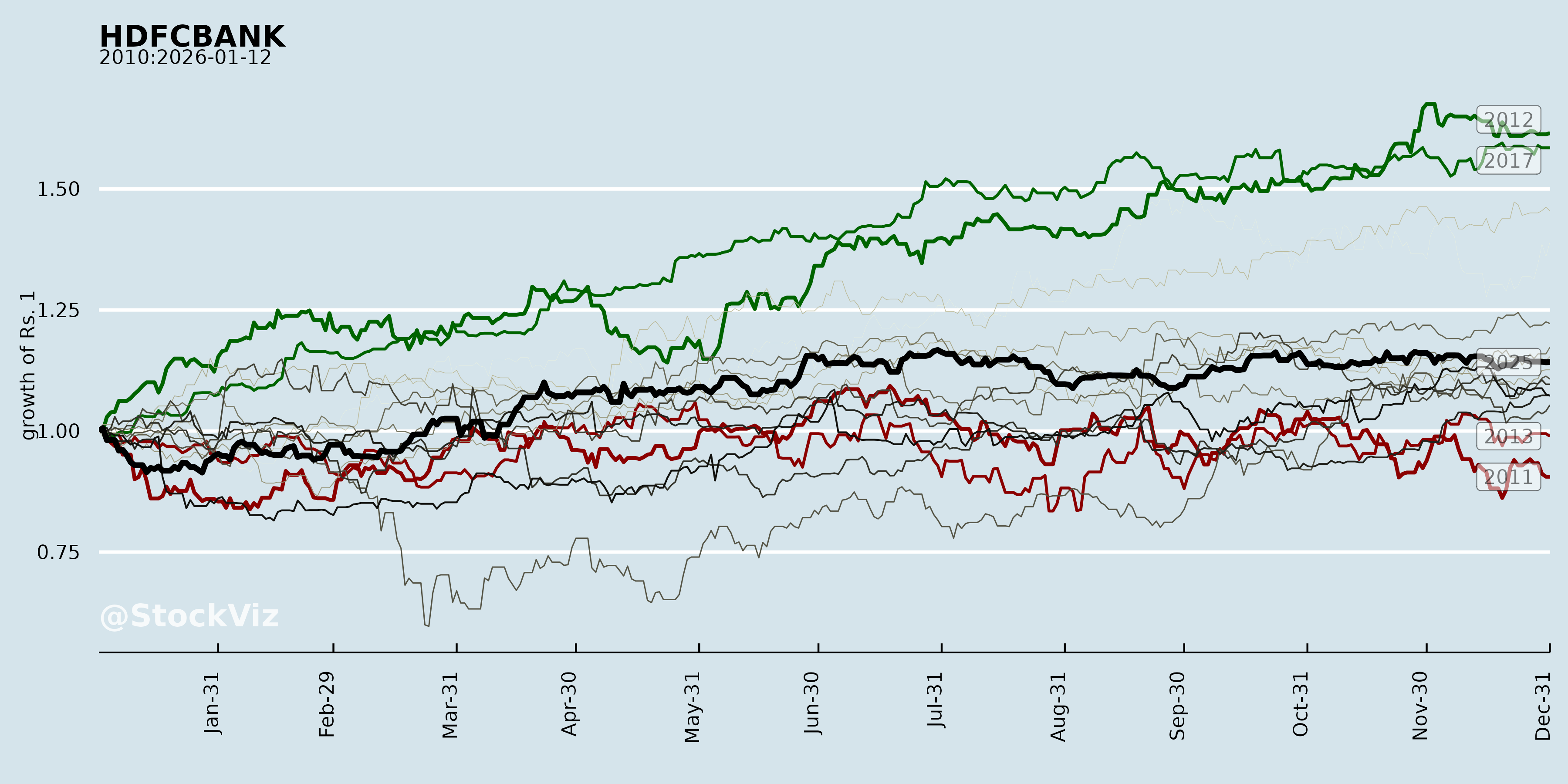
Annual Returns
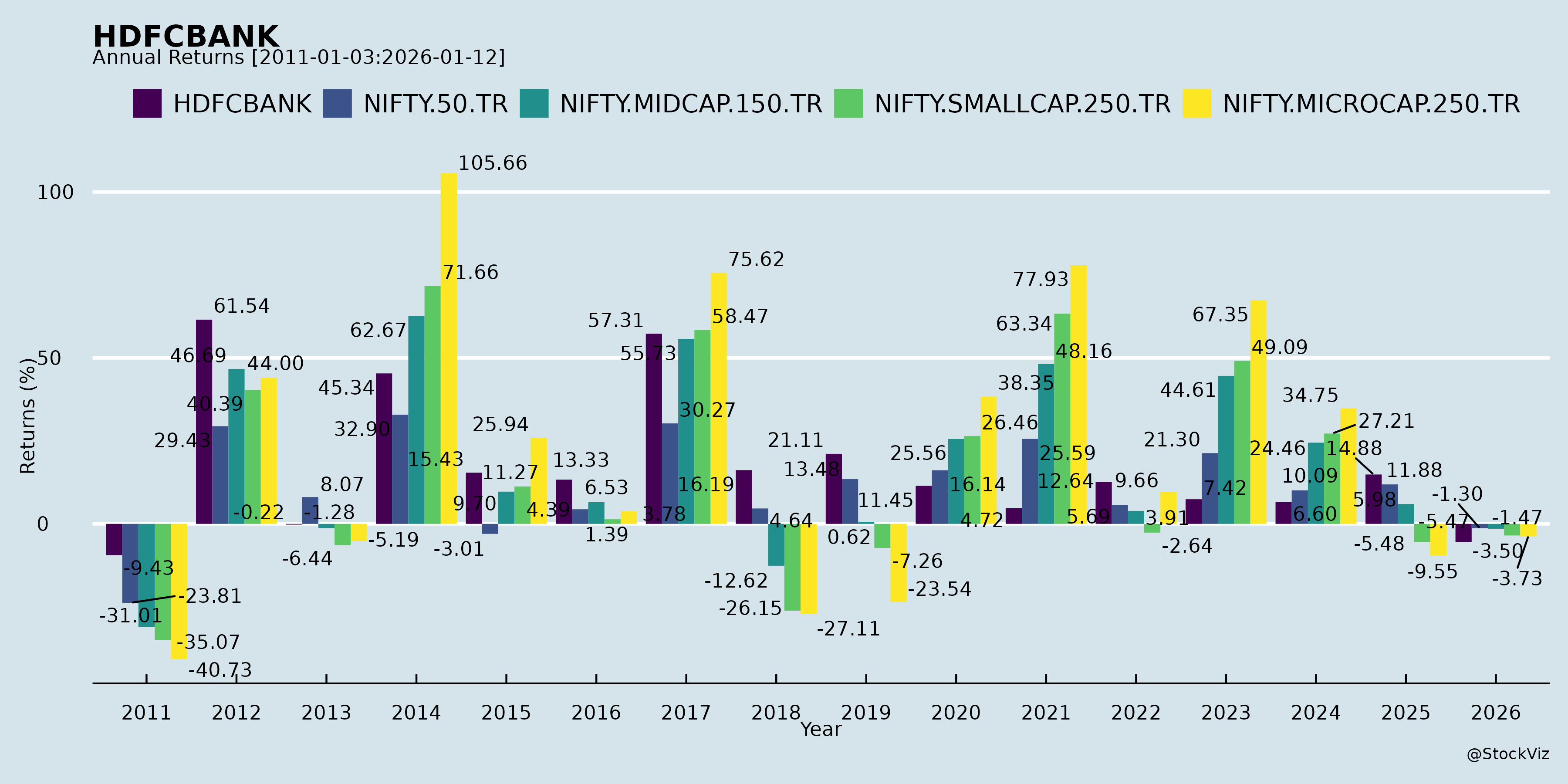
Cumulative Returns and Drawdowns
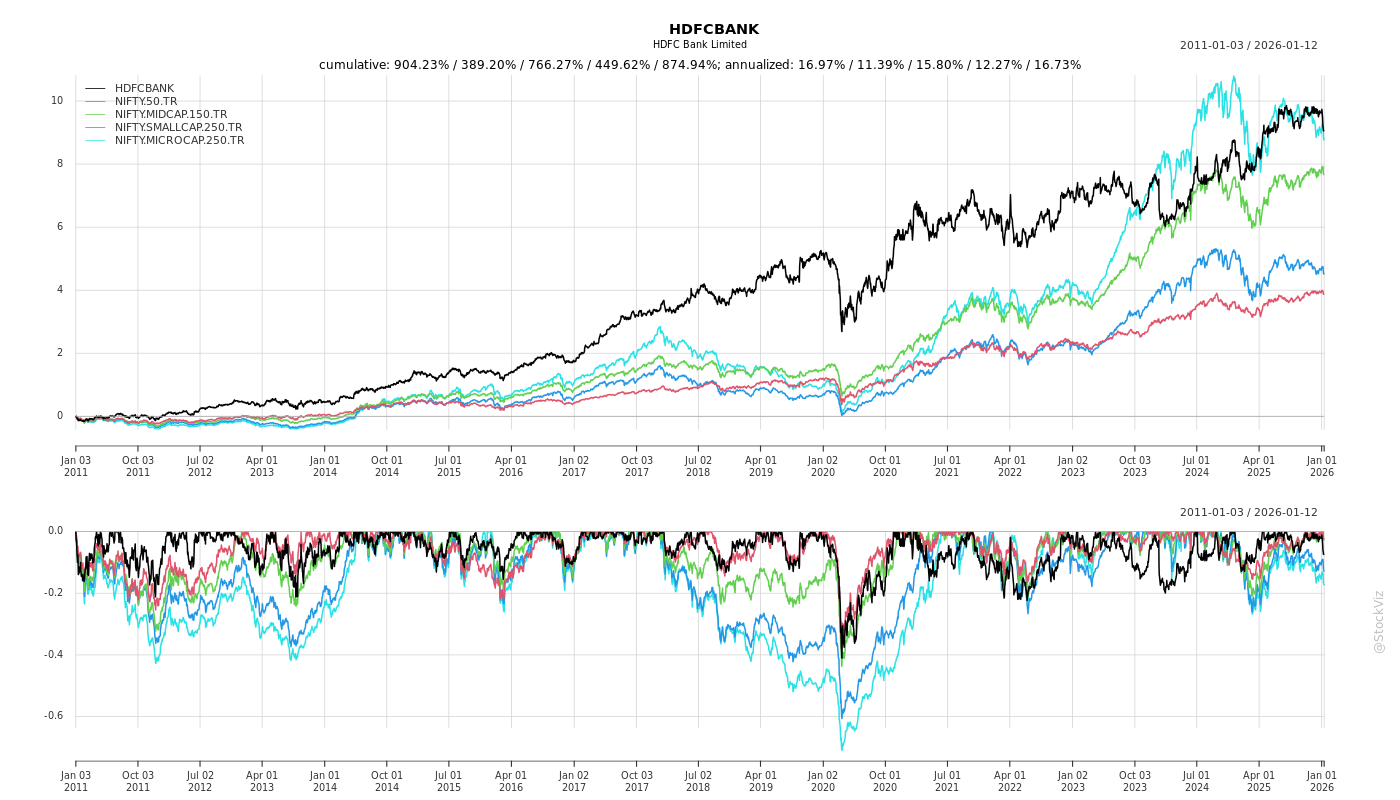

Fundamentals
Ownership
Margined
AI Summary
asof: 2026-09-14
HDFC Bank — Recent Corporate Announcements: Analysis
1. Headwinds and Challenges
The earnings-call disclosure identifies a broad set of external and operating pressures: economic uncertainties, potential geopolitical tensions, market volatility in oil and energy prices, risks of military conflict, inflation, deflation, pandemics, changes in government policies, and regulatory or tax changes. Cyber security threats and credit risks are also flagged as ongoing challenges.
A specific regulatory/operational challenge is disclosed: a notice received by the DIFC Branch from the Dubai Financial Services Authority, described among prohibitions or restrictions on business operations.
At the 32nd AGM (August 5, 2026), shareholders raised concerns and sought clarifications on matters including cyber security, technological advancements, credit growth plans, merger synergies, ESG matters, MSME lending, the FCNR(B) deposit programme, branch details, and dividend matters — indicating areas of investor scrutiny. The Chairman also addressed governance developments, stating the Bank has no systemic governance concerns.
2. Tailwinds and Growth Prospects
The Q1 FY2026-27 results (quarter ended June 30, 2026) show net interest income growth of 6.7%, total balance sheet size rising to ₹43,975 billion, increases in average deposits and CASA deposits, expansion of the branch and ATM distribution network, and growth in gross and retail advances. Subsidiaries performed solidly: HDFC Life, HDFC ERGO, HDFC AMC, HDFC Securities, and HDBFS.
At the AGM, the Chairman described steady post-merger momentum, improved business synergies, a strong MSME presence, an expanded distribution network, and continued investments in technology modernization and GenAI. He highlighted financial inclusion, support for government programmes, and CSR/ESG initiatives. Priorities for the current financial year include customer-centricity and disciplined growth.
The Bank is engaging institutional investors through the JP Morgan Emerging and Frontier Markets Opportunities Conference (September 17, 2026, London), signalling continued investor outreach.
3. Key Risks
- External/macro: economic uncertainty, geopolitical tensions, oil and energy price volatility, military conflict, inflation/deflation, pandemics, and policy, regulatory, or tax changes.
- Operational/credit: cyber security threats and credit risk.
- Regulatory/operational restriction: the notice from the Dubai Financial Services Authority to the DIFC Branch.
- Forward-looking statement risk: management notes that statements about future business, strategies, financial position, and operations are subject to risks and uncertainties that could cause actual results to differ materially.
- Governance-related: the Chairman reaffirmed no systemic governance concerns, a statement made in the context of governance developments.
4. Management Guidance vs. Observed Performance
Management’s forward-looking statements are explicitly framed as subject to risks and uncertainties that could materially alter outcomes. On the JP Morgan conference participation, management noted the schedule of analyst and institutional investor meetings may change due to exigencies on the part of attendees or the Bank.
Observed performance against stated priorities: - The AGM speech (August 5, 2026) cited steady post-merger momentum, improved synergies, MSME strength, network expansion, and technology/GenAI investment; the Q1 FY2026-27 results (quarter ended June 30, 2026) evidence net interest income growth of 6.7%, balance sheet expansion to ₹43,975 billion, deposit and CASA growth, network expansion, and advances growth — consistent with the described momentum. - Capital adequacy stood at 19.6% and gross non-performing assets at 1.17% of gross advances for the quarter, indicating the disciplined-growth posture referenced at the AGM. - All resolutions at the 32nd AGM were passed with requisite majority, including adoption of standalone and consolidated financial statements for FY2025-26, dividend declaration, re-appointment of Mr. V. Srinivasa Rangan, auditor remuneration, issuance of perpetual debt instruments/Tier II/long-term bonds, modification of the material related party transaction with HDFC Life, and appointment/compensation of Mr. Rajiv Kumar as Part-time Chairman (Independent Director). The re-appointment resolution drew the highest dissent at 2.422% of votes polled against; other resolutions saw dissent ranging from 0.004% to 1.775%. - The trading window for designated persons opened on July 21, 2026, following the July 18, 2026 earnings call. - An ESG rating of 77.78 was assigned to HDFC Bank by Niche Ninety Nine Capability and Certifications (OPC) Private Limited on September 11, 2026; the Bank did not engage Niche for this rating, which was independently prepared using publicly available information.
Broker Narrative
The broker narrative shifted from merger-driven optimism in 2023 — emphasizing synergies, cross-sell access to 25 million clients, and superior asset quality — to a defensive stance by 2026, acknowledging unresolved balance sheet, NIM, and execution problems. The early theme of resilient post-merger profitability eroded as the stock endured a prolonged drawdown with dozens of DISAPPOINTMENT outcomes and actual returns as low as -25.9% from late 2024 onward. Governance chaos, including the Chairman’s resignation and the CEO’s decision not to seek reappointment, escalated beyond the original merger-integration concerns, yet the Buy rating was retained with a trimmed target, reflecting diminished but persistent conviction.
Fears that came true
- Merger-Related Cost Pressure: The temporary C/I ratio spike from integration costs persisted far longer than expected, correlating with the sustained wave of DISAPPOINTMENT outcomes across dozens of broker reports from 2024 through 2026.
- Deposit Competition & Margin Pressure: Intense deposit competition materialized as described, confirmed by the last report’s acknowledgment of lower NIM from unfavorable incremental loan mix dragging core RoA.
- Execution Scale Risks: Operational and technological execution challenges at the merged entity’s massive scale materialized, evidenced by the catastrophic string of negative actual returns and governance failures including the Chairman’s resignation over governance concerns.
- MSME Sector Caution: Asset quality stress in the MSME portfolio appears to have materialized, as the last report cites unresolved balance sheet construct (LDR) and persistent management guidance-versus-execution gaps.
Optimism that failed
- Merger Synergies & Cross-Sell Opportunities: Despite projected access to 25 million HDFC group clients, the last report notes only that ‘core earnings quality stabilizing post merger transition phase,’ indicating synergies have yet to deliver the transformative growth originally promised.
- Resilient Profitability (RoA/RoE): The post-merger RoA target of 1.9–2.1% was undermined, as the last report explicitly cites lower NIM due to unfavorable incremental loan mix dragging core RoA below expectations.
- Superior Asset Quality: The pristine asset quality thesis was contradicted by governance penalties for ‘business overreach’ regarding deposit arrangements and the Chairman’s resignation citing governance concerns.
- Aggressive Distribution Expansion & Corporate Capex Tailwinds: Despite plans to open ~1,500 branches annually and leverage PLI-driven capex, the stock’s persistent underperformance suggests these growth drivers were overwhelmed by merger-related drag and governance failures.
Broker Timeline
129 broker calls · 2023-05-25 to 2026-08-31
Copyright © 2023 SAS Data Analytics Pvt. Ltd. All rights reserved.