HCLTECH
Equity Metrics
November 18, 2026
HCL Technologies Limited
Computers - Software & Consulting
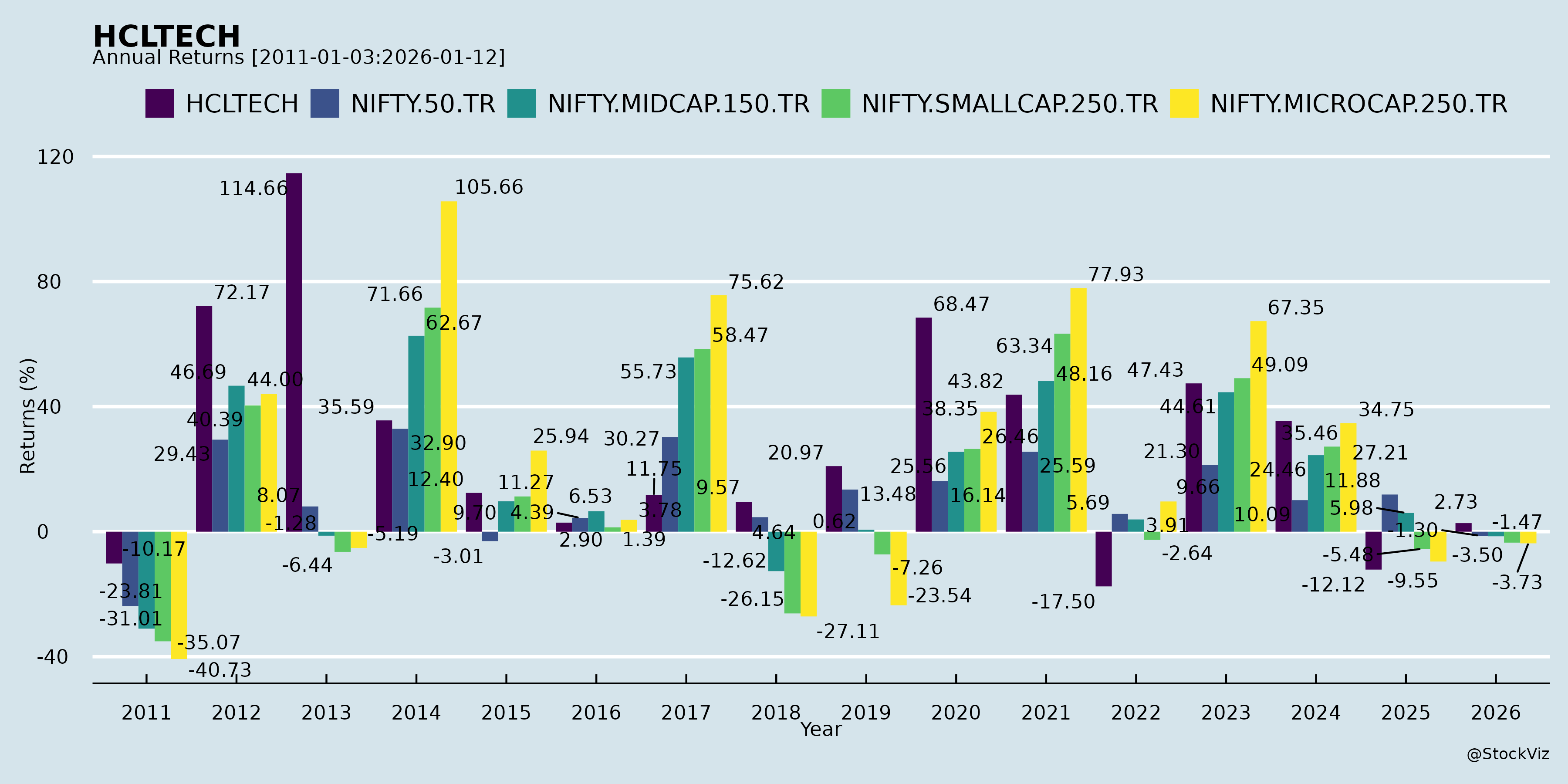
Annual Returns
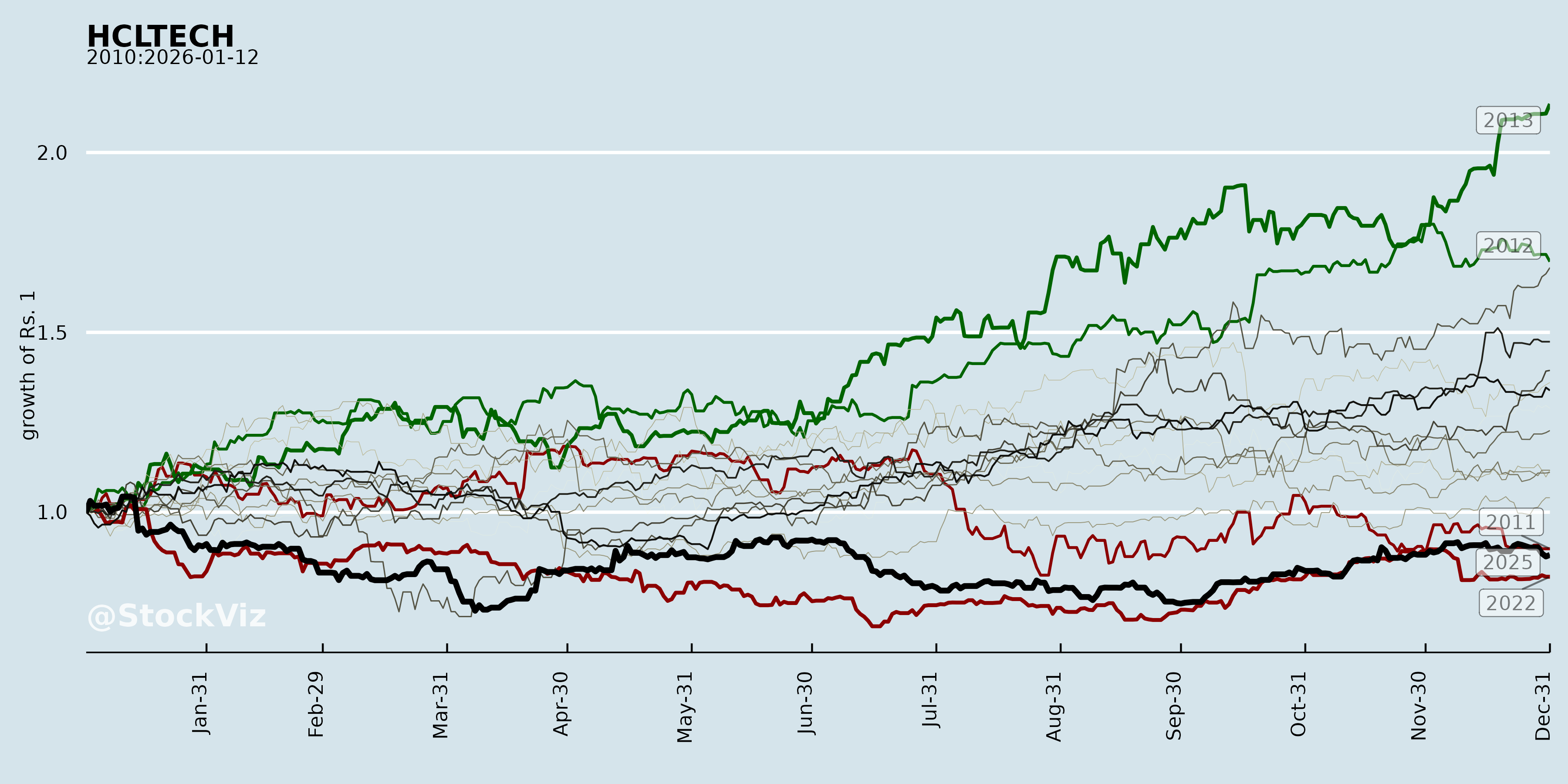
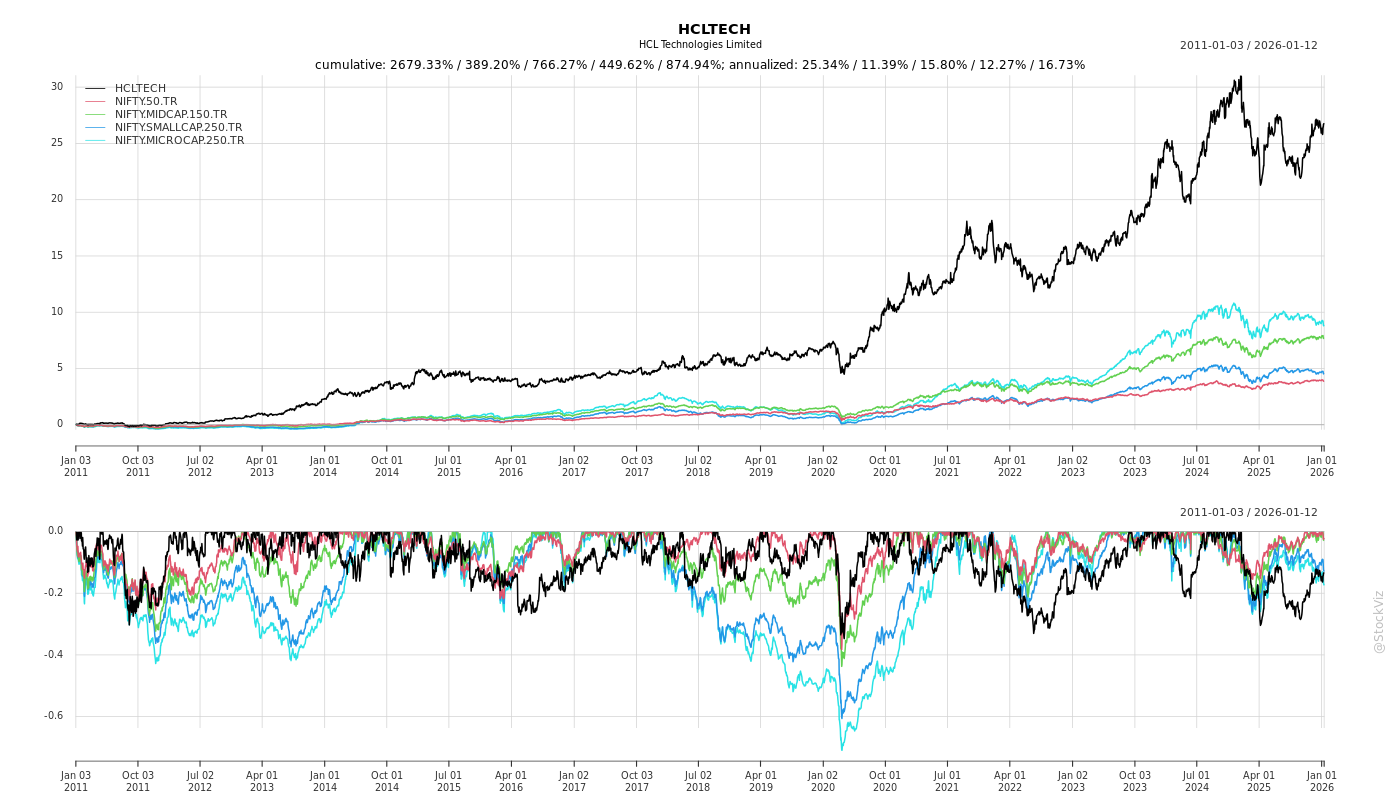
Cumulative Returns and Drawdowns
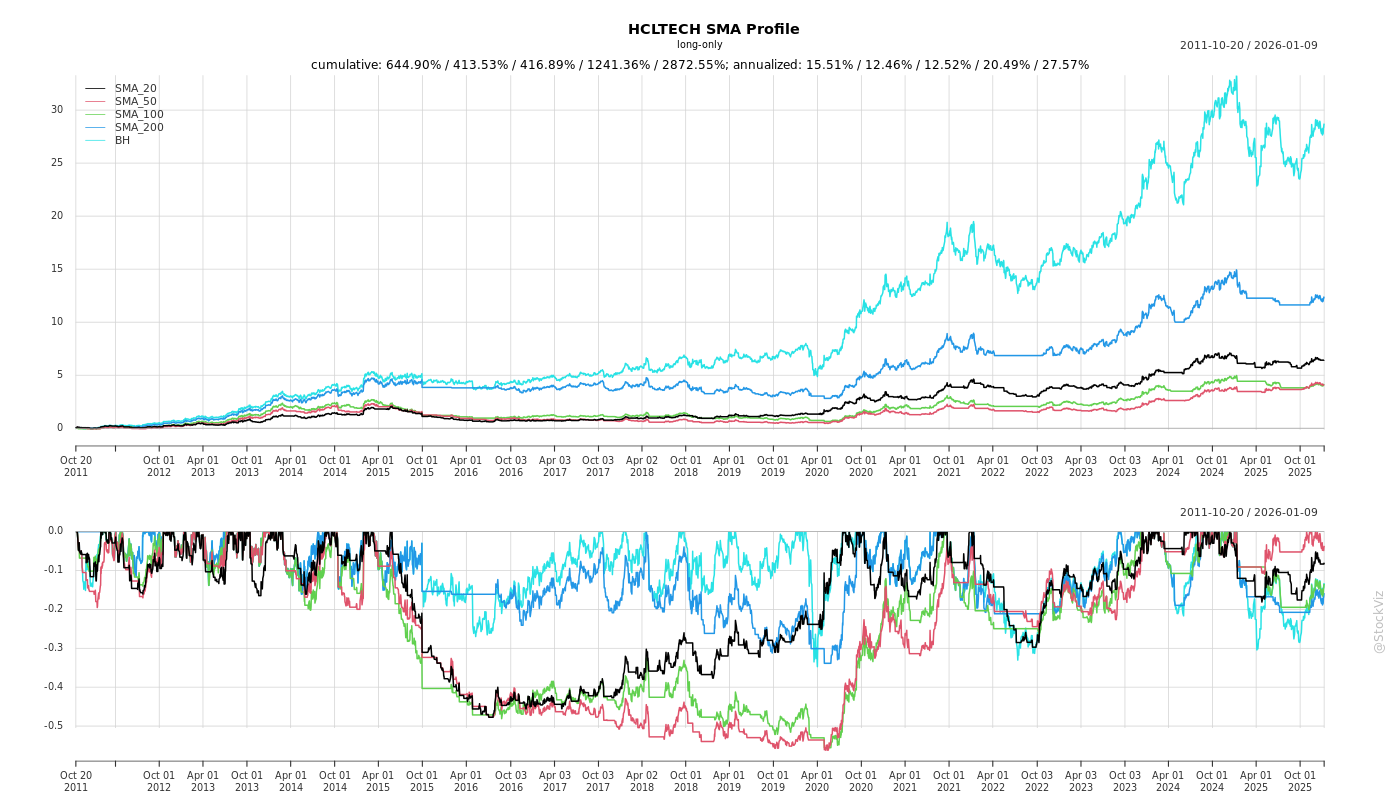
Fundamentals
Ownership
Margined
AI Summary
asof: 2026-09-14
Headwinds and Challenges
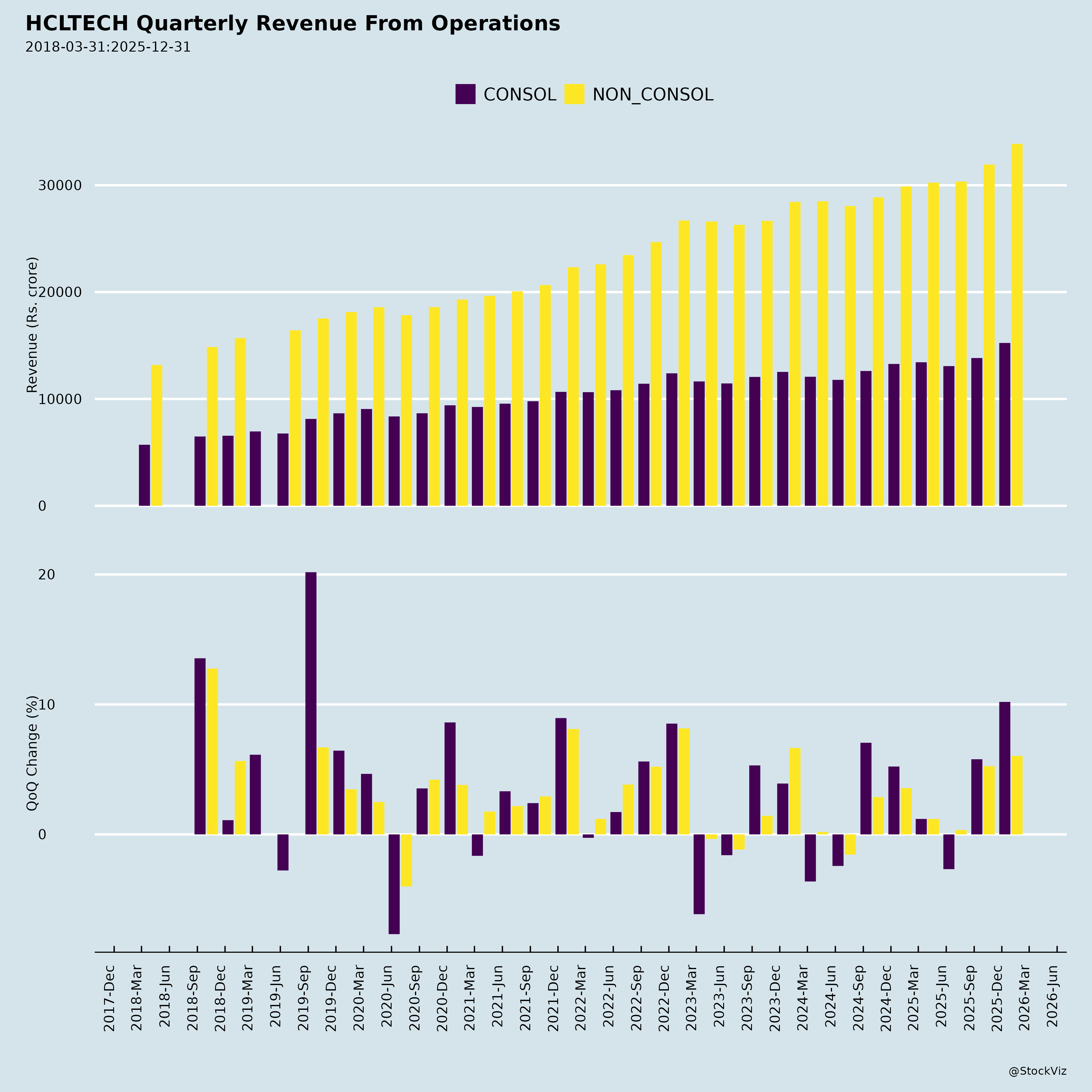
- Seasonal weakness in the April–June quarter (AMJ). Management noted that AMJ is typically a weaker quarter due to planned revenue declines tied to productivity commitments in large managed services contracts. Q1 FY27 revenue declined 0.5% sequentially, though it grew 2.6% year-on-year in constant currency.
- Engineering and R&D services (ERS) decline. ERS declined 3.7% sequentially and grew only 0.3% year-on-year. The decline was concentrated in the Tech and Telecom, Media and Entertainment verticals, following sharp cuts in discretionary spending at two large US telcos, which management had flagged in the prior quarter. Management also cited a high base after several quarters of strong momentum in the tech vertical.
- Life Sciences and Healthcare softness. Management attributed a gradual multi-quarter decline in this vertical to the completion of regulatory work for medical device companies that was not replaced, and to stress in the US healthcare segment, which accounts for most of the company’s healthcare revenue.
- AI-driven deflation in traditional services. Management described a divergence in the AI landscape: strong growth in AI-native and AI-amplified services, but continued optimization and AI-enabled automation pressure in AI-disrupted, commoditized services. The stated intent is to innovate faster than the market to stay ahead of the deflationary curve.
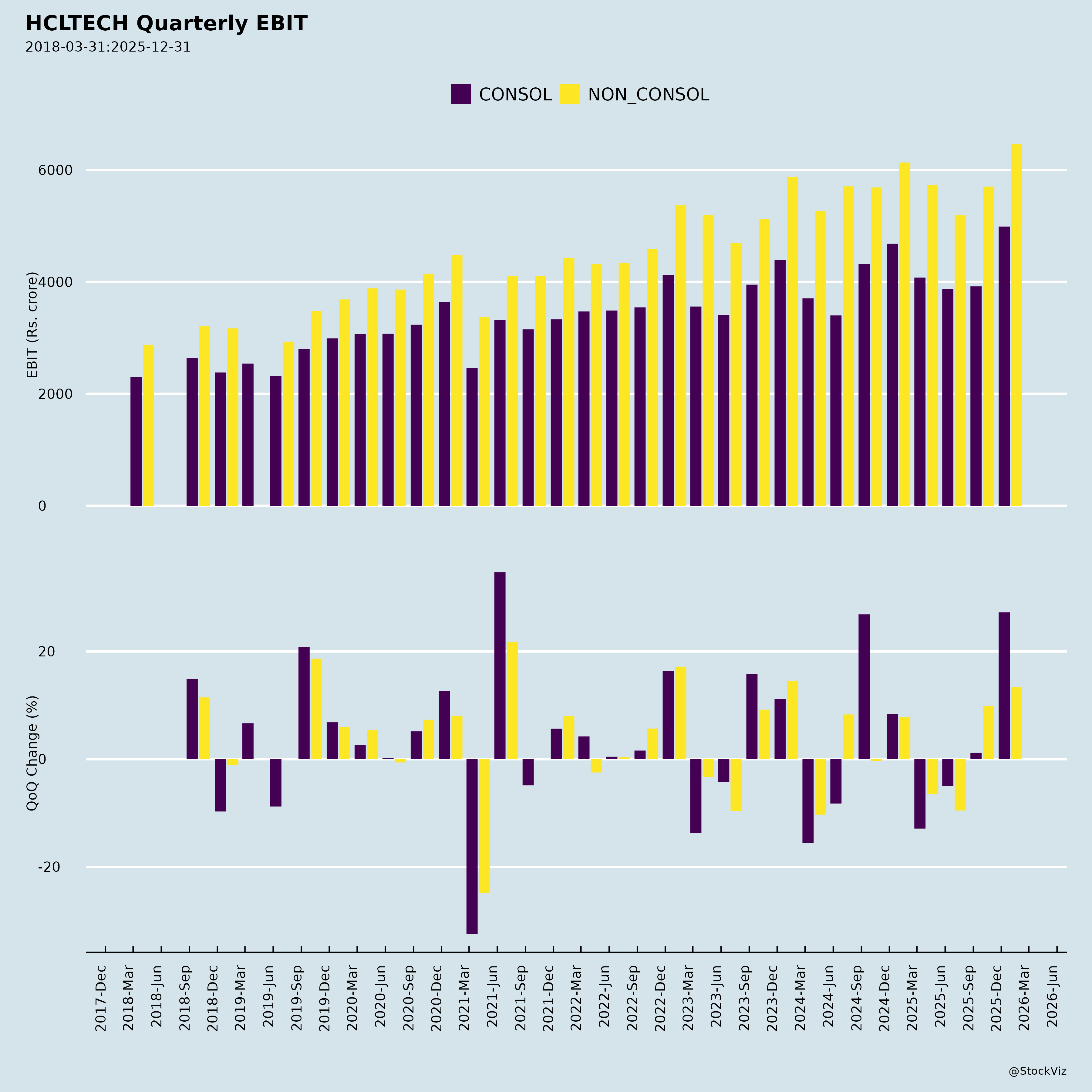
- Margin drag from seasonality and restructuring. The sequential margin bridge included a 110 basis point headwind from annual productivity benefits and lower ERS revenue. FY27 margin guidance of 17.5%–18.5% includes an estimated 40–50 basis points of restructuring cost impact.
- Headcount reduction. Headcount stood at 223,889 as of June 30, 2026, a decrease of 3,292 from the previous quarter. Attrition was 12.7% on an LTM basis.
- Working capital. Total DSO including unbilled receivables rose two days quarter-on-quarter to 86 days.
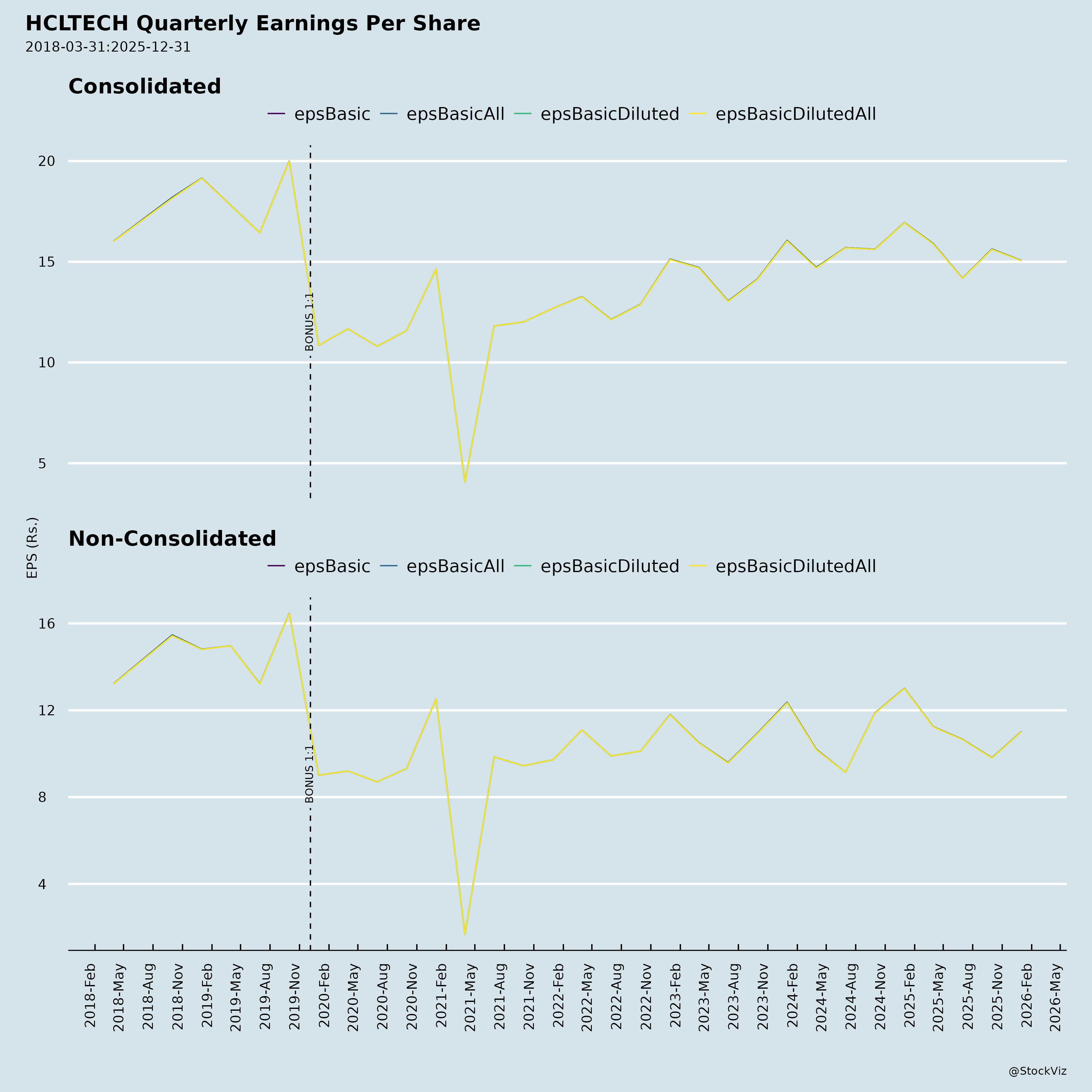
- Prior-year exceptional items. FY26 results included a one-time impact of the New Labour Codes (₹956 crores at group level, with a consequential tax benefit of ₹237 crores) and, at the standalone level, a material Bilateral Advance Pricing Agreement (BAPA) impact of ₹6,436 crores recognized in the quarter ended March 31, 2026, with a related tax benefit of ₹1,531 crores.
Tailwinds and Growth Prospects
- Advanced AI revenue momentum. Advanced AI revenue for Q1 FY27 was $171 million, up 10.6% quarter-on-quarter and 62.1% year-on-year. The FY26 advanced AI annualized run rate was $620 million.
- Record Q1 bookings. Net new TCV bookings for Q1 FY27 were $2.4 billion, the highest ever for a first quarter, and were well-balanced across verticals, service lines and geographies. This excludes a mega deal signed in early July 2026.
- Mega deal win. HCLTech signed a strategic partnership with a Europe-headquartered Fortune Global 50 firm to establish an AI-driven operating model for its global digital workplace and enterprise networks. The initial term runs from July 2026 to December 2031, extendable by five years, with an estimated value of $1.14 billion during the initial term, entirely net new business. Transition is expected to start in a couple of months, with steady state expected only in April 2027, implying negligible revenue impact in FY27.
- AI strategy across five pillars. Progress cited includes AI Force deployed across 92 distinct client accounts; the AI Force 2.2 release with VS Code IDE plugin support, multimodal AI, long-term memory, configurable governance guardrails, AWS native integration and enhanced observability; an Agent Store for reuse of AI assets; AI Force for Oracle; 23 industry AI solutions; and AI Labs crossing 1,000-plus AI engagements delivered.
- AI Factory and infrastructure. A global technology major expanded its partnership with an incremental scope of over $180 million for AI datacenter build-out. HCLTech also announced a collaboration with Red Hat in the AI Factory ecosystem.
- New AI datacenter business. HCLTech is entering the AI datacenter business with a strategic investment of up to ₹3,500 crores and a long-term vision of 50 megawatts of capacity. Management described this as a full-stack play combining datacenter design, DevOps and cloud operations with the software portfolio, targeting sovereign cloud, secure AI and managed AI infrastructure, and supporting outcome-based and managed services contracts. The investment is expected to be funded through a mix of partner arrangements with silicon and OEM vendors, committed client capacity, and equity and debt, with further investment disciplined by free cash flow.
- Sovereign AI and partnerships. HCLTech made a strategic investment of $150 million in Sarvam, described as India’s full-stack sovereign AI company, to build a differentiated full-stack AI platform for governments and enterprises. Other ecosystem progress includes a dedicated Gemini enterprise business unit with Google Cloud, AI Innovation Zones with Google Cloud and Intel, inclusion in OpenAI’s Trusted Access for Cyber program, AWS AI Services Competency, and integration of HCLTech composable agents into AWS Transform.
- Acquisitions. The acquisition of HPE’s Telco Solutions Business was completed at 9:31 a.m. IST on August 1, 2026, following the December 18, 2025 intimation. Jaspersoft, a business unit of Cloud Software Group, was acquired for ₹2,275 crores ($240 million), completing on July 1, 2026, with expected contribution of $10–15 million per quarter. The Guardian India acquisition (100% stake for $10.5 million in cash) was announced on July 16, 2026, alongside a new seven-year expanded partnership with Guardian; approximately 2,000 employees are expected to transition into a dedicated Strategic Business Unit. The CTG acquisition was expected to close in the later part of the September 2026 quarter.
- Vertical and geographic breadth. Six of seven verticals registered year-on-year growth, led by Public Services (12%) and Retail & CPG (10.1%). India grew 16.9%, Rest of the World 10.8%, the USA 2.9% and Europe 0.1%. Financial services momentum was attributed to AI-native engagement with large clients and broad-based data and analytics traction.
- Client relationship deepening. Year-on-year additions included one client in the $100 million category, six in the $50 million category, 11 in the $20 million category and 31 in the $10 million category.
- Productivity and returns. Revenue per employee rose 3.3% year-on-year, increasing every quarter for five consecutive quarters. LTM ROIC was 40.7% (up 257 basis points year-on-year), Services ROIC 47.8% and HCL Software ROIC 21.6%. LTM free cash flow was $1.98 billion and operating cash flow $2.14 billion, with free cash flow to net income at 99% and operating cash flow to net income at 107%.
- Balance sheet and shareholder returns. Gross cash was $2.86 billion and net cash $2.84 billion as of June 30, 2026. The board declared an interim dividend of ₹12 per share for Q1 FY27, with a record date of July 17, 2026 and payment date of July 27, 2026. LTM payout was ₹60 per share, effectively distributing 93.2% of net income. The 34th Annual General Meeting was held on August 12, 2026, where a total dividend of ₹60 per share for FY26 was declared and three resolutions were passed.
Key Risks
- Client-specific discretionary spending cuts. Sharp reductions at two large US telcos materially affected ERS, and management indicated some of these challenges would continue to play out in subsequent quarters.
- Macro uncertainty. Management stated the macro situation observed in March continued unchanged, limiting visibility beyond the current guidance.
- AI disruption of traditional services. Continued optimization and automation of commoditized work represents an ongoing deflationary pressure on the traditional services mix.
- Datacenter execution and demand risk. The AI datacenter initiative carries capital intensity and demand-timing uncertainty. Management addressed analyst concerns about compute scarcity and tenancy ratios by stating the market remains heavily GPU-starved, that 50 megawatts is a small fraction of needed capacity, and that initial capacity is supported by committed consumption, with further investment contingent on delivery of the initial phase.
- Acquisition integration and accounting. Jaspersoft, the HPE Telco Solutions Business, Guardian India and the expected CTG acquisition bring integration requirements; Jaspersoft will be accounted for in the next quarter, and management noted the revenue and margin guidance excludes acquisition impacts.
- Token cost economics. Management noted that token costs have become a live enterprise issue and that customers are seeking creative ways to reduce them, which shapes the tiered, small-language-model architecture HCLTech is pursuing.
- Regulatory and tax matters. The New Labour Codes and the BAPA settlement produced material one-time charges in FY26, reflecting exposure to legislative and tax authority outcomes.
Management Guidance Versus Observed Business Performance
- FY27 revenue guidance retained at 1%–4% in constant currency, described as organic growth guidance excluding acquisitions including Jaspersoft. In Q1 FY27, revenue grew 2.6% year-on-year in constant currency and declined 0.5% sequentially, with Services growing 3.5% year-on-year and IT and business services growing 4.2% year-on-year.
- FY27 margin guidance retained at 17.5%–18.5%. Q1 FY27 reported EBIT margin was 16.9%, or 17.5% adjusting for restructuring expenses of 62 basis points, compared with 17.7% in the previous quarter on the same adjusted basis. Management noted FY26 margins were closer to 18% excluding restructuring costs, and that the FY27 guidance includes approximately 40–50 basis points of restructuring cost impact.
- Guidance not raised despite strong bookings. When asked why guidance was not increased after $2.4 billion in Q1 bookings and the July mega deal, management cited the broader guidance band, the fact that it is only the first quarter, and the mega deal’s steady state being expected only in April 2027 with negligible FY27 revenue impact.
- Medium-term margin guidance deferred. Management declined to provide an FY28 margin band, stating it would be given at the appropriate time alongside FY28 guidance.
- Acquisition contribution guidance. Jaspersoft is expected to contribute $10–15 million per quarter, with seasonality, and is outside the organic guidance. The CTG acquisition was expected to close in the later part of the September 2026 quarter.
- Datacenter investment guidance. The ₹3,500 crores investment represents only a fraction of the long-term 50-megawatt vision, with management stating it does not expect total investment anywhere near the roughly ₹30,000 crores implied by full 50-megawatt build economics, and that further investment will be based on free cash flow from the business.
Broker Narrative
The narrative pivoted from a 2023 top-down macro bear case (US recession, discretionary IT-spending cuts, margin pressure, rich valuations) to a 2026 bottom-up, AI-centric Hold where the debate is now the software licence-to-subscription transition, public-services weakness, and AI-driven deflation. Demand and pricing caution is the persistent thread: 2023’s ‘slower for longer’ reappears in 2026’s ‘cautious outlook’ and ‘deflationary pressure in traditional services.’ What flipped is the margin story — 2023 feared margin compression, but the 2026 report shows ~150 bps of margin expansion driven by Project Ascent and advanced AI. Notably the 2023 Sell was premature, as the stock rallied 40-55% through 2023 on the very tailwinds the broker itself cited, before a 2024-2025 de-rating (~-25%) partly vindicated the caution and an AI-led recovery restored gains into 2026.
Fears that came true
- Cuts in discretionary IT spending: the feared demand weakness materialized in the 2024-2025 downturn, when Buy/Add calls repeatedly DISAPPOINTED (e.g., Motilal Oswal Buy from Feb-2024 through Jul-2025) and the stock slid to -24.9%, with the 2026 report still flagging ‘deflationary pressure in traditional services.’
- Guidance & estimate downgrades: the ‘slower for longer’ recovery the brokers warned would be cut played out, with the 2026 report showing revenue below consensus, growth guided only to the midpoint and a ‘cautious outlook,’ alongside the cluster of 2024-2025 DISAPPOINTMENT outcomes.
- Elevated starting valuations: the ‘limited expansion upside’ fear was borne out as the stock gave back its 2023 gains and de-rated roughly 25% from peak before recovering, consistent with the flagged valuation-compression risk.
Optimism that failed
- Long-term core Digital Transformation demand: the ‘intact over 5 years’ secular DT thesis eroded as traditional services hit ‘AI-driven deflation’ and the software business weakened on the perpetual-to-subscription transition, so core/traditional DT pricing and demand did not hold up as hoped.
Broker Timeline
90 broker calls · 2023-06-14 to 2026-10-13
CNBC-TV18: ratings, targets and commentary
No recorded CNBC-TV18 statements for this ticker.
Management comments
No recorded management comments with an explicit designation and affiliation for this ticker.
Copyright © 2023 SAS Data Analytics Pvt. Ltd. All rights reserved.