GRINFRA
Equity Metrics
November 18, 2026
G R Infraprojects Limited
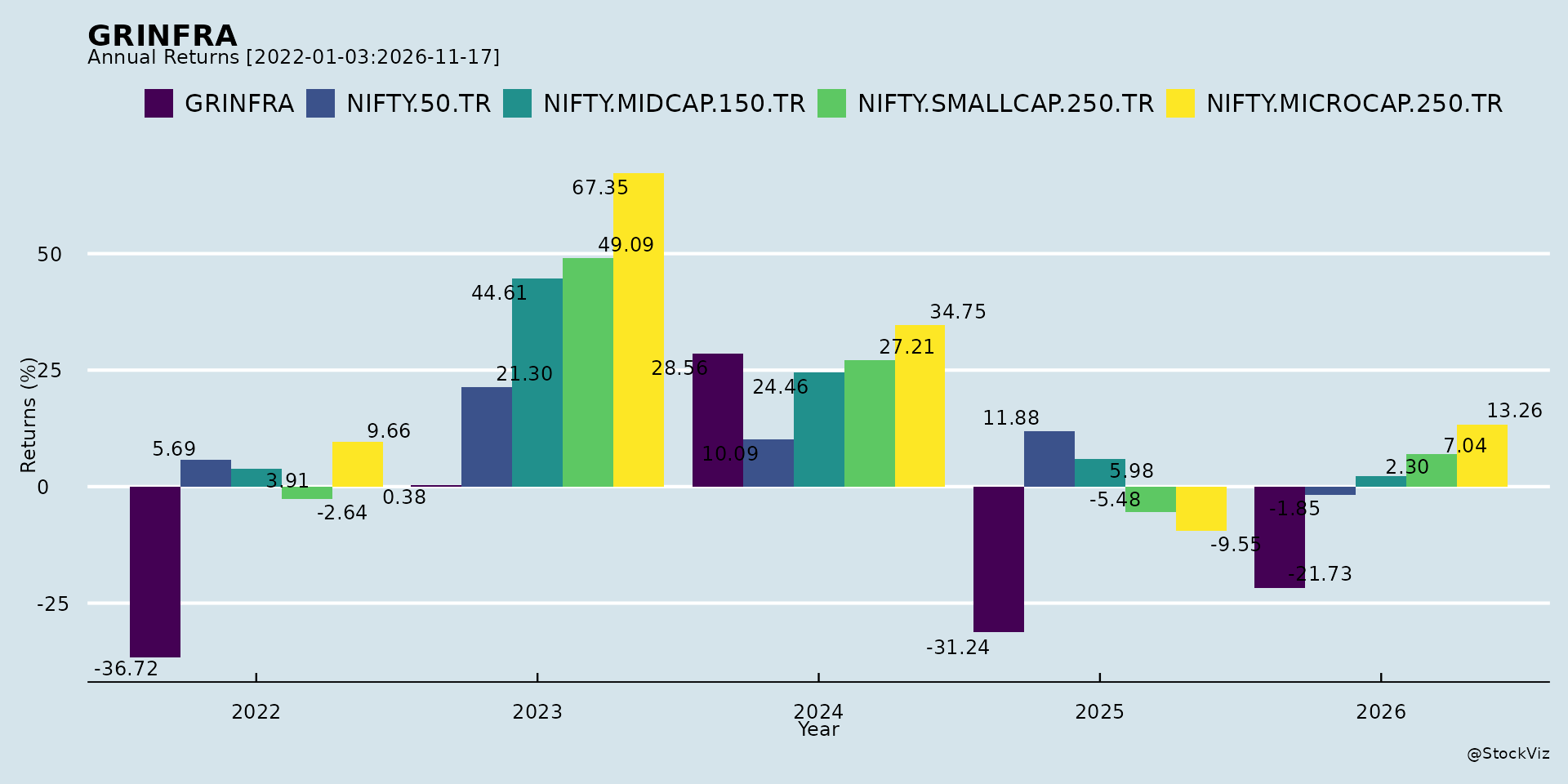
Annual Returns
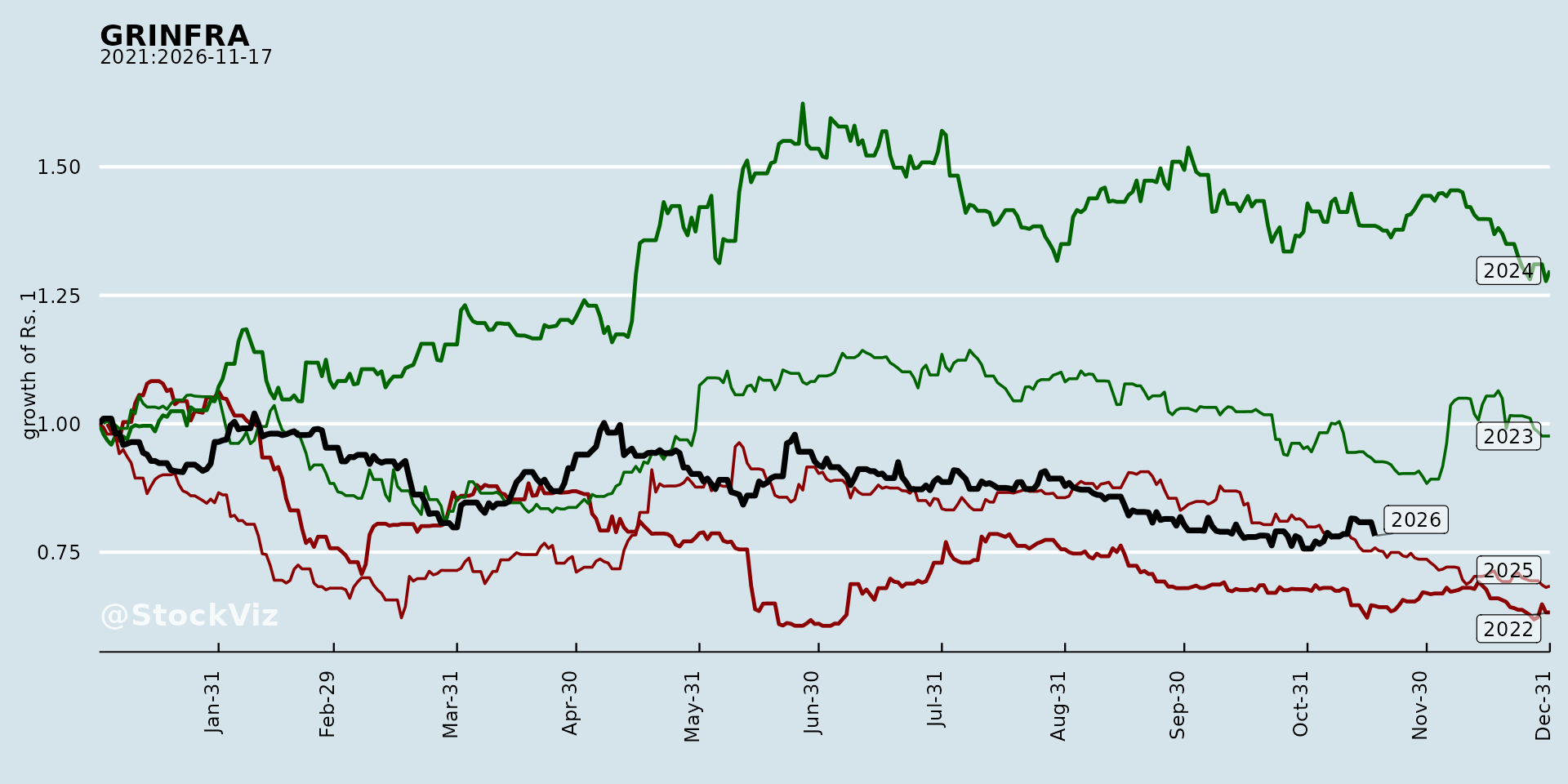
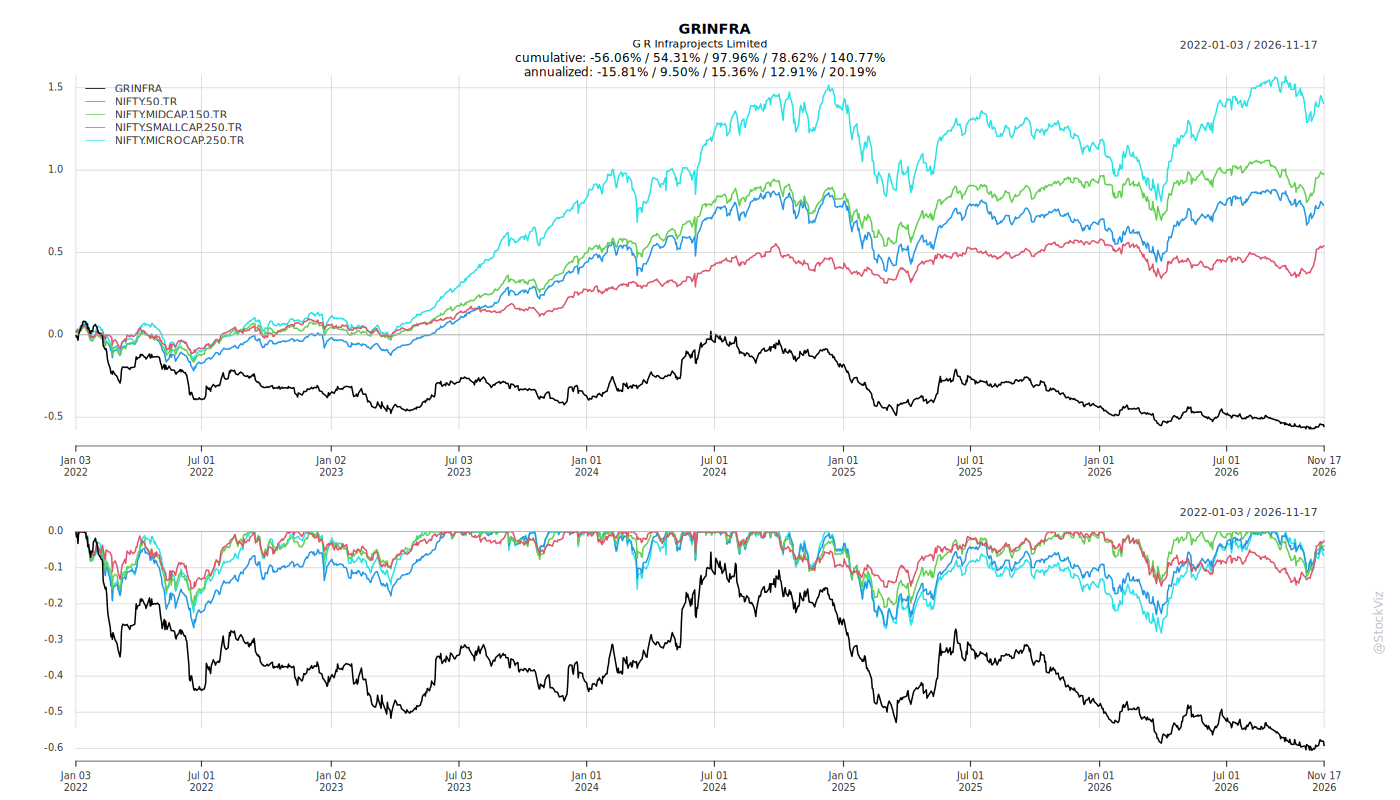
Cumulative Returns and Drawdowns
Fundamentals
Ownership
Margined
AI Summary
asof: 2026-09-17
GRINFRA: Recent Corporate Announcements — Analysis
1. Headwinds and Challenges
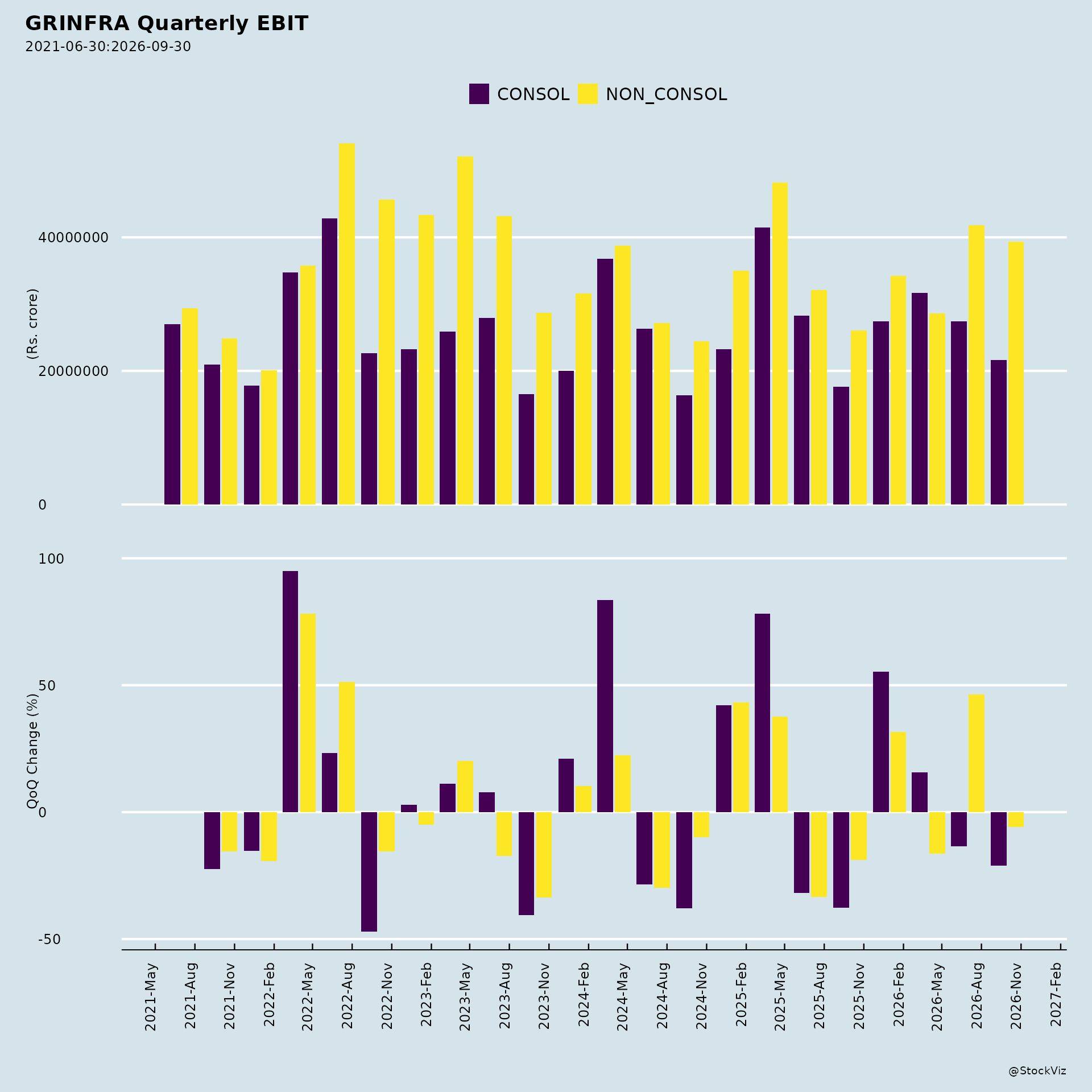
Margin compression. Standalone EBITDA margin fell to 11.02% in Q1 FY27 from 12.65% in Q1 FY25, which management attributed primarily to higher construction and material costs. At the group level, EBITDA margin declined to 16.8% from 20% a year earlier. Management indicated that 10%–11% is the appropriate range for the current environment, with only marginal improvement possible depending on macroeconomic factors.
Input cost inflation and uneven pass-through. Bitumen price increases were described as being directly compensated by a government circular, over and above contractual escalation clauses. However, diesel and energy-linked cost increases were not compensated, affecting financials. In power transmission, aluminium and copper volatility was attributed more to speculation than supply chain issues, and management noted that no escalation is available in transmission projects, so higher procurement costs in the near term are not recovered; the impact is expected to spread over roughly two years as materials are procured over 1–1.5 years.
Weak project awarding and intense competition. Management acknowledged that despite large advertised pipelines, road ordering has not converted on the ground for the last two years. Highway bids continue to see 15–20 bidders. The MD noted that while discussions suggest a very large opportunity in the next quarter, “reality for the last 2 years” has been that it is not happening.
Working capital deterioration. Working capital days rose to 148 at end-June 2026 from 128 at end-FY26, driven by higher debtor and inventory days. Trade receivables at standalone level were INR2,655 crores, including INR1,784 crores of HAM debtors. Management attributed elevated external receivables largely to the oil and gas segment, where payment release occurs on project completion; receivables are expected to stay elevated through the year, with realization expected around October–December to March, and project completion targeted by May 2027.
Appointed date delays. Appointed dates for three projects worth INR7,250 crores were still awaited as of the call. Agra-Gwalior was guided for October–November 2026, and two HAM projects (received in March) for December 2026. Monsoon patterns extending to October mean on-ground construction effectively starts in November.
BharatNet execution constraints. The company is awaiting Right of Way for new capex; only O&M activity has started. New project capex is expected to begin around October. Optical fibre cable costs have risen with no escalation from the client, though the company has a fixed-price vendor contract for three years.
BESS timing. Work has started, but battery ordering is being deferred due to geopolitical issues and dollar-rupee movement; management expects to order batteries in about three months.
Other income volatility. Other income was lower this quarter because InvIT distribution came partly as capital repayment (a balance sheet item) rather than interest/dividend. Total other income was around INR68 crores, of which INR20 crores was InvIT interest and INR35 crores other interest income.
Legal matters. A June 2022 CBI case under the Prevention of Corruption Act remains sub judice before the Gauhati High Court, which has granted a stay on proceedings; the chargesheet includes the company and three employees. An Income Tax Department search under Section 132 was conducted during FY26 at company premises and residences of promoters, promoter group members, and certain senior management; no assessment order, demand, penalty notice, or adverse communication has been received, and no liability has been recognized.
2. Tailwinds and Growth Prospects
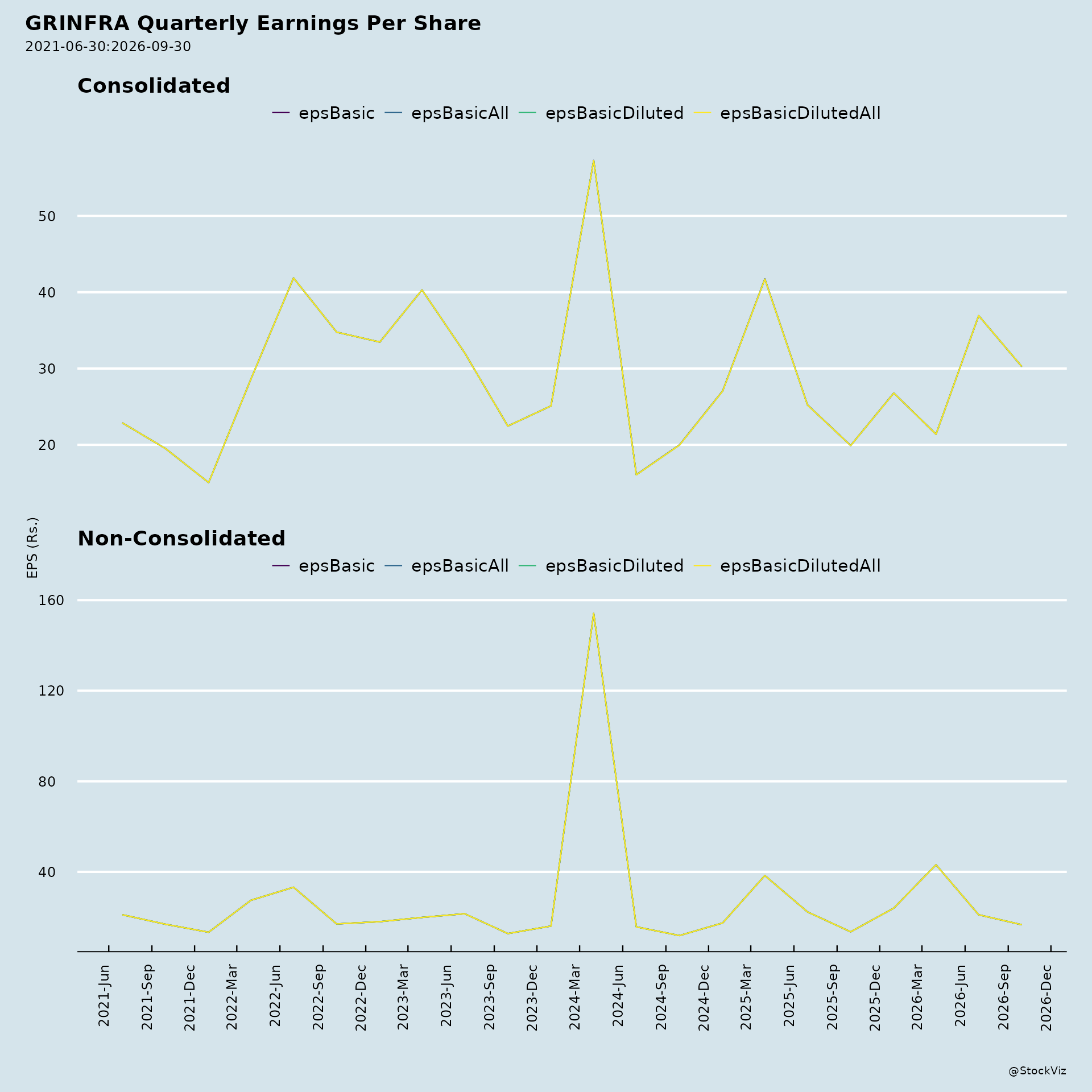
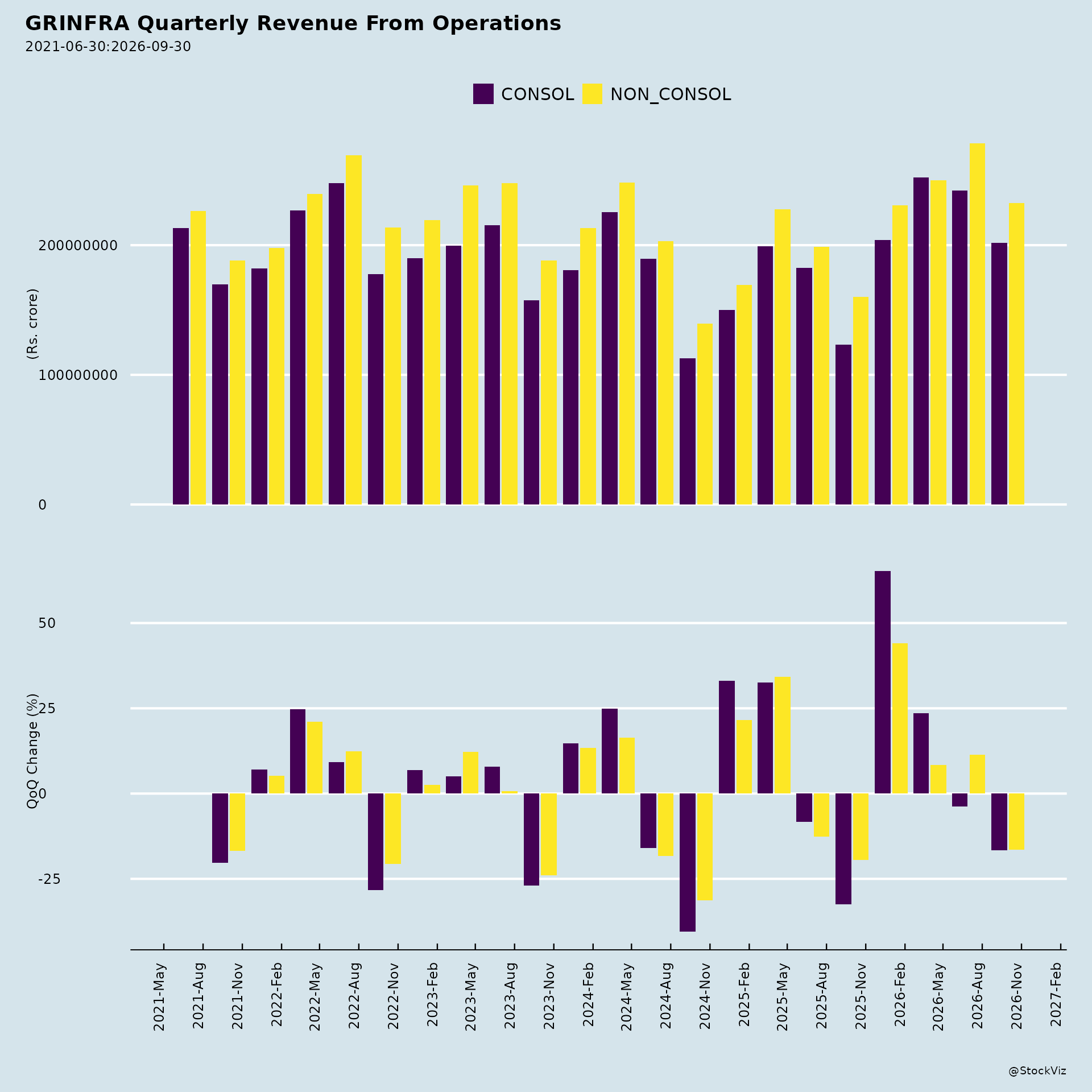
Strong Q1 FY27 execution. Standalone revenue from operations was approximately INR2,423 crores, up 32.71% year-over-year from INR1,826 crores. Consolidated revenue was INR2,784 crores, up 40% from INR1,988 crores. Consolidated PAT rose to INR358 crores from INR244 crores, including an exceptional gain of INR46 crores from dilution of interest in Indus Infra Trust (from 43.56% to 31.58%).
Order book and bid pipeline. Order book stood at approximately INR25,300 crores as of 1 July 2026, with bids aggregating approximately INR32,000 crores yet to be opened — about INR28,000 crores in road/surface transport and INR4,000 crores in hydro and tunnels.
Diversification beyond roads. Management reiterated growth across metro, railway, power transmission, logistics and warehousing, tunnels, battery energy storage, telecom infrastructure, and oil and gas. Q1 FY27 revenue included approximately INR110 crores from T&D (up from INR75 crores in the prior-year quarter) and INR270 crores from oil and gas, with a full-year O&G target of approximately INR1,000 crores plus.
Policy-driven pipeline. The transportation sector pipeline is around INR3.85 lakh crores (approximately 78% highways, 16% railway, 6% metro). A new toll-cum-annuity model combining BOT and HAM features would offer 10%–25% upfront government support for projects needing higher viability gap funding, with concessionaires retaining toll revenue over a fixed 20-year concession. The revamped BOT toll framework is expected to bring over 10,000 km of projects into private bidding. The Urban Decongestion Policy is expected to strengthen centre-state coordination on ring roads and bypasses.
Sector opportunities. Railway: multiple multi-tracking projects approved with aggregate investment of approximately INR48,000 crores. Power transmission: industry estimates indicate transmission capex of approximately INR5–6 lakh crores between FY27 and FY32, with a National Electricity Policy overhaul under preparation. Tunnels and hydro: estimated opportunity of approximately INR1 lakh crores over five years. Energy storage: proposed INR15,000 crores viability gap funding for 112 GW of storage capacity, including 60 GW pumped storage. Oil and gas: INR84,000 crores incentive package for deepwater exploration with support up to 50% of exploratory drilling cost, plus 46 new exploration blocks under OALP rounds 10 and 11 covering over 2.6 lakh sq km. Logistics: India may require around 216 multimodal logistics parks by 2047; institutional investment in warehousing rose 53% year-on-year to around INR500 crores.
New order wins. On 13 August 2026, the company received a Letter of Award from Varanasi MMLP Limited for development, operation and maintenance of the Multi Modal Logistics Park at Varanasi under PPP on DBFOT basis, with a consideration of INR91.60 crores, a one-year construction period from appointed date, and a 45-year concession period including construction. This follows an earlier announcement dated 7 August 2026.
Asset monetization. Four assets were sold to Indus Infra Trust in FY26 (GRBAHPL, GRENEPL, GRBUHPL, GRUBHPL) under share purchase agreements dated 29 December 2025 and 24 March 2026. Management targets transferring at least 3–4 more assets to the InvIT in the current year. InvIT distribution received in the quarter was approximately INR70 crores.
Capital deployment capacity. Investment in subsidiaries via loan and equity was INR2,445 crores at end-June 2026, with balance equity contribution required for HAM and BOT projects of INR3,346 crores, of which approximately INR900–1,000 crores is expected in FY27. Total equity investment planned over the next three years is around INR3,300 crores. Management views BOT as a deployment avenue for cash accruals, alongside transmission and logistics.
Transmission tower manufacturing. The company has set up transmission tower manufacturing facilities and is expanding capacity, motivated by delays in obtaining towers; this could support future international expansion once Indian demand is comfortably served.
3. Key Risks
- Order inflow shortfall: FY27 inflow guidance of INR20,000–22,000 crores (with plus/minus 10% variability) depends on government awarding converting into bids; road sector inflow target is around INR14,000 crores, with a possible range of INR10,000–18,000 crores depending on competition.
- Margin risk from commodities: Diesel, energy, aluminium, and copper inflation without escalation in transmission; BESS battery pricing and currency exposure.
- Execution timing risk: Appointed date slippage for Agra-Gwalior and two HAM projects; monsoon extending construction start to November; BharatNet ROW delays.
- Working capital risk: Elevated oil and gas receivables until project completion (targeted May 2027); working capital days already up to 148.
- Competitive intensity: 15–20 bidders in highway bids; road players entering metro, railway, and other segments.
- Legal/regulatory overhang: CBI case pending before Gauhati High Court; Income Tax search with outcome dependent on judicial proceedings; no liability recognized.
- International macro factors: Oil price and bitumen disturbances cited as affecting project bidding decisions; geopolitical issues affecting battery procurement.
- New sector execution risk: Oil and gas, transmission, and logistics are newer sectors where teams are still being developed; management stated no international focus for the next 1–2 years.
4. Management Guidance vs. Observed Performance
Revenue growth. Management maintained FY27 standalone revenue growth guidance of 15%–20% despite Q1 FY27 actual growth of 32.71%. For FY28, management indicated approximately 20% growth is achievable, implying revenue in the range of INR11,000–12,000 crores, depending on order inflow. When asked why not 25%–30% for FY27 given the strong Q1, management cited dependence on appointed date timing (October–December) and monsoon patterns, while acknowledging 25% annual growth is possible.
Margins. Management guided 10%–11% for the current environment, consistent with Q1 FY27 standalone EBITDA margin of 11.02% (though down from 12.65% a year earlier). FY28 margin is expected in the same range, contingent on macroeconomic conditions.
Order inflow. FY27 target of INR20,000–22,000 crores, with sector-wise targets including approximately INR14,000 crores in roads. Management expressed confidence in achieving INR20,000–25,000 crores given government discussions, while acknowledging actual awarding has lagged for two years.
Capex. FY27 capex guidance of approximately INR300 crores; FY28 guidance of INR200–250 crores. Q1 FY27 fixed asset additions were INR22 crores.
Equity commitment. Approximately INR900–1,000 crores expected in FY27 out of INR3,346 crores total balance equity contribution; approximately INR3,300 crores planned over three years.
Segment-specific guidance. Oil and gas full-year revenue target approximately INR1,000 crores plus (Q1 actual: INR270 crores). BharatNet FY27 revenue expectation approximately INR400 crores, of which around INR300 crores on capex side starting second half, with O&M already started. Railway project in MP has started; first-year execution guidance not more than 15%. Agra-Gwalior expected to contribute around 10% execution this year. Warehousing: INR130 crores deployed as on date; FY27 plan of INR450–500 crores. BESS: work started, battery ordering expected in about three months.
Observed versus guided. Q1 FY27 revenue growth of 32.71% significantly exceeded the full-year guidance range of 15%–20%, which management attributed to timing factors rather than a change in full-year outlook. The margin decline to 11.02% is at the lower end of the guided 10%–11% range. Order book of approximately INR25,300 crores and pending bids of approximately INR32,000 crores provide visibility, but conversion depends on awarding pace that has historically lagged expectations.
Broker Narrative
From the first report to the last, the broker stayed Buy and repeatedly leaned on the same pillars: a robust order book, diversification beyond roads, and strong inflow guidance. The narrative shifted from expecting steady 14-15% EBITDA margins and 5-10% revenue growth to conceding margin compression, elevated working capital, and delayed earnings from fresh orders. Later reports added sector-level offsets such as NHAI tightening bidding criteria, but the core thrust remained order-book-driven growth despite weak stock performance.
Fears that came true
- Higher input costs flagged in the first report materialized, as EBITDA margin contracted ~170bp YoY to 11% in 1QFY27 due to sharp raw-material cost increases, while most subsequent Buy calls ended as disappointments.
- Delays in project awarding/appointed date flagged in the first report materialized in the form of fresh-order execution only expected to reflect meaningfully in FY28, and the first Buy call itself saw a -31.1% actual return.
Optimism that failed
- The first report’s guided EBITDA margin of 14-15% failed to materialize, with actual margin at 11% in 1QFY27 and repeated negative returns after Buy calls.
Broker Timeline
12 broker calls · 2023-11-11 to 2026-08-07
CNBC-TV18: ratings, targets and commentary
No recorded CNBC-TV18 statements for this ticker.
Management comments
No recorded management comments with an explicit designation and affiliation for this ticker.
Copyright © 2023 SAS Data Analytics Pvt. Ltd. All rights reserved.