GREENPOWER
Equity Metrics
October 23, 2026
Orient Green Power Company Limited
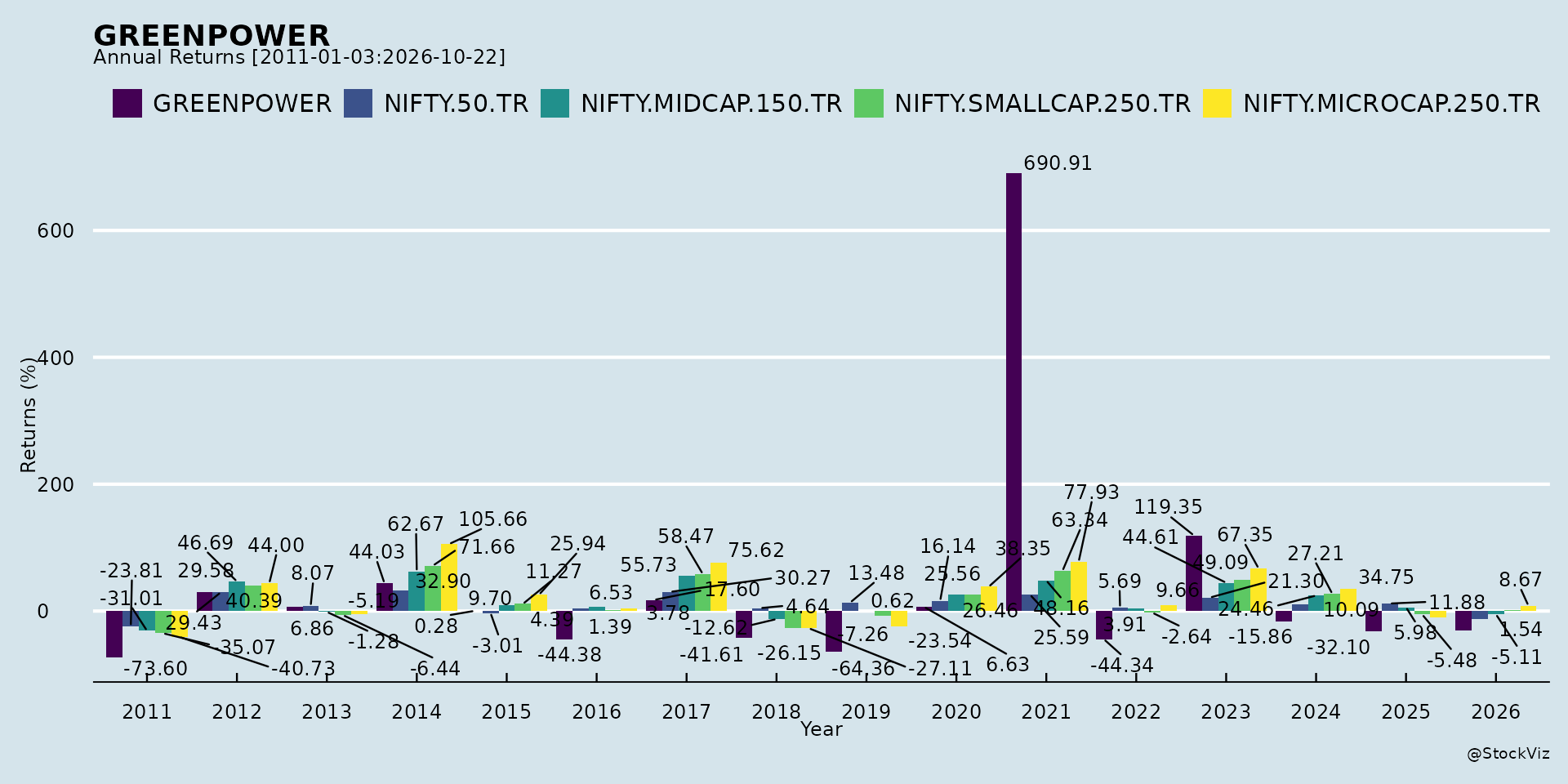
Annual Returns
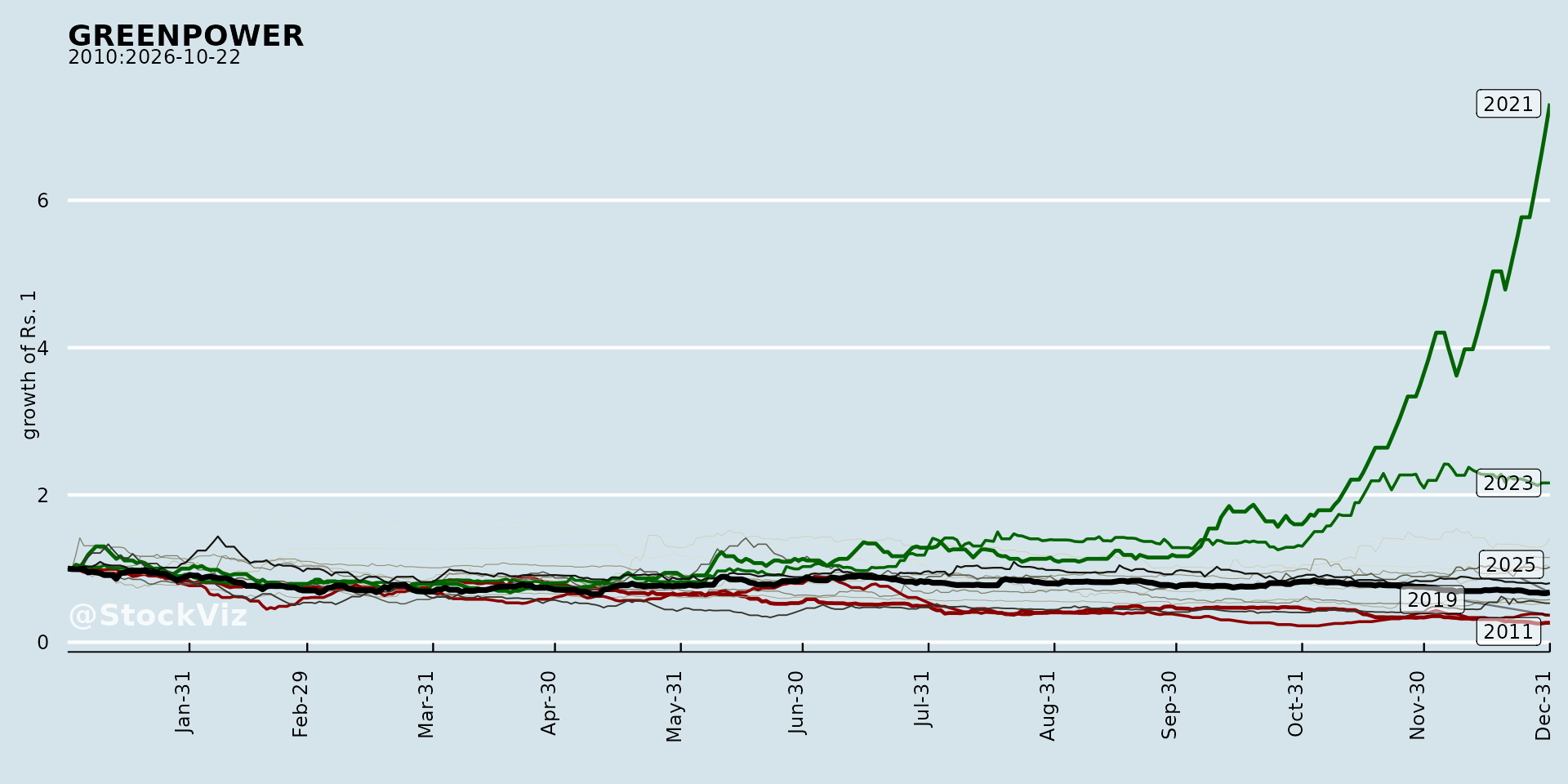
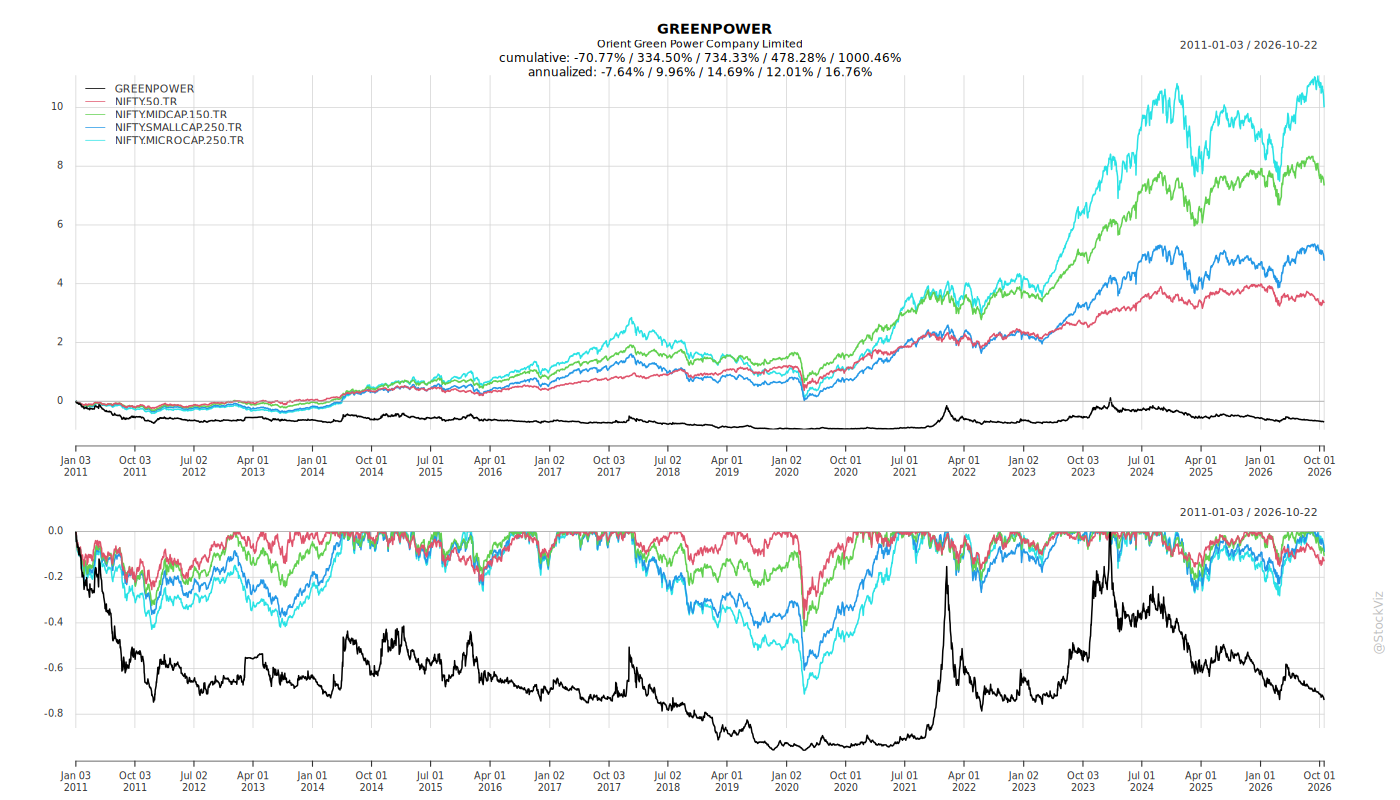
Cumulative Returns and Drawdowns
Fundamentals
Ownership
Margined
AI Summary
asof: 2026-09-18
GREENPOWER: Q1 FY27 Earnings Call and Corporate Announcements Analysis
1. Headwinds and Challenges
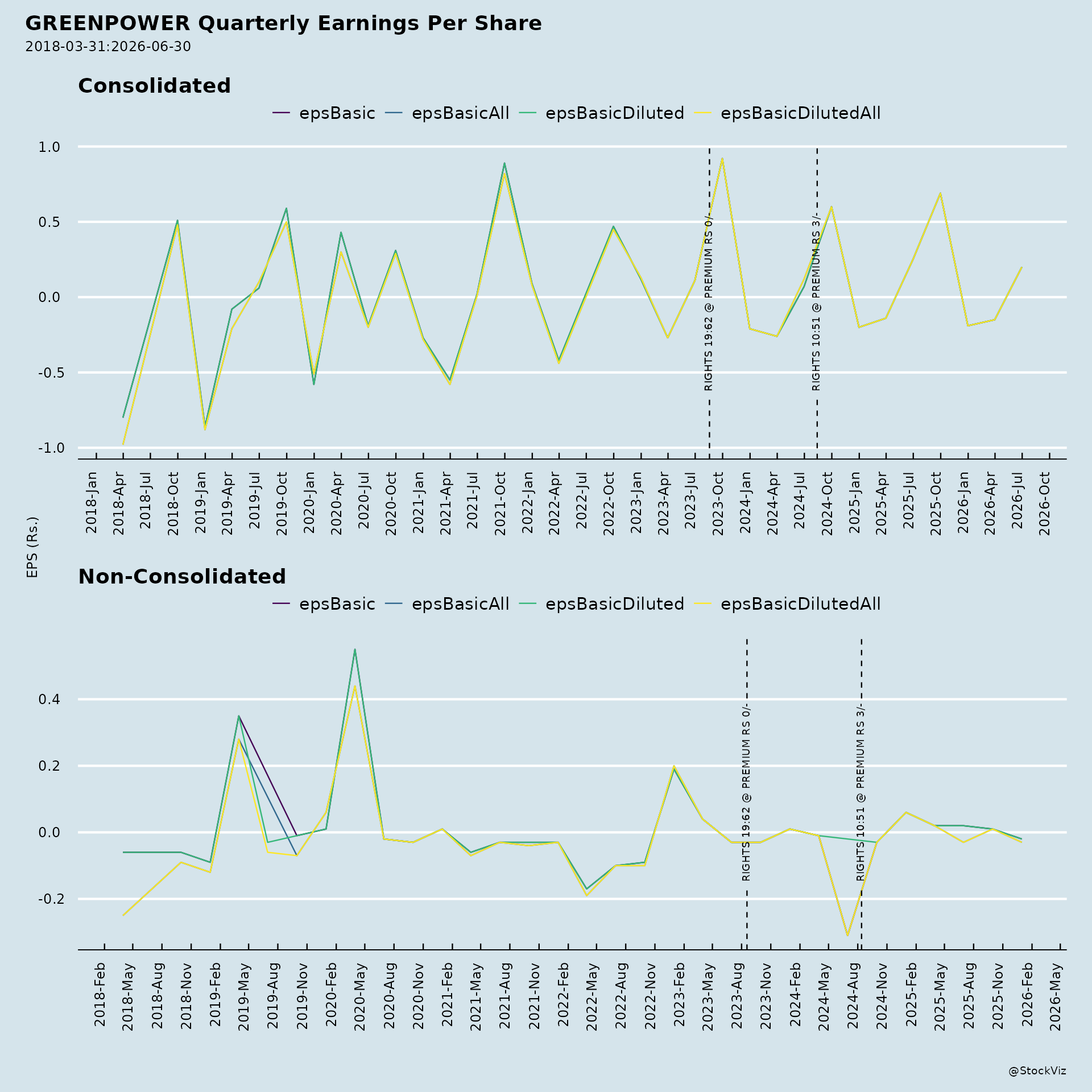
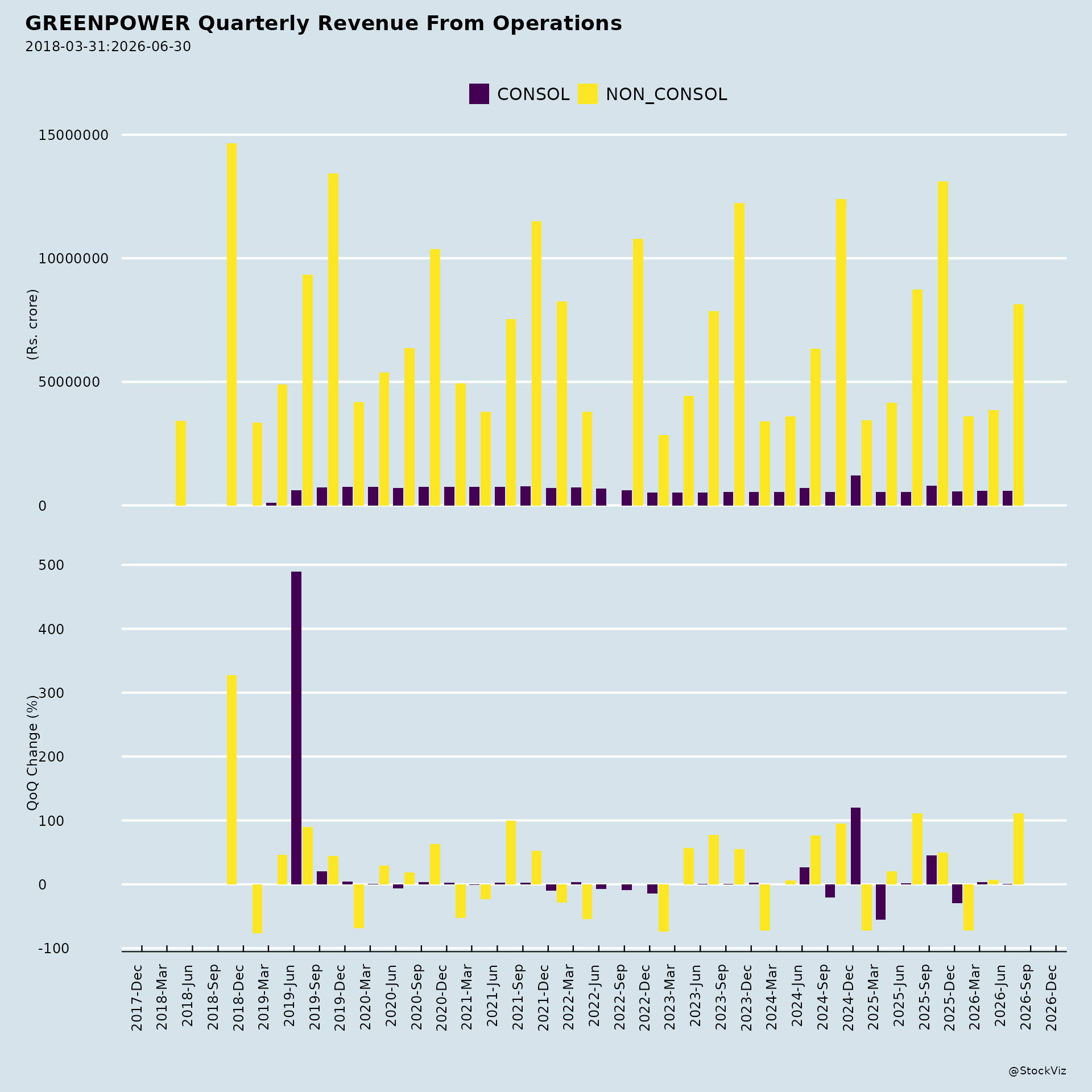
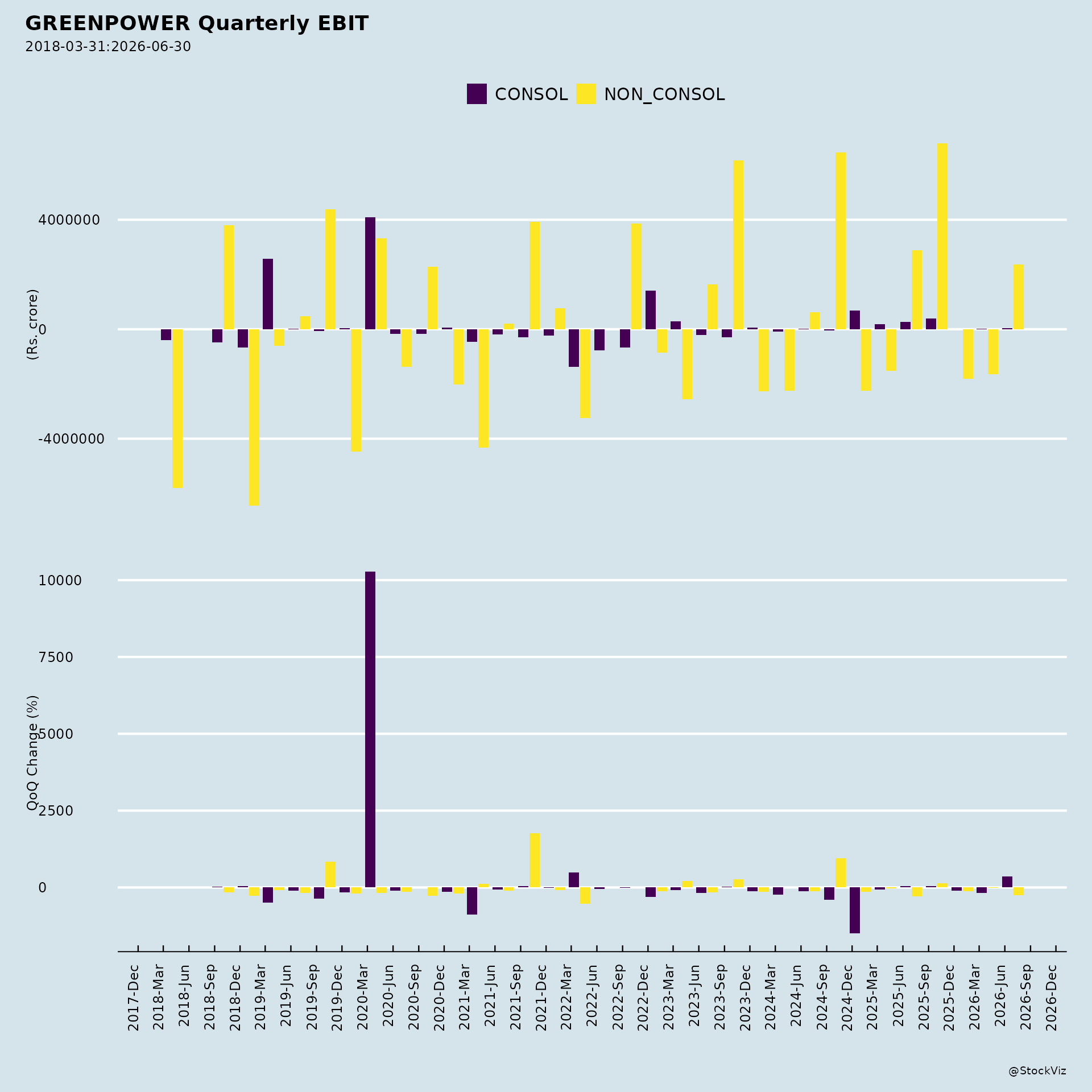
Delayed and moderate wind season: The monsoon was delayed in the current year, pushing back the wind season. The first part of the wind season was muted compared to the previous year. Q1 FY27 revenue from operations and EBITDA were lower by 7% and 9% respectively versus Q1 FY26 due to lower wind availability. PAT came in 16% lower year-on-year.
Reduction in interest income: The rights issue proceeds that were held as deposits in the same quarter last year have now been deployed for project implementation, reducing interest income.
Increase in depreciation: Additional capacity commissioned has increased depreciation, contributing to lower PAT.
Project commissioning delays: The 17.6 MW solar project and 7.8 MW wind repowering project faced delays due to the change of government in Tamil Nadu and certain approval requirements. The original deadline of June 30 was postponed to September 30, 2026.
Capital constraints: The stock price at around Rs. 10 makes further preferential issues or rights issues at the same price difficult. The company cannot expand through debt alone beyond an additional 20–25 MW by leveraging existing assets; equity is required beyond that.
Repowering practical difficulties: Some sites are difficult to repower because of surrounding turbines. At other sites, older turbines still perform well enough that repowering does not make economic sense. Urbanization around certain turbine locations makes the land potentially more valuable as real estate than for wind turbines.
Andhra Pradesh interest dispute: A dispute with the Andhra Pradesh government over interest on delayed payments remains pending. The Andhra Pradesh Electricity Regulatory Commission is currently non-functional due to lack of necessary members. The company has made provisions of about Rs. 6.5 crores on a total outstanding of around Rs. 20 crores (approximately 30%).
Battery storage economics: Battery costs have risen slightly in the last year. Single-cycle charging and discharging makes battery storage economics challenging unless higher customer realization can be achieved. Regulatory clarity on battery storage in Tamil Nadu is still pending.
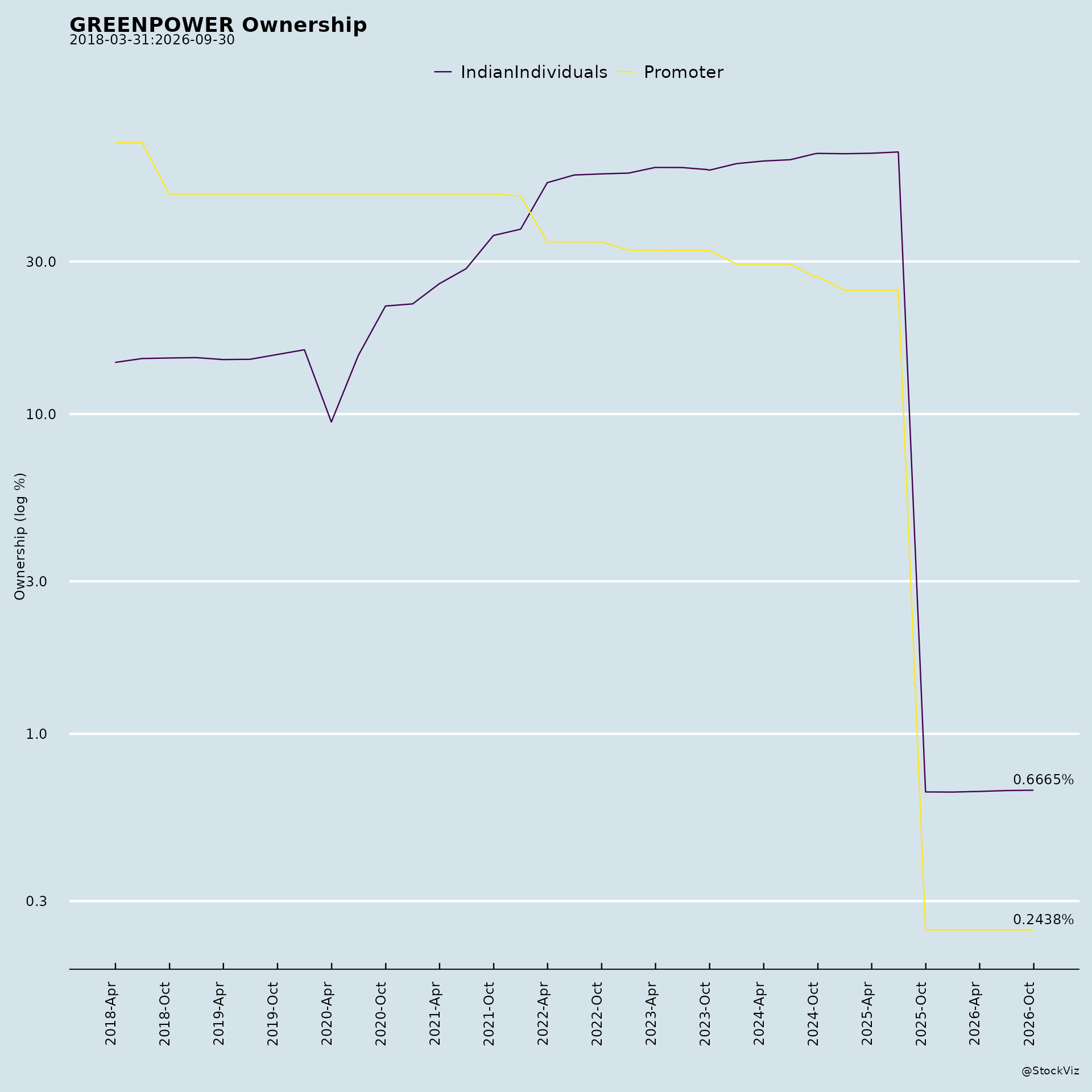
Promoter pledge: The promoter loan taken by pledging shares has installments running up to September 2027. About 40% of the loan has been repaid. Full release of the pledge is hoped for by end of the current financial year if repayment continues at the same pace.
Tamil Nadu regulatory uncertainty: New ministers in Tamil Nadu are still getting a grip on the subject. Clarity on open issues is expected in the next two to three months.
2. Tailwinds and Growth Prospects
Capacity additions already commissioned: A 3.3 MW wind turbine was commissioned at the beginning of Q1 FY27, in addition to two 3.3 MW turbines commissioned in the previous quarter, providing 9.9 MW of incremental wind capacity. A 7 MW solar plant commissioned in December 2025 is also available.
Upcoming capacity additions: The 17.6 MW solar project and 7.8 MW wind repowering project are progressing satisfactorily and are expected to be commissioned by end of September 2026, with generation expected from the second half of FY27.
Improved wind availability in Q2: Wind availability in Q2 to date has been reasonably good, and the company hopes to recover a significant portion of the Q1 shortfall.
Healthy balance sheet and liquidity: Interest costs are under control, and the company is making continuing efforts to reduce the cost of borrowing. The blended interest rate is 9.1%, with efforts to bring it down to around 9%.
Debt repayment: The company will repay around Rs. 90–100 crores of debt in the current year, with year-end debt expected at around Rs. 535 crores.
Tax losses: The company has accumulated losses of about Rs. 800–850 crores, providing a tax cover.
Hybrid potential: The company can potentially add at least another 100 MW of solar on existing wind farm sites as hybrid, subject to land availability and economics.
Demand environment: There are enough opportunities in the wind sector. Industrial customers want to go to 100% renewables, and governments want to buy more renewable power, particularly wind.
Repowering pipeline: Beyond the current 7.8 MW, another 2.8 MW may be taken up next year in Clarion, and around 17.5 MW of repowering is planned in Gamma next year. First-stage repowering totals around 28 MW.
Solar and battery storage plans: The company is looking at solar possibilities and battery storage for existing solar projects, with plans to retrofit BESS for the 25 MW solar project next year. Any further solar will almost certainly include battery storage.
Group captive structure: New projects are structured as group captive, with customers investing 26% equity.
Europe restructuring: The company is liquidating Orient Green Power Europe B.V., a wholly owned subsidiary with no assets, to eliminate an intermediate holding layer and expedite repatriation of assets. The 10.5 MW Croatia asset remains with the company. The Europe business generates about EUR 1 million (approximately Rs. 9 crores) per annum in revenue.
3. Key Risks
Wind variability: Revenue and profitability are dependent on wind availability, which cannot be precisely predicted. The current year’s wind season does not look as good as last year and is probably similar to the year before last.
Regulatory and approval risks: Delays in approvals due to change of government in Tamil Nadu held up projects. Battery storage regulations are still pending. The Andhra Pradesh Electricity Regulatory Commission is non-functional, delaying resolution of the interest dispute.
Capital availability: The biggest hurdle for growth is capital. Traditional private equity investors are now more comfortable investing in unlisted entities than listed entities to avoid mark-to-market losses. The company is in conversations with multiple parties, but no firm outcome has been reached.
Repowering execution risk: Practical difficulties at some sites, including surrounding turbines and urbanization, limit repowering potential.
Battery storage cost risk: Battery costs have gone up slightly, and single-cycle usage makes economics challenging.
Counterparty and receivables risk: The Andhra Pradesh interest receivable remains disputed and provisioned. No material outstanding above 90 days other than the Andhra Pradesh interest outstanding.
Pledge overhang: Promoter shares remain pledged until the promoter loan is repaid, with final due in September 2027.
Cross subsidy surcharge claims: TNPDCL has filed petitions before the Tamil Nadu Electricity Regulatory Commission seeking to declare that certain subsidiaries have not met CGP criteria for certain earlier years and claiming CSS and additional surcharge. Based on legal opinion and CGP compliance certificates, the likelihood of any liability is remote.
REC floor price dispute: A stay granted by the Supreme Court on the CERC order reducing floor price remains in place. The company is confident of a favourable decision and realization of Rs. 2,071 lakhs in receivables as on March 31, 2017, but has made a provision of Rs. 1,621 lakhs for expected credit losses till June 30, 2026.
4. Management Guidance Versus Observed Business Performance
Revenue and EBITDA guidance: Management stated that FY27 revenue and EBITDA should be better than last year, though a lot depends on the monsoon and winds. The company looks to be equal to or better than last year as of now. Management explicitly said it is being conservative because wind cannot be predicted. If wind were as good as last year, the company would be significantly better; given the patchy and delayed monsoon, wind availability is expected to be similar to the year before last, but additional capacity and better machine availability should still result in exceeding last year.
Observed Q1 FY27 performance: Revenue from operations was Rs. 81.43 crores, EBITDA Rs. 60.01 crores, and PAT Rs. 23.94 crores, lower by 7%, 9%, and 16% respectively versus Q1 FY26. This reflects the delayed and moderate wind season, partially mitigated by generation from new capacity.
Margin guidance: Management stated that margins will be sustained because O&M costs are more or less fixed, and interest and depreciation are predictable. Observed EBITDA margin was 70% in Q1 FY27 versus 71% in Q1 FY26.
Interest cost guidance: Quarterly interest cost is around Rs. 13–14 crores, with a blended interest rate of 9.1%. Management expects the blended rate to reach around 9% going forward. The best rate achieved was around 8.2% for old assets from HDFC. Beta’s loan with IREDA has come down from 9.75% to 9.15% over three years, with efforts to reduce another 15 basis points.
Debt guidance: The company will repay around Rs. 90–100 crores of debt in the current year, with year-end debt at around Rs. 535 crores, slightly lower than last year. Net increase in debt is around Rs. 70 crores from last year’s level.
Capacity addition guidance: For FY27, the company is adding 17.5 MW of solar and about 7.8 MW of wind, plus the 3.3 MW already added, totaling about 11 MW of wind and about 15 MW of solar this fiscal. For FY28, the company expects to add 15–20 MW of repowered assets, with better clarity towards the middle of Q3.
Commissioning timeline guidance: The 17.6 MW solar and 7.8 MW wind repowering projects were originally targeted for June 30, 2026, but the revised date of commencement of commercial production is September 30, 2026, subject to receipt of necessary approvals. Management stated both are proceeding as per plan and are expected to be commissioned by end of September 2026.
1 GW target: The company had set a target of 2028 for 1 GW. Management stated it is still working on it, looking at brownfield or acquisition possibilities, but expansion has been slower than anticipated. The 1 GW will be a combination of inorganic and organic growth, with inorganic likely more wind than solar because solar projects are relatively new and expensive for acquisition.
Shareholder value initiatives: Management stated it is evaluating multiple options, including fund raising, acquisitions, and mergers, but cannot discuss specifics until something reaches a stage to take to the Board and shareholders. The company is in conversations with multiple parties, but no firm outcome has been reached.
Promoter pledge guidance: Management stated the pledge should be released shortly, with conditions now over. The CFO clarified that the promoter loan installments run up to September 2027, and about 40% has been repaid. Full release is hoped for by end of the current financial year if repayment continues at the same pace.
Andhra Pradesh provision guidance: The company is making a provision of about 5–6% on the exposure on an annual basis, with around Rs. 6.5 crores provided on Rs. 20 crores (approximately 30%). Management is certain the money will be collected over time once APERC starts functioning.
AGM resolutions: All five resolutions put to shareholders at the 19th AGM held on July 22, 2026 were passed with requisite majority, including adoption of financial statements, re-appointment of Mr. T. Shivaraman and Mr. R. Ganapathi as directors, approval of material related party transactions, and approval to advance loans/give guarantees/provide security under Section 185.
Copyright © 2023 SAS Data Analytics Pvt. Ltd. All rights reserved.