GODIGIT
Equity Metrics
October 23, 2026
Go Digit General Insurance Limited
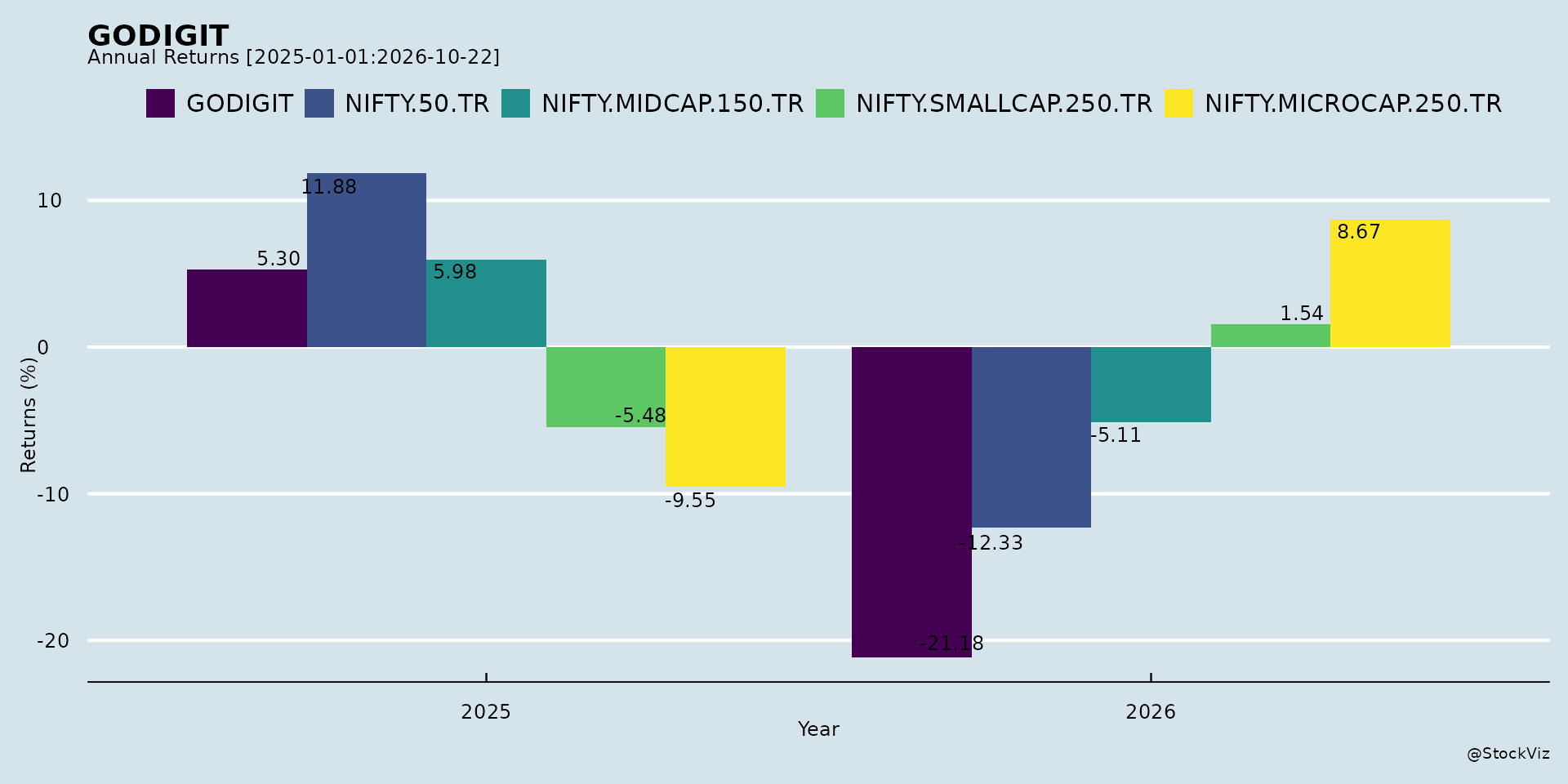
Annual Returns

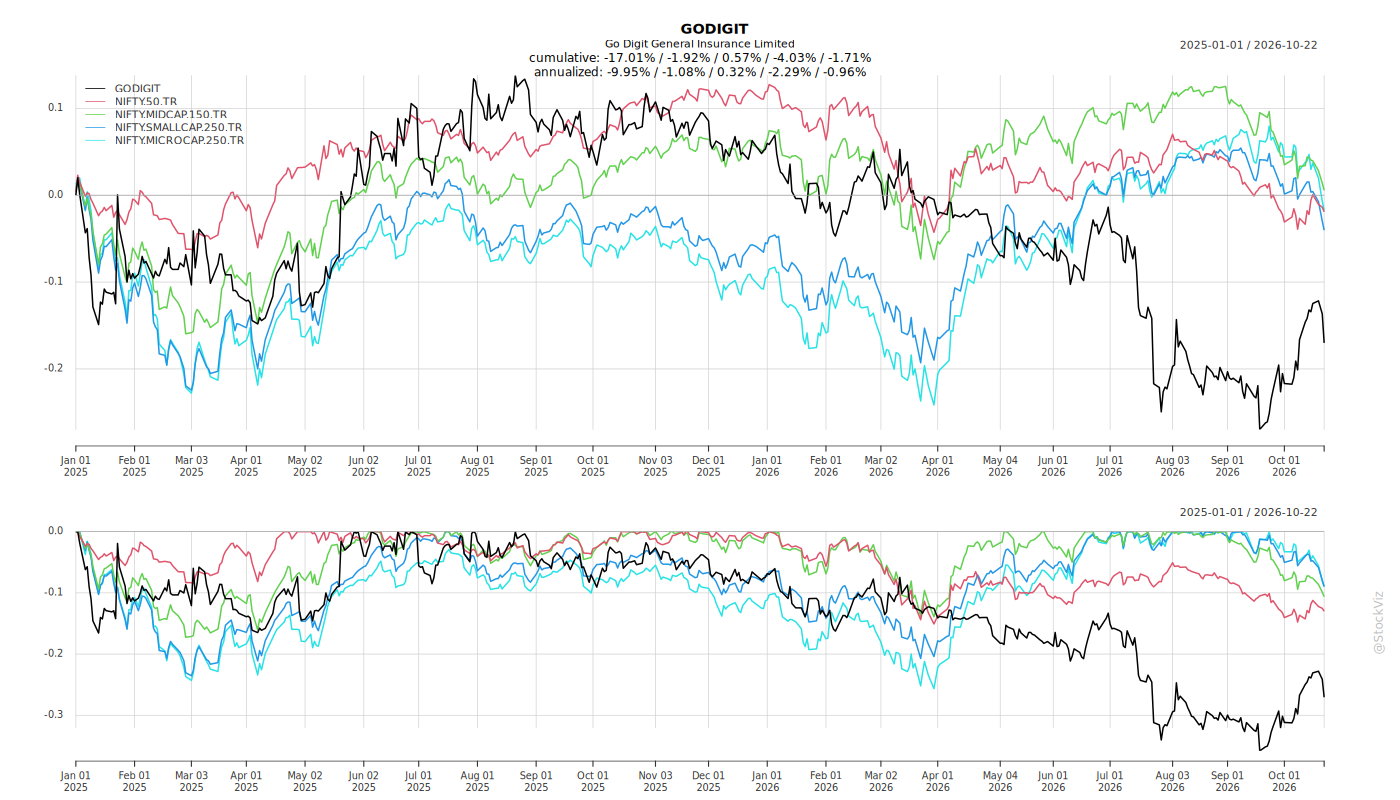
Cumulative Returns and Drawdowns
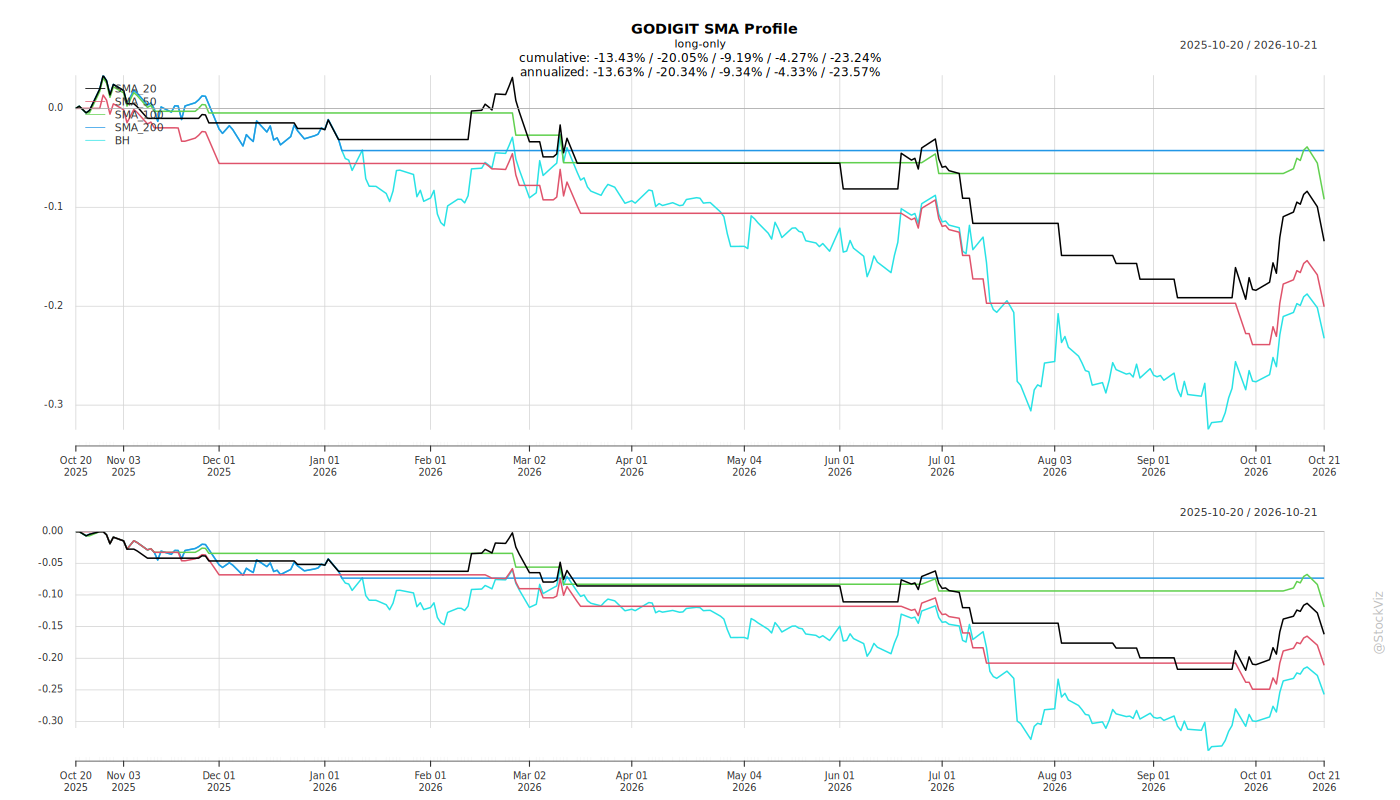
Fundamentals
Ownership
Margined
AI Summary
asof: 2026-09-16
GODIGIT: Recent Corporate Announcements — Summary
1. Headwinds and Challenges
- Regulatory transition to Ind AS: The Ministry of Corporate Affairs notified Ind AS 117 (Insurance Contracts) effective for annual reporting periods beginning on or after April 1, 2024. IRDAI’s amendment regulations (notified March 30, 2026) require Ind AS implementation from April 1, 2026. Although the Company states it is fully Ind AS-ready operationally, actuarially, financially and from a systems standpoint — and has prepared audited special-purpose Ind AS financial statements for FY2025-26 — certain material income-tax implications arising from Ind AS adoption remain unresolved. The Board has therefore decided to seek one-year forbearance for FY2026-27, and subject to IRDAI approval will continue preparing statutory financial statements under IGAAP while disclosing Ind AS Proforma Financial Information.
- Competitive intensity and macro factors: The MD & CEO’s message notes the year was marked by regulatory transition, competitive intensity and various macro factors.
- Global uncertainty: The Chairman’s message cites geopolitical tensions, changing trade policies and volatility in financial markets through the year.
- Deterioration in combined ratio: The combined ratio rose to 110.7% in FY2025-26 from 109.3% in the previous year. The loss ratio was broadly flat at 72.9% (versus 72.8%), while the net retention ratio declined to 73.7% from 80.0%.
- Tax impact on PAT growth: PAT growth (28%) was lower than PBT growth (48.7%) due to a 13.8% tax rate in FY2025-26, compared to nil tax in the previous financial year.
- AGM rescheduling: The 10th AGM was rescheduled from August 6, 2026 to August 18, 2026, with corresponding revisions to the cut-off date and remote e-voting window.
- Dissenting votes at the AGM: While both resolutions passed with the requisite majority, Resolution No. 2 (re-appointment of Gopalakrishnan Soundarajan as director retiring by rotation) saw 19.22% of Public Institutions’ votes cast against, and 3.53% of total votes polled against.
2. Tailwinds and Growth Prospects
- Industry momentum: Indian non-life insurance gross direct premium income crossed ₹3.5 trillion, with growth improving to 9.3% from 6.2% the prior year. The Company’s own GDP grew 16.2% to ₹9,846 crore.
- Company growth: Gross Written Premium grew 9.8% to ₹11,294 crore; Profit Before Tax rose 48.7% to ₹632 crore; PAT rose 28% to ₹544 crore. AUM increased 16.3% to ₹22,922 crore, and the solvency ratio improved to 2.42x from 2.24x. Market share stood at 3.4% overall and 6.3% in motor.
- Structural opportunity: The Chairman notes India’s insurance penetration remains low, with reforms such as 100% FDI and the launch of Bima Sugam potentially resetting the industry operating model, aligned with the IRDAI mission of ‘Insurance for All by 2047’.
- Product innovation: Climate-linked parametric insurance initiatives included heat-based protection for migrant labourers and one of India’s first moisture index-based parametric insurance claims paid to farmers in Rajasthan.
- Operational agility proof points: 83% of cashless health requests approved within 30 minutes (average pre-authorisation TAT 21.38 minutes); average discharge approval TAT of 58.03 minutes with 86.4% within 90 minutes; average motor repair approval TAT of 15 hours 44 minutes; 75% of domestic non-medical travel claims processed through automation; 99.68% system reliability with 80% reduction in downtime.
- Digital and partner ecosystem: 99.63% digital policy issuances, 2,602 total APIs, 81,124 partners, and 4.7 lakh customers served on WhatsApp (with customers who used WhatsApp and still called the call centre dropping to 11% from 29%).
- Credit rating upgrade: CRISIL upgraded the Company’s Corporate Credit Rating to ‘CRISIL AA-/Stable’ from ‘CRISIL A+/Positive’ (letter dated September 17, 2025), later reaffirmed at ‘CRISIL AA-’ and placed under ‘Rating Watch with Developing Implications’ (December 31, 2025), and reaffirmed again on March 31, 2026.
- Proposed amalgamation: The Board approved a scheme of amalgamation of Go Digit Infoworks Services Private Limited into the Company (December 19, 2025), intended to simplify the holding structure, reduce shareholding tiers and administrative overheads, and strengthen the ownership structure — subject to stock exchange, creditor, member, CCI, IRDAI and NCLT approvals.
3. Key Risks
- Regulatory and tax risk: Unresolved income-tax implications from Ind AS adoption, and the outcome of the forbearance application to IRDAI, affect the statutory reporting framework for FY2026-27.
- Execution risk on the amalgamation: The scheme is conditional on multiple approvals (stock exchanges, creditors, members, CCI, IRDAI, NCLT) and becomes effective only upon filing of certified NCLT sanction orders with the Registrar of Companies.
- Underwriting and claims risk: The combined ratio above 100% (110.7%) indicates underwriting losses, with loss ratio at 72.9%.
- Macro and market risk: The annual report’s forward-looking statement disclaimer flags economic and market conditions, catastrophe and claims experience, reinsurance, solvency and expenses-of-management requirements, competitive intensity, and IRDAI/SEBI regulatory changes (including the Ind AS transition) as risks that could cause actual results to differ materially.
- Brand licensing transition: Trademarks ‘DIGIT’ and ‘GO DIGIT’ were assigned by the holding company to Go Digit Solutions Private Limited (a Promoter Group entity); the existing brand licence agreement was terminated and a new one executed with the new proprietor. The Board states this ensures continuity of brand usage with no adverse impact.
- Governance-related dissent: The 19.22% against votes from Public Institutions on the director re-appointment resolution represents a notable level of institutional dissent.
4. Management Guidance Versus Observed Business Performance
- Ind AS readiness: Management states the Company is fully Ind AS-ready and has prepared audited special-purpose Ind AS financial statements for FY2025-26, with Ind AS profit and loss results for FY2025-26 declared in the Q4 Investor Presentation. However, the Company has decided to seek one-year forbearance for FY2026-27 due to unresolved income-tax implications — meaning statutory reporting will remain on IGAAP in the interim, with parallel Ind AS Proforma disclosures.
- Growth and profitability: The stated FY2025-26 outcomes — GWP of ₹11,294 crore, PAT of ₹544 crore, AUM of ₹22,922 crore, solvency of 2.42x — align with the Chairman’s and MD & CEO’s characterisation of the year as one of “disciplined” and “profitable” growth.
- Customer experience commitments: Management’s emphasis on speed paired with empathy is supported by disclosed metrics: customer satisfaction scores of 95.7% (motor claims) and 83.3% (non-motor claims), 95% first-time resolution on helpdesk calls, and 40.6 lakh claims settled since inception.
- Capital and balance sheet: The stated improvement in solvency to 2.42x from 2.24x and net worth growth to ₹4,58,641 lakhs from ₹4,03,292 lakhs are consistent with the “stronger balance sheet” narrative.
- Dividend: The Directors do not recommend any dividend for FY2025-26.
- AGM outcomes: Both resolutions placed before the 10th AGM (adoption of audited financial statements for FY ended March 31, 2026, and re-appointment of Gopalakrishnan Soundarajan) were approved with the requisite majority, with total votes in favour at 99.99% for Resolution 1 and 96.47% for Resolution 2.
Broker Narrative
The broker kept a Sell stance from first to last report, and the persistent themes were stagnant TP tariffs, pricing competition/health underwriting strain, and a difficult industry environment. The narrative changed by making the P&L frictions more explicit—two-wheeler commission accounting, EV claims, and Government Mass Health loss ratios—while acknowledging some mitigants such as Motor OD share gains, GST-driven growth, expense-ratio improvement, and DAC unwind. Earlier Sell calls were disappointed by positive returns, but the last horizon produced a -30% actual return, vindicating the bearish thesis.
Fears that came true
- The absence of TP rate hikes persisted and was cited in the last report alongside four years of intense pricing competition, coinciding with the -30% actual return.
- The aggressive-pricing/health competition risk materialized via the Government Mass Health segment’s 90-95% loss ratio, which hurt overall health loss ratios.
- The difficult-industry-environment risk showed up as a Q2FY26 claims ratio of 73% (up 240bps YoY) and a PAT slightly below estimate.
Optimism that failed
- The AI/data-science underwriting optimism was contradicted by significantly higher EV claims than ICE vehicles, with EV Motor OD loss ratios ~25% higher and premiums appearing underpriced.
Broker Timeline
4 broker calls · 2025-02-18 to 2025-10-29
Copyright © 2023 SAS Data Analytics Pvt. Ltd. All rights reserved.