DABUR
Equity Metrics
October 23, 2026
Dabur India Limited
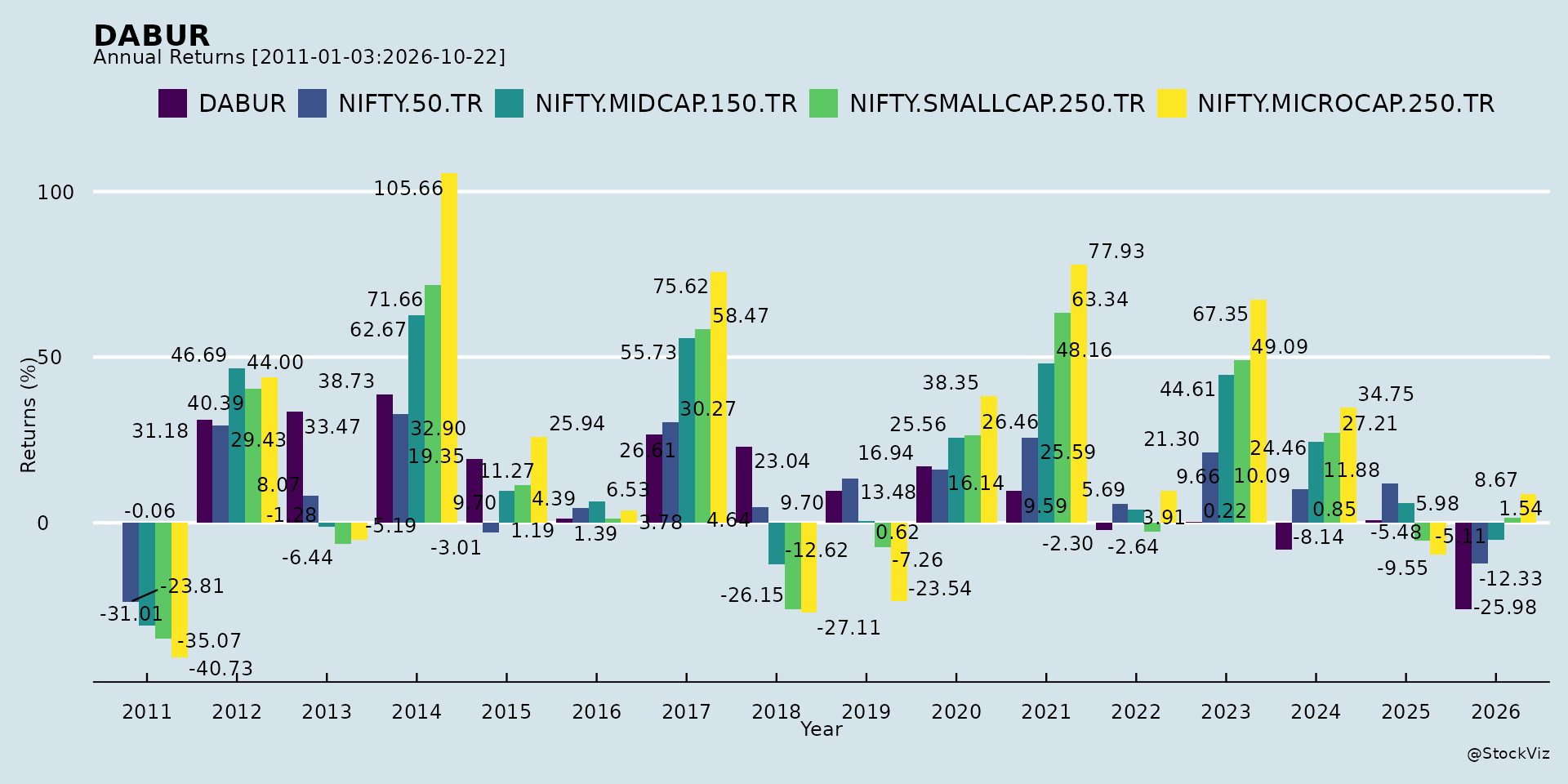
Annual Returns
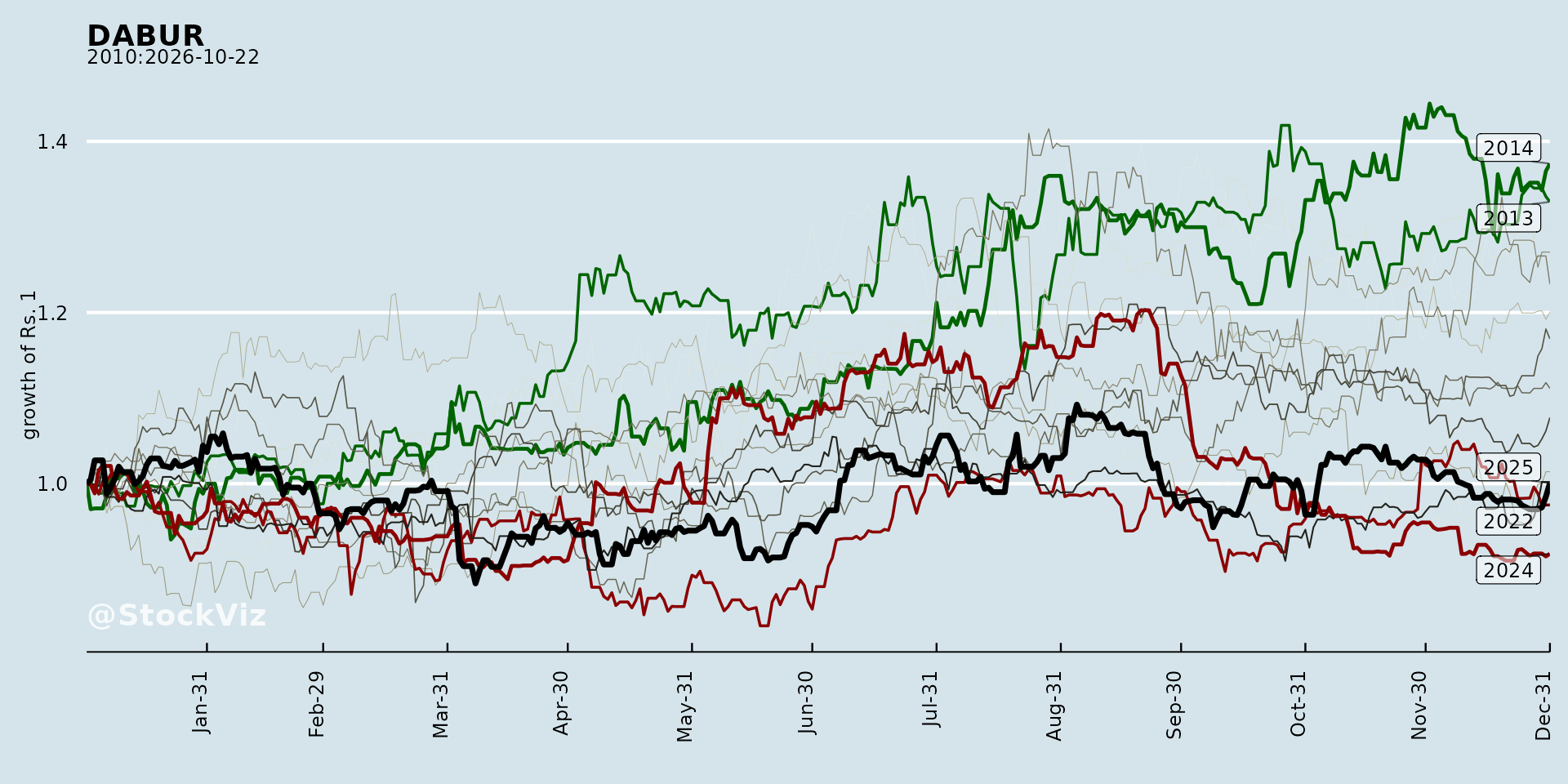
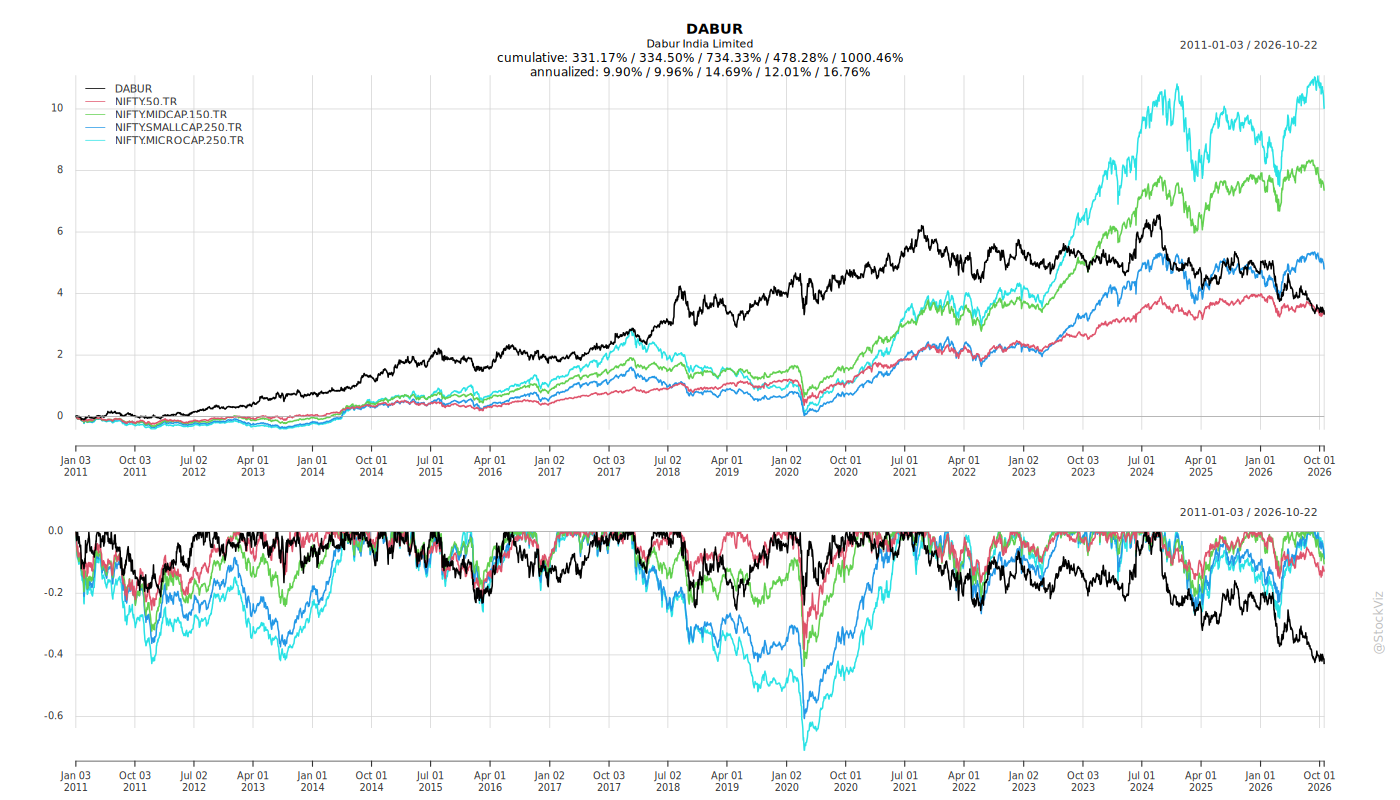
Cumulative Returns and Drawdowns
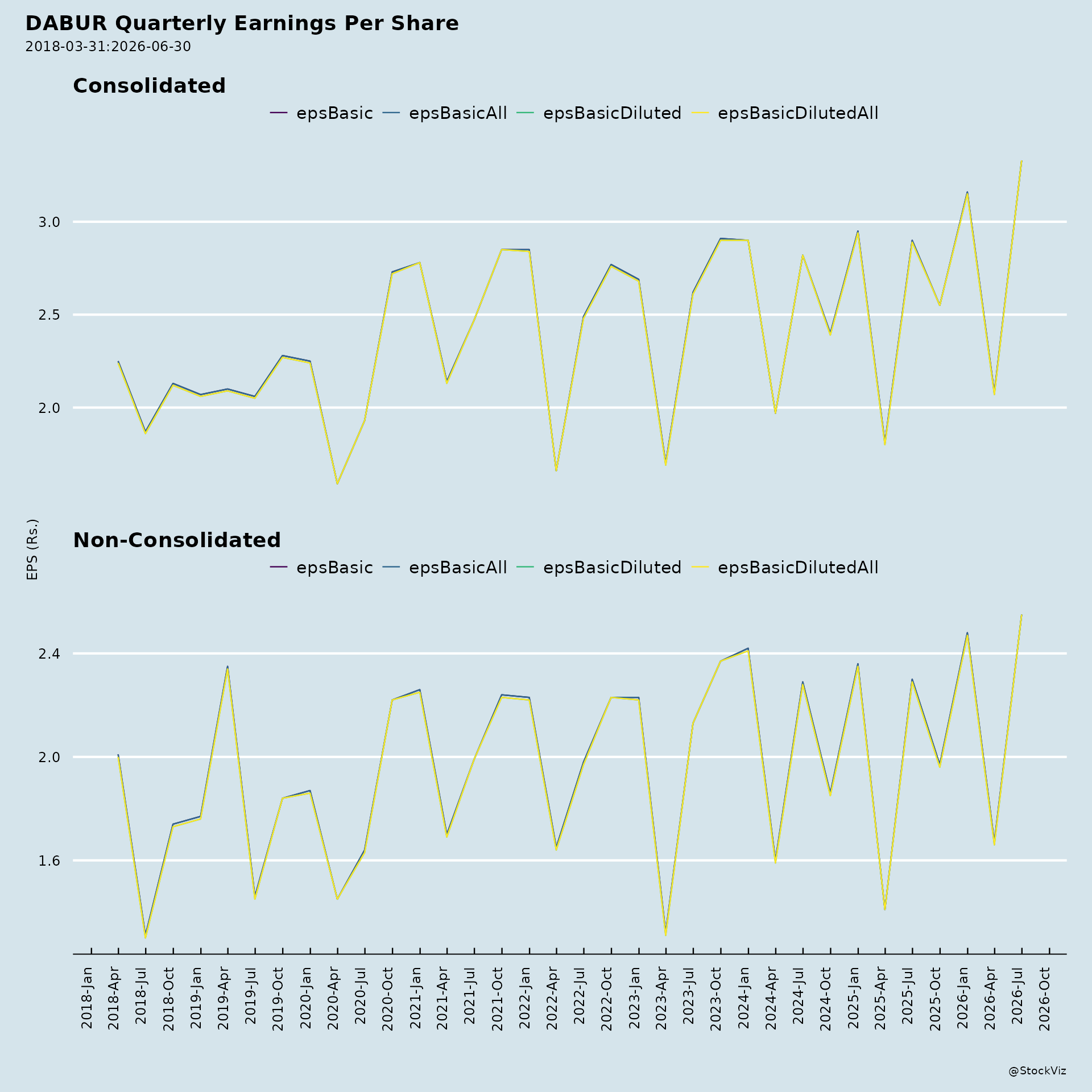
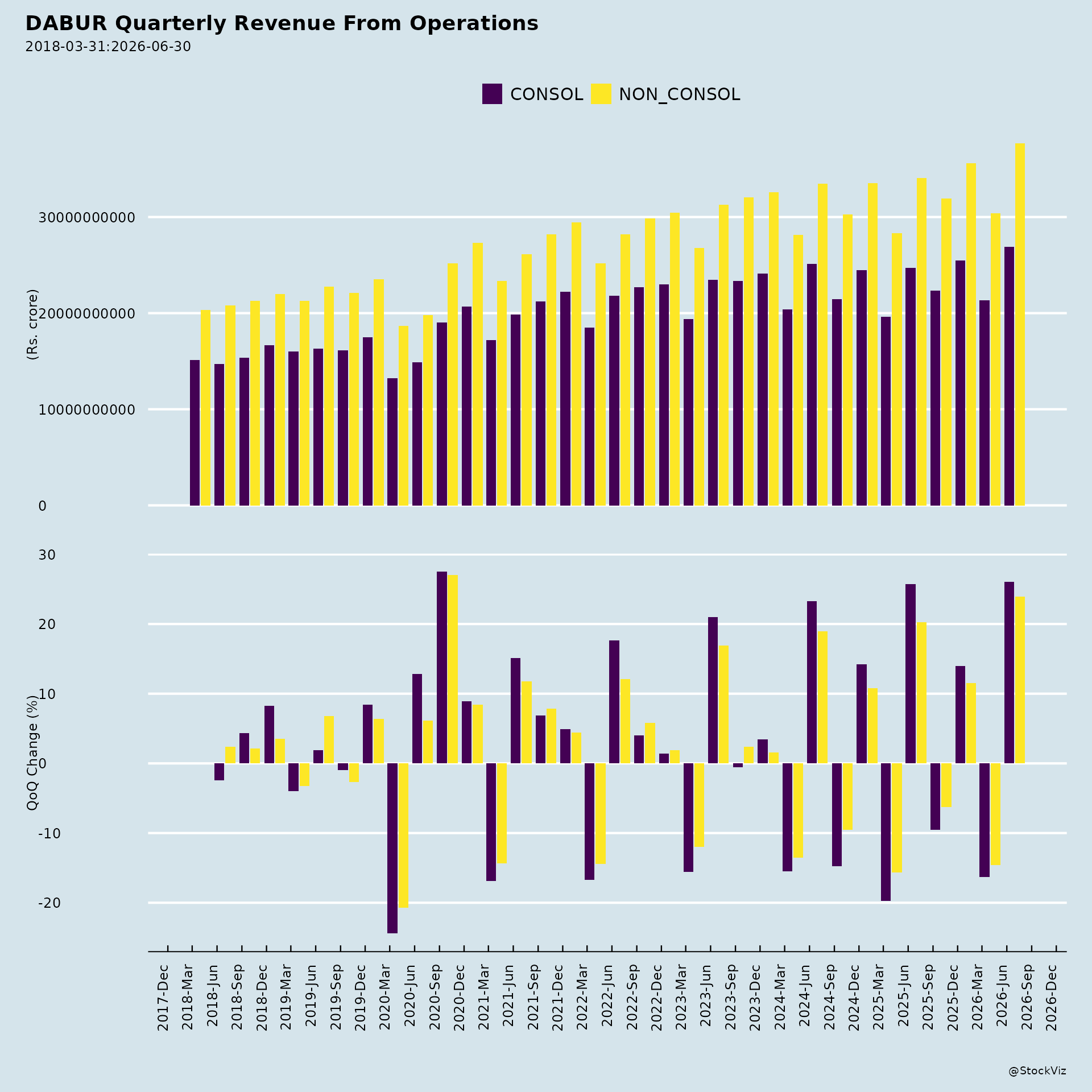
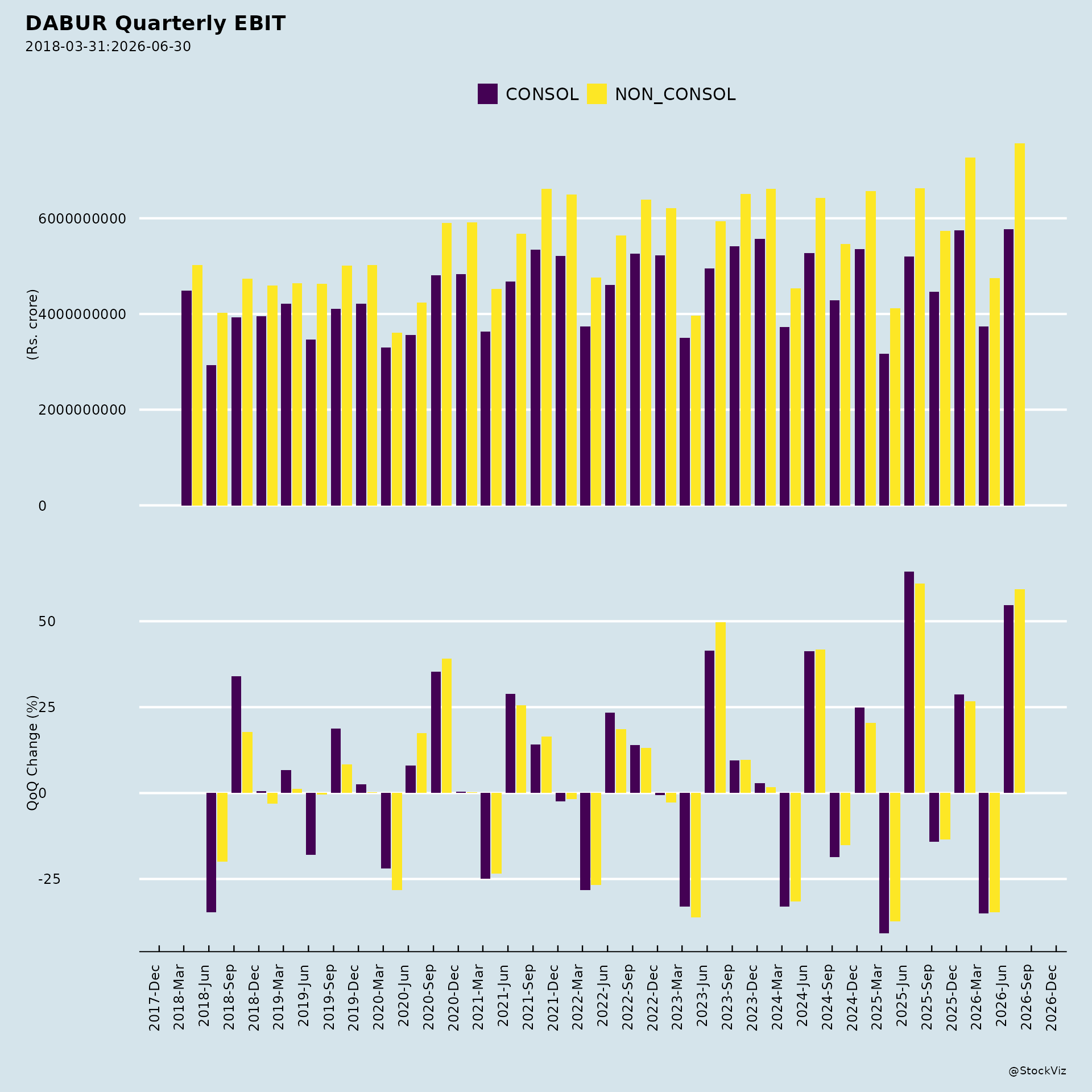
Fundamentals
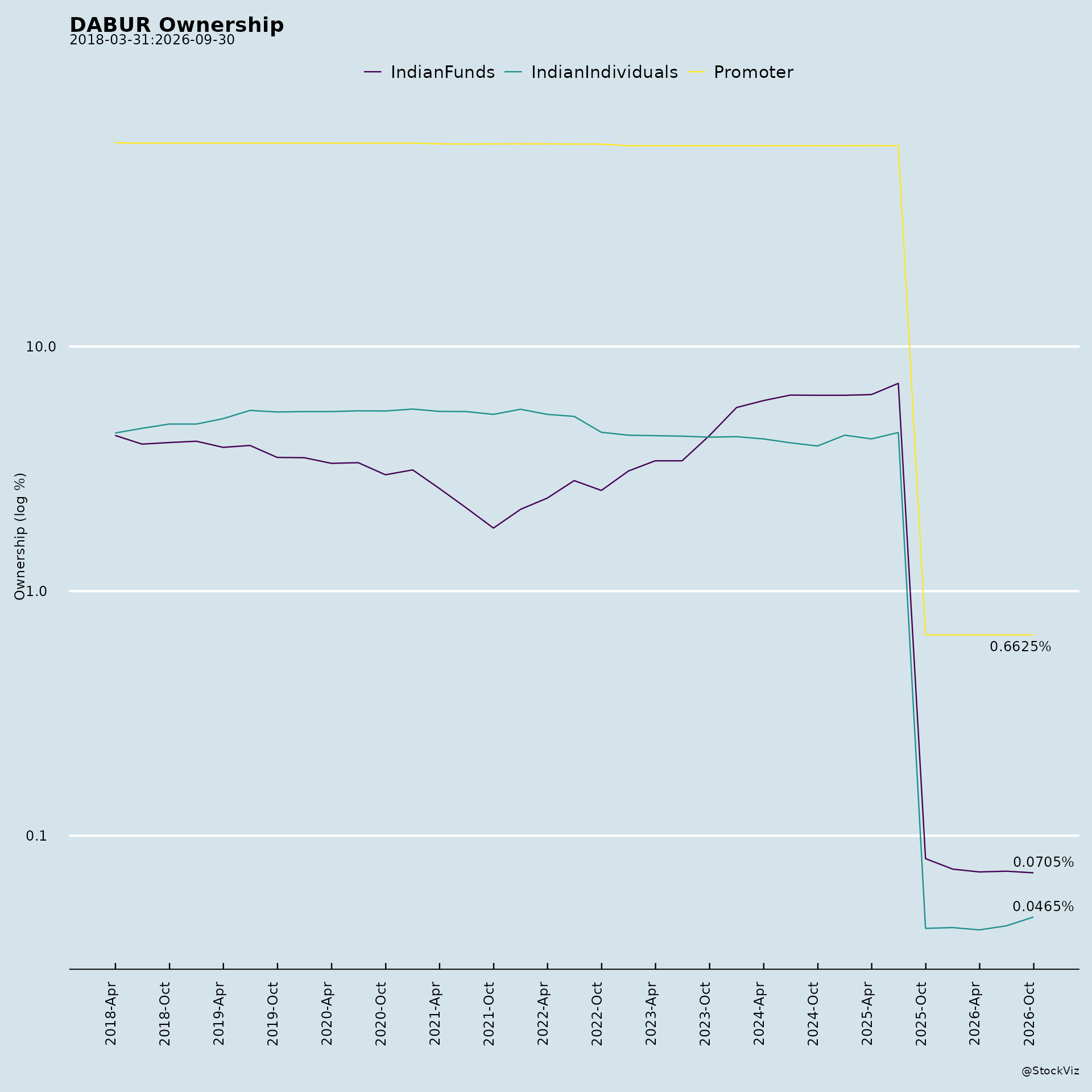
Ownership
Margined
AI Summary
asof: 2026-09-16
Dabur India — Recent Corporate Developments
1. Headwinds and Challenges
- Inflationary and geopolitical backdrop: Q1 FY27 unfolded against persistent inflationary pressures, heightened geopolitical uncertainties in the MENA region, and volatile commodity markets, described as a “hyper-inflationary environment.”
- Rural demand caution: Although rural outperformed urban for the eighth consecutive quarter, management flagged that rural demand needs to be watched given El-Nino, patchy monsoons, and rising inflationary pressures.
- Supply chain disruption: The Home Care business grew 6% despite supply chain disruptions due to the Middle East war; the MENA business grew 8.6% despite war-related disruptions.
- Beverages seasonality: The Beverages business had a challenging start to the season due to rain-led demand disruptions, though it recovered to mid-single-digit growth for the quarter.
- Regulatory action: An FSSAI order dated August 03, 2026 prohibited the use of ‘100%’ in a few of the company’s food products and the sale of such products. The Delhi High Court re-notified the matter for listing on December 16, 2026, and the stay granted against the FSSAI order continues to remain in force.
2. Tailwinds and Growth Prospects
- Profit momentum: Q1 FY27 marked the third straight quarter of double-digit profit growth; Net Profit rose 15% to Rs 591 Crore on Consolidated Revenue of Rs 3,761–3,764 Crore (up 10.6%), with India FMCG growing 9.5% on underlying volume growth of 5% and Operating Profit up 11%.
- Broad-based vertical growth: HPC grew 12.3%, F&B 7.2%, and Healthcare 5.5%. Within HPC, Shampoo grew 23%, Hair Oils 17.6%, Oral Care 9%, toothpowder 13.1%, and Skin & Salon 8.1%. In Healthcare, Digestives grew 11.2%, Honitus 28%, Health juices 24%, and Dabur Honey 8%. Foods grew 29.2% and Badshah 13.2%.
- Premiumisation and innovation: Premium brands grew at twice the pace of regular brands; new products contributed 2.6% of Revenue in Q1. Recent launches such as Siens and Cheers strengthened presence in emerging segments. Premium beverages scaled with Real Activ Juices up 42% and Coconut Water up 73%.
- International business: Grew 15.5% in INR terms, with Bangladesh up 34.3%, Egypt 28.4%, Sub-Saharan Africa 28%, Turkey 26.9%, UK 21.9%, and MENA 8.6%.
- Channel expansion: Quick Commerce grew 55.6%; new-age channels contribute 21% of sales; e-commerce contributes approximately 9%. Rural demand grew 6.2% versus urban 4.6% (170 bps ahead) per syndicated data.
- Market share: Gains across over 90% of the portfolio during the quarter.
- Capacity: Operations at the new manufacturing location at Tindivanam are expected to start by the end of FY27.
3. Key Risks
- The FSSAI prohibitory order on use of ‘100%’ in certain food products and sale of such products, currently stayed by the Delhi High Court, with the matter listed for December 16, 2026.
- Continued inflationary pressures and volatile commodity markets.
- Geopolitical uncertainty in the MENA region and associated war-related disruptions.
- Monsoon-related risks (El-Nino, patchy monsoons) affecting rural demand and seasonal categories such as Beverages.
4. Management Guidance vs. Observed Performance
- Guidance/forward-looking statements: Management expects premiumisation to play an increasingly important role in shaping the next phase of growth, driving market expansion and margin enhancement. Operations at the new Tindivanam manufacturing location are expected to start by the end of FY27. Any material update on the FSSAI matter will be intimated to the stock exchanges in due course.
- Observed performance against stated strategy: Management attributed healthy profit growth to disciplined cost management under Project Samriddhi, operational efficiencies, and judicious price increases; these translated into 11% Operating Profit growth and 15% Net Profit growth in Q1 FY27. The stated focus on premiumisation and innovation is reflected in premium brands growing at twice the pace of regular brands and innovation contributing 2.6% of Revenue. The stated strategic focus on emerging channels is reflected in Quick Commerce growth of 55.6% and new-age channels contributing 21% of sales.
5. Key Investor Facts
- FY26 (consolidated): Revenue INR 13,193 Cr, operating profit INR 2,452 Cr, PAT INR 1,895 Cr; net cash INR 84 Bn as of March 31, 2026; net worth INR 118 Bn; return on invested capital 42%; dividend paid INR 14.6 Bn with a payout ratio of 77%.
- Q1 FY27 (consolidated): Revenue INR 3,764 Cr (+10.6% YoY), operating profit INR 741 Cr (+11.0% YoY), PAT INR 591 Cr (+15% YoY).
- Scale: Among the top 4 FMCG companies in India; 8 out of 10 households consume its products; distribution reach of approximately 8.5 million outlets; 21 manufacturing facilities; ESG Crisil score of 83 (strong category).
- Dividend (FY26): Interim dividend of Rs 2.75 per equity share (@275%) confirmed and final dividend of Rs 5.50 per equity share (@550%) declared, both approved at the AGM.
- AGM (held 06-08-2026): All 7 resolutions passed. Re-appointment of Mr. Saket Burman as director saw 4.2407% of Public-Institution votes against; re-appointment of Mr. Rajiv Mehrishi as Non-Executive Independent Director saw 3.2582% of Public-Institution votes against; modification of the term of Mr. Mukesh Hari Butani as Non-Executive Independent Director saw 11.1531% of Public-Institution votes against.
- Investor engagement: Participation in the Anand Rathi Annual Flagship Conference G-200 Summit 2026 on September 21, 2026, and the J. P. Morgan India Conference 2026 on September 22, 2026, with no unpublished price sensitive information to be disclosed.
- Disclosure framework: Updated contact details of Key Managerial Personnel authorized for determining materiality of events and for disclosures under Regulation 30(5) of the SEBI Regulations, 2015.
Broker Narrative
The broker arc runs from a 2022-06-09 Buy built on digital-adoption tailwinds (rising internet penetration, ecommerce salience, post-pandemic digital acceleration) and fears of inflation/unit-economics, lower liquidity and venture-funding stress, to a 2026-07-29 Hold that has abandoned the digital thesis and now cites Super El Nino, unseasonal rains and a ~14-15% rainfall deficit plus India/Middle East geopolitics as the headwinds. The one persistent theme is consumer demand, which matured from ‘robust demand in niche consumer areas’ into hair oil (+18%), food and rural markets that still outpace urban, with steady margins via cost savings and premiumization — the cost-savings emphasis echoing the early inflation/unit-economics worry. What changed is the risk map: digital liquidity/CAC/venture-funding fears vanished, replaced by monsoon and geopolitical shocks. Predicted targets stayed mostly positive (+1% to +27%) while actuals, after a brief mid-2023 positive spell (last positive actual +3.3% on 2023-11-02), were uniformly negative (-0.9% to -41.5%), turning the overwhelming majority of calls into DISAPPOINTMENT.
Fears that came true
- Higher inflation impacting unit economics is the one early headwind the later reports corroborate: the 2026-07-29 report still leans on cost savings and premiumization merely to hold margins, and actual returns stayed negative across the span (-20.4% at the 2022-06-09 Buy and -13.7% at the 2026-07-29 Hold, with DISAPPOINTMENT on nearly every positive call), whereas the early digital-era fears (lower liquidity, high digital customer-acquisition cost, venture funding drying up on rising rates) are never evidenced in Dabur’s FMCG results.
Optimism that failed
- Rising internet penetration never translated into Dabur returns: after a brief positive spell in mid-2023 (actuals +14.1% on 2023-08-03 and +18.1% on 2023-09-16), actuals turned negative and stayed there, so the structural tailwind failed to show up in price.
- Ecommerce salience produced the same reversal: every Buy/Add/Accumulate leaning on digital salience from late 2023 onward was a DISAPPOINTMENT with negative actuals (e.g., Yes Securities 2023-11-02 predicted +20.8% vs -26.4% actual; 2024-08-01 predicted +18.8% vs -39.9% actual).
- The post-pandemic acceleration of digital adoption did not lift the stock, with predicted gains of roughly +12% to +27% repeatedly reversing into negative actuals (e.g., Motilal Oswal 2024-05-02 predicted +23.8% vs -7.7% actual; Anand Rathi 2026-07-29 predicted +27.0% vs -13.7% actual).
Broker Timeline
71 broker calls · 2022-06-09 to 2026-07-29
Copyright © 2023 SAS Data Analytics Pvt. Ltd. All rights reserved.