BEL
Equity Metrics
September 24, 2026
Bharat Electronics Limited
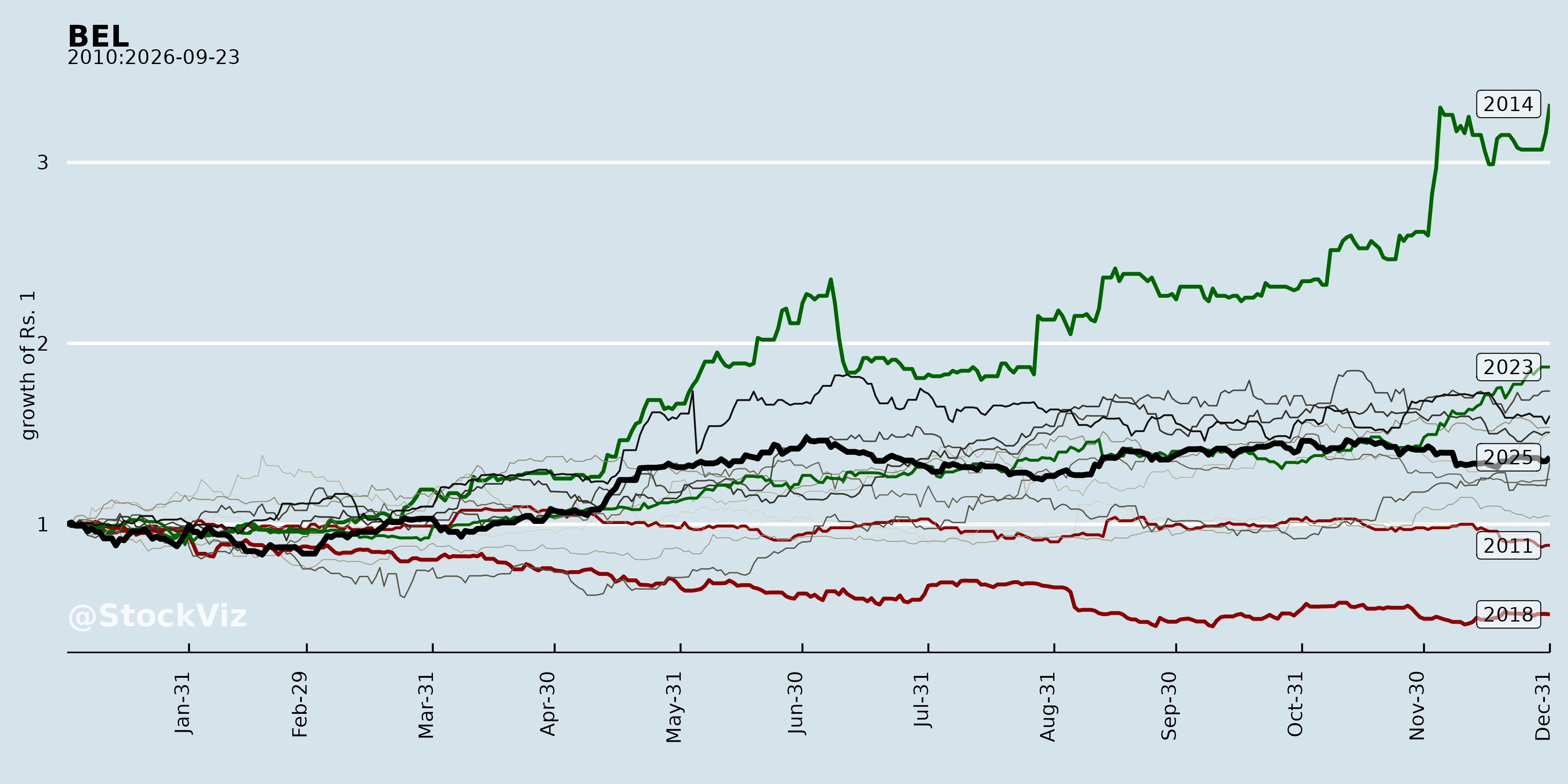
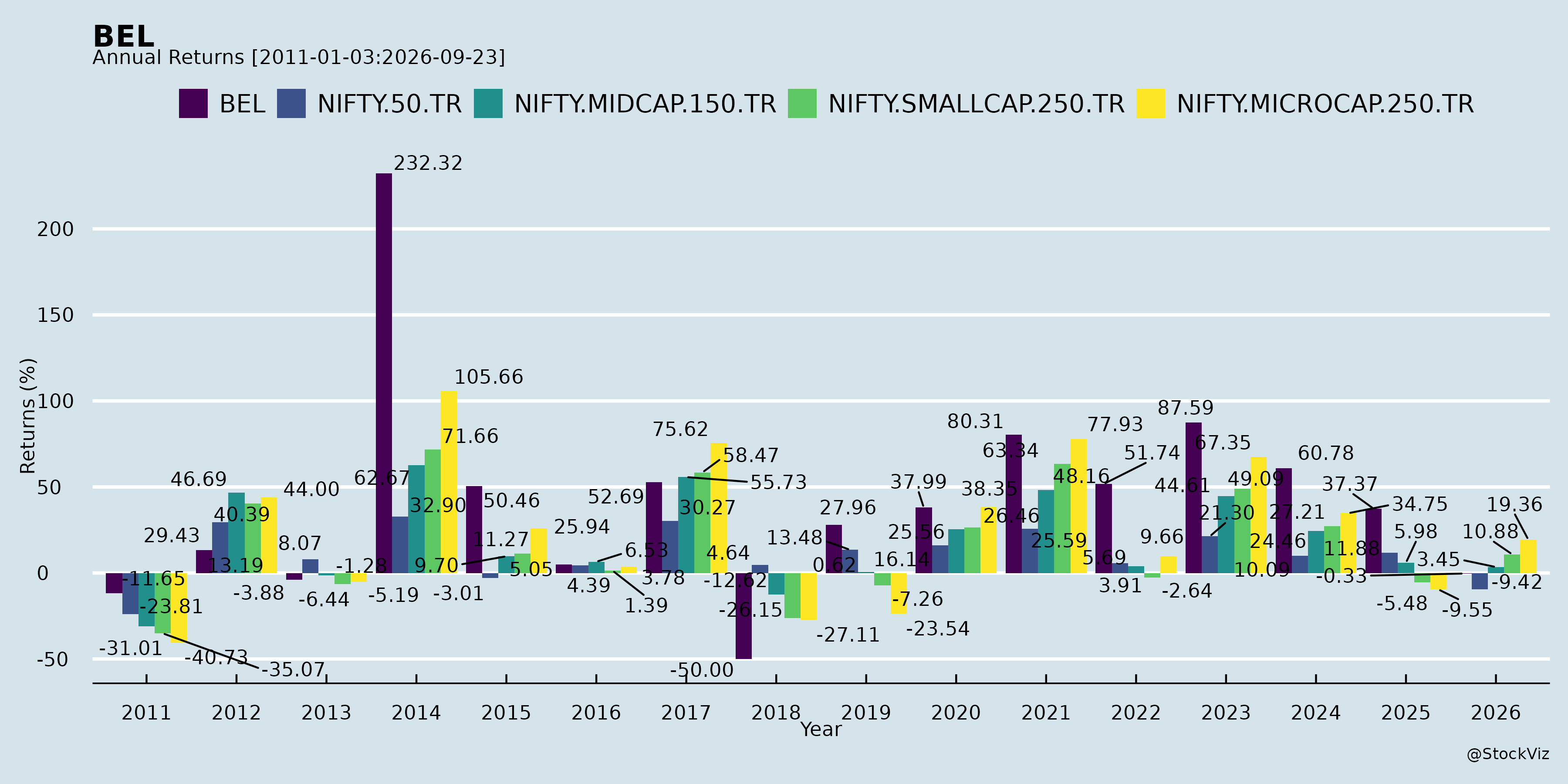
Annual Returns
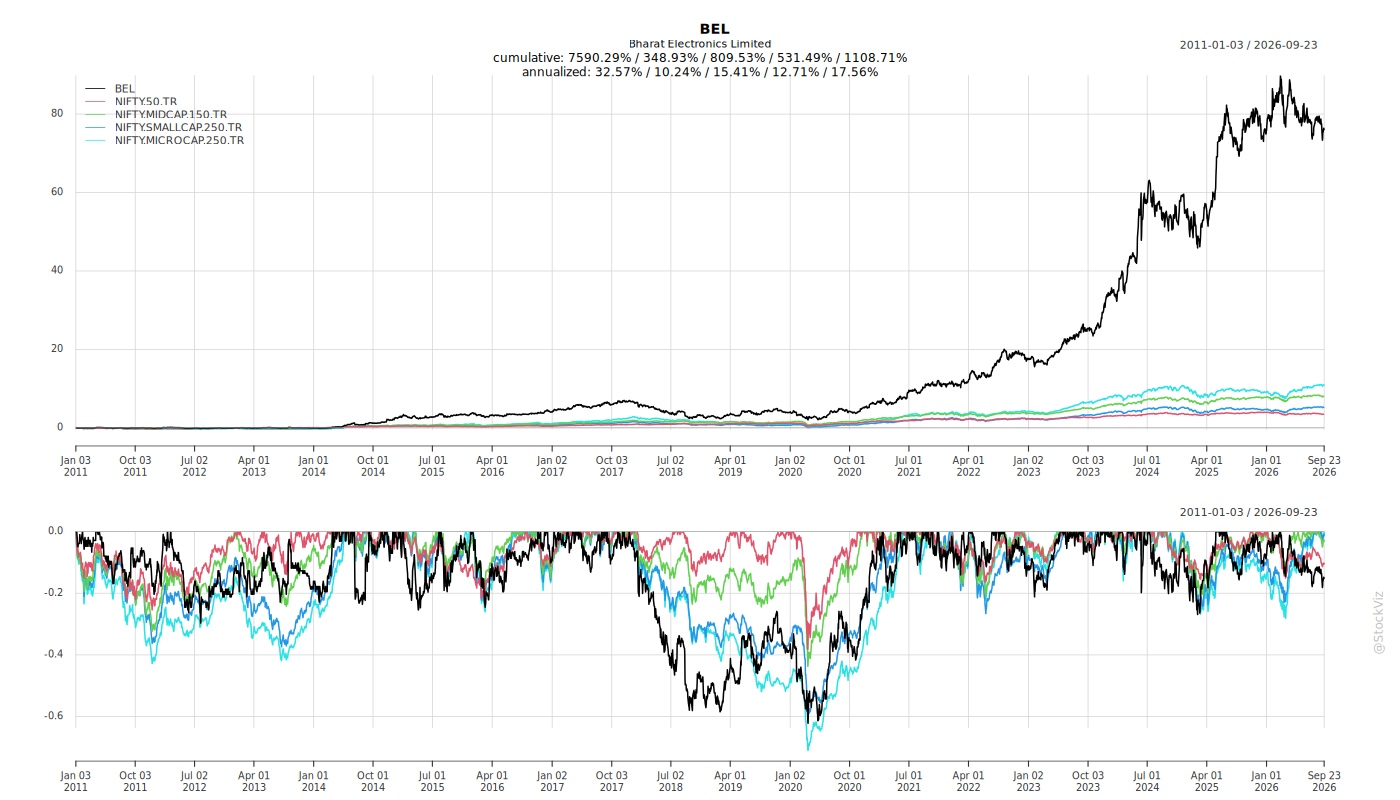
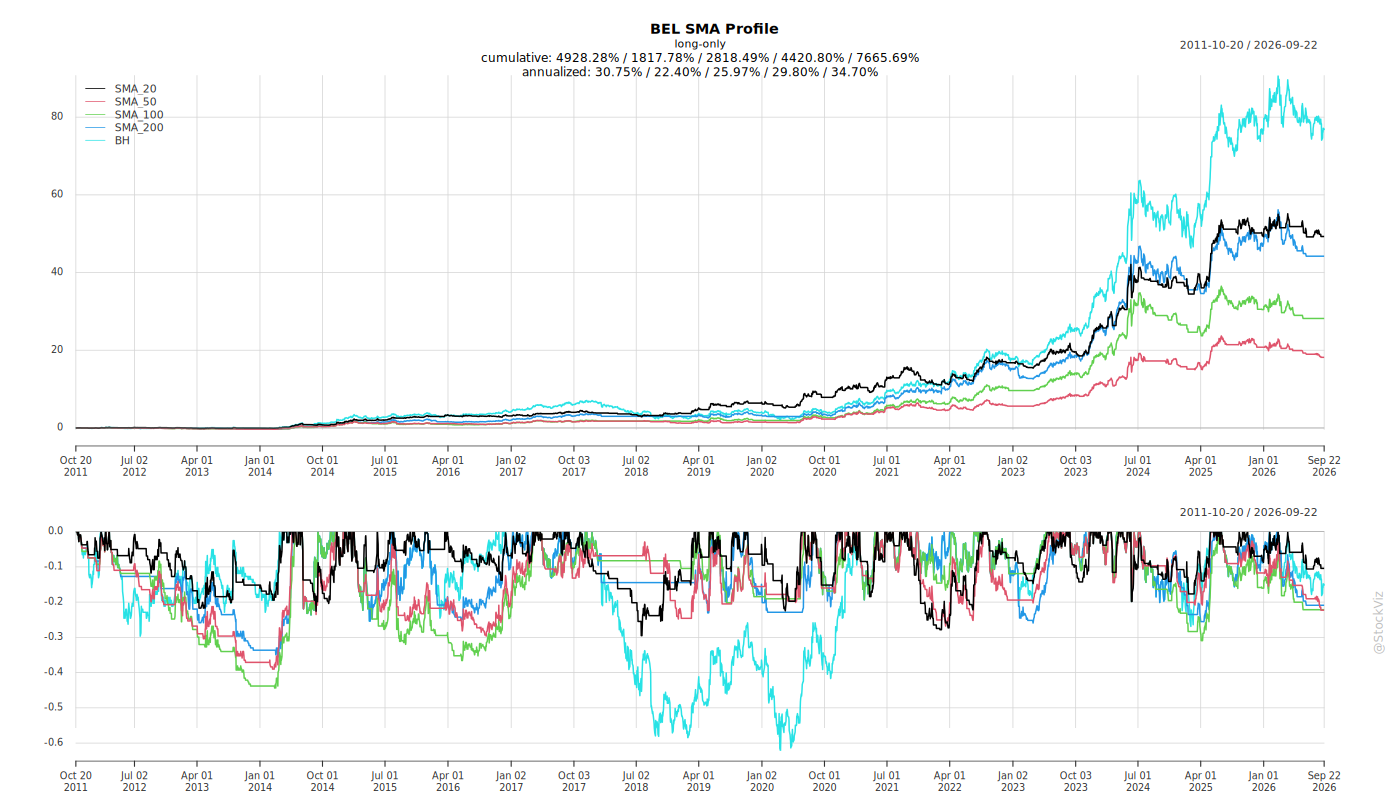
Cumulative Returns and Drawdowns
Fundamentals
Ownership
Margined
AI Summary
asof: 2026-09-14
BEL: Headwinds, Tailwinds, Risks, and Guidance vs. Performance
1. Headwinds and Challenges
Order inflow timing and lumpiness. Q1 FY27 order inflow was described as lean compared with Q1 FY26 and Q1 FY25. Management attributed this to the prior year’s inflow being a spillover of January–March orders (some received in April), whereas the current year was “more structured,” with Q1 receipts of about INR3,754 crores matching internal plans. The QRSAM order, previously expected by March, faced procedural delays and was guided to Q1/Q2, with September as the outer limit, pending CCS approval.
Programme approval dependency. Large programmes remain gated by government approval. Project Kusha testing is being run by DRDO across missile configurations, radar and control-centre integration, with RFP for commercial activity still some way off; management indicated an order of INR40,000-plus crores but not before FY28–29. Naval programmes (NGC, P75I, P17B, P18, NGD) are in configuration, specification and subsystem indigenization stages, with clarity on size and timing possibly a year away and orders beyond FY28–29.
Competitive losses. BEL was not L1 in the Netra 2 bid, where Adani Defence became systems integrator; BEL expects to participate at subsystem level (radar, EW, data links). Management framed this as part of competitive life, noting BEL’s subsystem strength should still generate business.
Customer-side delivery bottlenecks. Tejas LRU supplies to HAL were noted as fully ahead of schedule, with the aircraft bottleneck attributed to engines. Management acknowledged that if HAL slows intake, INR200–300 crores of turnover could shift by a few months — under 1% of planned turnover.
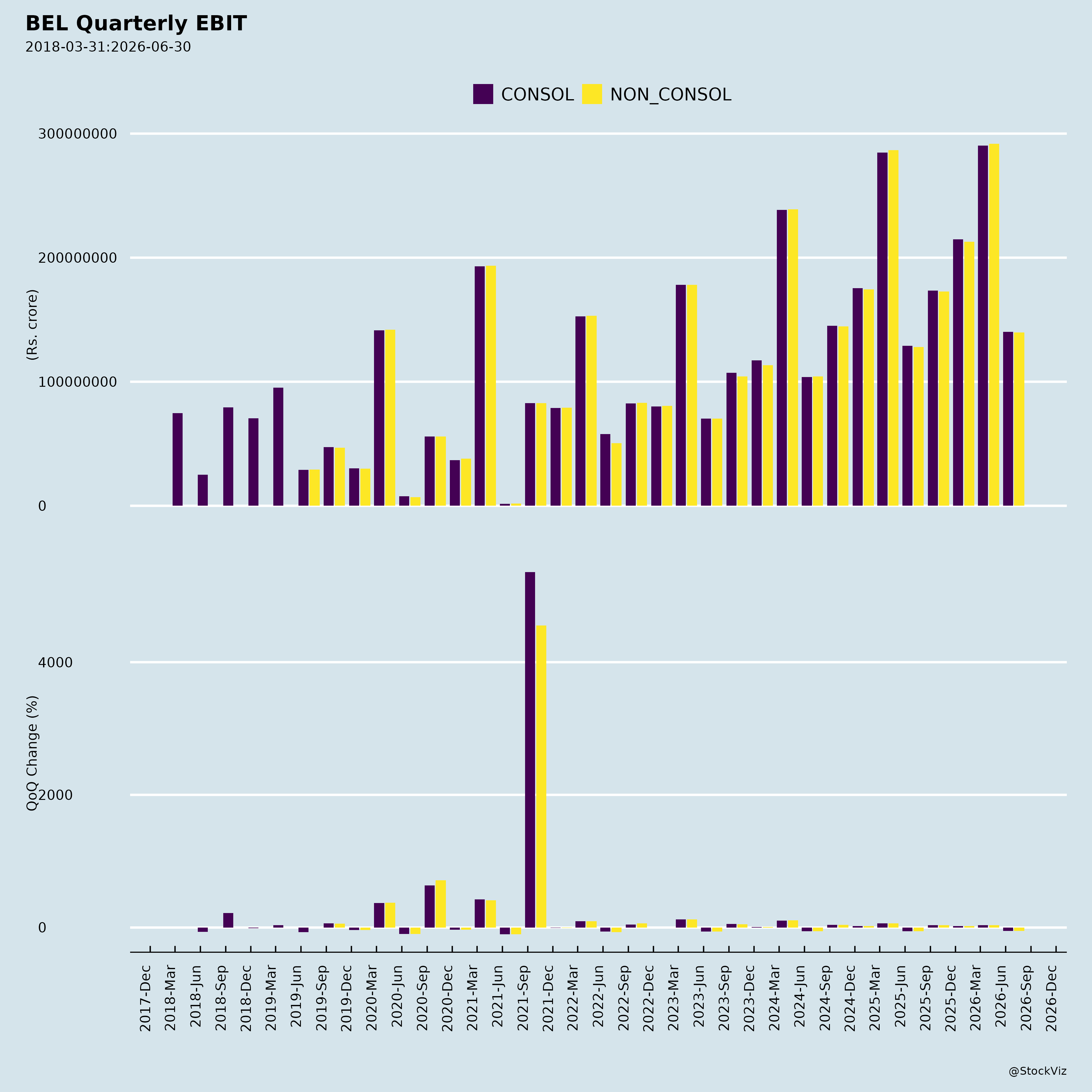
Margin and cost variability. Q1 FY27 EBITDA margin was 25.83%, below the full-year guidance, with a year-on-year decline. Management attributed this to product mix, not input cost pressure, and noted material cost varies between 50% and 59% depending on mix. Other expenses declined about 20% year-on-year because prior-year liquidated-damages provisions based on delivery schedules were absent in the current quarter.
Wage revision. Wage revision is due from January 2027, with three months of provision in the current year. Management expects employee cost to turnover to remain around 12% as turnover grows, but the quantum of the hike is not yet known and depends on government-level committees.
Customer complaint resolution. Of 18,344 customer complaints in FY 2025-26, 3,602 remained pending, attributed to non-availability of spares from original suppliers, supply-chain delays, or obsolescence requiring equivalent alternatives or form-fit redesign. Employee/worker complaints on working conditions (21 filed, 2 pending) and health and safety (49 filed, 5 pending) also remained in progress.
Attrition. Permanent employee turnover rose to 5.30% in FY 2025-26 from 2.48% in FY 2024-25; permanent worker turnover rose to 6.39% from 1.40%.
Geopolitical exposure. Following conflicts in Israel, BEL analysed existing contracts with Israel-based companies and reported no material financial impact as at the date of the results.
Environmental and social risks identified. Water scarcity, environmental pollution, and health/safety non-compliance were identified as material risks with negative financial implications; BEL has not implemented a mechanism for Zero Liquid Discharge, and sustainable sourcing procedures are not in place. Scope 3 emissions assessment is yet to be taken up.
2. Tailwinds and Growth Prospects
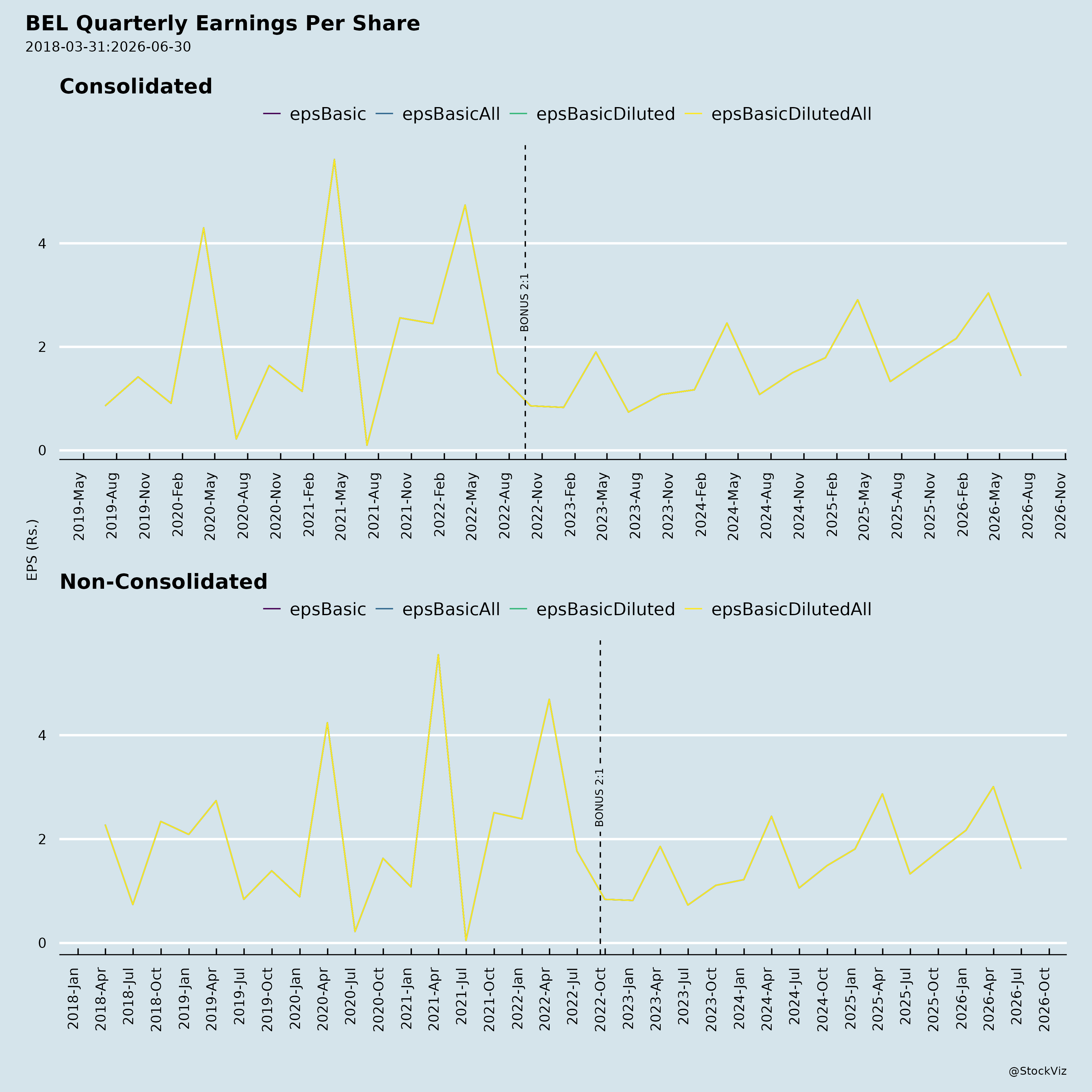
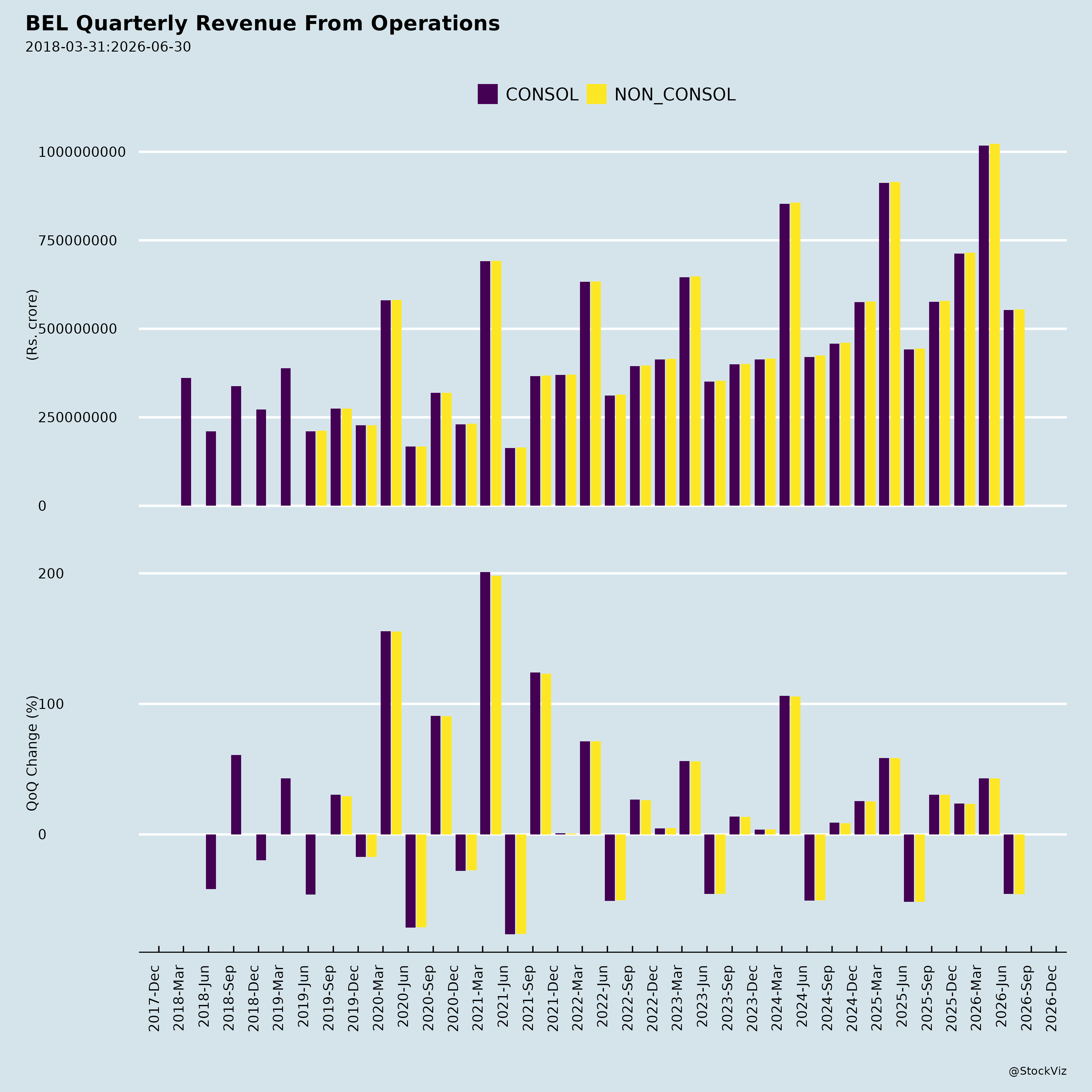
Q1 FY27 performance. Revenue from operations rose 25.27% to INR5,533.06 crores; PBT rose 8.81% to INR1,402.83 crores; PAT rose 8.17% to INR1,048.33 crores; EPS was INR1.43 versus INR1.33. Order book stood at INR72,258 crores as on 1 July 2026.
Order inflow pipeline. Full-year order inflow guidance of INR55,000-plus crores including QRSAM, comprising roughly INR30,000 crores from QRSAM, INR15,000-plus crores from platform orders, and the balance from base orders, support, services and AMCs. Expected in-year orders include Shatrughat and Samaghat (around INR9,000-plus crores combined, expected in 3–6 months), Shakti Phase 4 (around INR2,000 crores), and HAMMER (around INR2,500-plus crores), with repeat potential after two-plus years.
Order book composition. Army, Navy and Air Force each account for roughly 30% of the order book, with about 90% from defence. Top programmes include Electronic Fuzes (largest, eight-year requirement), LRSAM, LCA Mk1/Mk1A LRUs, BMP-2 upgrade, Ashwini Radar, EW suite for Mi-17 V5, and MPR Arudhra — together around INR20,000-plus crores of the order book.
Execution visibility. LRSAM has about INR3,000-plus crores left, of which roughly INR2,100–2,300 crores is planned this year. FY27 revenue contributors include Akash Army (over INR1,000 crores, around INR1,200 crores), and D-29 EW, MPR Arudhra, BMP-2 upgrade and LCA LRUs at INR500–1,000 crores each.
Counter-drone and directed energy. BEL has supplied about 80% of orders for 2 kW laser-based DEW received over three years; microwave DEW prototypes are ready (developed with DRDO) and under evaluation, with customized export configurations and demonstrations to foreign countries generating interest. BEL positions itself as de facto leader in large complex hard-kill D4 solutions, while also working on D2/D3 products and collaborating with startups.
Missiles and new domains. BEL is entering the missile domain as a DcPP partner in some programmes and describes itself as a leader in complex missile electronics. AMCA work with L&T is near finalization, with RFP submission date of 27 August 2026 after a two-month extension.
Exports. Export order book around USD465 million, with leads four to five times larger; internal target of about USD300 million this year, spread across 15–20 products. Key export products include next-generation software-defined radios (around INR2,000 crores order received last year), Satcom, D4 solutions, and build-to-print TR modules for airborne segments. Aspiration of 10% of revenues from exports within five years.
Indigenization. Target of zero import of modules/sub-modules within five years (excluding semiconductor components), supported by an indigenization policy, special budgets from R&D, and MSME/startup collaboration. Management expects indigenization to offset material cost escalation and support margins.
R&D and capex. R&D budget above INR2,200 crores for the year; capex above INR1,200 crores. Management expects higher R&D (from about 6.5–6.8% toward 8%) to support, not hurt, EBITDA margins.
Sustainability milestones. BEL achieved RE100 status in January 2025, ahead of its March 2025 target, and carried out all manufacturing operations using renewable energy in FY 2025-26, eliminating Scope 2 emissions. Net Zero Carbon Emissions target set for 2035, with FY 2024-25 as baseline, covering all three scopes. Energy intensity fell to 9.63 GJ/crore from 10.80; water intensity fell to 55.83 KL/crore from 61.17; Scope 1 and 2 emission intensity fell to 0.29 MT/crore from 1.14.
Order wins after period end. Additional orders of INR1,081 crores since 25 May 2026 (communication equipment, radars, CBRN protection systems, seekers, avionics, upgrades, spares, services) and INR730 crores since 10 August 2026 (communication equipment, radar, avionics, tank sub system, electro optics, cyber security, perimeter security, medical electronics, EVM, jammers, batteries, spares, services).
Governance and shareholder actions. The 72nd AGM on 28 August 2026 approved all 8 resolutions, including financial statements, dividend declaration, director re-appointments, cost auditor remuneration ratification, increase in authorized share capital, and alteration of the Memorandum of Association. The Board approved increasing authorized share capital from INR750 crores to INR1,000 crores, subject to shareholder approval.
3. Key Risks
- Approval and timing risk: QRSAM, Project Kusha, NGC, P75I and other large programmes depend on CCS and government decisions; delays push revenue recognition beyond FY28–29.
- Competitive risk: Loss of systems-integrator roles to private players (as in Netra 2), with BEL retaining subsystem positions.
- Customer schedule risk: HAL’s Tejas delivery pace could shift INR200–300 crores of BEL turnover by a few months.
- Margin mix risk: Quarterly EBITDA margins range 25–31% depending on product mix; material cost ranges 50–59%.
- Wage cost risk: Wage revision effective January 2027, with quantum undetermined; management expects the 12% employee-cost-to-turnover ratio to hold as turnover grows.
- Supply chain and obsolescence risk: Pending customer complaints stem from spare part non-availability, supply-chain delays and electronic obsolescence.
- Geopolitical risk: Israel-based contract exposure assessed as having no material financial impact as at the results date.
- Environmental and safety risks: Water scarcity, pollution, and health/safety non-compliance identified as material risks with negative financial implications; no Zero Liquid Discharge mechanism; no sustainable sourcing procedures; Scope 3 assessment pending.
- Attrition risk: Permanent employee and worker turnover increased in FY 2025-26.
- Data and cyber risk: No data breaches or cyber-security complaints reported; cyber security policy is an internal-circulation document.
4. Management Guidance vs. Observed Performance
Revenue growth. Guidance: 15% for FY27, with management stating it may exceed by 0.5–1.5%. Observed: Q1 FY27 revenue growth of 25.27% year-on-year, which management said met internal expectations.
EBITDA margin. Guidance: 28% for the year (closing remarks referenced 21–23% in one instance, while the CFO and CMD repeatedly affirmed 28%). Observed: Q1 FY27 EBITDA margin of 25.83%, with management attributing the quarter-on-quarter variation to product mix and reaffirming the full-year 28% target.
Order inflow. Guidance: INR55,000-plus crores including QRSAM. Observed: INR3,754 crores acquired in Q1 FY27; order book INR72,258 crores as on 1 July 2026. Management stated Q1 was in line with internal plans and reaffirmed the annual guidance.
QRSAM timing. Guidance: originally March, then Q1/Q2 FY27, maximum by September. Observed: not yet received as of the call; awaiting CCS approval.
Receivables. Observed: 140 days as on 30 June 2026 versus 176 days as on 31 March 2026, which management described as an improvement.
R&D and capex. Guidance: R&D above INR2,200 crores, capex above INR1,200 crores. Observed: no interim figures disclosed on the call; BRSR shows R&D investment in specific environmental/social technologies at 2.91% of total R&D in FY 2025-26 versus 2.18% in FY 2024-25, and such capex at 0.11% versus 0.06%.
Exports. Guidance: internal target of about USD300 million for the year, aspiration of 10% of revenues within five years. Observed: export order book around USD465 million, with leads four to five times larger.
Indigenization. Guidance: zero import of modules/sub-modules within five years. Observed: 78–80% of turnover from indigenous products and technologies; indigenization policy to be formally released.
Employee cost. Guidance: employee cost to turnover around 12% over coming years despite wage revision. Observed: 12% last year, per the CFO; three months of provision planned for January–March 2027.
RE100 and Net Zero. Guidance: RE100 by March 2025; Net Zero by 2035. Observed: RE100 achieved January 2025, ahead of target; all manufacturing operations on renewable energy in FY 2025-26; Scope 2 emissions at zero.
Broker Narrative
The broker narrative evolved from aggressive bullishness centered on orderbook momentum, a 3.5x bill-to-book ratio, and margin expansion (2023) toward a more tempered Accumulate stance anchored on government DAC AoN approvals (~INR1.1trn) and indigenization policy support (2026). Persistent themes of defense exposure and indigenization carried through, but specific growth metrics like bill-to-book ratio and order guidance disappeared, and all originally flagged headwinds were dropped despite mounting negative returns.
Fears that came true
- Orderbook & Execution Delays materialized as evidenced by multiple DISAPPOINTMENT outcomes (e.g., 2025-10-07, 2026-07-27, 2026-09-08) where predicted returns were positive but actual returns turned sharply negative.
- Cash Flow Pressures appear to have materialized as the stock sustained persistent negative actual returns from late 2025 through mid-2026, prompting a shift from Buy to Hold/Accumulate calls.
- Defence Capital Budget Allocation risk of lower-than-expected accretion materialized as the stock declined steadily through 2026 with multiple PENDING and DISAPPOINTMENT outcomes despite continued defense capex optimism.
Optimism that failed
- High bill-to-book ratio of 3.5x and ~17% p.a. revenue growth through FY25 failed to translate into returns, as BEL delivered negative actual returns across most reports from late 2025 onward.
- Robust order inflow momentum aligned with Rs200bn full-year guidance did not sustain, with DISAPPOINTMENT outcomes in 2025-2026 indicating the order-driven growth thesis unraveled.
- Operational efficiency and margin expansion from accelerating indigenization did not prevent the stock from declining, as evidenced by persistent negative actual returns in 2026 despite the same narrative continuing.
Broker Timeline
63 broker calls · 2023-06-21 to 2026-09-08
Copyright © 2023 SAS Data Analytics Pvt. Ltd. All rights reserved.