BDL
Equity Metrics
September 24, 2026
Bharat Dynamics Limited
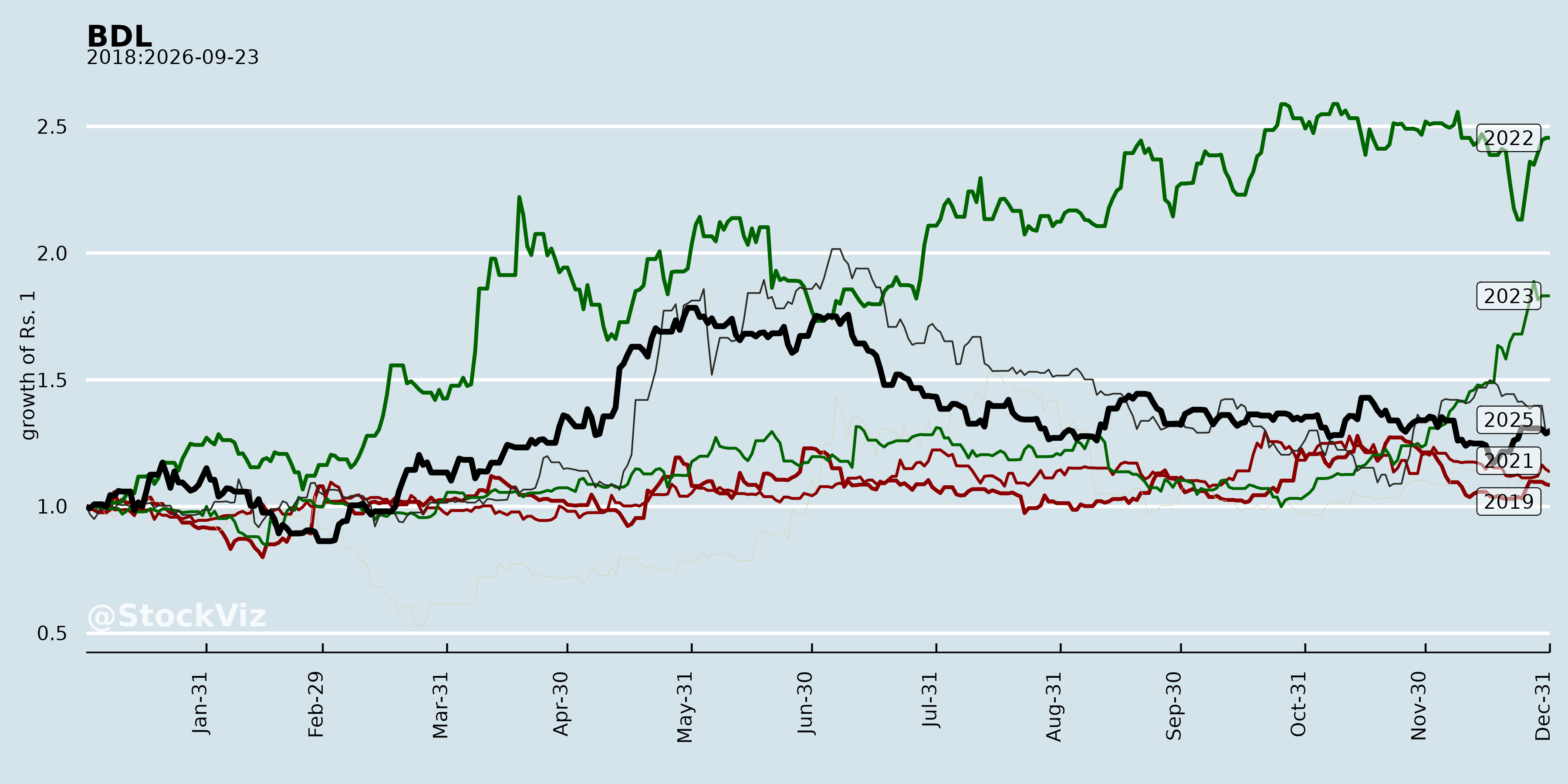
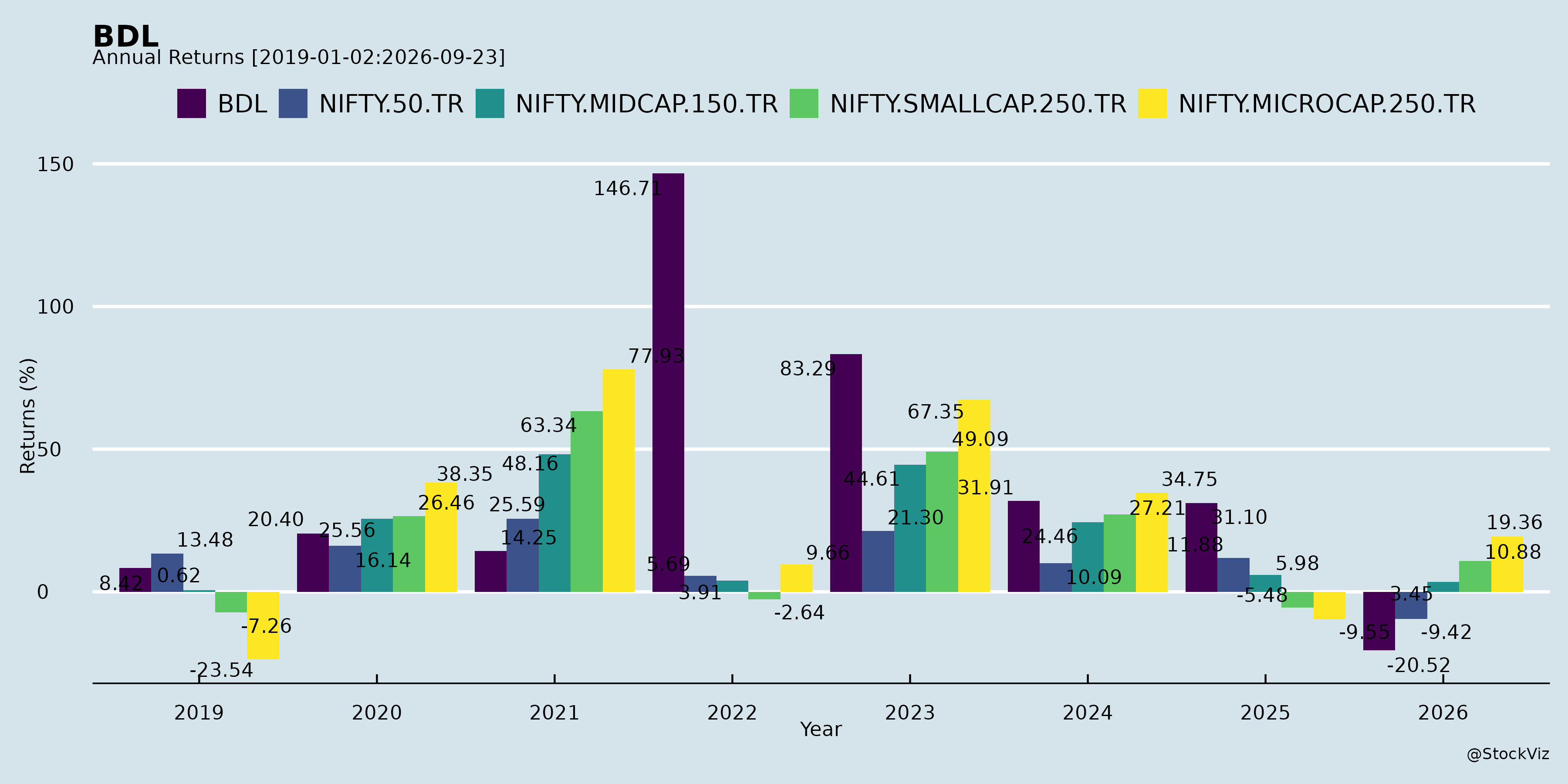
Annual Returns
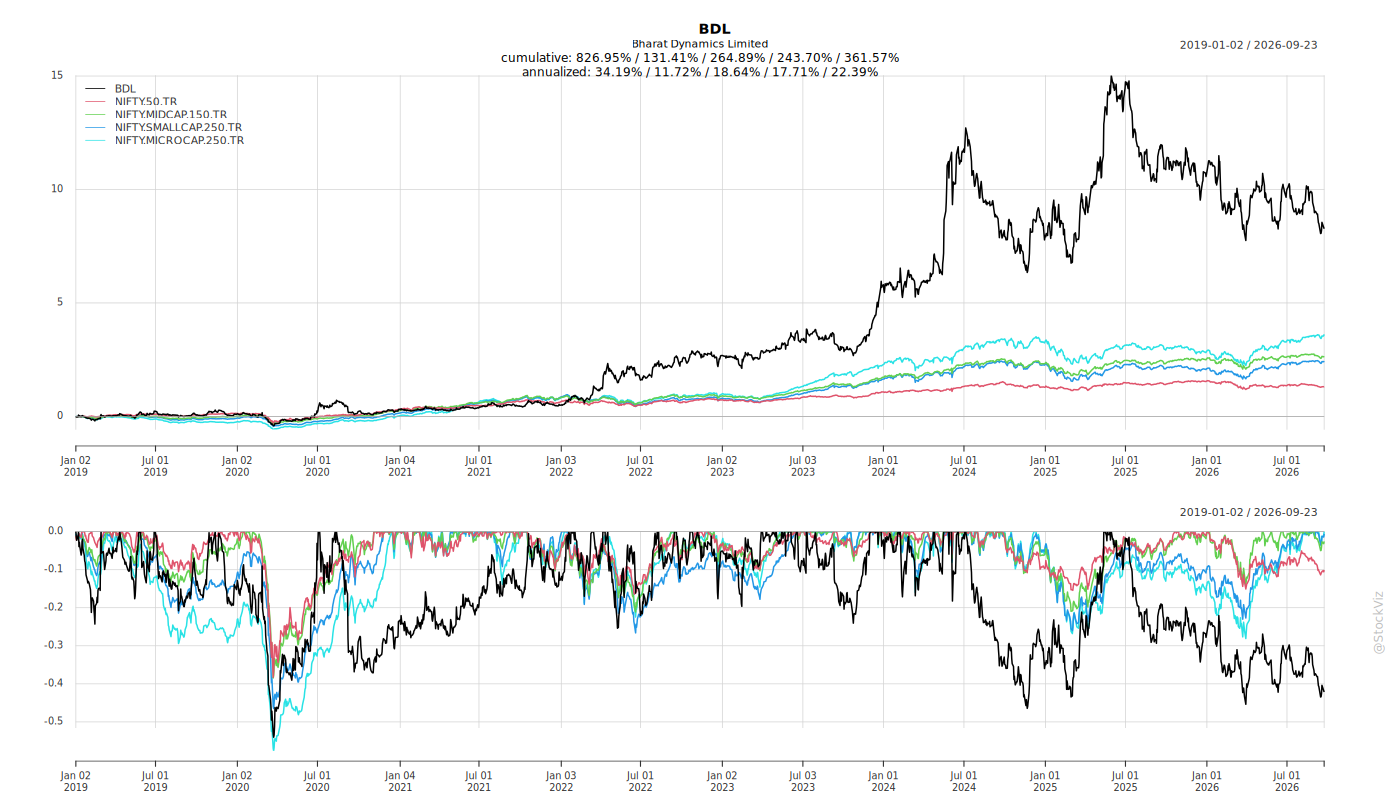
Cumulative Returns and Drawdowns
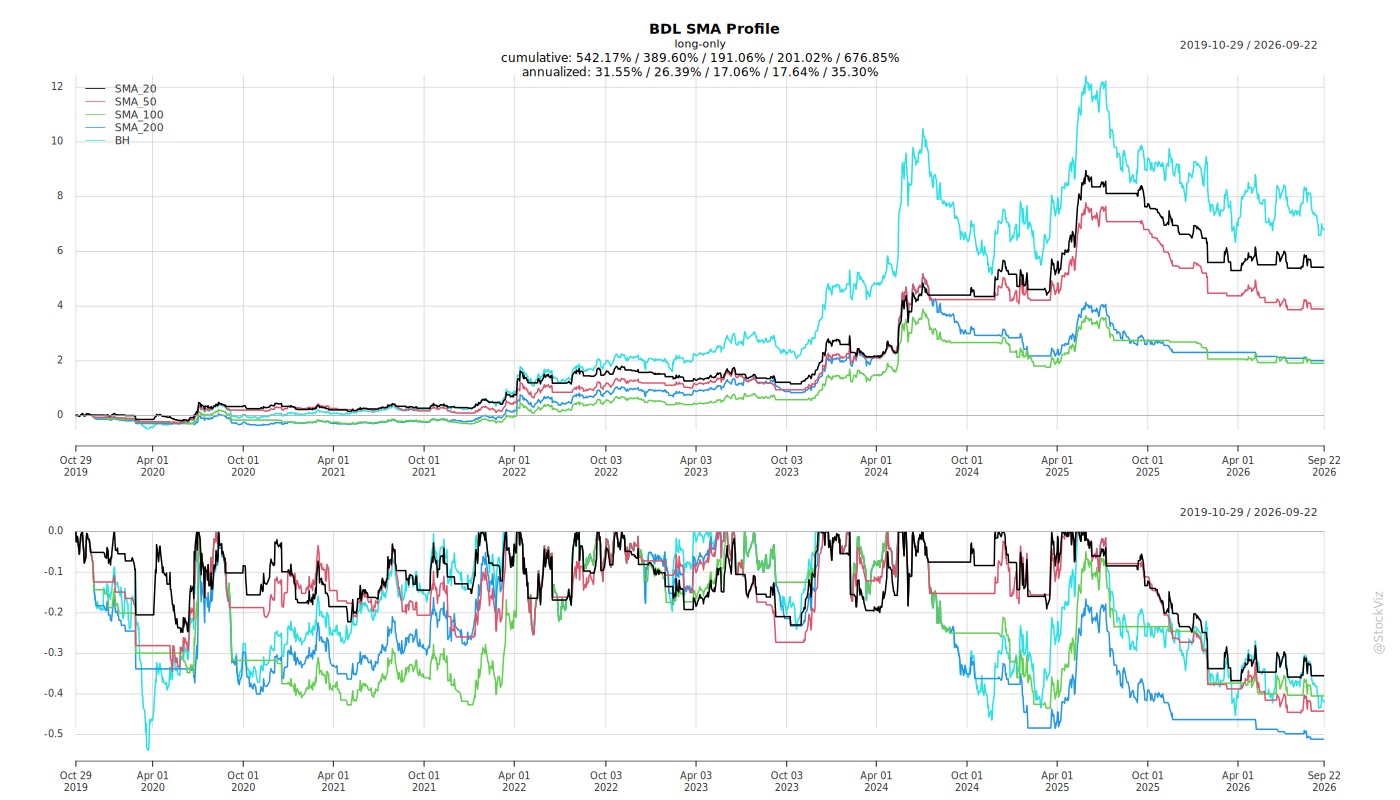
Fundamentals
Ownership
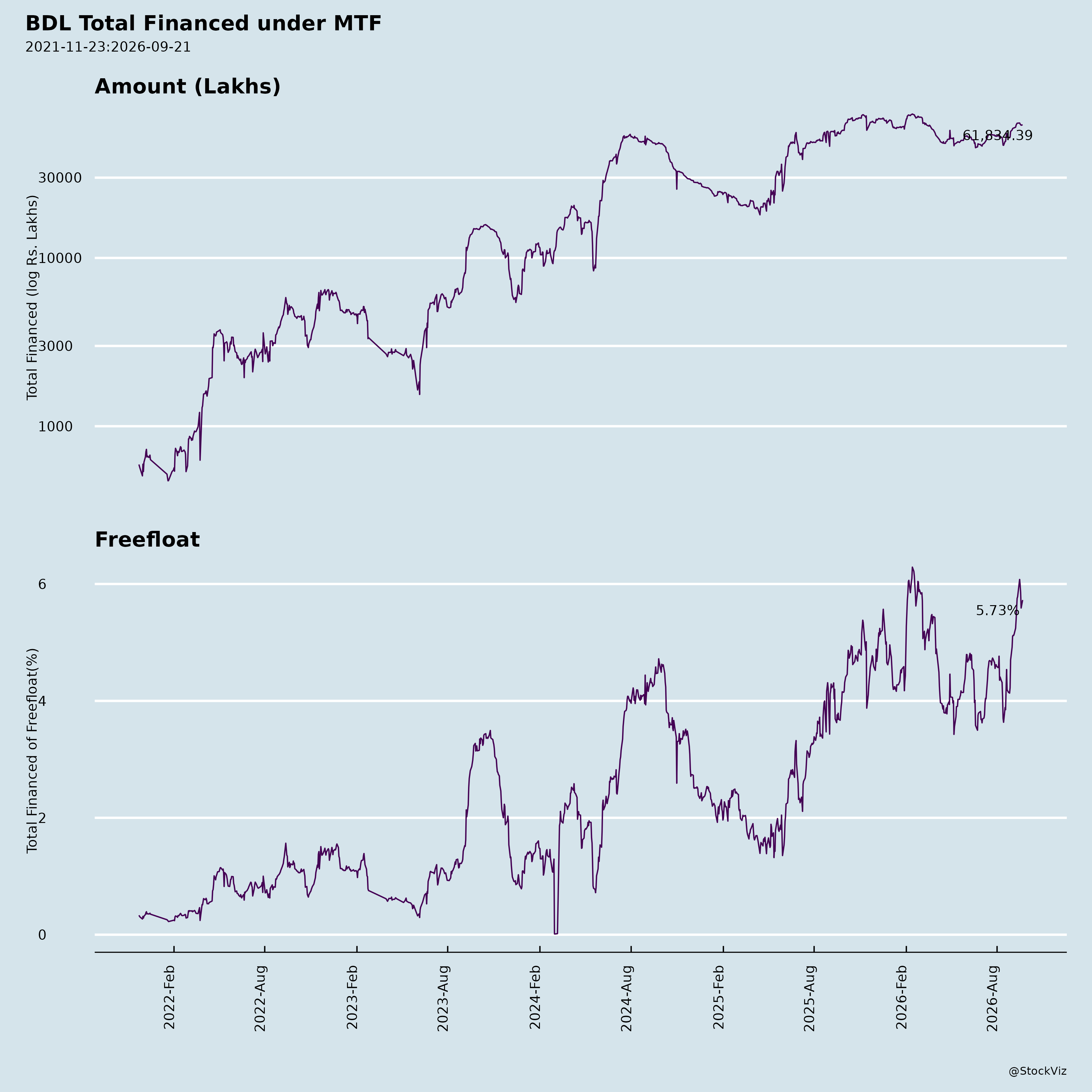
Margined
AI Summary
asof: 2026-09-16
Bharat Dynamics Limited — Recent Corporate Developments
1. Headwinds and Challenges
- Audit Committee not reconstituted. The company disclosed that reconstitution of the Audit Committee could not be completed following the expiration of the tenure of Independent Directors, because the requisite quorum mandated under the Companies Act, 2013 and SEBI (LODR) Regulations, 2015 was not met. As a government company, appointment and reappointment of directors fall under the purview of the Government of India, and that process is currently underway. In the absence of a duly constituted Audit Committee, the Board of Directors itself reviewed and approved the financial results at its meeting held on 14 August 2026.
- Non-moving inventory. Inventories include ₹8,327.07 lakh (unchanged from ₹8,327.07 lakh as of 31 March 2026) that are non-moving for more than five years, procured against firm orders/LOIs that were subsequently short closed by the customer. Although the company’s accounting policy requires a provision for redundancy on inventory not moved for more than five years, no such provision was considered necessary, because advances of ₹36,234.42 lakh received against these contracts exceed the assets acquired (including these inventories) and expenditures incurred thereon. The auditors drew attention to this matter in their limited review report, while stating that their conclusion is not modified in respect of it.
- Leadership transition. The appointment of Shri Shailesh Vagerwal as Chairman & Managing Director was conveyed by the Ministry of Defence vide Office Memorandum dated 18.06.2026, effective from the date of assumption of charge until 31.03.2031 or further orders. The intimation was received by BDL on 19.06.2026, and at that point he was yet to assume charge. He subsequently signed the quarterly results as Chairman and Managing Director on 14 August 2026.
- Volatile quarterly operating income. Other operating income was negative ₹841.90 lakh in the quarter ended 31 March 2026, compared with ₹650.08 lakh in the quarter ended 30 June 2026 and ₹1,683.64 lakh in the quarter ended 30 June 2025, indicating swings in this line item across periods.
2. Tailwinds and Growth Prospects
- New orders from HAL. On 24 June 2026, BDL announced receipt of orders worth about ₹1,347.71 crore (gross) from Hindustan Aeronautics Limited (HAL): Helina Launchers & LRUs of ₹1,109.37 crore (gross) and CMDS LRUs of ₹238.34 crore (gross). These are domestic orders, not related party transactions, with no promoter/promoter group interest in the awarding entity, and are to be executed over a span of 24–60 months.
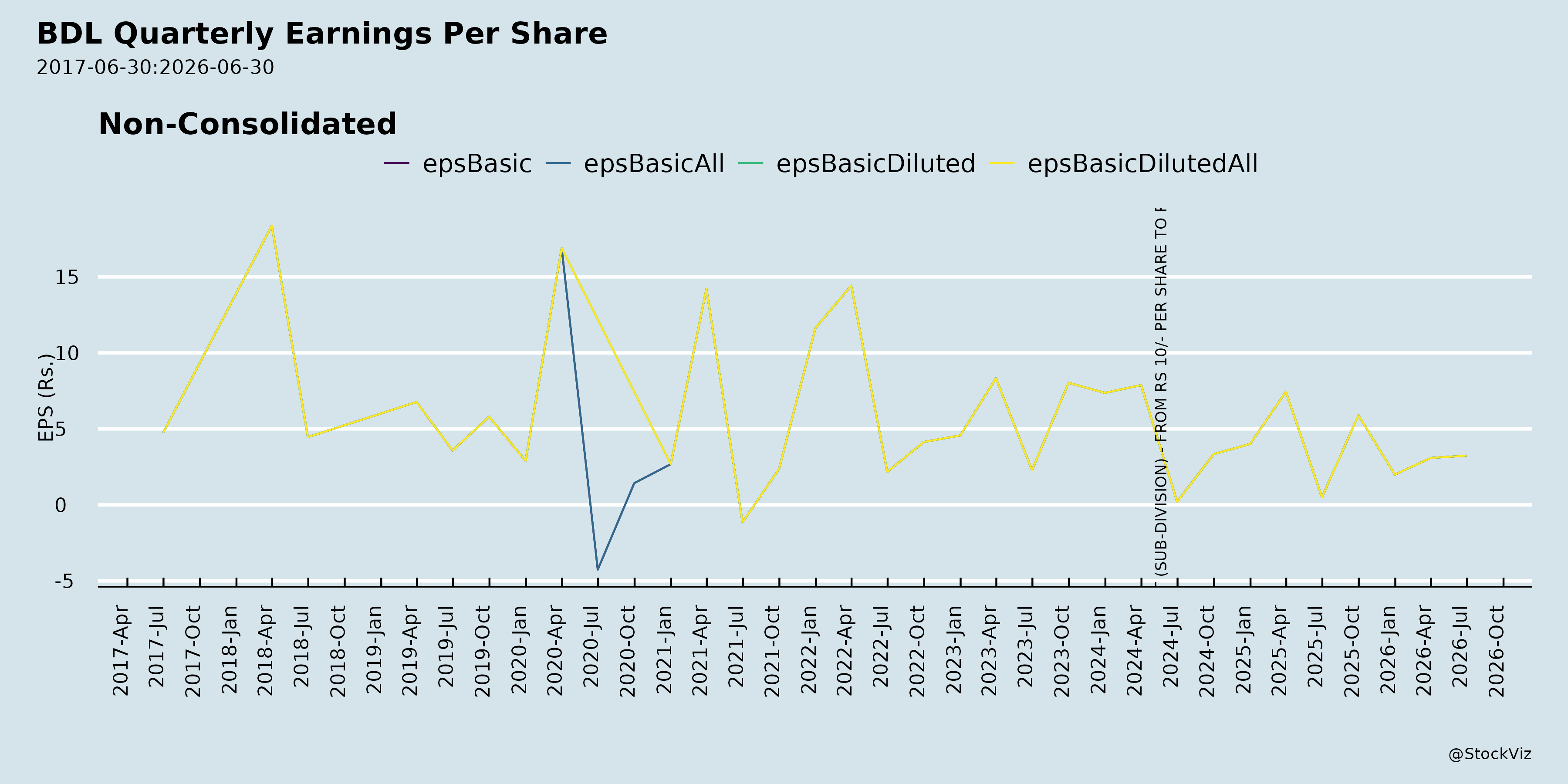
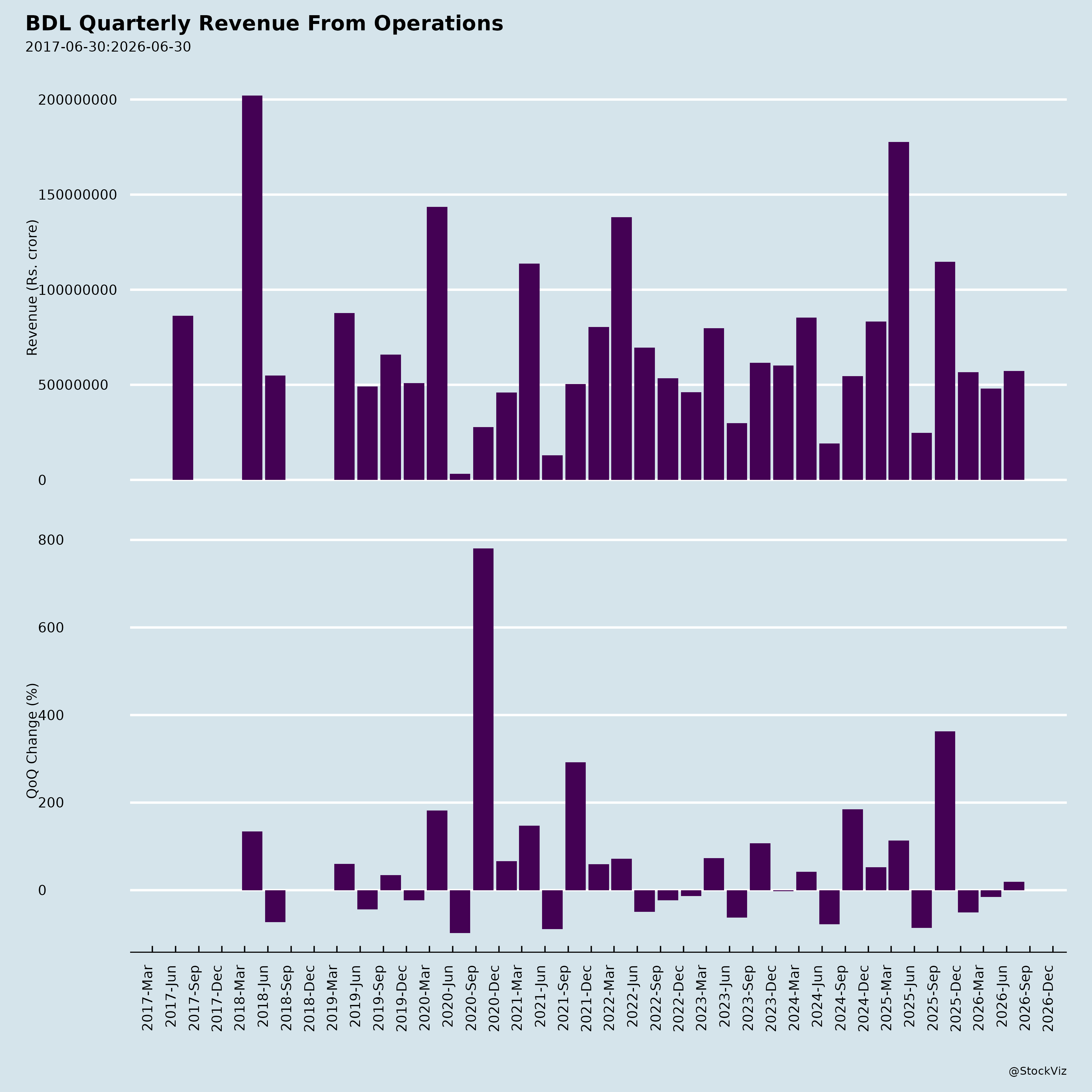
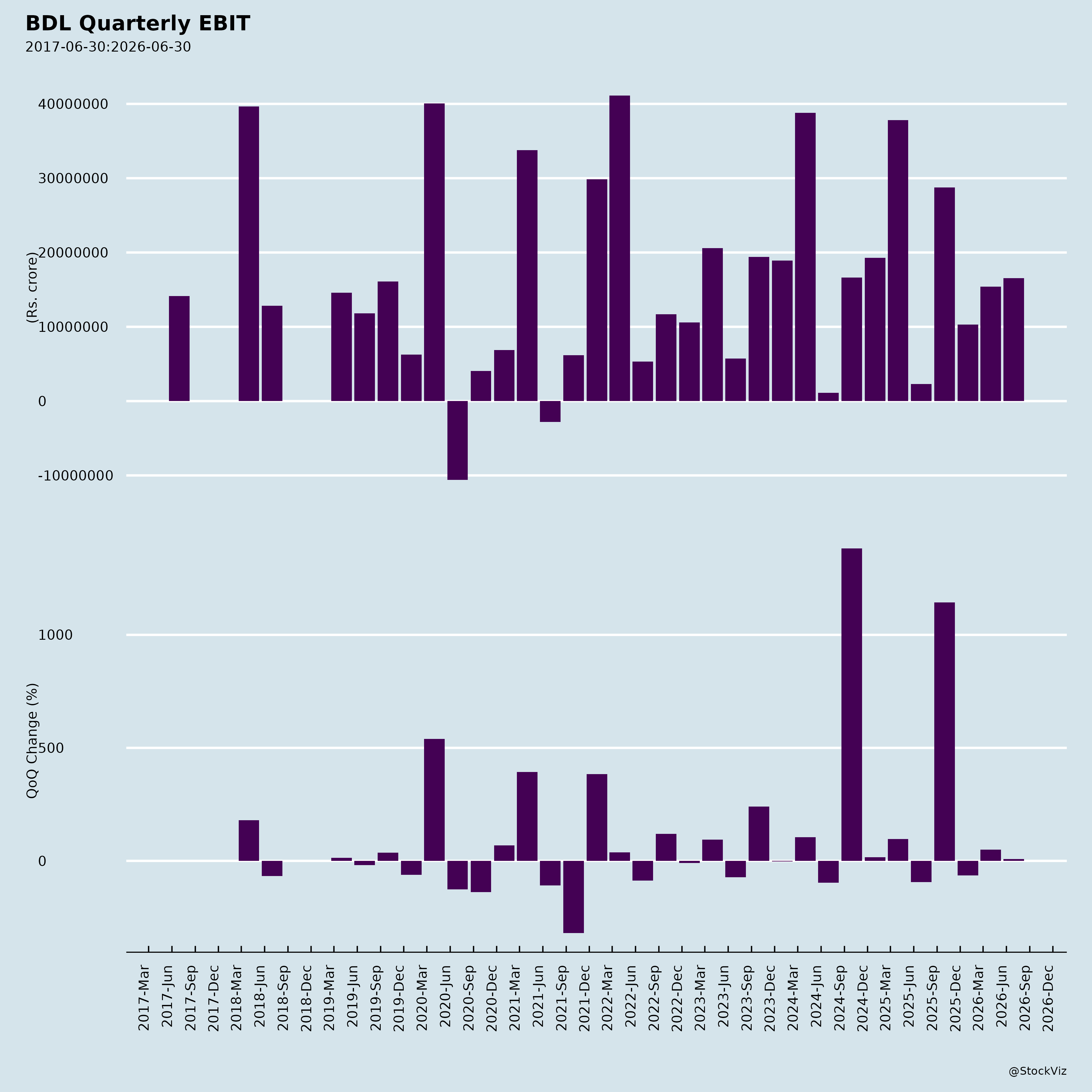
- Strong year-on-year quarterly performance. For the quarter ended 30 June 2026, total revenue from operations was ₹57,224.03 lakh and profit before tax was ₹16,563.05 lakh, compared with total revenue from operations of ₹24,792.90 lakh and profit before tax of ₹2,313.31 lakh for the quarter ended 30 June 2025. Profit for the period was ₹11,879.11 lakh versus ₹1,834.98 lakh a year earlier, and basic and diluted EPS was ₹3.24 versus ₹0.50.
- Dividend track record. A final dividend of ₹0.40 per equity share of ₹5 each for FY 2025-26 was recommended by the Board on 28 May 2026, in addition to an interim dividend of ₹4.50 per equity share, subject to shareholder approval at the ensuing Annual General Meeting.
- Defence-sector positioning. The company operates as a Government of India Enterprise under the Ministry of Defence, and MCA has exempted government companies engaged in defence production from segment reporting requirements.
3. Key Risks
- Governance and compliance risk. The absence of a duly constituted Audit Committee, pending government action on director appointments, is a structural governance gap disclosed by the company.
- Inventory provisioning risk. The auditors’ emphasis-of-matter on non-moving inventory older than five years, for which no redundancy provision was made, highlights a judgment area where the company relies on advances received exceeding related assets and expenditures.
- Order execution risk. The HAL orders are to be executed over 24–60 months, and their terms and conditions are confidential in view of national security, limiting visibility into execution milestones.
- Customer concentration and order short-closure risk. The non-moving inventory arose from firm orders/LOIs subsequently short closed by the customer, illustrating exposure to customer-side cancellations or closures.
- Earnings volatility. The swing in other operating income (including a negative figure in the quarter ended 31 March 2026) and the sharp difference between quarterly and full-year figures indicate variability in reported results.
4. Management Guidance Versus Observed Business Performance
- Order inflow guidance evidenced by action. The 24 June 2026 announcement of ₹1,347.71 crore (gross) of HAL orders, with an execution span of 24–60 months, is the concrete order-inflow event in the supplied material; the financial results for the quarter ended 30 June 2026 reflect the business performance for that quarter, though the announcement does not quantify revenue recognition from these orders.
- Dividend recommendation versus performance. The Board’s recommendation of a final dividend of ₹0.40 per share for FY 2025-26, on top of an interim dividend of ₹4.50 per share, followed a full year (FY 2025-26, audited) in which profit for the period was ₹42,033.76 lakh and EPS was ₹11.47, compared with quarterly profit of ₹11,879.11 lakh and EPS of ₹3.24 in the first quarter of the current year.
- Inventory stance versus accounting policy. Management’s position that no redundancy provision is necessary for the ₹8,327.07 lakh of non-moving inventory, because advances of ₹36,234.42 lakh against the related contracts exceed the assets and expenditures, is a stated judgment that departs from the company’s own accounting policy requiring such a provision; the auditors have drawn attention to this without modifying their conclusion.
- Audit Committee guidance versus observed practice. The company states that reconstitution of the Audit Committee is pending government action on director appointments; in the interim, the Board approved the results, and the limited review was conducted by M/s Tej Raj & Pal, Chartered Accountants, who concluded that nothing came to their attention indicating the statement did not disclose required information or contained material misstatement.
Broker Narrative
The first report was cautiously Not Rated, dominated by FY23 execution failures (supply-chain/design-change delays, inventory build-up, regulated margins) but optimistic about a huge order book and export/indigenisation-led revenue rebound. By the last report (August 2026) the broker had turned Buy, narrating a Q1FY27 execution recovery, a larger ₹26,500 crore backlog, capacity expansion and diversification, while still acknowledging government-contract dependence and raw-material/clearance risks. The order-book strength and execution/delay risk themes persisted; the tone shifted from concern about missed guidance to conviction in a demand and capacity-driven turnaround.
Fears that came true
- The early warning on production delays proved recurring: FY26 Akash deliveries were hit by pending clearances and execution challenges, echoing the FY23 supply-chain/design-change disruptions and coinciding with steep negative returns in mid-2025 (e.g. -29.4% on 2025-07-01).
- The financial-decline fear materialized in weak revenue delivery: although FY25/FY26 revenue of ~₹5,000/6,000 crore was promised, TTM revenue at the last report was only ~₹2,760 crore (₹26,500 crore backlog ÷ 9.6x), with multiple 2025-26 positive broker calls ending in losses or DISAPPOINTMENT outcomes.
Optimism that failed
- The strong revenue guidance failed: the modelled jump to ~₹50bn FY25 and ~₹60bn FY26 did not occur, as TTM revenue remained around ₹27.6bn by August 2026.
- The export-led diversification story did not materialise enough to remove reliance on the government: the final report still flags dependence on government contracts and cites no new large export orders to back the earlier expectation of 3–4 follow-on export orders.
Broker Timeline
33 broker calls · 2023-07-05 to 2026-08-18
Copyright © 2023 SAS Data Analytics Pvt. Ltd. All rights reserved.