BANKBARODA
Equity Metrics
September 24, 2026
Bank of Baroda
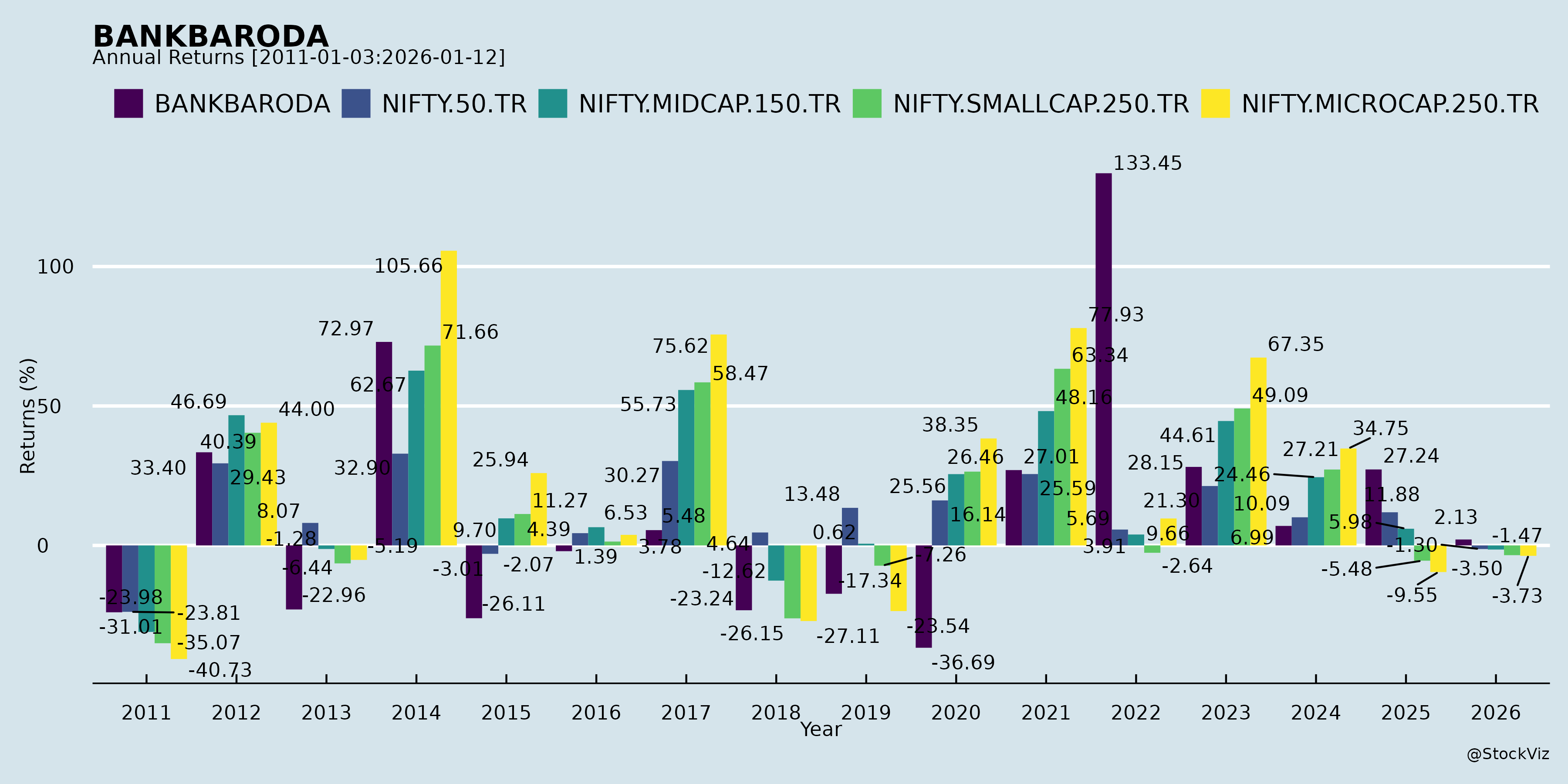
Annual Returns
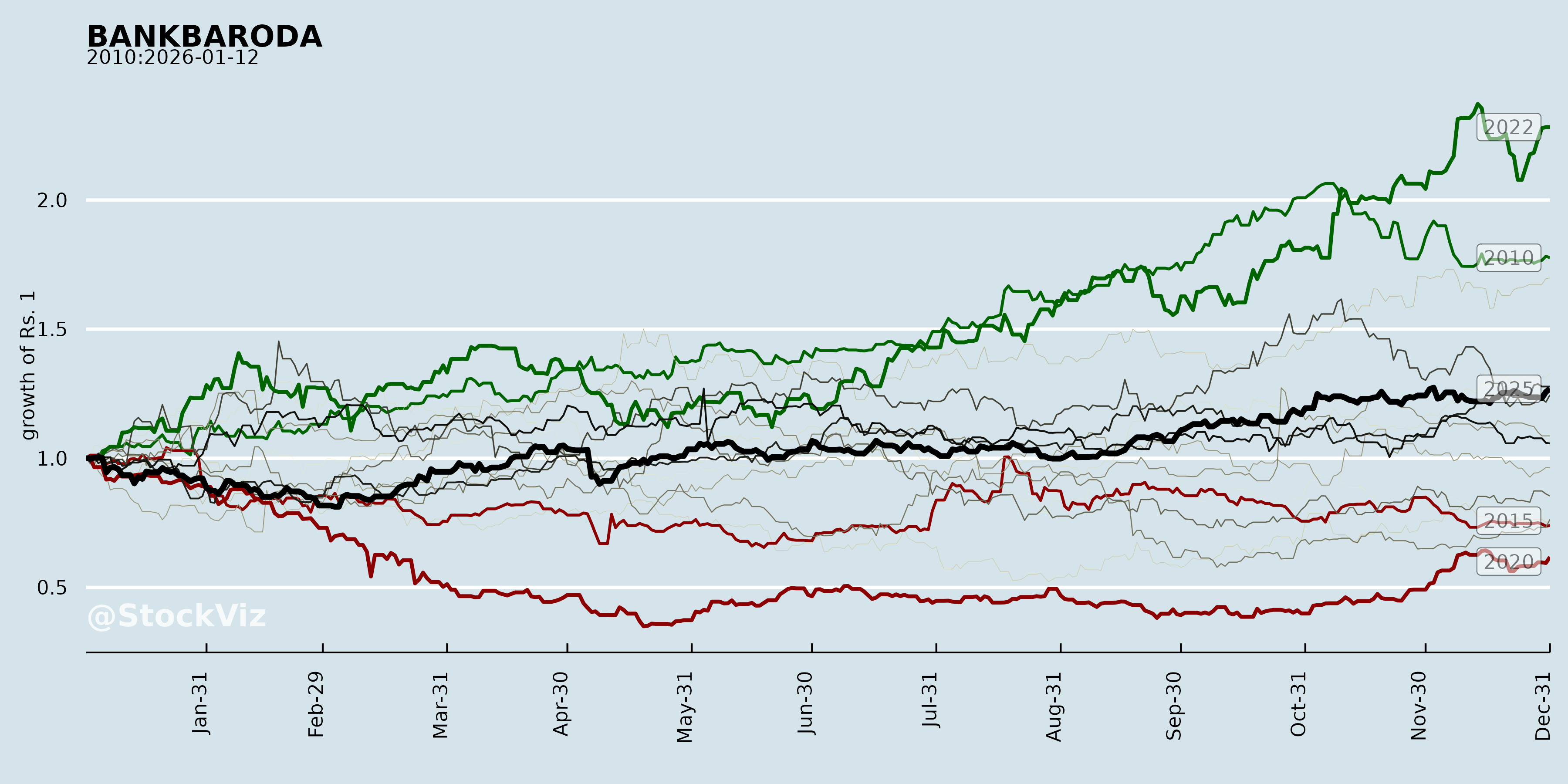
Cumulative Returns and Drawdowns


Fundamentals
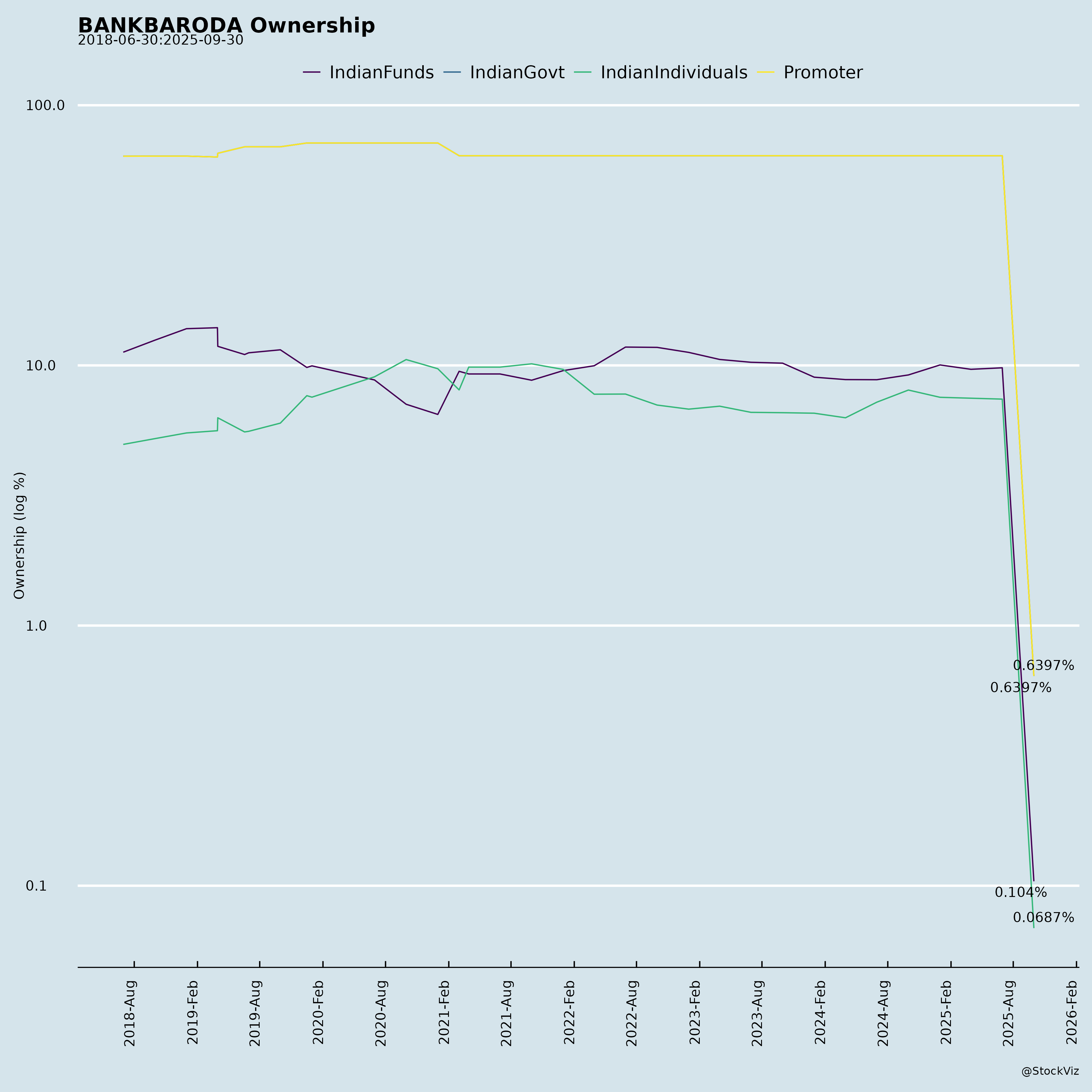
Ownership
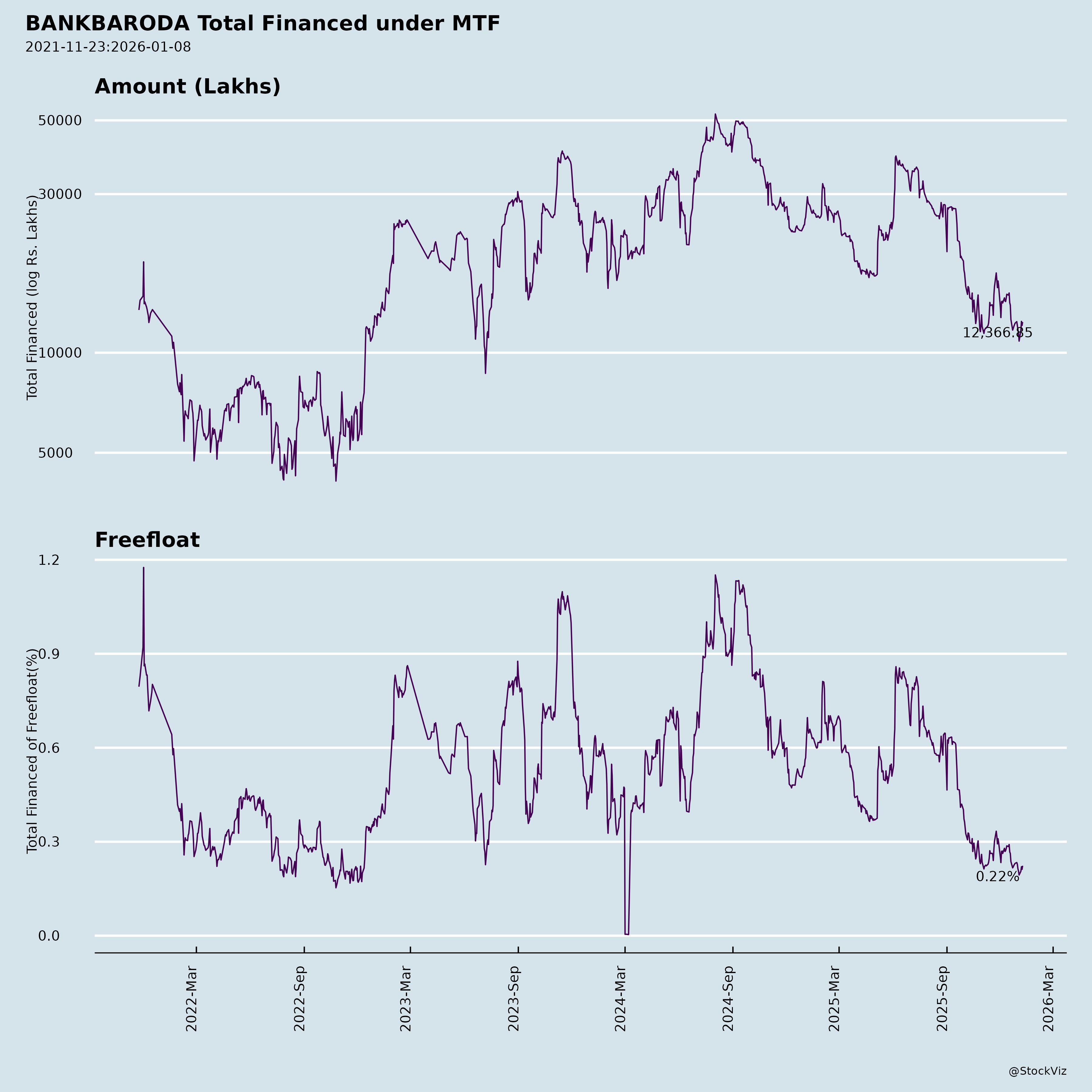
Margined
AI Summary
asof: 2026-09-14
Bank of Baroda — Q1 FY2026-27 Analysis
1. Headwinds and Challenges
Exceptional NMC settlement charge. The most significant drag on the quarter was the NMC Group settlement. Administrators of NMC Group entities had filed legal proceedings against Dr. BR Shetty, Mr. Prashant Manghat, and Bank of Baroda before the Abu Dhabi Global Market (ADGM) Court of First Instance and the England & Wales High Court, arising from insolvency linked to a fraud said to have been perpetrated by shareholders, senior management, and employees of the group between 2012 and 2020. Under a settlement agreement dated 1 July 2026, the Bank paid USD 600 million (equivalent to INR 5,680 crore), which was debited to the Profit & Loss Account for the quarter ended 30 June 2026. The Bank states the settlement resolves all claims without admission of liability or wrongdoing and that proceedings in the ADGM Court and the High Court of Justice of England & Wales have been discontinued.
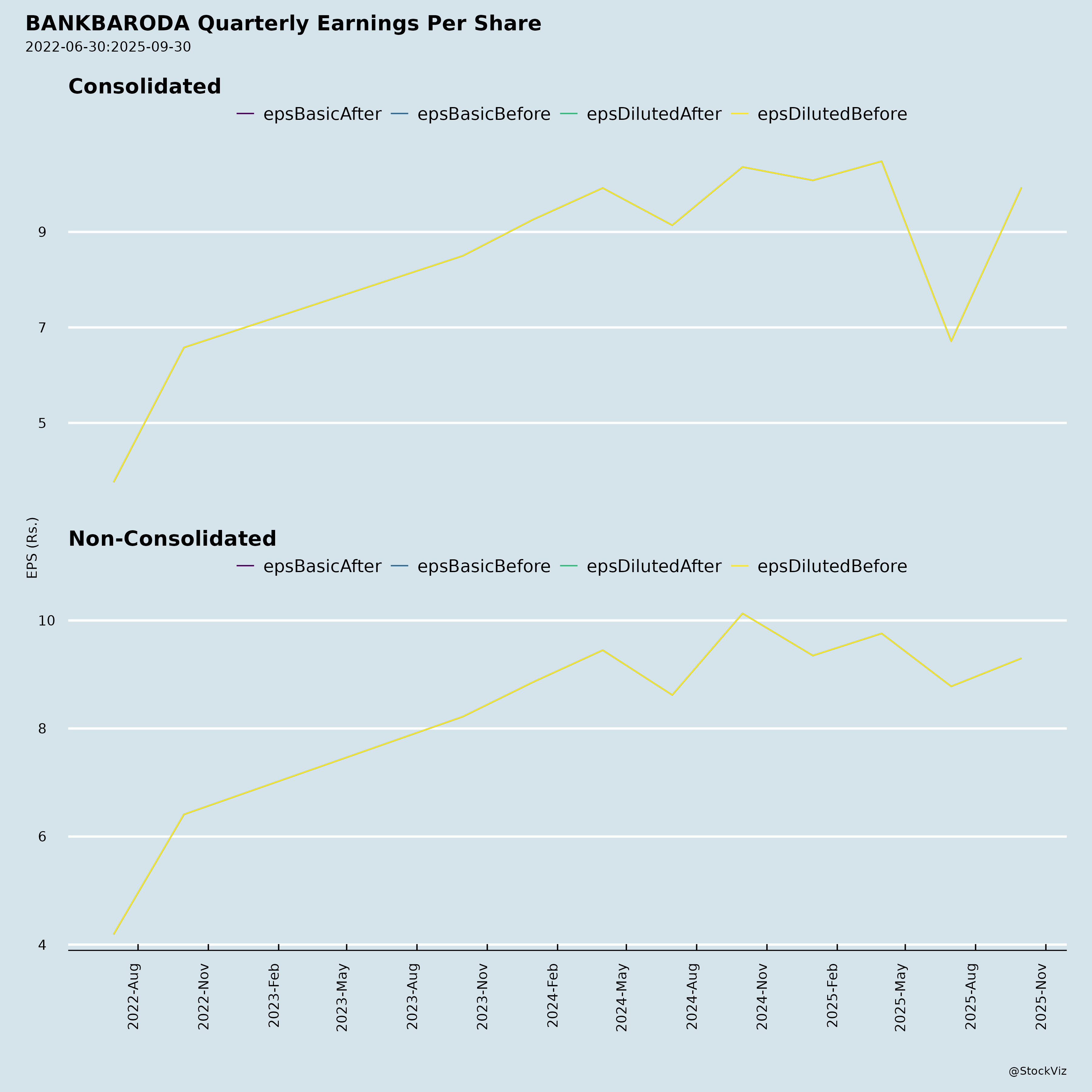
Profitability impact. Standalone net profit for Q1 FY27 fell to INR 1,278 crore from INR 4,541 crore in Q1 FY26 (down 71.8% YoY) and from INR 5,616 crore in Q4 FY26. The Bank notes that without the settlement payout, net profit would have been INR 5,528 crore. Return on Assets fell to 0.25% (1.10% excluding the exceptional item) and Return on Equity to 3.89% (16.57% excluding the item). Basic and diluted EPS dropped to INR 2.47 from INR 8.78 a year earlier.
Margin compression. Global NIM declined to 2.77% in Q1 FY27 from 2.91% in Q1 FY26 and 2.89% in Q4 FY26. Domestic NIM stood at 2.93%. Net interest income grew 9.5% YoY to INR 12,524 crore, but non-interest income fell 25.8% YoY to INR 3,470 crore, and operating income declined 0.7% YoY to INR 15,995 crore.
Sequential business contraction. Domestic deposits fell from INR 14,01,290 crore in March 2026 to INR 13,81,535 crore in June 2026, and domestic CASA declined from INR 5,45,034 crore to INR 5,21,149 crore. Global deposits also declined sequentially. Domestic advances fell from INR 11,69,458 crore to INR 11,50,906 crore, and global advances from INR 14,29,879 crore to INR 14,16,898 crore.
Asset quality softening versus the prior quarter. Gross NPA rose to 1.99% from 1.89% in Q4 FY26, and net NPA rose to 0.50% from 0.45%, though both improved YoY (from 2.28% and 0.60% respectively). Gross NPA in absolute terms increased to INR 28,15,042 lakh from INR 27,05,859 lakh at March 2026.
Elevated provisions. Total provisions (other than tax) and contingencies rose to INR 6,323 crore in Q1 FY27 from INR 1,967 crore in Q1 FY26, including the exceptional item. Provision for NPA/bad debts written off was INR 1,043 crore, down 38.2% YoY.
Project finance stress indicators. Of 150 projects under implementation at quarter-end (outstanding INR 15,16,702 lakh), 30 accounts (INR 2,41,244 lakh) had resolution processes invoked involving extension of DCCO; of these, resolution plans were implemented in 23 accounts (INR 78,349 lakh) and under implementation in 7 accounts (INR 1,62,895 lakh).
2. Tailwinds and Growth Prospects
Strong balance sheet growth. Global business stood at INR 30,50,457 crore, up 15.4% YoY. Global advances grew 17.4% YoY to INR 14,16,898 crore, with domestic advances up 16.1% to INR 11,50,906 crore and international advances up 23.3% to INR 2,65,992 crore. Global deposits grew 13.8% YoY to INR 16,33,559 crore, with domestic deposits up 14.7% to INR 13,81,535 crore and international deposits up 8.9% to INR 2,52,024 crore.
Retail and RAM momentum. Organic retail advances grew 18.4% YoY to INR 3,09,674 crore, led by auto loans (+25.3%), mortgage loans (+27.4%), home loans (+14.7%), and education loans (+10.8%). The RAM portfolio grew 16.5% YoY and constitutes 62.9% of advances. Agriculture loans grew 18.7% YoY to INR 1,91,989 crore, organic MSME grew 20.3% YoY to INR 1,63,264 crore, and corporate advances grew 15.3% to INR 4,27,082 crore. Domestic CASA grew 10% YoY to INR 5,21,149 crore.
Cost of deposits easing. Cost of deposits for Q1 FY27 stood at 4.66%, down 12 bps sequentially and 39 bps YoY.
Asset quality improvement YoY. GNPA declined 29 bps YoY to 1.99% and NNPA declined 10 bps YoY to 0.50%. Slippage ratio fell 25 bps YoY to 0.91%. Credit cost stood at 0.29% versus 0.55% in Q1 FY26. Provision Coverage Ratio was 93.28% with TWO and 75.07% without TWO.
Capital position. Standalone CRAR stood at 16.30% (CET-1 13.90%, AT1 0.51%, Tier-II 1.89%), up from 15.82% in Q4 FY26. Consolidated CRAR was 16.70% and CET-1 14.36%. Quarterly average LCR (standalone) was approximately 127%.
Non-interest income components. Non-interest income of INR 3,470 crore included treasury income of INR 893 crore, recovery from written-off accounts of INR 1,006 crore, and PSLC income of INR 280 crore.
Regulatory capital relief. Following the RBI (Commercial Banks — Classification, Valuation, and Operation of Investment Portfolio) Second Amendment Directions, 2026 dated 18 May 2026, the Investment Fluctuation Reserve requirement was discontinued; the Bank transferred its entire IFR balance of INR 3,34,000 lakh to General Reserve during the quarter (Group: INR 3,36,094 lakh). The Bank also holds a floating provision of INR 2,50,000 lakh (Group: INR 2,56,281 lakh) under its approved Floating Provision Policy per RBI directions dated 28 November 2025.
Segment performance. Standalone retail banking segment results rose to INR 3,88,897 lakh from INR 2,60,459 lakh YoY; wholesale banking rose to INR 3,39,909 lakh from INR 2,24,282 lakh; treasury operations fell to INR 1,47,060 lakh from INR 3,18,263 lakh. Digital banking remained loss-making at INR (376) lakh.
Green bond issuance. The Bank raised INR 10,000 crore through 7.10% Bank of Baroda 2033 Long Term Green Infrastructure Bonds Series I (ISIN INE028A08380) on 5 March 2026 via private placement, fully utilised with no deviation, for enhancing long-term resources and funding infrastructure sub-sectors and green debt securities.
3. Key Risks
Litigation and settlement risk. The NMC settlement demonstrates exposure to legacy fraud-related litigation. The Bank states its liability in these proceedings was limited to USD 600 million, which was paid on 1 July 2026, and that proceedings have been discontinued.
Asset quality risk. Although YoY improvement is evident, the sequential rise in GNPA (1.89% to 1.99%) and NNPA (0.45% to 0.50%) indicates underlying stress. Project finance accounts with DCCO extension and resolution plans under implementation (7 accounts, INR 1,62,895 lakh) represent potential slippage risk.
Margin risk. NIM compression from 2.91% to 2.77% YoY, alongside a 25.8% YoY decline in non-interest income, pressures overall profitability.
Concentration and credit transfer exposures. The Bank acquired loans through assignment (INR 10,60,168 lakh via syndication; INR 44,122 lakh via others) and novation (INR 95,916 lakh acquired; INR 9,466 lakh transferred). Rating-wise, acquired loans included INR 5,86,908 lakh rated A and above, INR 3,72,808 lakh rated B and above, and INR 1,96,368 lakh unrated. Stressed loans transferred during the quarter included 1 NPA account to ARCs (principal INR 27,370 lakh, consideration INR 24,445 lakh) and 2 accounts to permitted transferees (principal INR 2,464 lakh, consideration INR 2,900 lakh).
Security receipts exposure. The Bank holds SRs with book value of INR 45,728 lakh in investment categories (RR1: INR 31,057 lakh; RR2: INR 2,548 lakh; rating withdrawn: INR 12,123 lakh) and INR 71,586 lakh in matured investments (all rating withdrawn).
Co-lending arrangements. The Bank has 6 co-lending partners with gross outstanding of INR 45,693 lakh at a weighted average rate of 10.05%, across MSME, retail, and agriculture sectors, with no default loss guarantee.
Review scope limitations. The auditors note that the standalone results include interim financial information for 7,667 branches not reviewed by them, and that review reports covered 47.69% of the advance portfolio and 14.22% of NPAs; concurrent auditors covered 9.66% of advances and 36.25% of NPAs. For consolidated results, 9 subsidiaries were not reviewed by their auditors, and 7 subsidiaries plus 1 joint venture and 1 associate were reviewed by other auditors.
4. Management Guidance Versus Observed Business Performance
The source material does not contain explicit forward-looking management guidance figures. However, observed performance against stated strategic positioning can be summarised:
Growth delivery. The Bank reported global business growth of 15.4% YoY and global advances growth of 17.4% YoY, with domestic advances up 16.1%. The RAM portfolio share of 62.9% and organic retail growth of 18.4% indicate continued focus on retail, agriculture, and MSME segments. These outcomes are consistent with the reported strategic emphasis on retail-led growth.
Asset quality trajectory. The Bank reported YoY improvement in GNPA (2.28% to 1.99%) and NNPA (0.60% to 0.50%), with PCR at 93.28% including TWO. However, the sequential deterioration from Q4 FY26 (GNPA 1.89%, NNPA 0.45%) indicates that the improving trend is not linear.
Profitability excluding exceptional item. Management highlighted that without the NMC settlement payout, net profit would have been INR 5,528 crore, ROA 1.10%, and ROE 16.57%. This compares with reported Q1 FY26 net profit of INR 4,541 crore, ROA of 1.03%, and ROE implied by the reported figures. The adjusted profitability therefore represents an improvement over the prior-year quarter, though the reported figures are materially lower due to the one-off charge.
Capital adequacy. CRAR improved to 16.30% from 15.82% in Q4 FY26, and CET-1 to 13.90% from 13.16%, supported in part by the IFR transfer to General Reserve and retained earnings.
Cost management. Operating expenses were flat YoY at INR 7,868 crore (-0.1%), while operating profit stood at INR 8,127 crore (-1.3% YoY), reflecting the pressure from lower non-interest income.
Segment mix. Retail banking segment results showed the strongest YoY improvement (INR 2,60,459 lakh to INR 3,88,897 lakh), while treasury operations declined sharply (INR 3,18,263 lakh to INR 1,47,060 lakh), consistent with the lower treasury income contribution and margin environment.
Broker Narrative
The narrative shifted from macro-level market-technical framing—Nifty momentum, RSI, and intermediate tops—to idiosyncratic banking fundamentals such as NMC settlement impacts, NIM compression, and ECL transition costs. While the 2021 report viewed upside through broad market uptrends, the 2026 report anchors it to bank-specific earnings drivers, though both persistently weigh near-term headwinds against medium-term growth potential.
Fears that came true
- The 2021 warning of an imminent Nifty intermediate top and near-term correction materialized intermittently, correlating with DISAPPOINTMENT outcomes such as -5.7% in July 2024 and -14.2% in November 2025.
Optimism that failed
- The 2021 expectation of an intact intermediate uptrend with ‘scope for more upsides’ failed to prevent sustained drawdowns, with the stock posting negative actual returns of -16.6% in January 2026 and -12.4% in June 2026.
Broker Timeline
56 broker calls · 2021-06-07 to 2026-07-27
Copyright © 2023 SAS Data Analytics Pvt. Ltd. All rights reserved.