AUBANK
Equity Metrics
September 24, 2026
AU Small Finance Bank Limited
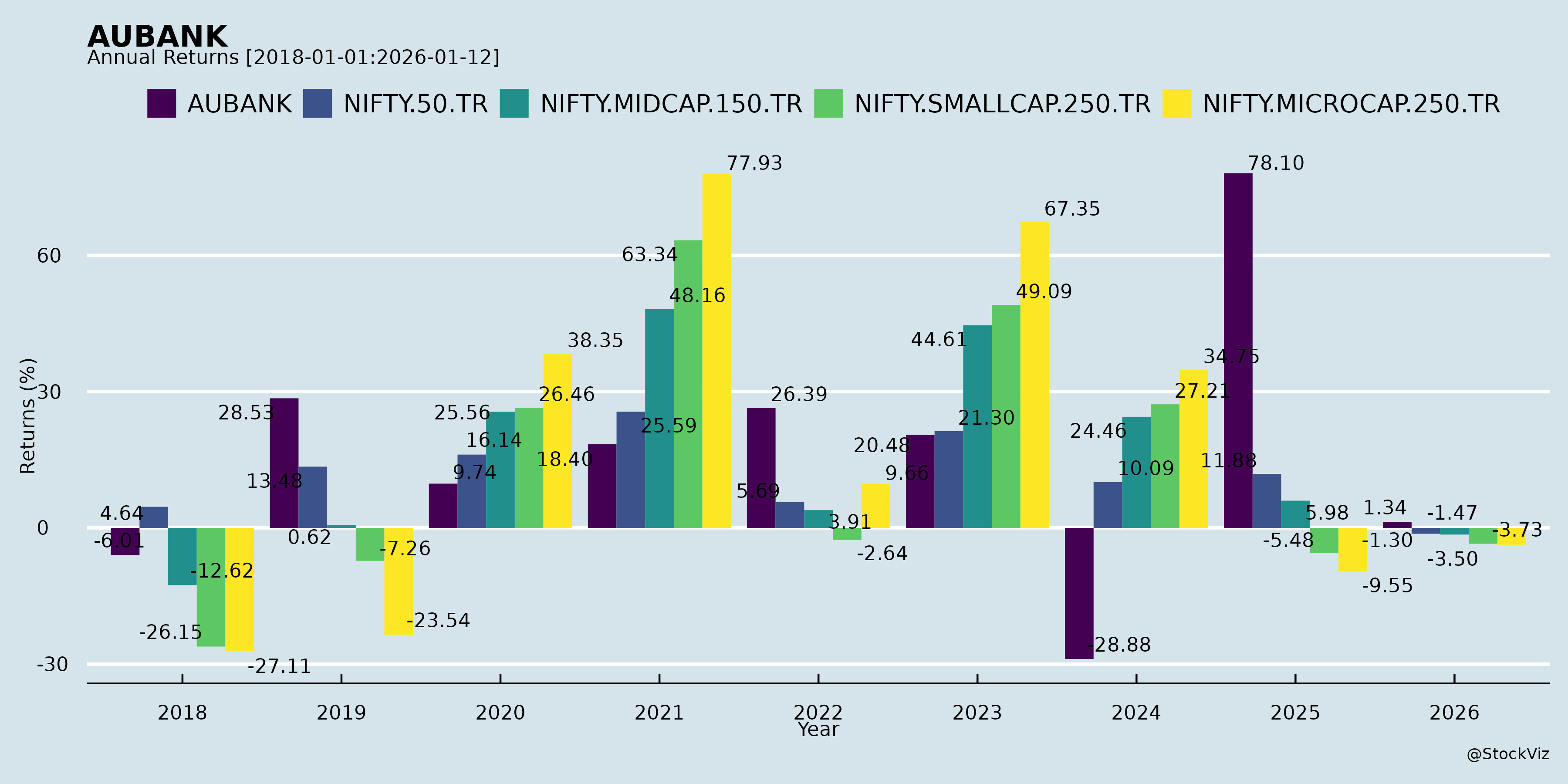
Annual Returns
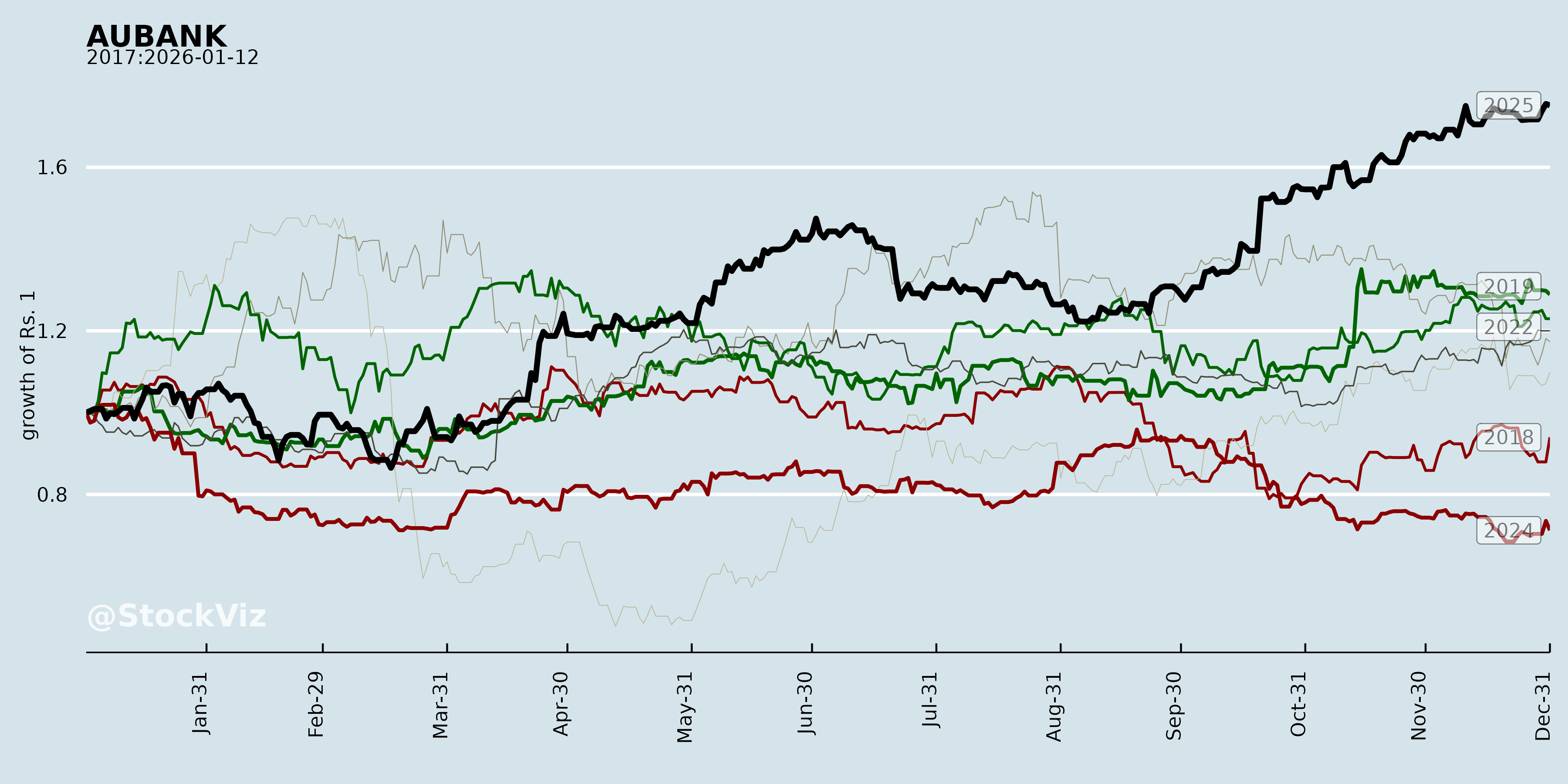
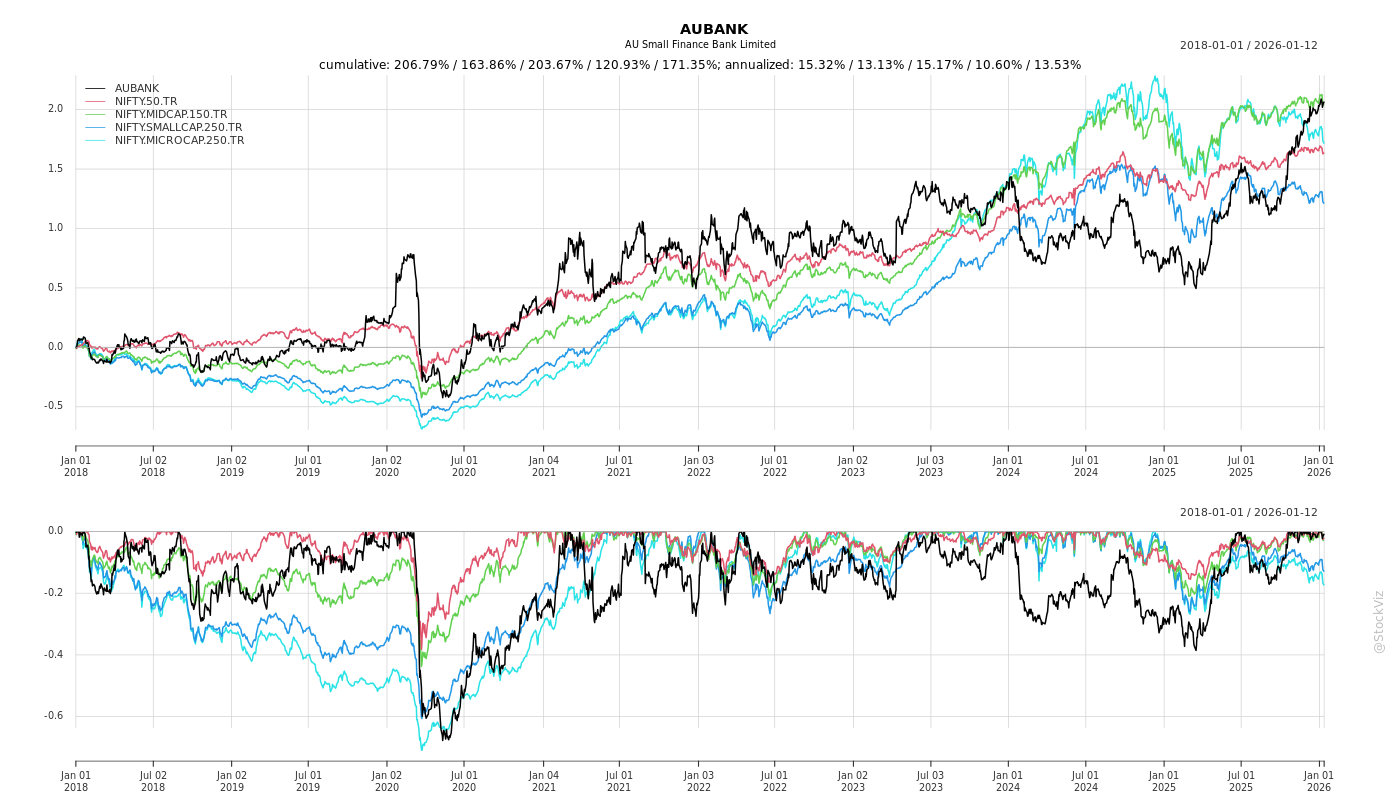
Cumulative Returns and Drawdowns
Fundamentals


Ownership

Margined
AI Summary
asof: 2026-09-16
AU Small Finance Bank — Q1 FY27: Headwinds, Tailwinds, Risks and Guidance
1. Headwinds and Challenges
Macro environment. Management describes Q1 FY27 as a quarter marked by geopolitical uncertainty in West Asia, higher currency volatility and tighter liquidity conditions. Despite this, domestic growth momentum and credit demand are described as resilient.
Seasonality. The quarter is characterised as “seasonally soft,” and NIM moderated by 7 bps QoQ to 5.9% on reversal of certain Q4 FY26 one-offs (day-count benefit and lower slippages in Q4).
Cost pressure. Operating expenses rose 26% YoY to ₹1,949 cr, reflecting higher business volumes and investment in distribution, manpower, branding and technology. Cost-to-assets (ex-CGFMU premium) was 4.0% versus 3.9% in Q1 FY26, and the cost-to-income ratio (ex-CGFMU) rose to 56.6% from 53.7% YoY.
Treasury income drag. Total other income fell 15% YoY to ₹689 cr because Q1 FY26 had benefited from higher treasury gains linked to RBI liquidity operations; treasury income was only ₹9 cr in Q1 FY27 versus ₹300 cr a year earlier.
Yield compression. Yield on gross advances declined 6 bps QoQ to 13.7% (from 14.1% in Q1 FY26), with ~68% of the book fixed-rate and ~4% floating but largely still in a fixed-interest period.
Asset quality mix. Gross NPA rose to 2.10% from 2.03% QoQ (though improved from 2.47% YoY), and NNPA rose to 0.76% from 0.74% QoQ. Slippages of ₹798 cr were higher than Q4 FY26’s ₹659 cr. Segment-level gross NPAs remain elevated in Inclusive Banking (3.6%) and Digital Unsecured (3.5%). PCR excluding technical write-offs is 64%, which is modest.
Securitisation decline. Securitised assets fell 37% YoY and 12% QoQ to ₹3,789 cr, and the “Others” loan segment contracted 10% YoY and 33% QoQ.
Regulatory transition conditions. The Universal Bank in-principle approval (August 7, 2025, valid 18 months) originally required promoter shares to be transferred to a NOFHC; RBI’s March 8, 2026 letter replaced this stipulation, making the NOFHC requirement applicable only if the transitioned Universal Bank or its promoters establish a future group entity. Final licence remains subject to RBI assessment, and the Bank applied for the final licence in March 2026.
2. Tailwinds and Growth Prospects
Balance sheet growth. Deposits grew 24% YoY (3% QoQ) to ₹1,57,727 cr versus ~14% estimated private-sector bank growth; gross loans grew 23% YoY (3% QoQ) to ₹1,44,250 cr versus ~17% estimated private-sector growth. Disbursements grew ~42% YoY.
Liability franchise quality. CASA grew 22% YoY and 5% QoQ, with CASA ratio at 29%. Cost of funds declined 60 bps YoY to 6.48%. Stable deposits (CASA + retail TD + non-callable bulk TD) form 79% of deposits; ~60% of deposits come from branch banking. CD ratio ex-refinance was 80%; average LCR was 119%, with additional liquidity of 10–15% of LCR in high-quality non-LCR investments.
Profitability. NII grew 32% YoY to ₹2,695 cr; NIM expanded 47 bps YoY to 5.9%; core other income grew 33% YoY to ₹680 cr; core PPoP grew 41% YoY to ₹1,426 cr; PAT grew 37% YoY to ₹796 cr; annualised RoA/RoE at 1.7%/15.6%. Provisions fell 30% YoY to ₹371 cr, with credit cost (incl. CGFMU) at 0.8% versus 1.4% a year ago.
Capital. Tier-I at 17.1% and CRAR at 18.9%.
Secured and new-business momentum. Secured businesses (Retail + Commercial) grew 25% YoY and 4% QoQ, led by Wheels, gold loans, business banking and renewable energy. Gold loans grew 130% YoY, renewable energy 123% YoY, EE&FI 41% YoY, commercial vehicles 33% YoY, tractor finance 32% YoY. Commercial banking non-fund book is over ₹11,400 cr.
Distribution and customers. Net 130 touchpoints added QoQ, including 16 new liability branches, taking total touchpoints to 2,920; 125 lac+ customers and 58,400+ employees.
AI and technology. Tech strategy organised under Run, Build and Transform. Agentic AI gold loan origination rolled out in a limited environment, with a mobile-native journey in branch pilot; the same platform is being extended to mortgages, wheels, commercial banking, credit cards and PL. A unified lead platform has 25,000+ users with 92% daily active usage. AU 0101 processes more than 90% of transactions and service requests. Voice-AI covers 11 languages with ~1 million outbound calls in four months and a roadmap to automate ~25% of call volume. ML models auto-close ~70% of monthly AML alerts. An AI Centre of Excellence is driving 50+ use cases.
Product and partnership initiatives. Four lifecycle-based credit cards launched (AU Ananta, AU Laksya, AU Tejas, AU Prathama); zero-forex-margin retail remittances introduced; a fund-blocking feature added to the 3-in-1 account proposition with Motilal Oswal.
Universal Bank transition. In-principle approval received; final licence application submitted March 2026.
Capital raising capacity. Shareholders approved fund-raising through equity shares and/or instruments representing equity shares and/or convertible securities linked to equity shares, including via Qualified Institutions Placement, and through non-convertible debt securities/bonds/other permissible instruments, along with enhancing the borrowing limit up to ₹30,000 Crore.
3. Key Risks
- Asset quality: GNPA at 2.10% and NNPA at 0.76%; slippages of ₹798 cr; PCR ex-technical write-off at 64% (~71% including contingency provisions and government-guarantee benefits). Higher-NPA segments include Inclusive Banking (3.6%) and Digital Unsecured (3.5%).
- Unsecured book normalisation: Unsecured businesses grew only 11% YoY versus 25% for secured; credit cost improvement is attributed to recovery in unsecured loans, making this a sensitivity.
- Provisioning policy tightening: An additional one-time provision of ₹23 cr was taken from strengthening provisioning policy in MFI, PL/BL, EEFI and 2W.
- Concentration in core markets for lending: 62% of GLP is disbursed in core (rural/semi-urban) markets while 83% of deposits come from urban markets.
- Fixed-rate book: ~68% of the book is fixed rate, with ~4% floating largely still in a fixed-interest period, limiting repricing flexibility.
- Macro/geopolitical and liquidity conditions: West Asia developments, currency volatility and tighter liquidity are cited as the operating backdrop.
- Regulatory/licence risk: Final Universal Bank licence remains subject to RBI assessment of compliance; the NOFHC requirement now applies on the transitioned Universal Bank if the Bank or its promoters establish a future group entity.
- Government guarantee dependence: ~7.7% of gross advances are covered under government guarantee schemes; CGFMU coverage on the MFI book is ~96%.
- Cost trajectory: Cost-to-assets and cost-to-income both rose YoY, with management expecting improvement only on a full-year basis.
4. Management Guidance Versus Observed Performance
Cost-to-assets. Management states operating leverage “continues to play out on underlying basis” and expects cost-to-assets to improve on a full-year basis. Observed: cost-to-assets (ex-CGFMU) was 4.0% in Q1 FY27 versus 3.9% in Q1 FY26, though it improved from 4.1% in Q4 FY26 and 4.2% in FY26.
NIM. Management attributes the 7 bps QoQ moderation to reversal of Q4 FY26 one-offs (day-count benefit and lower slippages in Q4). Observed: NIM at 5.9%, up 47 bps YoY but down 7 bps QoQ.
Credit cost. Management links the improvement to normalisation in unsecured loans. Observed: credit cost (incl. CGFMU) at 0.8% versus 1.4% in Q1 FY26, but higher than Q4 FY26’s 0.6%.
Growth quality. Management states performance is “increasingly being driven by the underlying strength of the franchise and disciplined execution, rather than cyclical or one-off factors.” Observed: core PPoP grew 41% YoY while reported PPoP grew only 9% YoY, with the gap explained by the ₹300 cr treasury gain in Q1 FY26 versus ₹9 cr in Q1 FY27.
Universal Bank transition. Management states the Bank “remains well positioned” and continues “progress towards becoming a Universal Bank.” Observed: in-principle approval received August 7, 2025; final licence application submitted March 2026; NOFHC stipulation replaced by RBI letter dated March 8, 2026.
AI/tech outcomes. Management states investments are “focused on delivering tangible business outcomes through accelerated growth, enhanced customer experience, improved productivity and stronger operating leverage.” Observed: gold loan AI origination in limited rollout and branch pilot; unified lead platform with 25,000+ users and 92% daily active usage; ~70% of AML alerts auto-closed; roadmap to automate ~25% of call volume.
Analytics for secured loans. Management describes this as “early-stage, with positive outcomes expected soon.”
Dividend. The Board set July 31, 2026 as the record date for determining members eligible to receive a final dividend, if declared at the ensuing AGM; the 31st AGM was held September 5, 2026, where shareholders approved a dividend of ₹1 per equity share of ₹10 each.
Leadership. Mr. Yogesh Jain, COO, was elevated as Deputy CEO effective July 25, 2026, continuing to report to the MD & CEO and remaining categorised as SMP. Mr. Yogesh Soni was categorised as SMP effective July 25, 2026; Mr. Bhaskar Karkera, Mr. Vaman Ramesh Kamat, Mr. Vivek Rathi, Mr. Dhavan Natvarlal Shah and Mr. Ankur Tripathi were re-categorised from SMP to non-SMP effective July 25, 2026; Mr. Deepak Jain was to be re-categorised from SMP to non-SMP effective September 1, 2026 upon completion of his term as Chief Risk Officer. Mr. Anil Agarwal was appointed Senior Executive Group Head – Commercial & Institutional Banking (categorised as SMP) effective September 14, 2026.
Broker Narrative
The broker narrative evolved from banking-sector concerns about rising cost of deposits, margin moderation, stagnating loan yields, and wage-driven expense pressures toward growth drivers centered on digital business EBITDA expansion, ARPU improvement, O2C margin recovery, and value unlocking in digital and retail segments. Persistent themes included deposit dynamics and retail performance, while treasury health and credit cost control faded from prominence as new revenue and margin recovery narratives took center stage.
Fears that came true
- Rising cost of deposits (CoD) and higher funding costs and bulk deposits mix materialized, contributing to DISAPPOINTMENT outcomes with negative actual returns (-14.3%, -12.1%, -8.3%) on Buy-rated calls in 2023.
- Margin moderation for several banks and elevated operating expenses due to wage revisions eroded profitability, correlating with Motilal Oswal’s repeated DISAPPOINTMENT results (-12.7%, -6.0%) in 2024.
- Stagnating loan yields persisted as a headwind, reflected in DISAPPOINTMENT outcomes including Yes Securities’ Neutral call with an actual -4.7% return in January 2024.
Optimism that failed
- Healthy treasury performance due to moderation in bond yields did not prove durable enough to offset headwinds, as DISAPPOINTMENT outcomes persisted even when treasury strength was cited as a tailwind.
- Controlled slippages and credit costs, supported by recoveries failed to sustain, evidenced by DISAPPOINTMENT results suggesting credit costs re-emerged as a drag on performance.
Broker Timeline
40 broker calls · 2023-06-01 to 2025-10-20
Copyright © 2023 SAS Data Analytics Pvt. Ltd. All rights reserved.