ASHOKA
Equity Metrics
November 18, 2026
Ashoka Buildcon Limited
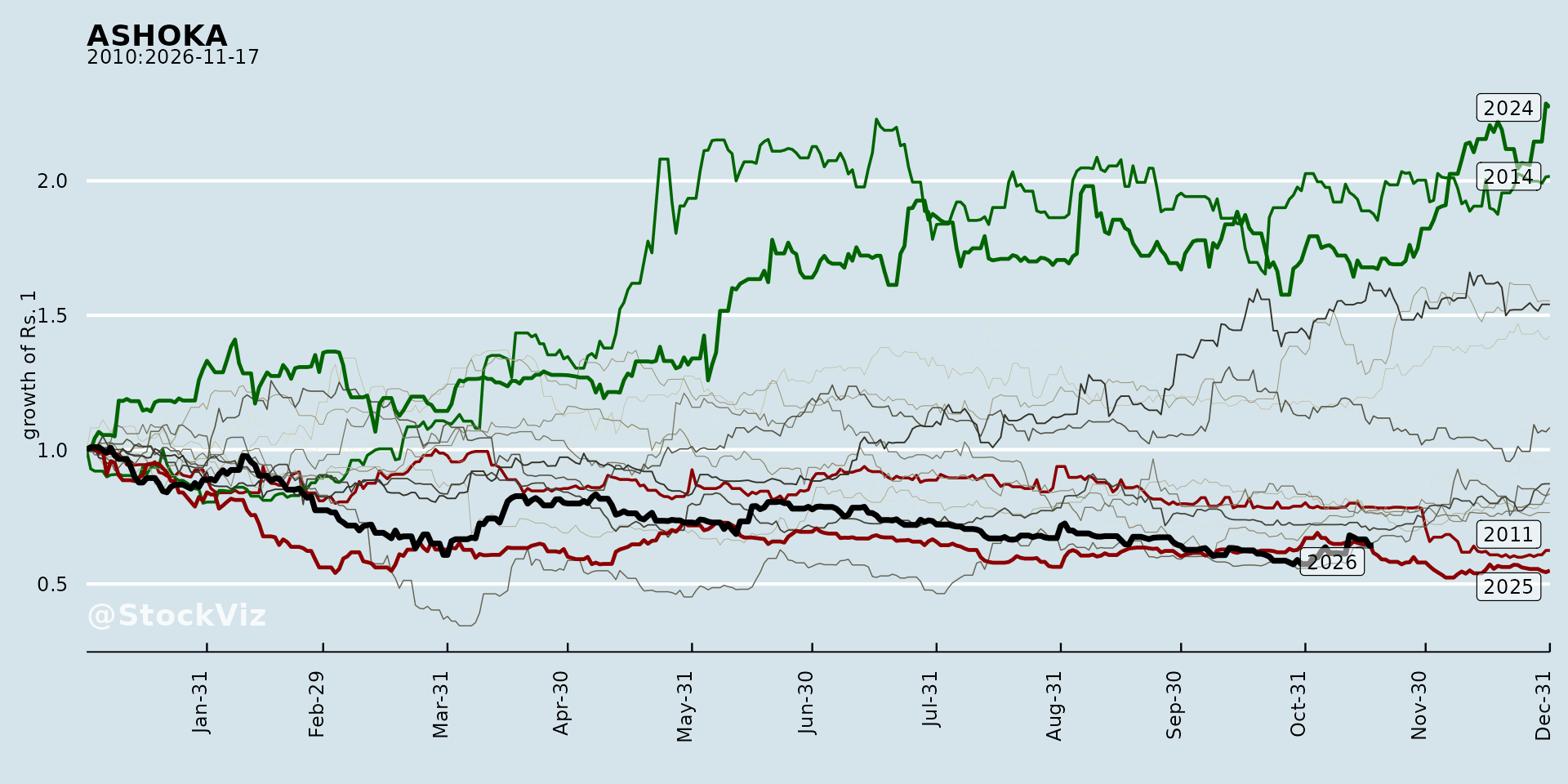
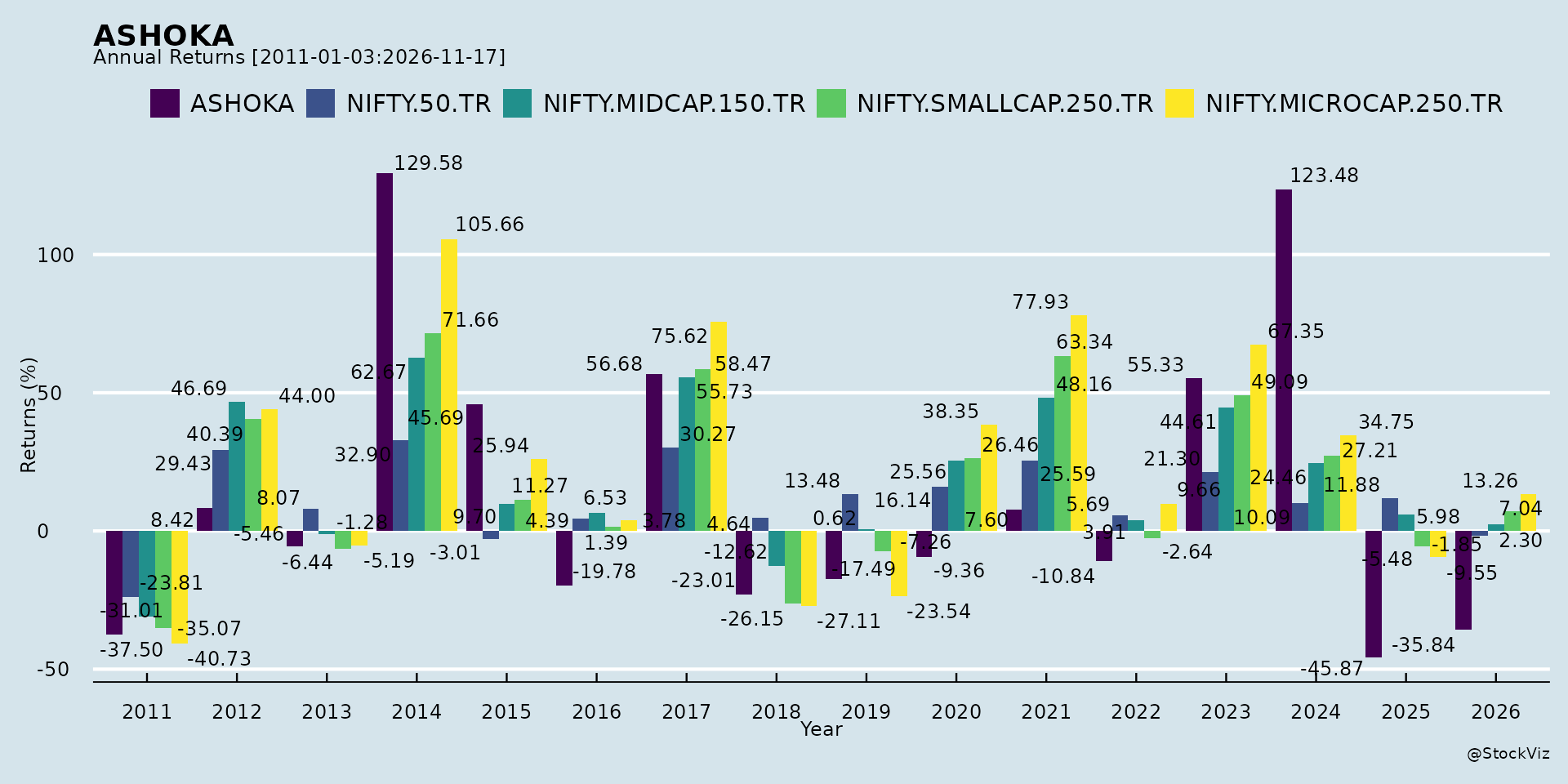
Annual Returns
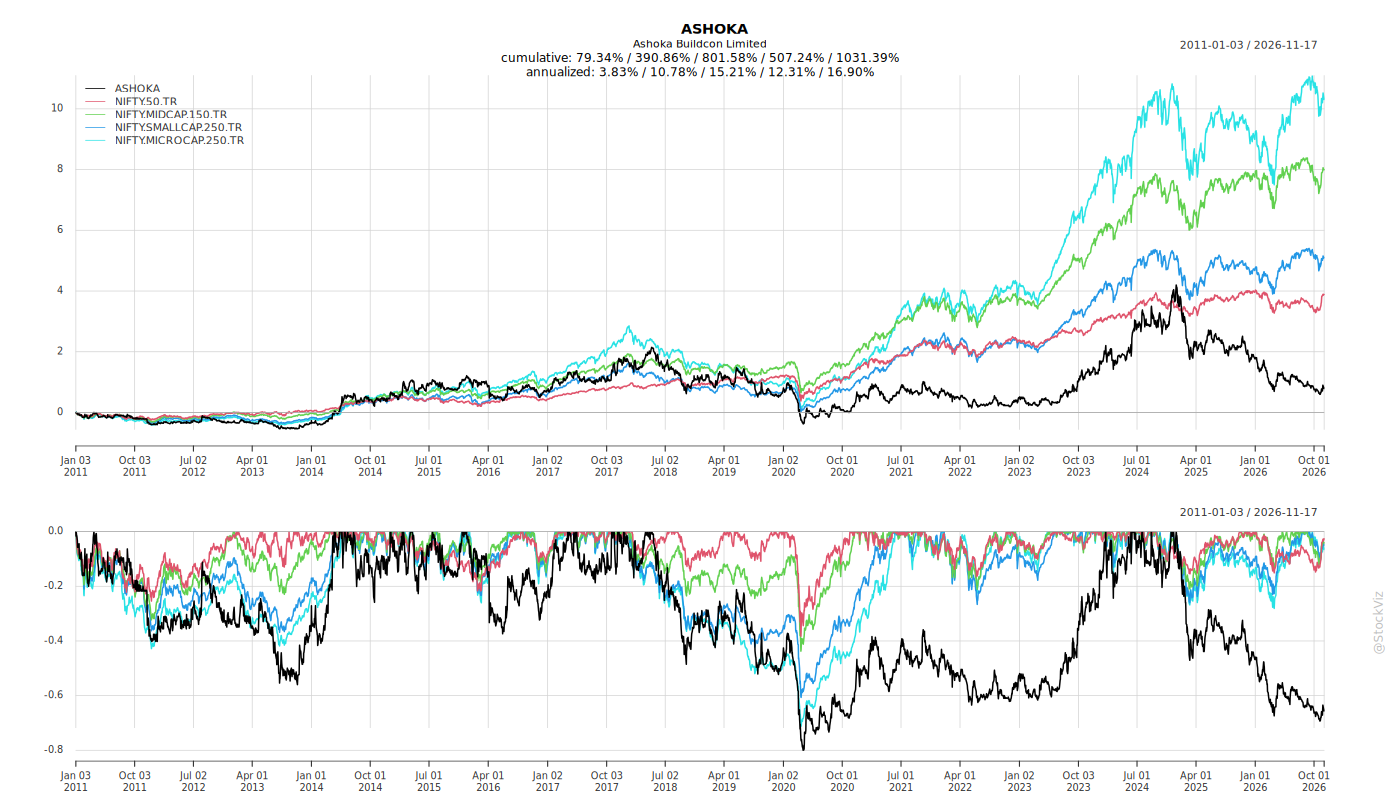
Cumulative Returns and Drawdowns
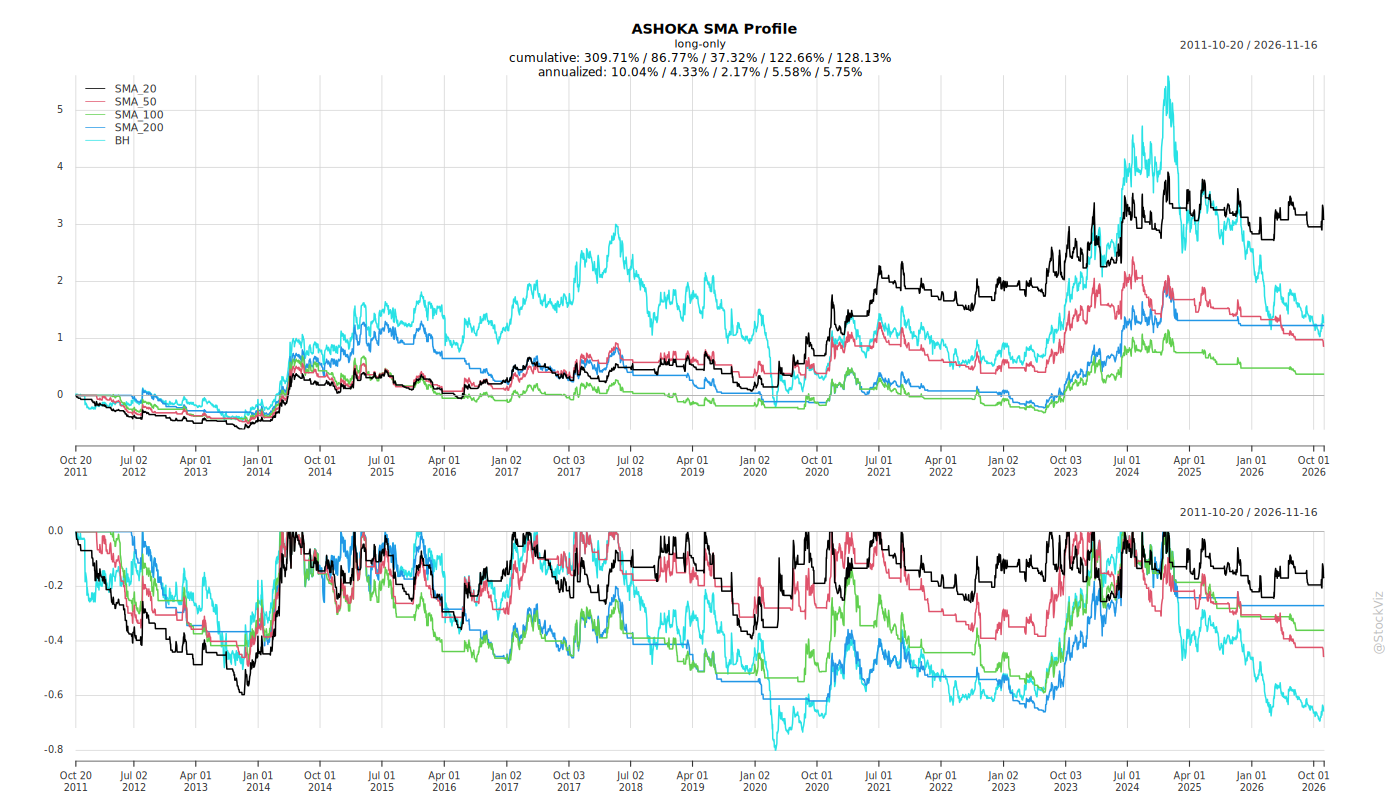
Fundamentals
Ownership
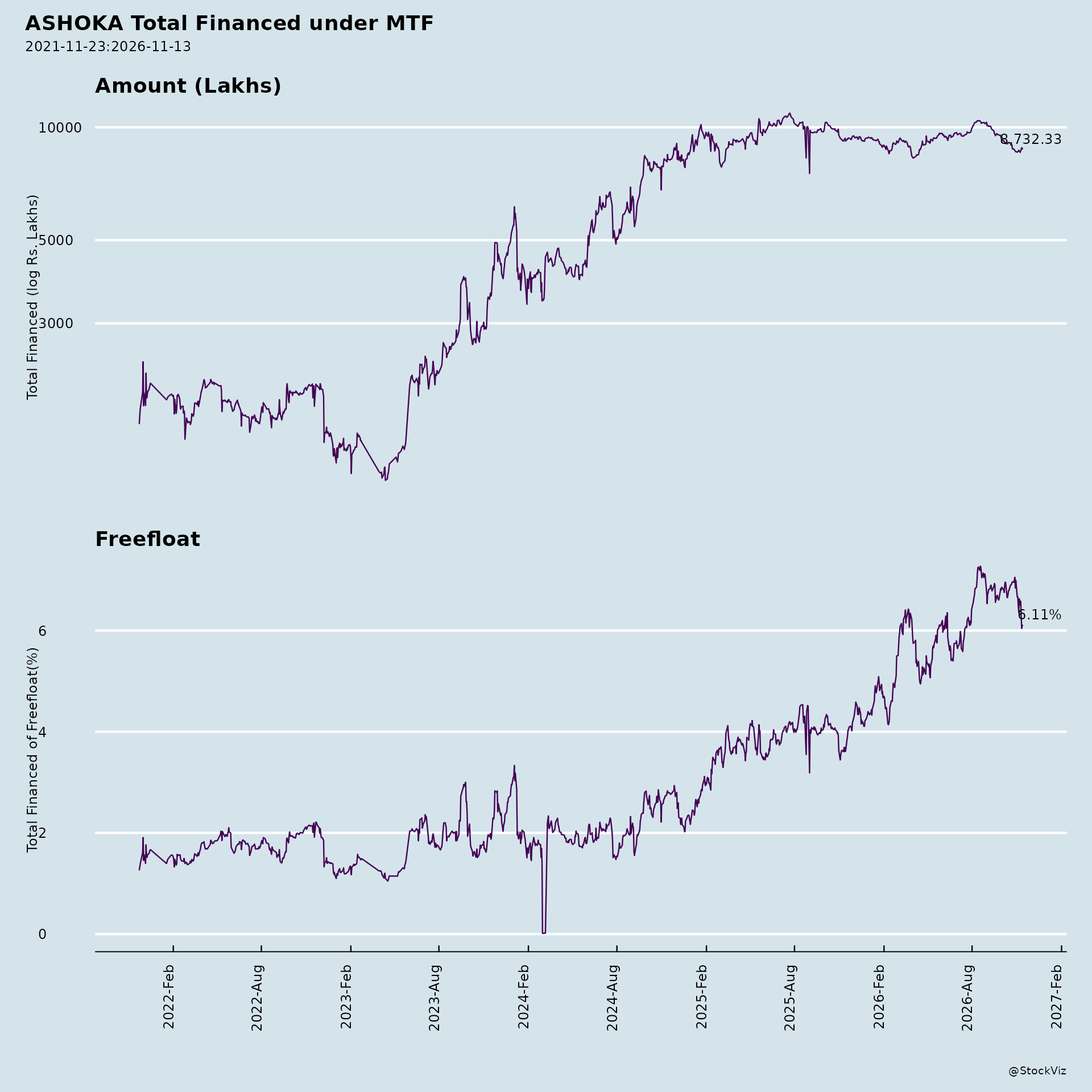
Margined
AI Summary
asof: 2026-09-17
Ashoka Buildcon — Q1 FY27 Developments, Guidance and Risks
1. Headwinds and challenges
Subdued domestic highway awarding and execution. Management described Q1 FY27 as starting on a “mixed note,” with the domestic highway awarding environment remaining subdued. NHAI awarded only around 5 km of projects in June compared with 102 km in May, while construction activity in June declined 32% year-on-year to around 274 km. For the first two months of FY27, construction stood at approximately 638 km, around 34% lower year-on-year. Management characterised the sector as shifting focus from simply awarding more kilometres to proper project appraisal, land availability and efficient execution.
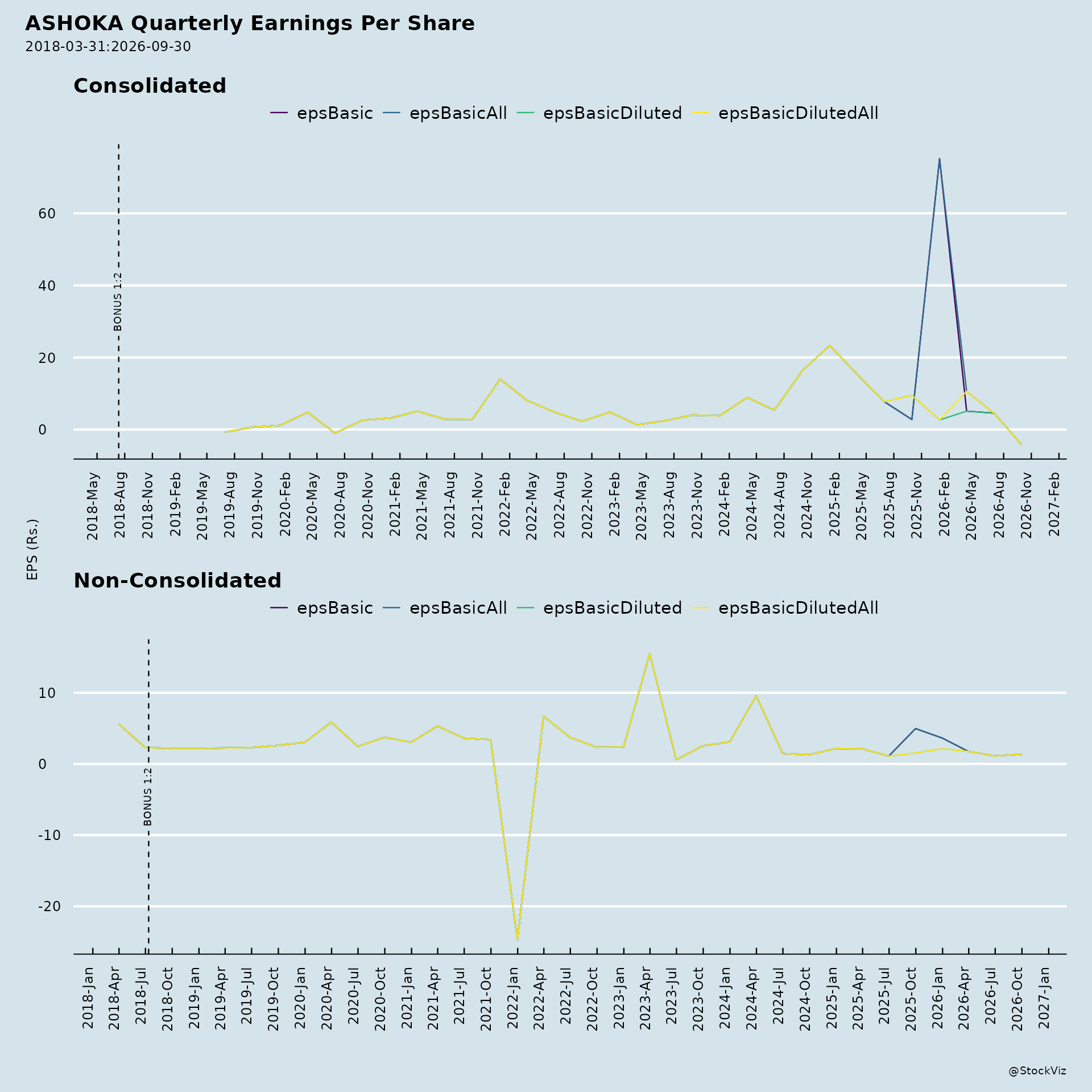
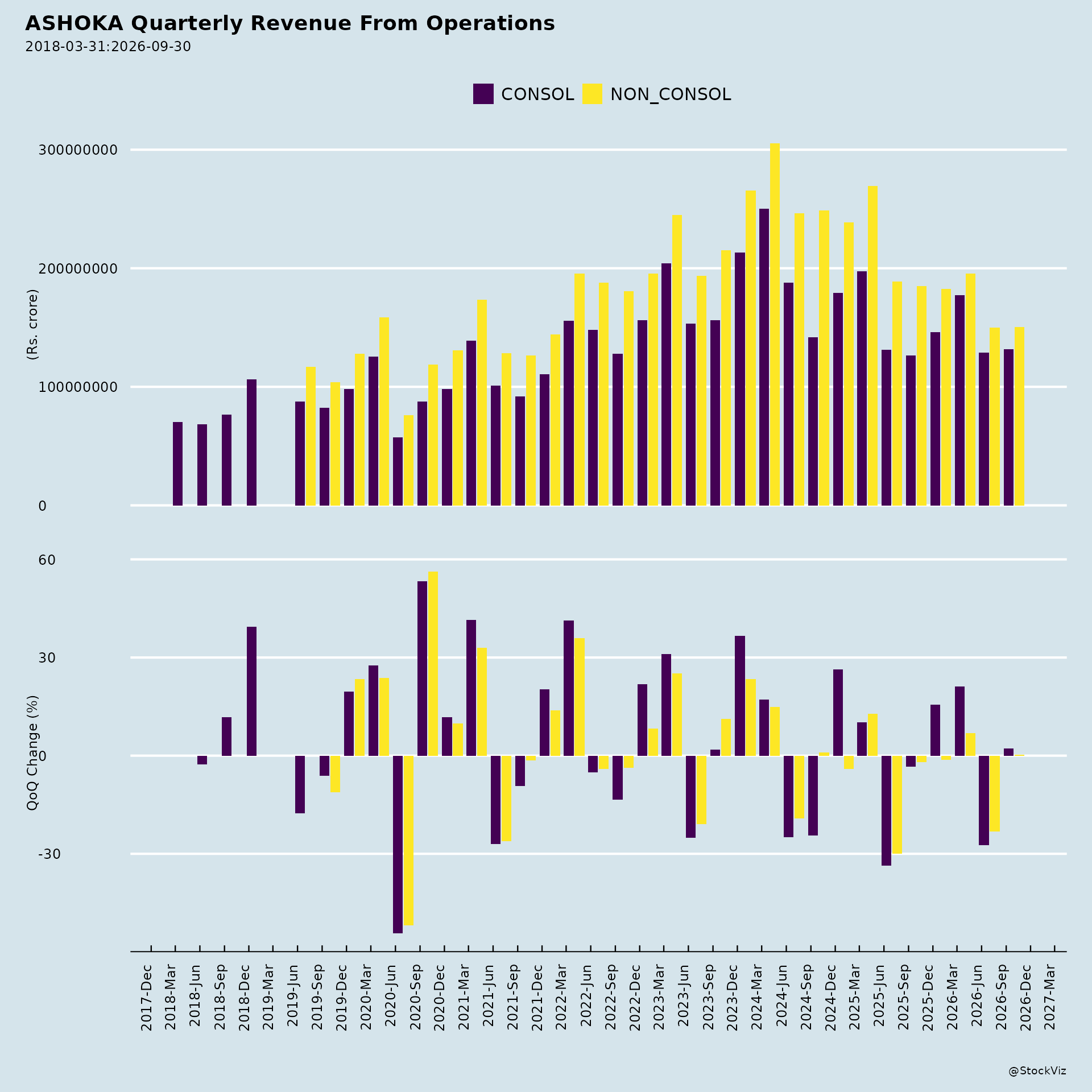
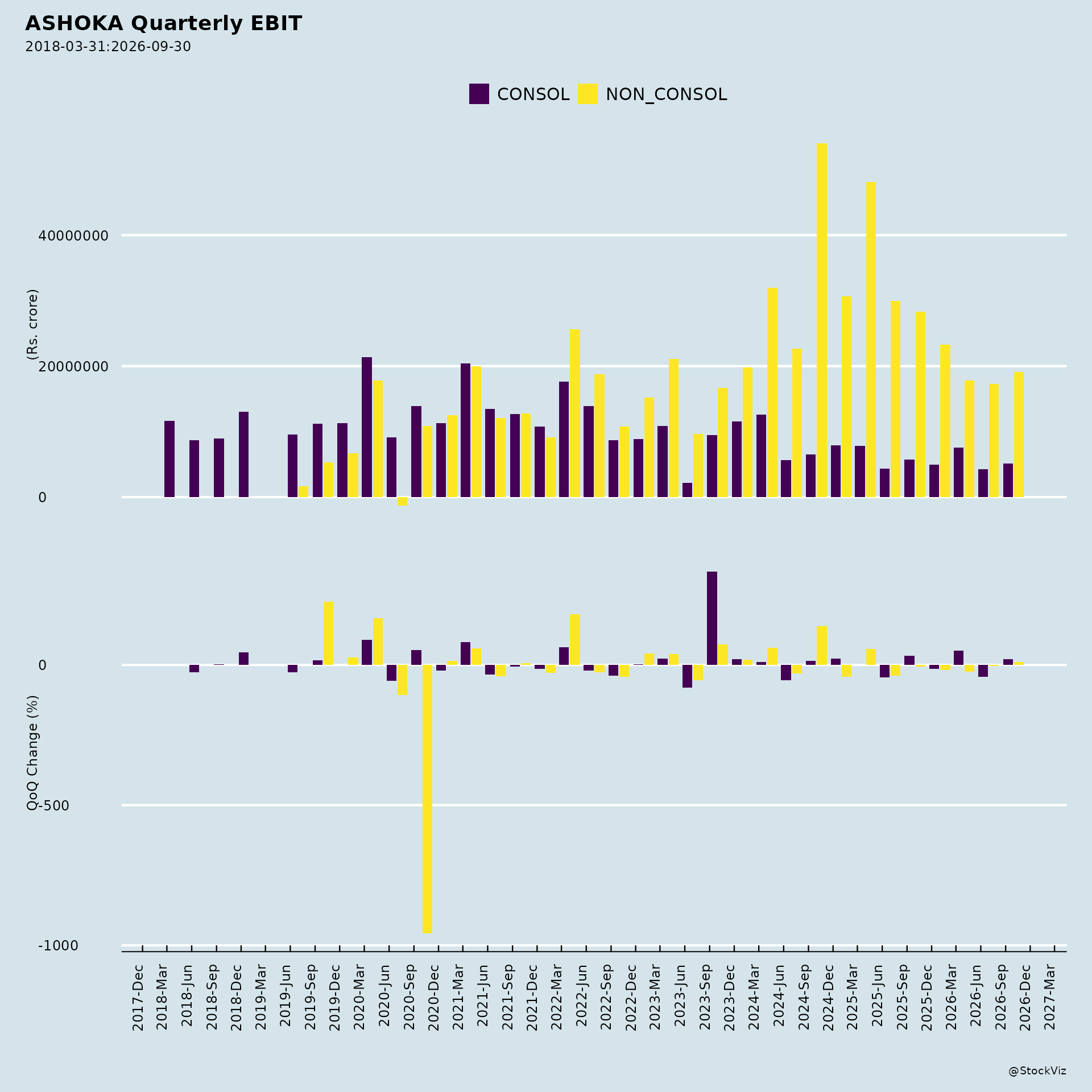
Flat standalone performance and margin compression. Standalone total income was INR1,320.4 crores in Q1 FY27 versus INR1,339.1 crores in Q1 FY26 (down 1%). Standalone EBITDA fell 17% year-on-year to INR125.5 crores, with EBITDA margin at 9.5% versus 11.3% a year earlier. Operating margin (excluding other income) was 7.22% in Q1 FY27 against 9.33% in Q1 FY26. Management attributed the margin pressure to mobilisation of new administrative and employee costs for new verticals, with initial-phase costs loaded into the quarter.
Consolidated de-growth from asset monetisation. Consolidated total income fell 21% year-on-year to INR1,534 crores from INR1,937 crores, and consolidated EBITDA fell 55% to INR292 crores with a 19.0% margin, largely attributed to monetisation of BOT and HAM projects in Q3 FY26.
Working capital absorption and delayed Power T&D collections. Approximately INR250-odd crores was infused between March and June for new projects where billings are yet to start, including advances paid to contractors. Collections in the Power T&D sector increased and are expected to be realised over the next couple of quarters, with most payments expected by Q4 of the year. Execution itself was not described as hurt by collections.
Monetisation timeline slippage. The sale of the remaining six SPVs of Ashoka Concessions Limited has been extended. Four assets originally targeted for the June quarter are now expected by Q2, with completion targeted by September end or the first part of October; the other two assets require duty and other compliances and are expected by December or Q4. The indicative completion date was extended to September 15, 2026 for TS-1, TS-2 and TS-3 and to September 30, 2026 for the BS SPV, subject to conditions precedent and regulatory/lender approvals. A further document records mutual agreement to extend indicative timelines to allow individual completion of conditions precedent, with the indicative date for SPVs where major construction works are complete (TS-1, TS-2, TS-3) extended to October 31, 2026 and others to follow per the transaction documents. Holdbacks of roughly INR30–40 crores are possible, and amounts previously pending (around INR50 crores for BOT and INR90 crores for HAM) are still being received, with about 30% collected.
Regulatory matter. A CBI matter relating to a Bihar project remains sub-judice before the Ld. Court of Special Judge, CBI, Bihar, with no adjustments made to the financial results. The company filed a writ petition dated May 11, 2026 with the High Court of Judicature at Patna seeking quashing of the allegations. Separately, a Show Cause Notice dated November 26, 2025 from NHAI was resolved through a Settlement Agreement, with NHAI closing proceedings with no further action, withdrawal of suspension and confirmation of no debarment, against payment of INR1.04 crore deposited on July 9, 2026.
2. Tailwinds and growth prospects
Railways. The Indian budget provided a record railway capital expenditure allocation of approximately INR2.93 lakh crores. The government announced 7 new high-speed rail corridors covering around 4,000 km with estimated investment potential of INR16 lakh crores, along with a 2,052 km dedicated freight corridor between Dankuni and Surat. Management noted the railway opportunity now spans electrification, signalling, safety systems, freight infrastructure, station development and specialised EPC. Ashoka received a Letter of Acceptance from Rail Vikas Nigam Limited for Package-3 of the Rishikesh Karnprayag New BG Rail Line Project in Uttarakhand, valued at Rs.602.16 crore including GST, with a 30-month completion period from commencement.
Power transmission and distribution. India’s rapid renewable capacity addition is driving significant investment into state transmission systems and energy corridors, which management sees as a long structural growth area.
International expansion. Ashoka received a Letter of Acceptance from the Central Housing and Planning Authority, Guyana, for four-laning of the Versailles–Parika Highway in Region 3, valued at GYD $7,455 million (USD 35.42 million, around INR328 crores), to be executed within 20 months. Management stated the company is working in 7 countries and plans to expand to around 10, with an independent international vertical. In Q1, around INR145 crores of revenue came from outside India, about 80% of it from Guyana. Management also noted the company has expanded its international presence to 7 countries in FY2026, creating a more diversified revenue base.
New verticals. The Chhattisgarh State Industrial Development Corporation Letter of Acceptance covers development of a Gems & Jewellery Park under PPP mode at Raipur over 38,922 sq. mtrs, with an accepted premium of approximately INR112.40 crores, a 30-year lease extendable up to 90 years and a 5-year construction period; Ashoka holds 51% in the JV. Management described this as entry into industrial park development, with the project sized at around INR1,000-odd crores to be spent and recovered over 5 years, and roughly INR100 crores per year of revenue potential. A new SPV, Ashoka-RDB Infrastructure & Development Private Limited, was incorporated on July 15, 2026 with Ashoka holding 51%, for this park.
Order book and bid pipeline. As on June 30, 2026, the order book stood at INR15,251 crores, excluding orders received after that date of about INR451 crores. Road and railway comprised around INR9,648 crores (63.3%), including HAM of about INR1,500 crores, EPC of about INR6,780 crores and railway of about INR1,346 crores. Power T&D accounted for around INR5,066 crores (33.2%) and building EPC INR536 crores (3.5%). The bid pipeline includes around INR1 lakh crores from NHAI and MoRTH, about INR25,000 crores from states, around INR50,000 crores from railways, plus power T&D and renewable energy EPC. Bids submitted but not yet opened total around INR8,000 crores. Management expects good awarding in Q3 and Q4, with NHAI moving to larger packages that should rationalise competition, and is evaluating large BOT orders project by project.
Portfolio streamlining. The stake in Ashoka Purestudy Technologies Private Limited was diluted from 59% to 39.33% via a preferential allotment on June 12, 2026, reclassifying it from subsidiary to associate. Management said a strategic partner was brought in to help execute projects at the Purestudy level and create more value at the SPV level.
3. Key risks
- Continued weakness in domestic highway awarding and construction, with NHAI awarding and construction volumes well below historical levels.
- Execution and margin risk from new projects and verticals, where initial establishment, mobilisation and administrative costs are incurred before revenue ramps up.
- Timing and completion risk on the six-SPV monetisation, including conditions precedent, regulatory and lender approvals, and possible holdbacks; the two remaining assets require duty and other compliances.
- Collection risk in Power T&D, with amounts locked in working capital, unbilled revenue and debtors, expected to normalise by Q4.
- The sub-judice CBI matter in Bihar, where no adjustments have been made to the financial results pending outcome.
- Dependence on international markets for incremental growth, with management noting margins and competition vary country to country.
- Interest cost sensitivity: standalone interest cost was guided to around INR225–240 crores for FY27 and approximately INR200–210 crores for FY28, dependent on turnover.
4. Management guidance versus observed performance
Revenue growth guidance lowered. Management lowered revenue growth guidance from 20% to between 10% and 15%, citing a flat quarter and uncertainties particularly in supply chain. This followed Q1 FY27 standalone total income of INR1,320.4 crores, down 1% year-on-year, and consolidated total income down 21% year-on-year.
Margin guidance lowered. Management guided FY27 EBITDA margin to around 9% to 9.5%, about 0.5% below the earlier roughly 10% expectation, because the shortfall in Q1 is not expected to be fully recovered in the remaining three quarters. Q1 FY27 standalone EBITDA margin was 9.5% versus 11.3% in Q1 FY26. Management expects H1 to remain subdued with H2 ramping up, and expects margins of 10.5% to 11% over time, with FY28 potentially in the 10% to 10.5% range.
Order inflow guidance. Management guided order inflow of INR6,000 to INR8,000 crores for the balance three quarters, after around INR780–800 crores received in Q1 and L1 status on around INR1,800 crores expected to materialise in Q2. The order book as on June 30, 2026 was INR15,251 crores, excluding about INR451 crores received after that date.
Monetisation guidance versus slippage. The earlier plan of four assets by the June quarter and two by the December quarter was revised, with four assets now expected by Q2 (September end or early October) and the remaining two by December or Q4. The disclosed total consideration was around INR1,100 crores (INR1,150 crores on a rounding basis), with approximately INR700 crores expected from the four assets. The company and proposed investor subsequently agreed to extend indicative timelines, with TS-1, TS-2 and TS-3 now up to October 31, 2026.
Debt guidance. Management guided third-party debt post-monetisation to around INR500–600 crores, with total debt including subsidiary debt around INR1,100–1,200 crores. Standalone debt was reported at INR1,173 crores (INR63 crores equipment loans and INR1,110 crores working capital loans) and consolidated debt at INR2,773 crores. Interest cost paid to subsidiaries was INR17 crores in the quarter.
HAM equity commitment. For FY27, INR179 crores is to be invested in existing HAM projects including Bowaichandi; INR72 crores each for FY28 and FY29. Investment up to June across the six HAM projects is approximately INR638 crores. Appointed date for Bowaichandi HAM is expected in the first week of October, with around 15% of work expected this year.
Capex. Q1 capex was approximately INR25 crores, of which INR7 crores was for international projects, against a full-year target of approximately INR125 crores.
Other project timelines. Mithi River work has started; Guyana work is ongoing; Angola is expected to start in about two months. Chennai ORR monetisation could happen by year-end, and Jaora-Nayagaon by March end or the first half of next year, with Q1 targeted for aggressive monetisation. Jaora-Nayagaon gross toll collection was INR75 crores in Q1 FY27, up 8% year-on-year.
Leadership changes. The Board approved re-designation of Mr. Sanjay Prabhakar Londhe and Mr. Ashish Ashok Kataria from Whole-time Directors to Joint Managing Directors with effect from August 11, 2026, for the remaining periods of their existing tenures up to March 31, 2028 and March 31, 2027 respectively, subject to shareholder approval. The 33rd Annual General Meeting is scheduled for Friday, September 25, 2026 at 12:30 PM IST via video conferencing/OAVM, with proposals including adoption of annual financial statements, re-appointment of both directors retiring by rotation, ratification of cost auditors’ remuneration of Rs. 5,40,000, and the re-designations.
Broker Narrative
The broker narrative evolved from a cautious Hold in 2023—dominated by margin weakness, high finance costs, and execution risk—to a Buy by 2026, with optimism shifting toward infrastructure capex, power-sector demand, overseas projects, and AI-driven EPC efficiency. Execution challenges flagged since the first report persisted as a recurring headwind through the last report, while margin recovery optimism was repeatedly deferred rather than delivered. The early focus on asset-sale-driven deleveraging faded, replaced by themes of diversifying order books and overseas margin expansion. Throughout, the persistent gap between bullish calls and deeply negative actual returns (-50%+ at multiple points) suggests structural concerns outlived the optimistic narratives.
Fears that came true
- Execution challenges involving multiple authorities, utility shifting, clearances, and frequent design changes causing delays and working-capital build-up were flagged in 2023 and explicitly confirmed as ongoing in the last report, correlating with years of DISAPPOINTMENT outcomes.
- High finance costs (+160% YoY) and depreciation (+32% YoY) pressures persisted, as evidenced by continued working-capital build-up and margin stress flagged in the last report alongside prolonged negative returns.
- EBITDA margin weakness (~4.6%) did not recover to double digits as expected by FY25E; the last report still cites near-term FY27 margin pressure from cost inflation, coinciding with the stock’s -50%+ drawdowns and DISAPPOINTMENT outcomes through 2024-2025.
- The cost-of-carry provision of Rs240mn per quarter tied to the SBI JV payment settlement reflected ongoing cash-flow strain that materialized as persistent DISAPPOINTMENT across subsequent reports.
Optimism that failed
- The strong order book of Rs169bn (~3 years revenue visibility) failed to deliver revenue growth or returns, as the stock fell over 50% during 2024-2025 with repeated DISAPPOINTMENT outcomes.
- Asset sale progress (NIIF road asset by Dec-23, City Gas and Chennai ORR by Oct-23, 11 HAM SPAs) did not materialize as expected, with no evidence of standalone debt reducing to Rs5bn by FY24E or margins recovering, as DISAPPOINTMENT outcomes persisted through 2025-2026.
- EBITDA margin recovery to double digits by FY25E was repeatedly deferred; the last report still flags margin pressure from higher commodity, freight, and insurance costs, confirming the expected recovery failed.
- Revenue growth guidance of ~15% for FY24E (lowered from 20-25%) was not sustained, and the stock experienced -50%+ returns by late 2024, indicating growth assumptions embedded in Buy calls were consistently wrong.
Broker Timeline
30 broker calls · 2023-08-13 to 2026-09-03
CNBC-TV18: ratings, targets and commentary
No recorded CNBC-TV18 statements for this ticker.
Management comments
No recorded management comments with an explicit designation and affiliation for this ticker.
Copyright © 2023 SAS Data Analytics Pvt. Ltd. All rights reserved.