ALKEM
Equity Metrics
September 24, 2026
Alkem Laboratories Limited
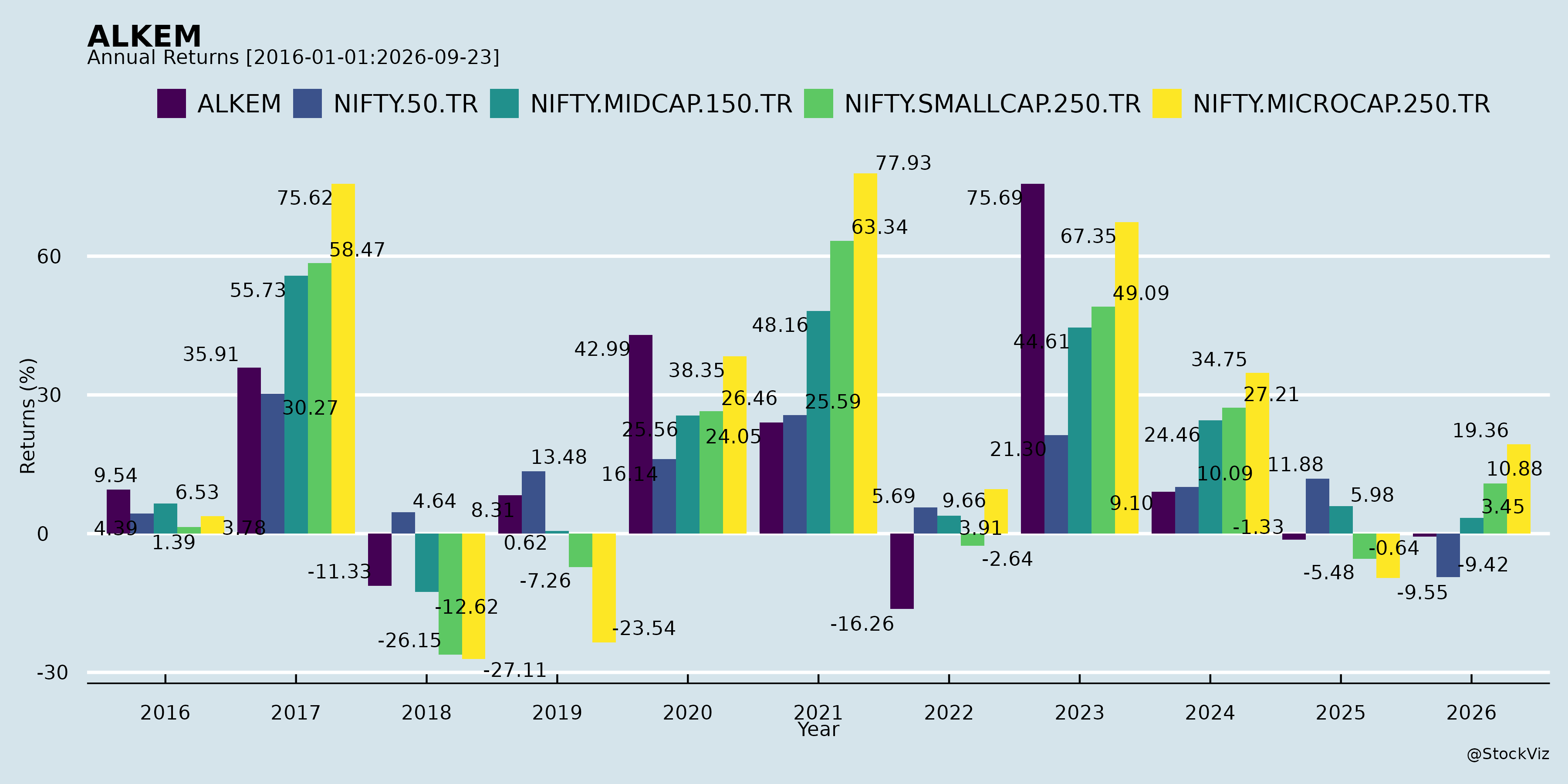
Annual Returns
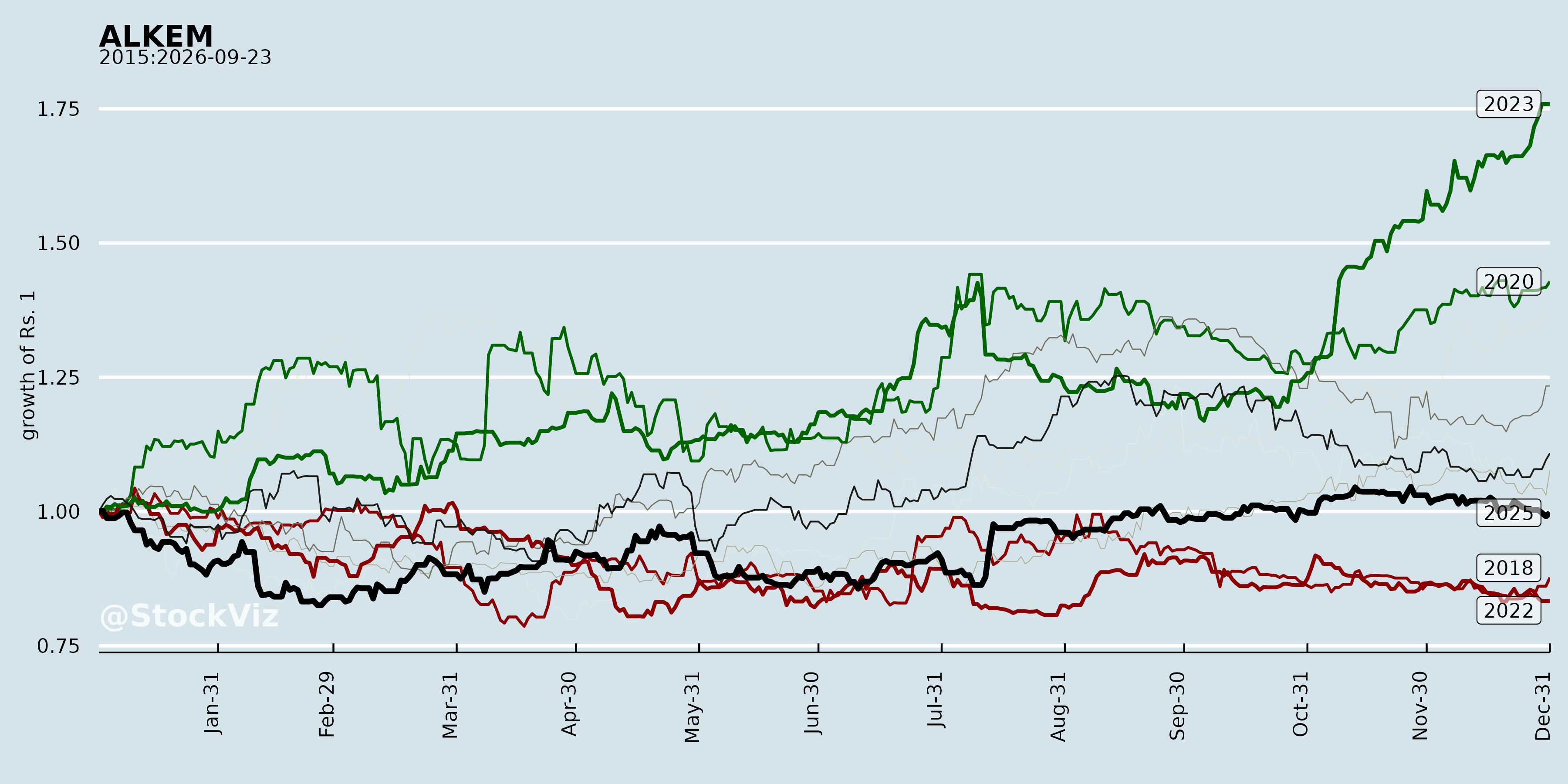
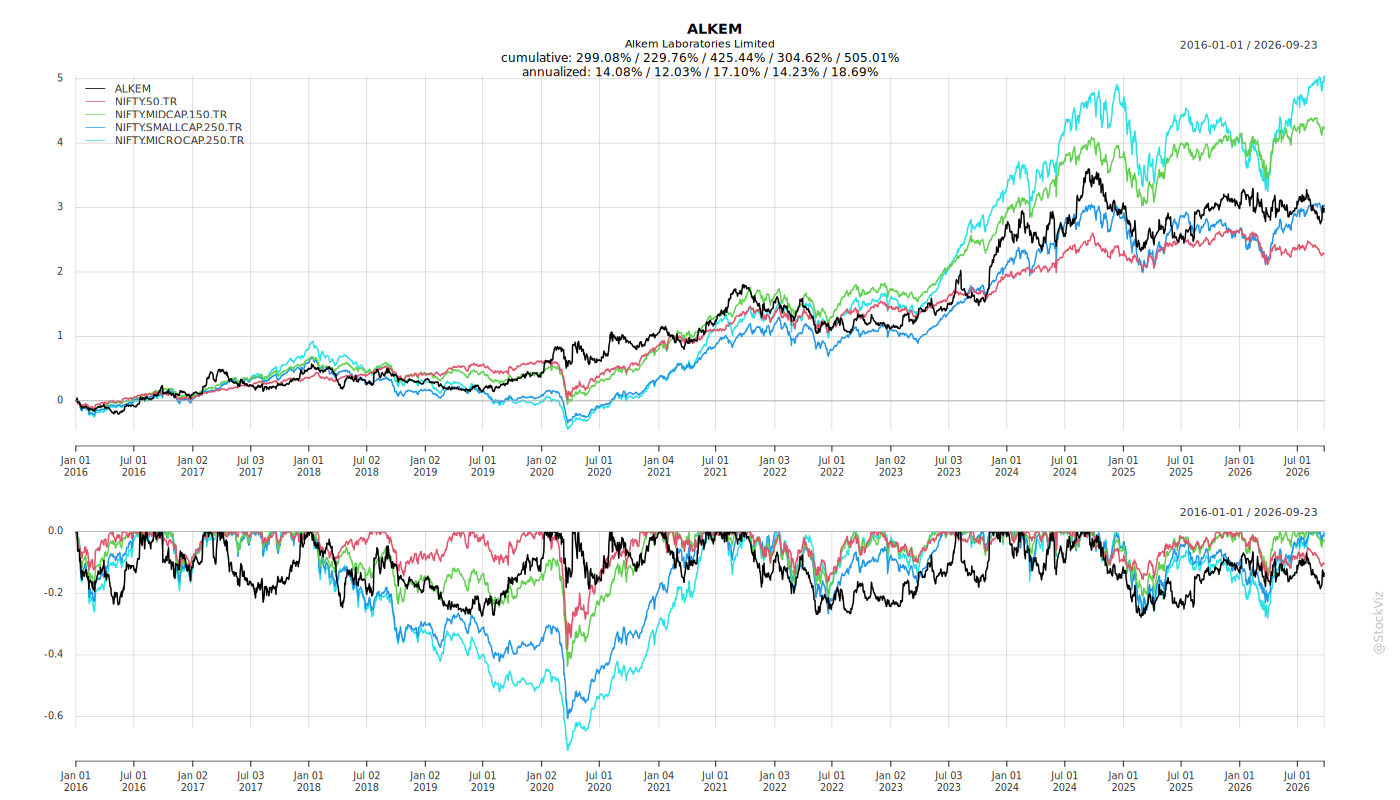
Cumulative Returns and Drawdowns
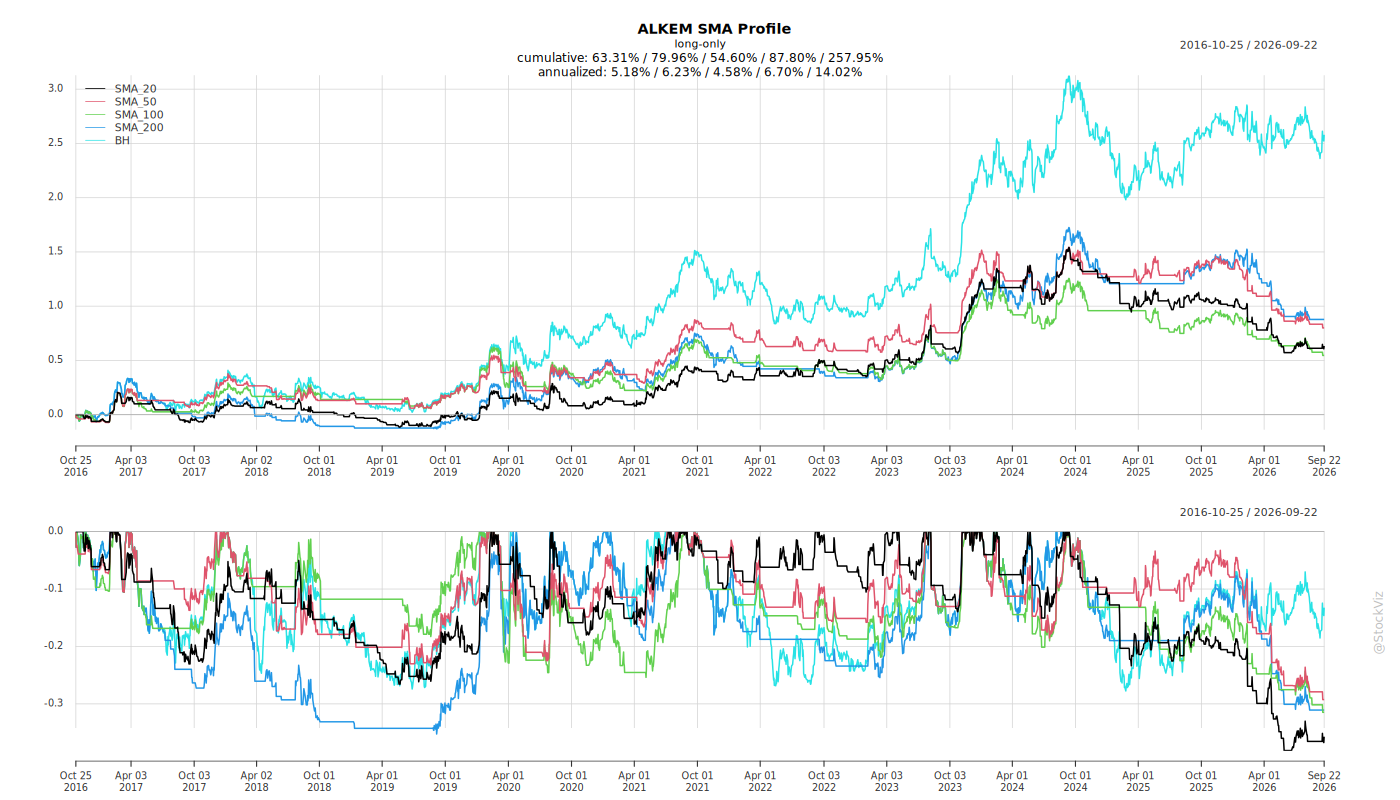
Fundamentals
Ownership
Margined
AI Summary
asof: 2026-09-16
Headwinds and Challenges
Trade Generics slowdown. The Trade Generics business grew only flattish in Q1 FY27, dragging down overall India growth to 10.3% even as branded generics grew 12%. Management attributed this to intensifying competition (many large companies have entered the segment in recent years), the law of large numbers given Alkem’s #1/#2 position, and a deliberate tightening of market practices around days sales outstanding. CFO Nitin Agrawal noted that on a January–June basis Trade Generics grew at a high single digit rate, but April–June was flat year-on-year, partly because price increases (due to higher API prices) may have reduced inventory in the channel.
Daman facility OAI. The Daman formulations facility received Official Action Indicated (OAI) status in August 2026 following an April 2026 inspection. Management stated that corrective and preventive actions have been initiated and engagement with the regulator continues, and that approved product supplies from the facility to the US continue without interruption. Sandeep Singh noted that approximately 45% of US revenue comes from this facility, and expressed confidence that the business would not be impacted this year, with resolution hoped for in 6–12 months.
US business softness. US sales grew 6.5% year-on-year to ₹7,439 million, but management described the US as challenging with no volume growth, with performance largely currency-driven. Price erosion was described as close to flattish and possibly bottomed out.
Cost pressures. Employee cost grew more than 16% in the quarter due to annual increments, the addition of around 1,200 MRs over recent quarters, and the Enzene CDMO business becoming operational from November 2025. Other expenses rose due to Enzene CDMO costs and a roughly 10% higher dollar conversion rate affecting foreign subsidiary expenses. API price increases are expected to weigh on gross margins in subsequent quarters as old inventory is exhausted.
New business drags. The US CDMO operation incurred around ₹60 crores of quarterly operating expense, with breakeven requiring roughly USD 25–30 million of annual revenue, expected around FY28. The ortho business (excluding Occlutech) recorded an EBITDA loss of around ₹5–7 crores, with breakeven expected in about 12 months. Occlutech’s acquisition closed in mid-July 2026, later than originally planned, so Q1 was unaffected; the integration delay means FY27 targets are now around ₹400 crores of sales over ~8.5 months with breakeven EBITDA, “a bit off” from prior guidance.
Denosumab biosimilar delay. The denosumab biosimilar approval in the US did not come on the goal date and has been pushed off by at least a few months. In Europe, the Prolia biosimilar is partnered with Theramex; management described the European market as very competitive with many players and not expected to be a meaningful ramp-up for some time. Xgeva biosimilar launch in Europe was indicated as possibly about three months away.
Taxation. Net profit declined 21.7% year-on-year, attributed purely to taxation reasons. The consolidated tax rate is guided at 30–32% (versus 27–28% standalone) because loss-making entities such as Enzene US are not having deferred tax assets created.
Other items. The Q1 FY27 results included a provision for impairment of ₹747 million related to recoverability of certain real estate investments, and potential liabilities from revised regulatory frameworks under Labour Codes were noted.
Tailwinds and Growth Prospects
India business outperformance. Domestic sales grew 10.3% to ₹24,978 million. Per IQVIA (SSA) data for Q1 FY27, the company grew 13.2% versus IPM growth of 12.2% — a 100 bps outperformance, in line with prior guidance. The acute segment grew 12.3% versus IPM’s 10.1% (220 bps outperformance) and the chronic segment grew 17.9% versus IPM’s 15.4% (250 bps outperformance). Alkem outperformed IPM in seven key focus therapies: anti-infectives (~1.1x), gastro (~1.2x), VMN (~1.4x), pain (~1.8x), anti-diabetic (~1.4x), respiratory (~1.6x) and derma (~1.6x). Management indicated India growth could end up close to 12% for the year, about 100 bps better than prior guidance.
Non-US international momentum. Non-US sales grew 34.5% to ₹4,785 million, contributing 12.9% of total sales versus 10.8% a year earlier, driven by double-digit growth across key markets including Germany, Chile and Australia. Management called this growth “quite sustainable, more than sustainable,” while noting these markets are on a small base relative to the US.
US pipeline. US sales grew 6.5% to ₹7,439 million. The company received five ANDA approvals in Q1 FY27 (including one tentative). As of June 30, 2026, Alkem had filed 192 ANDAs, 2 NDAs and 1 BLA, with 170 ANDA approvals (including 18 tentative) and 2 NDA approvals. Tolvaptan generic launch in the US was indicated for the current quarter. Full-year US guidance was maintained at mid-to-high single digit growth, helped by currency.
Biosimilars in India. Seven biosimilars have been launched in India, generating around ₹150 crores of annual sales, with margins improved at consolidated level due to backward integration.
MedTech and new growth areas. The Occlutech acquisition (via wholly owned subsidiary Alkem Medtech Private Limited) completed on 16 July 2026. Management expects gradual annual margin improvement, targeting 7–8% EBITDA improvement year-on-year and reaching guided margins over 3–4 years, describing it as a “very healthy EBITDA business” within that timeframe. The company also launched Renocia Exo, described as India’s first patented Ginsenoside Exosome-based hair growth serum, strengthening the dermatology portfolio amid rising demand for regenerative hair therapies.
CDMO opportunity. Enzene’s US CDMO business focuses on monoclonal antibodies, spanning development to clinical trial supplies with commercial supply hoped for in future. Management expects revenue to kick in around FY28 and breakeven at USD 25–30 million annual revenue, noting CDMO is lumpy — “when it rains, it pours.”
Capacity expansion. The Board approved setting up a new block within the existing Baddi (Himachal Pradesh) manufacturing facility, with an investment of up to ₹75 crores (announced 14 August 2026).
Balance sheet strength. Net cash stood at ₹57.64 billion as of 30 June 2026. ROCE (pre-tax) was 29.6% in FY26. Management stated there are no acquisition plans in orthopedics or MedTech currently and no change to capital allocation plans.
Tax appeal win. On 30 June 2026, Alkem received favourable Orders-in-Appeal from the Commissioner of Income Tax (Appeals)-47, Mumbai, for assessment years 2018-19 to 2022-23, deleting disallowances made under Section 80-IE involving a tax amount of ₹660.77 crores. The company stated there is no material impact on financial, operational or other activities.
Governance. All six resolutions at the 52nd Annual General Meeting held on 27 August 2026 were approved with requisite majority, including adoption of financial statements, declaration of dividends, re-appointment of directors (Mr. Sandeep Singh, Mr. Sarvesh Singh, and Mrs. Madhurima Singh), and ratification of the Cost Auditor’s remuneration.
Key Risks
- Regulatory risk at Daman: The OAI status carries uncertainty, though management stated supplies continue and no business impact is expected this year. Resolution is hoped for in 6–12 months.
- US pricing and volume environment: Management described the US as challenging with no volume growth and performance largely currency-dependent.
- Competitive intensity in Trade Generics: Entry of large players and Alkem’s own discipline measures on receivables could continue to constrain growth; management stated it would be “happy with late single digits” for the next 1–2 years.
- New business execution risk: CDMO, MedTech and ortho businesses are currently loss-making or sub-scale, with breakeven timelines dependent on client funding, clinical trial progress and integration execution. Occlutech integration delays have already pushed FY27 targets off prior guidance.
- API price inflation: Expected to pressure gross margins in subsequent quarters as old inventory is consumed.
- Biosimilar approval timing: Denosumab US approval delayed beyond the goal date; European Prolia biosimilar market described as highly competitive with many players.
- Tax rate: Consolidated tax rate guided at 30–32% due to losses at entities like Enzene US where no deferred tax asset is being created.
- Impairment and regulatory provisions: A ₹747 million impairment provision on certain real estate investments was recorded, and potential liabilities from Labour Codes were noted.
- Currency: The weaker rupee benefited top line but also raised the cost of foreign subsidiary expenses; conversely, currency support to US and other market revenues may not persist.
Management Guidance Versus Observed Performance
India growth: Management had previously guided to 100 bps outperformance versus IPM. In Q1 FY27, IQVIA data showed 13.2% growth versus IPM’s 12.2% — a 100 bps outperformance, in line with guidance. However, reported India sales growth of 10.3% was lower than many peers who had reported so far, which management attributed to the Trade Generics drag. Management now indicates full-year India growth could be close to 12%, about 100 bps better than prior guidance.
US growth: Management maintained full-year guidance of mid-to-high single digit growth despite Q1 constant-currency softness, with currency expected to help.
Gross margin: Q1 FY27 gross margin was 67.9% versus 65.3% in Q1 FY26, aided by a better mix (lower Trade Generics, stronger prescription business) and currency support. Management maintained full-year gross margin guidance of 66.5%–67%, noting API price increases will weigh on subsequent quarters.
Tax rate: Standalone guidance of 27–28% was maintained, but consolidated guidance is 30–32% due to losses at entities such as Enzene US where no deferred tax asset is created.
CDMO breakeven: Earlier expectations of breakeven in 4–5 quarters were revised; management clarified the US CDMO will not breakeven in the next 12 months, with USD 25–30 million annual revenue needed and revenue expected to kick in around FY28. The ₹60 crores quarterly opex is expected to annualize at similar levels.
Occlutech: Prior guidance anticipated completing the acquisition and starting integration in Q1 FY27; the deal actually closed in mid-July 2026. FY27 target is now around ₹400 crores of sales over ~8.5 months with breakeven EBITDA, described as “a bit off” from prior guidance. Management targets 7–8% year-on-year EBITDA improvement and reaching guided margins over 3–4 years.
Ortho business: Breakeven expected in about 12 months, with annual sales of around ₹50 crores (excluding Occlutech).
Denosumab: Approval did not arrive on the goal date and has been pushed off by at least a few months.
CEO hiring: Management reiterated that a CEO search is ongoing, described as a critical hire that cannot be hurried, with hope that the appointee would be in place by the next quarterly meeting.
Broker Narrative
The broker narrative evolved from macro-level market concerns (Nifty intermediate top risks and limited near-term upside) and technical optimism (new highs, strong RSI) to company-specific fundamental headwinds (trade generics weakness, CDMO/med-tech gestation, US pipeline delays, site remediation) and tailwinds (margin expansion, chronic therapy and ROW growth). While early fears centered on broad market corrections, later headwinds shifted to operational execution risks such as opex front-loading and regulatory compliance. The persistent theme of near-term earnings pressure remained, but it transformed from general market volatility into structural business challenges.
Broker Timeline
28 broker calls · 2021-06-07 to 2026-08-15
Copyright © 2023 SAS Data Analytics Pvt. Ltd. All rights reserved.