AARON
Equity Metrics
September 24, 2026
Aaron Industries Limited
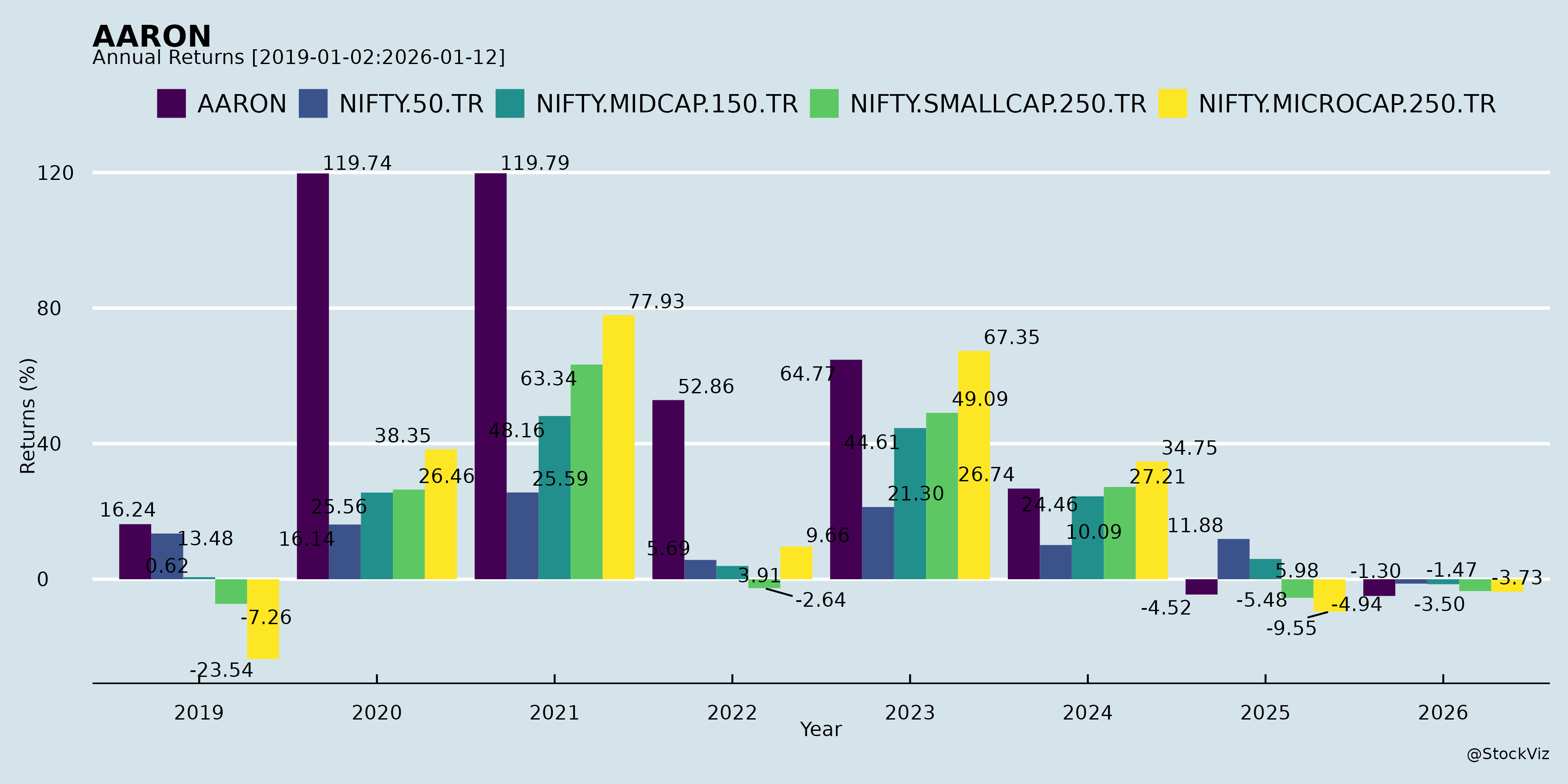
Annual Returns
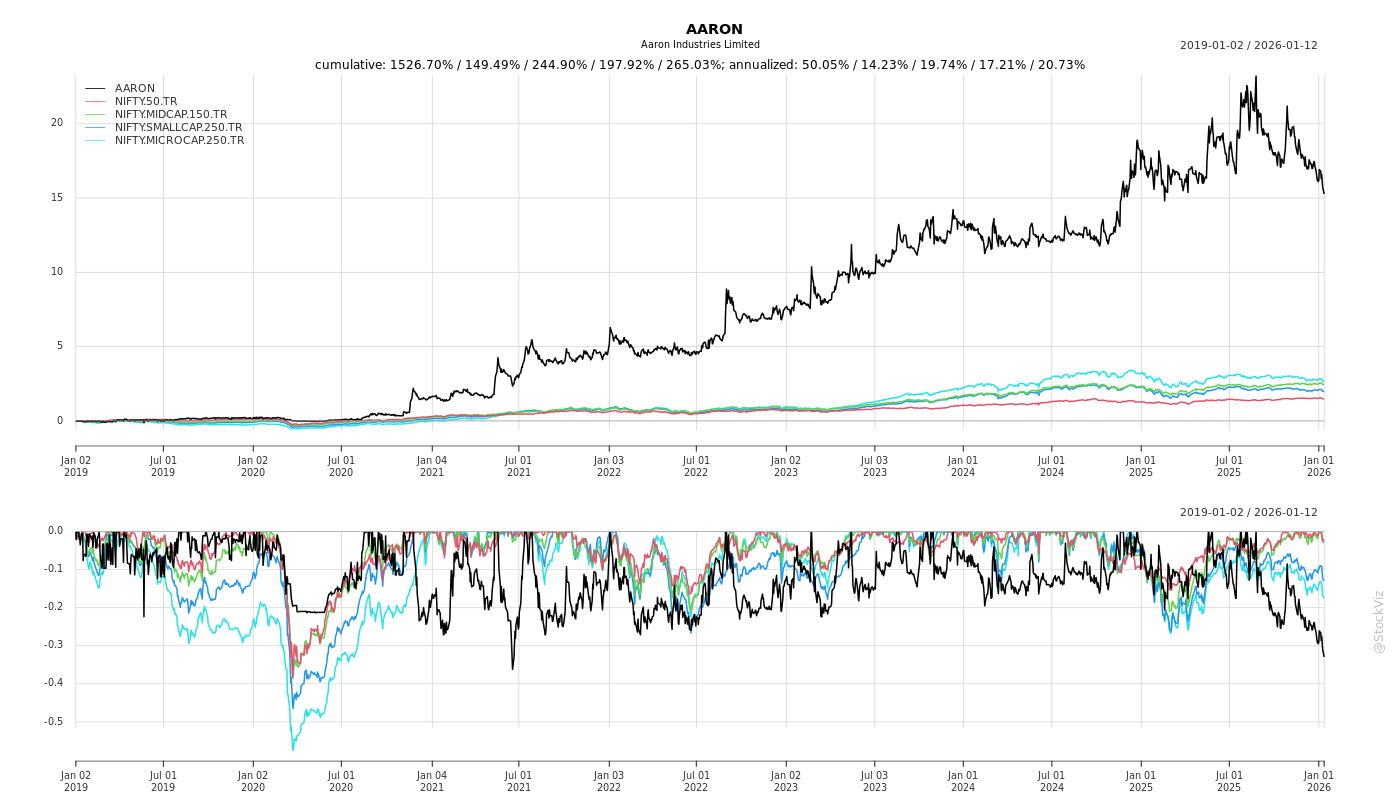
Cumulative Returns and Drawdowns

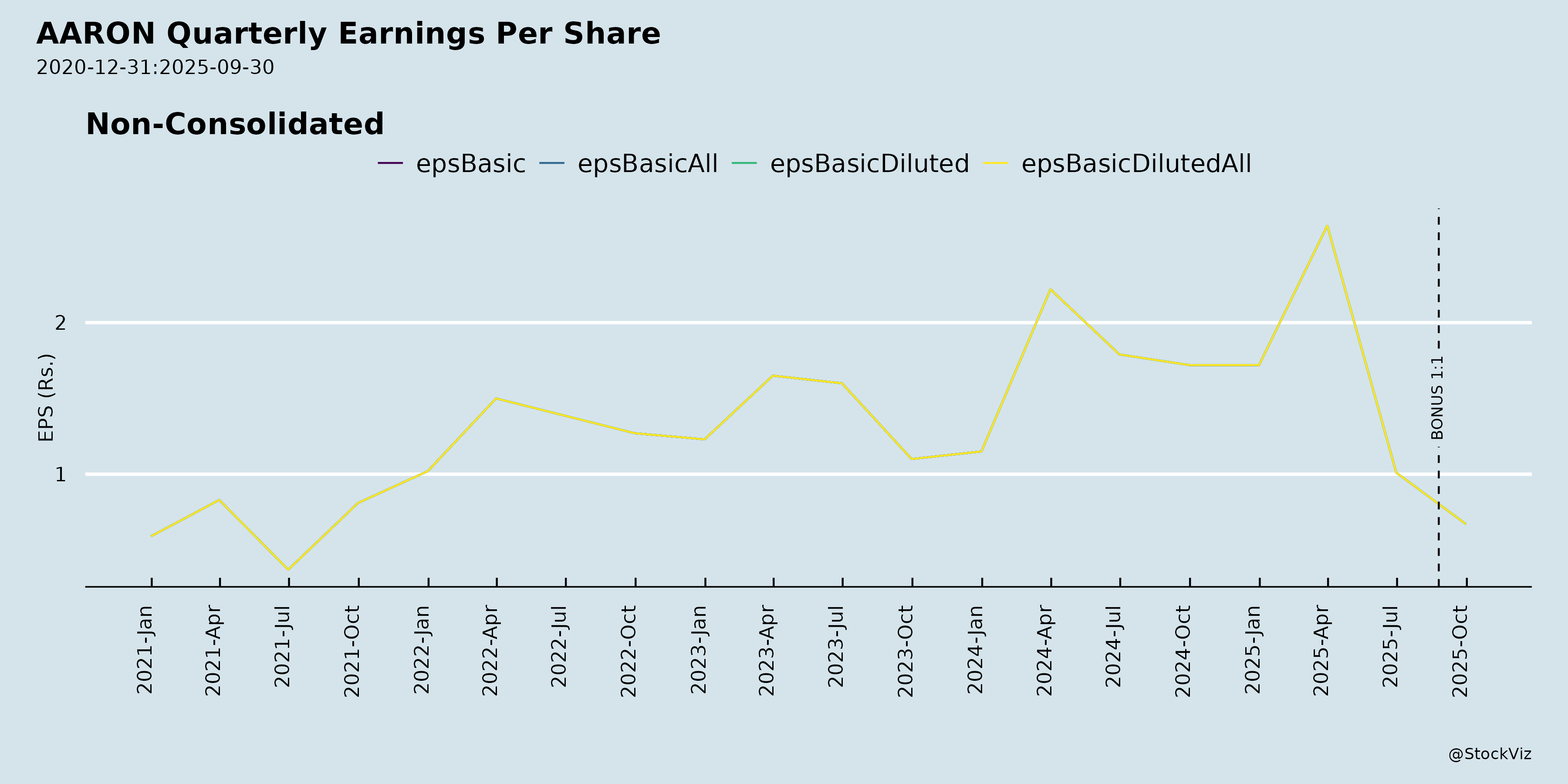
Fundamentals
Ownership
Margined
AI Summary
asof: 2026-09-19
Aaron Industries Limited — Recent Corporate Announcements Analysis
1. Headwinds and Challenges
International OEM engagement is progressing slowly. Management stated that meetings have been held with Johnson and Kone, and that the vendor registration process has started with Johnson, Kone, and Wittur. However, no orders have been received from these OEMs yet — only samples have been taken. Fujitec is the sole international OEM that has begun placing regular orders, on the sheet front. Management indicated that business from these OEMs is expected to take time due to technicalities involved.
Africa expansion has not translated into growth. The company had focused on Kenya and Tanzania, including participation in exhibitions, but management noted that prevailing political and economic conditions in those markets have limited growth, and the business is still awaiting development.
Steel price volatility has dampened the steel business. Management attributed lower utilization, procurement, and sales in the steel business over the preceding three to four months to heavy fluctuation in steel prices. This also affected procurement of embossed and designer sheets by customers such as Fujitec, Omega, and Techno, where quantum was lower because of price fluctuation.
Railway opportunity has not fructified. The company has applied to the railways, but no orders have been received. Management cited a long vendor registration process and the presence of many government-sector vendors, with much steel procurement happening through SAIL.
Distribution, brand recall, and short-term customer relationships are identified as growth constraints. The investor presentation states that translating rising demand into steady long-term growth remains a challenge limited by distribution reach, brand recall, and short-term customer relationships.
Working capital requirements are rising. Management acknowledged that short-term debt has been increasing year-on-year and that crossing the ₹100 crore top-line milestone will increase working capital needs. No decision has been finalized on fundraising or additional debt; the current focus is on increasing productivity and reducing inventory days.
EVOQ360 adoption faces project-cycle constraints. Because construction on many projects began with traditional designs, some ongoing projects are not viable for incorporating EVOQ360. Management also noted the product is designed for a maximum of G+3 and is not intended for high-rise buildings, limiting its addressable scope within the overall elevator market.
Segment-level appearance of losses in the steel polishing division. Management clarified that the division is not loss-making; most production is consumed internally by the elevator division through internal transfers, and the segmental results should be viewed as a whole business rather than sector-wise.
2. Tailwinds and Growth Prospects
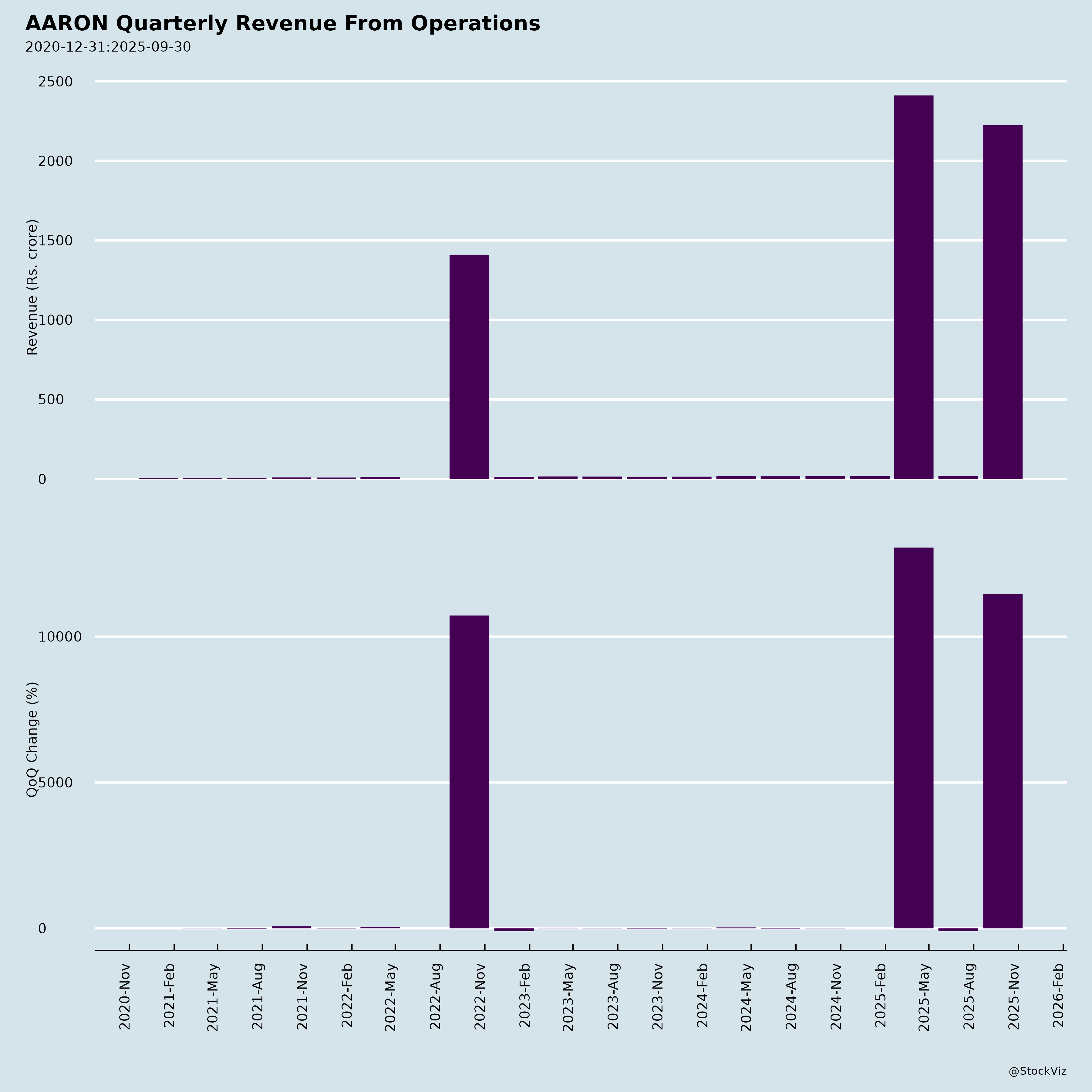
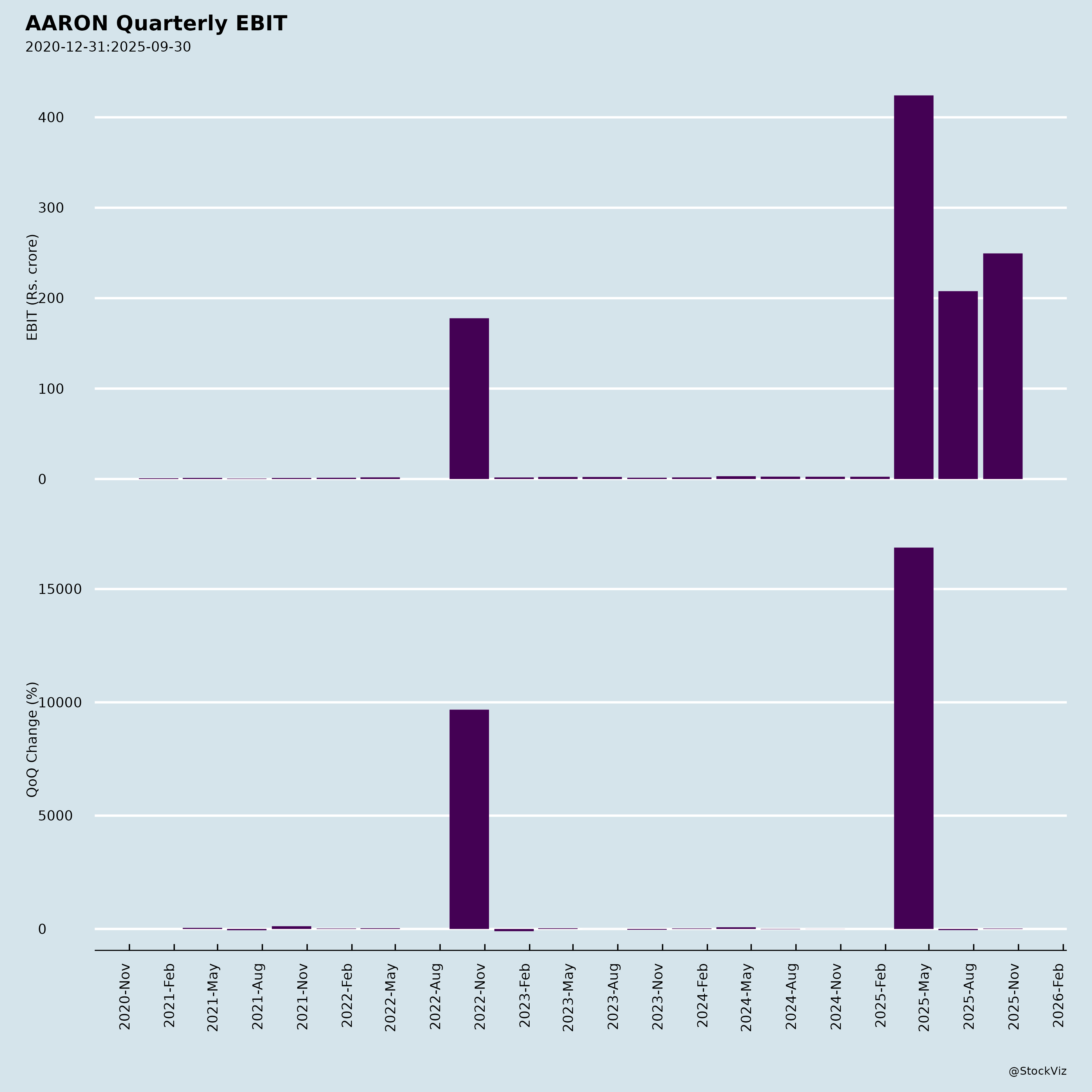
Q1FY27 delivered strong growth. Revenue from operations rose 27.01% YoY to ₹24.44 crore; EBITDA rose 34.83% YoY to ₹4.99 crore with margin at 20.19%; PBT rose 66.60% YoY to ₹3.46 crore; PAT rose 141.94% YoY to ₹2.56 crore with PAT margin at 10.46%. Interest costs declined 23.20% YoY.
EVOQ360 home lift is gaining traction. Since its launch, more than 25 projects have been executed across India. The company was appointed All-India Distributor for EVOQ360 components following discussions with a well-known Chinese component manufacturer. Management stated it has finalized exclusive territory partnerships with four to five partners and is in discussions with multiple others. Management targets close to 150 home lift units by the end of the year. EVOQ360 contributed around 5–7% of total revenue in the last quarter, with margins close to 20–25%.
EVOQ360 has differentiated features and pricing. Management highlighted a battery management system that can operate the lift for 100 cycles without power as a unique feature not currently offered by other companies in India. The product is positioned as premium, with component pricing of around ₹6–6.5 lakh on average (up to ₹8–9 lakh depending on project), and an installed end-product cost of around ₹8–9.5 lakh versus competitor products at ₹10–12 lakh.
Stelix brand launched for external stainless steel sales. Stelix is a branding strategy for stainless steel sheets sold externally to the elevator market and interior decoration segment, created partly because elevator manufacturers preferred a separate brand name for the sheet business. Management stated the brand has been successful and expects good growth in the sheet business, with traders being appointed to promote it.
Distribution network is broad and expanding. The company is present in all states of India with more than 750 regular customers, over 80% of whom are consistent buyers. Warehouses are set up in Ahmedabad and Kolkata, with traders in Indore, Raipur, Hyderabad, Patna, Bangalore, and Belgaum. Senior sales staff have been hired for Punjab, Haryana, and UP, and the employee cost is already factored into Q1.
Capacity headroom exists without further capex. Total capacity exceeds 5,000 auto door systems per month and 400+ cabins per month. Current utilization is around 45–50%. Utilization is projected to reach 3,500 auto door systems per month over the next 1–2 years, with meaningful headroom for growth without further capex. The Salvagnini automatic line at Unit 3 has enhanced door production and reduced cycle times.
Vertical integration supports margins. The in-house stainless steel processing and polishing division processes raw coil, with the majority consumed internally, retaining the processing margin and earning a second margin on externally sold sheet. BIS certification reinforces quality and compliance.
Industry growth drivers are favorable. The global elevator market is projected to grow from USD 86.3 billion in 2026 to USD 136.9 billion by 2033 at a 6.8% CAGR, with India cited as the fastest-growing country globally at 9.9% CAGR (2026–2033), centered on Mumbai and Bengaluru high-rises. The global stainless steel sheet market is projected to grow from USD 126.09 billion in 2025 to USD 211.22 billion by 2034 at a 5.9% CAGR, with Asia Pacific holding 74.06% share.
Aaron Be Creative app supports sales conversion. The app enables visualization of products including cabin finishes and EVOQ360, helping elevator companies close sales faster and pushing new designs efficiently.
3. Key Risks
- Dependence on international OEM orders materializing. Vendor registration with Johnson, Kone, and Wittur is underway, but orders have not started; timelines are uncertain.
- Steel price volatility. The steel division is fully exposed to steel pricing with pass-through to customers; the elevator business has a fixed margin and price range where the company may bear losses or enjoy gains within limits, with pass-through typically executed within a month only when price changes exceed 10–15%.
- Geopolitical and economic conditions in Africa limiting growth in Kenya and Tanzania.
- Working capital constraints could limit expansion reach if not addressed through productivity improvements, fundraising, or debt.
- Project cycle dependency for EVOQ360, as ongoing projects designed for traditional lifts cannot easily incorporate the product.
- Competition in home lifts from players such as Nibav, Elite Elevator, and LT Elevator (partnered with Ricardo), though management claims advanced features and better pricing.
- Import dependence for EVOQ360 components — around 40% of cost is imported from China, with R&D working to reduce this.
- Railway vendor registration process is long and competitive with government-sector vendors.
4. Management Guidance Versus Observed Business Performance
Revenue growth guidance: Management targets 25–30% revenue growth for FY27, with business bifurcation similar to last year between steel and elevator businesses. Observed: Q1FY27 revenue grew 27.01% YoY, within the guided range. Management acknowledged the company was not able to deliver the 25% bare-minimum growth expected last year.
EBITDA margin guidance: Management aims to maintain EBITDA percentage between 18–20%, with a focus on improving margins over time. Observed: Q1FY27 EBITDA margin was 20.19%, above the guided range and improved from 18.99% in Q1FY26 and 18.58% in Q4FY26.
Door production guidance: Management previously guided reaching around 3,500 door units per month. Observed: Management stated the company is moving toward that target and expects to achieve it in coming quarters, positively by December end if market conditions are good and sufficient orders are secured. Current utilization is around 45–50%.
EVOQ360 volume guidance: Management plans close to around 150 units of home lifts by the end of the year. Observed: More than 25 projects executed since launch; EVOQ360 contributed around 5–7% of total revenue in Q1. Management noted it cannot guarantee a huge jump next quarter due to project cycles.
Capacity utilization: Management stated utilization will keep improving based on demand, with production aligned to demand to avoid overproduction and over-inventory that blocks working capital.
Operating leverage: Management confirmed that achieving 3,500+ doors per month would provide an additional boost to revenue and operating leverage by FY27, contingent on demand.
Working capital: Management stated no decision has been finalized on fundraising or debt; focus is on increasing productivity and reducing inventory days, with options including market fundraising or bank debt to be evaluated based on timing of requirement.
AGM outcomes: The 13th AGM held on August 19, 2026, passed all seven resolutions with requisite majority and 100% of valid votes cast in favour, covering adoption of financial statements, declaration of dividend, retirement/appointment/re-appointment of directors, and revision in remuneration.
Copyright © 2023 SAS Data Analytics Pvt. Ltd. All rights reserved.