5PAISA
Equity Metrics
September 24, 2026
5Paisa Capital Limited
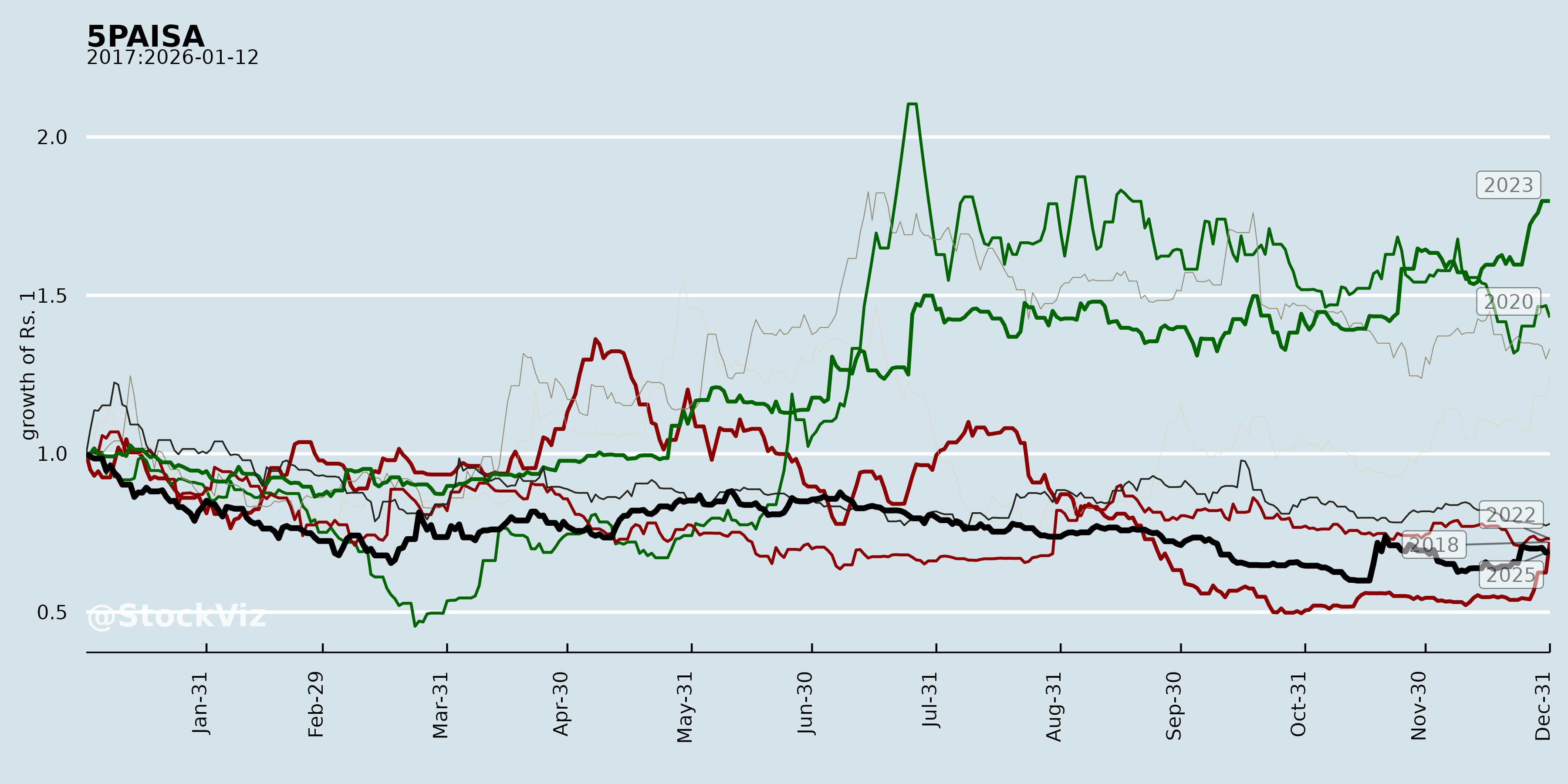
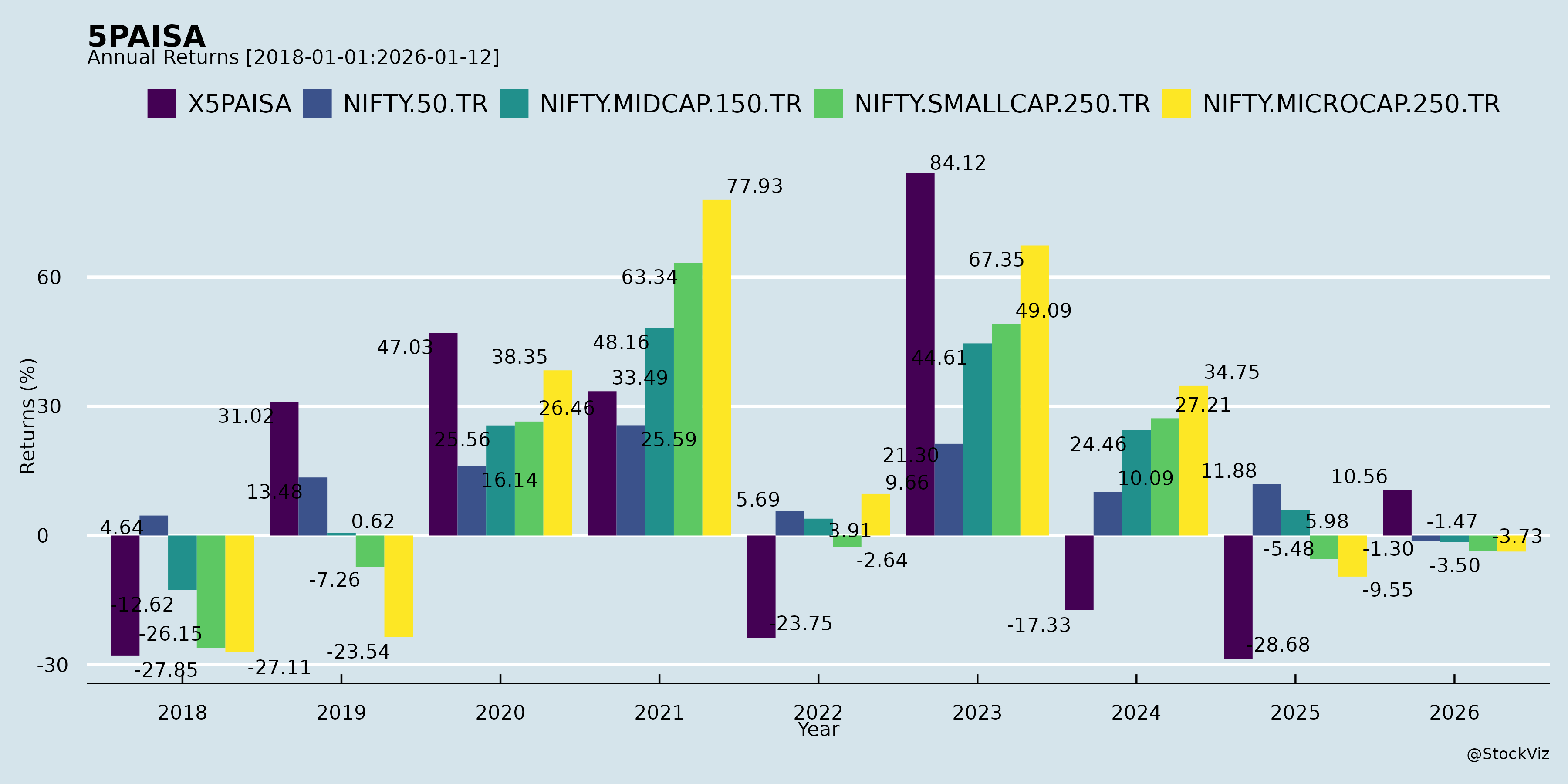
Annual Returns
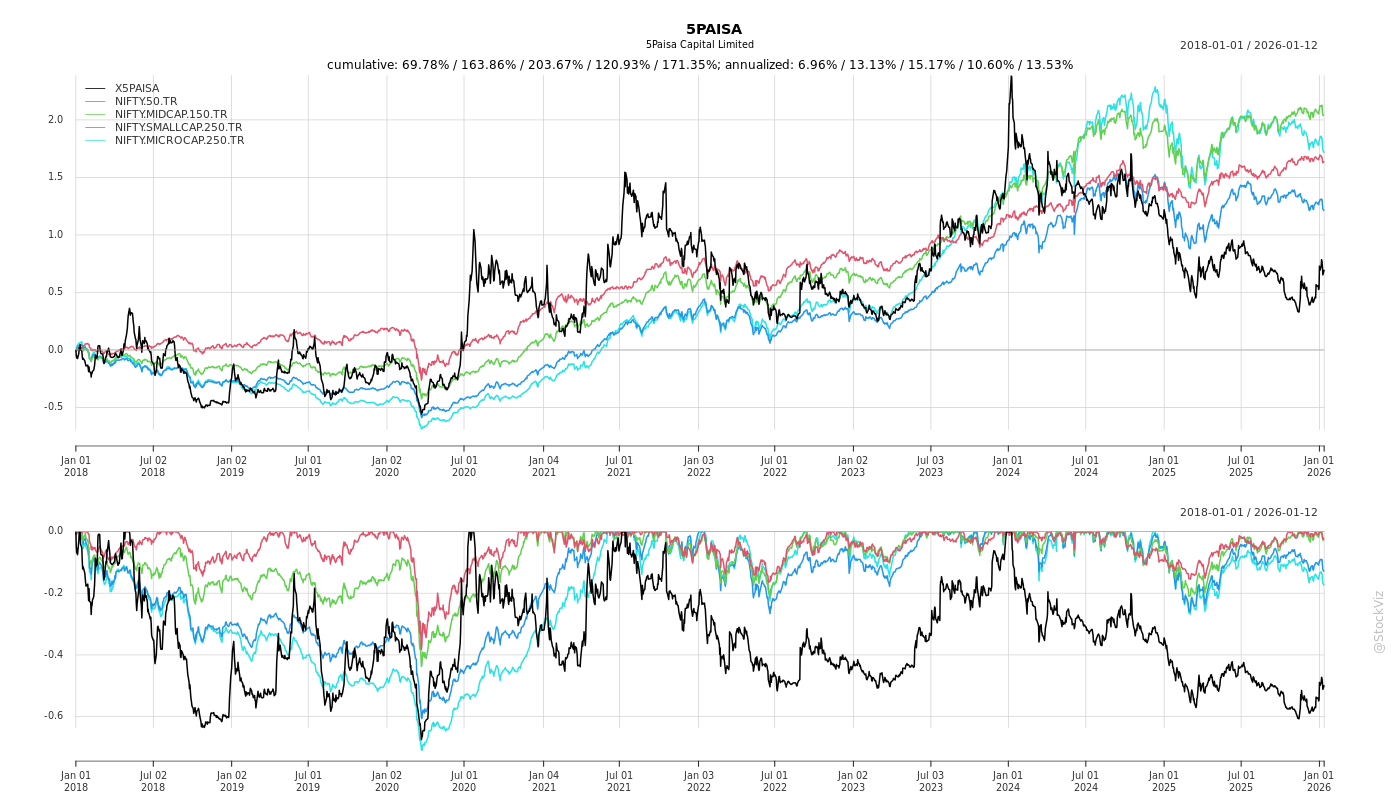
Cumulative Returns and Drawdowns

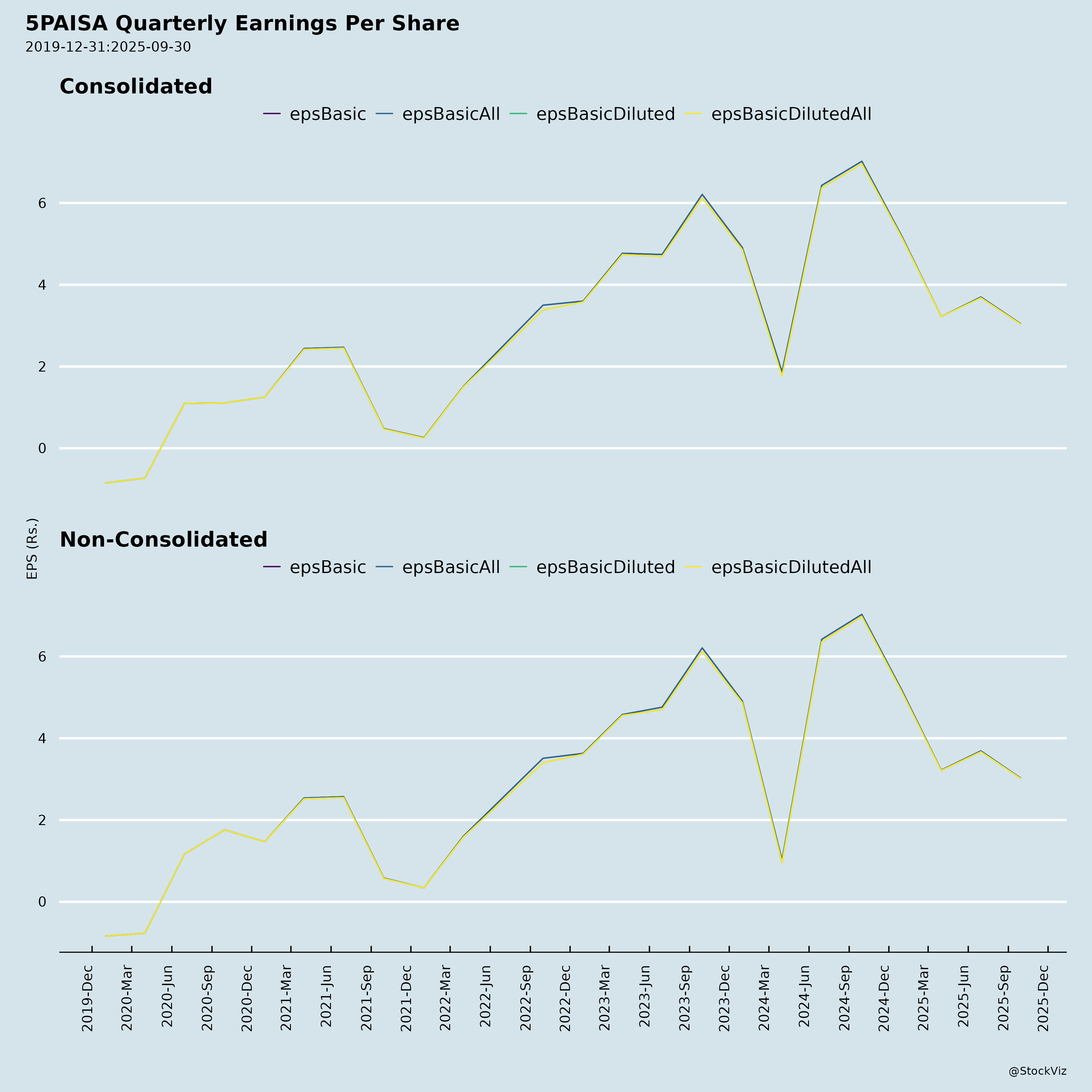
Fundamentals
Ownership
Margined
AI Summary
asof: 2026-09-18
5paisa Capital — Recent Corporate Announcements: Summary
1. Headwinds and Challenges
- Revenue growth has been muted. Management acknowledged on the Q1 FY27 earnings call (July 17, 2026) that revenue had been “almost flat for the last three years or so,” and that Q1 FY27 saw “a little bit of moderation” and “some slowness.”
- F&O-driven base exposed to regulatory change. Management noted that after the F&O changes introduced in October 2024, there was “a moderation across the board” among players whose revenue was heavily sourced from F&O, and that 5paisa itself has had an “F&O-heavy base.”
- Market volatility. The Q1 FY27 press release (July 16, 2026) quoted the MD & CEO stating “The market is volatile,” and on the call he noted the past year had been “a little choppy” with volatility having “some rub-off effect.”
- Operating expenses growing faster than income. At consolidated level, total income grew 14% y-o-y while operating expenses increased 17% y-o-y, resulting in PAT growth of only 1% y-o-y.
- Declining business metrics q-o-q in Q1 FY27. Client acquisition was 0.74 lakh (down 28% q-o-q); ADTO was ₹3.04 Tn (down 12% q-o-q); total orders were 25.1 Mn (down 5% q-o-q); brokerage income fell 6% q-o-q.
- EPS dilution. Basic EPS fell 25% q-o-q and 30% y-o-y to ₹2.60; diluted EPS fell 29% y-o-y to ₹2.60.
- Industry-level pressure. The investor presentation noted active NSE clients declined to 44.2 million in Q1 FY27.
- Regulatory funding requirement. The CFO noted that with effect from July 1, RBI disallowed banks from providing intraday facilities to brokers, requiring every broker to arrange the money itself.
- Disclosure errors requiring correction. The company issued a revised press release on July 17, 2026 correcting “52.6 million” to “52.6 lakh” registered customers, and a revised Board Meeting outcome on July 29, 2026 removing an inadvertently included paragraph relating to the GDPL acquisition.
2. Tailwinds and Growth Prospects
- Capital raise completed. The company raised ₹468.8 crore through a rights issue in April 2026 (1,56,27,419 equity shares of face value ₹10 each), strengthening the balance sheet to a net worth north of ₹1,100 crore as stated on the earnings call.
- Deployment of rights issue proceeds. Per the CFO: ₹227 crore deployed for exchange margin, ~₹150 crore for repayment of loans to banks and CPs, and ₹88 crore for general corporate purposes (product, tech, marketing).
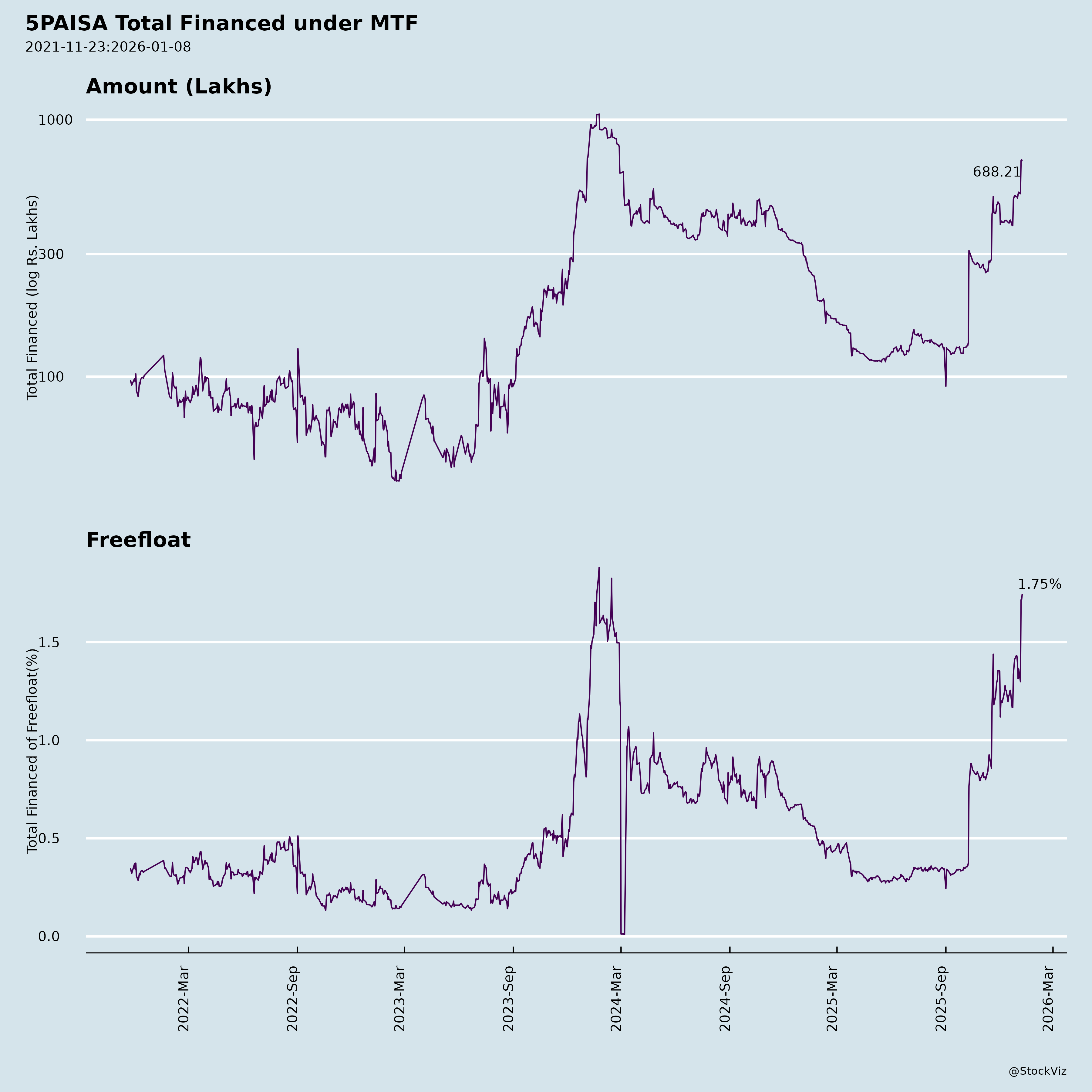
- Growth in adjacent products. Average client funding book (MTF plus T+5) stood at ₹422 crore, up 3% q-o-q; mutual fund AUM reached ₹2,073 crore, up 18% q-o-q. Management stated MTF “literally doubled” over roughly the last 15 months.
- Product expansion. T+5 offering expanded to 2,500 eligible scrips with interest rates starting at 0.045% per day; MTF extended to 1,500 scrips with funding limits increased up to ₹25 crore. New launches included AlgoSpace (algo trading platform), OI profile on charts, OneClick execution, AI insights on the app, and an MCP integration with a major LLM provider.
- Platform revamp underway. Management stated a complete platform revamp is moving to production in the next few months, with “very, very encouraging” early beta-stage testing results.
- Acquisition of Giskard Datatech Private Limited (GDPL). Board approved on July 28, 2026 the acquisition of 100% of GDPL — a data-driven technology solutions company incorporated June 13, 2016 — through a combination of cash consideration not exceeding ₹1,21,57,49,108 for up to 1,03,082 equity shares (58.68% of diluted paid-up equity capital) and a share swap of 1:31 for up to 66,148 equity shares (37.65%), via preferential issue of 20,50,588 equity shares. GDPL turnover: ₹7.66 crore (FY23), ₹12.07 crore (FY24), ₹15.75 crore (FY25). Valuation per share of GDPL: ₹11,794, based on a Discounted Cash Flow valuation report dated June 18, 2026 by an independent registered valuer. Indicative completion: up to 6 months.
- Strategic rationale for the acquisition. Expected integration of research and analytics capabilities (stock screening, portfolio analytics, research reports, investment alerts, proprietary databases, algorithms, AI-enabled investment solutions), improved customer engagement and retention, cross-selling across broking, mutual funds, IPO, derivatives and wealth management, and acquisition of technology assets and intellectual property.
- Industry opportunity. The presentation cited 7 Mn demat accounts opened in Q1 FY27, derivative ADTO CAGR of 48.3% over six years, and rising DII and retail ownership. Management described the Indian capital markets retail journey as “still in early innings” with “lot of financialization” underway.
- Quality-over-quantity strategy. Management stated focus on higher revenue per customer (RPC) and lifetime value (LTV), with improvement in both RPC and LTV observed, and a stated intent to change channel mix based on CAC plus RPC metrics.
3. Key Risks
- Regulatory approval risk on the GDPL acquisition. The transaction is subject to corporate, statutory and regulatory approvals including SEBI approval, since GDPL holds a Research Analyst registration under the SEBI (Research Analysts) Regulations, 2014; prior SEBI approval is required in the event of a change in control or surrender of such registration.
- Shareholder and regulatory approvals for the preferential issue. The preferential issue of 20,50,588 equity shares requires shareholder approval (postal ballot) and other regulatory/statutory approvals.
- Execution risk on the platform revamp. Management tied its growth expectations to the revamped product; the benefits depend on adoption and monetization of new app and feature rollouts.
- Competitive risk. Management acknowledged large scaled players have different strategies and that “there could be some cross points,” while stating the long-term market is large enough for all participants.
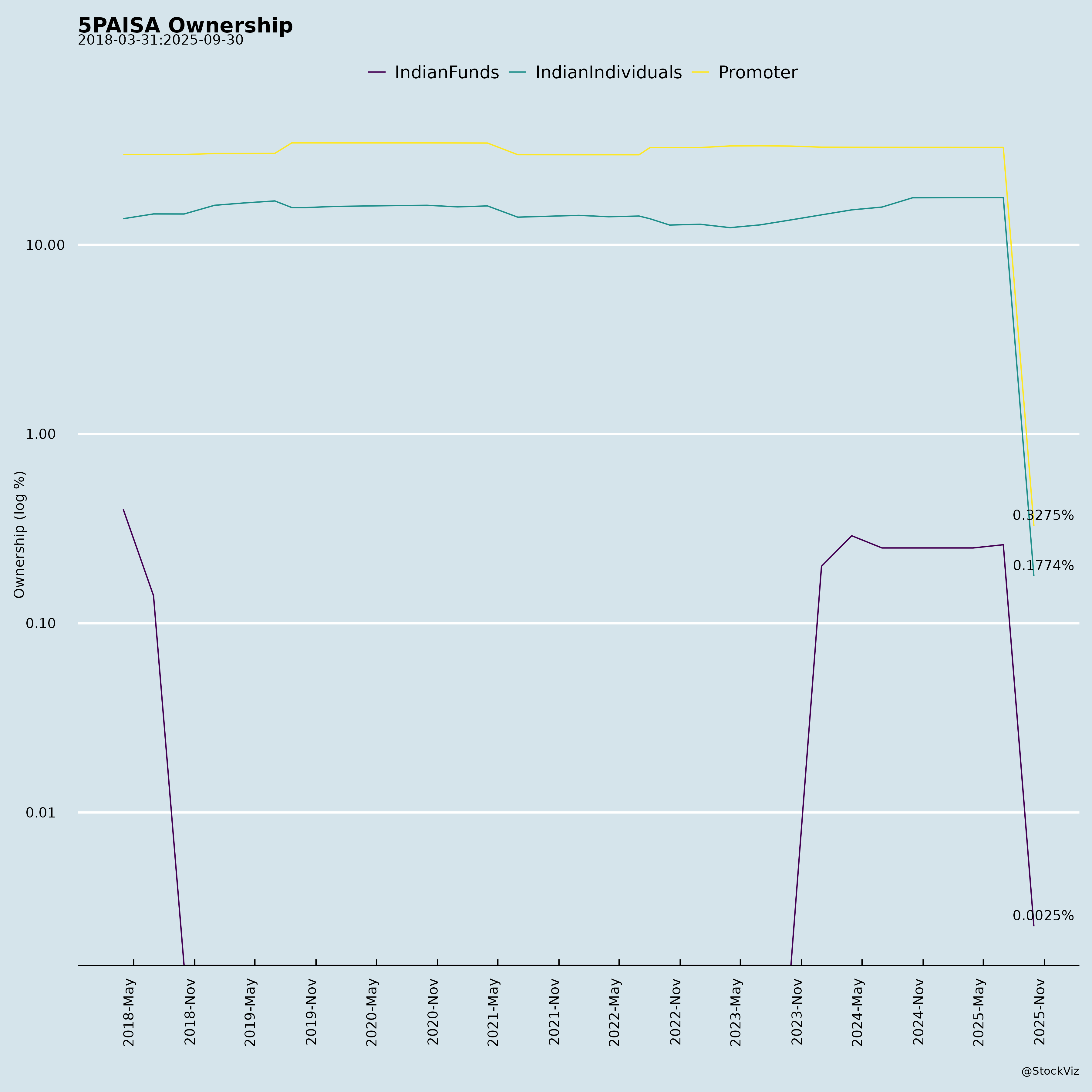
- Dilution from the preferential issue. Post-swap, the two allottees (Mr. Amber Pabreja and Ms. Devi Yeshodharan) would hold 2.42% and 1.77% respectively, totaling 4.19% of post-allotment shareholding.
- Dependence on market conditions. Revenue is tied to ADTO, order volumes and customer trading activity, which moderated in Q1 FY27.
- No near-term third-party distribution. Management stated no TPD plans in the “very near future,” with medium-term consideration only.
4. Management Guidance Versus Observed Business Performance
- Growth acceleration guidance. On the Q1 FY27 call, management said Q1 moderation was “slightly one-off” and that “from these quarters on, we can see an acceleration in growth,” citing product work and growth marketing. Observed Q1 FY27 performance: income up 3% q-o-q and 14% y-o-y, but PAT up only 1% y-o-y, with client acquisition down 28% q-o-q, ADTO down 12% q-o-q, and orders down 5% q-o-q.
- Operating leverage guidance. Management stated the aim to “get to a state very quickly where we have operating leverage” and make “meaningful improvements in our unit economics to improve our margin and overall PAT.” Observed: PAT margin was 13% in Q1 FY27 versus 15% in Q1 FY26 (down 11% y-o-y); operating expenses rose 17% y-o-y against 14% income growth.
- Quality acquisition guidance. Management said focus is on higher-quality customers and that improvement in RPC and LTV is “already getting reflected in our numbers.” Observed: DIY acquisition was 96.8%, up 0.2% q-o-q, and management cited RPC growth for the quarter, while headline client acquisition declined 28% q-o-q.
- MTF traction guidance. Management cited MTF as an example of monetization of the existing customer base, having “literally doubled from last 15 months or so.” Observed: average client funding book (MTF plus T+5) at ₹422 crore, up 3% q-o-q.
- New revenue lines guidance. Management stated there are “a couple of other things in the pipeline, which will be meaningful revenue generators for us in the next coming quarters,” without disclosing specifics.
- Acquisition timeline guidance. The company guided an indicative completion period of up to 6 months for the GDPL acquisition, subject to regulatory and statutory approvals.
- AGM outcome. All 16 resolutions set out in the Notice of the 19th Annual General Meeting held on September 1, 2026 — including adoption of financial statements, appointment of Mr. Gourav Munjal, various material related party transactions, issuance of Non-Convertible Securities on a private placement basis, and payment of commission to Non-Executive Directors — were duly passed by members with the requisite majority.
Broker Narrative
The narrative evolved from seeing repo-rate cuts as a two-sided story — near-term NIM pressure but eventual funding-cost relief — to a more stressed outlook, with the last report noting negative sector earnings growth from elevated funding costs and yield compression. MFI/unsecured stress and asset-quality weakness in MSME/CV persisted as recurring risks, while optimism shifted toward deposit repricing, CRR cuts, GST/tax-driven demand, and resilient capital-market flows.
Optimism that failed
- The expected NIM expansion from cumulative repo-rate cuts, CRR cuts, and lower funding costs did not materialize; the last report instead cited margin pressure from elevated funding costs and yield compression.
- The expected easing of credit costs in unsecured retail and MFI did not materialize; the last report says asset-quality stress in unsecured loans, MSME, and CV continues to weigh on profitability.
Copyright © 2023 SAS Data Analytics Pvt. Ltd. All rights reserved.