TATASTEEL
Equity Metrics
October 23, 2026
Tata Steel Limited
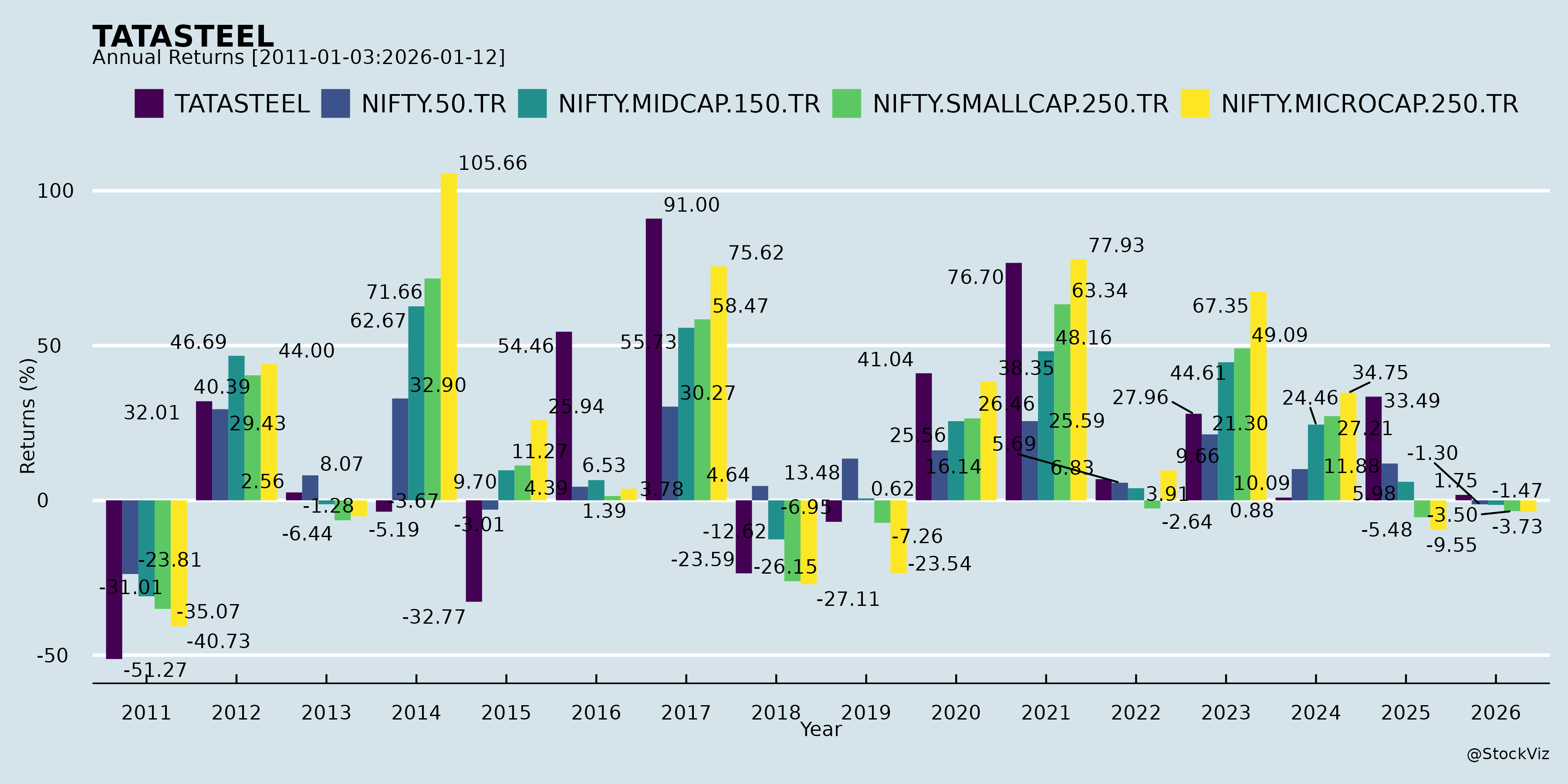
Annual Returns
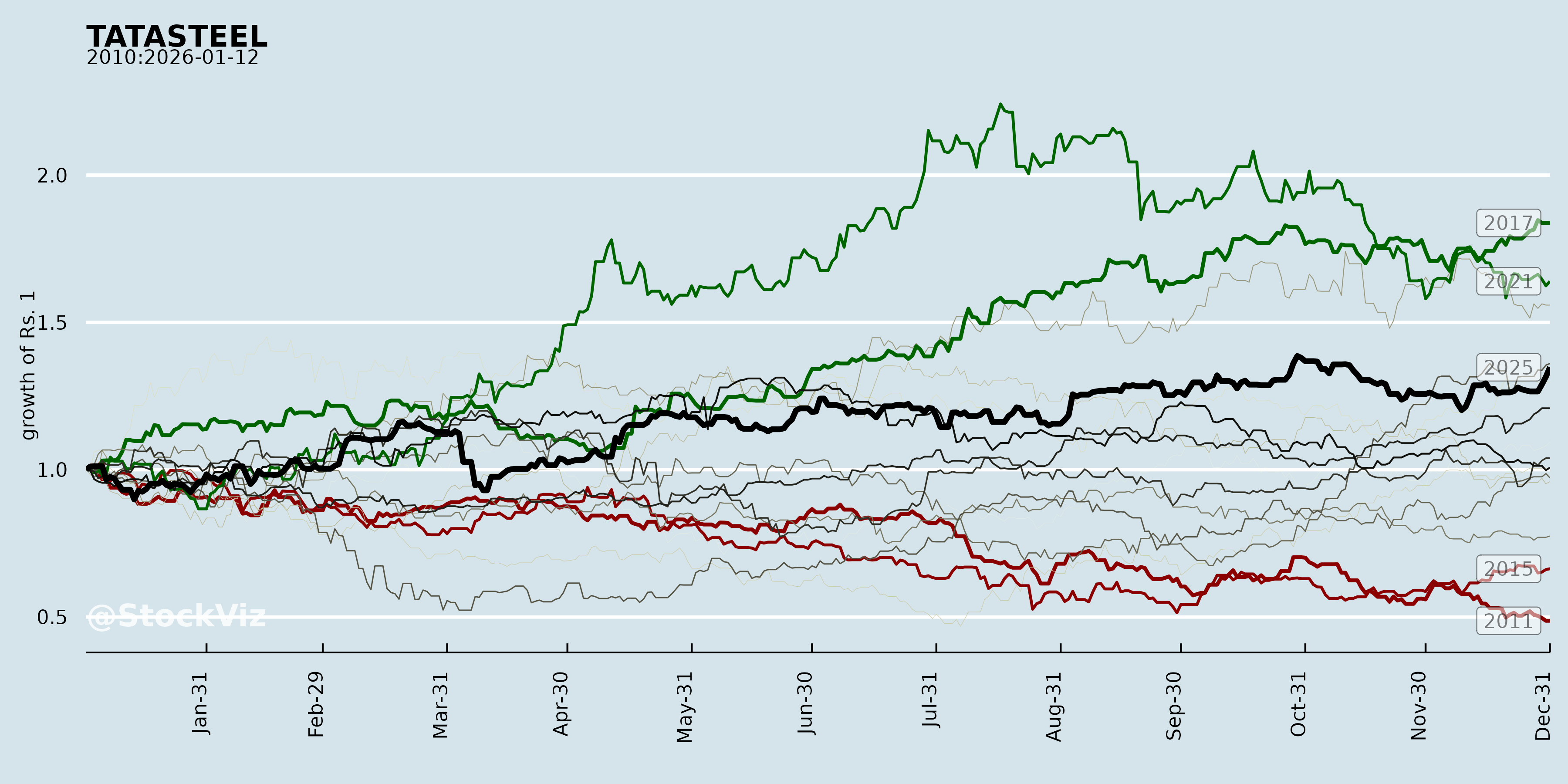
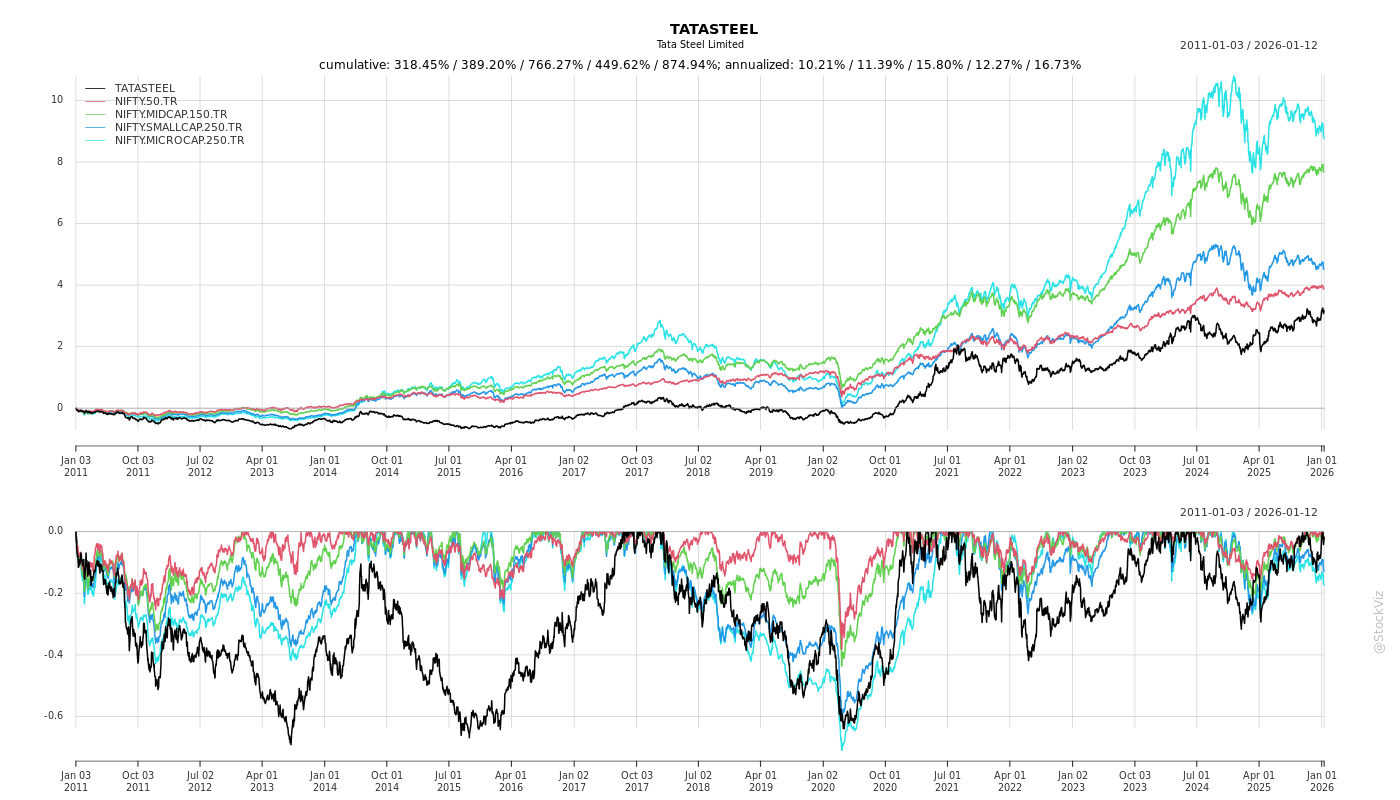
Cumulative Returns and Drawdowns
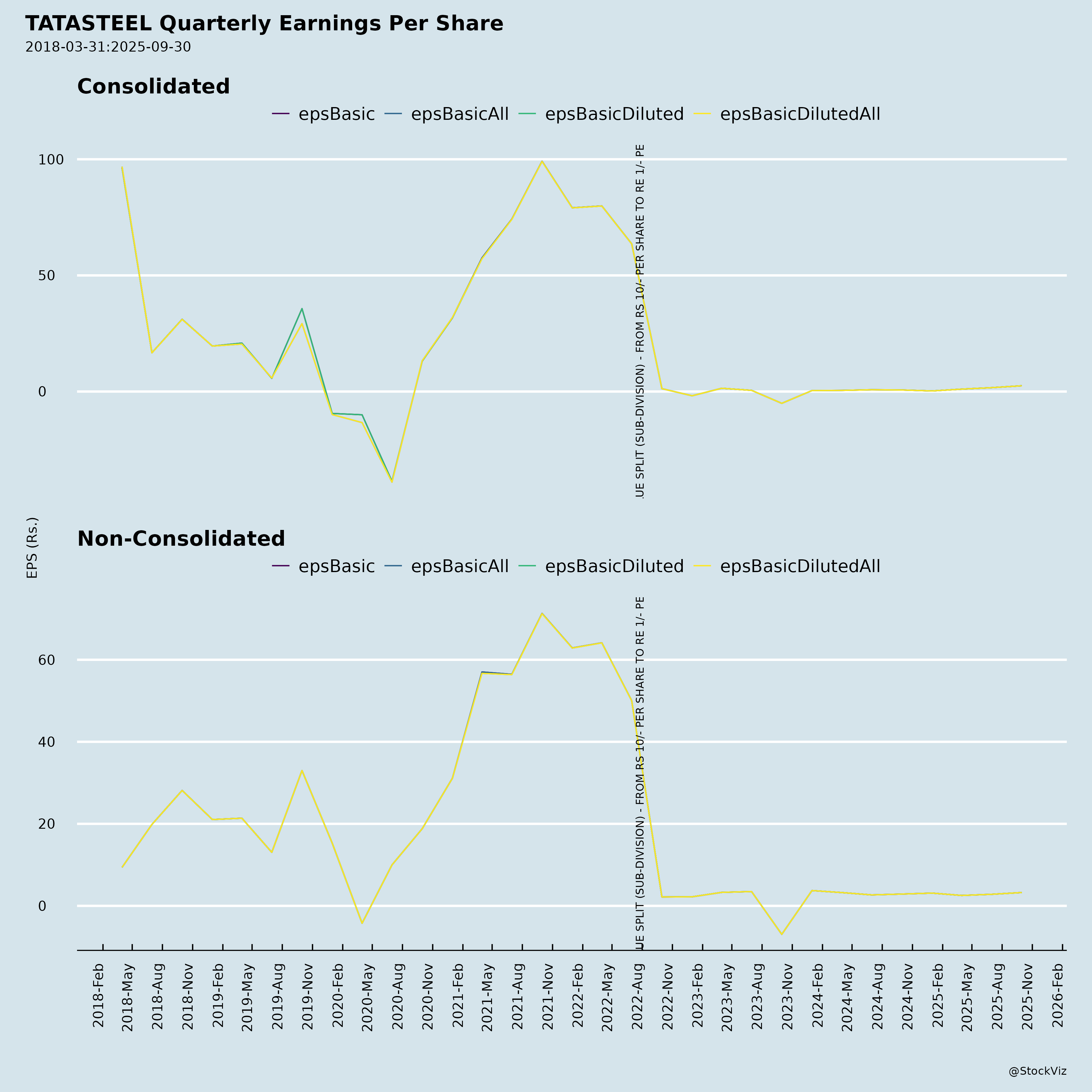
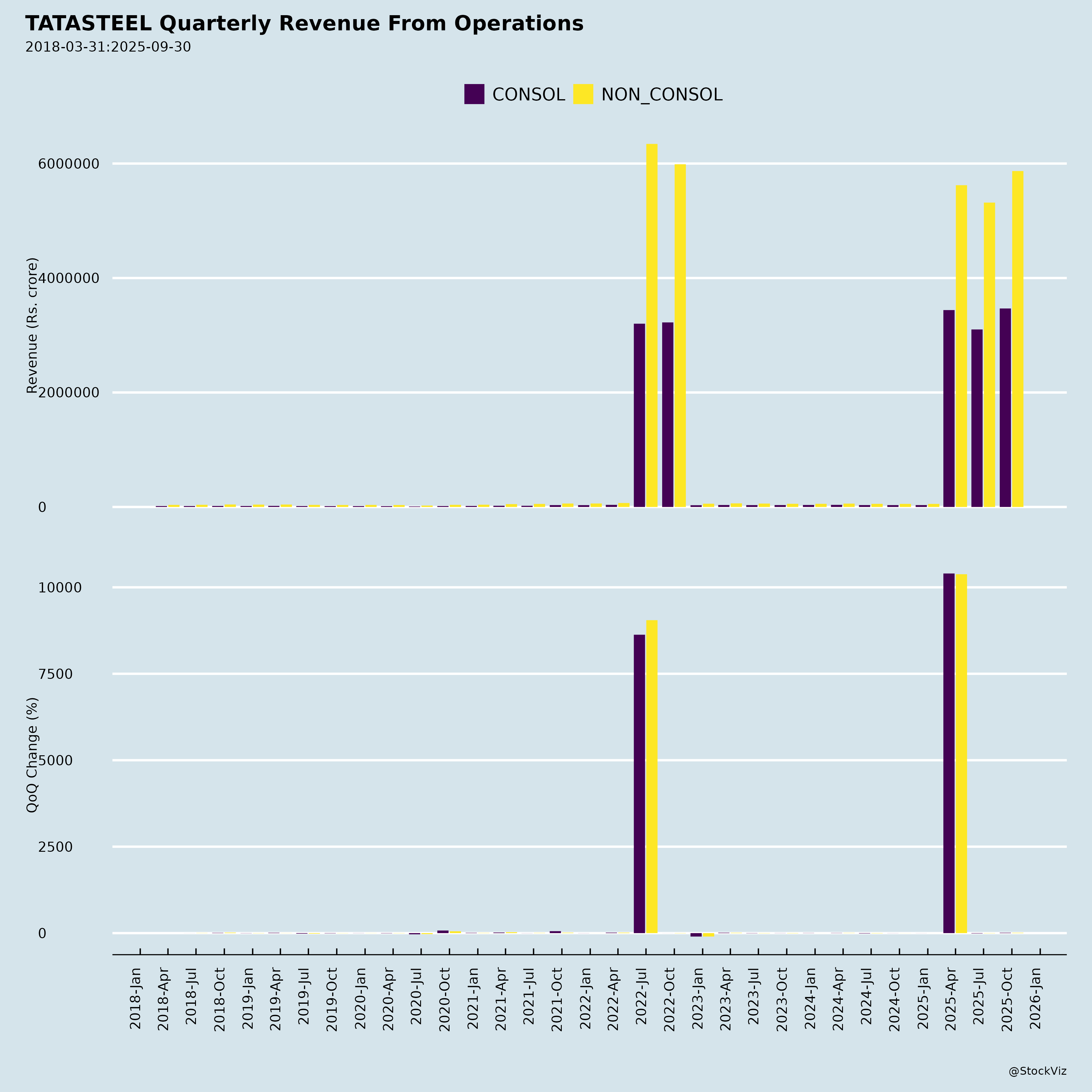
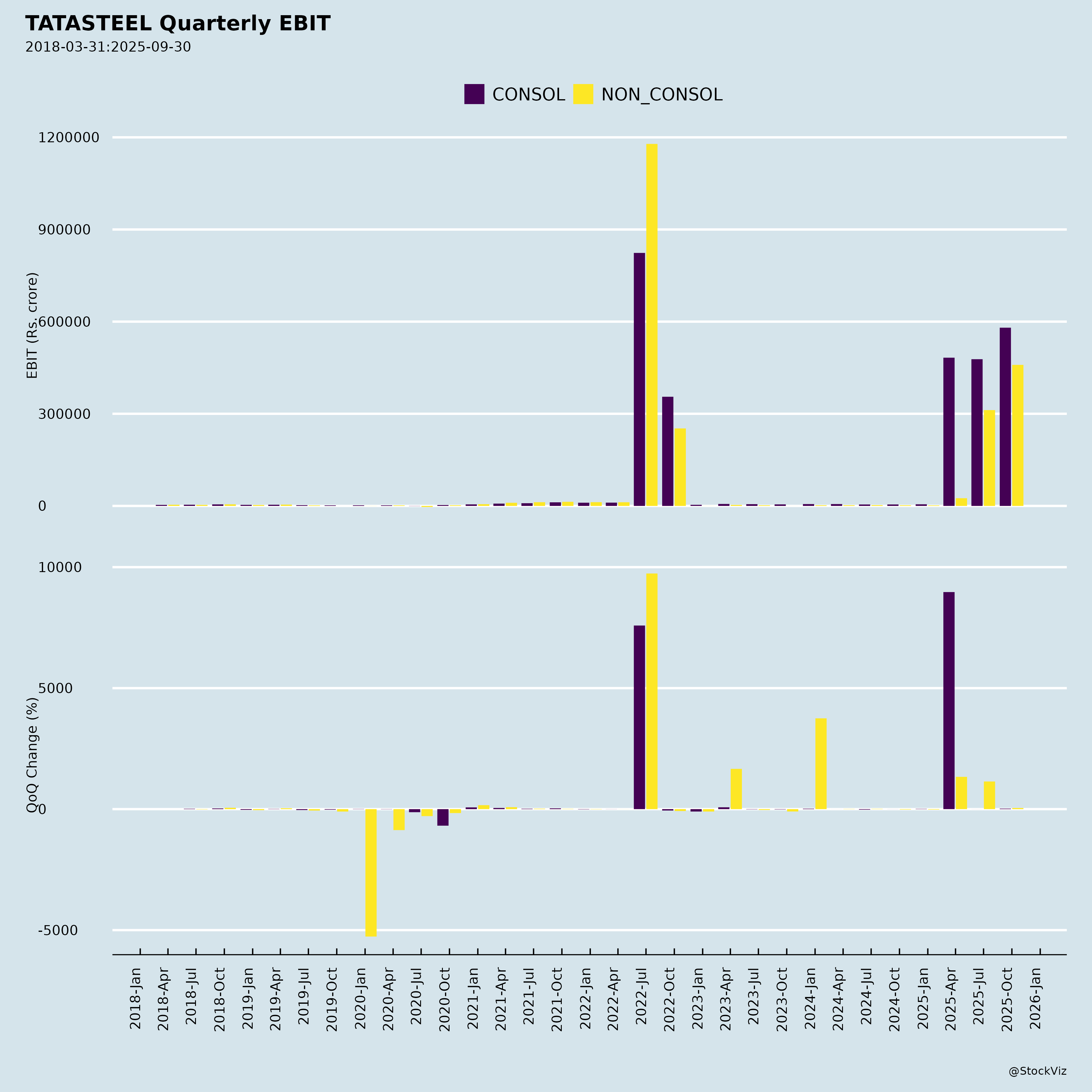
Fundamentals
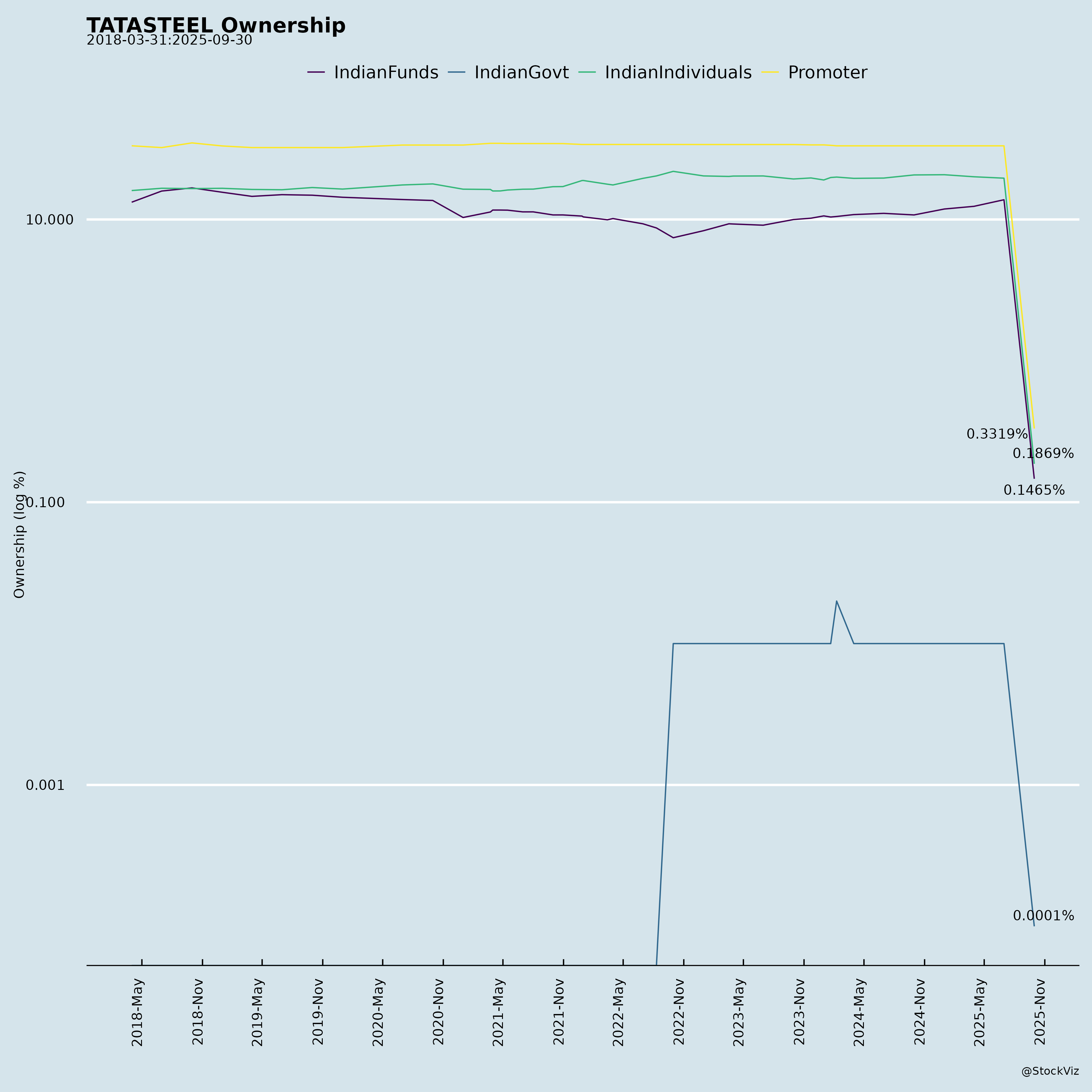
Ownership
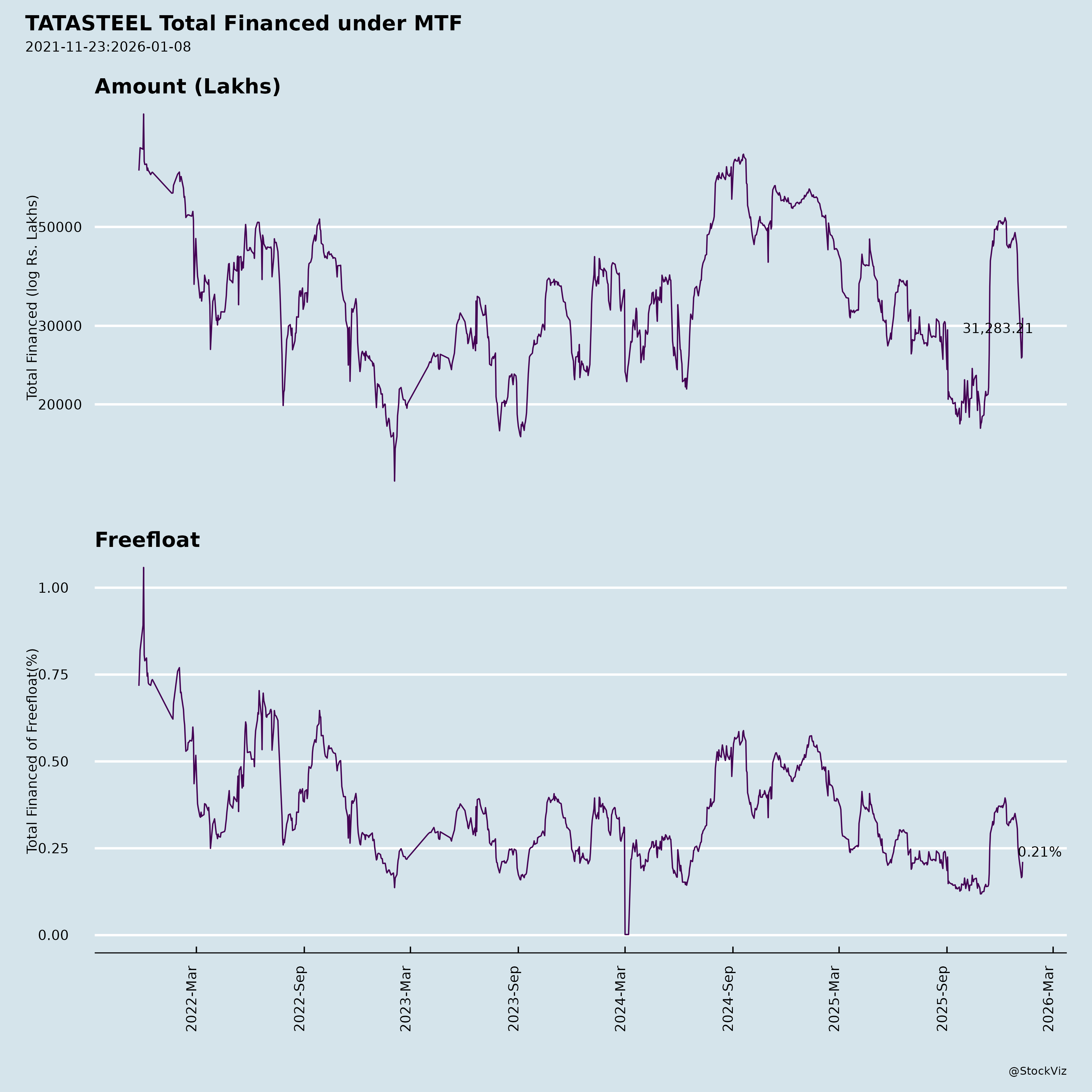
Margined
AI Summary
asof: 2026-09-14
Headwinds and Challenges
- The June 2026 quarter (1QFY27) was marked by a complex global operating environment, with developments in West Asia affecting supply chains and input costs more acutely during the quarter.
- Consolidated revenues declined sequentially to ₹60,794 crores from ₹63,270 crores in 4QFY26, driven by a seasonal drop in volumes, particularly in India, partly offset by higher steel realisations.
- India crude steel production (5.76 million tons) and deliveries (5.17 million tons) were affected by maintenance shutdowns at Meramandali and Kalinganagar. Production and deliveries are expected to normalise in coming quarters.
- Netherlands operations were impacted by the closure of the Direct Sheet Plant. Liquid steel production was 1.55 million tons and deliveries 1.40 million tons; Netherlands EBITDA fell to €4 million for the quarter. The local environment authority has permitted trial runs, which are ongoing, ahead of restart of full operations.
- UK operations reported revenues of £484 million and an EBITDA loss of £27 million, although the loss narrowed from £48 million in 4QFY26. The improvement came despite operational disruptions from a pickle line fire.
- Raw material costs moved higher due to a rise in coking coal consumption cost in India and Netherlands. Other expenses rose on account of higher royalty and West Asia crisis-induced increases in power and fuel costs.
- Working capital was impacted by inventory build-up due to operational and supply chain disruptions, and an increase in prices.
- Net debt stood at ₹84,173 crores, with Net debt to EBITDA at 2.3x.
- Exceptional loss of ₹345 crores related to an employee separation scheme in India and redundancy-related provisions in the UK.
- The company reassessed useful lives of certain items of property, plant and equipment, resulting in an additional depreciation charge of ₹294.49 crore for the quarter and an expected additional charge of approximately ₹1,178 crore for the year ending March 31, 2027.
- In the Netherlands, the Environmental Agency and Province of North Holland issued a letter on April 23, 2026 indicating intention to revoke operating permits and trigger early closure of Coke and Gas Plants 1 and 2. TSN is engaged with regulators on a safe, responsible and controlled closure process, and is exploring all options including legal recourse. TSN is also engaged with regulators on evolving standards for steel slag classification and disposal, with removal from the IJmuiden site temporarily disrupted, resulting in excess stockpiling. A material uncertainty exists surrounding the impact of these adversities on the financial stability of TSN as an entity.
- India apparent steel demand continued to grow, but imports outpaced exports during the quarter. The government initiated an anti-dumping investigation on Hot Rolled steel imports from select countries.
- EU and UK incorporated tighter safeguard quotas effective July 1, 2026, though in the UK there were deviations from the initial proposal with implications for product categories.
Tailwinds and Growth Prospects
- Consolidated EBITDA for 1QFY27 was ₹9,370 crores, up 25% YoY despite the volatile operating environment. EBITDA per ton improved to ₹12,898 from ₹11,410 in 4QFY26 and ₹10,503 in 1QFY26.
- India revenues were ₹36,989 crores and EBITDA was ₹9,908 crores, translating to an EBITDA margin of 27%. India EBITDA per ton improved by ₹3,255 per ton QoQ to ₹19,162 per ton.
- Domestic deliveries grew 11% YoY to 4.85 million tons. Net steel realisations improved by ₹5,991 per ton QoQ.
- Automotive & Special Products delivered its best-ever 1Q performance, driven by 21% YoY growth in hi-end sales.
- Branded portfolio gained momentum, with Tata Tiscon and Tata Steelium registering growth of more than 30% YoY.
- E-commerce platforms Aashiyana and DigECA generated Gross Merchandise Value of around ₹2,200 crores, up 61% YoY.
- The company strengthened presence in emerging segments such as shipbuilding, data centers and containers.
- Neelachal Ispat Nigam Limited generated EBITDA of ₹498 crores, a margin of 29%, providing confidence for the expansion project.
- The Board approved the core project of steelmaking capacity expansion by 4.8 MTPA at NINL at an estimated capex of ₹33,873 crores, expanding total capacity to 6.2 MTPA. This is the first phase of growth at NINL and is at an advanced stage of readiness after completion of engineering. This will enable expansion of the long products portfolio, especially in retail where branded products are in high demand.
- The 0.75 MTPA EAF at Ludhiana is ramping up, and construction is in progress for the 0.7 MTPA Hot Rolled Pickling & Galvanising Line, along with Phase 1 expansion of Tinplate from 0.4 to 0.7 MTPA.
- Capital expenditure of ₹3,579 crores was spent during the quarter.
- Group liquidity remains strong at ₹45,950 crores, including cash & cash equivalents of ₹13,221 crores.
- In the UK, recently implemented safeguard measures are expected to provide a more supportive market environment, although benefits vary across product categories. The company continues to engage with the UK government to support a level playing field for domestic producers.
- In the Netherlands, the company is engaging closely with local environmental authorities to implement required technical measures for a safe, compliant and sustained restart of the Direct Sheet Plant.
- Cost optimisation initiatives target benefits of ₹7,140 crores for FY2027, with key drivers including raw material cost, production yield & reliability, procurement cost, fuel rate optimisation, downstream initiatives and supply chain optimisation.
- The company is progressing towards sustainable steelmaking in the UK and Netherlands. In the UK, transition to scrap-based EAF steelmaking aims to reduce 50 million tons CO2e over a decade. The EAF project is for around 3 MTPA capacity, with project cost of £1.25 billion including £500 million funding from the UK Government. Upon commissioning, emission intensity is expected to be ~0.4 tCO2e per ton of crude steel.
- Over €300 million has been spent towards sustainability-linked initiatives to reduce emissions in the Netherlands.
- The company has announced Net Zero by 2045 as a major sustainability objective.
- Tata Steel has been recognised with the World Economic Forum’s Global Lighthouse recognition for its Jamshedpur, Kalinganagar, and IJmuiden Plants. 78% of steel comes from these global lighthouses.
- The company has been part of the DJSI Emerging Markets Index since 2012 and consistently ranked among the top 10 steel companies in the DJSI Corporate Sustainability Assessment since 2016.
- Tata Steel’s Jamshedpur Plant is India’s first site to receive ResponsibleSteelTM Certification. Subsequently, Kalinganagar and Meramandali plants have also received the certification. In India, more than 90% of steel production now comes from ResponsibleSteelTM certified sites.
- The company received 2026 Steel Sustainability Champion recognition from worldsteel for nine years in a row.
- The Board approved acquisition of 41,40,000 equity shares (23% equity stake) in TM International Logistics Limited from IQ Martrade Holding Und Management GmbH for a consideration of ₹335 crore, subject to necessary approvals. On completion, the company will hold 74% equity shares in TMILL and NYK will hold 26%.
- The Board considered and approved the amalgamation of Neelachal Ispat Nigam Limited into and with the Company by way of scheme of amalgamation. The draft scheme has been filed at the relevant bench of the NCLT and sanction is awaited.
- The Board considered and approved the amalgamation of Rujuvalika Investments Limited into and with the Company by way of scheme of amalgamation. The Scheme is subject to certain conditions, including sanction by the Hon’ble National Company Law Tribunal, Mumbai bench.
- The company agreed to transfer its equity shares in Jamshedpur Football & Sporting Private Limited to Churchill Brothers Football Club for a token consideration of ₹100. The transfer includes the Club’s Indian Super League sporting licence and the transfer of 12 players & 2 coaches. Churchill Brothers will take over the contracts of all JFC players and coaching staff with effect from September 2026. The completion is subject to satisfaction of conditions precedent, including receipt of necessary approvals from the All-India Football Federation, with expected completion by August 31, 2026.
- JFSPL had a turnover of ₹32.23 crore for FY2025-26, representing 0.01% of the consolidated turnover of Tata Steel Limited. Net-worth of JFSPL as on March 31, 2026 was ₹(5.8) crore.
- Tata Steel will continue to focus on football at the grassroots and youth level, including the Tata Football Academy, which has trained 150 cadets who have represented India and 26 captains of national teams across various age groups. The company will continue to maintain and enhance its sporting infrastructure, repurposing it for grassroots football and athlete development, and will be modernising its youth system in collaboration with the AIFF.
- The company remains committed to its long legacy of developing sports at a grassroots level, expanding access, and strengthening India’s sporting ecosystem. The Tata Football Academy was established in 1987 at Jamshedpur and has trained over 300 cadets, 150 of whom have represented the Indian National team. The majority of the Jharkhand boys U-14 and U-16 teams have come through Tata Steel Foundation football training centres, which work with tribal communities.
- Besides football, Tata Steel operates world-class sports academies across archery, hockey, sport climbing and rowing. The Tata Archery Academy is India’s premier archery institution, having trained over 180+ cadets in 25 years, including 8 Olympians. The Naval Tata Hockey Academy provides elite coaching and high-performance training, nutrition and mental conditioning across 3 regional development and 32 grassroots centres.
- The company has been recognised with the CII Sports Business Award 2025 for ‘The Legacy of Excellence in Sports Patronage’.
- The company has been recognised with the World Economic Forum’s Global Diversity Equity & Inclusion Lighthouse 2023 and is the world’s largest SA8000 Certified organisation in terms of workforce coverage.
- The company received the Legal Team of the Year - Manufacturing at the 15th Annual Legal Era Indian Legal Awards 2025-26, 2023 Global ERM Award of Distinction at the RIMS ERM Conference 2023, ‘Masters of Risk - Risk Technology’ recognition at The India Risk Management Awards, and ICSI Business Responsibility and Sustainability Award 2023 for its first Business Responsibility and Sustainability Report (BRSR), Excellence in Financial Reporting FY20 from ICAI, among several others.
- The company has been on a multi-year digital-enabled business transformation journey intending to be the leader in ‘Digital Steel making’. The company received the ‘Digital Enterprise of India - Steel’ Award 2024 by Economic Times CIO.
- The company has been recognised with the World Economic Forum’s Global Lighthouse recognition for its Jamshedpur, Kalinganagar, and IJmuiden Plants. 78% of steel comes from these global lighthouses.
- The company has been a part of the DJSI Emerging Markets Index since 2012 and has been consistently ranked among the top 10 steel companies in the DJSI Corporate Sustainability Assessment since 2016.
- Tata Steel’s Jamshedpur Plant is India’s first site to receive ResponsibleSteelTM Certification. Subsequently, its Kalinganagar and Meramandali plants have also received the certification. In India, Tata Steel now has more than 90% of its steel production from ResponsibleSteelTM certified sites.
- Received Prime Minister’s Trophy for the best performing integrated steel plant for 2016-17, 2026 Steel Sustainability Champion recognition from worldsteel for nine years in a row, CDP 2024 ‘Supplier Engagement Assessment’ Leader, Top performer in Iron and Steel sector in Dun & Bradstreet’s India’s top 500 companies 2022, Ranked as the 2024 most valuable Mining and Metals brand in India by Brand Finance, ‘Most Ethical Company’ award 2021 from Ethisphere Institute, and CII Sports Business Award 2025 for ‘The Legacy of Excellence in Sports Patronage’.
- Received the Legal Team of the Year - Manufacturing at the 15th Annual Legal Era Indian Legal Awards 2025-26, 2023 Global ERM (Enterprise Risk Management) Award of Distinction at the RIMS ERM Conference 2023, ‘Masters of Risk - Risk Technology’ recognition at The India Risk Management Awards, and ICSI Business Responsibility and Sustainability Award 2023 for its first Business Responsibility and Sustainability Report (BRSR), Excellence in Financial Reporting FY20 from ICAI, among several others.
Key Risks
- The completion of the divestment of JFSPL is subject to the satisfaction of certain conditions precedent, including receipt of necessary approvals from the All-India Football Federation and completion of other customary actions and activities as agreed between Tata Steel and Churchill.
- The completion of the acquisition of 23% equity stake in TMILL is subject to customary conditions precedent, and approvals from regulatory authorities including Competition Commission of India and other stakeholders, as applicable.
- The amalgamation of NINL into and with the Company is subject to certain conditions, including sanction of the Scheme by the Hon’ble National Company Law Tribunal. The draft scheme has been filed at the relevant bench of the NCLT and the sanction of the NCLT is awaited.
- The amalgamation of RIL into and with the Company is subject to certain conditions, including sanction of the Scheme by the Hon’ble National Company Law Tribunal, Mumbai bench.
- In the Netherlands, the timing, nature and contents of a decision that may be issued by the EA and the Province regarding the potential revocation of operating permits and early closure of CGP 1 and 2 is still unclear, while discussions, exchange of technical information and independent validation continues. TSN is also exploring all options including legal recourse to ensure that the closure process is managed with due care and prudence.
- TSN is engaged with regulators on evolving standards relating to classification of steel slag as a material and its disposal. In the interim, the removal of steel slag from the IJmuiden site is temporarily disrupted resulting in excess stockpiling. A range of mitigating actions is being pursued, including regulatory engagement, legal and technical assessments and the development of alternative storage and disposal solutions. But the resolution of the underlying regulatory conditions is not wholly within TSN’s control.
- Given the significance of both the above matters to TSN’s operations, there exists a material uncertainty surrounding the impact of such adversities on the financial stability of TSN as an entity. The financial results of TSN as an entity have accordingly been prepared on a going concern basis while recognising the aforesaid material uncertainty.
- The financial results of Tata Steel UK have also been prepared on a going concern basis, considering the UK Government funding being available under the Grant Funding Agreement (GFA) signed with the UK Government and a commitment to infuse equity into TSUK by the Company.
- In view of the matters stated above, the Group has assessed its ability to meet any liquidity requirements of the Group, including at TSUK and TSN, as may be required, and concluded that its cashflow and liquidity position remains adequate.
- Statements in the press release describing the Company’s performance may be ‘forward-looking statements’ within the meaning of applicable securities laws and regulations. Actual results may differ materially from those directly or indirectly expressed, inferred or implied. Important factors that could make a difference to the Company’s operations include, among others, economic conditions affecting demand/supply and price conditions in the domestic and overseas markets in which the Company operates, changes in or due to the environment, Government regulations, laws, statutes, judicial pronouncements and/or other incidental factors.
Management Guidance Versus Observed Business Performance
- Management stated that India crude steel production and deliveries were affected by maintenance shutdowns in Meramandali and Kalinganagar, and that production and deliveries are expected to normalise in the coming quarters. Observed performance: India crude steel production was 5.76 million tons and deliveries were 5.17 million tons in 1QFY27, compared to 6.22 million tons production and 6.19 million tons deliveries in 4QFY26.
- Management stated that in the Netherlands, the local environment authority has permitted Tata Steel Netherlands to carry out trial runs, which are ongoing, ahead of the restart of full operations. Observed performance: Netherlands liquid steel production was 1.55 million tons and deliveries were 1.40 million tons, with operations affected by the closure of the Direct Sheet Plant.
- Management stated that in the UK, the recently implemented safeguard measures are expected to provide a more supportive market environment, although the benefits vary across product categories. Observed performance: UK revenues were £484 million for the quarter and EBITDA loss narrowed to £27 million from £48 million in 4QFY26, reflecting the impact of targeted improvement initiatives and better pricing supported by trade measures, achieved despite operational disruptions arising from the pickle line fire.
- Management stated that the company continues to engage with the UK government to support a level playing field for domestic producers. Observed performance: UK EBITDA loss narrowed from -ve £48 million in 4Q to -ve £27 million in 1Q.
- Management stated that in the Netherlands, the company is engaging closely with the local environmental authorities to implement the required technical measures for a safe, compliant and sustained restart of the Direct Sheet Plant. Observed performance: Netherlands EBITDA was €4 million for the quarter, with operations affected by the closure of the Direct Sheet Plant.
- Management stated that the Board approved the 4.8 MTPA expansion at Neelachal Ispat Nigam Limited, which is central to the strategy of deepening presence in high-margin and branded long products. Observed performance: NINL generated EBITDA of ₹498 crores, a margin of 29%, providing confidence for the expansion project.
- Management stated that the 0.75 MTPA EAF at Ludhiana is ramping up and construction is in progress for the 0.7 MTPA Hot Rolled Pickling & Galvanising Line, along with Phase 1 expansion of Tinplate from 0.4 to 0.7 MTPA. Observed performance: capital expenditure of ₹3,579 crores was spent during the quarter.
- Management stated that the company remains focused on cost optimisation and working capital efficiency to maximise cashflows. Observed performance: working capital was impacted by inventory build due to operational and supply chain disruptions, and an increase in prices. Net debt stood at ₹84,173 crores and Net debt to EBITDA was 2.3x, below the stated range of 2.5 - 3.0x through cycle. Group liquidity remains strong at ₹45,950 crores, which includes cash & cash equivalents of ₹13,221 crores.
- Management stated that the Board approved ~₹33,873 crores towards the core project of steelmaking capacity expansion by 4.8 MTPA at Neelachal Ispat Nigam Limited, which will expand the total capacity to 6.2 MTPA. This expansion is the first phase of growth at NINL and is at an advanced stage of readiness after completion of engineering. Observed performance: NINL is currently going through the process of amalgamation into and with Tata Steel Limited.
- Management stated that the company will continue to focus on football at the grassroots and youth level, given its legacy of identifying and nurturing young talent, especially among local and tribal communities. This includes the Tata Football Academy, which has trained 150 cadets who have represented India and 26 captains of national teams across various age groups. The company will continue to maintain and enhance its sporting infrastructure - repurposing it for grassroots football and athlete development. It will be modernising its youth system, investing in and further building its capability in collaboration with the AIFF. Observed performance: the company agreed to transfer its equity shares in JFSPL to Churchill Brothers Football Club for a token consideration, including the transfer of the Club’s Indian Super League sporting licence and the transfer of 12 players & 2 coaches. Churchill Brothers will take over the contracts of all JFC players and coaching staff with effect from September 2026.
- Management stated that the company remains firmly committed to its long legacy of developing sports at a grassroots level, expanding access, and strengthening India’s sporting ecosystem. Observed performance: the Tata Football Academy was established in 1987 at Jamshedpur and has trained over 300 cadets, 150 of whom have represented the Indian National team. The majority of the Jharkhand boys U-14 and U-16 teams have come through Tata Steel Foundation football training centres, which work with tribal communities. Besides football, Tata Steel also operates world-class sports academies across the disciplines of archery, hockey, sport climbing and rowing. It also organises world-class marathon and chess competitions. The Tata Archery Academy is India’s premier archery institution, having trained over 180+ cadets in 25 years, including 8 Olympians. The Naval Tata Hockey Academy provides elite coaching and high-performance training, nutrition and mental conditioning across 3 regional development and 32 grassroots centres.
- Management stated that the company has announced its major sustainability objectives including Net Zero by 2045. Observed performance: the company is pursuing multiple initiatives in India to achieve ‘Responsible Growth’, with strategic levers including breakthrough technologies, scrap-based steelmaking, energy efficiency & process optimisation, greening of power mix, and use of alternate reductants. Status includes setting up HIsarna demo and EASyMelt pilot, commissioning 0.75 MTPA EAF, Coke Dry Quenching, Kraftblock etc., renewable energy, substitute coal with gas, H2 injection trial, Biochar usage & CBM gas.
- Management stated that in the UK, transition to scrap-based EAF steelmaking aims to reduce 50 million tons CO2e over a decade. Observed performance: EAF project is for around 3 MTPA capacity, with project cost of £1.25 billion including £500 million funding from the UK Government. Upon commissioning, emission intensity is expected to be ~0.4 tCO2e per ton of crude steel.
- Management stated that over €300 million has been spent towards sustainability-linked initiatives to reduce emissions in the Netherlands. Observed performance: Roadmap Plus initiatives include reduction in odor load by 85% vs. 2019 levels, dust removal systems with PM10 down 41% vs. 2019 levels, and PAH emissions down 50% at three largest sources vs. 2019.
- Management stated that the company has been on a multi-year digital-enabled business transformation journey intending to be the leader in ‘Digital Steel making’. Observed performance: the company received the World Economic Forum’s Global Lighthouse recognition for its Jamshedpur, Kalinganagar, and IJmuiden Plants. 78% of steel comes from these global lighthouses. The company has also been recognised with the ‘Digital Enterprise of India - Steel’ Award 2024 by Economic Times CIO.
- Management stated that the company has been recognised with the World Economic Forum’s Global Diversity Equity & Inclusion Lighthouse 2023. Observed performance: the company is the world’s largest SA8000 Certified organisation in terms of workforce coverage.
- Management stated that the company has been a part of the DJSI Emerging Markets Index since 2012 and has been consistently ranked among the top 10 steel companies in the DJSI Corporate Sustainability Assessment since 2016. Observed performance: the company continues to be part of the DJSI Emerging Markets Index.
- Management stated that Tata Steel’s Jamshedpur Plant is India’s first site to receive ResponsibleSteelTM Certification. Subsequently, its Kalinganagar and Meramandali plants have also received the certification. In India, Tata Steel now has more than 90% of its steel production from ResponsibleSteelTM certified sites. Observed performance: the company continues to maintain these certifications.
- Management stated that the company received Prime Minister’s Trophy for the best performing integrated steel plant for 2016-17, 2026 Steel Sustainability Champion recognition from worldsteel for nine years in a row, CDP 2024 ‘Supplier Engagement Assessment’ Leader, Top performer in Iron and Steel sector in Dun & Bradstreet’s India’s top 500 companies 2022, Ranked as the 2024 most valuable Mining and Metals brand in India by Brand Finance, ‘Most Ethical Company’ award 2021 from Ethisphere Institute, and CII Sports Business Award 2025 for ‘The Legacy of Excellence in Sports Patronage’. Observed performance: the company continues to receive these recognitions.
- Management stated that the company received the Legal Team of the Year - Manufacturing at the 15th Annual Legal Era Indian Legal Awards 2025-26, 2023 Global ERM (Enterprise Risk Management) Award of Distinction at the RIMS ERM Conference 2023, ‘Masters of Risk - Risk Technology’ recognition at The India Risk Management Awards, and ICSI Business Responsibility and Sustainability Award 2023 for its first Business Responsibility and Sustainability Report (BRSR), Excellence in Financial Reporting FY20 from ICAI, among several others. Observed performance: the company continues to receive these recognitions.
- Management stated that the company has been recognised with the World Economic Forum’s Global Lighthouse recognition for its Jamshedpur, Kalinganagar, and IJmuiden Plants. 78% of steel comes from these global lighthouses. Observed performance: the company continues to maintain these recognitions.
- Management stated that the company has been a part of the DJSI Emerging Markets Index since 2012 and has been consistently ranked among the top 10 steel companies in the DJSI Corporate Sustainability Assessment since 2016. Observed performance: the company continues to be part of the DJSI Emerging Markets Index.
- Management stated that Tata Steel’s Jamshedpur Plant is India’s first site to receive ResponsibleSteelTM Certification. Subsequently, its Kalinganagar and Meramandali plants have also received the certification. In India, Tata Steel now has more than 90% of its steel production from ResponsibleSteelTM certified sites. Observed performance: the company continues to maintain these certifications.
- Management stated that the company received Prime Minister’s Trophy for the best performing integrated steel plant for 2016-17, 2026 Steel Sustainability Champion recognition from worldsteel for nine years in a row, CDP 2024 ‘Supplier Engagement Assessment’ Leader, Top performer in Iron and Steel sector in Dun & Bradstreet’s India’s top 500 companies 2022, Ranked as the 2024 most valuable Mining and Metals brand in India by Brand Finance, ‘Most Ethical Company’ award 2021 from Ethisphere Institute, and CII Sports Business Award 2025 for ‘The Legacy of Excellence in Sports Patronage’. Observed performance: the company continues to receive these recognitions.
- Management stated that the company received the Legal Team of the Year - Manufacturing at the 15th Annual Legal Era Indian Legal Awards 2025-26, 2023 Global ERM (Enterprise Risk Management) Award of Distinction at the RIMS ERM Conference 2023, ‘Masters of Risk - Risk Technology’ recognition at The India Risk Management Awards, and ICSI Business Responsibility and Sustainability Award 2023 for its first Business Responsibility and Sustainability Report (BRSR), Excellence in Financial Reporting FY20 from ICAI, among several others. Observed performance: the company continues to receive these recognitions.
Broker Narrative
The narrative evolved from a Neutral stance highlighting global demand weakness and UK operational risks to a Buy call buoyed by domestic price surges and capacity expansion, while early coal dependency fears materialized as input cost inflation and the UK shutdown risk crystallized into the DSP shutdown. Domestic growth themes (capacity, demand) persisted, but the Europe/UK drag shifted from a potential shutdown to a regulatory-contingent earnings issue, and decarbonization plans stalled. Broker optimism became tied to domestic cyclicality despite new environmental and cost headwinds.
Fears that came true
- UK operations shutdown risk materialized as TSN’s DSP was shut down in Apr’26 due to Chromium-6 emissions, correlating with negative actual returns (-2.6% to -11.5%) on 2026 Buy calls.
- Coal import dependency risk materialized as input costs (coking coal, iron ore, pellet) increased, raising the cost base, which correlates with DISAPPOINTMENT outcomes on multiple 2026 reports.
Optimism that failed
- The downstream capacity/VAP expansion tailwind failed as the DSP shutdown caused lower volumes and higher costs instead of driving margins.
Broker Timeline
68 broker calls · 2023-05-17 to 2026-09-21
Copyright © 2023 SAS Data Analytics Pvt. Ltd. All rights reserved.