TATACONSUM
Equity Metrics
May 8, 2026
TATA CONSUMER PRODUCTS LIMITED
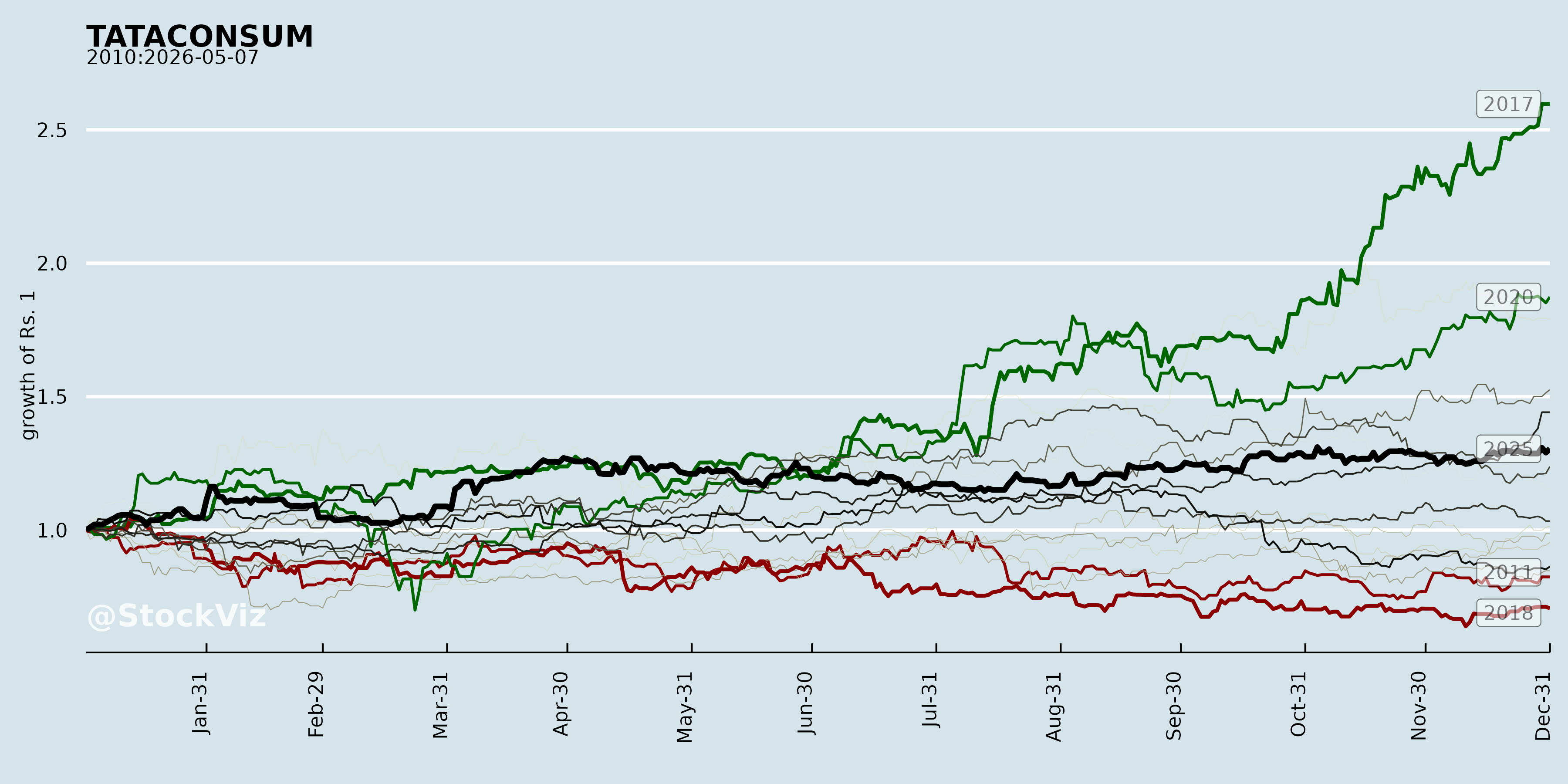
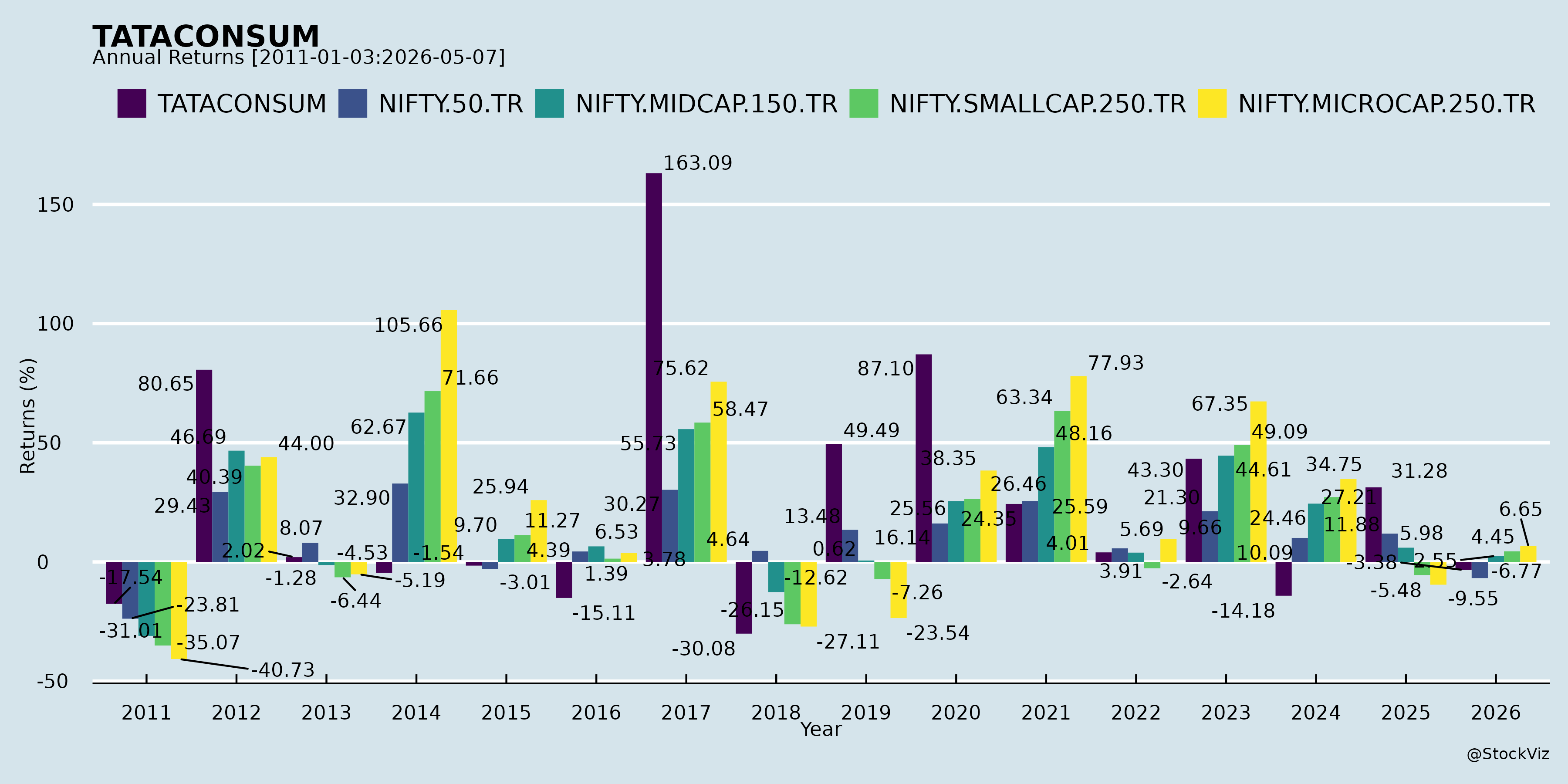
Annual Returns
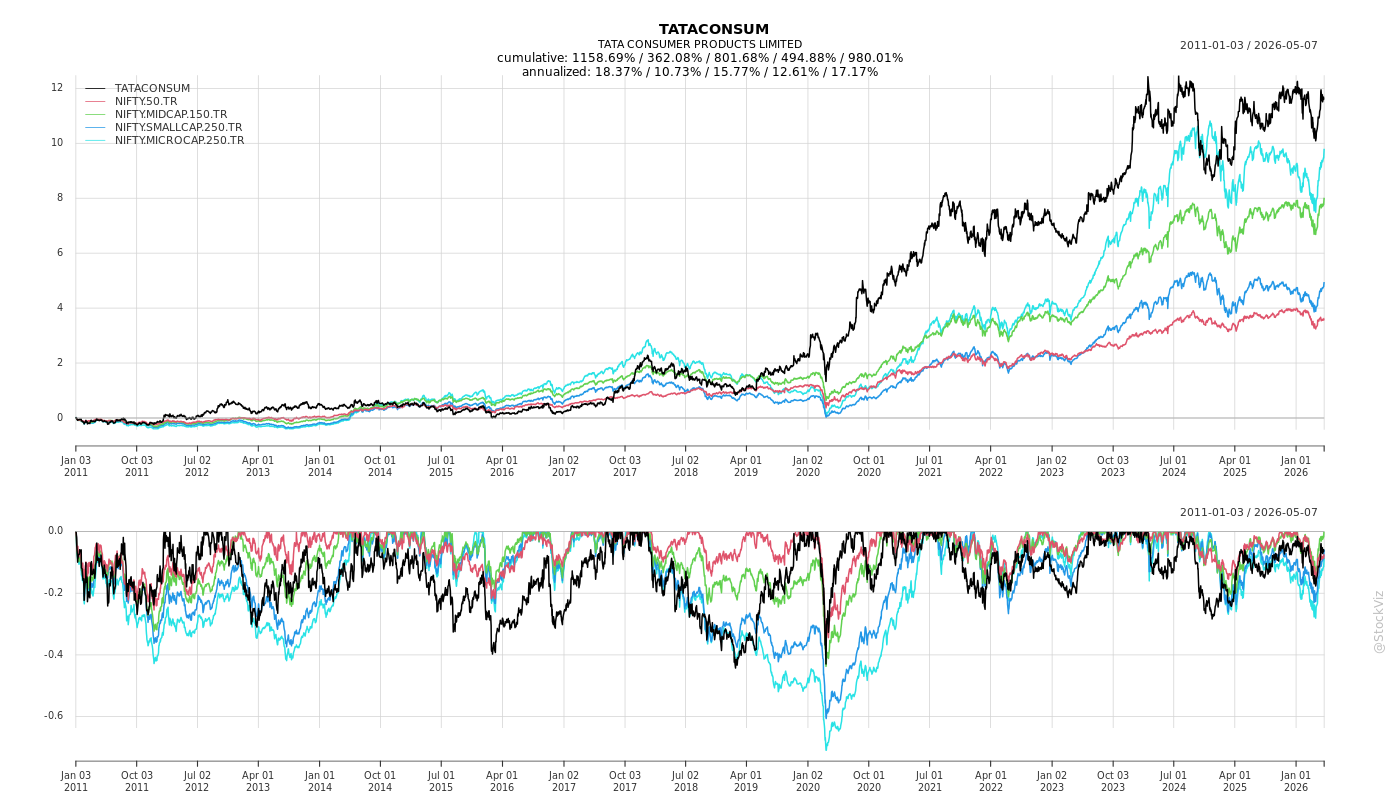
Cumulative Returns and Drawdowns
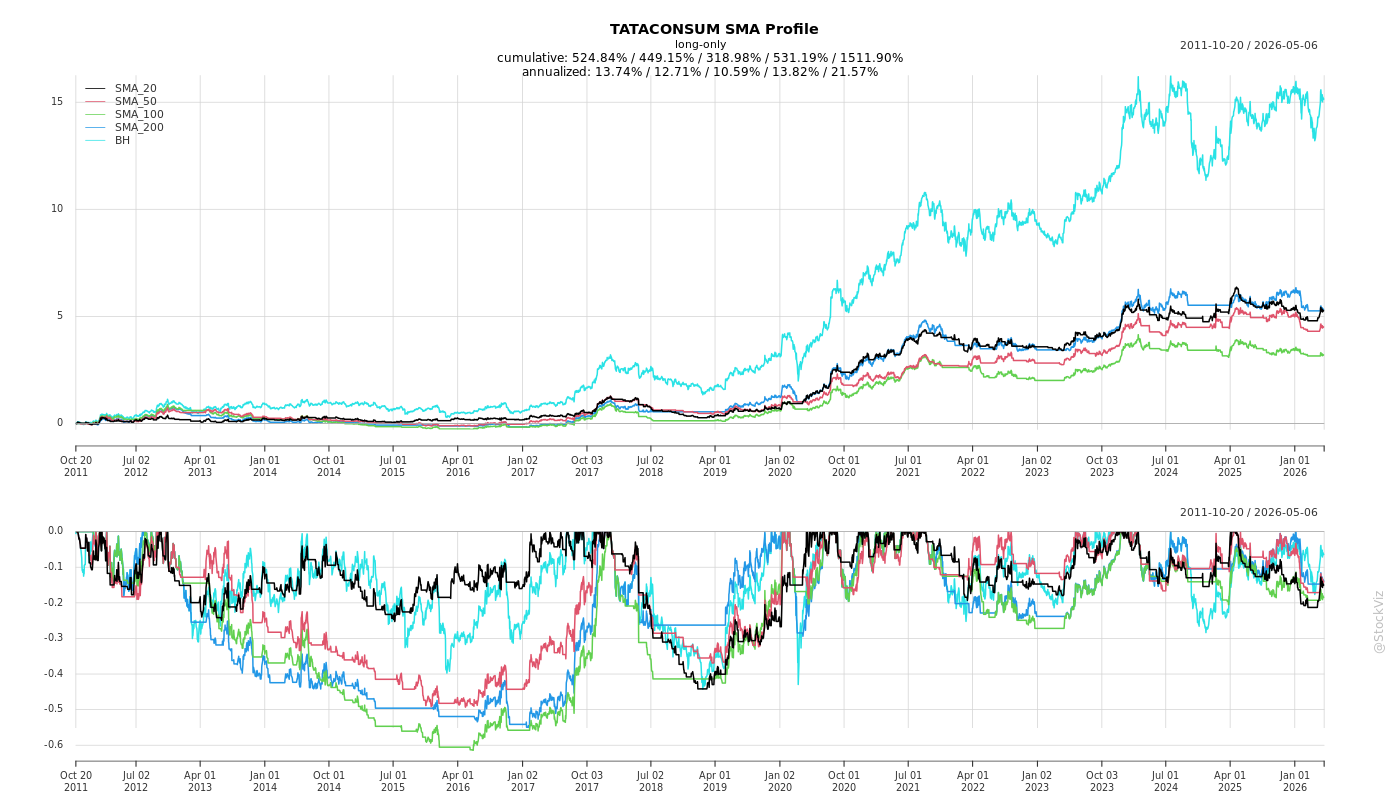
Fundamentals
Ownership
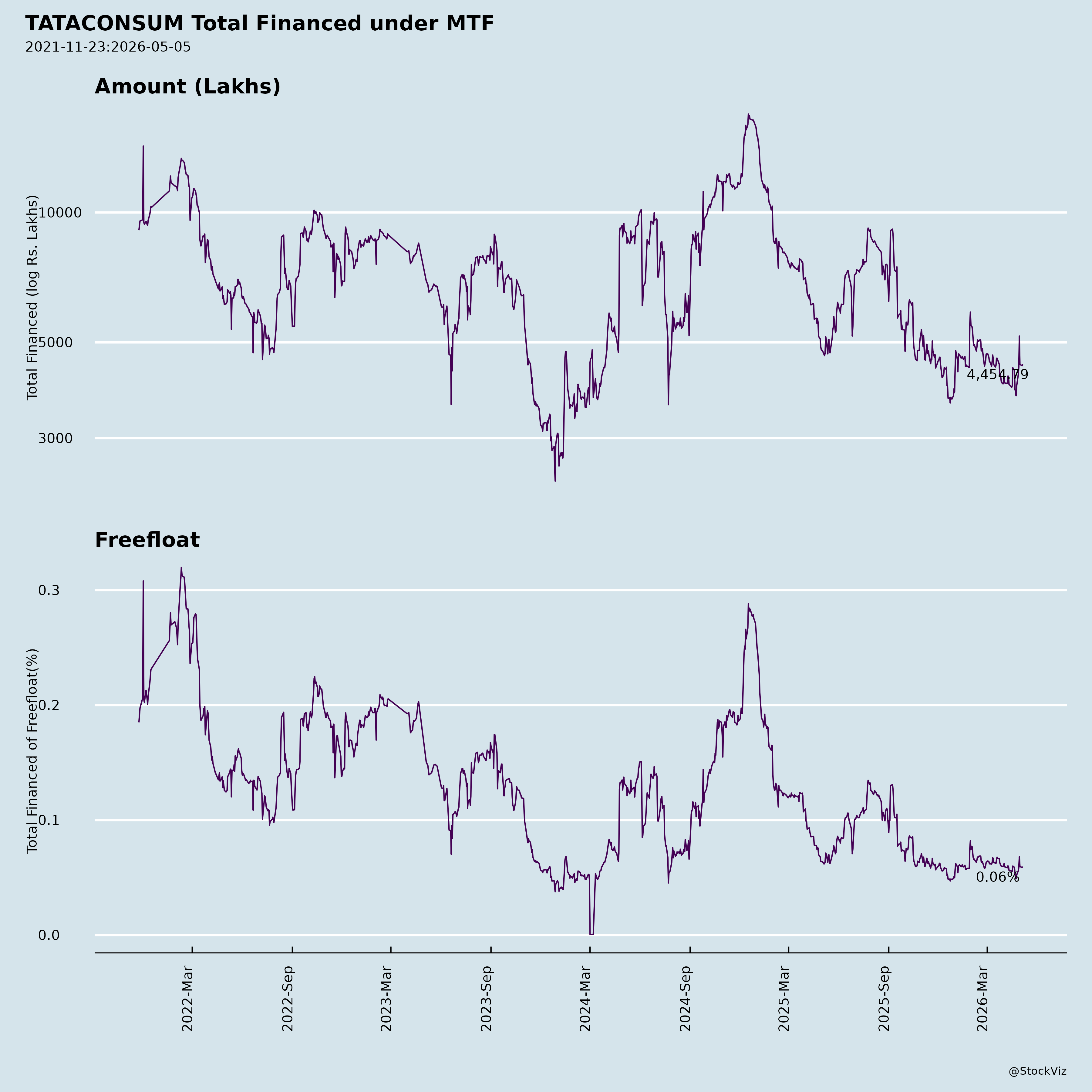
Margined
AI Summary
asof: 2025-12-08
Based on the provided financial, governance, and operational documents for Tata Consumer Products Limited (TCPL) — including unaudited standalone and consolidated financial results, auditor review reports, shareholder resolutions, and related disclosures up to September 30, 2025 — we can analyze the headwinds, tailwinds, growth prospects, and key risks for TATACONSUM (Scrip Code: 500800; TATACONSUM). This analysis will be grounded in recent performance, capital allocation trends, corporate actions, and strategic direction.
🔍 Company Overview
- Headquarters: Kolkata, India
- CIN: L15491WB1962PLC031425
- Sector: Consumer Goods – Branded Foods & Beverages (Tea, Coffee, Water, Snacks), Non-Branded Plantation & Extraction
- Subsidiaries/Associates Include: Tata Coffee, Organic India, Capital Foods Private Limited, Tata Starbucks, Teapigs, etc.
- Auditor: Deloitte Haskins & Sells LLP
📈 Fiscal Performance Snapshot (Quarter Ended September 30, 2025)
| Metric | Q2 FY26 (Sep ’25) | Q2 FY25 (Sep ’24) | YoY Growth |
|---|---|---|---|
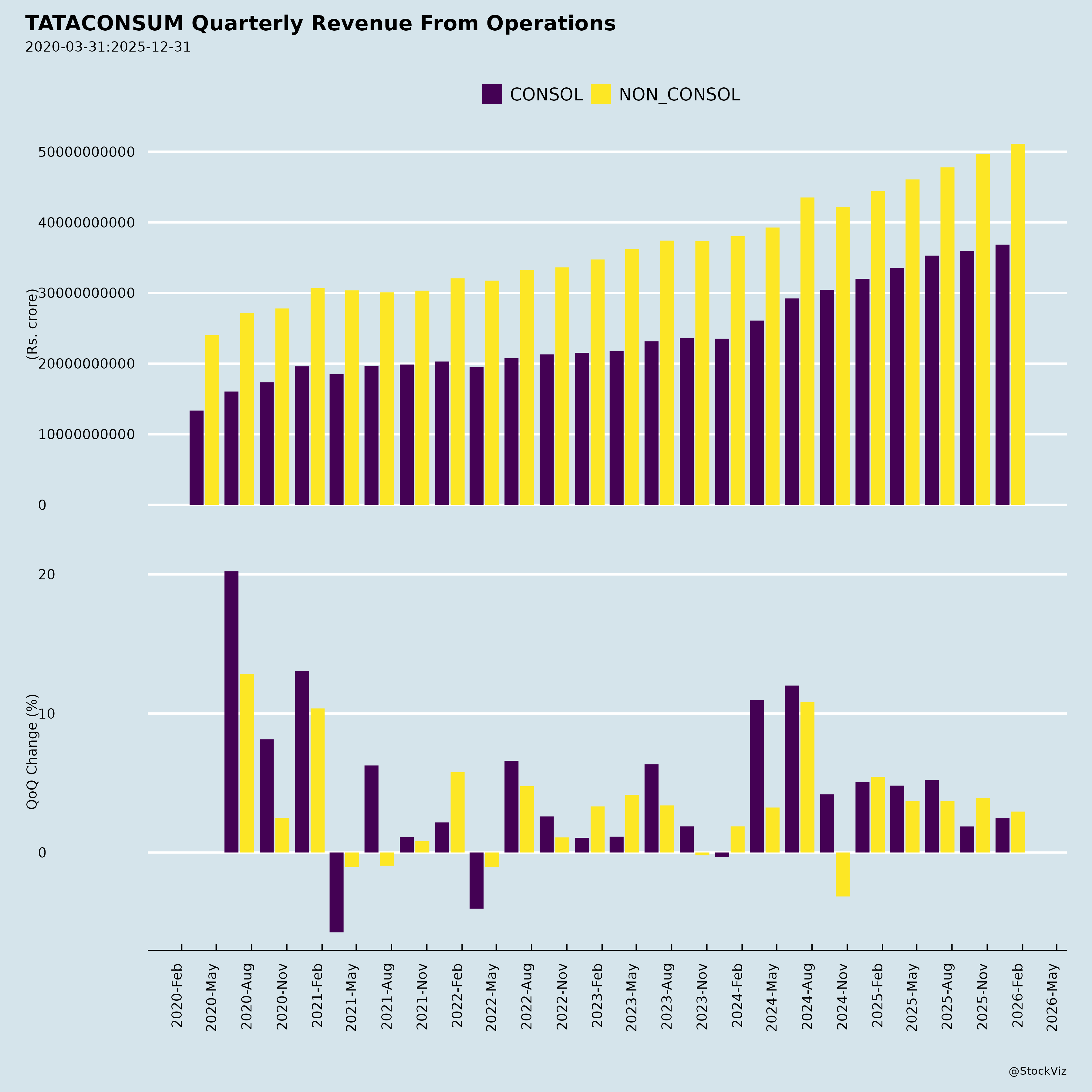
| Revenue from Operations (Consolidated) | ₹4,965.9 Cr | ₹4,214.45 Cr | +18% |
| Net Profit (Group Consolidated) | ₹406.81 Cr | ₹367.21 Cr | +11% |
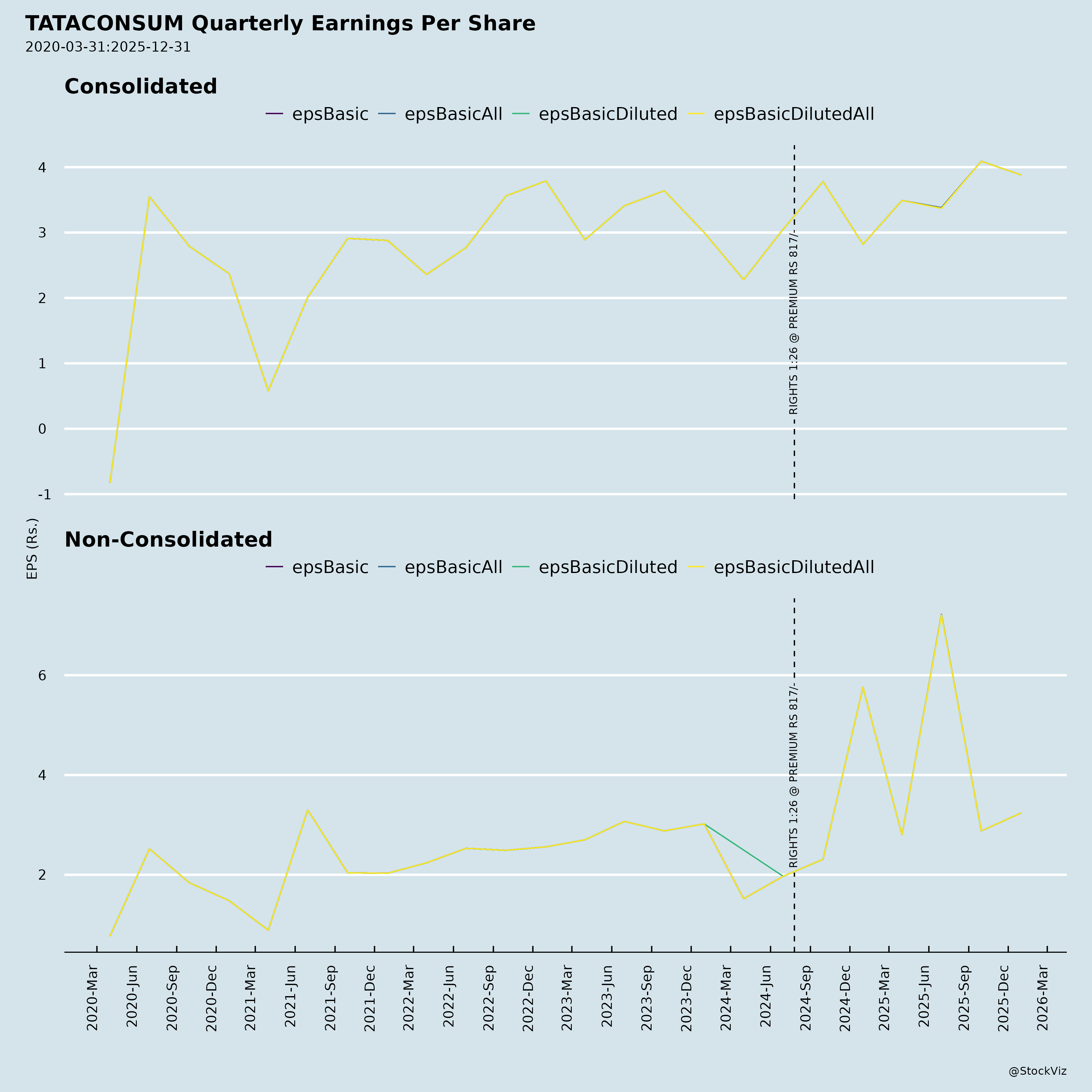
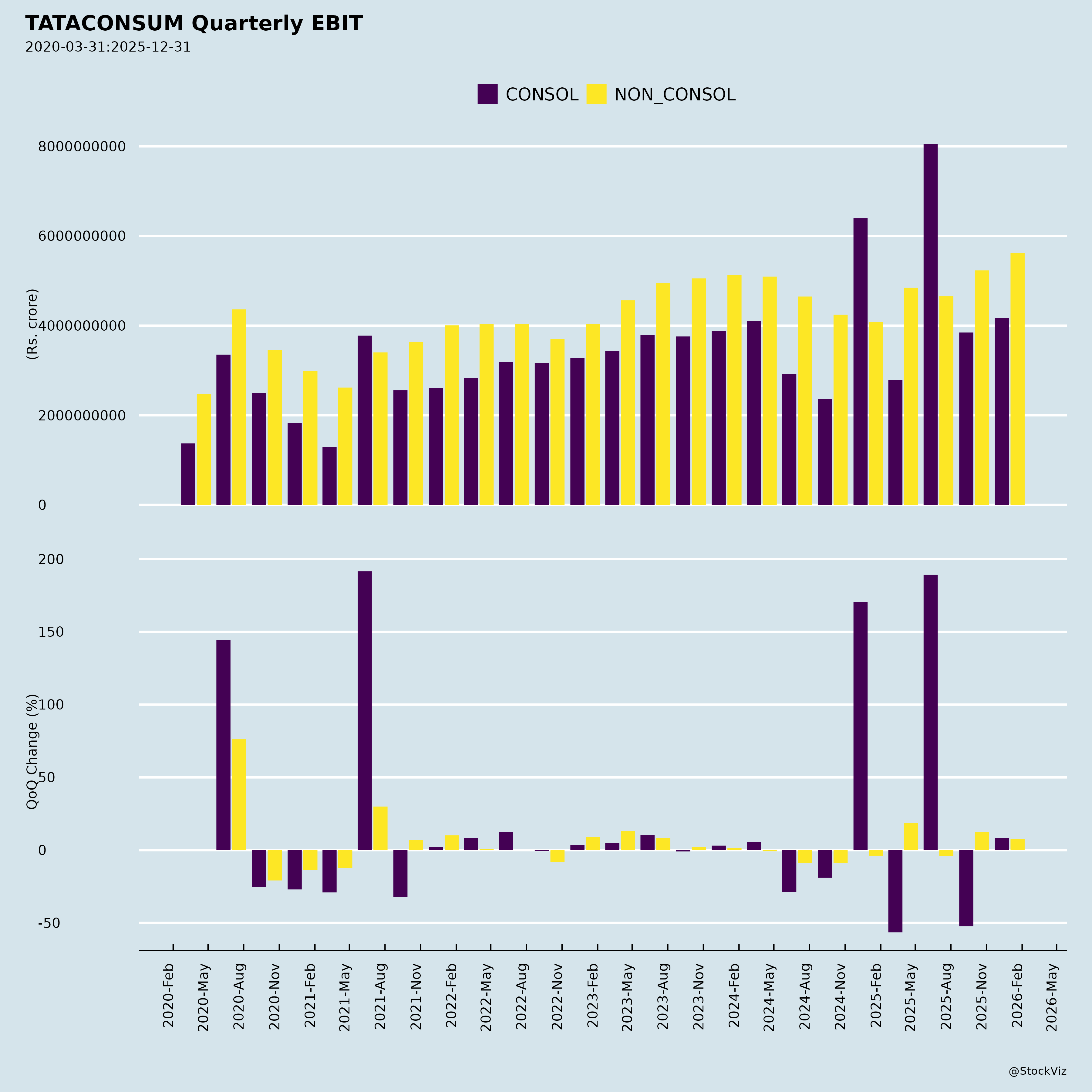
| EBIT (Profit before Exceptional Items & Tax) | ₹523.28 Cr | ₹424.24 Cr | +23% |
| Operating Margin (Consolidated) | 10.51% (vs 11.39% YoY) | — | Slight decline but stable core performance |
| Net Profit Margin (Consolidated) | 8.19% | 8.71% | Slight dip |
| Cash Flow from Operations (H1 FY26) | ₹203.41 Cr | ₹295.03 Cr | Down due to working capital adjustments |
📌 Note: Profit growth occurred despite adverse movements in commodity pricing and higher brand investments.
✅ TAILWINDS
1. Strong Revenue Growth Across Segments
- 18% overall revenue growth YoY (16% in constant currency).
- Driven by:
- +18% growth in India Branded Business
- +10% in International Branded Business
- +26% in Non-Branded Business (plantation/extraction)
- Demonstrates successful dual strategy: strengthening legacy brands and expanding agri-commodity base.
2. Improving Branded Business Operating Performance
- Branded margins improved due to tapering tea cost inflation in India.
- Despite inflationary pressure on coffee input costs internationally, operating leverage is being restored.
- Focus on value enhancement over volume suggests improved mix and pricing power.
3. Healthy Debt Metrics and Low Leverage
- Debt-Equity Ratio (Consolidated): 0.12x, well below sector average (~0.5–0.8x).
- Interest Service Coverage Ratio: 22.3x — very strong ability to service debt.
- Low net borrowings, ample liquidity: cash cushion allows flexibility for M&A or dividends.
4. Robust Free Cash Flow Generation
- Despite lower operating cash flow in H1, still positive FCF.
- Capex disciplined at ₹210 Cr (H1), primarily in PPE and development assets.
- Strong dividend policy continued, with ₹820 Cr dividend paid in H1.
5. Strategic Investments in High-Growth Subsidiaries
- Capital Foods (owner of Ching’s Secret & Smith & Jones) now a subsidiary.
- Approval of RMRs (Related Party Transactions) up to ₹1,650 Cr indicates deep integration plans.
- This unlocks cross-selling, shared distribution, and synergies in snacks/noodles space.
6. Strong Brand Positioning
- Portfolio includes iconic brands:
- Tetley (global presence)
- Tata Tea, Tata Coffee
- Organic India
- Teapigs (UK premium tea)
- Leadership in organic and wellness category gives first-mover advantages in evolving consumption patterns.
⚠️ HEADWINDS
1. Input Cost Volatility
- Coffee input costs remain elevated, especially in international markets.
- Though tea inflation is moderating in India, potential for rural wage pressures, weather risks (monsoon, frost), and global freight cost swings continue to be concerns.
2. Commodities-Driven Earnings Volatility
- Non-Branded Business margins impacted by reversal of prior-year fair value gains.
- Agri-commodity prices are inherently cyclical — profit volatility expected in this vertical.
3. Increasing Capex and Investment in Branding
- Higher marketing and branding investments temporarily compressed net margins (EBIT margin: ~10.5% vs 11.4% YoY).
- Returns may take time, especially in International markets where penetration is still growing.
4. Deterioration in Working Capital
- Trade payables down sharply (₹623 Cr outflow in H1), while receivables and inventory built up.
- Indicates extended payment terms to suppliers may have tightened, possibly due to negotiation power shifts post-pandemic.
- Could pressure near-term cash flows.
5. Foreign Exchange Exposure
- Significant international operations: revenue translation exposes earnings to INR volatility.
- Exchange gains/losses on translation were material in other comprehensive income (OCI), though not in P&L.
📈 GROWTH PROSPECTS
1. Integration with Capital Foods – Game-Changing Opportunity
- Capital Foods has seen explosive growth in instant noodles, sauces, and ethnic mixes (e.g., Ching’s).
- Potential for synergy via:
- Distribution cross-leveraging (rural/urban expansion)
- Export platform utilization
- R&D and sourcing aggregation
- TCPL can become a full-spectrum FMCG player beyond beverages.
3. Plantation Modernization and Non-Branded Scale
- Non-Branded business growth (26%) signals effective vertical integration.
- Extraction and commodity sales now contribute more reliably to earnings.
- Future carbon credit monetization at estates possible.
4. International Expansion Beyond Tea
- Building presence in US, Canada, UK, Australia, Africa.
- Organic India USA, Tata Coffee Vietnam, and Star Alliance (Tata Starbucks) provide scalable platforms.
- Beverage expansion (especially RTD coffee/tea) offers long-term growth.
5. Dividend Stability Attracts Long-Term Investors
- Shareholders rewarded despite strategic investments.
- Payout ratios remain sustainable (~70–80%) given net margins and solid equity base.
- Dividend yield ~1.0–1.2% historically — attractive in stable consumer space.
🔒 KEY RISKS
1. Regulatory & Compliance Risk
- High volume of related-party transactions (e.g., with Capital Foods) requires transparency and arm’s length compliance.
- Scrutiny from SEBI, MCA, and institutional investors on MRPTs (Material Related Party Transactions) is expected.
2. Dependency on Commodity Cycles
- While branded business diversifies risk, ~12% of revenue from Non-Branded (plantation) remains subject to monsoon, disease, global prices.
- Negative EBIT impact if prices correct downward in tea/coffee markets.
3. Execution Risk in Integration
- Integrating large subsidiaries (e.g., Capital Foods) involves cultural, systemic, and brand alignment risks.
- Poor integration could lead to dilution of ROI, write-downs.
4. Foreign Operation Volatility
- India contributes ~64% of consolidated segment revenue; balance from internationally volatile markets.
- Geopolitical risks (Africa, Middle East), currency swings, and trade regulations could hurt margins.
5. Competition in Branded Space
- Intense competition from:
- HUL (Bru, Red Label)
- ITC (Sunfeast, Aashirvaad Noodles via recent snack push)
- Nestle India (Maggie, Nescafé)
- Patanjali & emerging D2C players
- Pricing power challenge in mass-market segments.
📊 Key Ratios & Financial Health (Consolidated)
| Ratio | Sep 2025 | Mar 2025 | Trend |
|---|---|---|---|
| Current Ratio | 1.54 | 1.54 | Stable |
| Quick Ratio (approximate) | ~1.1 | ~1.2 | Slight dip (inventory buildup) |
| Net Debt to Equity | ~0.12 | ~0.11 | Low leverage |
| ROE (approx., trailing) | ~12.8% (based on Q2 run rate) | 12.87% FY25 audited | Maintained |
| Inventory Turnover (annualized) | 5.44x | 5.53x | Normalizing, not alarming |
| Debtors Turnover | 19.18x | 19.95x | Slight delay in collections |
💡 Note: TCPL maintains high-quality balance sheet — suitable for further inorganic growth.
🎯 Strategic Takeaways
| Aspect | Verdict |
|---|---|
| Business Resilience | ✅ Strong |
| Growth Momentum | ✅ Positive |
| Free Cash Flow | ⚠️ Stable but under pressure |
| Valuation Headroom | ✅ High |
| Governance | ✅ Robust |
| Investor Returns | ✅ Attractive |
🏁 Conclusion: Investment Summary for TATACONSUM
| Category | Assessment |
|---|---|
| Outlook | Positive – structural growth story with brand-led recovery and agri-commodity play |
| Key Bull Case | Successful integration of Capital Foods can transform TCPL into a multi-category FMCG leader, driving long-term EPS re-rating |
| Valuation Cue | Currently trading at ~35–40x P/E — premium justified if growth sustains above 15% |
| Recommendation | Hold / Accumulate on Dips – strong for long-term investors seeking inflation-resistant, dividend-paying consumer stock |
| Risk Profile | Moderate – low financial risk, but operational leverage to commodity prices and integration execution |
✅ TCPL is transitioning from a “tea company” to a “total consumer products company”.
This shift, supported by strong governance, balance sheet strength, and strategic clarity, makes it a compelling growth play in the Indian consumer sector.
Final Note: Monitor next quarter’s Capital Foods integration updates, RPT utilization, and working capital trends — these will be key indicators of strategic momentum.
Copyright © 2023 SAS Data Analytics Pvt. Ltd. All rights reserved.