SHRIRAMFIN
Equity Metrics
September 24, 2026
Shriram Finance Limited
Non Banking Financial Company (NBFC)
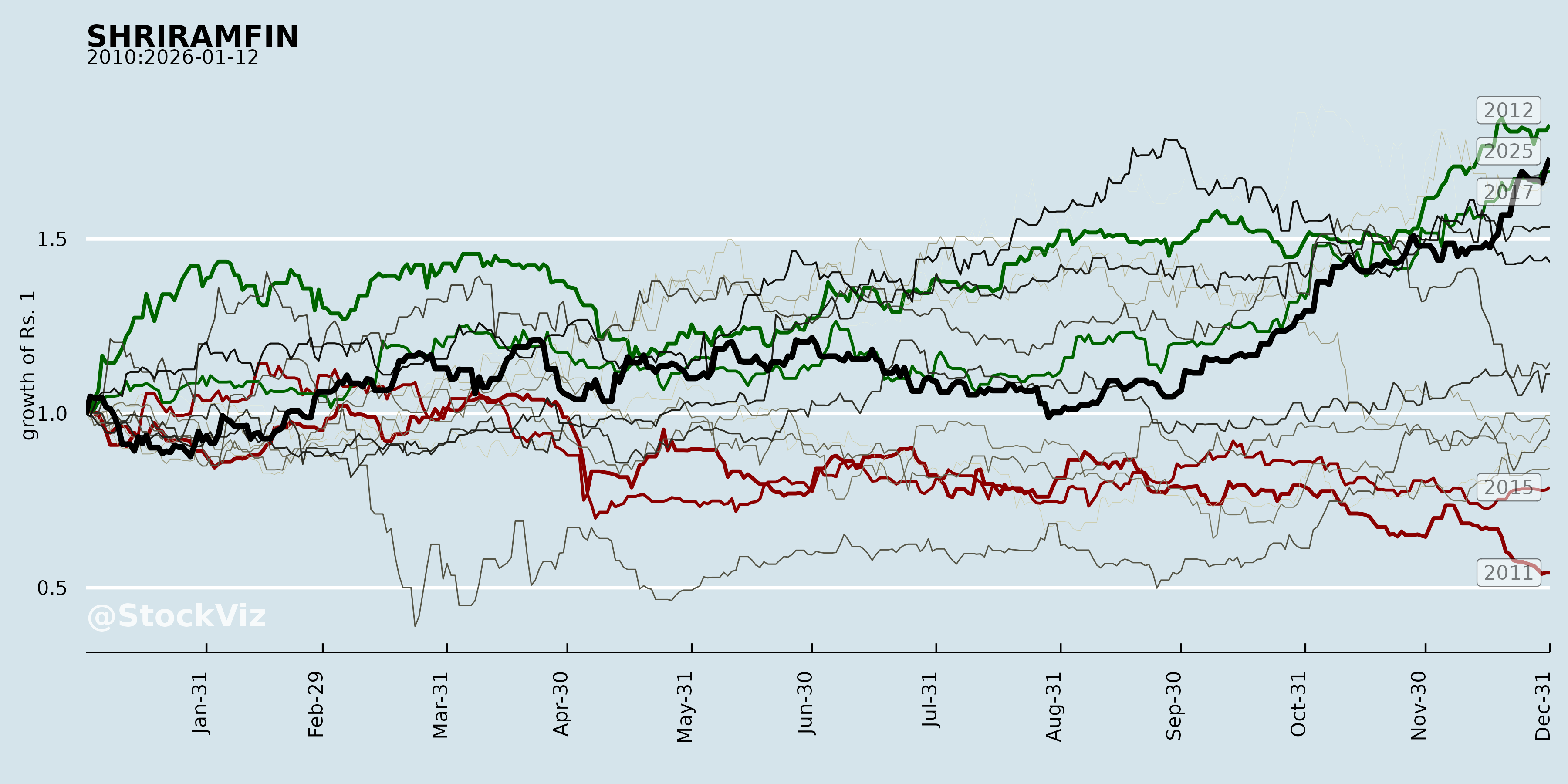
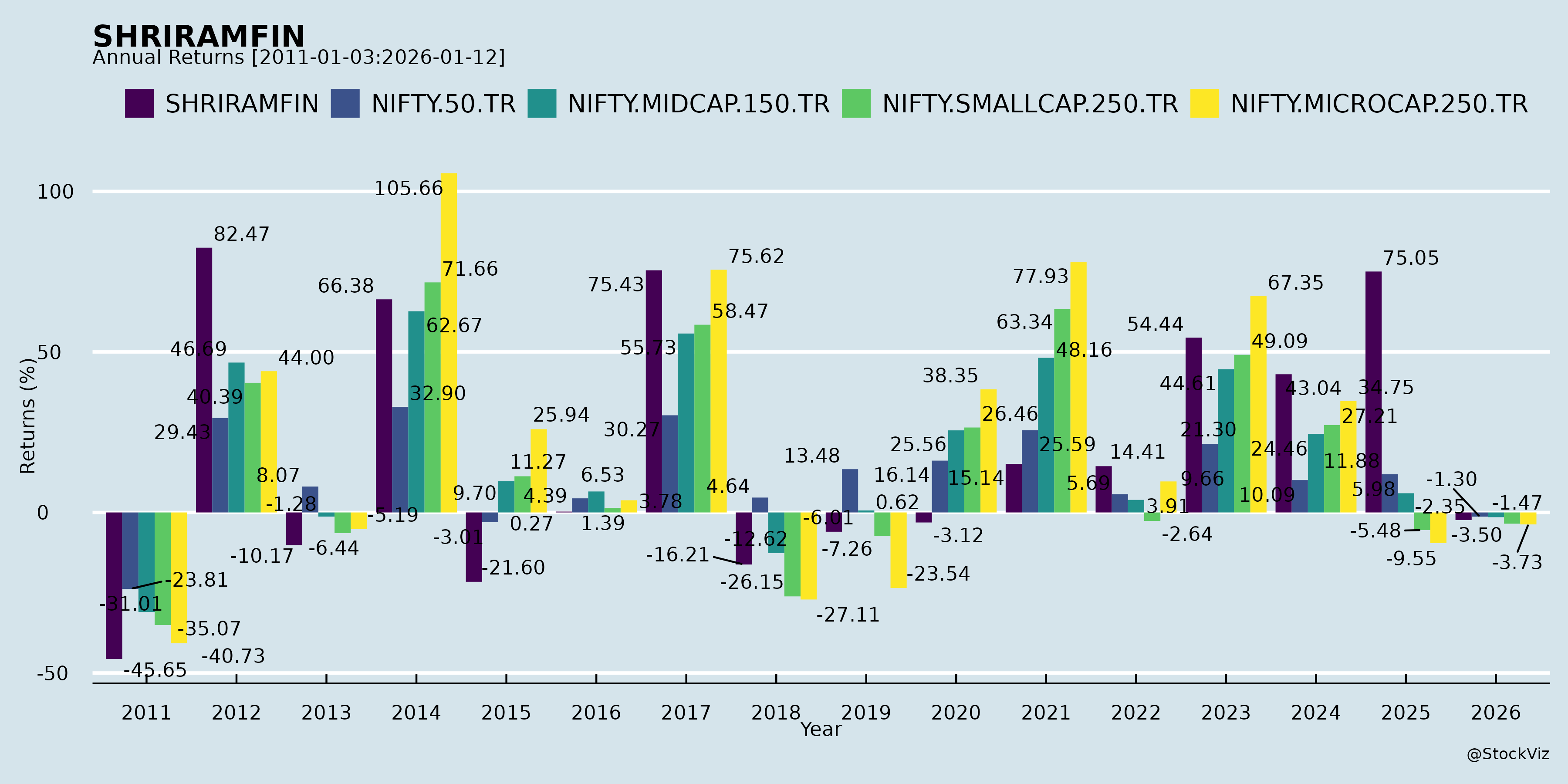
Annual Returns
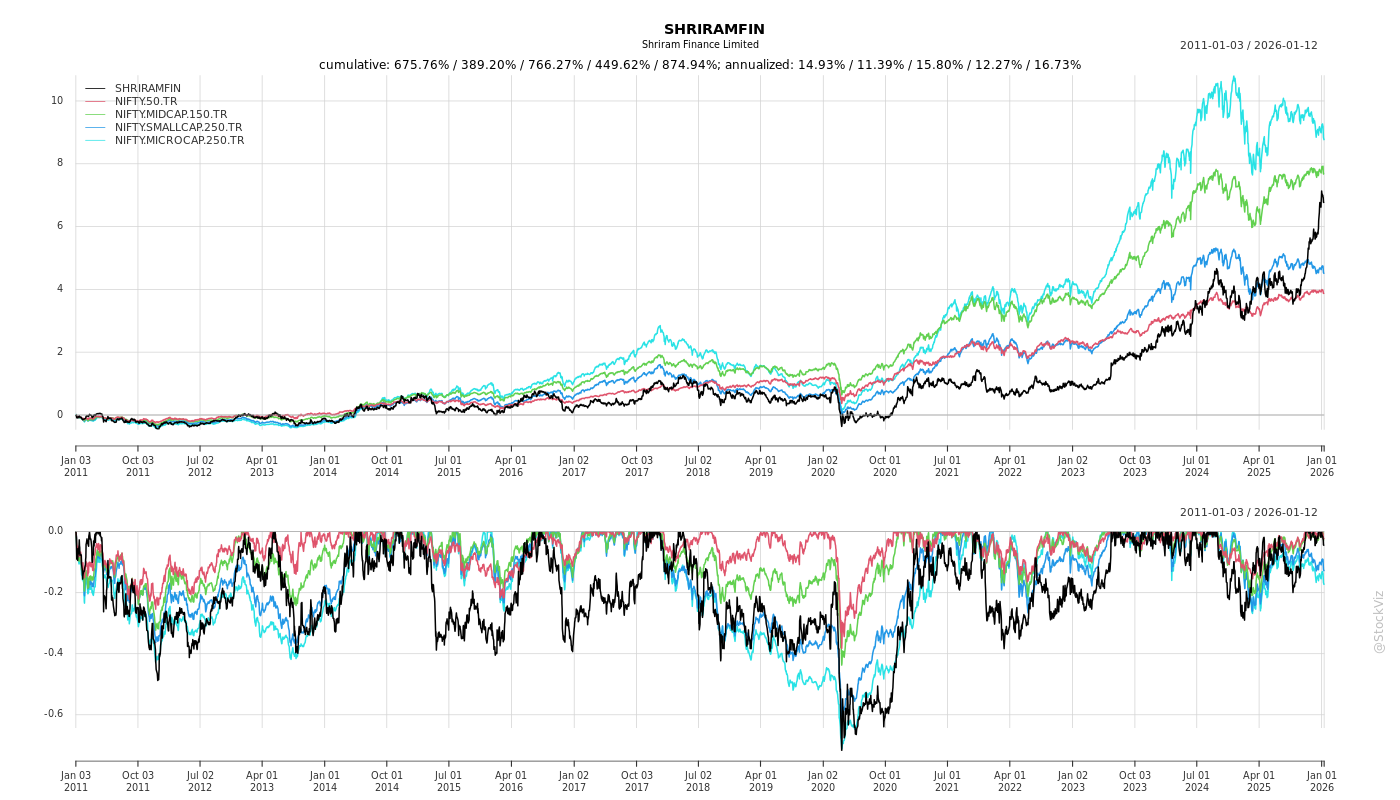
Cumulative Returns and Drawdowns
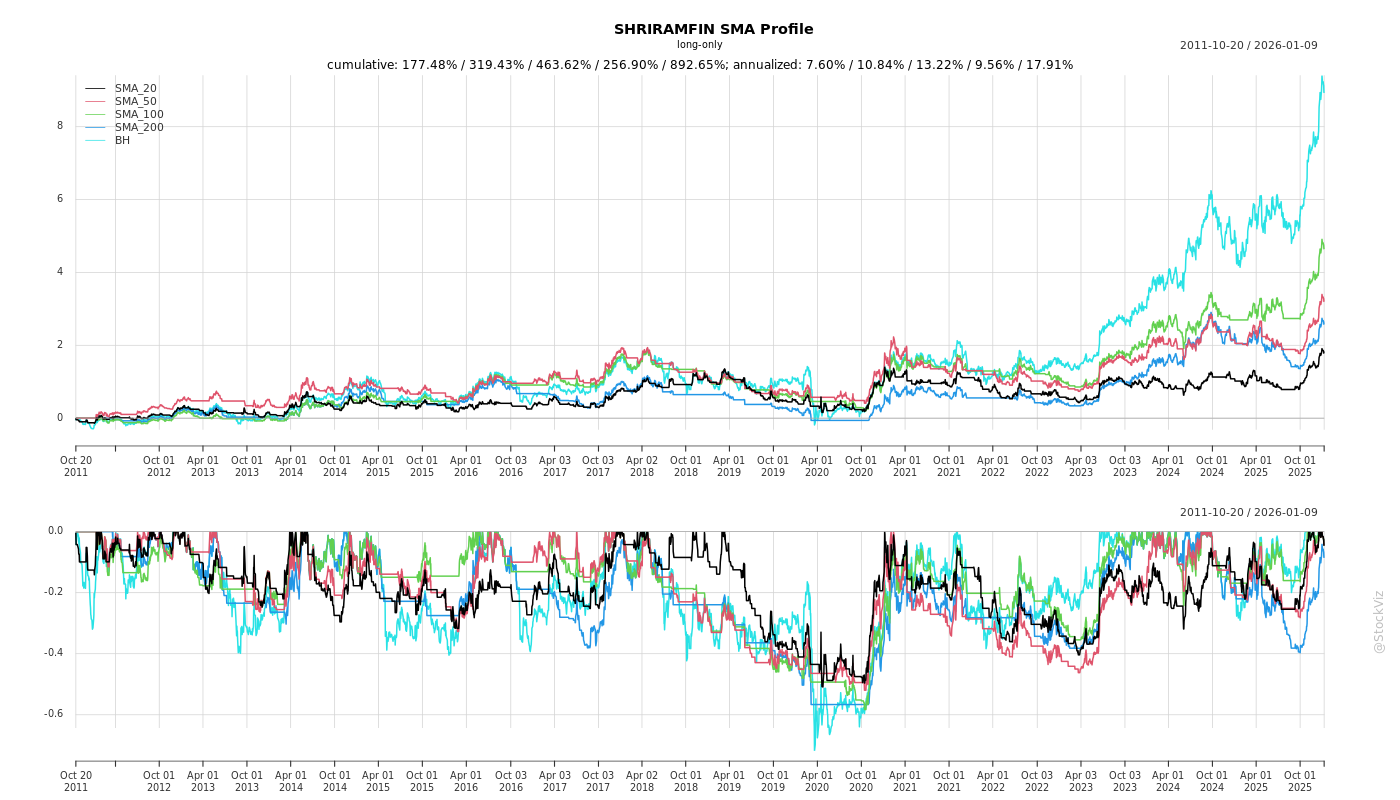
Fundamentals
Ownership
Margined
AI Summary
asof: 2026-09-14
Shriram Finance: ESG Rating, Q1 FY2026 Results and Capital Actions
Headwinds and Challenges
Environmental gaps flagged by the ESG rater. NSE Sustainability’s FY2026 report (dated August 10, 2026) notes that the company’s Scope 3 carbon footprint is higher than standard practices, its reliance on renewable energy is minimal, and waste recycling and recovery fall short when compared with peers. These are the principal environmental weaknesses behind an Environment pillar score of 65.
Social pressures. The report flags higher-than-average turnover among permanent employees (up 1% year on year) and customer complaint frequency above benchmarks (up 39% year on year). Employee grievances, while described as lower in number than peers, rose 60% year on year.
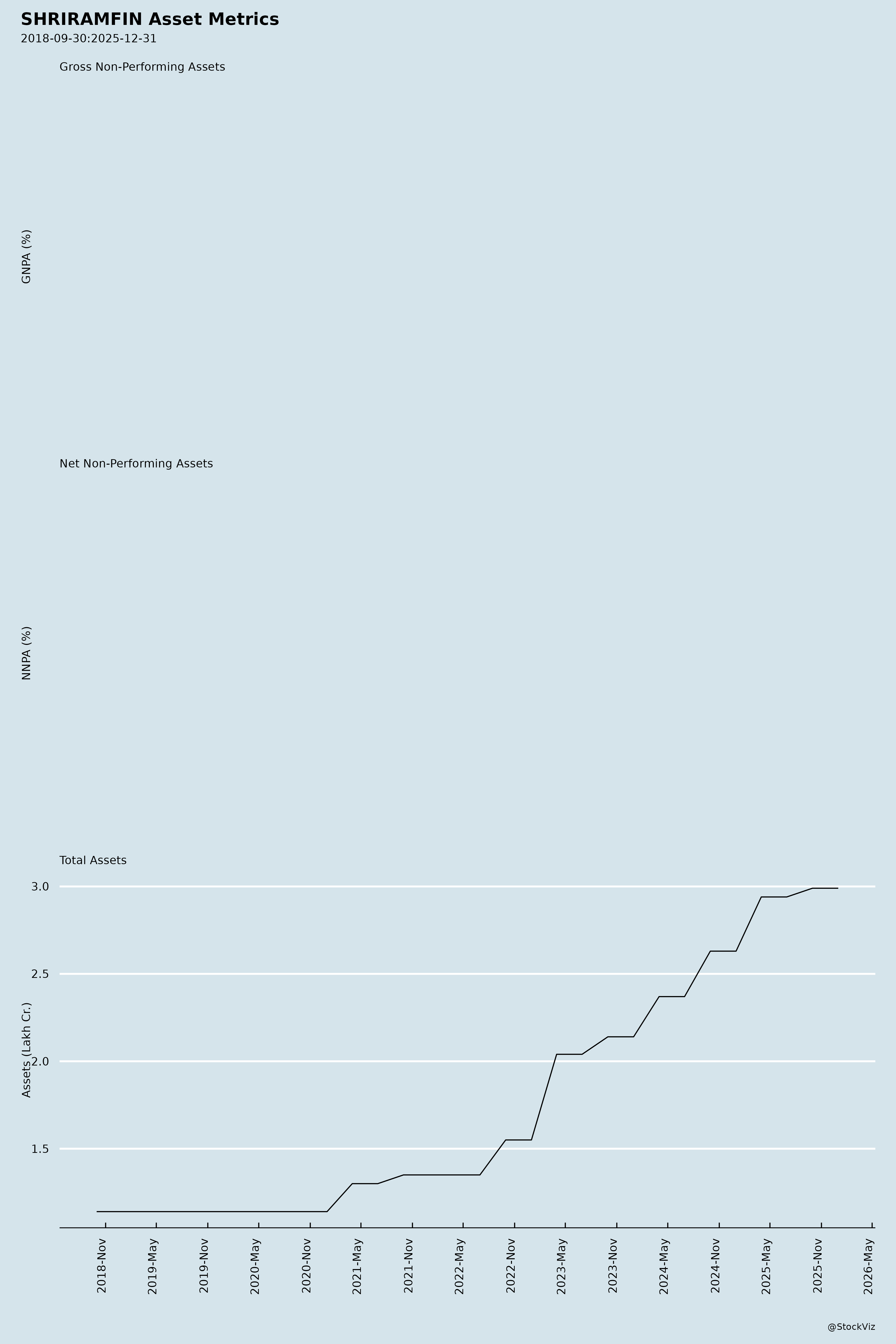
Asset quality drift. On a standalone basis, the Gross NPA ratio moved to 4.64% at June 30, 2026 from 4.58% at March 31, 2026 and 4.53% at June 30, 2025. The Net NPA ratio was 2.33%, unchanged from March 2026 but improved from 2.57% a year earlier. Impairment on financial instruments rose to Rs. 1,463.26 crores in Q1 FY2026 from Rs. 1,285.69 crores in Q1 FY2025.
Cost and margin dynamics. Finance costs of Rs. 5,204.28 crores were lower than both the prior quarter and the prior-year quarter, but employee benefits expenses rose to Rs. 1,142.26 crores from Rs. 976.47 crores a year earlier. The company also notes the operational burden of transitioning to the New Labour Codes, effective November 21, 2025, with rules notified May 8, 2026; the prior year included incremental gratuity and compensated absence impacts of Rs. 131.71 crores and Rs. 65.24 crores respectively.
Governance observation. Executive remuneration is not linked to ESG performance parameters, per the rating report.
Tailwinds and Growth Prospects
ESG standing. Shriram Finance received an ESG rating of 74 (Leader category) for FY2026 from NSE Sustainability, with pillar scores of 65 (Environment), 77 (Social) and 77 (Governance). The Core ESG Rating, derived from BRSR Core disclosures, was also 74, comprising Environment 66, Social 79 and Governance 73. The company clarified it did not engage NSE Sustainability; the rating was prepared independently from public disclosures, and the company sought clarifications on August 12, 2026, receiving a response on August 14, 2026.
Environmental efficiency gains. The report records year-on-year improvements: direct-operations and energy-consumption emissions down 13%, Scope 3 emissions down 3%, energy intensity down 10% (described as significantly lower than peers), and waste intensity down 60%. Energy intensity and waste intensity are both characterised as significantly better than peers.
Social strengths. Lost-time injury rate approaching zero, zero employee fatalities disclosed, 100% health insurance coverage for permanent employees, female employee percentage meeting industry standards (up 4% year on year), CSR spending significantly exceeding obligations, a documented CSR policy, and domestic procurement above industry standards.
Governance strengths. Independent director presence above regulatory minimums, sufficient women on the board, an Independent Director as Chairperson, separation of Chairman and CEO roles, independent director representation in the Nomination and Remuneration, Audit, Risk Management and CSR Committees at or above requirements, a CEO-to-median-employee pay ratio aligned with peers and verified by the nomination committee, a comprehensive Anti-Corruption and Anti-Bribery policy, and an ESG/Sustainability/BRSR policy.
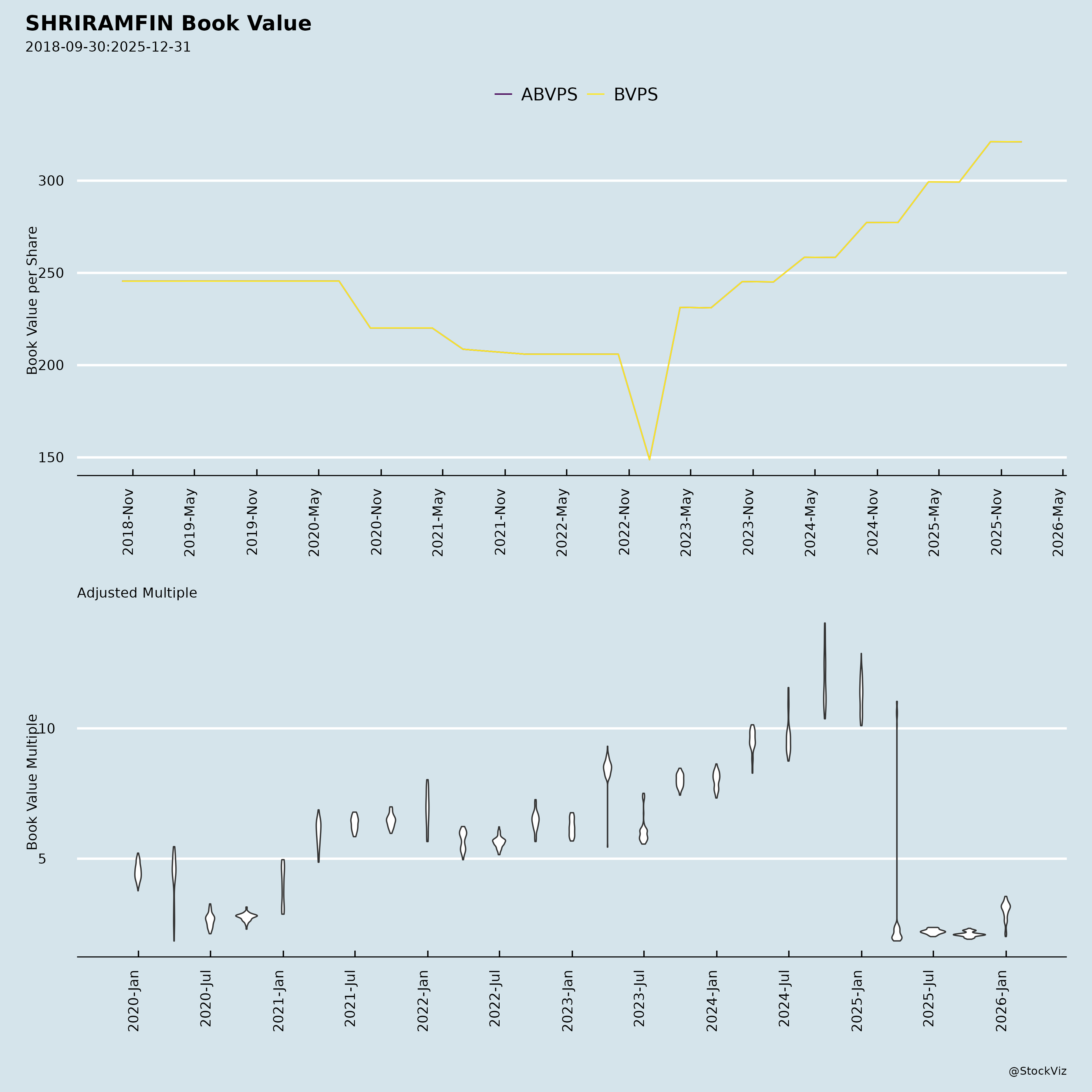
Profitability and capital strength. Q1 FY2026 standalone profit after tax was Rs. 3,444.56 crores, up from Rs. 2,155.73 crores a year earlier and Rs. 3,013.57 crores in the prior quarter. Net profit margin improved to 25.68% from 18.68% a year earlier. The MUFG preferential issue of 471,121,055 equity shares at Rs. 840.93 per share raised Rs. 39,617.98 crores, allotted April 8, 2026, giving MUFG a 20% fully diluted stake. Net worth rose to Rs. 108,297.48 crores from Rs. 65,244.09 crores at March 2026, and the debt-equity ratio fell to 2.14 times from 3.82 times. Capital adequacy stood at 34.17% versus 20.79% a year earlier.
Funding and liquidity actions. The Board approved a resource mobilisation plan on July 24, 2026 for NCDs, subordinated debentures, bonds or notes via private placement and/or public issue from August 1, 2026 to October 31, 2026. A Rs. 100 crores NCD private placement was raised May 5, 2026 (ISIN INE721A07RY4), fully utilised with no deviation. Liquidity coverage ratio was 262.54%.
Dividends. A final dividend of Rs. 6 per share (300%) for FY2025-26 was approved at the 47th AGM on July 10, 2026, paid July 21, 2026, in addition to an interim dividend of Rs. 4.80 per share declared October 31, 2025, totalling Rs. 10.80 per share for the year.
Key Risks
- Asset quality: Gross NPA ratio edged up to 4.64% at June 30, 2026, with provisioning coverage at 50.99%.
- Co-lending exposure: Under co-lending as Partner RE, one arrangement covering business and personal loans showed total disbursement of Rs. 1,233.62 crores, outstanding of Rs. 16.83 crores, write-offs of Rs. 9.14 crores and net NPA of Rs. 1.23 crores. Under co-lending as Originating RE, two arrangements in commercial vehicle lending showed disbursement of Rs. 324.06 crores, outstanding of Rs. 177.04 crores, write-offs of Rs. 1.85 crores and net NPA of Rs. 11.67 crores.
- Security cover: Secured NCDs of Rs. 33,021.82 crores carried a security cover of 1.09 times as at June 30, 2026, with exclusive security cover ratio of 1.09.
- Regulatory transition: The New Labour Codes and various RBI directions (capital adequacy, asset-liability management, credit risk transfer, stressed assets, credit facilities) frame ongoing compliance obligations.
- ESG data limitations: The rating report states no independent verification of disclosed data was undertaken and that ratings may favour entities with more robust disclosure practices; ratings are also adjusted for controversy scores and deflated for systemic ESG change.
Management Guidance Versus Observed Performance
The company’s stated use of the MUFG preferential issue proceeds was: up to Rs. 20,000 crores for onward lending, up to Rs. 15,000 crores for retirement of borrowings including interest, and up to Rs. 4,617.98 crores for general corporate purposes. Against this, Rs. 17,833.24 crores was utilised for onward lending, Rs. 15,000.00 crores for debt retirement and Rs. 4,617.98 crores for general corporate purposes — Rs. 37,451.22 crores in total, with Rs. 2,166.76 crores unutilised and invested in liquid mutual funds. The Regulation 32 statement confirms no deviation or variation for the period April 8, 2026 to June 30, 2026, reviewed by the Audit Committee on July 23, 2026, with CRISIL Ratings as monitoring agency.
For the Rs. 100 crores NCD issue, the stated object of augmenting long-term resources was matched by full utilisation of Rs. 100 crores with no deviation.
On accounting estimates, the company changed its treatment of Direct Selling Agent commission for two-wheeler loans from January 1, 2026, moving from upfront expensing to amortisation at EIR over the loan tenure, citing the increased estimated two-wheeler portfolio; the impact was assessed as not material. The company also stated it continues to monitor minimum wage rates and other aspects of the New Labour Codes and would provide appropriate accounting effects as developments require.
Broker Narrative
The broker narrative evolved from sweeping structural optimism about India’s auto sector (low vehicle penetration, demographics, strong disbursement momentum, and NBFC balance sheet strength) in 2023 toward more specific, company-level arguments by 2026 (MUFG capital infusion, lower funding costs, gold loan scaling, and 18% AUM growth guidance). Persistent themes include the branch network and distribution moat, while macro tailwinds like demographics faded from prominence as headwinds shifted to operational concerns — adverse monsoon, margin normalization, and segmental AUM contraction — with the stock collapsing from triple-digit returns to near-flat performance.
Fears that came true
- The DFC-driven rapid shift in private freight load away from road transport materialized, as evidenced by Construction Equipment AUM contracting 25.2% YoY in the last report.
- Adverse monsoon impacts flagged as a risk materialized, with seasonal rainfall running 24% below normal threatening rural income and triggering higher stress accretion concerns.
- Margin normalization concerns materialized as NIM is expected to glide down from an elevated 9.04% to approximately 8.5% over the medium term due to lower-yielding new vehicle mix rising.
Optimism that failed
- Robust commercial vehicle demand momentum flagged in the first report failed to sustain, as the last report warns of potential demand moderation in CV financing that could slow overall AUM growth despite reiterated 18% guidance.
- The structural growth thesis (very low vehicle penetration, favorable demographics, rising per capita GDP) did not translate into sustained stock outperformance, with returns collapsing to near-zero (+0.4% to +11.4%) across 2026 reports despite reiterated growth targets.
- Gold loan scaling and MSME expansion beyond South India, heralded as key growth levers, remain unproven as the stock’s actual returns stagnated despite management targeting gold loans at ~5% of AUM within three years.
Broker Timeline
65 broker calls · 2023-06-21 to 2026-07-27
Copyright © 2023 SAS Data Analytics Pvt. Ltd. All rights reserved.