CAPTRUST
Equity Metrics
November 18, 2026
Capital Trust Limited
Non Banking Financial Company (NBFC)
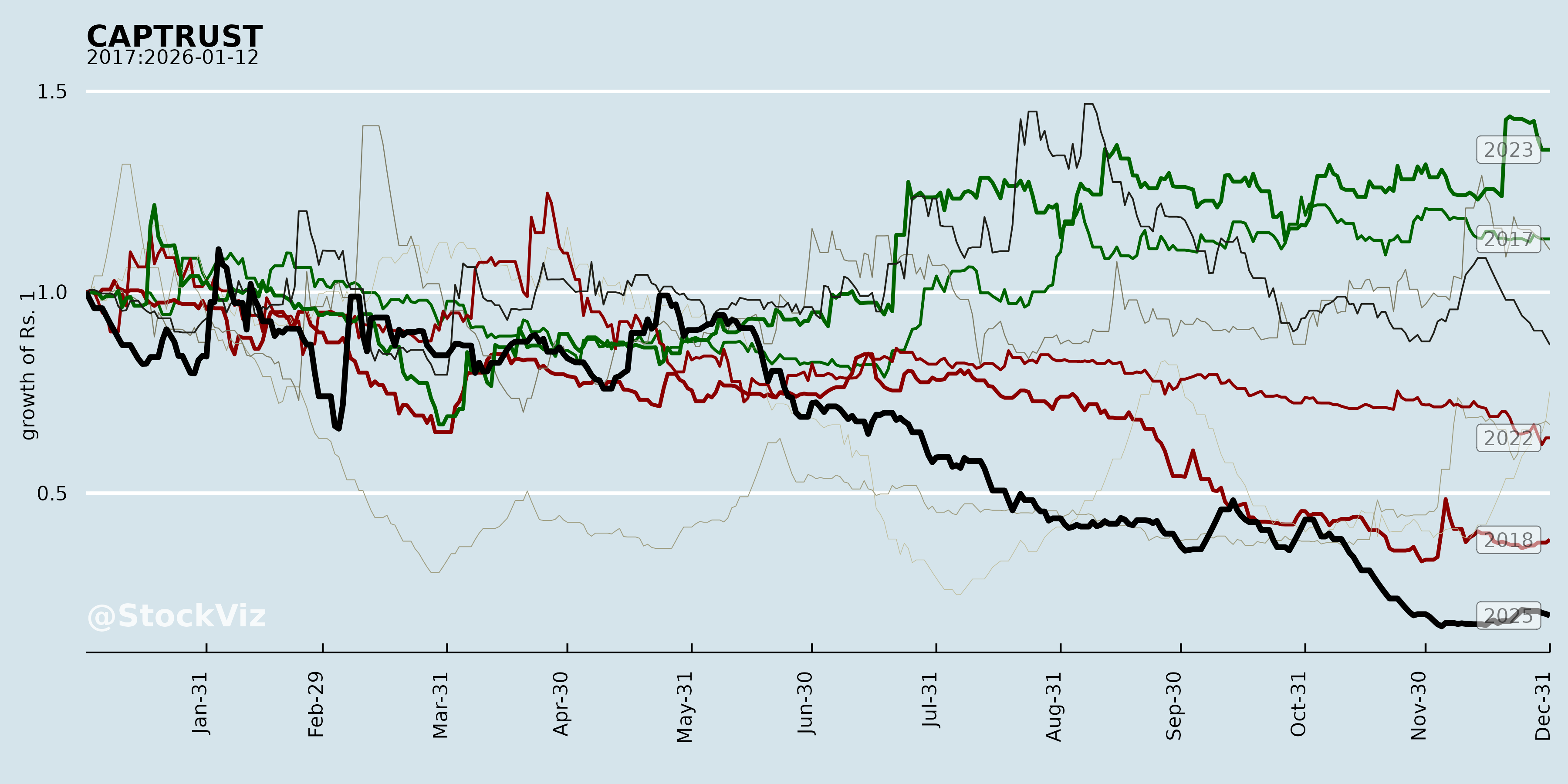
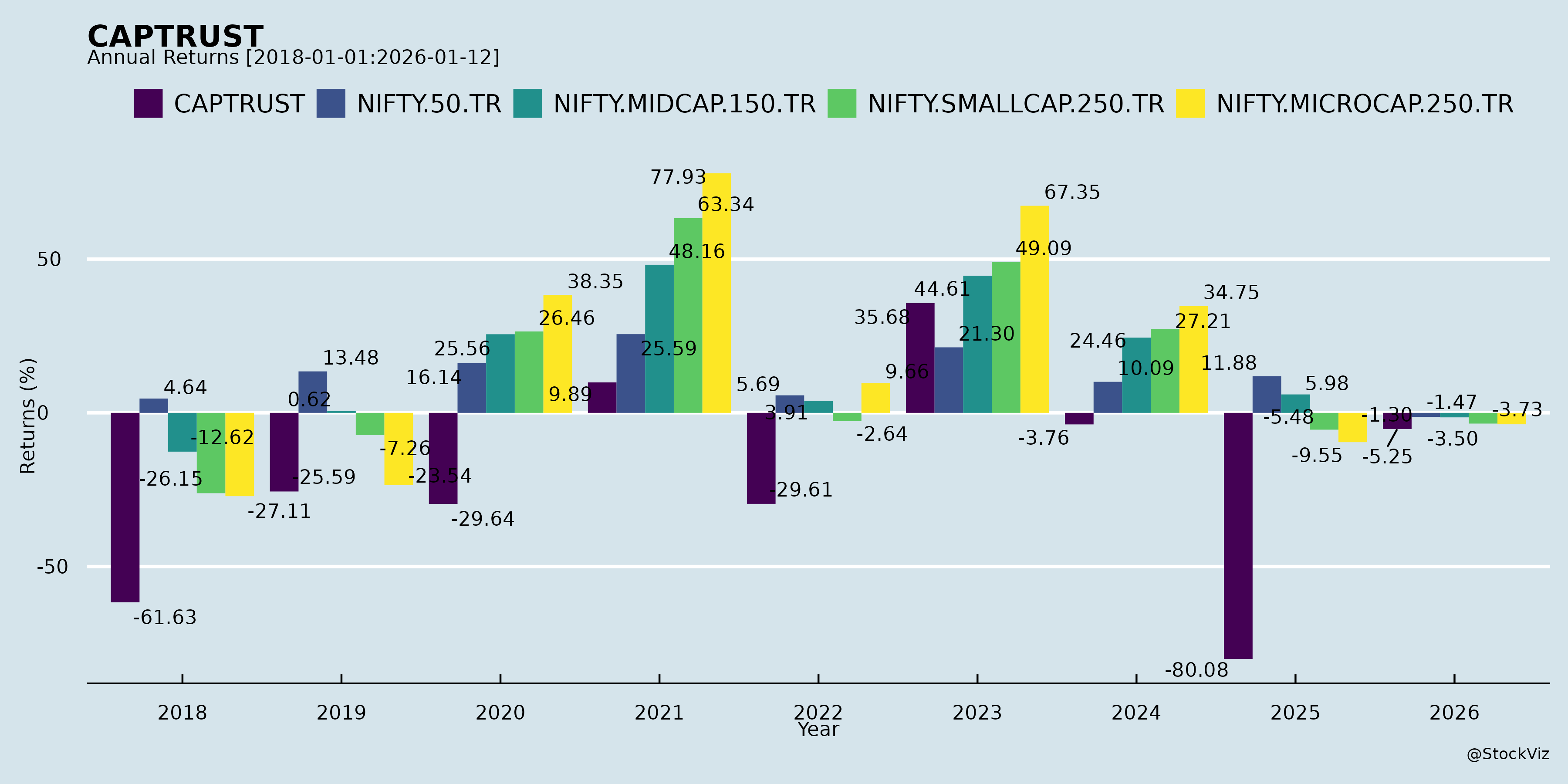
Annual Returns
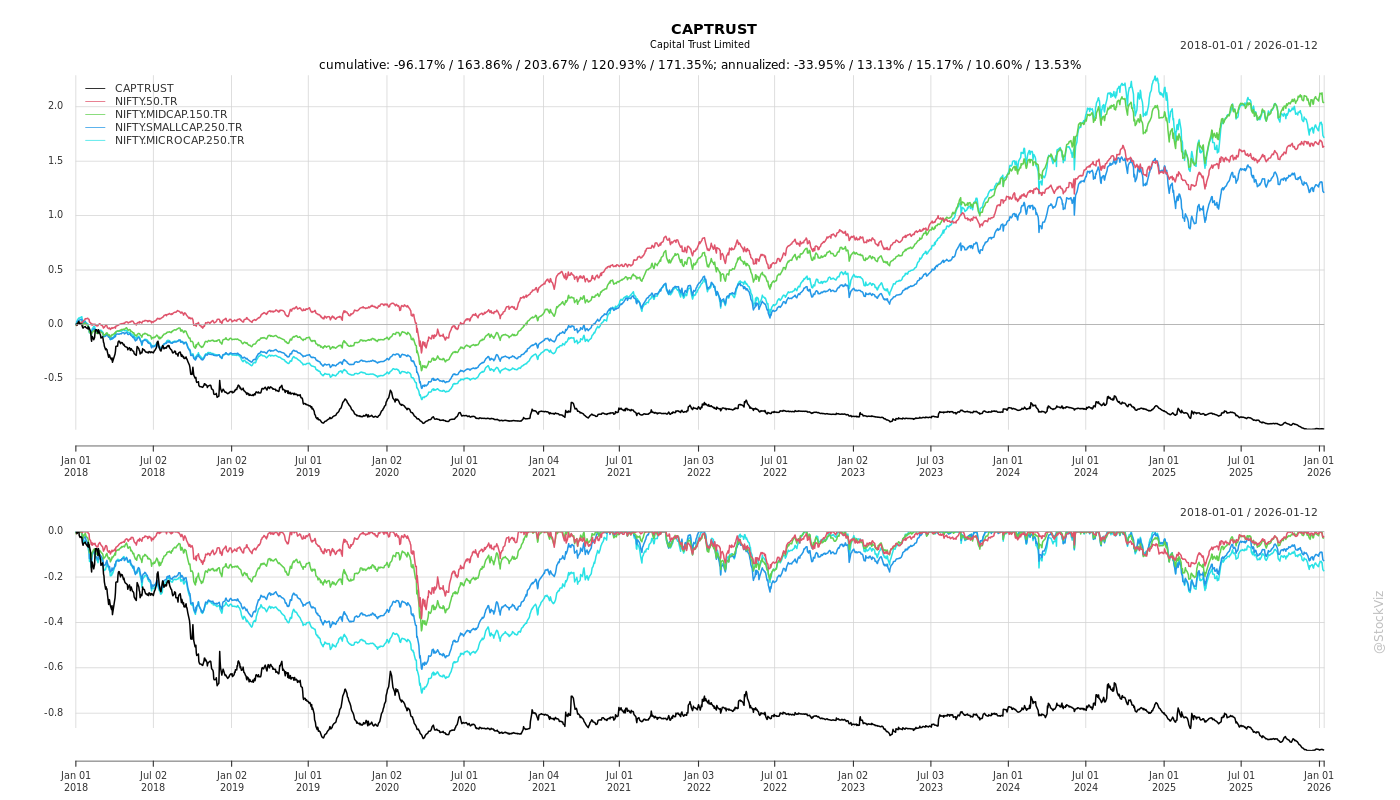
Cumulative Returns and Drawdowns
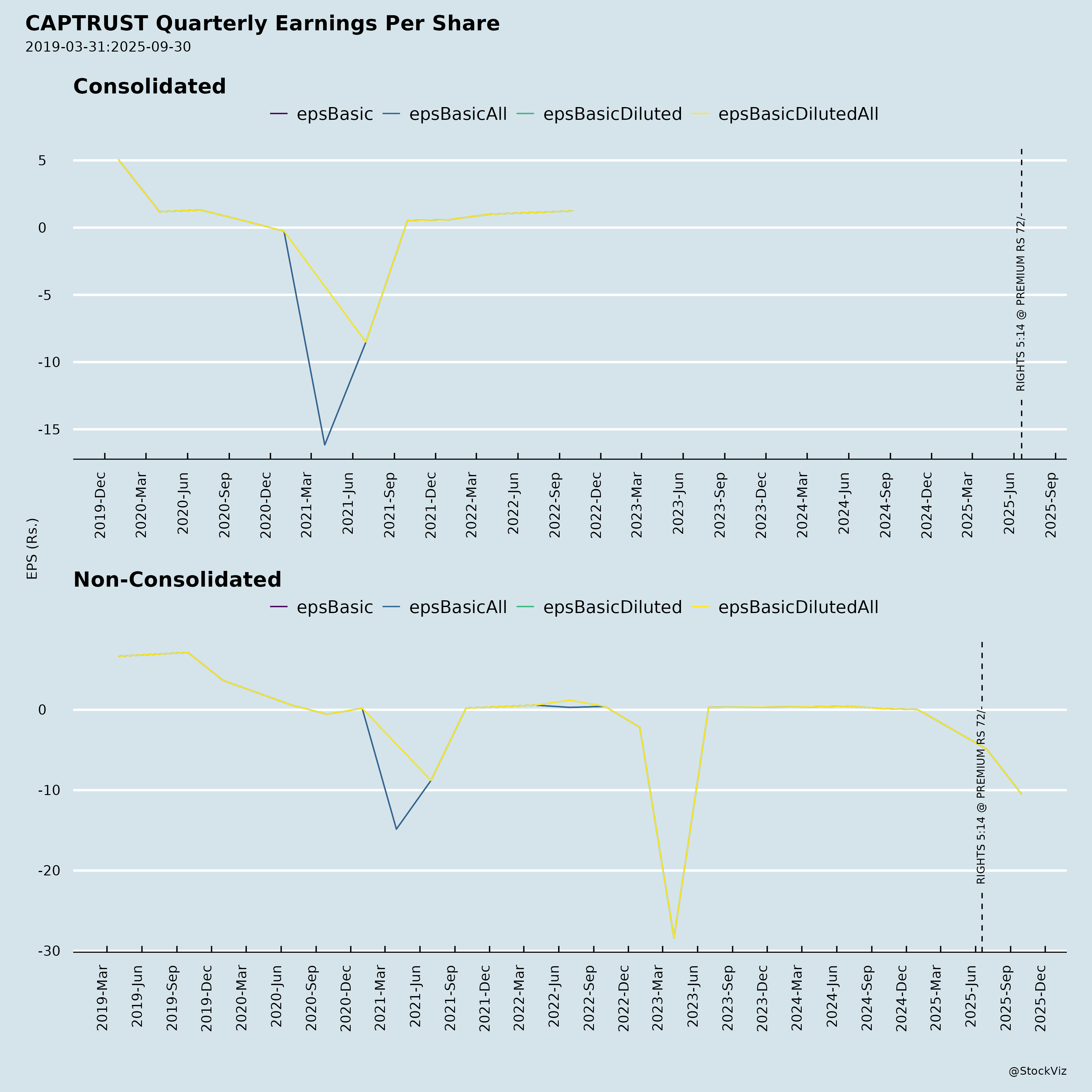
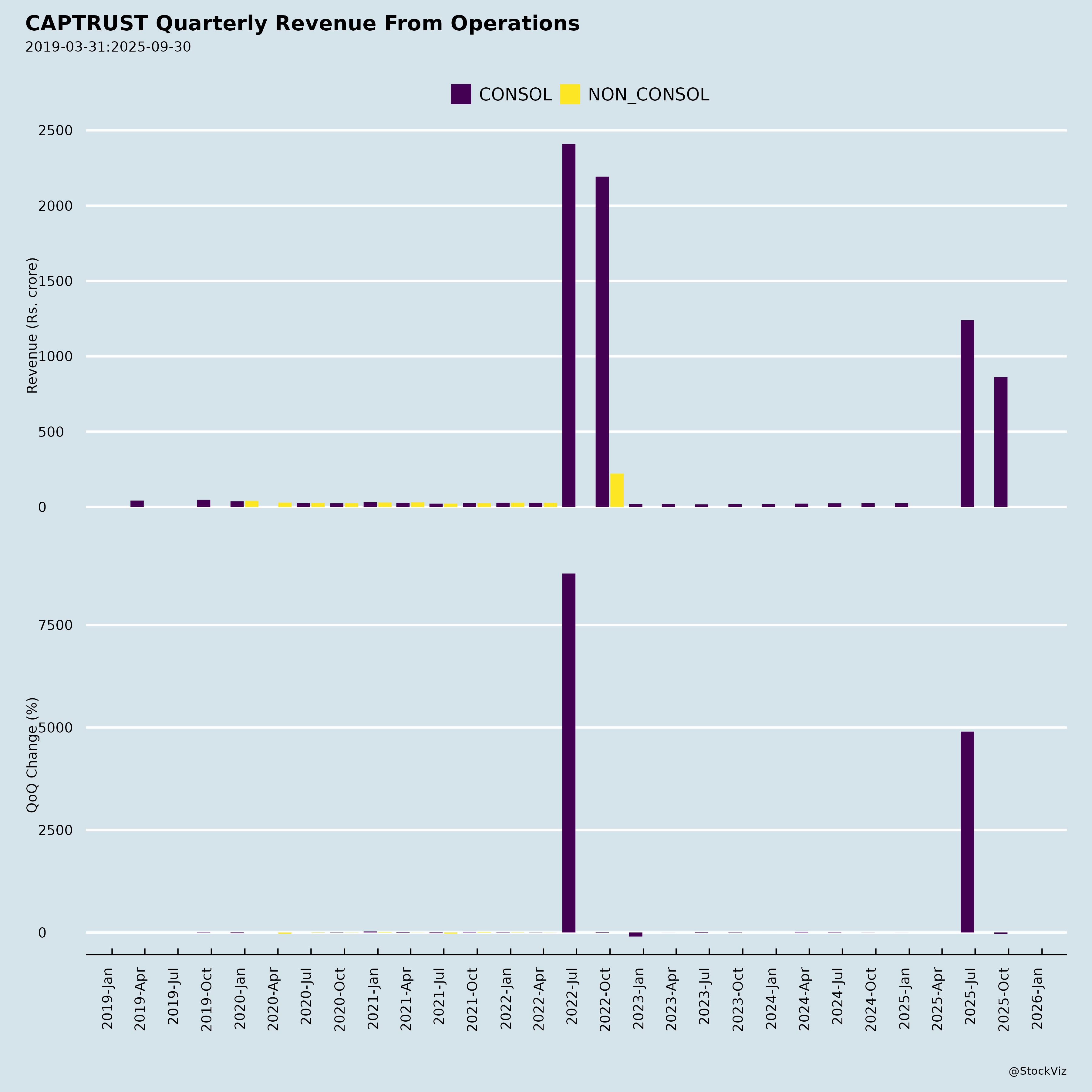
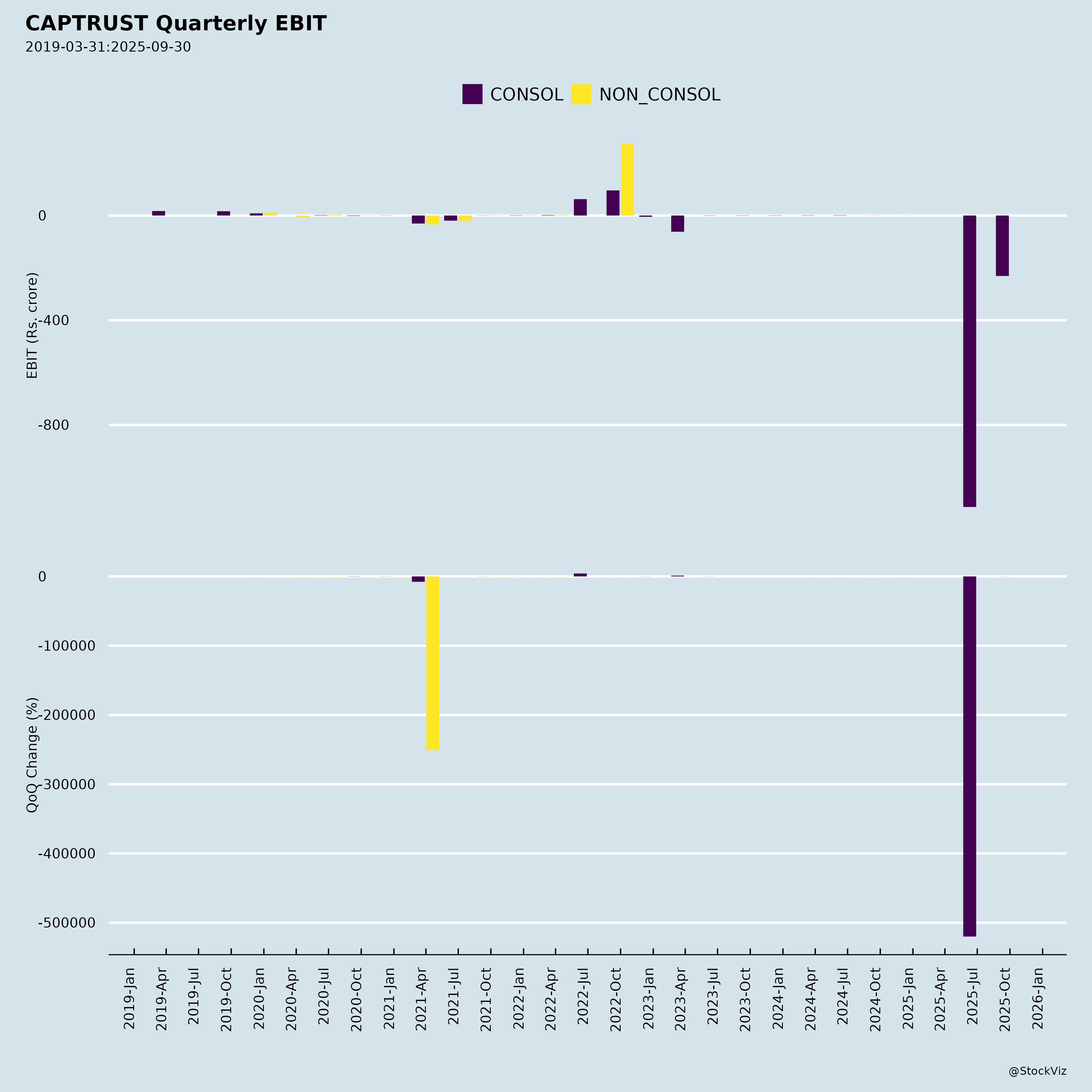
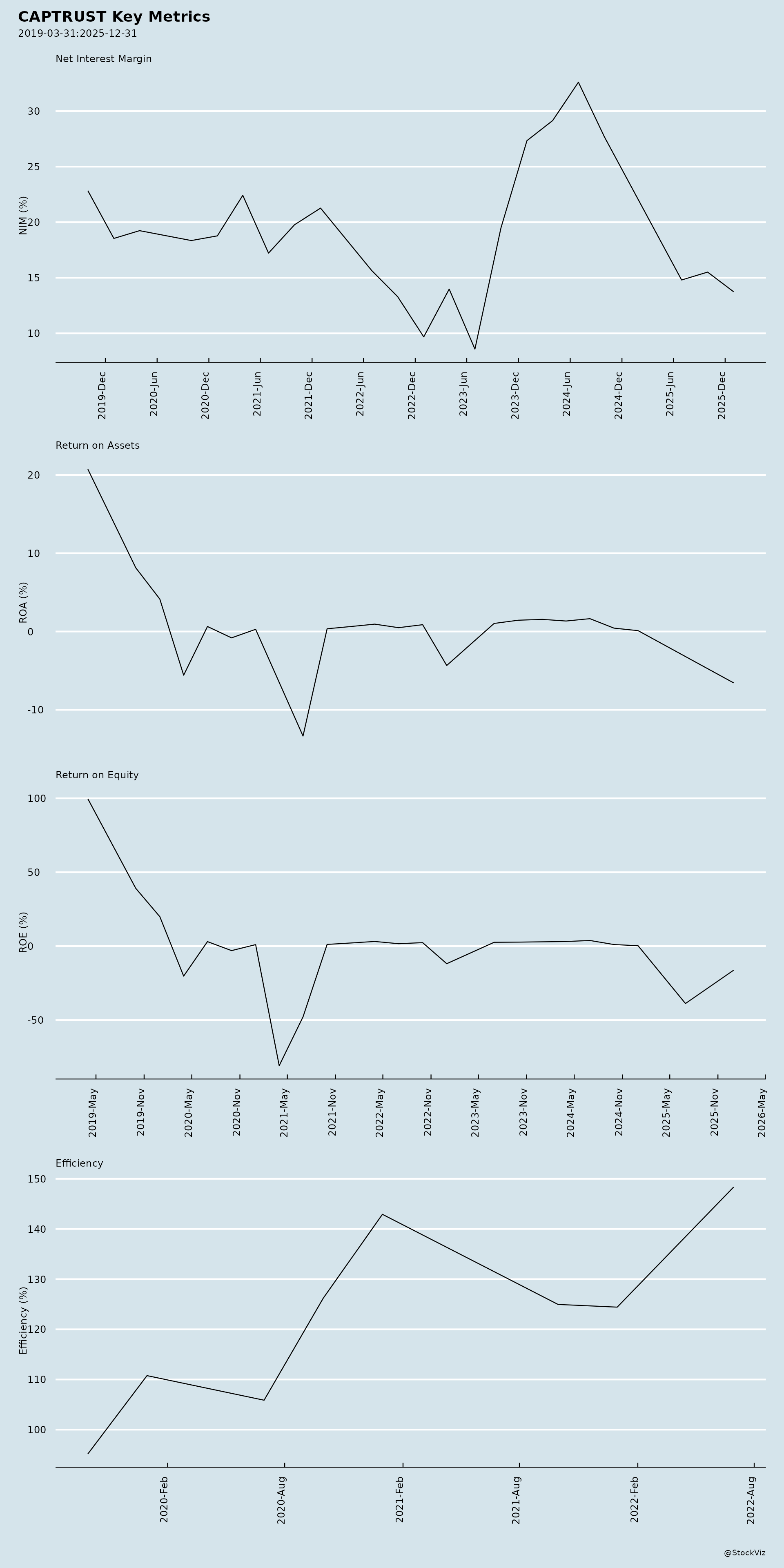
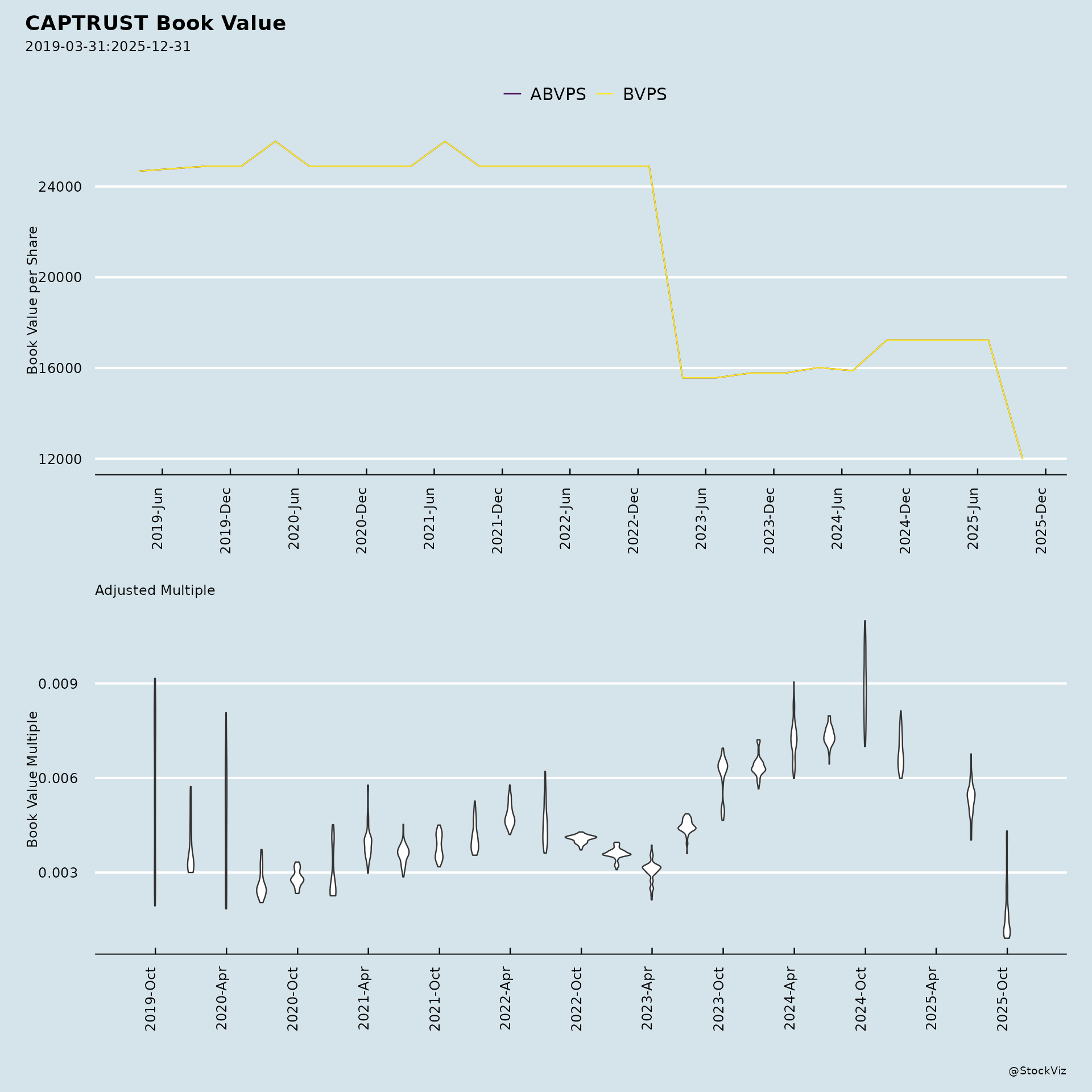
Fundamentals
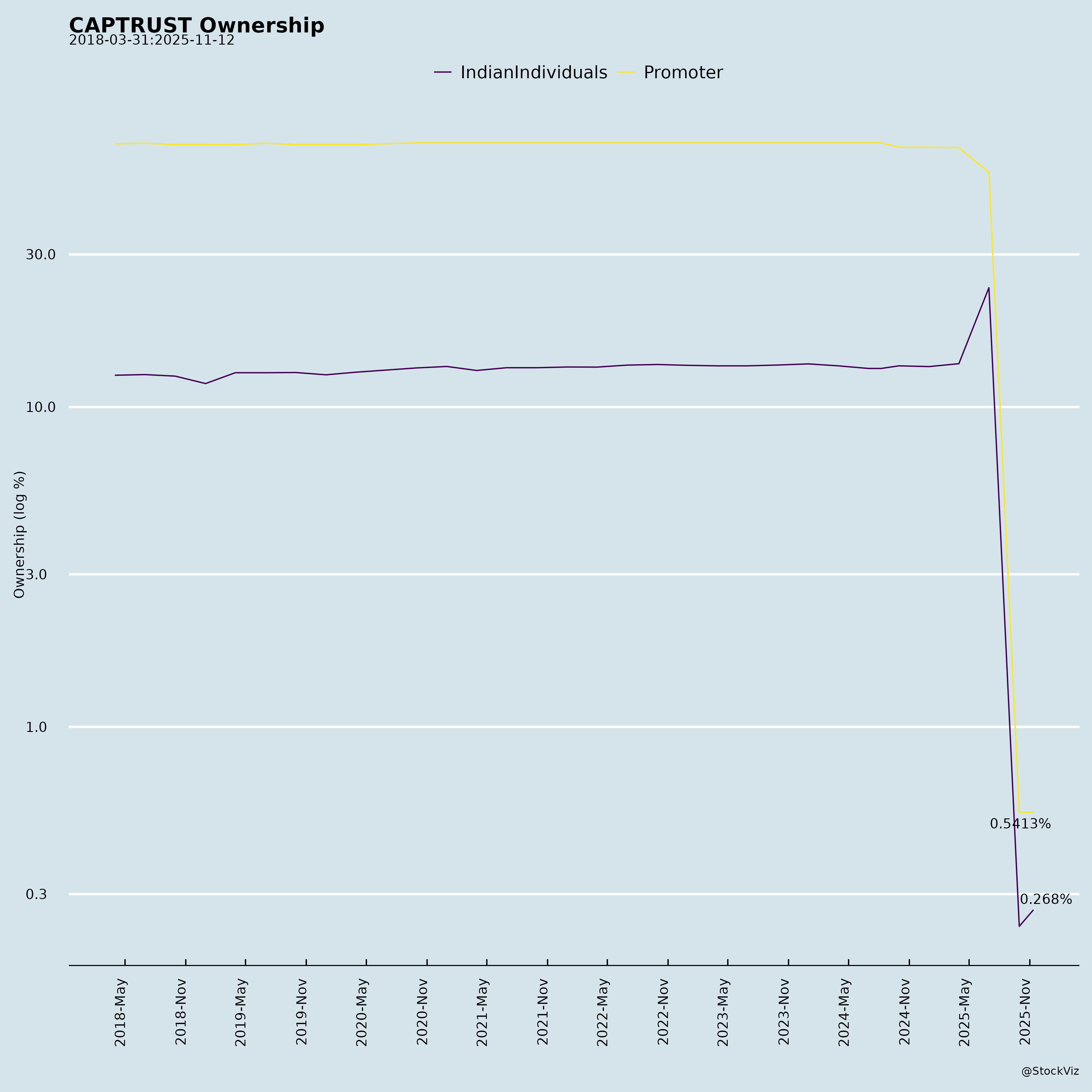
Ownership
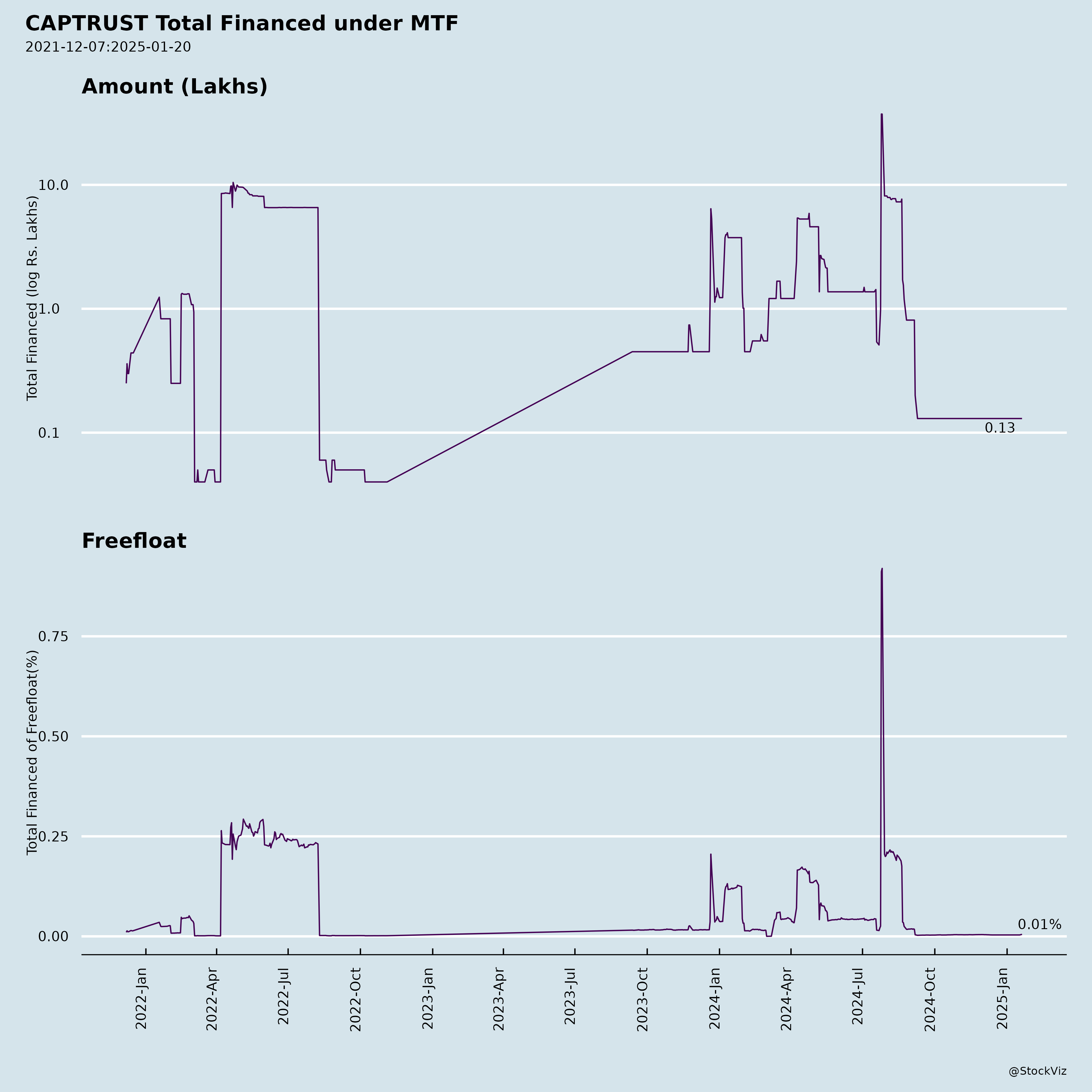
Margined
AI Summary
asof: 2026-09-19
Capital Trust Limited — Recent Corporate Announcements
1. Headwinds and Challenges
- Transition burden from the old model. FY26 was described as a year of restructuring and transition, during which the company moved away from unsecured, partner-led, risk-capped MSME lending through BC and co-lending arrangements. The Q1FY27 results are presented as the second consecutive profitable quarter following that overhaul.
- Low leverage constrains balance-sheet-led growth. External borrowings were reduced from ₹93.2 Cr as at March 2025 to ₹15.3 Cr as at June 2026, with Debt/TNW at 0.6x. The company states it will need to raise term borrowings to deploy against secured collateral, meaning growth in the own-book gold loan business depends on fresh funding.
- Gold loan business still sub-scale. Six branches were operational in Q1FY27, with cumulative disbursements crossing ₹40 crore and a monthly run-rate of approximately ₹5 crore. Management identifies improving gold branch productivity as a FY27 priority, indicating current branch-level output is not yet at target.
- Dependence on partners for MSME origination. The 250-branch MSME network is being monetised through partner balance sheets, so fee income and disbursement volumes depend on BC and co-lending partnerships rather than direct lending.
- General forward-looking risk factors. Forward-looking statements are subject to risks and uncertainties including government actions, local, political or economic developments, and technological risks.
- Auditor transition. The tenure of statutory auditors M/s. JKVS & Co. concludes at the ensuing AGM, with the board recommending M/s. SGR & ASSOCIATES LLP for a five-year term from the 39th to the 44th AGM.
2. Tailwinds and Growth Prospects
- Formalisation of India’s gold-loan market. Only about 40% of the market is in the formal sector, and Indian households hold nearly 25,000T of gold with the formal credit system monetising barely 10%.
- Shift toward collateral-backed lending. Borrowers are moving to gold loans due to tightening credit and limited access to MFI/unsecured loans.
- Fading stigma of gold loans in North India, expanding the addressable customer base.
- RBI’s unified gold loan regulations released in June 2025, providing a clearer regulatory framework.
- AUM momentum. Total AUM increased 52% QoQ from ₹158 Cr to ₹240 Cr, continuing momentum established in Q4FY26. Own-book AUM was ₹29 Cr and managed AUM ₹211 Cr.
- Disbursement growth. Total disbursements rose 24% QoQ to ₹112 Cr, driven by gold loan branch scale-up and expansion of BC and co-lending partnerships. Q1FY27 gold loan disbursements crossed ₹20 Cr.
- Partner-led MSME engine. The 250+ branch network runs at a monthly disbursement run-rate of approximately ₹30 Cr through partner balance sheets, generating fee income with lower balance-sheet and credit-risk intensity.
- Funding partnerships for gold loans. Two co-lending partners and three lenders were onboarded to support the secured gold loan book.
- Improved portfolio quality. The secured or zero-credit-risk share of AUM rose to 72% from 56% at the end of FY26; Gross NPA reduced to 2.7% and Net NPA remained nil.
- Strong capital position. Capital Adequacy (CRAR) strengthened to 40%, with leverage at historic lows.
3. Key Risks
- Credit risk in the residual unsecured or risk-capped book, though Gross NPA reduced to 2.7% and Net NPA is nil.
- Execution risk in scaling the gold loan branch network from six operational branches and improving branch productivity.
- Funding risk if term borrowings for secured lending are not raised as planned.
- Partner concentration and dependence risk in the BC and co-lending MSME model.
- Regulatory and macroeconomic risk, including government actions, political or economic developments, and technological risks.
- Governance continuity risk around the statutory auditor change recommended for a five-year term.
4. Management Guidance Versus Observed Performance
- Guidance: Management stated the FY27 strategy is to scale Gold AUM, scale partner-led MSME, raise term debt, improve the risk mix further, improve gold branch productivity, and sustain profitability. Gold loans are to be the primary area for incremental deployment of Capital Trust’s balance sheet, supported by term borrowings for secured lending, while the 250-branch MSME network is increasingly monetised through partner balance sheets.
- Observed performance: Q1FY27 PAT was ₹0.20 Cr, described as the second consecutive profitable quarter following the return to operational profitability in Q4FY26. AUM grew 52% QoQ to ₹240 Cr, disbursements rose 24% QoQ to ₹112 Cr, the secured/zero-credit-risk share of AUM improved to 72% from 56% at FY26 end, Gross NPA reduced to 2.7%, Net NPA remained nil, and CRAR stood at 40% with Debt/TNW at 0.6x.
- Alignment: The reported quarter shows progress against the stated priorities of scaling gold loans (six branches, ₹40+ crore cumulative disbursements, ~₹5 crore monthly run-rate), expanding partner-led MSME (250+ branches, ~₹30 crore monthly run-rate), improving the risk mix (72% secured/zero-credit-risk), and sustaining profitability (₹0.20 Cr PAT). The stated intent to raise term debt for secured lending is not yet reflected in the reported borrowing figure of ₹15.3 Cr as at June 2026.
- AGM-related guidance: The consolidated voting results and the Scrutiniser’s Report were to be submitted to BSE Limited and the National Stock Exchange of India Limited within two working days of the conclusion of the AGM and placed on the websites of the Company and NSDL.
CNBC-TV18: ratings, targets and commentary
No recorded CNBC-TV18 statements for this ticker.
Management comments
No recorded management comments with an explicit designation and affiliation for this ticker.
Copyright © 2023 SAS Data Analytics Pvt. Ltd. All rights reserved.